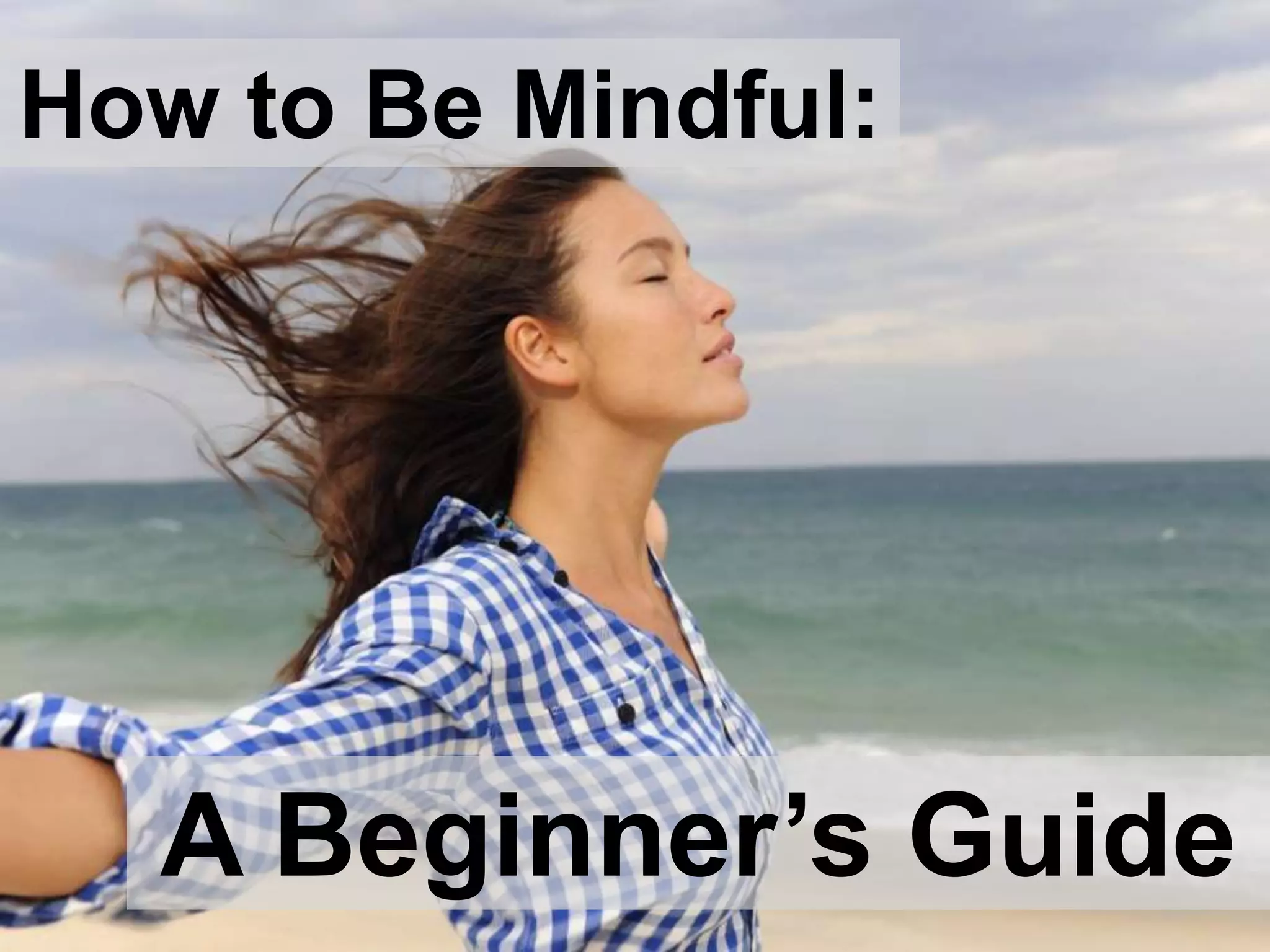

















How to Be Mindful:
A Beginner’s Guide
Did you know
…
… you can use the
power of your mind to
lose
weight,
improve your
health,
live longer,
and sleep better?
The secret technique
is called:
Mindfulness.
Mindfulness
is the opposite of
Mindlessness.
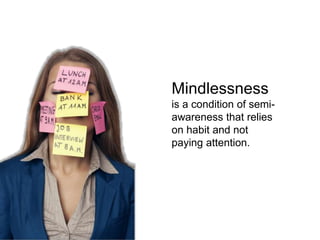
Mindlessness
is a condition of semi-
awareness that relies
on habit and not
paying attention.
Mindfulness Defined in Plain English
Mindfulness is . . .
Being Attentive
Mindfulness is . . .
Being Attentive
Non-Judging
Mindfulness is . . .
Being Attentive
Non-Judging
Heightened Awareness
Mindfulness is . . .
Being Attentive- become attentively aware of your moment-by-
moment experience as it unfolds.
Non-Judging- you stop evaluating and judging everything as you
normally do.
Heightened Awareness- you realize that thoughts and
emotions are temporary and will soon pass and you become less
vulnerable to emotional distress.
The Many Scientifically Proven
Benefits of Mindfulness
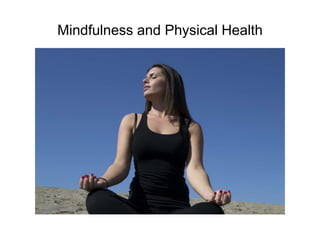
Mindfulness and Physical Health
Weight Loss
Eating slower and more thoughtfully could help in
dealing with weight problems.
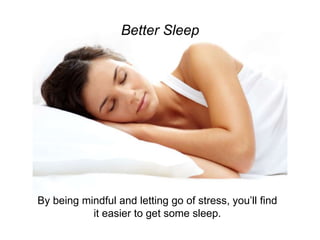
Better Sleep
By being mindful and letting go of stress, you’ll find
it easier to get some sleep.
Mindfulness Helps Against Cold and Flu
Mindfulness meditation and moderate exercise
seem to have protective effects against cold and
flu.
Addiction Recovery
Mindfulness is about deliberately focusing on
emotions that are difficult to deal with.
Lowers Blood Pressure
Studies showed that those who were educated in
mindfulness decreased their blood pressure.
Helps with Dealing with Pain
Being mindful teaches us to consider what we
can learn about the pain.
Mindfulness and Mental Health
Mindfulness is like a gym for the mind.
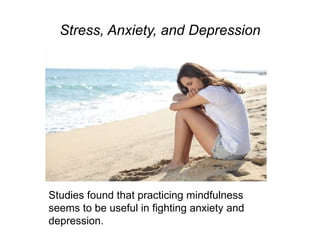
Stress, Anxiety, and Depression
Studies found that practicing mindfulness
seems to be useful in fighting anxiety and
depression.
Mindfulness Helps Improve Memory,
Reasoning and Concentration
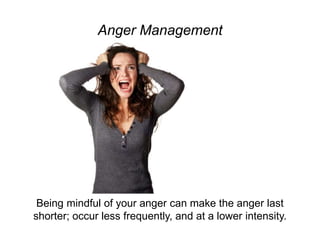
Anger Management
Being mindful of your anger can make the anger last
shorter, occur less frequently, and at a lower intensity.
Dealing with Grief
Grief can exact a great emotional toll and those suffering
from grief are often physically and mentally stressed.
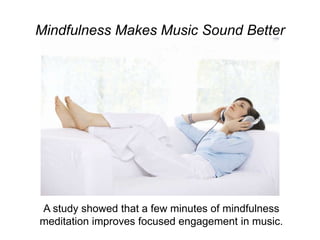
Mindfulness Makes Music Sound Better
A study showed that a few minutes of mindfulness
meditation improves focused engagement in music.
More Satisfying Relationships
Mindfulness can help couples become happier
in their relationship.
Helps You Become Better at Your Job
A study proves that you’ll perform better at your
job when you practice mindfulness.
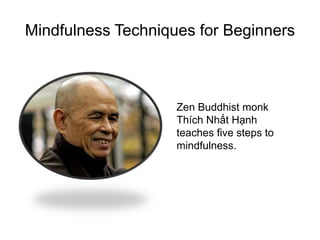
Mindfulness Techniques for Beginners
Zen Buddhist monk
Thích Nhất Hạnh
teaches five steps to
mindfulness.
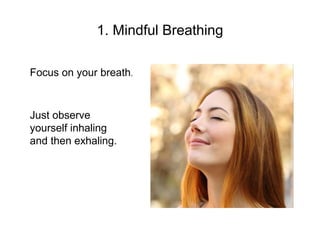
1. Mindful Breathing
Focus on your breath.
Just observe
yourself inhaling
and then exhaling.
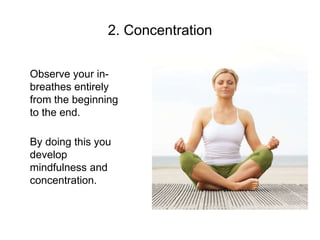
2. Concentration
Observe your in-
breathes entirely
from the beginning
to the end.
By doing this you
develop
mindfulness and
concentration.
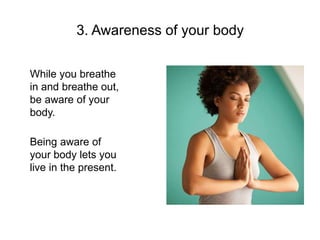
3. Awareness of your body
While you breathe
in and breathe out,
be aware of your
body.
Being aware of
your body lets you
live in the present.
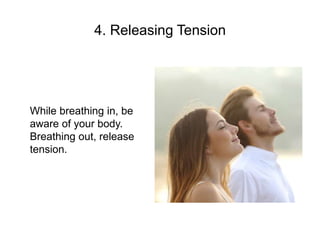
4. Releasing Tension
While breathing in, be
aware of your body.
Breathing out, release
tension.
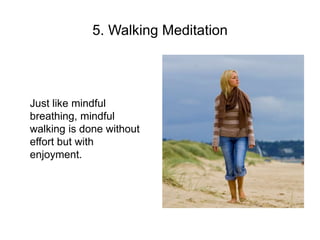
5. Walking Meditation
Just like mindful
breathing, mindful
walking is done without
effort but with
enjoyment.
Conclusion
We can all benefit from practicing
mindfulness.
Conclusion
We can all benefit from practicing
mindfulness.
And all it takes is cultivating awareness.
Conclusion
We can all benefit from practicing
mindfulness.
And all it takes is cultivating awareness.
It’s not hard.
Conclusion
We can all benefit from practicing
mindfulness.
And all it takes is cultivating awareness.
It’s not hard.
Actually, it’s almost effortless.
For more useful articles, please visit:
http://rnblog.rockwellnutrition.com/

How to be mindful a beginner’s guide