Download to read offline
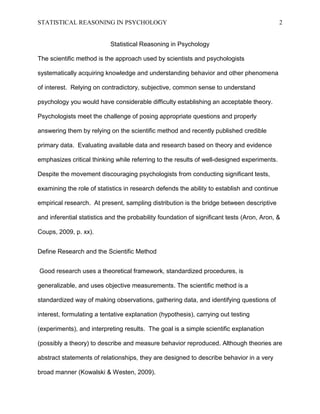
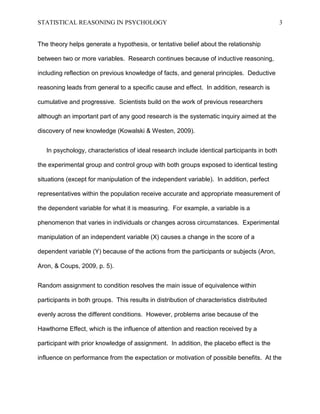



The document discusses statistical reasoning in psychology. It defines the scientific method as a standardized way to systematically acquire knowledge through observations, data collection, hypothesis formulation, testing through experiments, and results interpretation. Statistics are used in psychology to organize, analyze, and interpret numerical data to evaluate the reliability of data and research findings. The role of statistics is to solve problems by analyzing quantitative and qualitative data using tools like t-distributions and p-values to scientifically illustrate relationships in the data and differences over time. Both primary data that is original to a study and secondary data from other sources are important, though secondary data reliability depends on the organization collecting and reporting it.


