o Kuchipudi is pronounced as 'Koochipoodi' is a Classical
  Indian dance originated in Andhra Pradesh, India.

o Origin of the name Kuchipudi is taken from name of a
  village in the Divi Tehsil of Krishna district that borders
  the Bay of Bengal.

o The resident Brahmins were practicing this traditional
  dance form, and it acquired the present name.

o According to facts Siddhendra Yogi first developed a
  unique and particular style of kuchipudi based on the
  Natya Shastra.
o kuchipudi dance style, like many other classical dance forms,
  was initially presented at temples and was performed by the
  Brahmin men.

o The first documented evidence of Kuchipudi male dancers’
  performance was recorded in 1502 A.D. where they performed
  in front of Veeranarasimha Rayalu of Vijayanagara Empire and
  depicted the misdeeds and corrupt rule of Sammeta
  Guravaraju, Siddavatam ruler.

o Another evidence shows that the Nawab of Golconda, Habul
  Hussan Qutub Tanisha, fond of the performance of kuchipudi,
  gifted the village of Kuchipudi and made it a cultural center to
  pursue the art with peace and harmony. Even today, artists and
  scholars living there continue the age-old tradition and pass the
  knowledge to present and future generations.
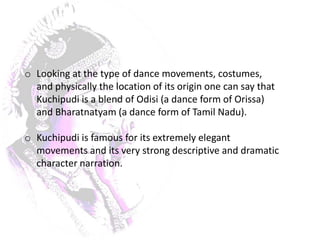
o Looking at the type of dance movements, costumes,
  and physically the location of its origin one can say that
  Kuchipudi is a blend of Odisi (a dance form of Orissa)
  and Bharatnatyam (a dance form of Tamil Nadu).

o Kuchipudi is famous for its extremely elegant
  movements and its very strong descriptive and dramatic
  character narration.
o These dance dramas were mostly performed as an
  offering to lord Krishna mostly. All these dances were
  performed by men who could play the roles of both
  men and women as performers.

o Initially, it was performed for lord Krishna, but with
  passage of time the dance form was even performed for
  Lord Shiva. This started happening by the end of the
  18th century.
o In the early 1900s, after Siddhendra Yogi another towering
  figure in Kuchipudi - Vedantam Lakshminarayana Shastri -
  once again changed the stylistic direction of dance form.

o He moved from the little village of Kuchipudi, the birth
  place of this art form, to the larger metropolis of Madras
  (now Chennai), a major centre for art and culture in India.
  His talent and brilliance was immediately recognized.

o He introduced women to Kuchipudi and choreographed
  several solo dances, which have become part of the
  Kuchipudi today.
o Thus, Kuchipudi has under gone a number of changes and today
  surprisingly women are the ones who have finally mastered this
  dance form better than men.

o Kuchipudi dance groups today are broadly classified in to two
  groups.
Natyamelamu consists of a group of actors (males) performing Kuchipudi dance
drama.
Nattuvamelamu is a tradition of dance performed by woman artistes. This
tradition had two sections, those who performed at the royal courts and those
who performed in temples.

oInitially, as we know it, Kuchipudi was just a form of temple dance
but now with passage of time it has finally become one of the most
well known performing arts in the whole of our country.
o The Kuchipudi is a dance-drama of Nritta, Nritya and Natya.

oThe Nritta consists of theermanams and jatis.
Nritta encompasses steps and movements in the form of
patterns of dance which, though decorated in them, have no
meaning to convey.

o The Nritya consists of Sabdams.

o The Natya consists of acting with mudras for the songs.
oKuchipudi is based on natya shastra covers as many and
diverse aspects such as:

o MUSIC (raga, tala, sruti, and instrumental knowledge).

oSTAGE-DESIGN (mandapa).

oDANCE (rules & classification of dances, acting, expression
of bhava, eight kinds of rasas, choreography, and direction).

o MAKEUP, and virtually every aspect of the STAGECRAFT.
o The whole dance follow the navrasas theory to show the
expressions and convey their moods.

oThese are:
oShringara (love and beauty).
oHasya (joy or mirth).
oBhibatsya (disgust).
oRowdra (anger and its forms).
oShanta (serenity and peace).
oVeera (heroism).
oBhaya (fear).
oKaruna (grief and compassion).
oAdbhuta (wonder and curiosity).
o DARU: it is a small composition of dance and song specially
designed for each character to help the artist reveal his or
her identity and also to show the performer's skill in the art.

oThere are nearly 80 darus or dance sequences in a
traditional Kuchipudi dance drama.

o KALAPAS: it has a few characters with theme revolving
around a single incident or a character.

oYAKSHAGANAS: are dance forms evolved from more ancient
tradition. This form of dance involves more characters, and
gives a more dramatic essence to the dance.
o Some of dance which is practiced today in kuchipudi are:

Purvaranga,
Tandava Nritya kari Gajanana or Vinayaka Kautham
Bhamakalapam,
Satya Bhama,
Bhakta Phrahalda,
Usha Parinayam,
Sasirekha Parinayam,
Rama Natakam,
Gollakalapam,
Gollabhama,
Tarangam,
o Field of expertise: Kuchipudi and
  Bharatnatyam dancer.
o Born on April 5, 1954 at Ahmedabad.
o Daughter of classical dancer Mrinalini
  Sarabhai and space scientist Vikram
  Sarabhai.
o She started to learn dancing at a very
  young age and also acted in parallel
  cinema. She played the role of
  Draupadi in Peter Brook’s movie ‘The
  Mahabharata’.
o She studied at St. Xaviers College in
  Ahmedabad and later on did MBA and
  doctorate from IIM Ahmedabad
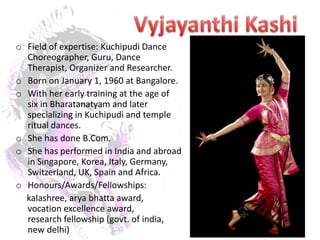
o Field of expertise: Kuchipudi Dance
  Choreographer, Guru, Dance
  Therapist, Organizer and Researcher.
o Born on January 1, 1960 at Bangalore.
o With her early training at the age of
  six in Bharatanatyam and later
  specializing in Kuchipudi and temple
  ritual dances.
o She has done B.Com.
o She has performed in India and abroad
  in Singapore, Korea, Italy, Germany,
  Switzerland, UK, Spain and Africa.
o Honours/Awards/Fellowships:
  kalashree, arya bhatta award,
  vocation excellence award,
  research fellowship (govt. of india,
  new delhi)
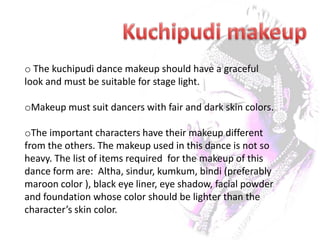
o The kuchipudi dance makeup should have a graceful
look and must be suitable for stage light.

oMakeup must suit dancers with fair and dark skin colors.

oThe important characters have their makeup different
from the others. The makeup used in this dance is not so
heavy. The list of items required for the makeup of this
dance form are: Altha, sindur, kumkum, bindi (preferably
maroon color ), black eye liner, eye shadow, facial powder
and foundation whose color should be lighter than the
character’s skin color.
Steps of application :
oFirstly oil- free moisturizer is applied then a light coat of
facial powder is followed by a thick coat of foundation.
o Over the foundation again a coat of facial powder is
applied followed by blush. On the nose especially on the
sides dark foundation is applied.
oThen the outline of both the eyes is drawn using black
eye liner. The ends of the outline are curved so that the
eye looks like a lotus petal.
oThen appropriate color lipstick is used with some gloss.
At last put the maroon color bindi in the middle of your
forehead.
oThe Kuchpudi costumes look similar to Bharatnatyam
costumes.

oOnly difference is the Katcham that comes at the back of
a kuchipudi costume.

oA long pleat in the centre with a border and a black
katcham with a side small fan makes a typical kuchipudi
style costumes.

oCross pleat costume: Cross pleats are used for both
Bharatnatyam and kuchipudi. This pattern is mainly for
male dancers. This cross fan costumes can be used for
devotional characters like Muruga & Krishna.
oTYPES OF SAREES FOR A KUCHIPUDI COSTUME:

1. Kanchipuram silk saree- The kanchipuram silk saree is
hand-woven. It is made of dyed silk with zari works.
Kanchipuram sarees are expensive than other types of silk
available in south India. Kanchipuam sarees are stronger
than Dhamavaram or Arani silks generally.

2. Dharmavaram silk saree- In many others places also,
silk sarees are produced, they are Dhramavaram, Arni,
Salem, & Tribhvanam. Even though these sarees are good
in quality, kanchpuram is the best.
oTYPES OF SAREES FOR A KUCHIPUDI COSTUME:

3. Semi silk saree – costumes are also made of semi silk
sarees which is cheaper than the other two types. This
saree is mainly used for group performance where cost
factor matters. Many costumes are stitched at a time in
group performance.

oDRESS USED:
Blouse (upper part)
Pyjama (lower part)
Small fan (waist)
Pallu (drape over bosom)
KUCHIPUDI CLASSICAL DANCE
           (Andhra Pradesh)
KUCHIPUDI
Krishna (Andhra Pradesh)
INDIAN CLASSICAL KUCHIPUDI
Kuchipudi - Hyderabad
(Andhra Pradesh)
oThe dancers adorn themselves with temple jewellery, which is
the style of ornaments worn by the deities in south Indian
temples.
oSome ornaments are made from silver with a plating of gold
and some worn by the artists are made up of a light weight
wood, called Boorugu.

o Jewelleries adorn the head, ear, neck, hands, fingers, and the
waist of the female dancers. It includes
            RAKUDI (head ornament),
            CHANDRA VANKI (arm ornament) and
            ADDA BHASA and KASINA SARA (neck ornaments).
Even the long plait of dancer’s hair is decorated with
ornaments and beautiful white flowers.
o The male dancers are lightly ornamented.
Thus we can say that the kuchipudi dance form is known for its
grace and beauty which would be incomplete without its dressing
style, costumes, makeup and its jewellery.

JEWELRY USED:
Jumka (earring with upward extension)
Oddiyanam (waist band)
Nathni (nose ring)
Long Mala (long necklace)
Short Mala (choker)
2 Vaanki (arm bands)
Chudiya (colored bangles to match your dress)
Ghungroo (musical anklet with metallic bells)
Mattal (forehead)
Chandra (moon shaped hair ornament)
Surya (sun shaped hair ornament)
1 Red stick-on Bindi(a decorative mark worn in the middle of the forehead)
HAIR DECORATED
WITH
                    RAKUDI
WHITE FLOWERS       (head ornament)


 ADDA BHASA
      &
 KASINA SARA          CHANDRA VANKI
                      (arm ornament)
 (neck ornaments)
mridangam


manjira
Saraswati veena


violin
kanjira


surpeti
Venu


Tanpura
oAesthetics of color
o Darker colors make the dancer appear slimmer.
o lighter colors look better on a slim body.
ocolor black appears to make the body attractive and slim.
oPale colors enlarge the shape of the dancer.
oTo make the light colors stand out and the dark colors recede,
the colors should be shaded from light to dark.
oShringara (love and beauty).
oHasya (joy or mirth).
oBhibatsya (disgust).
oRowdra (anger and its forms).
oShanta (serenity and peace).
oVeera (heroism).
oBhaya (fear).
oKaruna (grief and compassion).
oAdbhuta (wonder and curiosity).
o HEAD GESTURES (nine)
 Sama - level
 Udvaahita - raised up
 Adhomukha - down-cast face
 Aalolita - rolling
 Dhuta - shaken sideways
 Kampita - nodded
 Paraavrtta - turned round
 Utksipta - thrown up
 parivaahita - widely moved
oEYES (eight)
Sama - level
Aalokita - keen glance
Saaci - side long
Pralokita - wide glance
Nimilita - closed
Ullokita - looking up
Anuvrtta - quickly up & down
Avalokita - looking down
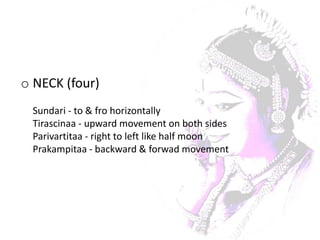
o NECK (four)
 Sundari - to & fro horizontally
 Tirascinaa - upward movement on both sides
 Parivartitaa - right to left like half moon
 Prakampitaa - backward & forwad movement
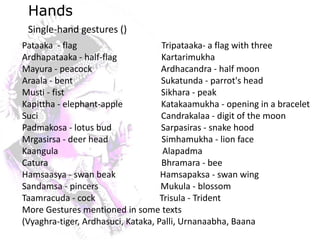
Hands
 Single-hand gestures ()
Pataaka - flag                      Tripataaka- a flag with three
Ardhapataaka - half-flag            Kartarimukha
Mayura - peacock                    Ardhacandra - half moon
Araala - bent                       Sukatunda - parrot's head
Musti - fist                        Sikhara - peak
Kapittha - elephant-apple           Katakaamukha - opening in a bracelet
Suci                                Candrakalaa - digit of the moon
Padmakosa - lotus bud               Sarpasiras - snake hood
Mrgasirsa - deer head               Simhamukha - lion face
Kaangula                             Alapadma
Catura                              Bhramara - bee
Hamsaasya - swan beak               Hamsapaksa - swan wing
Sandamsa - pincers                  Mukula - blossom
Taamracuda - cock                   Trisula - Trident
More Gestures mentioned in some texts
(Vyaghra-tiger, Ardhasuci, Kataka, Palli, Urnanaabha, Baana
COMBINED HANDS GESTURES (twenty three)

     Anjali            Kapota
     Karkata           Svastika
     Dolaa             Puspaputa
     Utsanga           Sivalinga
     Katakaavardhana   Kartaisvastika
     Sakata            Sankha
     Cakra             Samputa
     Paasa             Kilaka
     Matsya            Kurma
     Varaha            Garuda
     Nagabandha        Khatva
     Bherunda
o http://www.kuchipudi.com
o http://www.indianheritage.com
o http://www.4to40.com
o Kuchipudi: Indian Classical Dance Art – by
  Sunil Kothari and Avinash Pasricha.
o Classical dances of india.
Presented by

Deepak Kumar
Prince Kumar
Shailesh Kumar

Kuchipudi

  • 2.
    o Kuchipudi ispronounced as 'Koochipoodi' is a Classical Indian dance originated in Andhra Pradesh, India. o Origin of the name Kuchipudi is taken from name of a village in the Divi Tehsil of Krishna district that borders the Bay of Bengal. o The resident Brahmins were practicing this traditional dance form, and it acquired the present name. o According to facts Siddhendra Yogi first developed a unique and particular style of kuchipudi based on the Natya Shastra.
  • 3.
    o kuchipudi dancestyle, like many other classical dance forms, was initially presented at temples and was performed by the Brahmin men. o The first documented evidence of Kuchipudi male dancers’ performance was recorded in 1502 A.D. where they performed in front of Veeranarasimha Rayalu of Vijayanagara Empire and depicted the misdeeds and corrupt rule of Sammeta Guravaraju, Siddavatam ruler. o Another evidence shows that the Nawab of Golconda, Habul Hussan Qutub Tanisha, fond of the performance of kuchipudi, gifted the village of Kuchipudi and made it a cultural center to pursue the art with peace and harmony. Even today, artists and scholars living there continue the age-old tradition and pass the knowledge to present and future generations.
  • 4.
    o Looking atthe type of dance movements, costumes, and physically the location of its origin one can say that Kuchipudi is a blend of Odisi (a dance form of Orissa) and Bharatnatyam (a dance form of Tamil Nadu). o Kuchipudi is famous for its extremely elegant movements and its very strong descriptive and dramatic character narration.
  • 5.
    o These dancedramas were mostly performed as an offering to lord Krishna mostly. All these dances were performed by men who could play the roles of both men and women as performers. o Initially, it was performed for lord Krishna, but with passage of time the dance form was even performed for Lord Shiva. This started happening by the end of the 18th century.
  • 6.
    o In theearly 1900s, after Siddhendra Yogi another towering figure in Kuchipudi - Vedantam Lakshminarayana Shastri - once again changed the stylistic direction of dance form. o He moved from the little village of Kuchipudi, the birth place of this art form, to the larger metropolis of Madras (now Chennai), a major centre for art and culture in India. His talent and brilliance was immediately recognized. o He introduced women to Kuchipudi and choreographed several solo dances, which have become part of the Kuchipudi today.
  • 7.
    o Thus, Kuchipudihas under gone a number of changes and today surprisingly women are the ones who have finally mastered this dance form better than men. o Kuchipudi dance groups today are broadly classified in to two groups. Natyamelamu consists of a group of actors (males) performing Kuchipudi dance drama. Nattuvamelamu is a tradition of dance performed by woman artistes. This tradition had two sections, those who performed at the royal courts and those who performed in temples. oInitially, as we know it, Kuchipudi was just a form of temple dance but now with passage of time it has finally become one of the most well known performing arts in the whole of our country.
  • 8.
    o The Kuchipudiis a dance-drama of Nritta, Nritya and Natya. oThe Nritta consists of theermanams and jatis. Nritta encompasses steps and movements in the form of patterns of dance which, though decorated in them, have no meaning to convey. o The Nritya consists of Sabdams. o The Natya consists of acting with mudras for the songs.
  • 9.
    oKuchipudi is basedon natya shastra covers as many and diverse aspects such as: o MUSIC (raga, tala, sruti, and instrumental knowledge). oSTAGE-DESIGN (mandapa). oDANCE (rules & classification of dances, acting, expression of bhava, eight kinds of rasas, choreography, and direction). o MAKEUP, and virtually every aspect of the STAGECRAFT.
  • 10.
    o The wholedance follow the navrasas theory to show the expressions and convey their moods. oThese are: oShringara (love and beauty). oHasya (joy or mirth). oBhibatsya (disgust). oRowdra (anger and its forms). oShanta (serenity and peace). oVeera (heroism). oBhaya (fear). oKaruna (grief and compassion). oAdbhuta (wonder and curiosity).
  • 11.
    o DARU: itis a small composition of dance and song specially designed for each character to help the artist reveal his or her identity and also to show the performer's skill in the art. oThere are nearly 80 darus or dance sequences in a traditional Kuchipudi dance drama. o KALAPAS: it has a few characters with theme revolving around a single incident or a character. oYAKSHAGANAS: are dance forms evolved from more ancient tradition. This form of dance involves more characters, and gives a more dramatic essence to the dance.
  • 12.
    o Some ofdance which is practiced today in kuchipudi are: Purvaranga, Tandava Nritya kari Gajanana or Vinayaka Kautham Bhamakalapam, Satya Bhama, Bhakta Phrahalda, Usha Parinayam, Sasirekha Parinayam, Rama Natakam, Gollakalapam, Gollabhama, Tarangam,
  • 13.
    o Field ofexpertise: Kuchipudi and Bharatnatyam dancer. o Born on April 5, 1954 at Ahmedabad. o Daughter of classical dancer Mrinalini Sarabhai and space scientist Vikram Sarabhai. o She started to learn dancing at a very young age and also acted in parallel cinema. She played the role of Draupadi in Peter Brook’s movie ‘The Mahabharata’. o She studied at St. Xaviers College in Ahmedabad and later on did MBA and doctorate from IIM Ahmedabad
  • 14.
    o Field ofexpertise: Kuchipudi Dance Choreographer, Guru, Dance Therapist, Organizer and Researcher. o Born on January 1, 1960 at Bangalore. o With her early training at the age of six in Bharatanatyam and later specializing in Kuchipudi and temple ritual dances. o She has done B.Com. o She has performed in India and abroad in Singapore, Korea, Italy, Germany, Switzerland, UK, Spain and Africa. o Honours/Awards/Fellowships: kalashree, arya bhatta award, vocation excellence award, research fellowship (govt. of india, new delhi)
  • 15.
    o The kuchipudidance makeup should have a graceful look and must be suitable for stage light. oMakeup must suit dancers with fair and dark skin colors. oThe important characters have their makeup different from the others. The makeup used in this dance is not so heavy. The list of items required for the makeup of this dance form are: Altha, sindur, kumkum, bindi (preferably maroon color ), black eye liner, eye shadow, facial powder and foundation whose color should be lighter than the character’s skin color.
  • 17.
    Steps of application: oFirstly oil- free moisturizer is applied then a light coat of facial powder is followed by a thick coat of foundation. o Over the foundation again a coat of facial powder is applied followed by blush. On the nose especially on the sides dark foundation is applied. oThen the outline of both the eyes is drawn using black eye liner. The ends of the outline are curved so that the eye looks like a lotus petal. oThen appropriate color lipstick is used with some gloss. At last put the maroon color bindi in the middle of your forehead.
  • 18.
    oThe Kuchpudi costumeslook similar to Bharatnatyam costumes. oOnly difference is the Katcham that comes at the back of a kuchipudi costume. oA long pleat in the centre with a border and a black katcham with a side small fan makes a typical kuchipudi style costumes. oCross pleat costume: Cross pleats are used for both Bharatnatyam and kuchipudi. This pattern is mainly for male dancers. This cross fan costumes can be used for devotional characters like Muruga & Krishna.
  • 19.
    oTYPES OF SAREESFOR A KUCHIPUDI COSTUME: 1. Kanchipuram silk saree- The kanchipuram silk saree is hand-woven. It is made of dyed silk with zari works. Kanchipuram sarees are expensive than other types of silk available in south India. Kanchipuam sarees are stronger than Dhamavaram or Arani silks generally. 2. Dharmavaram silk saree- In many others places also, silk sarees are produced, they are Dhramavaram, Arni, Salem, & Tribhvanam. Even though these sarees are good in quality, kanchpuram is the best.
  • 20.
    oTYPES OF SAREESFOR A KUCHIPUDI COSTUME: 3. Semi silk saree – costumes are also made of semi silk sarees which is cheaper than the other two types. This saree is mainly used for group performance where cost factor matters. Many costumes are stitched at a time in group performance. oDRESS USED: Blouse (upper part) Pyjama (lower part) Small fan (waist) Pallu (drape over bosom)
  • 21.
  • 22.
  • 23.
    INDIAN CLASSICAL KUCHIPUDI Kuchipudi- Hyderabad (Andhra Pradesh)
  • 24.
    oThe dancers adornthemselves with temple jewellery, which is the style of ornaments worn by the deities in south Indian temples. oSome ornaments are made from silver with a plating of gold and some worn by the artists are made up of a light weight wood, called Boorugu. o Jewelleries adorn the head, ear, neck, hands, fingers, and the waist of the female dancers. It includes RAKUDI (head ornament), CHANDRA VANKI (arm ornament) and ADDA BHASA and KASINA SARA (neck ornaments). Even the long plait of dancer’s hair is decorated with ornaments and beautiful white flowers.
  • 25.
    o The maledancers are lightly ornamented. Thus we can say that the kuchipudi dance form is known for its grace and beauty which would be incomplete without its dressing style, costumes, makeup and its jewellery. JEWELRY USED: Jumka (earring with upward extension) Oddiyanam (waist band) Nathni (nose ring) Long Mala (long necklace) Short Mala (choker) 2 Vaanki (arm bands) Chudiya (colored bangles to match your dress) Ghungroo (musical anklet with metallic bells) Mattal (forehead) Chandra (moon shaped hair ornament) Surya (sun shaped hair ornament) 1 Red stick-on Bindi(a decorative mark worn in the middle of the forehead)
  • 26.
    HAIR DECORATED WITH RAKUDI WHITE FLOWERS (head ornament) ADDA BHASA & KASINA SARA CHANDRA VANKI (arm ornament) (neck ornaments)
  • 27.
  • 28.
  • 29.
  • 30.
  • 31.
    oAesthetics of color oDarker colors make the dancer appear slimmer. o lighter colors look better on a slim body. ocolor black appears to make the body attractive and slim. oPale colors enlarge the shape of the dancer. oTo make the light colors stand out and the dark colors recede, the colors should be shaded from light to dark.
  • 32.
    oShringara (love andbeauty). oHasya (joy or mirth). oBhibatsya (disgust). oRowdra (anger and its forms). oShanta (serenity and peace). oVeera (heroism). oBhaya (fear). oKaruna (grief and compassion). oAdbhuta (wonder and curiosity).
  • 34.
    o HEAD GESTURES(nine) Sama - level Udvaahita - raised up Adhomukha - down-cast face Aalolita - rolling Dhuta - shaken sideways Kampita - nodded Paraavrtta - turned round Utksipta - thrown up parivaahita - widely moved
  • 35.
    oEYES (eight) Sama -level Aalokita - keen glance Saaci - side long Pralokita - wide glance Nimilita - closed Ullokita - looking up Anuvrtta - quickly up & down Avalokita - looking down
  • 36.
    o NECK (four) Sundari - to & fro horizontally Tirascinaa - upward movement on both sides Parivartitaa - right to left like half moon Prakampitaa - backward & forwad movement
  • 37.
    Hands Single-hand gestures() Pataaka - flag Tripataaka- a flag with three Ardhapataaka - half-flag Kartarimukha Mayura - peacock Ardhacandra - half moon Araala - bent Sukatunda - parrot's head Musti - fist Sikhara - peak Kapittha - elephant-apple Katakaamukha - opening in a bracelet Suci Candrakalaa - digit of the moon Padmakosa - lotus bud Sarpasiras - snake hood Mrgasirsa - deer head Simhamukha - lion face Kaangula Alapadma Catura Bhramara - bee Hamsaasya - swan beak Hamsapaksa - swan wing Sandamsa - pincers Mukula - blossom Taamracuda - cock Trisula - Trident More Gestures mentioned in some texts (Vyaghra-tiger, Ardhasuci, Kataka, Palli, Urnanaabha, Baana
  • 38.
    COMBINED HANDS GESTURES(twenty three) Anjali Kapota Karkata Svastika Dolaa Puspaputa Utsanga Sivalinga Katakaavardhana Kartaisvastika Sakata Sankha Cakra Samputa Paasa Kilaka Matsya Kurma Varaha Garuda Nagabandha Khatva Bherunda
  • 46.
    o http://www.kuchipudi.com o http://www.indianheritage.com ohttp://www.4to40.com o Kuchipudi: Indian Classical Dance Art – by Sunil Kothari and Avinash Pasricha. o Classical dances of india.
  • 47.