A SYSTEMATIC APPROACH FOR ERP
IMPLEMENTATION IN THE
CONSTRUCTION INDUSTRY
Authors:
Assaf, Sadi A
KFUPM, KSA
Hadidi, Laith A
KFUPM, KSA
Presented By: Mohammad Rabay’ah
ByM
oham
m
ad
Rabay'ah
Outline
• Abstract
• Introduction
• Research Methodology
• Case Study
• Conclusion
• Critique
By Mohammad Rabay'ah
ByM
oham
m
ad
Rabay'ah
Abstract
• This paper provides a Decision support tool that
helps in prioritizing ERP modules’ implementation.
• A “case study approach” is conducted with experts
in ERP implementation at construction field.
• This research develop a four steps methodology to
sequence the ERP module implementation.
By Mohammad Rabay'ah
ByM
oham
m
ad
Rabay'ah
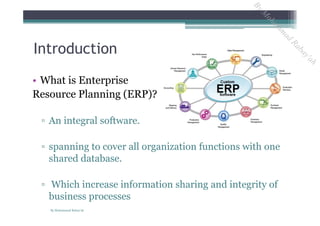
• What is Enterprise
Resource Planning (ERP)?
▫ An integral software.
▫ spanning to cover all organization functions with one
shared database.
▫ Which increase information sharing and integrity of
business processes
Introduction
By Mohammad Rabay'ah
ByM
oham
m
ad
Rabay'ah
• ERP is seen as an expensive investment for
architectural and construction companies.
• ERP is deployed in a form of internal company
project usually with multi-years delivery plan:
▫ Size of company
▫ Number of selected ERP modules.
• ERP is noticeably deployed successfully in
manufacturing and trading firms.
Introduction
By Mohammad Rabay'ah
ByM
oham
m
ad
Rabay'ah
• ERP in Construction field:
▫ Time and cost required to deploy a full scale ERP
projects are higher than other fields.
▫ Higher Failure rate in reported deployment projects.
▫ ERP implementations within large scale construction
organizations have yielded more failures than
successes.
Introduction
By Mohammad Rabay'ah
ByM
oham
m
ad
Rabay'ah
• Assessing the risk of ERP implementation failures is
encouraged to be assessed prior to deployment.
• Better risk management will help organizations to
increase the likelihood for ERP implementation
success.
Introduction
By Mohammad Rabay'ah
ByM
oham
m
ad
Rabay'ah
• This research proposes the case study methodology
approach.
• This approach fits in situation when “how” and
“why” questions are being posed, and the researcher
has little control over events.
• paper propose a decision model developed in four
steps as follows:
Research Methodology
By Mohammad Rabay'ah
ByM
oham
m
ad
Rabay'ah
▫ First step:
Identify common-used ERP Modules in construction and
validate it by experts.
▫ Second step:
Identify benefit evaluation criteria and validate it by
expert.
Research Methodology
By Mohammad Rabay'ah
ByM
oham
m
ad
Rabay'ah
 Six benefit evaluation criteria of ERP modules are
validated by the same ERP expert; namely:
 1 cost reduction.
 2 increased efficiency.
 3 improved decision making.
 4 improved information quality.
 5 improved user satisfaction.
 6 improved organizational flexibility.
Research Methodology
By Mohammad Rabay'ah
ByM
oham
m
ad
Rabay'ah
▫ Third step:
Evaluate the ERP Modules against each benefit criteria.
▫ Fourth step:
The overall ranking of ERP Modules is found by
calculating the total weight for ERP modules.
Research Methodology
By Mohammad Rabay'ah
ByM
oham
m
ad
Rabay'ah
• This Study conducted in Eastern Province of Saudi
Arabia .
• The data collection was done using face to face
interviews with ERP managers:
▫ interview started with introduction of the subject.
▫ questionnaire is presented and explained to interviewee.
Case Study
By Mohammad Rabay'ah
ByM
oham
m
ad
Rabay'ah
• This research approached grade 1 building
contracting companies in Saudi Arabia as classified
by MOMRA (ministry of municipality and rural
affairs, Saudi Arabia).
• The grade 1 contractors in the eastern province,
Saudi Arabia are twenty three, Only 13 had an ERP
systems.
• Seven valid responses (out of thirteen) were received
Case Study
By Mohammad Rabay'ah
ByM
oham
m
ad
Rabay'ah
• The valid responses were only seven which compose 53% of
the population in eastern province, Saudi Arabia.
Case Study
By Mohammad Rabay'ah
ByM
oham
m
ad
Rabay'ah
Step 1:
Identify common-used ERP Modules in
construction
Case Study
By Mohammad Rabay'ah
ByM
oham
m
ad
Rabay'ah
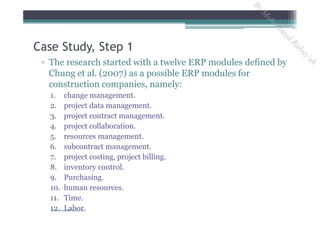
▫ The research started with a twelve ERP modules defined by
Chung et al. (2007) as a possible ERP modules for
construction companies, namely:
1. change management.
2. project data management.
3. project contract management.
4. project collaboration.
5. resources management.
6. subcontract management.
7. project costing, project billing.
8. inventory control.
9. Purchasing.
10. human resources.
11. Time.
12. Labor.
Case Study, Step 1
By Mohammad Rabay'ah
ByM
oham
m
ad
Rabay'ah
▫ Previous ERP modules were reviewed by the research team
and ERP expert and revised into thirteen modules, namely:
1. Sales and Marketing.
2. Human Resources.
3. Tendering/bid management.
4. Resource management.
5. Data/document management.
6. Collaboration.
7. Contract and Change management.
8. Project management and Budgeting.
9. Subcontractor management.
10. Time, expenses & invoicing.
11. Project Finance and accounting.
12. Procurement.
13. Inventory control and logistics.
Case Study, Step 1
By Mohammad Rabay'ah
ByM
oham
m
ad
Rabay'ah
Step 2:
Benefit Sub-Criteria Weights
Case Study
By Mohammad Rabay'ah
ByM
oham
m
ad
Rabay'ah
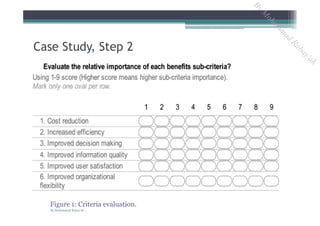
▫ The ranking of EPR modules is based on scoring inputs of
respondents as shown in figure 1 (Next slide).
▫ Each respondent will evaluate the importance of each
benefit criteria on a scale from 1 to 9 (highest score).
Case Study, Step 2
By Mohammad Rabay'ah
ByM
oham
m
ad
Rabay'ah
Figure 1: Criteria evaluation.
Case Study, Step 2
By Mohammad Rabay'ah
ByM
oham
m
ad
Rabay'ah
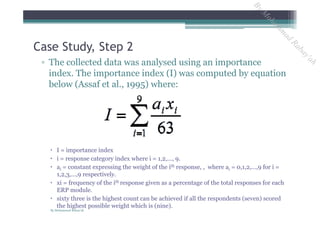
▫ The collected data was analysed using an importance
index. The importance index (I) was computed by equation
below (Assaf et al., 1995) where:
 I = importance index
 i = response category index where i = 1,2,…, 9.
 ai = constant expressing the weight of the ith response, , where ai = 0,1,2,…,9 for i =
1,2,3,…,9 respectively.
 xi = frequency of the ith response given as a percentage of the total responses for each
ERP module.
 sixty three is the highest count can be achieved if all the respondents (seven) scored
the highest possible weight which is (nine).
Case Study, Step 2
By Mohammad Rabay'ah
ByM
oham
m
ad
Rabay'ah
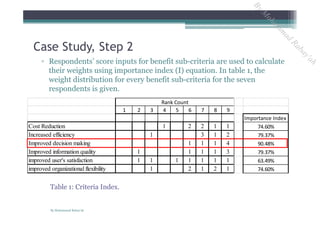
▫ Respondents’ score inputs for benefit sub-criteria are used to calculate
their weights using importance index (I) equation. In table 1, the
weight distribution for every benefit sub-criteria for the seven
respondents is given.
Table 1: Criteria Index.
Case Study, Step 2
1 2 3 4 5 6 7 8 9
Cost Reduction 1 2 2 1 1
Increased efficiency 1 3 1 2
Improved decision making 1 1 1 4
Improved information quality 1 1 1 1 3
improved user's satisfaction 1 1 1 1 1 1 1
improved organizational flexibility 1 2 1 2 1
Rank Count
Importance Index
74.60%
79.37%
90.48%
79.37%
63.49%
74.60%
By Mohammad Rabay'ah
ByM
oham
m
ad
Rabay'ah
Step 3:
Evaluate ERP Modules on benefit criteria
Case Study
By Mohammad Rabay'ah
ByM
oham
m
ad
Rabay'ah
▫ The questionnaire proceeds to collect the ranking of the
thirteen modules for each benefit
▫ For each benefit criteria, the thirteen module will be
ranked similar to the way the benefits were ranked.
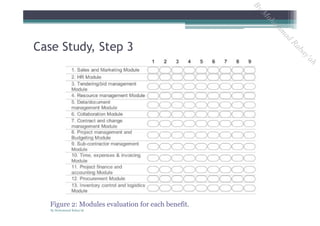
▫ Figure 2 (next slide) shows the modules evaluation against
each criteria.
Case Study, Step 3
By Mohammad Rabay'ah
ByM
oham
m
ad
Rabay'ah
Figure 2: Modules evaluation for each benefit.
Case Study, Step 3
By Mohammad Rabay'ah
ByM
oham
m
ad
Rabay'ah
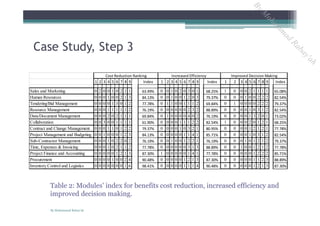
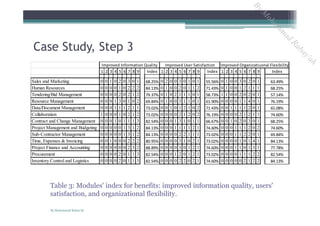
▫ Tables 2 and 3 in the next two slides shows the weighted
count for ERP modules under the six benefits criteria.
▫ Higher ranking number means higher benefit of the
module compared to others.
Case Study, Step 3
By Mohammad Rabay'ah
ByM
oham
m
ad
Rabay'ah
Table 2: Modules' index for benefits cost reduction, increased efficiency and
improved decision making.
Case Study, Step 3
1 2 3 4 5 6 7 8 9 Index 1 2 3 4 5 6 7 8 9 Index 1 2 3 4 5 6 7 8 9 Index
Sales and Marketing 0 2 0 0 1 0 2 1 1 63.49% 0 0 1 0 2 0 3 0 1 68.25% 1 0 0 0 2 1 1 1 1 65.08%
Human Resources 0 0 0 1 0 0 2 1 3 84.13% 0 0 1 0 0 1 2 0 3 79.37% 0 0 0 1 0 0 2 2 2 82.54%
Tendering/Bid Management 0 0 0 0 1 3 0 1 2 77.78% 0 1 1 0 0 1 1 1 2 69.84% 0 1 0 0 0 0 2 2 2 79.37%
Resource Management 0 0 0 1 1 1 1 1 2 76.19% 0 0 0 0 0 0 2 3 2 88.89% 0 0 0 0 1 0 3 1 2 82.54%
Data/Document Management 0 0 0 2 0 2 1 1 1 69.84% 0 1 0 0 0 0 4 0 2 76.19% 0 0 0 0 1 3 2 0 1 73.02%
Collaboration 0 0 3 0 0 1 1 1 1 61.90% 0 0 0 0 1 1 1 2 2 82.54% 1 0 0 0 2 0 1 2 1 68.25%
Contract and Change Management 0 0 0 1 1 0 1 2 2 79.37% 0 0 0 0 1 0 3 2 1 80.95% 0 0 0 0 1 2 1 2 1 77.78%
Project Management and Budgeting 0 0 1 0 0 0 1 2 3 84.13% 0 0 0 0 0 1 1 4 1 85.71% 0 0 0 0 1 0 3 1 2 82.54%
Sub-Contractor Management 0 0 0 1 0 2 2 0 2 76.19% 0 0 1 0 0 1 2 2 1 76.19% 0 0 0 1 0 1 2 1 2 79.37%
Time, Expenses & Invoicing 0 0 0 1 0 2 1 1 2 77.78% 0 0 0 0 0 0 3 1 3 88.89% 0 0 1 0 0 1 2 1 2 77.78%
Project Finance and Accounting 0 0 0 0 0 1 2 1 3 87.30% 1 0 0 0 0 0 1 4 1 77.78% 0 0 0 0 0 1 2 2 2 85.71%
Procurement 0 0 0 0 1 0 0 2 4 90.48% 0 0 0 0 0 1 2 1 3 87.30% 0 0 0 0 0 1 1 2 3 88.89%
Inventory Control and Logistics 0 0 0 0 0 0 0 1 6 98.41% 0 0 0 0 0 1 1 1 4 90.48% 0 0 0 0 0 1 2 1 3 87.30%
Improved Decision MakingCost Reduction Ranking Increased Efficiency 
By Mohammad Rabay'ah
ByM
oham
m
ad
Rabay'ah
Table 3: Modules' index for benefits: improved information quality, users'
satisfaction, and organizational flexibility.
Case Study, Step 3
1 2 3 4 5 6 7 8 9 Index 1 2 3 4 5 6 7 8 9 Index 1 2 3 4 5 6 7 8 9 Index
Sales and Marketing 0 0 1 0 2 0 3 0 1 68.25% 0 2 0 0 3 0 1 0 1 55.56% 0 1 0 0 3 0 2 0 1 63.49%
Human Resources 0 0 0 0 1 0 2 2 2 84.13% 0 1 0 0 2 0 1 1 2 71.43% 0 1 0 0 1 2 1 1 1 68.25%
Tendering/Bid Management 0 0 0 0 2 0 2 1 2 79.37% 0 1 0 2 1 1 1 0 1 58.73% 1 1 0 0 2 0 2 0 1 57.14%
Resource Management 0 0 0 1 3 0 1 0 2 69.84% 0 1 0 0 3 1 1 0 1 61.90% 0 0 0 0 1 1 4 0 1 76.19%
Data/Document Management 0 0 0 1 1 1 2 1 1 73.02% 0 0 1 0 1 2 1 0 2 71.43% 0 0 1 1 1 1 2 0 1 65.08%
Collaboration 1 0 0 0 1 0 2 1 2 73.02% 0 0 0 0 2 1 2 0 2 76.19% 0 0 0 0 2 1 2 1 1 74.60%
Contract and Change Management 0 0 0 1 0 1 1 1 3 82.54% 0 0 0 1 3 1 0 1 1 66.67% 0 0 1 0 2 0 3 0 1 68.25%
Project Management and Budgeting 0 0 0 0 0 1 3 1 2 84.13% 0 0 0 1 1 1 1 2 1 74.60% 0 0 0 1 1 1 2 0 2 74.60%
Sub-Contractor Management 0 0 0 0 0 1 3 1 2 84.13% 0 0 0 0 2 2 1 1 1 73.02% 0 0 0 1 1 2 2 0 1 69.84%
Time, Expenses & Invoicing 0 0 1 0 0 0 2 2 2 80.95% 0 0 0 0 3 1 0 2 1 73.02% 0 0 0 0 1 0 1 4 1 84.13%
Project Finance and Accounting 0 0 0 0 0 0 2 3 2 88.89% 0 0 0 0 3 0 1 2 1 74.60% 0 0 0 1 1 0 1 3 1 77.78%
Procurement 0 0 0 0 2 0 1 1 3 82.54% 0 0 0 1 2 0 1 2 1 73.02% 0 0 0 0 1 1 1 2 2 82.54%
Inventory Control and Logistics 0 0 0 0 2 0 1 1 3 82.54% 0 0 0 0 2 2 0 2 1 74.60% 0 0 0 0 0 2 1 2 2 84.13%
Improved Information Quality Improved User Satisfaction Improved Organizatiuonal Flexibility
By Mohammad Rabay'ah
ByM
oham
m
ad
Rabay'ah
Step 4:
Find the overall ranking of ERP Modules
Case Study
By Mohammad Rabay'ah
ByM
oham
m
ad
Rabay'ah
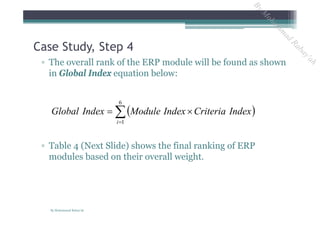
▫ The overall rank of the ERP module will be found as shown
in Global Index equation below:
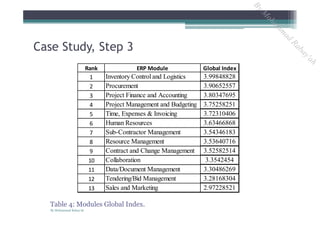
▫ Table 4 (Next Slide) shows the final ranking of ERP
modules based on their overall weight.
Case Study, Step 4
 

6
1i
IndexCriteriaIndexModuleIndexGlobal
By Mohammad Rabay'ah
ByM
oham
m
ad
Rabay'ah
Table 4: Modules Global Index.
Case Study, Step 3
Rank ERP Module Global Index
1 Inventory Control and Logistics 3.99848828
2 Procurement 3.90652557
3 Project Finance and Accounting 3.80347695
4 Project Management and Budgeting 3.75258251
5 Time, Expenses & Invoicing 3.72310406
6 Human Resources 3.63466868
7 Sub-Contractor Management 3.54346183
8 Resource Management 3.53640716
9 Contract and Change Management 3.52582514
10 Collaboration 3.3542454
11 Data/Document Management 3.30486269
12 Tendering/Bid Management 3.28168304
13 Sales and Marketing 2.97228521
By Mohammad Rabay'ah
ByM
oham
m
ad
Rabay'ah
Conclusion
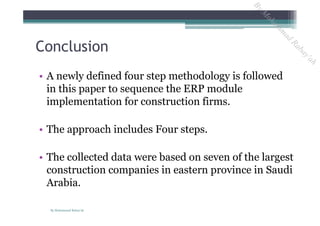
• A newly defined four step methodology is followed
in this paper to sequence the ERP module
implementation for construction firms.
• The approach includes Four steps.
• The collected data were based on seven of the largest
construction companies in eastern province in Saudi
Arabia.
By Mohammad Rabay'ah
ByM
oham
m
ad
Rabay'ah
Conclusion
• Out of thirteen modules, the top ranked modules
were
▫ Inventory control and Logistics
▫ Procurement
▫ Project finance and Accounting.
• The findings of the paper would help construction
firms to prioritize the acquisition of different ERP
modules and can be easily adjusted to their specific
needs.
By Mohammad Rabay'ah
ByM
oham
m
ad
Rabay'ah
Critiques
• The title of the article is appropriate and clear.
• Abstract specific, representative of the article.
• The purpose of the article made clear in the
introduction.
• All related details are explained within the paper
By Mohammad Rabay'ah
ByM
oham
m
ad
Rabay'ah
Critiques
• Referring to more than 30 paper most of it with a
recent Publish date
• More solved examples is required, at least one in
each step.
• Make a summary of formulas and tables at the end
Article to ease calculation follow up.
By Mohammad Rabay'ah
ByM
oham
m
ad
Rabay'ah
By Mohammad Rabay'ah
ByM
oham
m
ad
Rabay'ah

A systematic approach for ERP implementation in the construction industry

  • 1.
    A SYSTEMATIC APPROACHFOR ERP IMPLEMENTATION IN THE CONSTRUCTION INDUSTRY Authors: Assaf, Sadi A KFUPM, KSA Hadidi, Laith A KFUPM, KSA Presented By: Mohammad Rabay’ah ByM oham m ad Rabay'ah
  • 2.
    Outline • Abstract • Introduction •Research Methodology • Case Study • Conclusion • Critique By Mohammad Rabay'ah ByM oham m ad Rabay'ah
  • 3.
    Abstract • This paperprovides a Decision support tool that helps in prioritizing ERP modules’ implementation. • A “case study approach” is conducted with experts in ERP implementation at construction field. • This research develop a four steps methodology to sequence the ERP module implementation. By Mohammad Rabay'ah ByM oham m ad Rabay'ah
  • 4.
    • What isEnterprise Resource Planning (ERP)? ▫ An integral software. ▫ spanning to cover all organization functions with one shared database. ▫ Which increase information sharing and integrity of business processes Introduction By Mohammad Rabay'ah ByM oham m ad Rabay'ah
  • 5.
    • ERP isseen as an expensive investment for architectural and construction companies. • ERP is deployed in a form of internal company project usually with multi-years delivery plan: ▫ Size of company ▫ Number of selected ERP modules. • ERP is noticeably deployed successfully in manufacturing and trading firms. Introduction By Mohammad Rabay'ah ByM oham m ad Rabay'ah
  • 6.
    • ERP inConstruction field: ▫ Time and cost required to deploy a full scale ERP projects are higher than other fields. ▫ Higher Failure rate in reported deployment projects. ▫ ERP implementations within large scale construction organizations have yielded more failures than successes. Introduction By Mohammad Rabay'ah ByM oham m ad Rabay'ah
  • 7.
    • Assessing therisk of ERP implementation failures is encouraged to be assessed prior to deployment. • Better risk management will help organizations to increase the likelihood for ERP implementation success. Introduction By Mohammad Rabay'ah ByM oham m ad Rabay'ah
  • 8.
    • This researchproposes the case study methodology approach. • This approach fits in situation when “how” and “why” questions are being posed, and the researcher has little control over events. • paper propose a decision model developed in four steps as follows: Research Methodology By Mohammad Rabay'ah ByM oham m ad Rabay'ah
  • 9.
    ▫ First step: Identifycommon-used ERP Modules in construction and validate it by experts. ▫ Second step: Identify benefit evaluation criteria and validate it by expert. Research Methodology By Mohammad Rabay'ah ByM oham m ad Rabay'ah
  • 10.
     Six benefitevaluation criteria of ERP modules are validated by the same ERP expert; namely:  1 cost reduction.  2 increased efficiency.  3 improved decision making.  4 improved information quality.  5 improved user satisfaction.  6 improved organizational flexibility. Research Methodology By Mohammad Rabay'ah ByM oham m ad Rabay'ah
  • 11.
    ▫ Third step: Evaluatethe ERP Modules against each benefit criteria. ▫ Fourth step: The overall ranking of ERP Modules is found by calculating the total weight for ERP modules. Research Methodology By Mohammad Rabay'ah ByM oham m ad Rabay'ah
  • 12.
    • This Studyconducted in Eastern Province of Saudi Arabia . • The data collection was done using face to face interviews with ERP managers: ▫ interview started with introduction of the subject. ▫ questionnaire is presented and explained to interviewee. Case Study By Mohammad Rabay'ah ByM oham m ad Rabay'ah
  • 13.
    • This researchapproached grade 1 building contracting companies in Saudi Arabia as classified by MOMRA (ministry of municipality and rural affairs, Saudi Arabia). • The grade 1 contractors in the eastern province, Saudi Arabia are twenty three, Only 13 had an ERP systems. • Seven valid responses (out of thirteen) were received Case Study By Mohammad Rabay'ah ByM oham m ad Rabay'ah
  • 14.
    • The validresponses were only seven which compose 53% of the population in eastern province, Saudi Arabia. Case Study By Mohammad Rabay'ah ByM oham m ad Rabay'ah
  • 15.
    Step 1: Identify common-usedERP Modules in construction Case Study By Mohammad Rabay'ah ByM oham m ad Rabay'ah
  • 16.
    ▫ The researchstarted with a twelve ERP modules defined by Chung et al. (2007) as a possible ERP modules for construction companies, namely: 1. change management. 2. project data management. 3. project contract management. 4. project collaboration. 5. resources management. 6. subcontract management. 7. project costing, project billing. 8. inventory control. 9. Purchasing. 10. human resources. 11. Time. 12. Labor. Case Study, Step 1 By Mohammad Rabay'ah ByM oham m ad Rabay'ah
  • 17.
    ▫ Previous ERPmodules were reviewed by the research team and ERP expert and revised into thirteen modules, namely: 1. Sales and Marketing. 2. Human Resources. 3. Tendering/bid management. 4. Resource management. 5. Data/document management. 6. Collaboration. 7. Contract and Change management. 8. Project management and Budgeting. 9. Subcontractor management. 10. Time, expenses & invoicing. 11. Project Finance and accounting. 12. Procurement. 13. Inventory control and logistics. Case Study, Step 1 By Mohammad Rabay'ah ByM oham m ad Rabay'ah
  • 18.
    Step 2: Benefit Sub-CriteriaWeights Case Study By Mohammad Rabay'ah ByM oham m ad Rabay'ah
  • 19.
    ▫ The rankingof EPR modules is based on scoring inputs of respondents as shown in figure 1 (Next slide). ▫ Each respondent will evaluate the importance of each benefit criteria on a scale from 1 to 9 (highest score). Case Study, Step 2 By Mohammad Rabay'ah ByM oham m ad Rabay'ah
  • 20.
    Figure 1: Criteriaevaluation. Case Study, Step 2 By Mohammad Rabay'ah ByM oham m ad Rabay'ah
  • 21.
    ▫ The collecteddata was analysed using an importance index. The importance index (I) was computed by equation below (Assaf et al., 1995) where:  I = importance index  i = response category index where i = 1,2,…, 9.  ai = constant expressing the weight of the ith response, , where ai = 0,1,2,…,9 for i = 1,2,3,…,9 respectively.  xi = frequency of the ith response given as a percentage of the total responses for each ERP module.  sixty three is the highest count can be achieved if all the respondents (seven) scored the highest possible weight which is (nine). Case Study, Step 2 By Mohammad Rabay'ah ByM oham m ad Rabay'ah
  • 22.
    ▫ Respondents’ scoreinputs for benefit sub-criteria are used to calculate their weights using importance index (I) equation. In table 1, the weight distribution for every benefit sub-criteria for the seven respondents is given. Table 1: Criteria Index. Case Study, Step 2 1 2 3 4 5 6 7 8 9 Cost Reduction 1 2 2 1 1 Increased efficiency 1 3 1 2 Improved decision making 1 1 1 4 Improved information quality 1 1 1 1 3 improved user's satisfaction 1 1 1 1 1 1 1 improved organizational flexibility 1 2 1 2 1 Rank Count Importance Index 74.60% 79.37% 90.48% 79.37% 63.49% 74.60% By Mohammad Rabay'ah ByM oham m ad Rabay'ah
  • 23.
    Step 3: Evaluate ERPModules on benefit criteria Case Study By Mohammad Rabay'ah ByM oham m ad Rabay'ah
  • 24.
    ▫ The questionnaireproceeds to collect the ranking of the thirteen modules for each benefit ▫ For each benefit criteria, the thirteen module will be ranked similar to the way the benefits were ranked. ▫ Figure 2 (next slide) shows the modules evaluation against each criteria. Case Study, Step 3 By Mohammad Rabay'ah ByM oham m ad Rabay'ah
  • 25.
    Figure 2: Modulesevaluation for each benefit. Case Study, Step 3 By Mohammad Rabay'ah ByM oham m ad Rabay'ah
  • 26.
    ▫ Tables 2and 3 in the next two slides shows the weighted count for ERP modules under the six benefits criteria. ▫ Higher ranking number means higher benefit of the module compared to others. Case Study, Step 3 By Mohammad Rabay'ah ByM oham m ad Rabay'ah
  • 27.
    Table 2: Modules'index for benefits cost reduction, increased efficiency and improved decision making. Case Study, Step 3 1 2 3 4 5 6 7 8 9 Index 1 2 3 4 5 6 7 8 9 Index 1 2 3 4 5 6 7 8 9 Index Sales and Marketing 0 2 0 0 1 0 2 1 1 63.49% 0 0 1 0 2 0 3 0 1 68.25% 1 0 0 0 2 1 1 1 1 65.08% Human Resources 0 0 0 1 0 0 2 1 3 84.13% 0 0 1 0 0 1 2 0 3 79.37% 0 0 0 1 0 0 2 2 2 82.54% Tendering/Bid Management 0 0 0 0 1 3 0 1 2 77.78% 0 1 1 0 0 1 1 1 2 69.84% 0 1 0 0 0 0 2 2 2 79.37% Resource Management 0 0 0 1 1 1 1 1 2 76.19% 0 0 0 0 0 0 2 3 2 88.89% 0 0 0 0 1 0 3 1 2 82.54% Data/Document Management 0 0 0 2 0 2 1 1 1 69.84% 0 1 0 0 0 0 4 0 2 76.19% 0 0 0 0 1 3 2 0 1 73.02% Collaboration 0 0 3 0 0 1 1 1 1 61.90% 0 0 0 0 1 1 1 2 2 82.54% 1 0 0 0 2 0 1 2 1 68.25% Contract and Change Management 0 0 0 1 1 0 1 2 2 79.37% 0 0 0 0 1 0 3 2 1 80.95% 0 0 0 0 1 2 1 2 1 77.78% Project Management and Budgeting 0 0 1 0 0 0 1 2 3 84.13% 0 0 0 0 0 1 1 4 1 85.71% 0 0 0 0 1 0 3 1 2 82.54% Sub-Contractor Management 0 0 0 1 0 2 2 0 2 76.19% 0 0 1 0 0 1 2 2 1 76.19% 0 0 0 1 0 1 2 1 2 79.37% Time, Expenses & Invoicing 0 0 0 1 0 2 1 1 2 77.78% 0 0 0 0 0 0 3 1 3 88.89% 0 0 1 0 0 1 2 1 2 77.78% Project Finance and Accounting 0 0 0 0 0 1 2 1 3 87.30% 1 0 0 0 0 0 1 4 1 77.78% 0 0 0 0 0 1 2 2 2 85.71% Procurement 0 0 0 0 1 0 0 2 4 90.48% 0 0 0 0 0 1 2 1 3 87.30% 0 0 0 0 0 1 1 2 3 88.89% Inventory Control and Logistics 0 0 0 0 0 0 0 1 6 98.41% 0 0 0 0 0 1 1 1 4 90.48% 0 0 0 0 0 1 2 1 3 87.30% Improved Decision MakingCost Reduction Ranking Increased Efficiency  By Mohammad Rabay'ah ByM oham m ad Rabay'ah
  • 28.
    Table 3: Modules'index for benefits: improved information quality, users' satisfaction, and organizational flexibility. Case Study, Step 3 1 2 3 4 5 6 7 8 9 Index 1 2 3 4 5 6 7 8 9 Index 1 2 3 4 5 6 7 8 9 Index Sales and Marketing 0 0 1 0 2 0 3 0 1 68.25% 0 2 0 0 3 0 1 0 1 55.56% 0 1 0 0 3 0 2 0 1 63.49% Human Resources 0 0 0 0 1 0 2 2 2 84.13% 0 1 0 0 2 0 1 1 2 71.43% 0 1 0 0 1 2 1 1 1 68.25% Tendering/Bid Management 0 0 0 0 2 0 2 1 2 79.37% 0 1 0 2 1 1 1 0 1 58.73% 1 1 0 0 2 0 2 0 1 57.14% Resource Management 0 0 0 1 3 0 1 0 2 69.84% 0 1 0 0 3 1 1 0 1 61.90% 0 0 0 0 1 1 4 0 1 76.19% Data/Document Management 0 0 0 1 1 1 2 1 1 73.02% 0 0 1 0 1 2 1 0 2 71.43% 0 0 1 1 1 1 2 0 1 65.08% Collaboration 1 0 0 0 1 0 2 1 2 73.02% 0 0 0 0 2 1 2 0 2 76.19% 0 0 0 0 2 1 2 1 1 74.60% Contract and Change Management 0 0 0 1 0 1 1 1 3 82.54% 0 0 0 1 3 1 0 1 1 66.67% 0 0 1 0 2 0 3 0 1 68.25% Project Management and Budgeting 0 0 0 0 0 1 3 1 2 84.13% 0 0 0 1 1 1 1 2 1 74.60% 0 0 0 1 1 1 2 0 2 74.60% Sub-Contractor Management 0 0 0 0 0 1 3 1 2 84.13% 0 0 0 0 2 2 1 1 1 73.02% 0 0 0 1 1 2 2 0 1 69.84% Time, Expenses & Invoicing 0 0 1 0 0 0 2 2 2 80.95% 0 0 0 0 3 1 0 2 1 73.02% 0 0 0 0 1 0 1 4 1 84.13% Project Finance and Accounting 0 0 0 0 0 0 2 3 2 88.89% 0 0 0 0 3 0 1 2 1 74.60% 0 0 0 1 1 0 1 3 1 77.78% Procurement 0 0 0 0 2 0 1 1 3 82.54% 0 0 0 1 2 0 1 2 1 73.02% 0 0 0 0 1 1 1 2 2 82.54% Inventory Control and Logistics 0 0 0 0 2 0 1 1 3 82.54% 0 0 0 0 2 2 0 2 1 74.60% 0 0 0 0 0 2 1 2 2 84.13% Improved Information Quality Improved User Satisfaction Improved Organizatiuonal Flexibility By Mohammad Rabay'ah ByM oham m ad Rabay'ah
  • 29.
    Step 4: Find theoverall ranking of ERP Modules Case Study By Mohammad Rabay'ah ByM oham m ad Rabay'ah
  • 30.
    ▫ The overallrank of the ERP module will be found as shown in Global Index equation below: ▫ Table 4 (Next Slide) shows the final ranking of ERP modules based on their overall weight. Case Study, Step 4    6 1i IndexCriteriaIndexModuleIndexGlobal By Mohammad Rabay'ah ByM oham m ad Rabay'ah
  • 31.
    Table 4: ModulesGlobal Index. Case Study, Step 3 Rank ERP Module Global Index 1 Inventory Control and Logistics 3.99848828 2 Procurement 3.90652557 3 Project Finance and Accounting 3.80347695 4 Project Management and Budgeting 3.75258251 5 Time, Expenses & Invoicing 3.72310406 6 Human Resources 3.63466868 7 Sub-Contractor Management 3.54346183 8 Resource Management 3.53640716 9 Contract and Change Management 3.52582514 10 Collaboration 3.3542454 11 Data/Document Management 3.30486269 12 Tendering/Bid Management 3.28168304 13 Sales and Marketing 2.97228521 By Mohammad Rabay'ah ByM oham m ad Rabay'ah
  • 32.
    Conclusion • A newlydefined four step methodology is followed in this paper to sequence the ERP module implementation for construction firms. • The approach includes Four steps. • The collected data were based on seven of the largest construction companies in eastern province in Saudi Arabia. By Mohammad Rabay'ah ByM oham m ad Rabay'ah
  • 33.
    Conclusion • Out ofthirteen modules, the top ranked modules were ▫ Inventory control and Logistics ▫ Procurement ▫ Project finance and Accounting. • The findings of the paper would help construction firms to prioritize the acquisition of different ERP modules and can be easily adjusted to their specific needs. By Mohammad Rabay'ah ByM oham m ad Rabay'ah
  • 34.
    Critiques • The titleof the article is appropriate and clear. • Abstract specific, representative of the article. • The purpose of the article made clear in the introduction. • All related details are explained within the paper By Mohammad Rabay'ah ByM oham m ad Rabay'ah
  • 35.
    Critiques • Referring tomore than 30 paper most of it with a recent Publish date • More solved examples is required, at least one in each step. • Make a summary of formulas and tables at the end Article to ease calculation follow up. By Mohammad Rabay'ah ByM oham m ad Rabay'ah
  • 36.