

Risk Management Diagnostic Roger Paveza 09/22/09
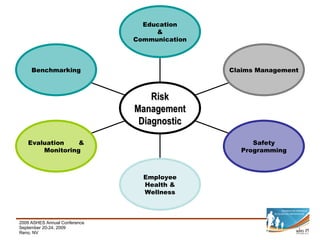
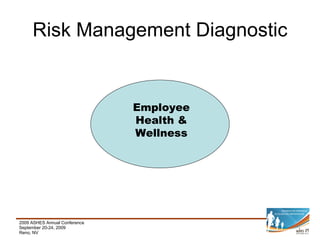
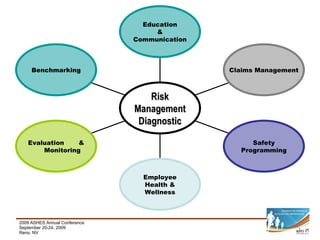
Benchmarking Evaluation  &  Monitoring Employee Health & Wellness Safety Programming Claims Management Education & Communication Risk Management Diagnostic
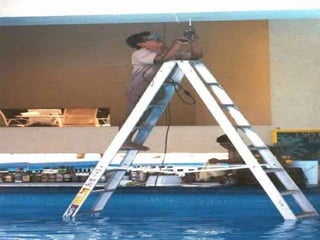
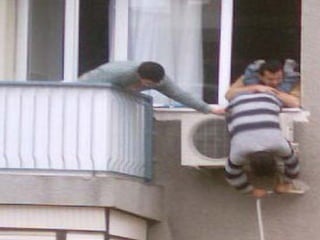
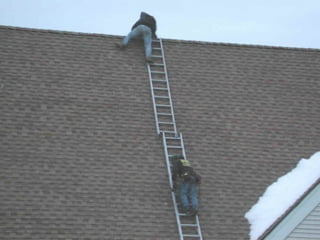
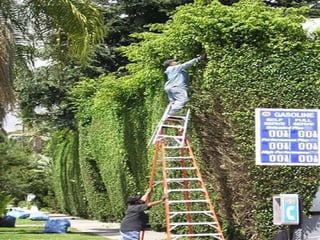
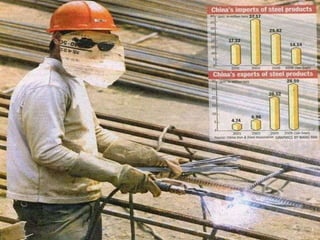
First,  WHY… Why is there a need for Safety??


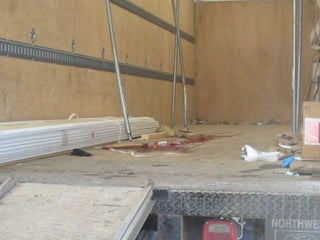
Case Study Fatality – Caught Between/Struck-by
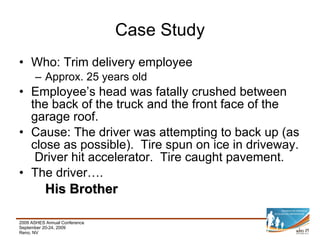
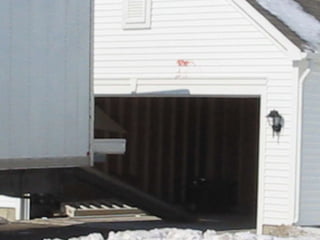
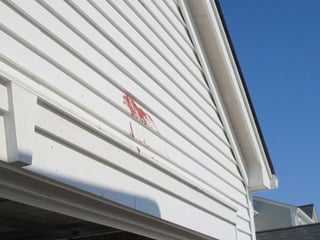
Who: Trim delivery employee Approx. 25 years old Employee’s head was fatally crushed between the back of the truck and the front face of the garage roof. Cause: The driver was attempting to back up (as close as possible).  Tire spun on ice in driveway.  Driver hit accelerator.  Tire caught pavement. The driver…. His Brother Case Study


Something this simple (unloading a truck) created a fatality. There’s more safety lessons to be learned, but the focus here… Case Study
Risk Management Diagnostic Education  & Communication
Education & Communication Is the one of the key components to achieving success with your safety efforts Regular training should be provided -  frequency breeds habit . BLS reports that 40% of workers injured have been on the job less than one year. A top 10 frequently cited OSHA standard.
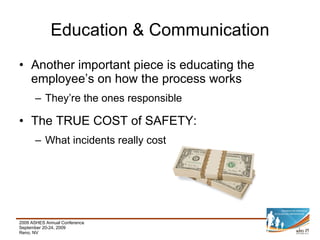
Education & Communication Another important piece is educating the employee’s on how the process works They’re the ones responsible The TRUE COST of SAFETY:  What incidents really cost
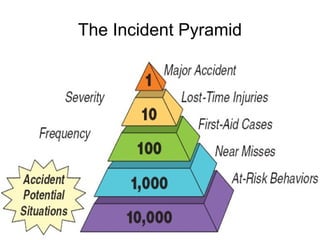
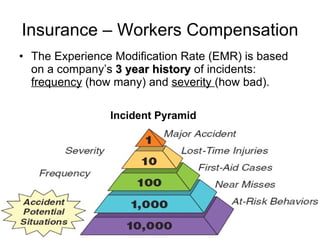
The Incident Pyramid
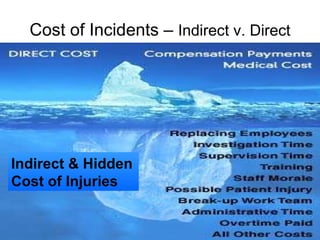
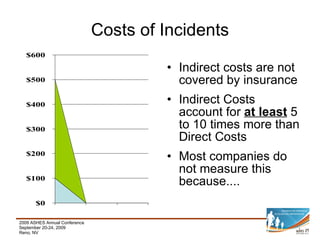
Cost of Incidents –  Indirect v. Direct Indirect & Hidden Cost of Injuries
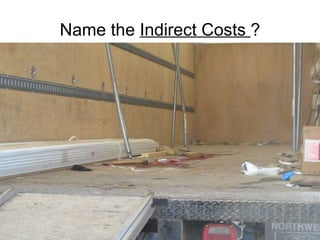
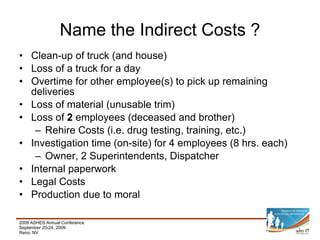
Name the  Indirect Costs  ?
Name the Indirect Costs ? Clean-up of truck (and house) Loss of a truck for a day Overtime for other employee(s) to pick up remaining deliveries Loss of material (unusable trim) Loss of  2  employees (deceased and brother) Rehire Costs (i.e. drug testing, training, etc.) Investigation time (on-site) for 4 employees (8 hrs. each) Owner, 2 Superintendents, Dispatcher Internal paperwork Legal Costs Production due to moral
Indirect costs are not covered by insurance Indirect Costs account for  at least  5 to 10 times more than Direct Costs Most companies do not measure this because.... Costs of Incidents
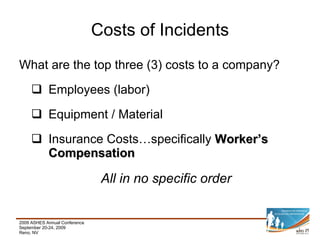
What are the top three (3) costs to a company? Employees (labor) Equipment / Material Insurance Costs…specifically  Worker’s Compensation All in no specific order Costs of Incidents
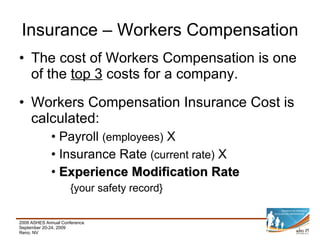
The cost of Workers Compensation is one of the  top 3  costs for a company. Workers Compensation Insurance Cost is calculated: Payroll  (employees)  X Insurance Rate  (current rate)  X Experience Modification Rate {your safety record}   Insurance – Workers Compensation
The Experience Modification Rate (EMR) is based on a company’s  3 year history  of incidents:  frequency  (how many) and  severity  (how bad). Insurance – Workers Compensation Incident Pyramid
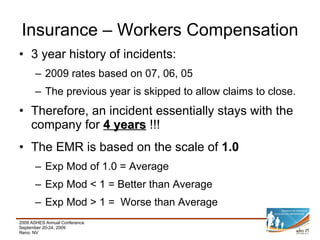
3 year history of incidents: 2009 rates based on 07, 06, 05 The previous year is skipped to allow claims to close. Therefore, an incident essentially stays with the company for  4 years  !!! The EMR is based on the scale of  1.0 Exp Mod of 1.0 = Average Exp Mod < 1 = Better than Average Exp Mod > 1 =  Worse than Average Insurance – Workers Compensation
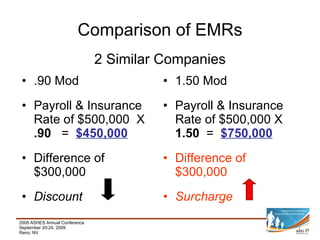
1.50 Mod Payroll & Insurance Rate of $500,000 X  1.50   =  $750,000 Difference of $300,000 Surcharge .90 Mod Payroll & Insurance Rate of $500,000  X  .90   =  $450,000 Difference of $300,000 Discount Comparison of EMRs 2 Similar Companies
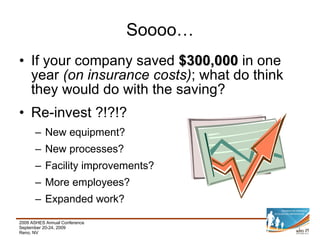
If your company saved  $300,000  in one year  (on insurance costs) ; what do think they would do with the saving? Re-invest ?!?!? New equipment? New processes? Facility improvements? More employees? Expanded work? Soooo…
Many companies are now requiring sub-contractors to report  monthly  hours/incidents to host companies/general contractors. If the EMR ever goes  over 1.0 ; the host reserves the right to terminate contract. They are even reserving the right to terminate based on the severity/frequency of incidents. Some are not even accepting bids/proposals with companies with a EMR over 1.0. Other Implications - EMR
Risk Management Diagnostic Claims Management
Enforce timely reporting of incidents Quantitative: no later than 8-hours, end of shift, etc. Investigate all incidents DOCUMENT, DOCUMENT, DOCUMENT Use as much detail as possible Forms Supervisor investigation Employee (written) statement Witness Reporting & Investigation
Early and frequent communication with the injured employee goes a long way to controlling the claim If the employee is not feeling taken care or cared for, they may go to someone who will… Do be afraid to tell the employee what they are entitled to and what they can expect throughout the claims process Again, if you don’t, someone else will – and it may be incorrect Communication
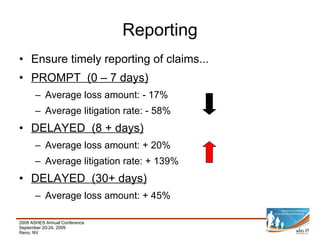
Ensure timely reporting of claims... PROMPT  (0 – 7 days) Average loss amount: - 17% Average litigation rate: - 58%  DELAYED  (8 + days) Average loss amount: + 20% Average litigation rate: + 139% DELAYED  (30+ days) Average loss amount: + 45% Reporting
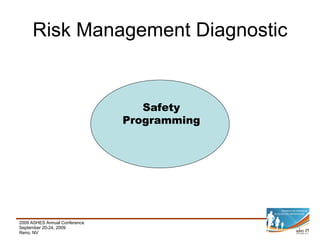
Risk Management Diagnostic Safety Programming
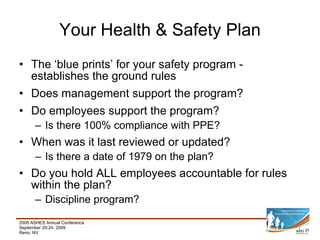
Your Health & Safety Plan The ‘blue prints’ for your safety program -  establishes the ground rules  Does management support the program? Do employees support the program? Is there 100% compliance with PPE?  When was it last reviewed or updated? Is there a date of 1979 on the plan? Do you hold ALL employees accountable for rules within the plan? Discipline program?
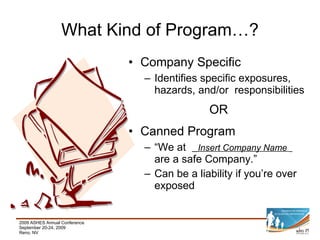
What Kind of Program…? Company Specific  Identifies specific exposures, hazards, and/or  responsibilities OR Canned Program “ We at  Insert Company Name   are a safe Company.” Can be a liability if you’re over exposed
Risk Management Diagnostic Employee Health & Wellness
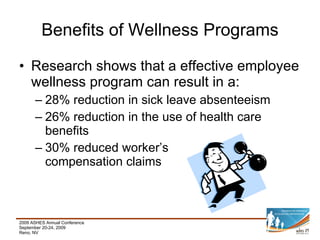
Benefits of Wellness Programs Research shows that a effective employee wellness program can result in a: 28% reduction in sick leave absenteeism 26% reduction in the use of health care benefits 30% reduced worker’s  compensation claims
Types of Programs Wellness programs come in all shapes and sizes: Educational programs for managing health Health risk assessments Health screenings Onsite fitness facilities or subsidy Stretching programs Smoking cessation programs Stress management & work/life balance
Environmental Health Don’t forget to look at possible hazards as well: Ergonomics Proper lifting techniques Industrial Hygiene (air / noise) Indoor air quality Ventilation
Risk Management Diagnostic Evaluation  &  Monitoring
Evaluation & Monitoring Evaluation … of your processes … of your facility … of your people Self-evaluation can be painful, but it is a necessary tool for advancing your company’s safety efforts Make the necessary adjustments – adjust the game plan
Employee Screening Some theories suggest the key to a successful safety program begins with employee screening and selection Drug / Alcohol Testing Pre-Hire / Post Incident / For Cause / Random Approximately 35 - 50 % of all worker's compensation claims are related to substance abuse in the workplace  It can affect: Productivity, Absenteeism, Incidents (human/property), Medical claims, Theft
Employee Screening Pre-Hire Physical Have job descriptions with detailed physical requirements Work with your HC provider to establish a program Background Checks Many companies are now performing some basic level background checks on their employees On all employee screening issues, check with your Attorney, Unions, etc. prior to implementing
Risk Management Diagnostic Benchmarking
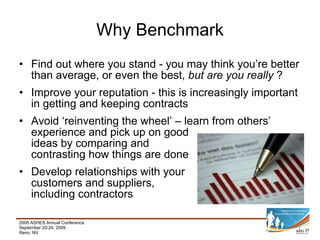
Why Benchmark Find out where you stand - you may think you’re better than average, or even the best,  but are you really  ? Improve your reputation - this is increasingly important in getting and keeping contracts Avoid ‘reinventing the wheel’ – learn from others’ experience and pick up on good  ideas by comparing and  contrasting how things are done Develop relationships with your  customers and suppliers,  including contractors
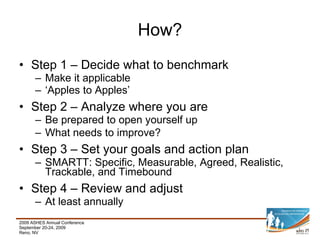
How? Step 1 – Decide what to benchmark Make it applicable ‘ Apples to Apples’ Step 2 – Analyze where you are Be prepared to open yourself up What needs to improve? Step 3 – Set your goals and action plan SMARTT: Specific, Measurable, Agreed, Realistic, Trackable, and Timebound Step 4 – Review and adjust At least annually
Benchmarking Evaluation  &  Monitoring Employee Health & Wellness Safety Programming Claims Management Education & Communication Risk Management Diagnostic
Questions / Thank You Roger Paveza 847.463.7223 [email_address]

Risk Management Diagnostic Ashes2009

  • 1.
    Risk Management DiagnosticRoger Paveza 09/22/09
  • 2.
    Benchmarking Evaluation & Monitoring Employee Health & Wellness Safety Programming Claims Management Education & Communication Risk Management Diagnostic
  • 3.
    First, WHY…Why is there a need for Safety??
  • 4.
  • 5.
  • 6.
  • 7.
  • 8.
  • 9.
  • 10.
  • 11.
  • 12.
  • 13.
  • 14.
    Case Study Fatality– Caught Between/Struck-by
  • 15.
    Who: Trim deliveryemployee Approx. 25 years old Employee’s head was fatally crushed between the back of the truck and the front face of the garage roof. Cause: The driver was attempting to back up (as close as possible). Tire spun on ice in driveway. Driver hit accelerator. Tire caught pavement. The driver…. His Brother Case Study
  • 16.
  • 17.
  • 18.
  • 19.
    Something this simple(unloading a truck) created a fatality. There’s more safety lessons to be learned, but the focus here… Case Study
  • 20.
    Risk Management DiagnosticEducation & Communication
  • 21.
    Education & CommunicationIs the one of the key components to achieving success with your safety efforts Regular training should be provided - frequency breeds habit . BLS reports that 40% of workers injured have been on the job less than one year. A top 10 frequently cited OSHA standard.
  • 22.
    Education & CommunicationAnother important piece is educating the employee’s on how the process works They’re the ones responsible The TRUE COST of SAFETY: What incidents really cost
  • 23.
  • 24.
    Cost of Incidents– Indirect v. Direct Indirect & Hidden Cost of Injuries
  • 25.
    Name the Indirect Costs ?
  • 26.
    Name the IndirectCosts ? Clean-up of truck (and house) Loss of a truck for a day Overtime for other employee(s) to pick up remaining deliveries Loss of material (unusable trim) Loss of 2 employees (deceased and brother) Rehire Costs (i.e. drug testing, training, etc.) Investigation time (on-site) for 4 employees (8 hrs. each) Owner, 2 Superintendents, Dispatcher Internal paperwork Legal Costs Production due to moral
  • 27.
    Indirect costs arenot covered by insurance Indirect Costs account for at least 5 to 10 times more than Direct Costs Most companies do not measure this because.... Costs of Incidents
  • 28.
    What are thetop three (3) costs to a company? Employees (labor) Equipment / Material Insurance Costs…specifically Worker’s Compensation All in no specific order Costs of Incidents
  • 29.
    The cost ofWorkers Compensation is one of the top 3 costs for a company. Workers Compensation Insurance Cost is calculated: Payroll (employees) X Insurance Rate (current rate) X Experience Modification Rate {your safety record} Insurance – Workers Compensation
  • 30.
    The Experience ModificationRate (EMR) is based on a company’s 3 year history of incidents: frequency (how many) and severity (how bad). Insurance – Workers Compensation Incident Pyramid
  • 31.
    3 year historyof incidents: 2009 rates based on 07, 06, 05 The previous year is skipped to allow claims to close. Therefore, an incident essentially stays with the company for 4 years !!! The EMR is based on the scale of 1.0 Exp Mod of 1.0 = Average Exp Mod < 1 = Better than Average Exp Mod > 1 = Worse than Average Insurance – Workers Compensation
  • 32.
    1.50 Mod Payroll& Insurance Rate of $500,000 X 1.50 = $750,000 Difference of $300,000 Surcharge .90 Mod Payroll & Insurance Rate of $500,000 X .90 = $450,000 Difference of $300,000 Discount Comparison of EMRs 2 Similar Companies
  • 33.
    If your companysaved $300,000 in one year (on insurance costs) ; what do think they would do with the saving? Re-invest ?!?!? New equipment? New processes? Facility improvements? More employees? Expanded work? Soooo…
  • 34.
    Many companies arenow requiring sub-contractors to report monthly hours/incidents to host companies/general contractors. If the EMR ever goes over 1.0 ; the host reserves the right to terminate contract. They are even reserving the right to terminate based on the severity/frequency of incidents. Some are not even accepting bids/proposals with companies with a EMR over 1.0. Other Implications - EMR
  • 35.
    Risk Management DiagnosticClaims Management
  • 36.
    Enforce timely reportingof incidents Quantitative: no later than 8-hours, end of shift, etc. Investigate all incidents DOCUMENT, DOCUMENT, DOCUMENT Use as much detail as possible Forms Supervisor investigation Employee (written) statement Witness Reporting & Investigation
  • 37.
    Early and frequentcommunication with the injured employee goes a long way to controlling the claim If the employee is not feeling taken care or cared for, they may go to someone who will… Do be afraid to tell the employee what they are entitled to and what they can expect throughout the claims process Again, if you don’t, someone else will – and it may be incorrect Communication
  • 38.
    Ensure timely reportingof claims... PROMPT (0 – 7 days) Average loss amount: - 17% Average litigation rate: - 58% DELAYED (8 + days) Average loss amount: + 20% Average litigation rate: + 139% DELAYED (30+ days) Average loss amount: + 45% Reporting
  • 39.
    Risk Management DiagnosticSafety Programming
  • 40.
    Your Health &Safety Plan The ‘blue prints’ for your safety program - establishes the ground rules Does management support the program? Do employees support the program? Is there 100% compliance with PPE? When was it last reviewed or updated? Is there a date of 1979 on the plan? Do you hold ALL employees accountable for rules within the plan? Discipline program?
  • 41.
    What Kind ofProgram…? Company Specific Identifies specific exposures, hazards, and/or responsibilities OR Canned Program “ We at Insert Company Name are a safe Company.” Can be a liability if you’re over exposed
  • 42.
    Risk Management DiagnosticEmployee Health & Wellness
  • 43.
    Benefits of WellnessPrograms Research shows that a effective employee wellness program can result in a: 28% reduction in sick leave absenteeism 26% reduction in the use of health care benefits 30% reduced worker’s compensation claims
  • 44.
    Types of ProgramsWellness programs come in all shapes and sizes: Educational programs for managing health Health risk assessments Health screenings Onsite fitness facilities or subsidy Stretching programs Smoking cessation programs Stress management & work/life balance
  • 45.
    Environmental Health Don’tforget to look at possible hazards as well: Ergonomics Proper lifting techniques Industrial Hygiene (air / noise) Indoor air quality Ventilation
  • 46.
    Risk Management DiagnosticEvaluation & Monitoring
  • 47.
    Evaluation & MonitoringEvaluation … of your processes … of your facility … of your people Self-evaluation can be painful, but it is a necessary tool for advancing your company’s safety efforts Make the necessary adjustments – adjust the game plan
  • 48.
    Employee Screening Sometheories suggest the key to a successful safety program begins with employee screening and selection Drug / Alcohol Testing Pre-Hire / Post Incident / For Cause / Random Approximately 35 - 50 % of all worker's compensation claims are related to substance abuse in the workplace It can affect: Productivity, Absenteeism, Incidents (human/property), Medical claims, Theft
  • 49.
    Employee Screening Pre-HirePhysical Have job descriptions with detailed physical requirements Work with your HC provider to establish a program Background Checks Many companies are now performing some basic level background checks on their employees On all employee screening issues, check with your Attorney, Unions, etc. prior to implementing
  • 50.
  • 51.
    Why Benchmark Findout where you stand - you may think you’re better than average, or even the best, but are you really ? Improve your reputation - this is increasingly important in getting and keeping contracts Avoid ‘reinventing the wheel’ – learn from others’ experience and pick up on good ideas by comparing and contrasting how things are done Develop relationships with your customers and suppliers, including contractors
  • 52.
    How? Step 1– Decide what to benchmark Make it applicable ‘ Apples to Apples’ Step 2 – Analyze where you are Be prepared to open yourself up What needs to improve? Step 3 – Set your goals and action plan SMARTT: Specific, Measurable, Agreed, Realistic, Trackable, and Timebound Step 4 – Review and adjust At least annually
  • 53.
    Benchmarking Evaluation & Monitoring Employee Health & Wellness Safety Programming Claims Management Education & Communication Risk Management Diagnostic
  • 54.
    Questions / ThankYou Roger Paveza 847.463.7223 [email_address]