Leadership in
Technology
Presented by:
KINZA RAZZAQ
BSIT-13-F72
Leadership inTechnology
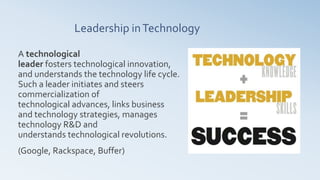
A technological
leader fosters technological innovation,
and understands the technology life cycle.
Such a leader initiates and steers
commercialization of
technological advances, links business
and technology strategies, manages
technology R&D and
understands technological revolutions.
(Google, Rackspace, Buffer)
Why study leadership in technology?
Leadership theories may help in analyzing why, in a given
situation, particular behavior produces certain results, so we can
learn from past experiences and the experiences of others, and
hence fine-tune our style at interacting with people.
Early Leadership Concepts
• Early leadership concepts focused on particular traits such as intelligence,
vocabulary, confidence, attractiveness, height, and gender.
• For the most part, the results were disappointing. These studies could not
define a common set of traits for successful leaders and effective
management.
• The traits, styles, values, and contributions to society differed
considerably from each other.
• Based on the lack of success in identifying personal traits of effective
leaders, research began to focus on other variables, especially the
behavior and actions of leaders.
Rensis Likert and the Michigan Studies
In the late 1940s, studies at the University of Michigan under Rensis Likert
identified two basic styles of leader behavior:
• Job-Centered Leader Behavior: The leader relies primarily on authority,
reward, and punishment power to closely supervise and control work
and subordinates.
• Employee-Centered Leader Behavior: The leader tries to achieve high
performance by building an effective workgroup. The leader pays
attention to workers’ needs and helps to achieve them. Focus is on team
development, participation, individual accountability, and self-direction
and control.
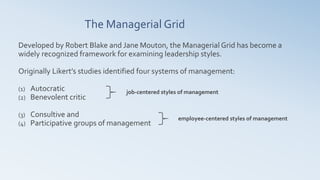
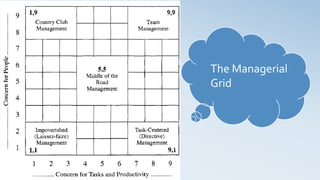
The Managerial Grid
Developed by Robert Blake and Jane Mouton, the Managerial Grid has become a
widely recognized framework for examining leadership styles.
Originally Likert’s studies identified four systems of management:
(1) Autocratic
(2) Benevolent critic
(3) Consultive and
(4) Participative groups of management
job-centered styles of management
employee-centered styles of management
Theory X & Theory Y
Douglas McGregor classified people for motivational purposes into two categories:
1) Those who follow “Theory X”
• dislike work
• are lazy
• must be controlled
• prefer clear direction
• and established norms
2) Those who follow “TheoryY”
• enjoy their work
• need professional challenges
• Need freedom
• Need gross potential
• are also willing to take responsibility
• and exercise leadership
Horizontal Axis
The grid displays leadership qualities in a two-dimensional matrix.
Its horizontal axis represents concern for tasks and productivity,
namely:
• Desire for achieving better results
• Cost effectiveness, resource utilization
• On-time performance
• Satisfaction of organizational objectives
• Getting the job done
Vertical Axis
The second dimension, shown on the vertical axis, represents concern
for people, which is defined as:
• Promoting cooperation and friendship
• Helping people to achieve their personal goals
• Building trust, friendship, and respect
• Minimizing conflicts
• Facilitating to achieve results
The Managerial
Grid
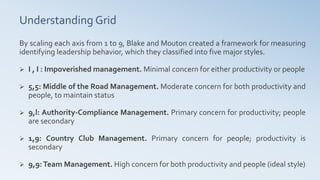
Understanding Grid
By scaling each axis from 1 to 9, Blake and Mouton created a framework for measuring
identifying leadership behavior, which they classified into five major styles.
 I , I : Impoverished management. Minimal concern for either productivity or people
 5,5: Middle of the Road Management. Moderate concern for both productivity and
people, to maintain status
 9,l: Authority-Compliance Management. Primary concern for productivity; people
are secondary
 1,9: Country Club Management. Primary concern for people; productivity is
secondary
 9,9:Team Management. High concern for both productivity and people (ideal style)
Leadership in technology

Leadership in technology

  • 1.
  • 2.
    Leadership inTechnology A technological leaderfosters technological innovation, and understands the technology life cycle. Such a leader initiates and steers commercialization of technological advances, links business and technology strategies, manages technology R&D and understands technological revolutions. (Google, Rackspace, Buffer)
  • 3.
    Why study leadershipin technology? Leadership theories may help in analyzing why, in a given situation, particular behavior produces certain results, so we can learn from past experiences and the experiences of others, and hence fine-tune our style at interacting with people.
  • 4.
    Early Leadership Concepts •Early leadership concepts focused on particular traits such as intelligence, vocabulary, confidence, attractiveness, height, and gender. • For the most part, the results were disappointing. These studies could not define a common set of traits for successful leaders and effective management. • The traits, styles, values, and contributions to society differed considerably from each other. • Based on the lack of success in identifying personal traits of effective leaders, research began to focus on other variables, especially the behavior and actions of leaders.
  • 5.
    Rensis Likert andthe Michigan Studies In the late 1940s, studies at the University of Michigan under Rensis Likert identified two basic styles of leader behavior: • Job-Centered Leader Behavior: The leader relies primarily on authority, reward, and punishment power to closely supervise and control work and subordinates. • Employee-Centered Leader Behavior: The leader tries to achieve high performance by building an effective workgroup. The leader pays attention to workers’ needs and helps to achieve them. Focus is on team development, participation, individual accountability, and self-direction and control.
  • 6.
    The Managerial Grid Developedby Robert Blake and Jane Mouton, the Managerial Grid has become a widely recognized framework for examining leadership styles. Originally Likert’s studies identified four systems of management: (1) Autocratic (2) Benevolent critic (3) Consultive and (4) Participative groups of management job-centered styles of management employee-centered styles of management
  • 7.
    Theory X &Theory Y Douglas McGregor classified people for motivational purposes into two categories: 1) Those who follow “Theory X” • dislike work • are lazy • must be controlled • prefer clear direction • and established norms 2) Those who follow “TheoryY” • enjoy their work • need professional challenges • Need freedom • Need gross potential • are also willing to take responsibility • and exercise leadership
  • 8.
    Horizontal Axis The griddisplays leadership qualities in a two-dimensional matrix. Its horizontal axis represents concern for tasks and productivity, namely: • Desire for achieving better results • Cost effectiveness, resource utilization • On-time performance • Satisfaction of organizational objectives • Getting the job done
  • 9.
    Vertical Axis The seconddimension, shown on the vertical axis, represents concern for people, which is defined as: • Promoting cooperation and friendship • Helping people to achieve their personal goals • Building trust, friendship, and respect • Minimizing conflicts • Facilitating to achieve results
  • 10.
  • 11.
    Understanding Grid By scalingeach axis from 1 to 9, Blake and Mouton created a framework for measuring identifying leadership behavior, which they classified into five major styles.  I , I : Impoverished management. Minimal concern for either productivity or people  5,5: Middle of the Road Management. Moderate concern for both productivity and people, to maintain status  9,l: Authority-Compliance Management. Primary concern for productivity; people are secondary  1,9: Country Club Management. Primary concern for people; productivity is secondary  9,9:Team Management. High concern for both productivity and people (ideal style)