Risk management
 Risk management is the identification and assessment
of risks followed by coordinated and economical
application of resources to minimize, monitor, and
control the probability and/or impact of unfortunate
events or to maximize the realization of opportunities.
Risk Management
 Risks can come from uncertainty in financial markets,
threats from project failures (at any phase in design,
development, production, or sustainment life-cycles),
credit risk, accidents, natural causes and disasters as
well as deliberate attack from an events of uncertain or
unpredictable root-cause.
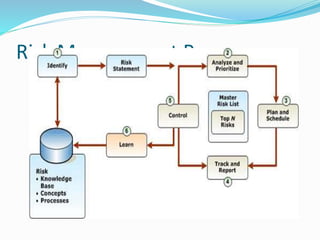
Risk Management Process
Step-1
 Identify - Risk identification allows individuals to
identify risks so that the operations staff becomes
aware of potential problems. Not only should risk
identification be undertaken as early as possible, but it
also should be repeated frequently.
Step-2
 Analyze and prioritize - Risk analysis transforms the
estimates or data about specific risks that developed
during risk identification into a consistent form that
can be used to make decisions around prioritization.
Risk prioritization enables operations to commit
resources to manage the most important risks.
Step-3
 Plan and schedule - Risk planning takes the
information obtained from risk analysis and uses it to
formulate strategies, plans, change requests, and
actions. Risk scheduling ensures that these plans are
approved and then incorporated into the standard
day-to-day processes and infrastructure
Step-4
 Track and report - Risk tracking monitors the status
of specific risks and the progress in their respective
action plans. Risk tracking also includes monitoring
the probability, impact, exposure, and other measures
of risk for changes that could alter priority or risk plans
and ultimately the availability of the service. Risk
reporting ensures that the operations staff, service
manager, and other stakeholders are aware of the
status of top risks and the plans to manage them
Step-5
 Control - Risk control is the process of executing risk
action plans and their associated status reporting.
Step-6
 Learn - Risk learning formalizes the lessons learned
and uses tools to capture, categorize, and index that
knowledge in a reus
 able form that can be shared with others.

ITFT Risk management

  • 1.
    Risk management  Riskmanagement is the identification and assessment of risks followed by coordinated and economical application of resources to minimize, monitor, and control the probability and/or impact of unfortunate events or to maximize the realization of opportunities.
  • 2.
    Risk Management  Riskscan come from uncertainty in financial markets, threats from project failures (at any phase in design, development, production, or sustainment life-cycles), credit risk, accidents, natural causes and disasters as well as deliberate attack from an events of uncertain or unpredictable root-cause.
  • 3.
  • 4.
    Step-1  Identify -Risk identification allows individuals to identify risks so that the operations staff becomes aware of potential problems. Not only should risk identification be undertaken as early as possible, but it also should be repeated frequently.
  • 5.
    Step-2  Analyze andprioritize - Risk analysis transforms the estimates or data about specific risks that developed during risk identification into a consistent form that can be used to make decisions around prioritization. Risk prioritization enables operations to commit resources to manage the most important risks.
  • 6.
    Step-3  Plan andschedule - Risk planning takes the information obtained from risk analysis and uses it to formulate strategies, plans, change requests, and actions. Risk scheduling ensures that these plans are approved and then incorporated into the standard day-to-day processes and infrastructure
  • 7.
    Step-4  Track andreport - Risk tracking monitors the status of specific risks and the progress in their respective action plans. Risk tracking also includes monitoring the probability, impact, exposure, and other measures of risk for changes that could alter priority or risk plans and ultimately the availability of the service. Risk reporting ensures that the operations staff, service manager, and other stakeholders are aware of the status of top risks and the plans to manage them
  • 8.
    Step-5  Control -Risk control is the process of executing risk action plans and their associated status reporting.
  • 9.
    Step-6  Learn -Risk learning formalizes the lessons learned and uses tools to capture, categorize, and index that knowledge in a reus  able form that can be shared with others.