RISK CONTROL
▫ 2 TYPES:
I. MATERIAL RISK CONTROL
II. WORKPLACE RISK CONTROL
By
Muhammad Ahmad Badar
.
MATERIAL RISK CONTROL:
 IMPORTANT ASSETS
I. HUMAN ASSETS
II. PHYSICAL ASSETS (including
money)
III. INTELLECTUAL ASSETS
MATERIAL RISK CONTROL
. Fire and other natural peril exposures
i. Fixed location
ii. Transport
 Security exposure
▫ Security threat:
i. Human
ii. Natural disasters
Theft:
The act of stealing; the wrongful taking
Malicious Damaged:
Damage with intent to destroy property.
Terrorism:
Destruction of people or property by
people.
4
Not all destruction is Terrorism:
Destruction Caused due to injustice.
Aimed directly or Indirectly to established a government.
To redress a real.
Technological Exposure:
IT security exposures are worthy of a mentioned at this point.
Thief are using technology as to achieve the aim.
Risk manager is to consider risks related to technology.
5
Work Place Risk Control:
For most dreaded tasks faced by the risk manager.
It’s a long and Complex process
Risk to employees and visitors:
Includes; Slips, working high up, high noise levels
and explosion.
Job Stress:
Harmful responses when requirement of the job do
not match.
Lead in considerable pressure and Stress.
6
Factors leading to work stress:
Heavy work load.
Job Insecurity.
Effects of work stress:
Stress can increase your risk for heart disease.
Psychological Disorders.
Other Health problem.
Penalties:
Consequence or disadvantage attached to any
condition.
7
Job Discriminations:
Unequal treatment on the basis of race and
gender.
Unequal Pay:
Discrimination take place due to unequal pay of
two persons.
Wrongful Termination:
Firing related to protected status.
Retaliation and Harassment:
Harasses or retaliates against an employee, and
discriminates.
8
Recruitment and Hiring:
excluding the qualified workers through hiring discrimination.
Workplace Facilities:
Certain employees are not allowed to use certain facility.
Risk Control Plan:
Help to meet legal obligations to identify hazards and control.
Regulations of assessing hazard:
Manual Handling
Asbestos (heat-resistant material)
9
Risk Control Plan
&
Risk Financing▫ .
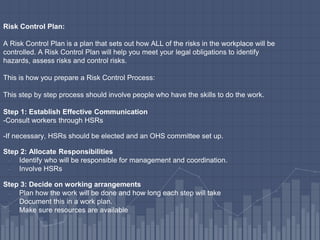
Risk Control Plan:
A Risk Control Plan is a plan that sets out how ALL of the risks in the workplace will be
controlled. A Risk Control Plan will help you meet your legal obligations to identify
hazards, assess risks and control risks.
This is how you prepare a Risk Control Process:
This step by step process should involve people who have the skills to do the work.
Step 1: Establish Effective Communication
-Consult workers through HSRs
-If necessary, HSRs should be elected and an OHS committee set up.
Step 2: Allocate Responsibilities
- Identify who will be responsible for management and coordination.
- Involve HSRs
Step 3: Decide on working arrangements
- Plan how the work will be done and how long each step will take
- Document this in a work plan.
- Make sure resources are available
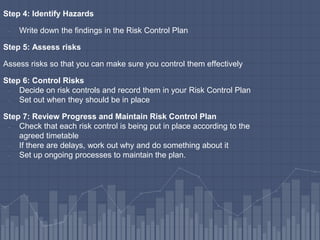
Step 4: Identify Hazards
- Write down the findings in the Risk Control Plan
Step 5: Assess risks
Assess risks so that you can make sure you control them effectively
Step 6: Control Risks
- Decide on risk controls and record them in your Risk Control Plan
- Set out when they should be in place
Step 7: Review Progress and Maintain Risk Control Plan
- Check that each risk control is being put in place according to the
agreed timetable
- If there are delays, work out why and do something about it
- Set up ongoing processes to maintain the plan.
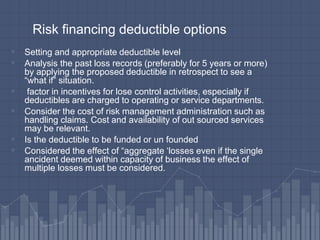
Risk financing deductible options
▫ Setting and appropriate deductible level
▫ Analysis the past loss records (preferably for 5 years or more)
by applying the proposed deductible in retrospect to see a
“what if” situation.
▫ factor in incentives for lose control activities, especially if
deductibles are charged to operating or service departments.
▫ Consider the cost of risk management administration such as
handling claims. Cost and availability of out sourced services
may be relevant.
▫ Is the deductible to be funded or un founded
▫ Considered the effect of “aggregate ‘losses even if the single
ancident deemed within capacity of business the effect of
multiple losses must be considered.
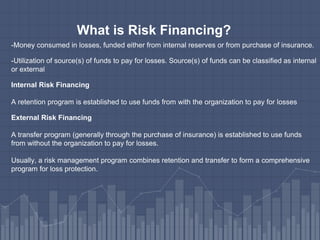
What is Risk Financing?
-Money consumed in losses, funded either from internal reserves or from purchase of insurance.
-Utilization of source(s) of funds to pay for losses. Source(s) of funds can be classified as internal
or external
Internal Risk Financing
A retention program is established to use funds from with the organization to pay for losses
External Risk Financing
A transfer program (generally through the purchase of insurance) is established to use funds
from without the organization to pay for losses.
Usually, a risk management program combines retention and transfer to form a comprehensive
program for loss protection.
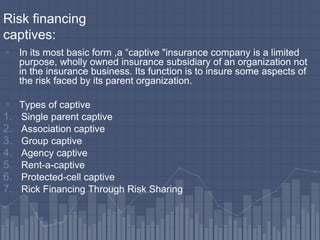
Risk financing
captives:
▫ In its most basic form ,a “captive "insurance company is a limited
purpose, wholly owned insurance subsidiary of an organization not
in the insurance business. Its function is to insure some aspects of
the risk faced by its parent organization.
▫ Types of captive
1. Single parent captive
2. Association captive
3. Group captive
4. Agency captive
5. Rent-a-captive
6. Protected-cell captive
7. Rick Financing Through Risk Sharing
▫ THANK YOU
16

Risk control types Slides

  • 1.
    RISK CONTROL ▫ 2TYPES: I. MATERIAL RISK CONTROL II. WORKPLACE RISK CONTROL By Muhammad Ahmad Badar
  • 2.
    . MATERIAL RISK CONTROL: IMPORTANT ASSETS I. HUMAN ASSETS II. PHYSICAL ASSETS (including money) III. INTELLECTUAL ASSETS
  • 3.
    MATERIAL RISK CONTROL .Fire and other natural peril exposures i. Fixed location ii. Transport  Security exposure ▫ Security threat: i. Human ii. Natural disasters
  • 4.
    Theft: The act ofstealing; the wrongful taking Malicious Damaged: Damage with intent to destroy property. Terrorism: Destruction of people or property by people. 4
  • 5.
    Not all destructionis Terrorism: Destruction Caused due to injustice. Aimed directly or Indirectly to established a government. To redress a real. Technological Exposure: IT security exposures are worthy of a mentioned at this point. Thief are using technology as to achieve the aim. Risk manager is to consider risks related to technology. 5
  • 6.
    Work Place RiskControl: For most dreaded tasks faced by the risk manager. It’s a long and Complex process Risk to employees and visitors: Includes; Slips, working high up, high noise levels and explosion. Job Stress: Harmful responses when requirement of the job do not match. Lead in considerable pressure and Stress. 6
  • 7.
    Factors leading towork stress: Heavy work load. Job Insecurity. Effects of work stress: Stress can increase your risk for heart disease. Psychological Disorders. Other Health problem. Penalties: Consequence or disadvantage attached to any condition. 7
  • 8.
    Job Discriminations: Unequal treatmenton the basis of race and gender. Unequal Pay: Discrimination take place due to unequal pay of two persons. Wrongful Termination: Firing related to protected status. Retaliation and Harassment: Harasses or retaliates against an employee, and discriminates. 8
  • 9.
    Recruitment and Hiring: excludingthe qualified workers through hiring discrimination. Workplace Facilities: Certain employees are not allowed to use certain facility. Risk Control Plan: Help to meet legal obligations to identify hazards and control. Regulations of assessing hazard: Manual Handling Asbestos (heat-resistant material) 9
  • 10.
  • 11.
    Risk Control Plan: ARisk Control Plan is a plan that sets out how ALL of the risks in the workplace will be controlled. A Risk Control Plan will help you meet your legal obligations to identify hazards, assess risks and control risks. This is how you prepare a Risk Control Process: This step by step process should involve people who have the skills to do the work. Step 1: Establish Effective Communication -Consult workers through HSRs -If necessary, HSRs should be elected and an OHS committee set up. Step 2: Allocate Responsibilities - Identify who will be responsible for management and coordination. - Involve HSRs Step 3: Decide on working arrangements - Plan how the work will be done and how long each step will take - Document this in a work plan. - Make sure resources are available
  • 12.
    Step 4: IdentifyHazards - Write down the findings in the Risk Control Plan Step 5: Assess risks Assess risks so that you can make sure you control them effectively Step 6: Control Risks - Decide on risk controls and record them in your Risk Control Plan - Set out when they should be in place Step 7: Review Progress and Maintain Risk Control Plan - Check that each risk control is being put in place according to the agreed timetable - If there are delays, work out why and do something about it - Set up ongoing processes to maintain the plan.
  • 13.
    Risk financing deductibleoptions ▫ Setting and appropriate deductible level ▫ Analysis the past loss records (preferably for 5 years or more) by applying the proposed deductible in retrospect to see a “what if” situation. ▫ factor in incentives for lose control activities, especially if deductibles are charged to operating or service departments. ▫ Consider the cost of risk management administration such as handling claims. Cost and availability of out sourced services may be relevant. ▫ Is the deductible to be funded or un founded ▫ Considered the effect of “aggregate ‘losses even if the single ancident deemed within capacity of business the effect of multiple losses must be considered.
  • 14.
    What is RiskFinancing? -Money consumed in losses, funded either from internal reserves or from purchase of insurance. -Utilization of source(s) of funds to pay for losses. Source(s) of funds can be classified as internal or external Internal Risk Financing A retention program is established to use funds from with the organization to pay for losses External Risk Financing A transfer program (generally through the purchase of insurance) is established to use funds from without the organization to pay for losses. Usually, a risk management program combines retention and transfer to form a comprehensive program for loss protection.
  • 15.
    Risk financing captives: ▫ Inits most basic form ,a “captive "insurance company is a limited purpose, wholly owned insurance subsidiary of an organization not in the insurance business. Its function is to insure some aspects of the risk faced by its parent organization. ▫ Types of captive 1. Single parent captive 2. Association captive 3. Group captive 4. Agency captive 5. Rent-a-captive 6. Protected-cell captive 7. Rick Financing Through Risk Sharing
  • 16.