By Jim McCann
A  Gold - Silver - Bronze command structure  is used by emergency services of the United Kingdom to establish a hierarchical framework for the command and control of major incidents and disasters.
The structure was created by the UK Metropolitan Police in 1985 directly after a serious riot in North London on the evening of 6 October where Police Constable Keith Blakelock was murdered.
The  Gold Commander  is in overall control of their organisation's resources at the incident. They will not be on site, but at a distant control room,  Gold Command , where they will formulate the strategy for dealing with the incident.
The  Silver Commander  is the senior member of the organisation at the scene, in charge of all their resources. They decide how to utilise these resources to achieve the strategic aims of the Gold Commander; they determine the tactics used.
A  Bronze Commander  directly controls the organisations resources at the incident and will be found with their staff working on scene.
In the United Kingdom the principle of  Police primacy  means that the Police will be the organisation in ultimate charge of the incident, over the other organisations that may attend. A limited exception to this occurs if the incident involves a fire or other dangerous hazard, in which case the fire service will have overall charge of the area inside the inner cordon where fire fighting or rescue is taking place.
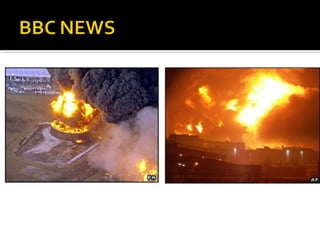
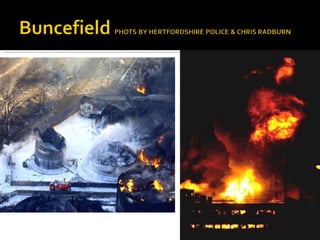
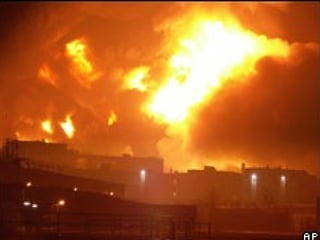
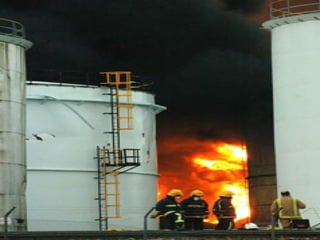
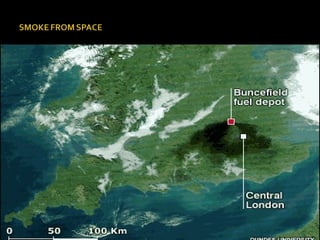
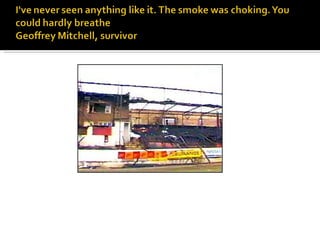
2005: Massive fire at Buncefield oil depot A series of massive explosions early this morning has led to an enormous fire at one of Britain's largest oil depots sending thick black smoke drifting up to 40 miles away. Police say 43 people were injured, two of them seriously, after flames shot hundreds of feet into the sky at the Buncefield oil depot near Hemel Hempstead in Hertfordshire.
About 2,000 people living nearby have been evacuated, while police have advised others to keep their windows and doors closed because of the fumes.
The 2005 Buncefield fire can be used as one of many examples to show how the command structure functions. After the explosions on Sunday 11 December 2005, the strategic operation to bring the incident under control was located at Hertfordshire Constabulary's headquarters in Welwyn Garden City - some distance from the incident. Hertfordshire Fire and Rescue Service's Chief Fire Officer (CFO) Roy Wilsher was based at gold command "within one hour of the incident". The location of silver command was initially located close to the incident then moved to Watford.  Bronze, was situated on the fire ground and was a Herts fire service control unit. Each of the services had its own senior officers who assumed the roles of gold, silver and bronze.


During the first three days of the fire, the gold command committee met at 1100hrs and 1400hrs, each session was usually followed by a media briefing.
The Act and the regulations lay out what is required; “ The chief requirement of the Act in regard to emergency planning is to maintain plans to ensure that, if an emergency occurs or is likely to occur, each Category 1 responder body can deliver its functions so far as necessary or desirable for the purpose of preventing the emergency, reducing, controlling or mitigating its effects, or taking other action in connection with it.”  Kevin Arbuthnot
Emergency management  (or  disaster management ) is the discipline of dealing with and avoiding risks. It is a discipline that involves preparing, supporting, and rebuilding society when natural or human-made disasters occur.  In general, any Emergency management is the continuous process by which all individuals, groups, and communities manage hazards in an effort to avoid or ameliorate the impact of disasters resulting from the hazards. Actions taken depend in part on perceptions of risk of those exposed.
Effective emergency management relies on thorough integration of emergency plans at all levels of government and non-government involvement.  Activities at each level (individual, group, community) affect the other levels.  It is common to place the responsibility for governmental emergency management with the institutions the emergency services.  In the private sector, emergency management is sometimes referred to as business continuity planning.
Modern thinking focuses on a more general intent to protect the civilian population in times of peace as well as in times of war.
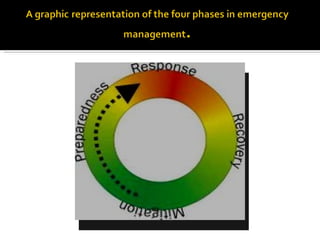
The nature of emergency management is highly dependent on economic and social conditions local to the emergency, or disaster. This is true to the extent that some disaster relief experts such as  Fred Cuny  have noted that in a sense the only real disasters are economic. Experts, such as Cuny, have long noted that the cycle of emergency management must include long-term work on infrastructure, public awareness, and even human justice issues. This is particularly important in developing nations. The process of emergency management involves four phases: mitigation, preparation, response, and recovery.
 
Risk Assessment The act places a risk assessment duty on all category 1 responders, and to make plans for such risks that are identified. The act also places a duty on all category 1 responders to cooperate in producing and maintaining a ‘Community Risk Register’. Emergency Planning The fire service is well placed for this, having a mixture of generic and specific plans, along with multi-agency plans, covering a very wide aspect of emergencies. For example, West Yorkshire has a multi-agency plan in place called ‘Who does what in an emergency’, produced and maintained by the emergency planners’ forum, and further work is now in place developing other multi-agency plans by the formation of sub working groups to the forum.
WYFRS is working to produce a ‘Business Continuity Plan’ (BCP) to ensure we can continue with our core functions in the event of an emergency’.
Category 1 and 2 responders should co-operate with each other and other organisations undertaking a response in the same local resilience area. The local resilience area is defined as the local police force boundary, and its group of responders forms the ‘Local Resilience Forum’ (LRF).
Mitigation efforts attempt to prevent hazards from developing into disasters altogether, or to reduce the effects of disasters when they occur.
Mitigation measures can be  structural  or  non-structural .  Structural measures use technological solutions, like flood levees.  Non-structural measures include legislation, land-use planning (e.g. the designation of nonessential land like parks to be used as flood zones), and  insurance.
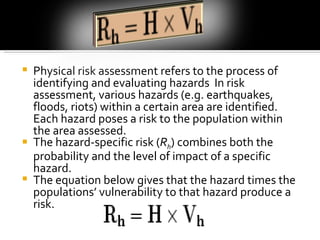
Physical risk assessment refers to the process of identifying and evaluating hazards  In risk assessment, various hazards (e.g. earthquakes, floods, riots) within a certain area are identified. Each hazard poses a risk to the population within the area assessed.  The hazard-specific risk ( R h ) combines both the probability and the level of impact of a specific hazard.  The equation below gives that the hazard times the populations’ vulnerability to that hazard produce a risk.
Preparation In the preparedness phase, emergency managers develop plans of action for when the disaster strikes.  Communication plans with easily understandable terminology and chain of command  Development and practice of multi-agency coordination and incident command  Proper maintenance and training of emergency services  Development and exercise of emergency population warning methods combined with emergency shelters and evacuation plans  Stockpiling, inventory, and maintenance of supplies and equipment  An efficient measure is an emergency operations centre (EOC) combined with a practiced region-wide doctrine for managing emergencies.
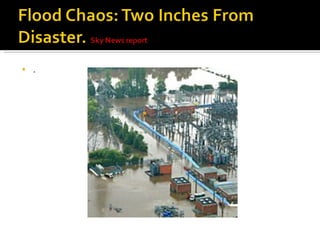
The response phase includes the mobilization of the necessary emergency services and first responders in the disaster area. This is likely to include a first wave of core emergency services, such as fire-fighters, police and ambulance crews. They may be supported by a number of secondary emergency services, such as specialist rescue teams. In the response phase, medical assets will be used in accordance with the appropriate triage of the affected victims.
Search and rescue efforts need to commence at an early stage .
.
 
The Ministry of Defence maintains a Nuclear Accident Response Organisation (NARO) to deal with the consequences of any incident (including one arising through terrorist acts) affecting the UK, or Overseas Territories, involving nuclear weapons, special nuclear materials, nuclear facilities or naval reactors.
  Developed to guide UK decision-makers through a menu of recovery options following a release of radioactive material into the environment..
NHS: Emergency Planning Guidance 2005  Department of Health: Deliberate Release (Emergency Planning Coordination Unit) Guidance  HPA: Deliberate Release - information for Health Professionals  REPPIR - Radiation (Emergency Preparedness and Public Information) Regulations 2001  HSE: Biological or Chemical Threats by Post  HPA: Responding to Suspect Packages and Materials - Actions to be taken 
The Royal Society Report: Making the UK safer: detecting and decontaminating chemical and biological agents (2004)  HPA report on Exercise East Wind - A multi-agency response to a radiological "dirty bomb".  Exercise Osiris at Bank Tube Station
THE END

Gold Silver Bronze Command By J Mc Cann

  • 1.
  • 2.
    A Gold- Silver - Bronze command structure is used by emergency services of the United Kingdom to establish a hierarchical framework for the command and control of major incidents and disasters.
  • 3.
    The structure wascreated by the UK Metropolitan Police in 1985 directly after a serious riot in North London on the evening of 6 October where Police Constable Keith Blakelock was murdered.
  • 4.
    The GoldCommander is in overall control of their organisation's resources at the incident. They will not be on site, but at a distant control room, Gold Command , where they will formulate the strategy for dealing with the incident.
  • 5.
    The SilverCommander is the senior member of the organisation at the scene, in charge of all their resources. They decide how to utilise these resources to achieve the strategic aims of the Gold Commander; they determine the tactics used.
  • 6.
    A BronzeCommander directly controls the organisations resources at the incident and will be found with their staff working on scene.
  • 7.
    In the UnitedKingdom the principle of Police primacy means that the Police will be the organisation in ultimate charge of the incident, over the other organisations that may attend. A limited exception to this occurs if the incident involves a fire or other dangerous hazard, in which case the fire service will have overall charge of the area inside the inner cordon where fire fighting or rescue is taking place.
  • 8.
    2005: Massive fireat Buncefield oil depot A series of massive explosions early this morning has led to an enormous fire at one of Britain's largest oil depots sending thick black smoke drifting up to 40 miles away. Police say 43 people were injured, two of them seriously, after flames shot hundreds of feet into the sky at the Buncefield oil depot near Hemel Hempstead in Hertfordshire.
  • 9.
    About 2,000 peopleliving nearby have been evacuated, while police have advised others to keep their windows and doors closed because of the fumes.
  • 10.
    The 2005 Buncefieldfire can be used as one of many examples to show how the command structure functions. After the explosions on Sunday 11 December 2005, the strategic operation to bring the incident under control was located at Hertfordshire Constabulary's headquarters in Welwyn Garden City - some distance from the incident. Hertfordshire Fire and Rescue Service's Chief Fire Officer (CFO) Roy Wilsher was based at gold command "within one hour of the incident". The location of silver command was initially located close to the incident then moved to Watford. Bronze, was situated on the fire ground and was a Herts fire service control unit. Each of the services had its own senior officers who assumed the roles of gold, silver and bronze.
  • 11.
  • 12.
  • 13.
  • 14.
  • 15.
  • 16.
    During the firstthree days of the fire, the gold command committee met at 1100hrs and 1400hrs, each session was usually followed by a media briefing.
  • 17.
    The Act andthe regulations lay out what is required; “ The chief requirement of the Act in regard to emergency planning is to maintain plans to ensure that, if an emergency occurs or is likely to occur, each Category 1 responder body can deliver its functions so far as necessary or desirable for the purpose of preventing the emergency, reducing, controlling or mitigating its effects, or taking other action in connection with it.” Kevin Arbuthnot
  • 18.
    Emergency management (or disaster management ) is the discipline of dealing with and avoiding risks. It is a discipline that involves preparing, supporting, and rebuilding society when natural or human-made disasters occur. In general, any Emergency management is the continuous process by which all individuals, groups, and communities manage hazards in an effort to avoid or ameliorate the impact of disasters resulting from the hazards. Actions taken depend in part on perceptions of risk of those exposed.
  • 19.
    Effective emergency managementrelies on thorough integration of emergency plans at all levels of government and non-government involvement. Activities at each level (individual, group, community) affect the other levels. It is common to place the responsibility for governmental emergency management with the institutions the emergency services. In the private sector, emergency management is sometimes referred to as business continuity planning.
  • 20.
    Modern thinking focuseson a more general intent to protect the civilian population in times of peace as well as in times of war.
  • 21.
    The nature ofemergency management is highly dependent on economic and social conditions local to the emergency, or disaster. This is true to the extent that some disaster relief experts such as Fred Cuny have noted that in a sense the only real disasters are economic. Experts, such as Cuny, have long noted that the cycle of emergency management must include long-term work on infrastructure, public awareness, and even human justice issues. This is particularly important in developing nations. The process of emergency management involves four phases: mitigation, preparation, response, and recovery.
  • 22.
  • 23.
    Risk Assessment Theact places a risk assessment duty on all category 1 responders, and to make plans for such risks that are identified. The act also places a duty on all category 1 responders to cooperate in producing and maintaining a ‘Community Risk Register’. Emergency Planning The fire service is well placed for this, having a mixture of generic and specific plans, along with multi-agency plans, covering a very wide aspect of emergencies. For example, West Yorkshire has a multi-agency plan in place called ‘Who does what in an emergency’, produced and maintained by the emergency planners’ forum, and further work is now in place developing other multi-agency plans by the formation of sub working groups to the forum.
  • 24.
    WYFRS is workingto produce a ‘Business Continuity Plan’ (BCP) to ensure we can continue with our core functions in the event of an emergency’.
  • 25.
    Category 1 and2 responders should co-operate with each other and other organisations undertaking a response in the same local resilience area. The local resilience area is defined as the local police force boundary, and its group of responders forms the ‘Local Resilience Forum’ (LRF).
  • 26.
    Mitigation efforts attemptto prevent hazards from developing into disasters altogether, or to reduce the effects of disasters when they occur.
  • 27.
    Mitigation measures canbe structural or non-structural . Structural measures use technological solutions, like flood levees. Non-structural measures include legislation, land-use planning (e.g. the designation of nonessential land like parks to be used as flood zones), and insurance.
  • 28.
    Physical risk assessmentrefers to the process of identifying and evaluating hazards In risk assessment, various hazards (e.g. earthquakes, floods, riots) within a certain area are identified. Each hazard poses a risk to the population within the area assessed. The hazard-specific risk ( R h ) combines both the probability and the level of impact of a specific hazard. The equation below gives that the hazard times the populations’ vulnerability to that hazard produce a risk.
  • 29.
    Preparation In thepreparedness phase, emergency managers develop plans of action for when the disaster strikes. Communication plans with easily understandable terminology and chain of command Development and practice of multi-agency coordination and incident command Proper maintenance and training of emergency services Development and exercise of emergency population warning methods combined with emergency shelters and evacuation plans Stockpiling, inventory, and maintenance of supplies and equipment An efficient measure is an emergency operations centre (EOC) combined with a practiced region-wide doctrine for managing emergencies.
  • 30.
    The response phaseincludes the mobilization of the necessary emergency services and first responders in the disaster area. This is likely to include a first wave of core emergency services, such as fire-fighters, police and ambulance crews. They may be supported by a number of secondary emergency services, such as specialist rescue teams. In the response phase, medical assets will be used in accordance with the appropriate triage of the affected victims.
  • 31.
    Search and rescueefforts need to commence at an early stage .
  • 32.
  • 33.
  • 34.
    The Ministry ofDefence maintains a Nuclear Accident Response Organisation (NARO) to deal with the consequences of any incident (including one arising through terrorist acts) affecting the UK, or Overseas Territories, involving nuclear weapons, special nuclear materials, nuclear facilities or naval reactors.
  • 35.
      Developed toguide UK decision-makers through a menu of recovery options following a release of radioactive material into the environment..
  • 36.
    NHS: Emergency PlanningGuidance 2005  Department of Health: Deliberate Release (Emergency Planning Coordination Unit) Guidance  HPA: Deliberate Release - information for Health Professionals  REPPIR - Radiation (Emergency Preparedness and Public Information) Regulations 2001 HSE: Biological or Chemical Threats by Post  HPA: Responding to Suspect Packages and Materials - Actions to be taken 
  • 37.
    The Royal SocietyReport: Making the UK safer: detecting and decontaminating chemical and biological agents (2004) HPA report on Exercise East Wind - A multi-agency response to a radiological "dirty bomb". Exercise Osiris at Bank Tube Station
  • 38.