Portfolio Management
Content
• Scope of Portfolio Management.
• Risk and Return.
Scope of Portfolio Management
• Portfolio management is a continuous
process.
• It is a dynamic activity.
• Identification of the investor’s objective,
constraints and preferences.
• Making an evaluation of portfolio income
(comparison with targets and achievement).
• Monitoring the performance of portfolio by
incorporating the latest market conditions.
Risk & Return
Introduction:
Risk and return are inseparable. Normally, the
higher the risk, the higher is the return.
Hence, investment process must be considered
both in terms of risk and return.
Risk
• All investments are risky. The degree of risk
varies based on the of the securities, the mode
of investment, the issuer of the security, etc.
• In general, the term risk refers to the
possibility of occurrence of loss in a financial
transaction.
Return
• A person making an investment expects to get
some return from the Investment in the
future.
• But future is uncertain. So the return may not
be certain.
Causes of risk factor
• Default in taking correct investment decision.
• Failure to decide the correct timing on investments.
• Selection of the highly risky investment instruments.
• Unsatisfactory creditworthiness of the issuer.
• Selection of the investment having longer maturity period. This
is because, the larger the period, the more risky is the investment
normally.
• Putting huge amount in any security. The higher the amount
invested in any security the larger is the risk.
• Selection of the risky industry or business in which the
company is operating.
• National and international factors, acts of goods etc. also affect
investments badly.
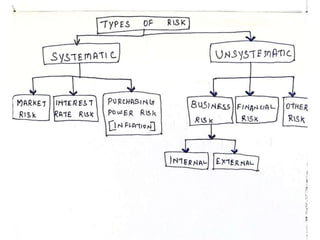
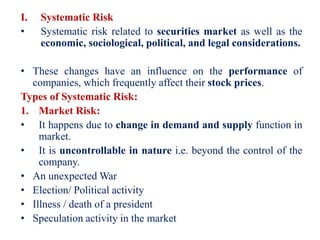
I. Systematic Risk
• Systematic risk related to securities market as well as the
economic, sociological, political, and legal considerations.
• These changes have an influence on the performance of
companies, which frequently affect their stock prices.
Types of Systematic Risk:
1. Market Risk:
• It happens due to change in demand and supply function in
market.
• It is uncontrollable in nature i.e. beyond the control of the
company.
• An unexpected War
• Election/ Political activity
• Illness / death of a president
• Speculation activity in the market
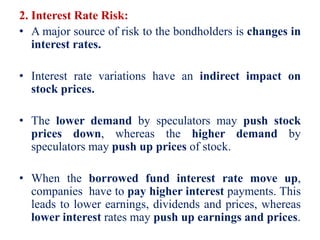
2. Interest Rate Risk:
• A major source of risk to the bondholders is changes in
interest rates.
• Interest rate variations have an indirect impact on
stock prices.
• The lower demand by speculators may push stock
prices down, whereas the higher demand by
speculators may push up prices of stock.
• When the borrowed fund interest rate move up,
companies have to pay higher interest payments. This
leads to lower earnings, dividends and prices, whereas
lower interest rates may push up earnings and prices.
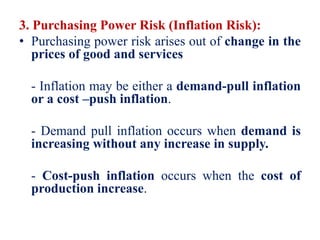
3. Purchasing Power Risk (Inflation Risk):
• Purchasing power risk arises out of change in the
prices of good and services
- Inflation may be either a demand-pull inflation
or a cost –push inflation.
- Demand pull inflation occurs when demand is
increasing without any increase in supply.
- Cost-push inflation occurs when the cost of
production increase.
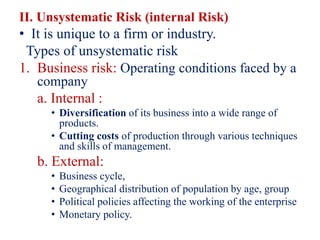
II. Unsystematic Risk (internal Risk)
• It is unique to a firm or industry.
Types of unsystematic risk
1. Business risk: Operating conditions faced by a
company
a. Internal :
• Diversification of its business into a wide range of
products.
• Cutting costs of production through various techniques
and skills of management.
b. External:
• Business cycle,
• Geographical distribution of population by age, group
• Political policies affecting the working of the enterprise
• Monetary policy.
II. Financial Risk:
• The presence of debt in the capital structure
creates fixed payments in the form of interest.
• Financial risk is an avoidable risk.
III. Other Risks:
• Social risk,
• Monetary risk,
• Value risk,
• Political environment risk.

PFM Day 2.pptx

  • 1.
  • 2.
    Content • Scope ofPortfolio Management. • Risk and Return.
  • 3.
    Scope of PortfolioManagement • Portfolio management is a continuous process. • It is a dynamic activity. • Identification of the investor’s objective, constraints and preferences. • Making an evaluation of portfolio income (comparison with targets and achievement). • Monitoring the performance of portfolio by incorporating the latest market conditions.
  • 4.
    Risk & Return Introduction: Riskand return are inseparable. Normally, the higher the risk, the higher is the return. Hence, investment process must be considered both in terms of risk and return.
  • 5.
    Risk • All investmentsare risky. The degree of risk varies based on the of the securities, the mode of investment, the issuer of the security, etc. • In general, the term risk refers to the possibility of occurrence of loss in a financial transaction.
  • 6.
    Return • A personmaking an investment expects to get some return from the Investment in the future. • But future is uncertain. So the return may not be certain.
  • 7.
    Causes of riskfactor • Default in taking correct investment decision. • Failure to decide the correct timing on investments. • Selection of the highly risky investment instruments. • Unsatisfactory creditworthiness of the issuer. • Selection of the investment having longer maturity period. This is because, the larger the period, the more risky is the investment normally. • Putting huge amount in any security. The higher the amount invested in any security the larger is the risk. • Selection of the risky industry or business in which the company is operating. • National and international factors, acts of goods etc. also affect investments badly.
  • 9.
    I. Systematic Risk •Systematic risk related to securities market as well as the economic, sociological, political, and legal considerations. • These changes have an influence on the performance of companies, which frequently affect their stock prices. Types of Systematic Risk: 1. Market Risk: • It happens due to change in demand and supply function in market. • It is uncontrollable in nature i.e. beyond the control of the company. • An unexpected War • Election/ Political activity • Illness / death of a president • Speculation activity in the market
  • 10.
    2. Interest RateRisk: • A major source of risk to the bondholders is changes in interest rates. • Interest rate variations have an indirect impact on stock prices. • The lower demand by speculators may push stock prices down, whereas the higher demand by speculators may push up prices of stock. • When the borrowed fund interest rate move up, companies have to pay higher interest payments. This leads to lower earnings, dividends and prices, whereas lower interest rates may push up earnings and prices.
  • 11.
    3. Purchasing PowerRisk (Inflation Risk): • Purchasing power risk arises out of change in the prices of good and services - Inflation may be either a demand-pull inflation or a cost –push inflation. - Demand pull inflation occurs when demand is increasing without any increase in supply. - Cost-push inflation occurs when the cost of production increase.
  • 12.
    II. Unsystematic Risk(internal Risk) • It is unique to a firm or industry. Types of unsystematic risk 1. Business risk: Operating conditions faced by a company a. Internal : • Diversification of its business into a wide range of products. • Cutting costs of production through various techniques and skills of management. b. External: • Business cycle, • Geographical distribution of population by age, group • Political policies affecting the working of the enterprise • Monetary policy.
  • 13.
    II. Financial Risk: •The presence of debt in the capital structure creates fixed payments in the form of interest. • Financial risk is an avoidable risk. III. Other Risks: • Social risk, • Monetary risk, • Value risk, • Political environment risk.