CONCEPTUAL FRAMEWORK AND RISK MANAGEMENTPRESENATATION BY NITIN MEHTA
CONCEPTUAL FRAMEWORKTHE CONCEPT OF RISK	The term risk may be defined as the possibility of adverse results flowing from any occurrence. It can also represent the possibility of an outcome being different from expected.	If it is known for certain that a loss will occur, there is no risk. At least one of the possible outcomes is undesirable.
DEFINITION OF RISKIn one definition, “Risks" are simply future issues that can be avoided or mitigated, rather than present problems that must be immediately addressed.A state of uncertainty where some of the possibilities involve a loss, catastrophe, or other undesirable outcome.
SPREADING OF RISKSThere are various methods to achieve spreading of risk. An Insurer would normally seek to achieve spread of risks as under:By writing different classes of insurance business.By writing business in different geographical locations.By incorporating as a public limited company so to attain larger capital resources.By means of Re-insurance.By entering into risk pools for certain risks, particularly of difficult nature.
CLASSIFICATION OF RISKFINANCIAL AND NON-FINANCIAL RISKS	There are some element of risk in every aspect of human life and many of these risks have no financial consequences. For Insurance, we are concerned with risks which involves financial loss.DYNAMIC AND STATIC RISKDynamic risks are those resulting from the changes in the economy. Changes in price level, consumer taste, income, technology are few examples. They are less predictable.Static risks involve those losses that occur even if there were no change in economy such as perils or dishonesty. They are generally predictable .
FUNDAMENTAL AND PARTICULAR RISKFundamental risks involve losses that are impersonal in origin and consequences. They are group risk effect large segments. War, inflation, earthquake, flood as examples.Particular risks involve losses that arise out of individual events and are felt by individual. They may be static or dynamic. The burning of house, robbery are particular risks.PURE AND SPECULATIVE RISKThe term pure risk is used to designate those situations that involve the chance of loss or no loss. Only pure risks are insurable.	Speculative risks describes a situation where there is possibility of gain from a event. Wagering is a type of speculative risk.
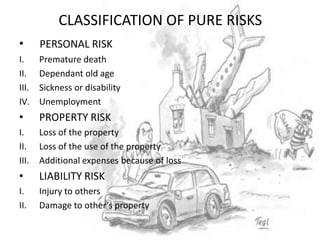
CLASSIFICATION OF PURE RISKSPERSONAL RISKPremature deathDependant old ageSickness or disabilityUnemploymentPROPERTY RISKLoss of the propertyLoss of the use of the propertyAdditional expenses because of lossLIABILITY RISKInjury to othersDamage to other’s property

Conceptual framework and risk management

  • 1.
    CONCEPTUAL FRAMEWORK ANDRISK MANAGEMENTPRESENATATION BY NITIN MEHTA
  • 2.
    CONCEPTUAL FRAMEWORKTHE CONCEPTOF RISK The term risk may be defined as the possibility of adverse results flowing from any occurrence. It can also represent the possibility of an outcome being different from expected. If it is known for certain that a loss will occur, there is no risk. At least one of the possible outcomes is undesirable.
  • 3.
    DEFINITION OF RISKInone definition, “Risks" are simply future issues that can be avoided or mitigated, rather than present problems that must be immediately addressed.A state of uncertainty where some of the possibilities involve a loss, catastrophe, or other undesirable outcome.
  • 4.
    SPREADING OF RISKSThereare various methods to achieve spreading of risk. An Insurer would normally seek to achieve spread of risks as under:By writing different classes of insurance business.By writing business in different geographical locations.By incorporating as a public limited company so to attain larger capital resources.By means of Re-insurance.By entering into risk pools for certain risks, particularly of difficult nature.
  • 5.
    CLASSIFICATION OF RISKFINANCIALAND NON-FINANCIAL RISKS There are some element of risk in every aspect of human life and many of these risks have no financial consequences. For Insurance, we are concerned with risks which involves financial loss.DYNAMIC AND STATIC RISKDynamic risks are those resulting from the changes in the economy. Changes in price level, consumer taste, income, technology are few examples. They are less predictable.Static risks involve those losses that occur even if there were no change in economy such as perils or dishonesty. They are generally predictable .
  • 6.
    FUNDAMENTAL AND PARTICULARRISKFundamental risks involve losses that are impersonal in origin and consequences. They are group risk effect large segments. War, inflation, earthquake, flood as examples.Particular risks involve losses that arise out of individual events and are felt by individual. They may be static or dynamic. The burning of house, robbery are particular risks.PURE AND SPECULATIVE RISKThe term pure risk is used to designate those situations that involve the chance of loss or no loss. Only pure risks are insurable. Speculative risks describes a situation where there is possibility of gain from a event. Wagering is a type of speculative risk.
  • 7.
    CLASSIFICATION OF PURERISKSPERSONAL RISKPremature deathDependant old ageSickness or disabilityUnemploymentPROPERTY RISKLoss of the propertyLoss of the use of the propertyAdditional expenses because of lossLIABILITY RISKInjury to othersDamage to other’s property