




WELCOME
!
A REVIEW OF RIDE-SHARING
PLATFORMS,
INTERFACE AND POTENTIALS
IN BANGLADESH
!
Presentation by-
A.B. M. Hasanul Kabir
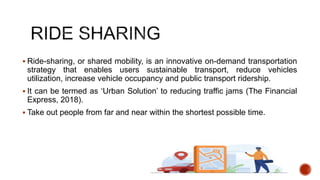
 Ride-sharing, or shared mobility, is an innovative on-demand transportation
strategy that enables users sustainable transport, reduce vehicles
utilization, increase vehicle occupancy and public transport ridership.
 It can be termed as ‘Urban Solution’ to reducing traffic jams (The Financial
Express, 2018).
 Take out people from far and near within the shortest possible time.
 The ride-sharing services have got a lion share acceptability in the
developed as well as developing countries especially, among young
generations.
 It reduce hassle of maintaining private transportation vehicles tremendously
and removes the tiresome.
 It is the most convenient and friendly mode of transportation it raises and
untapped opportunities to capture the potential market, increasing market
share.
 Creation of employment, reducing traffic jams which subsequently generate
a major source of revenues.
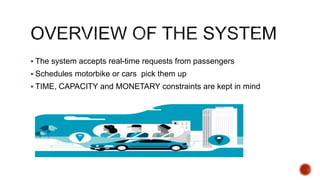
 The system accepts real-time requests from passengers
 Schedules motorbike or cars pick them up
 TIME, CAPACITY and MONETARY constraints are kept in mind
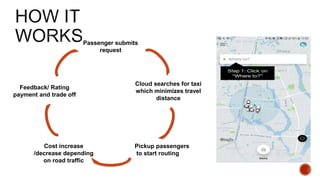
Feedback/ Rating
payment and trade off
Passenger submits
request
Cloud searches for taxi
which minimizes travel
distance
Pickup passengers
to start routing
Cost increase
/decrease depending
on road traffic
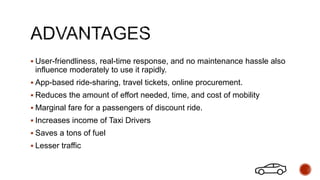
 User-friendliness, real-time response, and no maintenance hassle also
influence moderately to use it rapidly.
 App-based ride-sharing, travel tickets, online procurement.
 Reduces the amount of effort needed, time, and cost of mobility
 Marginal fare for a passengers of discount ride.
 Increases income of Taxi Drivers
 Saves a tons of fuel
 Lesser traffic
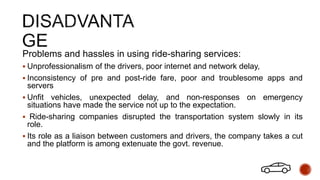
Problems and hassles in using ride-sharing services:
 Unprofessionalism of the drivers, poor internet and network delay,
 Inconsistency of pre and post-ride fare, poor and troublesome apps and
servers
 Unfit vehicles, unexpected delay, and non-responses on emergency
situations have made the service not up to the expectation.
 Ride-sharing companies disrupted the transportation system slowly in its
role.
 Its role as a liaison between customers and drivers, the company takes a cut
and the platform is among extenuate the govt. revenue.
 Vehicle capacity constraint.
 Riders that can sit in taxi.
 Total seats of vehicle at anytime.
 Rider does not pay more.
 Car driver does not earn more.
 Ride without apps use to earn more revenue.
 Fare of existing rider decreases every time a new rider joins the trip.
 This constraint says that a driver should charge for all distances they travelled.
Intuitively the driver should make money for the distance of reroutes incurred by
the join of any new passenger.
 In 2021, with the lifting of pandemic restrictions, Uber has had problems in getting
enough cars on the road to meet newly increased demand.
 It has offered sign-up incentives and significantly raised prices for rides.
 But it's also fiddled with compensation structures, so drivers tend not to share in
the bigger fares—while their earnings are up, it's due more to bonuses rather
than pocketing a percentage of the tab.
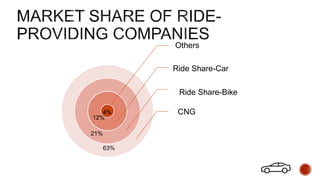
Others
Ride Share-Car
CNG
12%
Ride Share-Bike
63%
21%
4%
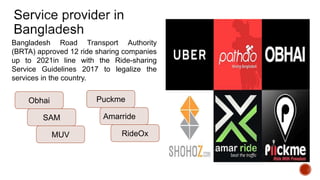
Obhai
SAM
RideOx
MUV
Amarride
Puckme
Bangladesh Road Transport Authority
(BRTA) approved 12 ride sharing companies
up to 2021in line with the Ride-sharing
Service Guidelines 2017 to legalize the
services in the country.
 Uber has served more than 4 million riders and created livelihood opportunities for
upwards of 175,000 driver-partners.
 A enlisted biker earns 500-1000 Taka at the end of the day after meeting all expenses
for the running of the bike.
 And a car earns 1000-2000 Taka at the end of the day after meeting all expenses for the
running of the car.
 Along with the Food delivering services (like uber eats, shohoz food) has added more
than a million of user in two big cities of Bangladesh.
 The requirements of different riders and passengers providing Regular, Premium, XL etc
service the companies met up the demands.
 Offering promo codes and discounts for new riders added more appreciation to all users
and non users.
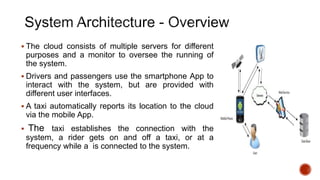
 The cloud consists of multiple servers for different
purposes and a monitor to oversee the running of
the system.
 Drivers and passengers use the smartphone App to
interact with the system, but are provided with
different user interfaces.
 A taxi automatically reports its location to the cloud
via the mobile App.
 The taxi establishes the connection with the
system, a rider gets on and off a taxi, or at a
frequency while a is connected to the system.
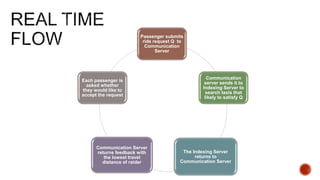
Passenger submits
ride request Q to
Communication
Server
Communication
server sends it to
Indexing Server to
search taxis that
likely to satisfy Q
The Indexing Server
returns to
Communication Server
returns feedback with
the lowest travel
distance of raider
Each passenger is
asked whether
they would like to
accept the request
 The average motor vehicle speed in Dhaka city is 5 to 6 km/hr in office hour.
 According to world bank traffic eats up 3.2 million work hours per day in Dhaka (The
World Bank, 2017).
 Only 4% of the private cars are actually used with an average of 50-60 rides per month
taking out time and depreciation money idly.
 Convenient and on-demand location is completely absent in the traditional
transportation system is replacing by ride sharing.
 Already ride-sharing providers faces complaints from various governments that it shirks
its tax liabilities onto its drivers and that the drivers are often non-compliant about
paying their taxes.
 More tax legislation could exacerbate the problem and will also mean either an
increase in ride fares or the end of the operations of particular ride-sharing providers.
 The ride-sharing services have distinct prospects and challenges from the
perspective of Bangladesh.
 Proper initiatives should be taken from the standpoint of executives as well as
the law-making body to overcome the
 Utilize the prospects and opportunities so that this service can be reached to
other cities successfully.
 Ride-sharing organization, the government can render crucial role-taking
appropriate initiatives.
 Providing subsidies to save infant industries, providing logistics and
infrastructural support.
 Proper way in getting license and route permission, offering loan on easy
terms.
 Government can reconsider the 5% levied tax, and offer tax rebates
 Service providers also required to strengthen the quality of apps and servers
 By extending and focusing the other cities within the shortest possible time.
 Awareness and reach the services to potential customers by suitable
promotion and advertisement.
 The Financial Express, 2018
 The World Bank. (2017). A Modern Dhaka is Key to Bangladesh’s Upper-Middle Income
Country Vision. Retrieved 30 August 2019, from https://www.worldbank.org/en/news/press-
release/2017/07/19/modern-dhaka-key-bangladesh-upper-middle-income-country-vision
 Amey, A., Attanucci, J. and Mishalani, R., (2011). Real-time ridesharing: opportunities and
challenges in using mobile phone technology to improve rideshare services. Transportation
Research Record, 2217(1), pp.103-110.
 Md. Nazmus Sakib, Md. Hasan Mia, (2019), The Ride-Sharing Services in Bangladesh:
Current Status, Prospects, and Challenges, European Journal of Business and
Management, Vol.11, No.31, 2019
Ride-sharing platforms.pptx

Ride-sharing platforms.pptx

  • 1.
  • 2.
    A REVIEW OFRIDE-SHARING PLATFORMS, INTERFACE AND POTENTIALS IN BANGLADESH ! Presentation by- A.B. M. Hasanul Kabir
  • 3.
     Ride-sharing, orshared mobility, is an innovative on-demand transportation strategy that enables users sustainable transport, reduce vehicles utilization, increase vehicle occupancy and public transport ridership.  It can be termed as ‘Urban Solution’ to reducing traffic jams (The Financial Express, 2018).  Take out people from far and near within the shortest possible time.
  • 4.
     The ride-sharingservices have got a lion share acceptability in the developed as well as developing countries especially, among young generations.  It reduce hassle of maintaining private transportation vehicles tremendously and removes the tiresome.  It is the most convenient and friendly mode of transportation it raises and untapped opportunities to capture the potential market, increasing market share.  Creation of employment, reducing traffic jams which subsequently generate a major source of revenues.
  • 5.
     The systemaccepts real-time requests from passengers  Schedules motorbike or cars pick them up  TIME, CAPACITY and MONETARY constraints are kept in mind
  • 6.
    Feedback/ Rating payment andtrade off Passenger submits request Cloud searches for taxi which minimizes travel distance Pickup passengers to start routing Cost increase /decrease depending on road traffic
  • 8.
     User-friendliness, real-timeresponse, and no maintenance hassle also influence moderately to use it rapidly.  App-based ride-sharing, travel tickets, online procurement.  Reduces the amount of effort needed, time, and cost of mobility  Marginal fare for a passengers of discount ride.  Increases income of Taxi Drivers  Saves a tons of fuel  Lesser traffic
  • 9.
    Problems and hasslesin using ride-sharing services:  Unprofessionalism of the drivers, poor internet and network delay,  Inconsistency of pre and post-ride fare, poor and troublesome apps and servers  Unfit vehicles, unexpected delay, and non-responses on emergency situations have made the service not up to the expectation.  Ride-sharing companies disrupted the transportation system slowly in its role.  Its role as a liaison between customers and drivers, the company takes a cut and the platform is among extenuate the govt. revenue.
  • 10.
     Vehicle capacityconstraint.  Riders that can sit in taxi.  Total seats of vehicle at anytime.  Rider does not pay more.  Car driver does not earn more.  Ride without apps use to earn more revenue.  Fare of existing rider decreases every time a new rider joins the trip.
  • 11.
     This constraintsays that a driver should charge for all distances they travelled. Intuitively the driver should make money for the distance of reroutes incurred by the join of any new passenger.  In 2021, with the lifting of pandemic restrictions, Uber has had problems in getting enough cars on the road to meet newly increased demand.  It has offered sign-up incentives and significantly raised prices for rides.  But it's also fiddled with compensation structures, so drivers tend not to share in the bigger fares—while their earnings are up, it's due more to bonuses rather than pocketing a percentage of the tab.
  • 12.
  • 13.
    Obhai SAM RideOx MUV Amarride Puckme Bangladesh Road TransportAuthority (BRTA) approved 12 ride sharing companies up to 2021in line with the Ride-sharing Service Guidelines 2017 to legalize the services in the country.
  • 14.
     Uber hasserved more than 4 million riders and created livelihood opportunities for upwards of 175,000 driver-partners.  A enlisted biker earns 500-1000 Taka at the end of the day after meeting all expenses for the running of the bike.  And a car earns 1000-2000 Taka at the end of the day after meeting all expenses for the running of the car.  Along with the Food delivering services (like uber eats, shohoz food) has added more than a million of user in two big cities of Bangladesh.  The requirements of different riders and passengers providing Regular, Premium, XL etc service the companies met up the demands.  Offering promo codes and discounts for new riders added more appreciation to all users and non users.
  • 16.
     The cloudconsists of multiple servers for different purposes and a monitor to oversee the running of the system.  Drivers and passengers use the smartphone App to interact with the system, but are provided with different user interfaces.  A taxi automatically reports its location to the cloud via the mobile App.  The taxi establishes the connection with the system, a rider gets on and off a taxi, or at a frequency while a is connected to the system.
  • 17.
    Passenger submits ride requestQ to Communication Server Communication server sends it to Indexing Server to search taxis that likely to satisfy Q The Indexing Server returns to Communication Server Communication Server returns feedback with the lowest travel distance of raider Each passenger is asked whether they would like to accept the request
  • 19.
     The averagemotor vehicle speed in Dhaka city is 5 to 6 km/hr in office hour.  According to world bank traffic eats up 3.2 million work hours per day in Dhaka (The World Bank, 2017).  Only 4% of the private cars are actually used with an average of 50-60 rides per month taking out time and depreciation money idly.  Convenient and on-demand location is completely absent in the traditional transportation system is replacing by ride sharing.  Already ride-sharing providers faces complaints from various governments that it shirks its tax liabilities onto its drivers and that the drivers are often non-compliant about paying their taxes.  More tax legislation could exacerbate the problem and will also mean either an increase in ride fares or the end of the operations of particular ride-sharing providers.
  • 21.
     The ride-sharingservices have distinct prospects and challenges from the perspective of Bangladesh.  Proper initiatives should be taken from the standpoint of executives as well as the law-making body to overcome the  Utilize the prospects and opportunities so that this service can be reached to other cities successfully.  Ride-sharing organization, the government can render crucial role-taking appropriate initiatives.  Providing subsidies to save infant industries, providing logistics and infrastructural support.
  • 22.
     Proper wayin getting license and route permission, offering loan on easy terms.  Government can reconsider the 5% levied tax, and offer tax rebates  Service providers also required to strengthen the quality of apps and servers  By extending and focusing the other cities within the shortest possible time.  Awareness and reach the services to potential customers by suitable promotion and advertisement.
  • 23.
     The FinancialExpress, 2018  The World Bank. (2017). A Modern Dhaka is Key to Bangladesh’s Upper-Middle Income Country Vision. Retrieved 30 August 2019, from https://www.worldbank.org/en/news/press- release/2017/07/19/modern-dhaka-key-bangladesh-upper-middle-income-country-vision  Amey, A., Attanucci, J. and Mishalani, R., (2011). Real-time ridesharing: opportunities and challenges in using mobile phone technology to improve rideshare services. Transportation Research Record, 2217(1), pp.103-110.  Md. Nazmus Sakib, Md. Hasan Mia, (2019), The Ride-Sharing Services in Bangladesh: Current Status, Prospects, and Challenges, European Journal of Business and Management, Vol.11, No.31, 2019