The Cost of Environmental Alarmism Iain Murray Bull & Bear Club Richmond, VA August 12 th  2008
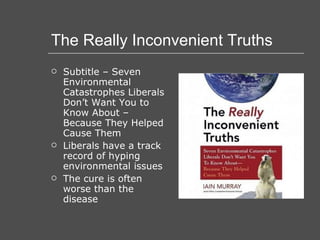
The Really Inconvenient Truths Subtitle – Seven Environmental Catastrophes Liberals Don’t Want You to Know About – Because They Helped Cause Them Liberals have a track record of hyping environmental issues The cure is often worse than the disease
The Alarmist Paradigm Identify a cause and the laws you want enacted Create a doomsday scenario Claim a threat to children Don the mantle of science Create a clamor to drown out rational debate Defend the enacted laws ruthlessly Keep quiet about inconvenient truths
Identify a Cause DDT – thins bird eggs Oil – a source of carbon emissions Contraception – fewer humans = good Natural Burn – natural fire is good Clean rivers – polluted by capitalism Endangered species – the cuter the better Central planning – what’s a sea between friends?
The Problems DDT – nightmare for Elm Street and millions of dead Africans Ethanol – starvation and deforestation Contraception – intersex fish Natural burn – Yellowstone in flames Rivers – Cuyahoga fire caused by government, not capitalism Endangered Species – Shoot, shovel and shut up Central planning – Aral Sea, Iraqi Marshes, Lake Chad, Darfur
The Solutions DDT should be used appropriately (wildlife property rights) Let the market decide the fuel mix based on “no regrets” principles Real water property rights Private stewardship & use of forests Privatize commons Wildlife property rights Recognize the superiority of the market in resource provision and allocation
Benefits of Affordable Energy “ Energy is an indispensable ingredient of material prosperity. . . . Where and when energy is in short supply or too expensive, people suffer from lack of direct energy services (such as cooking, heating, lighting, and transport) and from inflation, unemployment, and reduced economic output.” - John Holdren
So What Do We Do About Global Warming? Recognize that global warming is neither a hoax nor a crisis, but a risk to be managed Manage that risk by a three-pronged strategy No Regrets Mitigation Focused Adaptation Resiliency
No Regrets Mitigation Prime Example: Air Traffic Reform Utilizing satellite-based technology could save 146 million barrels of oil annually Saves the economy $20 billion Reduces GHG emissions by 53 million tonnes
Focused Adaptation Main risks of global warming: hunger, disease, sea level rise, water stress, biodiversity Halting global warming is an expensive way of tackling these problems Goklany (2008): halting global warming reduce hunger, disease and sea level rise by 4-10 percent by 2085, but increase water stress and biodiversity problems at a cost of much more than $165 billion annually for many years Focused adaptation could reduce each of these problems by 50-75% by 2015 at a cost of less than $34 billion annually, and also provide benefits in terms of child mortality, literacy etc.
Resiliency Wealthier societies manage disasters better 1955: Hurricane Janet, category 5, hits Mexico – 600 people killed 2007: Hurricane Dean, category 5, hits Mexico in exact same place – no-one killed 2005: Hurricane Katrina, category 5, hits most vulnerable place in America and kills 1,836 2008: Cyclone Nargis, category 4, hits Burma and kills at least 84,500
A Final Thought “ In short, if we can rise to the challenge, the permanent abolition of the wheel would have the marvelously synergistic effect of creating thousands of new jobs - as blacksmiths, farriers, grooms and so on - at the same time as it conserved energy and saved the planet from otherwise inevitable devastation.” -- Catherine Bennett, The Guardian, 2004
For more information The Really Inconvenient Truths on Amazon The PIG to Global Warming on Amazon http://www.globalwarming.org http://cei.org http://planetgore.nationalreview.com
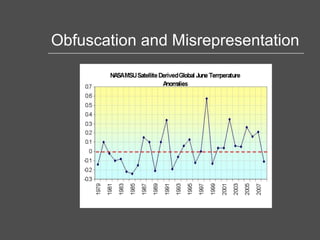
Obfuscation and Misrepresentation
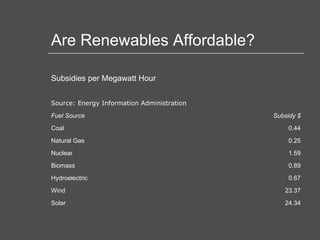
Are Renewables Affordable? 24.34 Solar 23.37 Wind 0.67 Hydroelectric 0.89 Biomass 1.59 Nuclear 0.25 Natural Gas 0.44 Coal Subsidy $ Fuel Source Source: Energy Information Administration Subsidies per Megawatt Hour
Cost to Replace Coal, Gas and Nuclear with Wind and Solar In 2007, the US generated 4000 billion kilowatthours of electricity 3659 bn kwh from coal, natural gas and nuclear ($3.6 billion in subsidies there) Subsidies needed to replace that with wind and solar: $88 BILLION Yet solar and wind  still  more expensive
Emissions Reduction Replacing high-emissions fuel sources with low-emissions fuel sources is expensive High prices mean less energy used Gas demand fallen 3% thanks to $4 gas Burden falls mostly on the poor
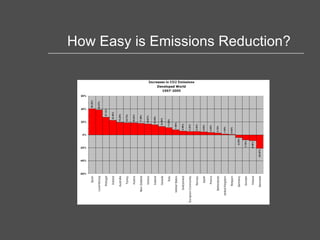
How Easy is Emissions Reduction?
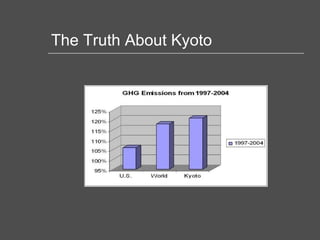
The Truth About Kyoto
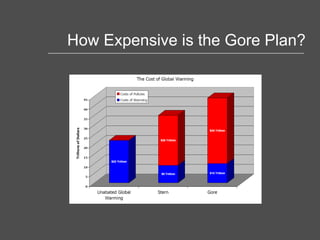
How Expensive is the Gore Plan?

Richmondmtg.Aug2008

  • 1.
    The Cost ofEnvironmental Alarmism Iain Murray Bull & Bear Club Richmond, VA August 12 th 2008
  • 2.
    The Really InconvenientTruths Subtitle – Seven Environmental Catastrophes Liberals Don’t Want You to Know About – Because They Helped Cause Them Liberals have a track record of hyping environmental issues The cure is often worse than the disease
  • 3.
    The Alarmist ParadigmIdentify a cause and the laws you want enacted Create a doomsday scenario Claim a threat to children Don the mantle of science Create a clamor to drown out rational debate Defend the enacted laws ruthlessly Keep quiet about inconvenient truths
  • 4.
    Identify a CauseDDT – thins bird eggs Oil – a source of carbon emissions Contraception – fewer humans = good Natural Burn – natural fire is good Clean rivers – polluted by capitalism Endangered species – the cuter the better Central planning – what’s a sea between friends?
  • 5.
    The Problems DDT– nightmare for Elm Street and millions of dead Africans Ethanol – starvation and deforestation Contraception – intersex fish Natural burn – Yellowstone in flames Rivers – Cuyahoga fire caused by government, not capitalism Endangered Species – Shoot, shovel and shut up Central planning – Aral Sea, Iraqi Marshes, Lake Chad, Darfur
  • 6.
    The Solutions DDTshould be used appropriately (wildlife property rights) Let the market decide the fuel mix based on “no regrets” principles Real water property rights Private stewardship & use of forests Privatize commons Wildlife property rights Recognize the superiority of the market in resource provision and allocation
  • 7.
    Benefits of AffordableEnergy “ Energy is an indispensable ingredient of material prosperity. . . . Where and when energy is in short supply or too expensive, people suffer from lack of direct energy services (such as cooking, heating, lighting, and transport) and from inflation, unemployment, and reduced economic output.” - John Holdren
  • 8.
    So What DoWe Do About Global Warming? Recognize that global warming is neither a hoax nor a crisis, but a risk to be managed Manage that risk by a three-pronged strategy No Regrets Mitigation Focused Adaptation Resiliency
  • 9.
    No Regrets MitigationPrime Example: Air Traffic Reform Utilizing satellite-based technology could save 146 million barrels of oil annually Saves the economy $20 billion Reduces GHG emissions by 53 million tonnes
  • 10.
    Focused Adaptation Mainrisks of global warming: hunger, disease, sea level rise, water stress, biodiversity Halting global warming is an expensive way of tackling these problems Goklany (2008): halting global warming reduce hunger, disease and sea level rise by 4-10 percent by 2085, but increase water stress and biodiversity problems at a cost of much more than $165 billion annually for many years Focused adaptation could reduce each of these problems by 50-75% by 2015 at a cost of less than $34 billion annually, and also provide benefits in terms of child mortality, literacy etc.
  • 11.
    Resiliency Wealthier societiesmanage disasters better 1955: Hurricane Janet, category 5, hits Mexico – 600 people killed 2007: Hurricane Dean, category 5, hits Mexico in exact same place – no-one killed 2005: Hurricane Katrina, category 5, hits most vulnerable place in America and kills 1,836 2008: Cyclone Nargis, category 4, hits Burma and kills at least 84,500
  • 12.
    A Final Thought“ In short, if we can rise to the challenge, the permanent abolition of the wheel would have the marvelously synergistic effect of creating thousands of new jobs - as blacksmiths, farriers, grooms and so on - at the same time as it conserved energy and saved the planet from otherwise inevitable devastation.” -- Catherine Bennett, The Guardian, 2004
  • 13.
    For more informationThe Really Inconvenient Truths on Amazon The PIG to Global Warming on Amazon http://www.globalwarming.org http://cei.org http://planetgore.nationalreview.com
  • 14.
  • 15.
    Are Renewables Affordable?24.34 Solar 23.37 Wind 0.67 Hydroelectric 0.89 Biomass 1.59 Nuclear 0.25 Natural Gas 0.44 Coal Subsidy $ Fuel Source Source: Energy Information Administration Subsidies per Megawatt Hour
  • 16.
    Cost to ReplaceCoal, Gas and Nuclear with Wind and Solar In 2007, the US generated 4000 billion kilowatthours of electricity 3659 bn kwh from coal, natural gas and nuclear ($3.6 billion in subsidies there) Subsidies needed to replace that with wind and solar: $88 BILLION Yet solar and wind still more expensive
  • 17.
    Emissions Reduction Replacinghigh-emissions fuel sources with low-emissions fuel sources is expensive High prices mean less energy used Gas demand fallen 3% thanks to $4 gas Burden falls mostly on the poor
  • 18.
    How Easy isEmissions Reduction?
  • 19.
  • 20.
    How Expensive isthe Gore Plan?