INTRODUCTION 
• Background 
• Hydrogen vs. Water 
• Project Objective 
• Program Plan Status 
• Conclusions To Date
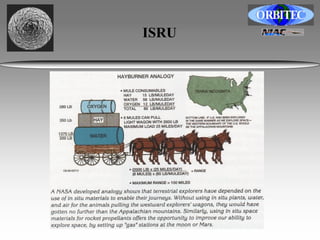
ISRU
BACKGROUND 
• "ISRU" -- Insitu Space Resource Utilization 
• The Utilization of Lunar Water Ice Near the Lunar Poles (cold traps) Is Expected to Have a 
Dramatic Effect on the Affordability of Future Lunar and Mars Exploration and Colonization 
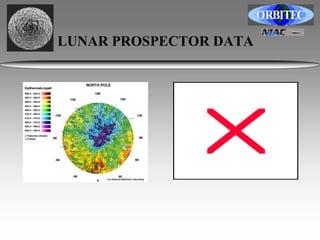
• The Latest Lunar Prospector Data Indicates up to 260 Million Tons of Water Ice is Present 
• The Use of Water Includes: Hydrogen and Oxygen Propellants for: Space Transport Systems, 
Life Support, Food Production, Chemical Energy Storage, Rover Fuels/Oxidizers, Concrete 
Production for Infrastructure, etc. 
• The Discovery and Use of Water Ice on the Moon is a Tremendously Important Event for Man's 
Exploration and Colonization of the Solar System 
• In This Effort, We Are Developing a Detailed Program Plan that NASA May Choose to Use to 
“Discover, Extract and Use” Lunar Water or Lunar Hydrogen and Oxygen
LUNAR PROSPECTOR DATA
WATER VS. HYDROGEN 
• Lunar Prospector’s Neutron Spectrometer (NS) is Designed to Detect the Presence of Hydrogen, which Is 
Believed by Many to Indicate the Presence of Water Ice 
• Current Data Indicate up to 260 Million Metric Tons of Water Ice Have Been Predicted by the Science 
Team, (July 1999) 
• Estimates Indicate 200 Million MT at the South Pole and 60 Million MT at the North Pole 
• Ice Likely in Deposites of Pure Water Ice Burried Beneath ~5 cm of Dry Regolith in ~1.5% Concentrations 
• Concentrations Appear Higher at the North Pole 
• Kulcinski, Schmidt and Others Have Suggested That the Neutron Spectrometer Data Are Due to Increased 
Hydrogen Concentration in the Regolith, Not Water 
• Binder Now Thinks That Perhaps Both Water and Hydrogen May Be Contributing to the NS Signal 
• Regardless, Still Gives Strong Motivation for Exploration and Extraction Missions 
• We Now Are Integrating the "Hydrogen Possibility" into the Study
PROJECT OBJECTIVE 
• The Project Objective Is the Development of An Overall System Architecture for the 
Discovery, Extraction, and Utilization of Ice Found Near the North and South Poles 
of the Moon 
• The Major Result of this Effort Will Be a Comprehensive Program Plan for the 
Acquisition and Use of Lunar Water Ice or Hydrogen and Oxygen
PROGRAM PLAN STATUS 
• Program Road Map 
• Work Breakdown Structure (WBS) 
• Milestone Schedule 
• Funding and Personnel Resources 
• WBS Details
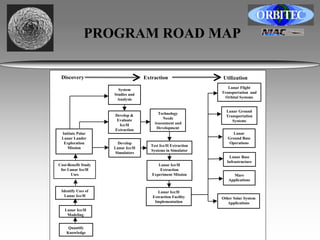
PROGRAM ROAD MAP 
Discovery Extraction Utilization 
Initiate Polar 
Lunar Lander 
Exploration 
Mission 
Cost-Benefit Study 
for Lunar Ice/H 
Uses 
Identify Uses of 
Lunar Ice/H 
Develop & 
Evaluate 
Ice/H 
Extraction 
Develop 
Lunar Ice/H 
Simulators 
Technology 
Needs 
Assessment and 
Development 
Test Ice/H Extraction 
Systems in Simulator 
System 
Studies and 
Analysis 
Lunar Ice/H 
Extraction Facility 
Implementation 
Lunar Flight 
Transportation and 
Orbital Systems 
Lunar Ground 
Transportation 
Systems 
Lunar 
Ground Base 
Operations 
Lunar Base 
Infrastructure 
Mars 
Applications 
Lunar Ice/H 
Extraction 
Experiment Mission 
Lunar Ice/H 
Modeling 
Quantify 
Knowledge 
Other Solar System 
Applications
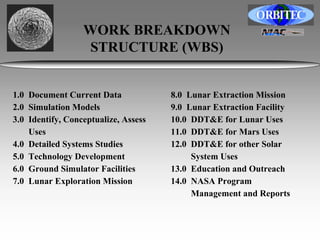
WORK BREAKDOWN 
STRUCTURE (WBS) 
1.0 Document Current Data 
2.0 Simulation Models 
3.0 Identify, Conceptualize, Assess 
Uses 
4.0 Detailed Systems Studies 
5.0 Technology Development 
6.0 Ground Simulator Facilities 
7.0 Lunar Exploration Mission 
8.0 Lunar Extraction Mission 
9.0 Lunar Extraction Facility 
10.0 DDT&E for Lunar Uses 
11.0 DDT&E for Mars Uses 
12.0 DDT&E for other Solar 
System Uses 
13.0 Education and Outreach 
14.0 NASA Program 
Management and Reports
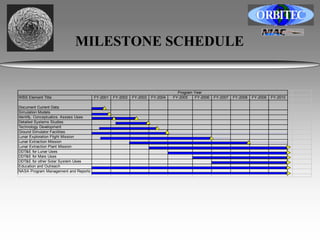
MILESTONE SCHEDULE 
Program Year 
WBS Element Title FY-2001 FY-2002 FY-2003 FY-2004 FY-2005 FY-2006 FY-2007 FY-2008 FY-2009 FY-2010 
Document Current Data 
Simulation Models 
Identify, Conceptualize, Assess Uses 
Detailed Systems Studies 
Technology Development 
Ground Simulator Facilities 
Lunar Exploration Flight Mission 
Lunar Extraction Mission 
Lunar Extraction Plant Mission 
DDT&E for Lunar Uses 
DDT&E for Mars Uses 
DDT&E for other Solar System Uses 
Education and Outreach 
NASA Program Management and Reports
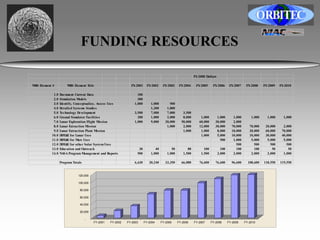
FUNDING RESOURCES 
FY-2000 Dollars 
WBS Element # WBS Element Title FY-2001 FY-2002 FY-2003 FY-2004 FY-2005 FY-2006 FY-2007 FY-2008 FY-2009 FY-2010 
1.0 Document Current Data 100 
2.0 Simulation Models 300 
3.0 Identify, Conceptualize, Assess Uses 1,000 1,000 500 
4.0 Detailed Systems Studies 1,200 1,800 
5.0 Technology Development 3,500 7,000 7,000 3,500 
6.0 Ground Simulator Facilities 200 1,000 2,000 8,000 1,000 1,000 1,000 1,000 1,000 1,000 
7.0 Lunar Exploration Flight Mission 1,000 9,000 20,000 50,000 60,000 30,000 2,000 
8.0 Lunar Extraction Mission 1,000 2,000 12,000 30,000 70,000 70,000 20,000 2,000 
9.0 Lunar Extraction Plant Mission 1,000 1,000 8,000 10,000 20,000 60,000 70,000 
10.0 DDT&E for Lunar Uses 1,000 5,000 10,000 10,000 30,000 40,000 
11.0 DDT&E for Mars Uses 500 1,000 5,000 5,000 5,000 
12.0 DDT&E for other Solar System Uses 500 500 500 500 
13.0 Education and Outreach 30 40 50 80 100 100 100 100 50 50 
14.0 NASA Program Management and Reports 500 1,000 1,000 1,500 1,500 2,000 2,000 2,000 2,000 1,000 
Program Totals 6,630 20,240 33,350 66,080 76,600 76,600 96,600 108,600 118,550 119,550 
120,000 
100,000 
80,000 
60,000 
40,000 
20,000 
- 
FY-2001 FY-2002 FY-2003 FY-2004 FY-2005 FY-2006 FY-2007 FY-2008 FY-2009 FY-2010
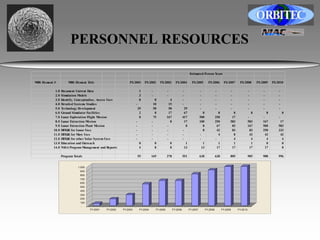
PERSONNEL RESOURCES 
Estimated Person Years 
WBS Element # WBS Element Title FY-2001 FY-2002 FY-2003 FY-2004 FY-2005 FY-2006 FY-2007 FY-2008 FY-2009 FY-2010 
1.0 Document Current Data 1 - - - - - - - - - 
2.0 Simulation Models 3 - - - - - - - - - 
3.0 Identify, Conceptualize, Assess Uses 8 8 4 - - - - - - - 
4.0 Detailed Systems Studies - 10 15 - - - - - - - 
5.0 Technology Development 29 58 58 29 - - - - - - 
6.0 Ground Simulator Facilities 2 8 17 67 8 8 8 8 8 8 
7.0 Lunar Exploration Flight Mission 8 75 167 417 500 250 17 - - - 
8.0 Lunar Extraction Mission - - 8 17 100 250 583 583 167 17 
9.0 Lunar Extraction Plant Mission - - - 8 8 67 83 167 500 583 
10.0 DDT&E for Lunar Uses - - - - 8 42 83 83 250 333 
11.0 DDT&E for Mars Uses - - - - - 4 8 42 42 42 
12.0 DDT&E for other Solar System Uses - - - - - - 4 4 4 4 
13.0 Education and Outreach 0 0 0 1 1 1 1 1 0 0 
14.0 NASA Program Management and Reports 4 8 8 13 13 17 17 17 17 8 
Program Totals 55 169 278 551 638 638 805 905 988 996 
1,000 
900 
800 
700 
600 
500 
400 
300 
200 
100 
- 
FY-2001 FY-2002 FY-2003 FY-2004 FY-2005 FY-2006 FY-2007 FY-2008 FY-2009 FY-2010
WBS DETAILS
1.0 DOCUMENT CURRENT 
DATA 
• Summarize, Quantify, and Document All the Scientific Data Currently 
Available from: 
-Apollo 
-Hubble 
-Clementine 
-Lunar Prospector 
-Earth-based Telescopes 
-Other Sources 
• Interview Leading Scientists in the Know
2.0 SIMULATION MODELS 
• Develop Simulation Models of the Possible Physical/Chemical 
Processes and Their Contributions That May Have Resulted in Polar 
Lunar H2O and Polar Lunar H 
-Solar Wind Impact on the Moon's Surface 
-Micro-Meteor and Meteor Impacts on the Surface 
-Comet Impacts
3.0 IDENTIFY, CONCEPTUALIZE, 
ASSESS USES OF LUNAR POLAR H2O 
ICE OR LUNAR POLAR H 
• Propellant Sources for Propulsion/Power Applications 
• Lunar Base Support Applications 
• Quantify and Prioritize Needs 
• Develop Concept Definitions for System/Subsystems 
• Determine Total System Infrastructure Needs 
• Create Mission Models for Cost-Benefit Analysis 
• Develop a Cost-Benefit Model and Conduct Detailed 
Analysis
PROPELLANT SOURCES FOR 
PROPULSION/POWER APPLICATIONS 
(Solid, Liquid,or Gas H2, O2, and H2O2 
Propellant Combinations) (3.1) 
• Lunar Flight Transportation and Orbital Support Systems 
-Lunar Surface to Lunar Surface Transport Systems 
-Lunar Surface to Lunar Orbit Transport Systems 
-Lunar Orbit to Earth Orbit Transport Systems 
-Lunar Orbit to Earth Reentry Transport Systems 
-Lunar Surface to Earth Orbit Support Systems (SPS, ISS, etc.) 
-Lunar Surface to Earth Reentry Transport Systems (exporting 
lunar resources) 
-Lunar Orbit Communications and Remote Sensing Satellite Systems 
-Lunar Orbiting Service Station (LOSS) System 
-Earth Orbiting Service Station (EOSS) System 
• Mars Flight Transportation Systems and Propellant Production 
-LH2/LO2 Propellants for Main and Auxiliary Chemical Propulsion 
-SOX/LH2 Propellants for Main and Auxiliary Chemical Propulsion 
-CH4/LO2 Propellants for Main and Auxiliary Chemical Propulsion 
-O2 for Solar Electric Propulsion for Mars 
-H2O for Nuclear Steam Rocket 
-LH2 for Nuclear or Solar Thermal Rocket 
-SH2 HEDM in LHe for Chemical Propulsion 
• Lunar or Mars Ground-based Fuel Cell or 
Combustion-Driven GroundTransport Vehicles 
-Exploration-based Robotic and Manned Rovers 
-Personnel Transporters 
-ISRU Material Transporters 
-Equipment Transporters 
-Regolith Bulldozers 
-Mining Equipment 
-Winged Aircraft Powered Balloons 
• Other Solar System Transport Systems 
-LH2/LO2 Propellants for Main and 
Auxiliary Chemical Propulsion 
-O2 for Solar Electric Propulsion 
-H2O for Nuclear Steam Rocket 
-LH2 for Nuclear or Solar Thermal Rocket 
• Non-Propulsion Mars Applications Using Lunar Ice or 
-H2O or H2 and O2 for Mars Crew Life Support Systems 
-H2O or H2 for Mars Crew Food Production Systems 
-H2O or H2 for Mars Crew Radiation Protection System 
-H2O or H2 for Mars Outpost Power Systems 
-Auxiliary or Emergency Power Systems 
-H2O for Mars Concrete Production
LUNAR BASE SUPPORT 
APPLICATIONS (3.2) 
• Crew Life Support Systems 
-Drinking Water 
-Atmospheric Oxygen 
-Atmospheric Humidity 
-Washing/Bathing 
-Waste Processing 
-Space Suit Life Support (H2O, O2, etc.) 
• Food Production Systems 
-Plant Growth 
-Food Processing 
-Plant Reprocessing and Resource 
Recovery 
-Animal-Based Food Production 
• Lunar Laboratory Research 
-Plant Research 
-Animal Research 
-Chemistry 
-Physics 
-Biology/Biotechnology 
-Mineralogy/Geology 
-ISRU Chemical Processing Research 
• Lunar Base Infrastructure Needs 
-Lunar Oxygen Production with H Recovery 
-Lunar Concrete Production for Roads, Buildings, 
Shielding 
-Thermal Control Support Systems 
-Oxygen or Hydrogen as Inflating Gas for Inflatable 
Structures 
-Water Radiation Shielding for Habitats/Laboratories 
-Water for Lunar Base Manufacturing Needs
4.0 DETAILED SYSTEMS 
STUDIES 
• Additional Characterization and Development of Models of the Lunar Ice/H 
• Study Cost-Benefit of Additional Lunar Orbiting Missions to Map Polar Regions 
• Study Cost-Efficient Space Transportation Systems 
• Study Cost-Efficient Approaches to Conducting Rover-based Exploration 
• Study Promising Extraction Techniques/Logistics Approaches 
• Conduct Ground-Based and Lunar In-situ Laboratory Experiments/Scientific Research 
• Define Requirements: 
-Simulator Designs 
-In-situ Flight Missions and Sample Returns 
-Lunar Production Facilities 
• Nuclear Thermal Device Application Assessment 
• Resource Use and Conservation Plan 
• Legal/Political/Treaty Issue Assessment 
• Commercial Development and Commercial/Government Partnership Potential Assessments 
• Lunar Environmental Impact Assessment 
• Cost Modeling and Analysis
5.0 TECHNOLOGY 
DEVELOPMENT 
• 70 K-Cold Operations of Mechanical, Electrical and Fluid Systems 
• Application of DOE’s ARPS, GPHS Brick, and other Systems for this Application 
• Small Nuclear Reactors 
• Microwave Energy Systems and ovens for In-situ Processing 
• Tether Systems for Ground-based Automated Experimental and Large Automated Water Ice 
Acquisition and Processing Systems 
• Technology for Materials Handling and Processing for Ground-based Automated Experimental 
and Large Automated Water Ice Acquisition and Processing Systems 
• Electrolysis Systems and Fuel Cells in Zero and Partial g’s 
• Water Rocket Technolgies for Orbit Transfer and Orbital Auxiliary Propulsion 
• Distillation/Purification of Water from the Regolith in 1/6 g 
• Solar Energy Beaming into the Cold Region
5.0 TECHNOLOGY 
DEVELOPMENT (CONT.) 
• Microwave Energy Beaming into the Cold Region 
• Water Storage and Transport/Transfer Systems 
• Water Recovery Systems Near Lunar Launch Sites 
• Water Recovery Systems for All Water Use Applications 
• Lunar Sample Return Mission Technology Using Processed Water Ice for 
Propellants 
• Superconducting Energy and Data Transmission 
• Cryogenic Hardening of Electronic and Mechanical Systems 
• Excavation Technology 
• Ballistic and Ground-based Transporters 
• Assess H2O2 Propulsion Systems for Lunar Transport Applications 
• Hydrogen Peroxide Production in 1/6 g
6.0 GROUND SIMULATOR 
FACILITIES 
Phase 1 - Small-Scale Demonstration Lunar Ice Simulator 
-Detailed Requirements Development 
-Experiment Definition Development 
-Detailed Subsystem Design and Analysis 
-Facility Construction 
-Research Program 
Phase 2 - Medium-Scale Demonstration Lunar Ice Simulator 
-Detailed Requirements Development 
-Experiment Definition Development 
-Detailed Subsystem Design and Analysis 
-Facility Construction 
-Research Program 
Phase 3 - Full-Scale Lunar Ice Flight System Simulator 
-Detailed Requirements Development 
-Flight Testing Definition Development 
-Detailed Subsystem Design and Analysis 
-Facility Construction/Modification at JSC 
-Testing Program
7.0 LUNAR EXPLORATION 
FLIGHT MISSION WITH 
SAMPLE RETURN 
• System Requirements and Experiment/Measurement Definition 
• Engineering and Analysis 
• Component Development and Testing 
• Detailed Design 
• Hardware Development and Checkout 
• In-Simulator Cold Operations Testing and Performance Evaluation 
• Flight System LV Integration 
• Mission Flight/Sample Return 
• Mission Operations and Data Analysis
8.0 LUNAR ICE/H 
EXTRACTION MISSION 
• System Requirements and Production Definition 
• Engineering and Analysis 
• Component Development and Testing 
• Detailed Design 
• Hardware Development and Checkout 
• In-Simulator Cold Operations Testing and Performance Evaluation 
• Flight System LV Integration 
• Mission Flight 
• Mission Operations and Data Analysis
9.0 LUNAR ICE/H 
EXTRACTION FACILITY 
• System Requirements and Production Definition 
• Engineering and Analysis 
• Component Development and Testing 
• Detailed Design 
• Hardware Development and Checkout 
• In-Simulator Cold Operations Testing and Performance Evaluation 
• Flight System LV Integration 
• Mission Flight 
• Mission Operations and Data Analysis
10.0 DDT&E FOR LUNAR 
USES 
• Lunar Flight Transportation and Orbital Support Systems 
-H/O Lunar Surface to Lunar Surface Transport Systems 
-H/O Lunar Surface to Lunar Orbit Transport Systems 
-H/O Lunar Orbit to Earth Orbit Transport Systems 
-H2O2 Propellants for Main and Auxiliary Chemical Propulsion 
-H/O Lunar Orbit to Earth Reentry Transport Systems 
-H/O Lunar Surface to Earth Orbit Support Systems (SPS, ISS, 
etc.) 
-H/O Lunar Surface to Earth Reentry Transport Systems 
(exporting lunar resources) 
-Lunar Orbit Communications and Remote Sensing Satellite 
Systems 
-Lunar Orbiting Service Station (LOSS) System 
-Earth Orbiting Service Station (EOSS) System 
• Lunar Ground-based Fuel Cell or Combustion-Driven 
Ground Transport Vehicles 
-Exploration-based (scientific and commercial) Robotic and 
Manned Rovers 
-Personnel Transporters 
-ISRU Material Transporters 
-Equipment Transporters 
-Regolith Bulldozers 
-Mining Equipment 
• Other Lunar Base Applications Using Lunar Ice or H 
-H2O or H2 and O2 for Lunar Crew Life Support Systems 
-H2O or H2 for Lunar Crew Food Production Systems 
-H2O or H2 for Lunar Crew Radiation Protection System 
-H2O or H2 for Lunar Outpost Power Systems 
-Auxiliary or Emergency Power Systems 
-H2O for Lunar Concrete Production for Roads, Buildings, Shielding 
-Auxiliary or Emergency Power Systems 
-Lunar Oxygen Production with H Recovery 
-Thermal Control Support Systems 
-Oxygen or Hydrogen as Inflating Gas for Inflatable Structures 
-Water for Lunar Base Manufacturing Needs 
-Lunar Laboratory Research (plant and animal, chemistry, physics, 
biology/biotechnology mineralogy/geology, 
ISRU chemical processing, etc.) 
-Electromagnetic Launcher Systems 
-Laser Propulsion Launcher Systems
11.0 DDT&E FOR MARS 
USES 
• Mars Flight Transportation Systems and Propellant 
Production 
-LH2/LO2 Propellants for Main and Auxiliary 
Chemical Propulsion 
-SOX/LH2 Propellants for Main and Auxiliary 
Chemical Propulsion 
-CH4/LO2 Propellants for Main and Auxiliary 
Chemical Propulsion 
-H2O2 Propellants for Main and Auxilliary 
Chemical Propulsion 
-O2 for Solar Electric Propulsion for Mars 
-H2O for Nuclear Steam Rocket 
-LH2 for Nuclear or Solar Thermal Rocket 
-SH2 HEDM in LHe for Chemical Propulsion 
• Mars Ground-based Fuel Cell or Combustion-Driven 
Ground Transport Vehicles 
-Exploration-based Robotic and Manned Rovers 
-Personnel Transporters 
-ISRU Material Transporters 
-Equipment Transporters 
-Regolith Bulldozers 
-Mining Equipment 
• Non-Propulsion Mars Applications Using Lunar Ice or H 
-H2O or H2 and O2 for Mars Crew Life Support Systems 
-H2O or H2 for Mars Crew Food Production Systems 
-H2O or H2 and O2 for Mars Mars Laboratory Research 
-H2O or H2 and O2 for Mars Base Infrastructure Needs 
-H2O or H2 for Mars Crew Radiation Protection System 
Outpost Power Systems 
-Auxiliary or Emergency Power Systems 
-H2O for Mars Concrete Production
12.0 DDT&E FOR OTHER 
SOLAR SYSTEM USES 
• LH2/LO2 Propellants for Main and Auxiliary Chemical 
Propulsion 
• O2 for Solar Electric Propulsion 
• H2O for Nuclear Steam Rocket 
• LH2 for Nuclear or Solar Thermal Rocket Propulsion
13.0 EDUCATION AND 
OUTREACH 
• Curriculum and Educational Materials -- create materials to be distributed in two forms, classroom materials and materials for individual 
use 
• Engineering and Experiment Design Lessons -- create materials on the design and function of the experiment itself, including its 
construction, the placement and function of all the instrument’s sensors and how this package will accomplish the experiment goals 
• Chemistry Lessons -- create materials on the chemistry of the Lunar environment and the chemical processes used to create the rocket 
propellants 
• Physics and Rocketry -- create materials on the general concepts of rocketry as they relate to the Lunar Ice Missions 
• Conventions -- distribute information regarding the program at all regional and National Science Teachers Association (NSTA) 
conventions as well as some major state conventions 
• Technical Conferences -- distribute information regarding the program at national conferences, including AIAA, ASME, SAE, etc 
• Publications -- papers written by the Program Public Affairs Officer will be distributed for publication in national Internet, education, and 
space publications 
• NASA Educators -- informational materials will be distributed through NASA Educators 
• USRA -- work closely with USRA to distribute information to the universities 
• Space Grant Consortia and Universities -- will work with space grant consortia and universities to foster direct involvement by school in 
each state 
• Direct Mailing -- in conjunction with NSTA will conduct a direct mailing to reach physics, chemistry, and physical science teachers who 
will benefit from the program 
• Partnerships -- develop primary public partnerships: AIAA, Planetary Society, National Space Society, Mars Society, NASA’s-state based 
Space Grant Consortia, NASA Educators, etc
14.0 NASA PROGRAM 
MANAGEMENT AND REPORTS 
• Program Management and Coordination 
• Budget Control 
• Liaison 
• Public affairs 
• Reports/Publications/Brochures
CONCLUSIONS 
âť– Element Hydrogen (from H2O or H2) is Available on the Moon in Useful Abundance 
âť– Lunar Base Development will be Heavilly Dependent on This Resource, as a Water-based Economy/System 
Will Develop 
âť– If Hydrogen is the Form, Then Oxygen Processing from the Regolith Will Be Necessary -- Technology for This 
Is Readily Available (H, C, reduction processes) 
âť– Early Mars Manned Exploration and Developments Could Well Be Enhanced by Using Lunar Water/H 
âť– Chemical or Nuclear-based Earth-Mars Transports May Be Economically Enhanced for Some Time 
âť– Later Mars Surface Activities Would Likely Use Mars-based Resources H2O and CO2 
âť– The Draft Program Plan for the First Ten Years Appears to be Doable Within the Expected NASA Budget 
âť– International Cooperation Could Reduce the US Contribution; Commercial Interests Could Also Contribute 
and Reduce the Government's Funding

Rice moon nov99

  • 1.
    INTRODUCTION • Background • Hydrogen vs. Water • Project Objective • Program Plan Status • Conclusions To Date
  • 2.
  • 3.
    BACKGROUND • "ISRU"-- Insitu Space Resource Utilization • The Utilization of Lunar Water Ice Near the Lunar Poles (cold traps) Is Expected to Have a Dramatic Effect on the Affordability of Future Lunar and Mars Exploration and Colonization • The Latest Lunar Prospector Data Indicates up to 260 Million Tons of Water Ice is Present • The Use of Water Includes: Hydrogen and Oxygen Propellants for: Space Transport Systems, Life Support, Food Production, Chemical Energy Storage, Rover Fuels/Oxidizers, Concrete Production for Infrastructure, etc. • The Discovery and Use of Water Ice on the Moon is a Tremendously Important Event for Man's Exploration and Colonization of the Solar System • In This Effort, We Are Developing a Detailed Program Plan that NASA May Choose to Use to “Discover, Extract and Use” Lunar Water or Lunar Hydrogen and Oxygen
  • 4.
  • 5.
    WATER VS. HYDROGEN • Lunar Prospector’s Neutron Spectrometer (NS) is Designed to Detect the Presence of Hydrogen, which Is Believed by Many to Indicate the Presence of Water Ice • Current Data Indicate up to 260 Million Metric Tons of Water Ice Have Been Predicted by the Science Team, (July 1999) • Estimates Indicate 200 Million MT at the South Pole and 60 Million MT at the North Pole • Ice Likely in Deposites of Pure Water Ice Burried Beneath ~5 cm of Dry Regolith in ~1.5% Concentrations • Concentrations Appear Higher at the North Pole • Kulcinski, Schmidt and Others Have Suggested That the Neutron Spectrometer Data Are Due to Increased Hydrogen Concentration in the Regolith, Not Water • Binder Now Thinks That Perhaps Both Water and Hydrogen May Be Contributing to the NS Signal • Regardless, Still Gives Strong Motivation for Exploration and Extraction Missions • We Now Are Integrating the "Hydrogen Possibility" into the Study
  • 6.
    PROJECT OBJECTIVE •The Project Objective Is the Development of An Overall System Architecture for the Discovery, Extraction, and Utilization of Ice Found Near the North and South Poles of the Moon • The Major Result of this Effort Will Be a Comprehensive Program Plan for the Acquisition and Use of Lunar Water Ice or Hydrogen and Oxygen
  • 7.
    PROGRAM PLAN STATUS • Program Road Map • Work Breakdown Structure (WBS) • Milestone Schedule • Funding and Personnel Resources • WBS Details
  • 8.
    PROGRAM ROAD MAP Discovery Extraction Utilization Initiate Polar Lunar Lander Exploration Mission Cost-Benefit Study for Lunar Ice/H Uses Identify Uses of Lunar Ice/H Develop & Evaluate Ice/H Extraction Develop Lunar Ice/H Simulators Technology Needs Assessment and Development Test Ice/H Extraction Systems in Simulator System Studies and Analysis Lunar Ice/H Extraction Facility Implementation Lunar Flight Transportation and Orbital Systems Lunar Ground Transportation Systems Lunar Ground Base Operations Lunar Base Infrastructure Mars Applications Lunar Ice/H Extraction Experiment Mission Lunar Ice/H Modeling Quantify Knowledge Other Solar System Applications
  • 9.
    WORK BREAKDOWN STRUCTURE(WBS) 1.0 Document Current Data 2.0 Simulation Models 3.0 Identify, Conceptualize, Assess Uses 4.0 Detailed Systems Studies 5.0 Technology Development 6.0 Ground Simulator Facilities 7.0 Lunar Exploration Mission 8.0 Lunar Extraction Mission 9.0 Lunar Extraction Facility 10.0 DDT&E for Lunar Uses 11.0 DDT&E for Mars Uses 12.0 DDT&E for other Solar System Uses 13.0 Education and Outreach 14.0 NASA Program Management and Reports
  • 10.
    MILESTONE SCHEDULE ProgramYear WBS Element Title FY-2001 FY-2002 FY-2003 FY-2004 FY-2005 FY-2006 FY-2007 FY-2008 FY-2009 FY-2010 Document Current Data Simulation Models Identify, Conceptualize, Assess Uses Detailed Systems Studies Technology Development Ground Simulator Facilities Lunar Exploration Flight Mission Lunar Extraction Mission Lunar Extraction Plant Mission DDT&E for Lunar Uses DDT&E for Mars Uses DDT&E for other Solar System Uses Education and Outreach NASA Program Management and Reports
  • 11.
    FUNDING RESOURCES FY-2000Dollars WBS Element # WBS Element Title FY-2001 FY-2002 FY-2003 FY-2004 FY-2005 FY-2006 FY-2007 FY-2008 FY-2009 FY-2010 1.0 Document Current Data 100 2.0 Simulation Models 300 3.0 Identify, Conceptualize, Assess Uses 1,000 1,000 500 4.0 Detailed Systems Studies 1,200 1,800 5.0 Technology Development 3,500 7,000 7,000 3,500 6.0 Ground Simulator Facilities 200 1,000 2,000 8,000 1,000 1,000 1,000 1,000 1,000 1,000 7.0 Lunar Exploration Flight Mission 1,000 9,000 20,000 50,000 60,000 30,000 2,000 8.0 Lunar Extraction Mission 1,000 2,000 12,000 30,000 70,000 70,000 20,000 2,000 9.0 Lunar Extraction Plant Mission 1,000 1,000 8,000 10,000 20,000 60,000 70,000 10.0 DDT&E for Lunar Uses 1,000 5,000 10,000 10,000 30,000 40,000 11.0 DDT&E for Mars Uses 500 1,000 5,000 5,000 5,000 12.0 DDT&E for other Solar System Uses 500 500 500 500 13.0 Education and Outreach 30 40 50 80 100 100 100 100 50 50 14.0 NASA Program Management and Reports 500 1,000 1,000 1,500 1,500 2,000 2,000 2,000 2,000 1,000 Program Totals 6,630 20,240 33,350 66,080 76,600 76,600 96,600 108,600 118,550 119,550 120,000 100,000 80,000 60,000 40,000 20,000 - FY-2001 FY-2002 FY-2003 FY-2004 FY-2005 FY-2006 FY-2007 FY-2008 FY-2009 FY-2010
  • 12.
    PERSONNEL RESOURCES EstimatedPerson Years WBS Element # WBS Element Title FY-2001 FY-2002 FY-2003 FY-2004 FY-2005 FY-2006 FY-2007 FY-2008 FY-2009 FY-2010 1.0 Document Current Data 1 - - - - - - - - - 2.0 Simulation Models 3 - - - - - - - - - 3.0 Identify, Conceptualize, Assess Uses 8 8 4 - - - - - - - 4.0 Detailed Systems Studies - 10 15 - - - - - - - 5.0 Technology Development 29 58 58 29 - - - - - - 6.0 Ground Simulator Facilities 2 8 17 67 8 8 8 8 8 8 7.0 Lunar Exploration Flight Mission 8 75 167 417 500 250 17 - - - 8.0 Lunar Extraction Mission - - 8 17 100 250 583 583 167 17 9.0 Lunar Extraction Plant Mission - - - 8 8 67 83 167 500 583 10.0 DDT&E for Lunar Uses - - - - 8 42 83 83 250 333 11.0 DDT&E for Mars Uses - - - - - 4 8 42 42 42 12.0 DDT&E for other Solar System Uses - - - - - - 4 4 4 4 13.0 Education and Outreach 0 0 0 1 1 1 1 1 0 0 14.0 NASA Program Management and Reports 4 8 8 13 13 17 17 17 17 8 Program Totals 55 169 278 551 638 638 805 905 988 996 1,000 900 800 700 600 500 400 300 200 100 - FY-2001 FY-2002 FY-2003 FY-2004 FY-2005 FY-2006 FY-2007 FY-2008 FY-2009 FY-2010
  • 13.
  • 14.
    1.0 DOCUMENT CURRENT DATA • Summarize, Quantify, and Document All the Scientific Data Currently Available from: -Apollo -Hubble -Clementine -Lunar Prospector -Earth-based Telescopes -Other Sources • Interview Leading Scientists in the Know
  • 15.
    2.0 SIMULATION MODELS • Develop Simulation Models of the Possible Physical/Chemical Processes and Their Contributions That May Have Resulted in Polar Lunar H2O and Polar Lunar H -Solar Wind Impact on the Moon's Surface -Micro-Meteor and Meteor Impacts on the Surface -Comet Impacts
  • 16.
    3.0 IDENTIFY, CONCEPTUALIZE, ASSESS USES OF LUNAR POLAR H2O ICE OR LUNAR POLAR H • Propellant Sources for Propulsion/Power Applications • Lunar Base Support Applications • Quantify and Prioritize Needs • Develop Concept Definitions for System/Subsystems • Determine Total System Infrastructure Needs • Create Mission Models for Cost-Benefit Analysis • Develop a Cost-Benefit Model and Conduct Detailed Analysis
  • 17.
    PROPELLANT SOURCES FOR PROPULSION/POWER APPLICATIONS (Solid, Liquid,or Gas H2, O2, and H2O2 Propellant Combinations) (3.1) • Lunar Flight Transportation and Orbital Support Systems -Lunar Surface to Lunar Surface Transport Systems -Lunar Surface to Lunar Orbit Transport Systems -Lunar Orbit to Earth Orbit Transport Systems -Lunar Orbit to Earth Reentry Transport Systems -Lunar Surface to Earth Orbit Support Systems (SPS, ISS, etc.) -Lunar Surface to Earth Reentry Transport Systems (exporting lunar resources) -Lunar Orbit Communications and Remote Sensing Satellite Systems -Lunar Orbiting Service Station (LOSS) System -Earth Orbiting Service Station (EOSS) System • Mars Flight Transportation Systems and Propellant Production -LH2/LO2 Propellants for Main and Auxiliary Chemical Propulsion -SOX/LH2 Propellants for Main and Auxiliary Chemical Propulsion -CH4/LO2 Propellants for Main and Auxiliary Chemical Propulsion -O2 for Solar Electric Propulsion for Mars -H2O for Nuclear Steam Rocket -LH2 for Nuclear or Solar Thermal Rocket -SH2 HEDM in LHe for Chemical Propulsion • Lunar or Mars Ground-based Fuel Cell or Combustion-Driven GroundTransport Vehicles -Exploration-based Robotic and Manned Rovers -Personnel Transporters -ISRU Material Transporters -Equipment Transporters -Regolith Bulldozers -Mining Equipment -Winged Aircraft Powered Balloons • Other Solar System Transport Systems -LH2/LO2 Propellants for Main and Auxiliary Chemical Propulsion -O2 for Solar Electric Propulsion -H2O for Nuclear Steam Rocket -LH2 for Nuclear or Solar Thermal Rocket • Non-Propulsion Mars Applications Using Lunar Ice or -H2O or H2 and O2 for Mars Crew Life Support Systems -H2O or H2 for Mars Crew Food Production Systems -H2O or H2 for Mars Crew Radiation Protection System -H2O or H2 for Mars Outpost Power Systems -Auxiliary or Emergency Power Systems -H2O for Mars Concrete Production
  • 18.
    LUNAR BASE SUPPORT APPLICATIONS (3.2) • Crew Life Support Systems -Drinking Water -Atmospheric Oxygen -Atmospheric Humidity -Washing/Bathing -Waste Processing -Space Suit Life Support (H2O, O2, etc.) • Food Production Systems -Plant Growth -Food Processing -Plant Reprocessing and Resource Recovery -Animal-Based Food Production • Lunar Laboratory Research -Plant Research -Animal Research -Chemistry -Physics -Biology/Biotechnology -Mineralogy/Geology -ISRU Chemical Processing Research • Lunar Base Infrastructure Needs -Lunar Oxygen Production with H Recovery -Lunar Concrete Production for Roads, Buildings, Shielding -Thermal Control Support Systems -Oxygen or Hydrogen as Inflating Gas for Inflatable Structures -Water Radiation Shielding for Habitats/Laboratories -Water for Lunar Base Manufacturing Needs
  • 19.
    4.0 DETAILED SYSTEMS STUDIES • Additional Characterization and Development of Models of the Lunar Ice/H • Study Cost-Benefit of Additional Lunar Orbiting Missions to Map Polar Regions • Study Cost-Efficient Space Transportation Systems • Study Cost-Efficient Approaches to Conducting Rover-based Exploration • Study Promising Extraction Techniques/Logistics Approaches • Conduct Ground-Based and Lunar In-situ Laboratory Experiments/Scientific Research • Define Requirements: -Simulator Designs -In-situ Flight Missions and Sample Returns -Lunar Production Facilities • Nuclear Thermal Device Application Assessment • Resource Use and Conservation Plan • Legal/Political/Treaty Issue Assessment • Commercial Development and Commercial/Government Partnership Potential Assessments • Lunar Environmental Impact Assessment • Cost Modeling and Analysis
  • 20.
    5.0 TECHNOLOGY DEVELOPMENT • 70 K-Cold Operations of Mechanical, Electrical and Fluid Systems • Application of DOE’s ARPS, GPHS Brick, and other Systems for this Application • Small Nuclear Reactors • Microwave Energy Systems and ovens for In-situ Processing • Tether Systems for Ground-based Automated Experimental and Large Automated Water Ice Acquisition and Processing Systems • Technology for Materials Handling and Processing for Ground-based Automated Experimental and Large Automated Water Ice Acquisition and Processing Systems • Electrolysis Systems and Fuel Cells in Zero and Partial g’s • Water Rocket Technolgies for Orbit Transfer and Orbital Auxiliary Propulsion • Distillation/Purification of Water from the Regolith in 1/6 g • Solar Energy Beaming into the Cold Region
  • 21.
    5.0 TECHNOLOGY DEVELOPMENT(CONT.) • Microwave Energy Beaming into the Cold Region • Water Storage and Transport/Transfer Systems • Water Recovery Systems Near Lunar Launch Sites • Water Recovery Systems for All Water Use Applications • Lunar Sample Return Mission Technology Using Processed Water Ice for Propellants • Superconducting Energy and Data Transmission • Cryogenic Hardening of Electronic and Mechanical Systems • Excavation Technology • Ballistic and Ground-based Transporters • Assess H2O2 Propulsion Systems for Lunar Transport Applications • Hydrogen Peroxide Production in 1/6 g
  • 22.
    6.0 GROUND SIMULATOR FACILITIES Phase 1 - Small-Scale Demonstration Lunar Ice Simulator -Detailed Requirements Development -Experiment Definition Development -Detailed Subsystem Design and Analysis -Facility Construction -Research Program Phase 2 - Medium-Scale Demonstration Lunar Ice Simulator -Detailed Requirements Development -Experiment Definition Development -Detailed Subsystem Design and Analysis -Facility Construction -Research Program Phase 3 - Full-Scale Lunar Ice Flight System Simulator -Detailed Requirements Development -Flight Testing Definition Development -Detailed Subsystem Design and Analysis -Facility Construction/Modification at JSC -Testing Program
  • 23.
    7.0 LUNAR EXPLORATION FLIGHT MISSION WITH SAMPLE RETURN • System Requirements and Experiment/Measurement Definition • Engineering and Analysis • Component Development and Testing • Detailed Design • Hardware Development and Checkout • In-Simulator Cold Operations Testing and Performance Evaluation • Flight System LV Integration • Mission Flight/Sample Return • Mission Operations and Data Analysis
  • 24.
    8.0 LUNAR ICE/H EXTRACTION MISSION • System Requirements and Production Definition • Engineering and Analysis • Component Development and Testing • Detailed Design • Hardware Development and Checkout • In-Simulator Cold Operations Testing and Performance Evaluation • Flight System LV Integration • Mission Flight • Mission Operations and Data Analysis
  • 25.
    9.0 LUNAR ICE/H EXTRACTION FACILITY • System Requirements and Production Definition • Engineering and Analysis • Component Development and Testing • Detailed Design • Hardware Development and Checkout • In-Simulator Cold Operations Testing and Performance Evaluation • Flight System LV Integration • Mission Flight • Mission Operations and Data Analysis
  • 26.
    10.0 DDT&E FORLUNAR USES • Lunar Flight Transportation and Orbital Support Systems -H/O Lunar Surface to Lunar Surface Transport Systems -H/O Lunar Surface to Lunar Orbit Transport Systems -H/O Lunar Orbit to Earth Orbit Transport Systems -H2O2 Propellants for Main and Auxiliary Chemical Propulsion -H/O Lunar Orbit to Earth Reentry Transport Systems -H/O Lunar Surface to Earth Orbit Support Systems (SPS, ISS, etc.) -H/O Lunar Surface to Earth Reentry Transport Systems (exporting lunar resources) -Lunar Orbit Communications and Remote Sensing Satellite Systems -Lunar Orbiting Service Station (LOSS) System -Earth Orbiting Service Station (EOSS) System • Lunar Ground-based Fuel Cell or Combustion-Driven Ground Transport Vehicles -Exploration-based (scientific and commercial) Robotic and Manned Rovers -Personnel Transporters -ISRU Material Transporters -Equipment Transporters -Regolith Bulldozers -Mining Equipment • Other Lunar Base Applications Using Lunar Ice or H -H2O or H2 and O2 for Lunar Crew Life Support Systems -H2O or H2 for Lunar Crew Food Production Systems -H2O or H2 for Lunar Crew Radiation Protection System -H2O or H2 for Lunar Outpost Power Systems -Auxiliary or Emergency Power Systems -H2O for Lunar Concrete Production for Roads, Buildings, Shielding -Auxiliary or Emergency Power Systems -Lunar Oxygen Production with H Recovery -Thermal Control Support Systems -Oxygen or Hydrogen as Inflating Gas for Inflatable Structures -Water for Lunar Base Manufacturing Needs -Lunar Laboratory Research (plant and animal, chemistry, physics, biology/biotechnology mineralogy/geology, ISRU chemical processing, etc.) -Electromagnetic Launcher Systems -Laser Propulsion Launcher Systems
  • 27.
    11.0 DDT&E FORMARS USES • Mars Flight Transportation Systems and Propellant Production -LH2/LO2 Propellants for Main and Auxiliary Chemical Propulsion -SOX/LH2 Propellants for Main and Auxiliary Chemical Propulsion -CH4/LO2 Propellants for Main and Auxiliary Chemical Propulsion -H2O2 Propellants for Main and Auxilliary Chemical Propulsion -O2 for Solar Electric Propulsion for Mars -H2O for Nuclear Steam Rocket -LH2 for Nuclear or Solar Thermal Rocket -SH2 HEDM in LHe for Chemical Propulsion • Mars Ground-based Fuel Cell or Combustion-Driven Ground Transport Vehicles -Exploration-based Robotic and Manned Rovers -Personnel Transporters -ISRU Material Transporters -Equipment Transporters -Regolith Bulldozers -Mining Equipment • Non-Propulsion Mars Applications Using Lunar Ice or H -H2O or H2 and O2 for Mars Crew Life Support Systems -H2O or H2 for Mars Crew Food Production Systems -H2O or H2 and O2 for Mars Mars Laboratory Research -H2O or H2 and O2 for Mars Base Infrastructure Needs -H2O or H2 for Mars Crew Radiation Protection System Outpost Power Systems -Auxiliary or Emergency Power Systems -H2O for Mars Concrete Production
  • 28.
    12.0 DDT&E FOROTHER SOLAR SYSTEM USES • LH2/LO2 Propellants for Main and Auxiliary Chemical Propulsion • O2 for Solar Electric Propulsion • H2O for Nuclear Steam Rocket • LH2 for Nuclear or Solar Thermal Rocket Propulsion
  • 29.
    13.0 EDUCATION AND OUTREACH • Curriculum and Educational Materials -- create materials to be distributed in two forms, classroom materials and materials for individual use • Engineering and Experiment Design Lessons -- create materials on the design and function of the experiment itself, including its construction, the placement and function of all the instrument’s sensors and how this package will accomplish the experiment goals • Chemistry Lessons -- create materials on the chemistry of the Lunar environment and the chemical processes used to create the rocket propellants • Physics and Rocketry -- create materials on the general concepts of rocketry as they relate to the Lunar Ice Missions • Conventions -- distribute information regarding the program at all regional and National Science Teachers Association (NSTA) conventions as well as some major state conventions • Technical Conferences -- distribute information regarding the program at national conferences, including AIAA, ASME, SAE, etc • Publications -- papers written by the Program Public Affairs Officer will be distributed for publication in national Internet, education, and space publications • NASA Educators -- informational materials will be distributed through NASA Educators • USRA -- work closely with USRA to distribute information to the universities • Space Grant Consortia and Universities -- will work with space grant consortia and universities to foster direct involvement by school in each state • Direct Mailing -- in conjunction with NSTA will conduct a direct mailing to reach physics, chemistry, and physical science teachers who will benefit from the program • Partnerships -- develop primary public partnerships: AIAA, Planetary Society, National Space Society, Mars Society, NASA’s-state based Space Grant Consortia, NASA Educators, etc
  • 30.
    14.0 NASA PROGRAM MANAGEMENT AND REPORTS • Program Management and Coordination • Budget Control • Liaison • Public affairs • Reports/Publications/Brochures
  • 31.
    CONCLUSIONS âť– ElementHydrogen (from H2O or H2) is Available on the Moon in Useful Abundance âť– Lunar Base Development will be Heavilly Dependent on This Resource, as a Water-based Economy/System Will Develop âť– If Hydrogen is the Form, Then Oxygen Processing from the Regolith Will Be Necessary -- Technology for This Is Readily Available (H, C, reduction processes) âť– Early Mars Manned Exploration and Developments Could Well Be Enhanced by Using Lunar Water/H âť– Chemical or Nuclear-based Earth-Mars Transports May Be Economically Enhanced for Some Time âť– Later Mars Surface Activities Would Likely Use Mars-based Resources H2O and CO2 âť– The Draft Program Plan for the First Ten Years Appears to be Doable Within the Expected NASA Budget âť– International Cooperation Could Reduce the US Contribution; Commercial Interests Could Also Contribute and Reduce the Government's Funding