Lecture - 2
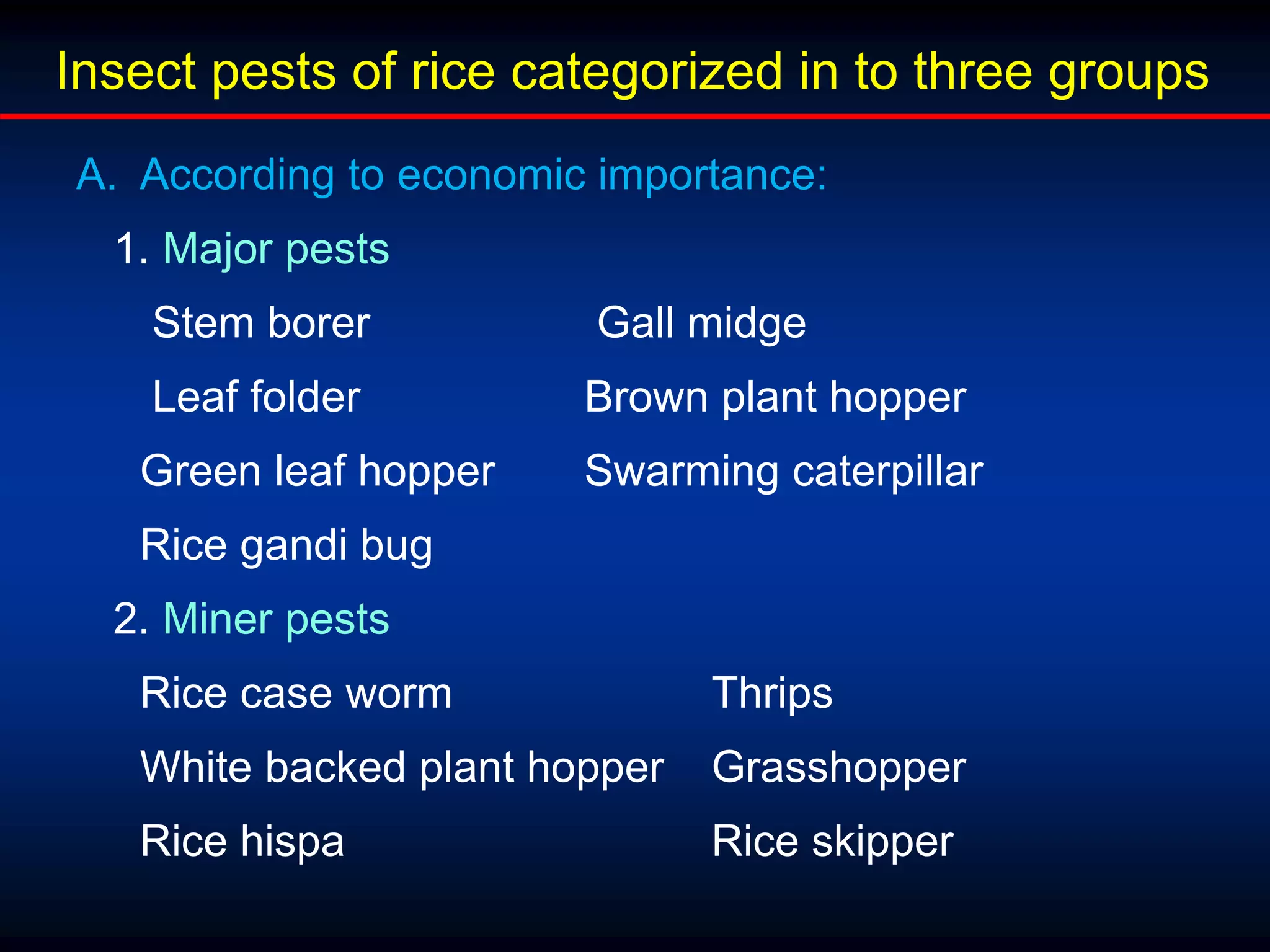
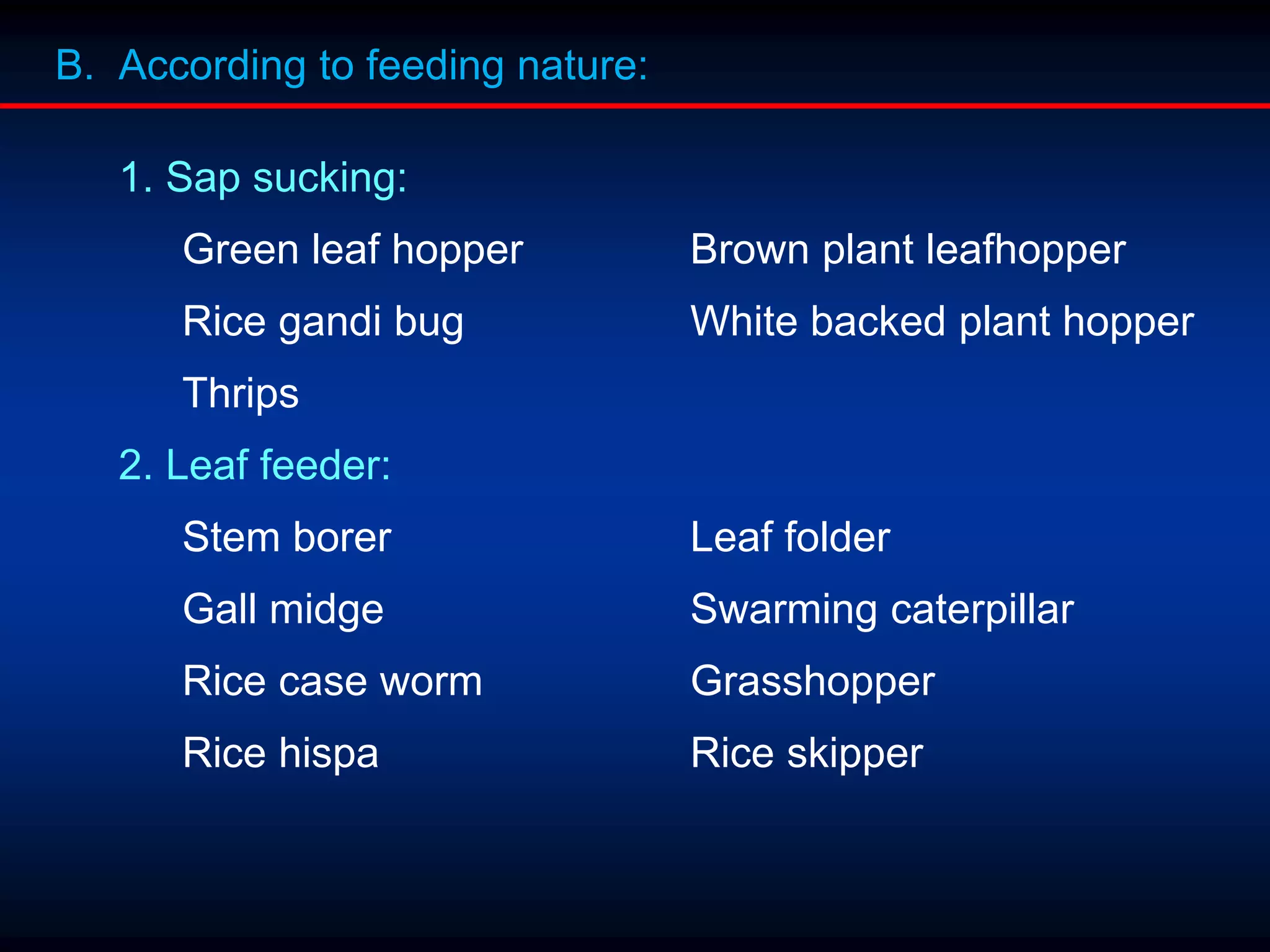
INSECT PESTS OF RICE
R K Panse
Asstt. Prof. (Entomology)
CoA, Balaghat
Subject: Pests of crop and stored grain and their Management
RICE
India has largest area of
44.3 million ha under rice
cultivation and stands
second in production
around 89.09 million t.
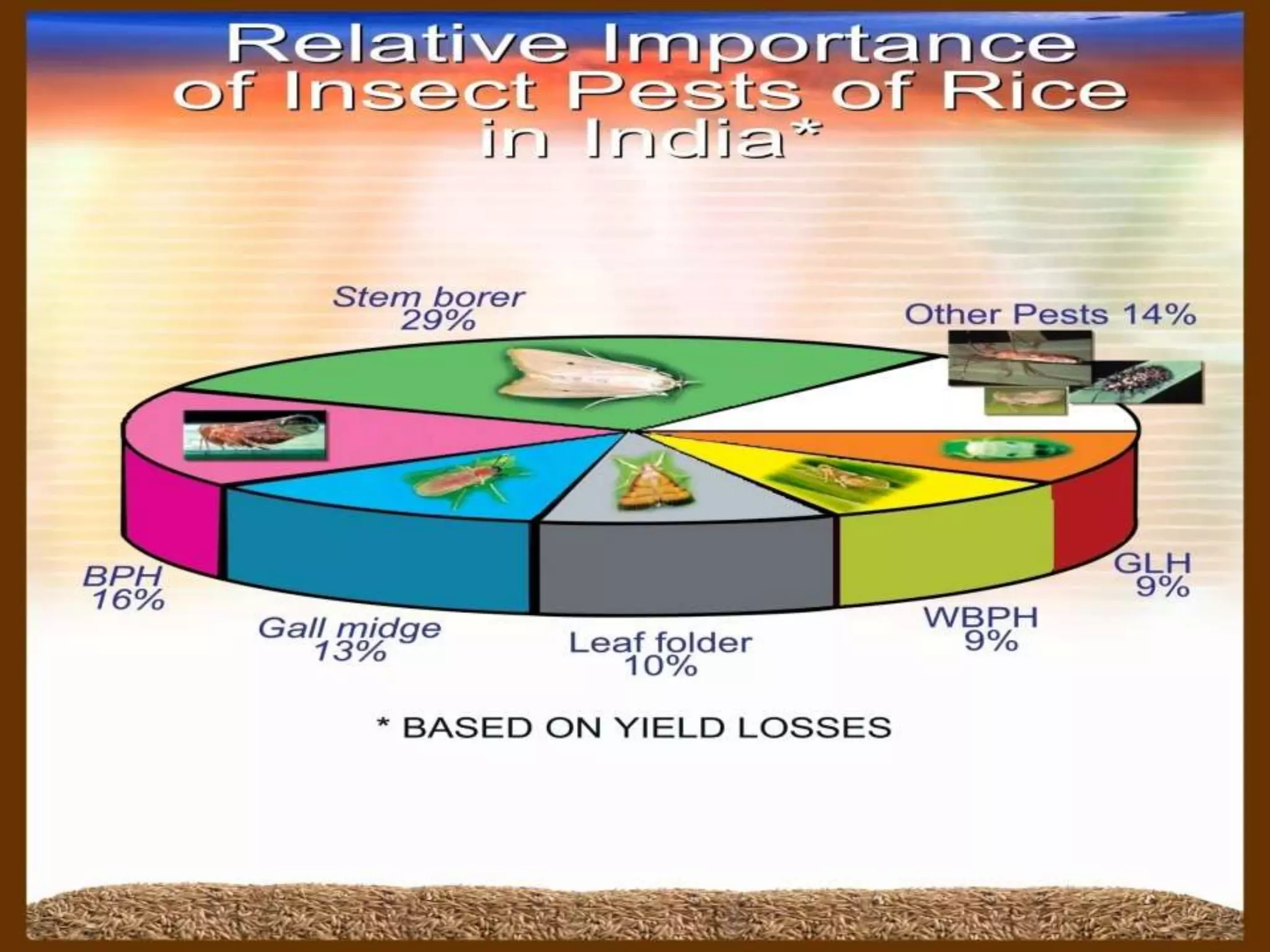
Yield loss due to insect
pests in rice in India is
estimated to the tune of
25%.
There are over 800 insect
species damaging rice in
one way or another but in
tropical Asia only about 20
species are of major
importance and of regular
occurrence.
Green leaf hopper , Brown
plant hopper, Stem borer,
Leaf folder, Gall midge,
Swarming caterpillar, Rice
gandi bug are important
pests of rice.
A. According to economic importance:
1. Major pests
Stem borer Gall midge
Leaf folder Brown plant hopper
Green leaf hopper Swarming caterpillar
Rice gandi bug
2. Miner pests
Rice case worm Thrips
White backed plant hopper Grasshopper
Rice hispa Rice skipper
Insect pests of rice categorized in to three groups
B. According to feeding nature:
1. Sap sucking:
Green leaf hopper Brown plant leafhopper
Rice gandi bug White backed plant hopper
Thrips
2. Leaf feeder:
Stem borer Leaf folder
Gall midge Swarming caterpillar
Rice case worm Grasshopper
Rice hispa Rice skipper
C. According to damaging place:
1. Nursery pests:
Stem borer Green leaf hopper
Case worm Swarming worm
Thrips
2. Main field pests:
Brown plant hopper Stem borer
Leaf folder Gall midge
Swarming caterpillar Rice gandi bug
White backed plant hopper Thrips
Grasshopper Rice hispa
Rice skipper
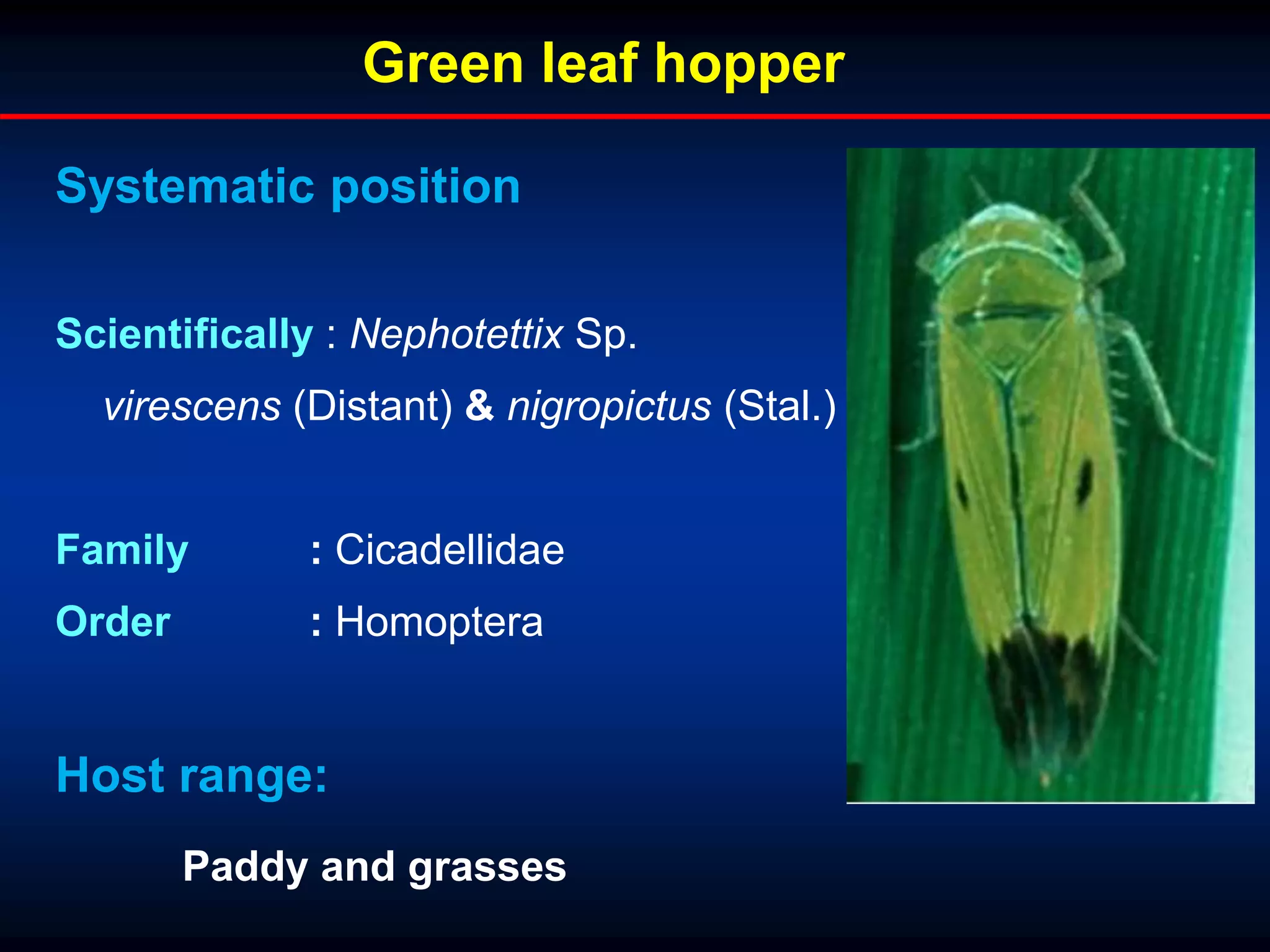
Systematic position
Scientifically : Nephotettix Sp.
virescens (Distant) & nigropictus (Stal.)
Family : Cicadellidae
Order : Homoptera
Green leaf hopper
Host range:
Paddy and grasses
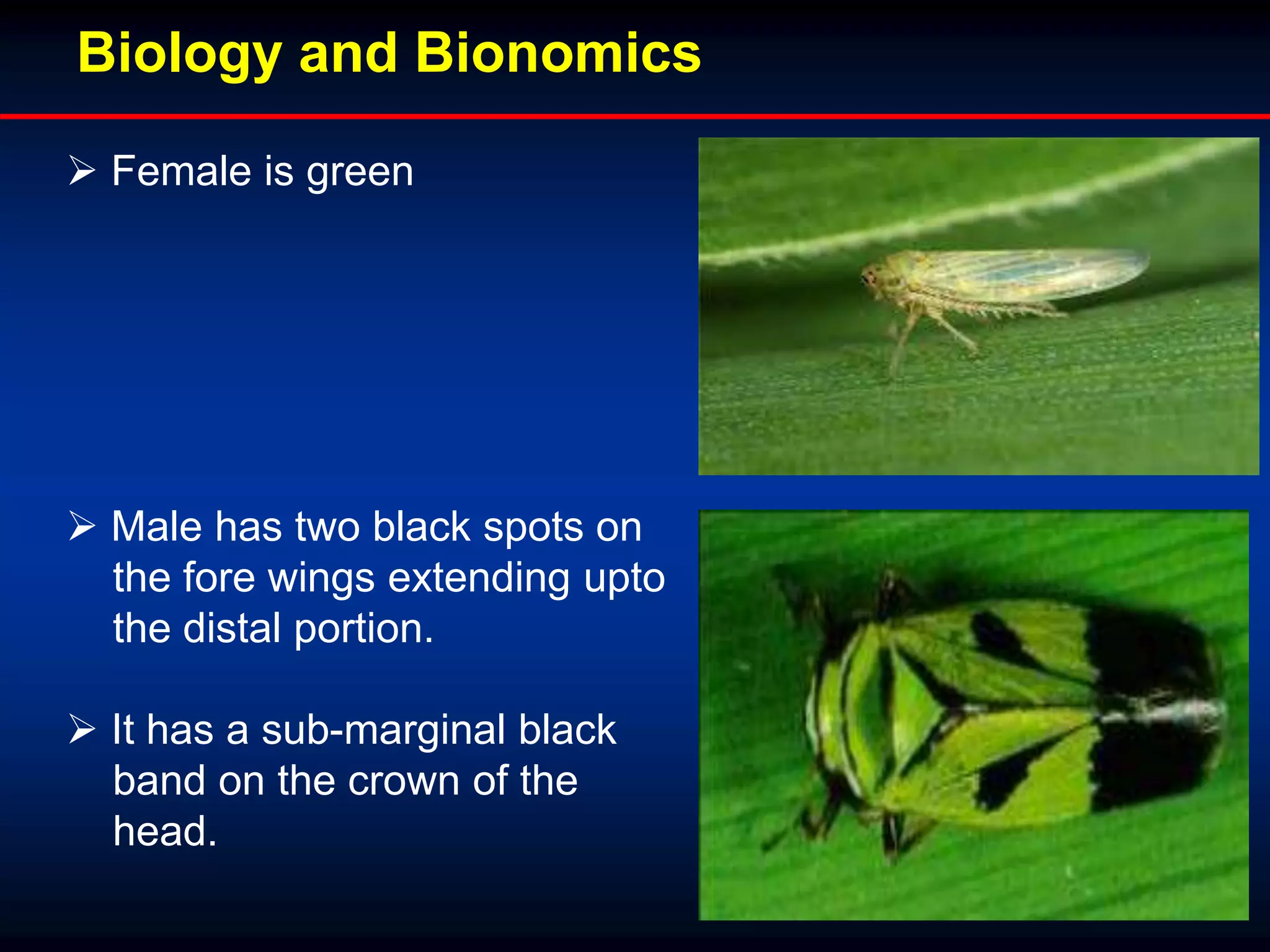
Biology and Bionomics
 Female is green
 Male has two black spots on
the fore wings extending upto
the distal portion.
 It has a sub-marginal black
band on the crown of the
head.
 In N. virescens black sub-marginal band on the crown
and the black spots on forewings are absent
 Distal portion of forewing is brown.
Cont..
Nature of damage with symptoms
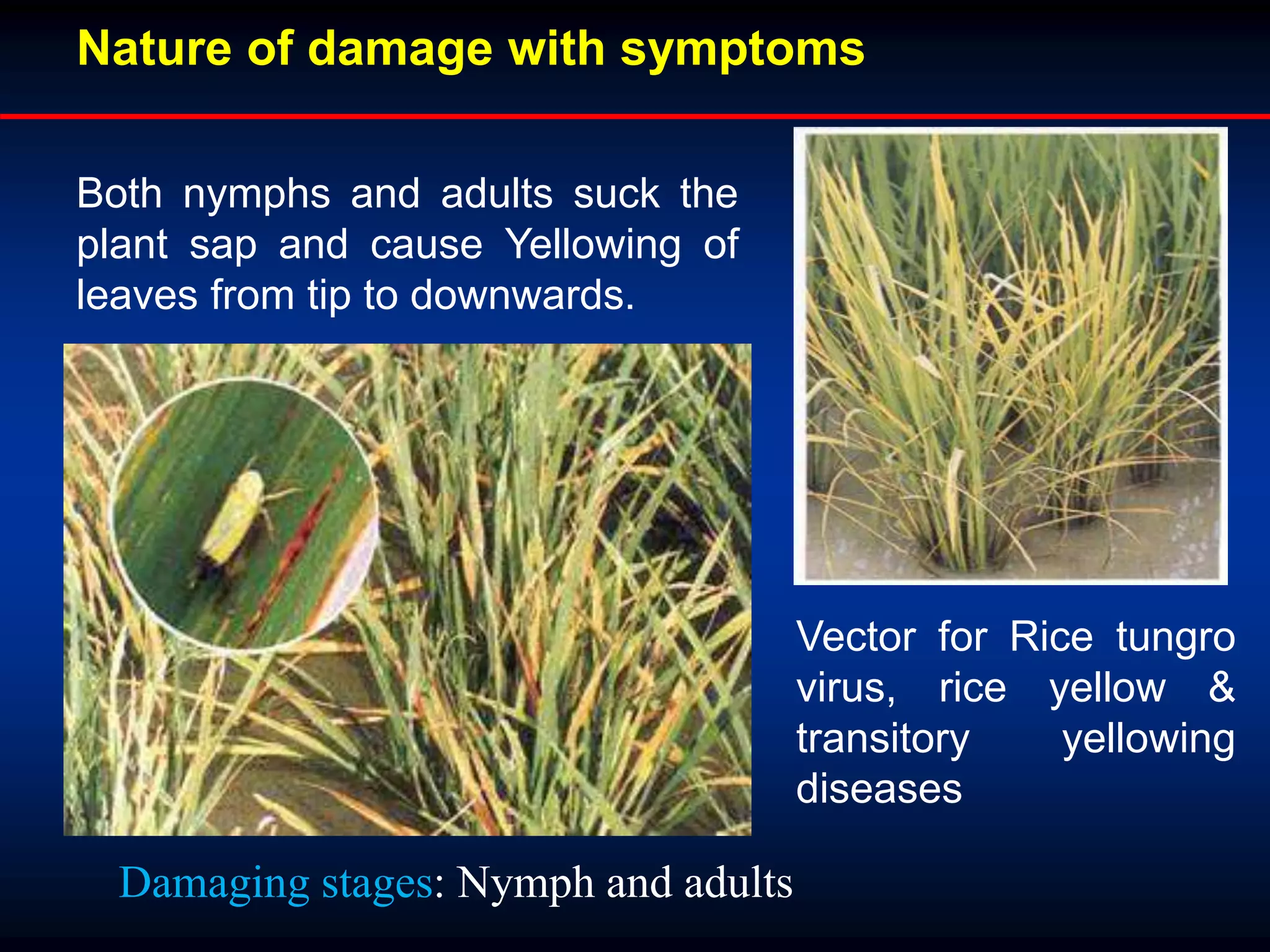
Both nymphs and adults suck the
plant sap and cause Yellowing of
leaves from tip to downwards.
Vector for Rice tungro
virus, rice yellow &
transitory yellowing
diseases
Damaging stages: Nymph and adults
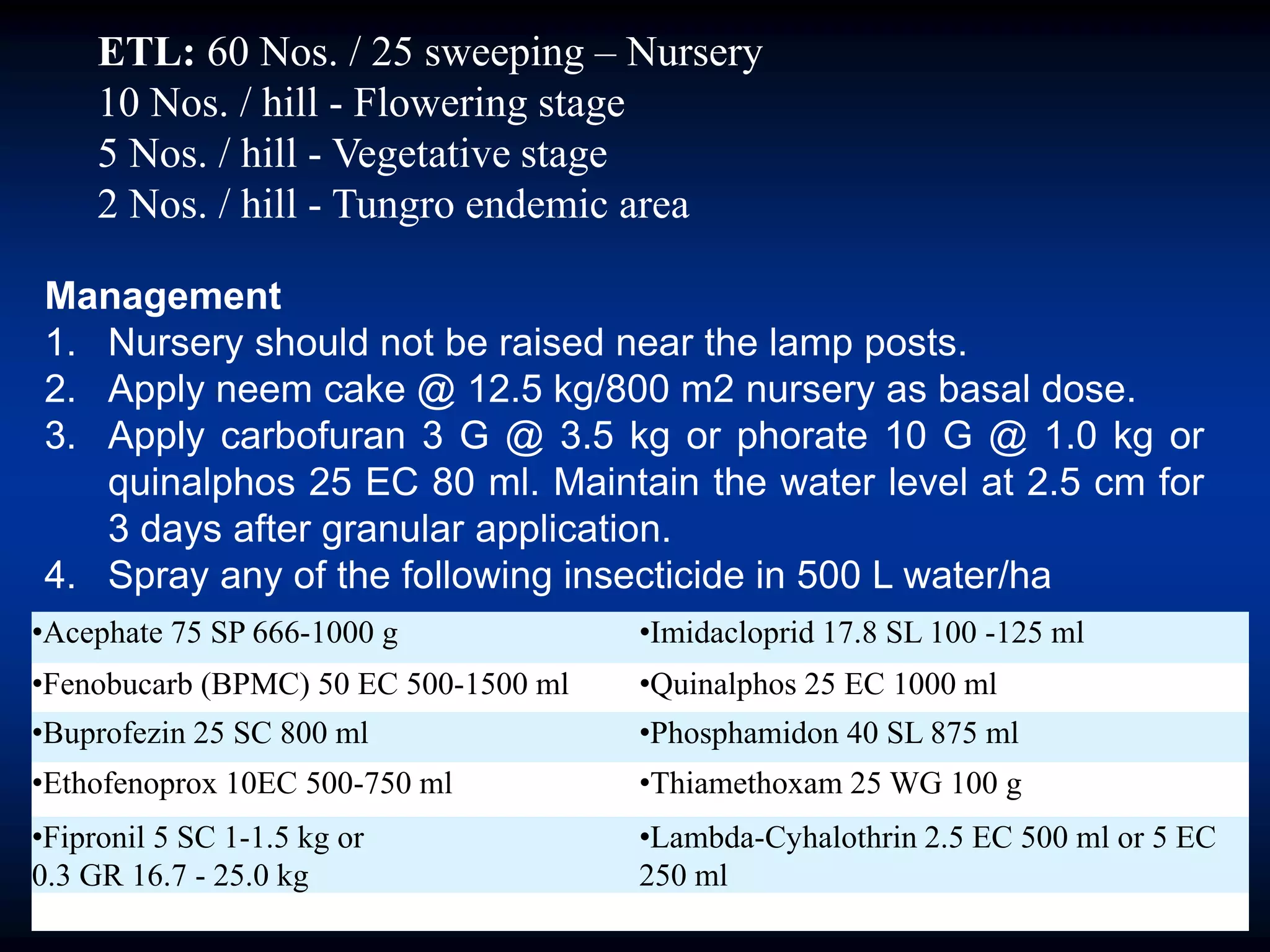
ETL: 60 Nos. / 25 sweeping – Nursery
10 Nos. / hill - Flowering stage
5 Nos. / hill - Vegetative stage
2 Nos. / hill - Tungro endemic area
•Acephate 75 SP 666-1000 g •Imidacloprid 17.8 SL 100 -125 ml
•Fenobucarb (BPMC) 50 EC 500-1500 ml •Quinalphos 25 EC 1000 ml
•Buprofezin 25 SC 800 ml •Phosphamidon 40 SL 875 ml
•Ethofenoprox 10EC 500-750 ml •Thiamethoxam 25 WG 100 g
•Fipronil 5 SC 1-1.5 kg or
0.3 GR 16.7 - 25.0 kg
•Lambda-Cyhalothrin 2.5 EC 500 ml or 5 EC
250 ml
Management
1. Nursery should not be raised near the lamp posts.
2. Apply neem cake @ 12.5 kg/800 m2 nursery as basal dose.
3. Apply carbofuran 3 G @ 3.5 kg or phorate 10 G @ 1.0 kg or
quinalphos 25 EC 80 ml. Maintain the water level at 2.5 cm for
3 days after granular application.
4. Spray any of the following insecticide in 500 L water/ha
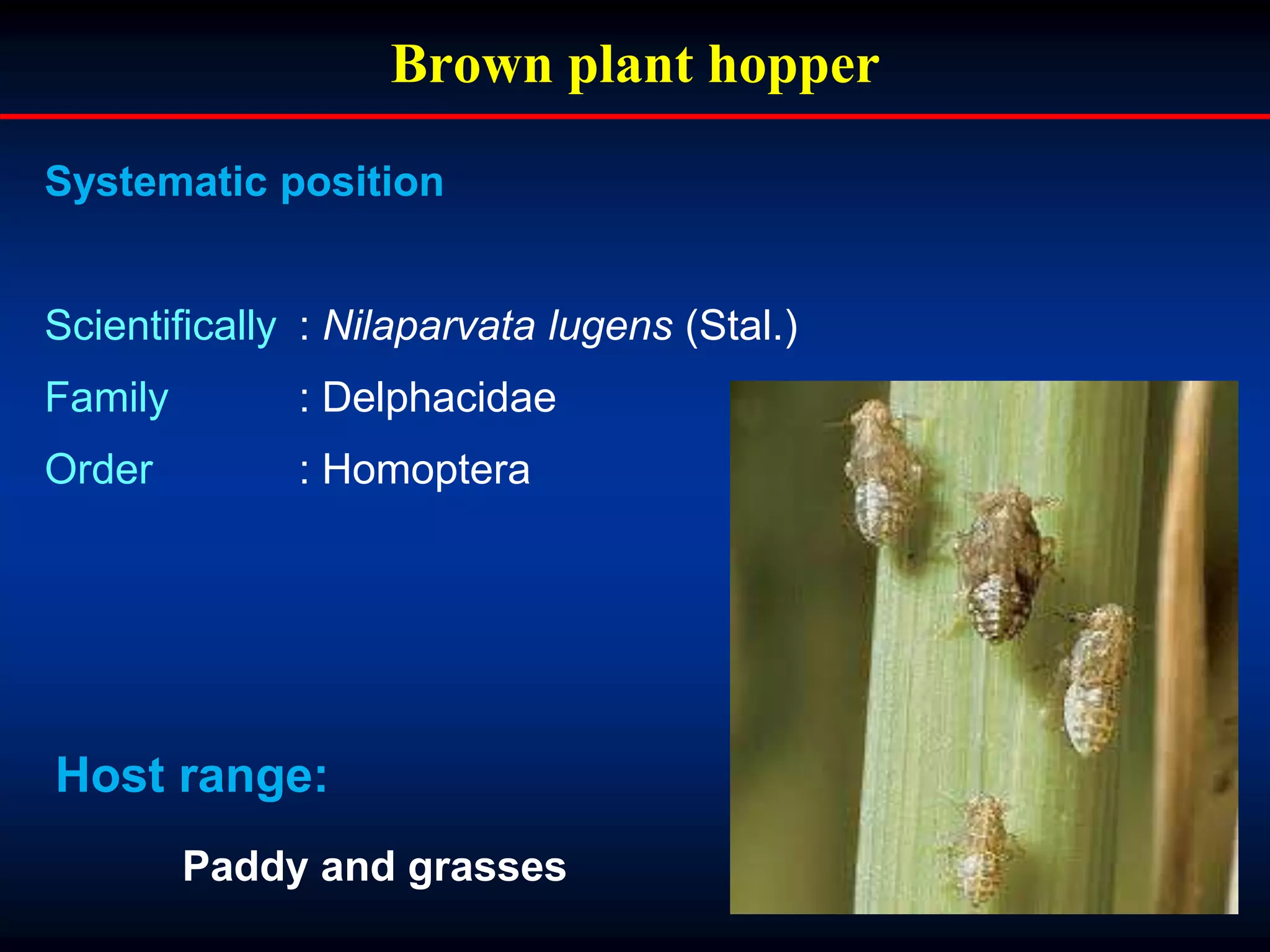
Brown plant hopper
Systematic position
Scientifically : Nilaparvata lugens (Stal.)
Family : Delphacidae
Order : Homoptera
Host range:
Paddy and grasses
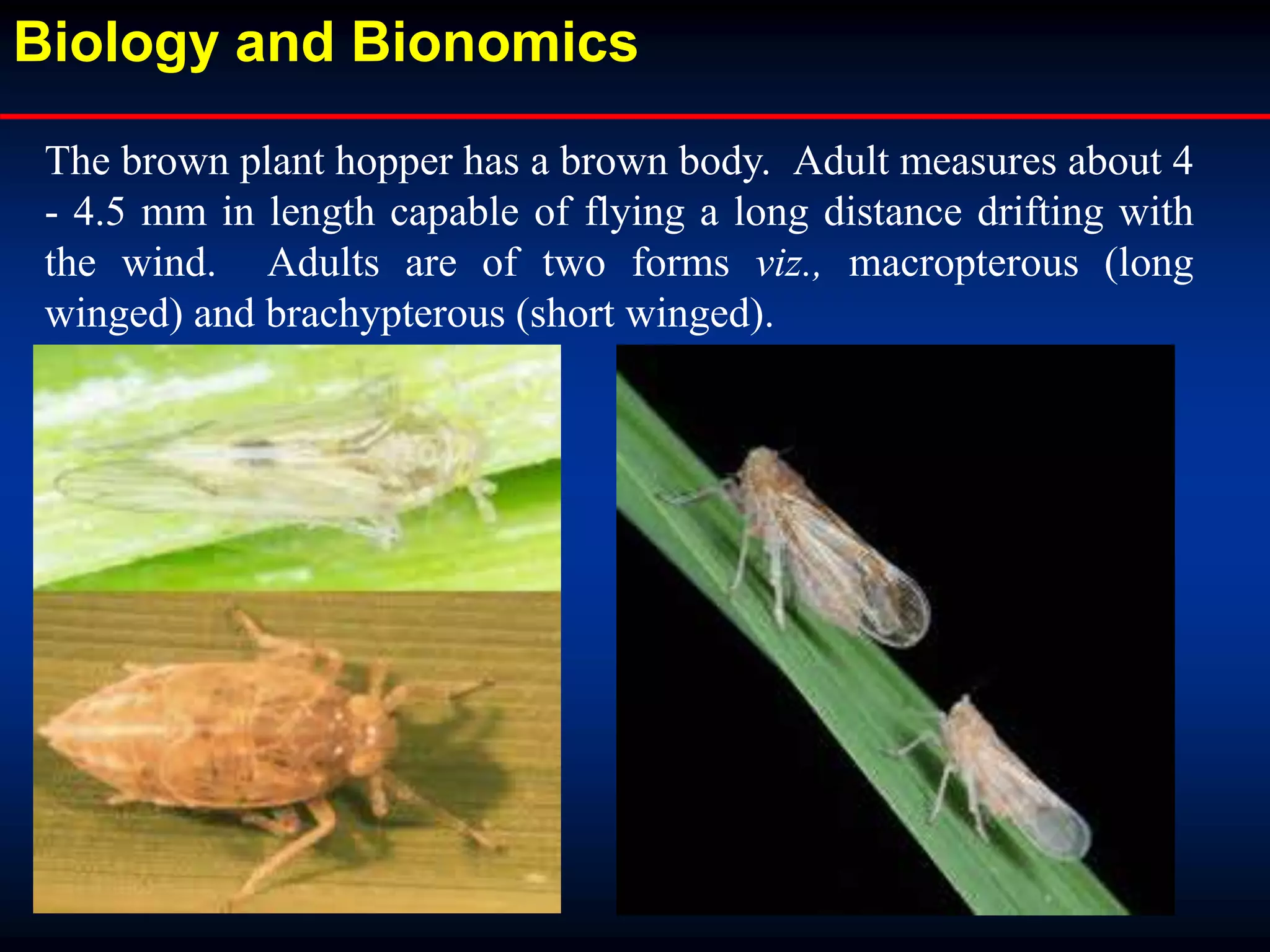
The brown plant hopper has a brown body. Adult measures about 4
- 4.5 mm in length capable of flying a long distance drifting with
the wind. Adults are of two forms viz., macropterous (long
winged) and brachypterous (short winged).
Biology and Bionomics
Brachypterous - Weak fliers & prolificbreeders
Macropterous - Strong fliers
Adult identification
Dr. R.K. Panse
CoA, Balaghat
Adult
Life cycle
Egg
(5-6 days)
Nymph
(15-18 days)
TLC: 20-24days
Dr. R.K. Panse
CoA, Balaghat
BPH
 Affected plant dries up and gives a scorched appearance
called “hopper burn”.
 Circular patches of drying and lodging of matured plant
Nature of damage with symptoms
Grassy stunt
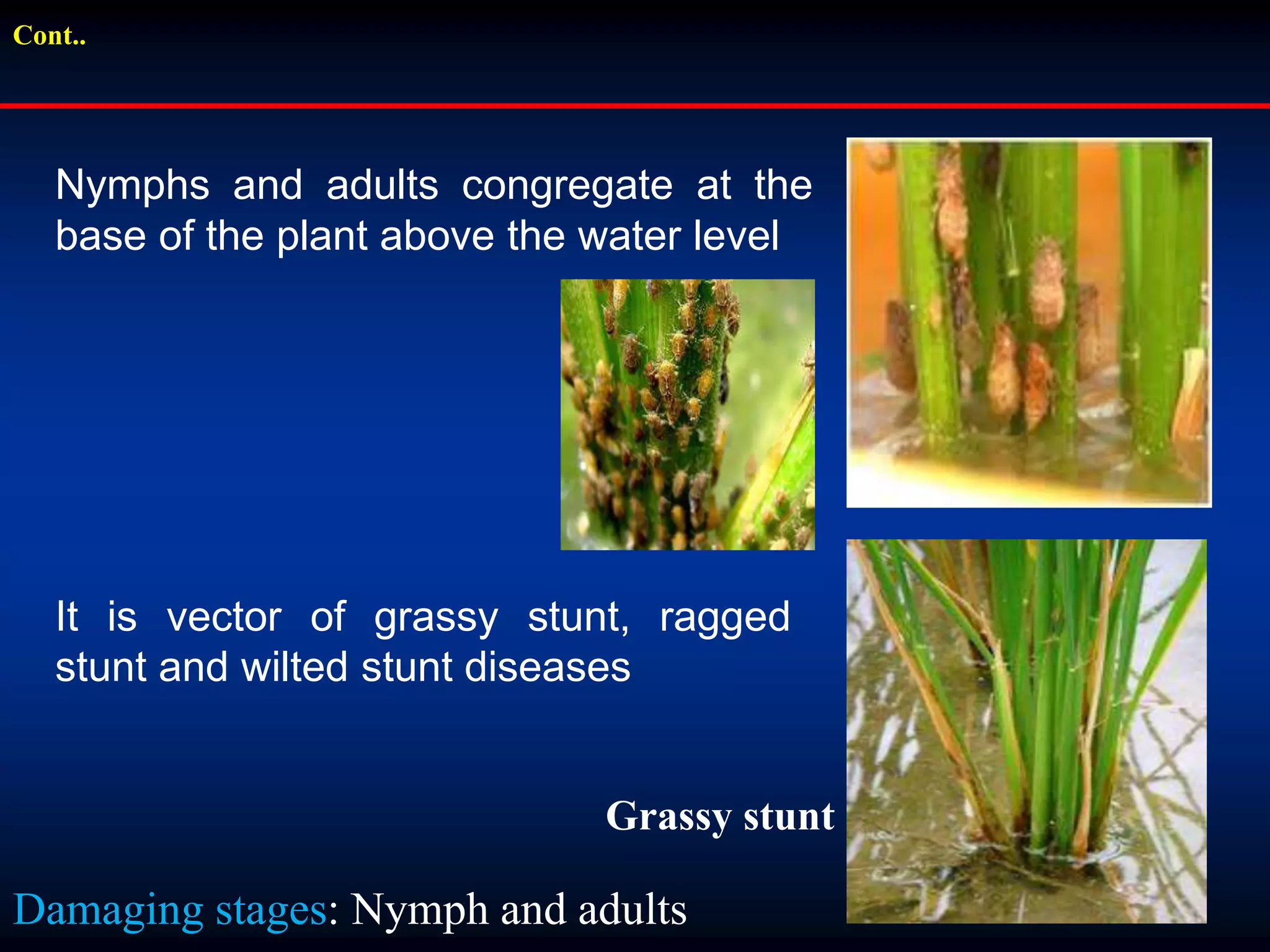
It is vector of grassy stunt, ragged
stunt and wilted stunt diseases
Nymphs and adults congregate at the
base of the plant above the water level
Cont..
Damaging stages: Nymph and adults
Nature of damage
Nymphs & adults ‘suck the sap at the base of the plant just above the water level’
Contd…….
Dr. R.K. Panse
CoA, Balaghat
BPH
Management:
Cultural practices
Avoid use of excess nitrogen.
Monitoring of GLH at base of the plant 30 days after transplanting
at weekly interval
Alternate wetting and drying the field during peak infestation.
Apply split dose of nitrogenous fertilizers
Biological control:
 Use Mirid bug Cyrtorhinus lividipennis or golf spider
Chemical control:
 Application of granular phorate 10G@ 4kg/acre or carbofuran
3G@ 10kg/acre .
Spray imidacloprid 200 SL @ 0.5ml (125ml/acre) or thiomethaxm
25WG @ 0.5g (125kg/acre) or
ETL: 8-10 Nos./hill or 20 Nos./hill when spider is present at 1
No./hill
Rice stem borer
Systematic position
Scientifically : Scirpophaga incertulas (Walker)
Family : Pyraustidae (Pyralidae)
Order : Lepidoptera
Host range:
Paddy
Egg - Laid in a mass and covered
with buff coloured hairs.
Larva - Pale yellow with dark brown
head.
Pupa - White silken cocoon.
Biology and Bionomics
Adult
Female moth - bright yellowish brown fore wings with a
black spot possess a tuft of yellow hairs.
Male moth - Smaller with pale yellow forewings without
black spot.
Adult
Life cycle
Egg
(5-8 days)
Larva
(33-41 days)
Pupa
(6-10 days)
TLC: 44-59days
Larva feeds inside the stem causing
drying of the central shoot called ‘dead
heart’ in young plant or drying of the
panicle called ‘white ear’ in older plants.
Presence of brown coloured egg mass
near leaf tip.
ETL
2 egg masses/ m2
10% dead hearts -
Vegetative stage
2% white ear - Flowering
Nature of damage with symptoms
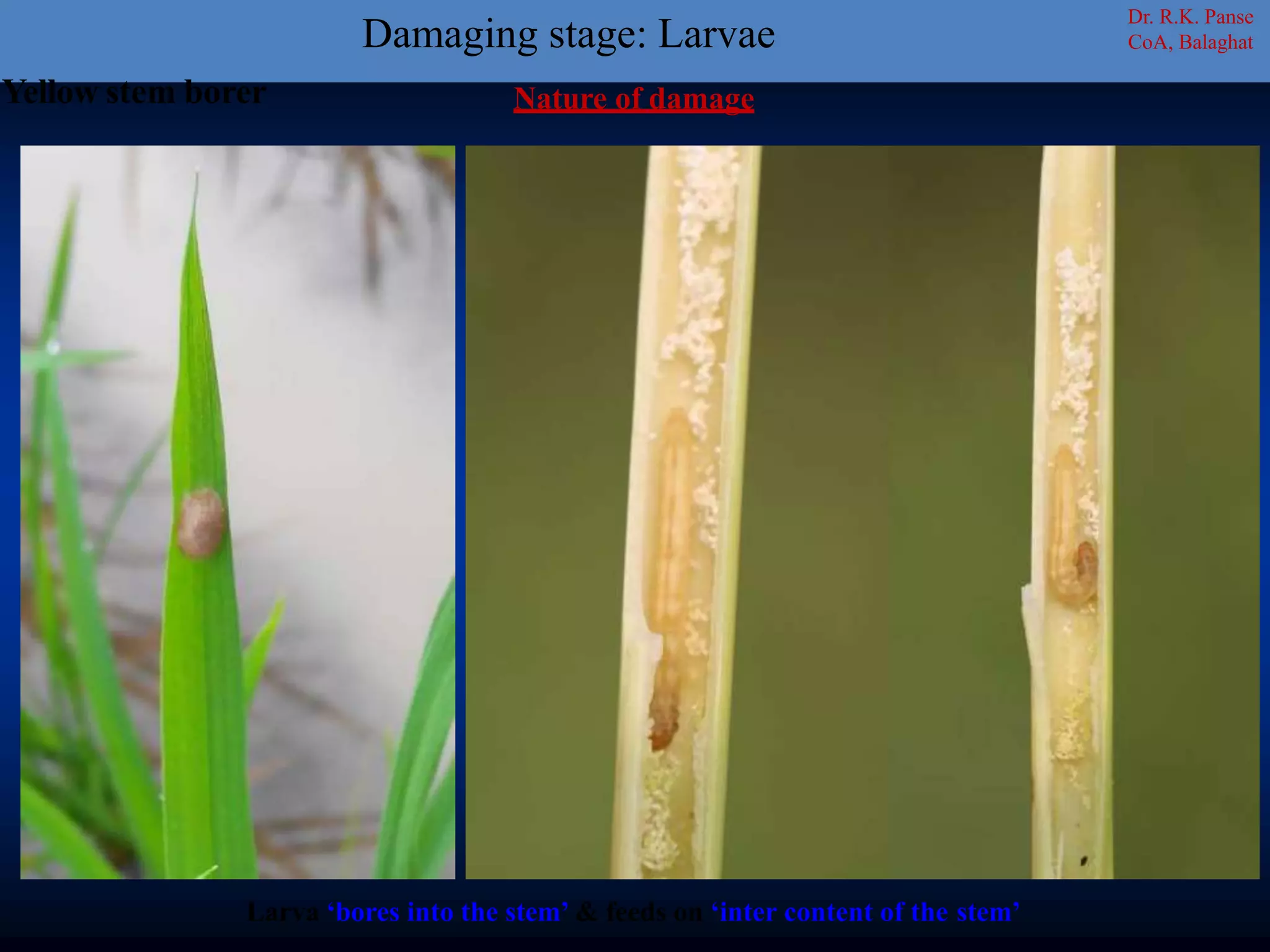
Nature of damage
Larva ‘bores into the stem’ & feeds on ‘inter content of the stem’
Dr. R.K. Panse
CoA, Balaghat
Yellow stem borer
Damaging stage: Larvae
Damage symptoms
‘Dead heart’ at vegetative stage ‘White ear’ at reproductive stage
Yellow stem borer
Dr. R.K. Panse
CoA, Balaghat
Management
• Clip the seedling tips.
• Avoid close planting & continuous water stagnation at early stages.
• Collect and destroy the dead hearts and white ears.
• Set up light traps to attract and kill the moths.
• Install sex pheromone traps to monitor and mass trap.
• Release the egg parasitoid, Trichogramma japonicum twice on 30
and 37 DAT @ 5 cc/ha/release.
• Apply Bacillus thuringiensis var kurstaki and neem seed kernel
extract in the combination of 2.5 g/L and 1% to reduce the
oviposition by the stem borer.
• Apply carbofuran 3 G @ 25 kg or chlorantraniliprole 0.4 G 10 kg or
fipronil 0.3 G 17-25 kg or cartap hydrochloride 4 G 18.75 kg or spray
acephate 75 SP 666-1000 g or monocrotophos 36 SL 1.0 L or
quinalphos 25 EC 1.0 L or azadirachtin 5 % 400 ml or carbosulfan 25
EC 800-1000 ml or chlorantraniliprole 18.5 SC 150 ml or
ethofenoprox 10 EC 500-750 ml or fipronil 5 SC 1-1.5 L
flubendiamide 39.35 M/M SC 50 ml or lambda-cyhalothrin 2.5 EC
500 ml/ 5 EC 250 ml per ha using water @ 500 L/ha
• Harvest the crop up to the ground level.
Rice leaf folder
Systematic position
Scientifically : Cnaphalocrocis medinalis (Guen.)
Family : Pyraustidae (Pyralidae)
Order : Lepidoptera
Host range:
Polyphagous
Dr. R.K. Panse
CoA, Balaghat
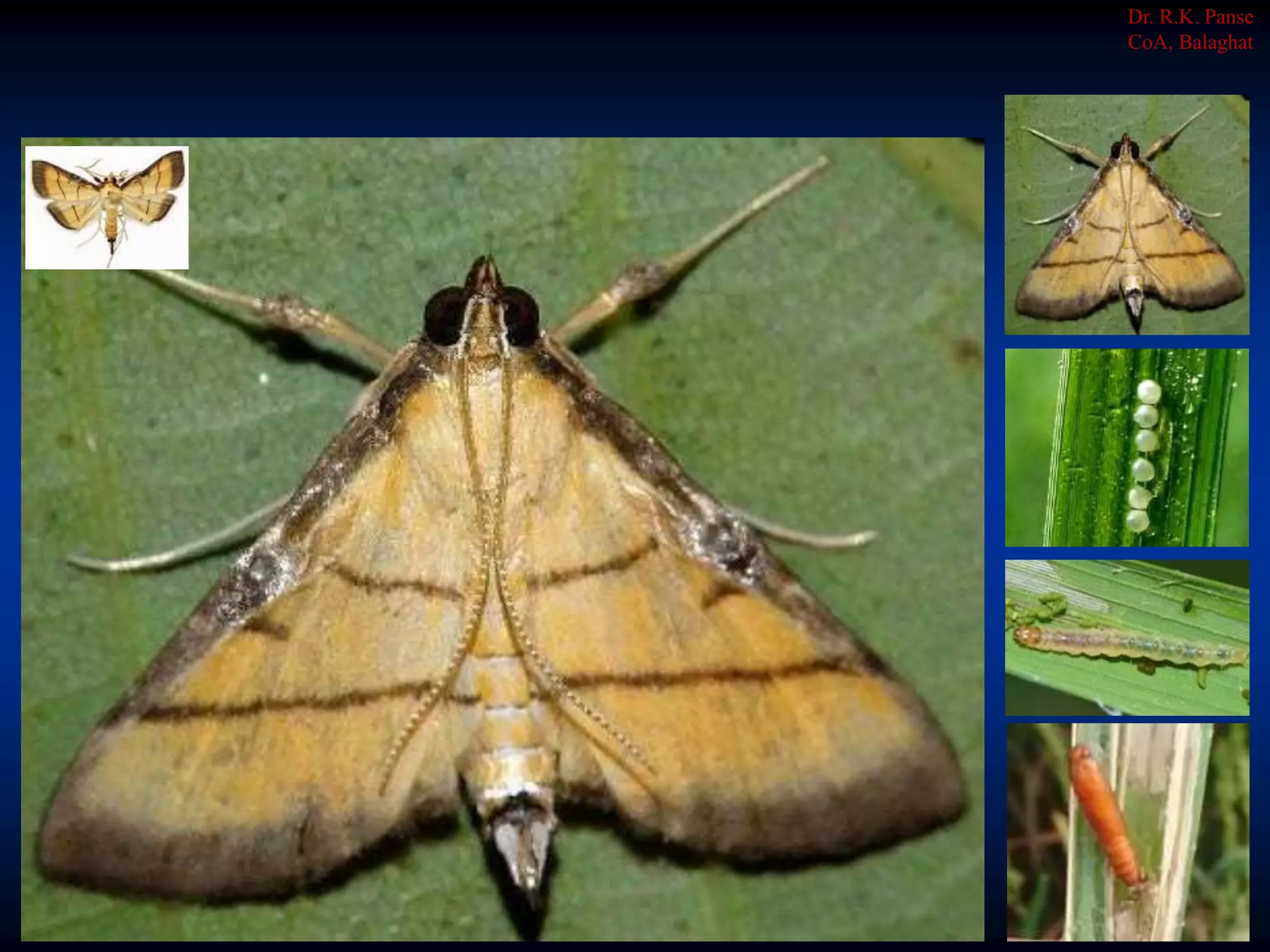
The brownish – orange moth
On forewing Two dark wavy lines and one
on hind wing.
Both wings have a dark brown to grey
band on their outer margin.
Larva:
Greenish translucent
Egg - Flat, oval in shape
and white in colour.
Newly formed pupa is light brown, but
turns reddish brown in later stage.
Biology and Bionomics
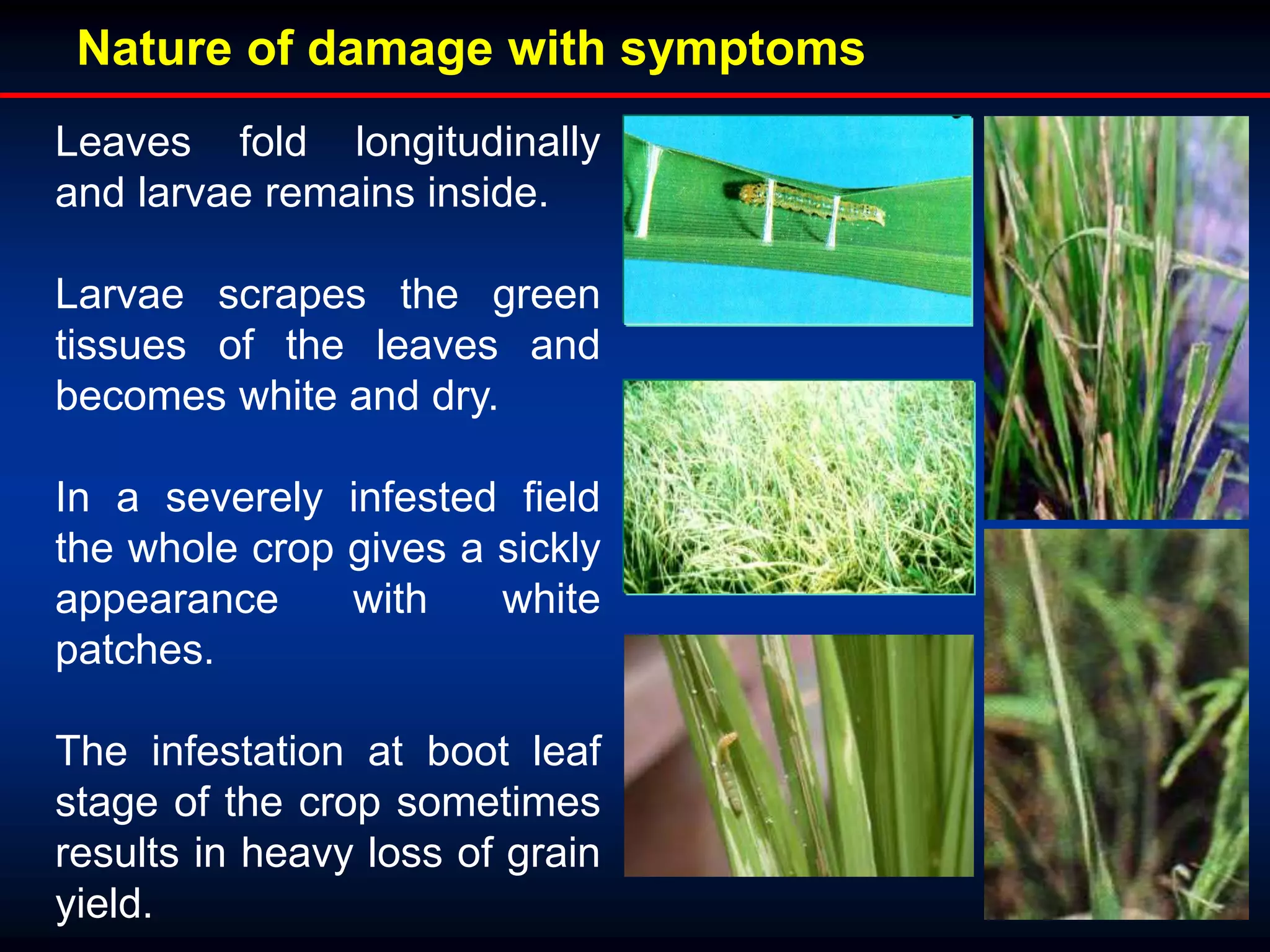
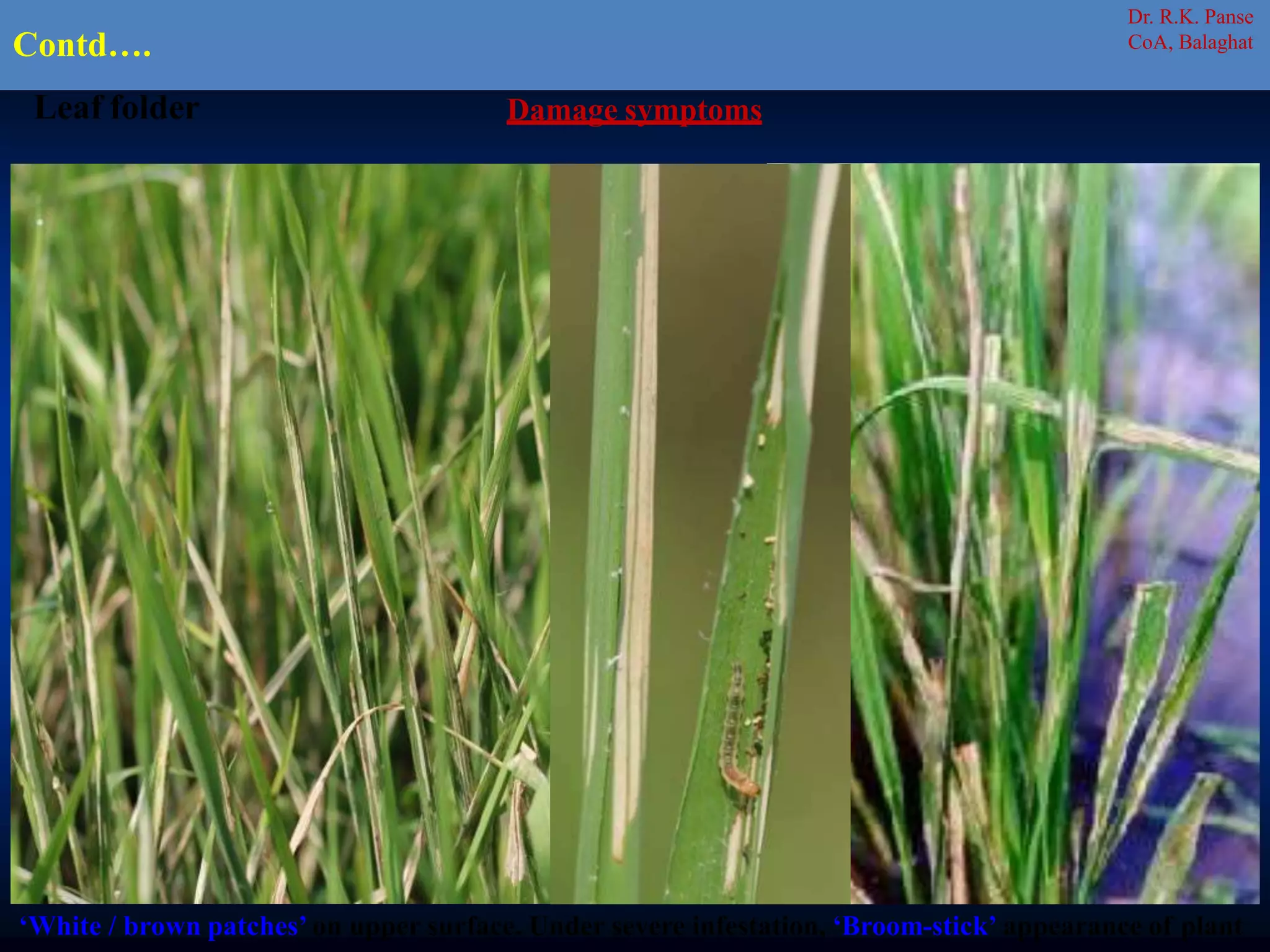
Leaves fold longitudinally
and larvae remains inside.
Larvae scrapes the green
tissues of the leaves and
becomes white and dry.
In a severely infested field
the whole crop gives a sickly
appearance with white
patches.
The infestation at boot leaf
stage of the crop sometimes
results in heavy loss of grain
yield.
Nature of damage with symptoms
Larva ‘folds margins of leaf blade together with its saliva’ & ‘feeds within’ by ‘scrapping green tissues’
Nature of damage
Contd….
Dr. R.K. Panse
CoA, Balaghat
Leaf folder
Damaging stage: Larvae
‘White / brown patches’ on upper surface. Under severe infestation, ‘Broom-stick’ appearance of plant
Damage symptoms
Contd….
Leaf folder
Dr. R.K. Panse
CoA, Balaghat
ETL: 2 freshly damaged leaves / hill or 10% damage to leaves at
vegetative stage 5% damage to leaves at boot leaf stage
Management
 Monitoring
 Set-up light traps @ 1 trap / acre
 Preventive measures
 Avoid excess use of nitrogen fertilizers
 Apply ‘K’ at higher dose
 Curative measures
 Inundative release of Trichogramma chilonis @ 50,000/ha/week for
5-6 times
 Spray Metarhizium rileyi @ 2-5g/l (2X10⁸ CFU/g)
 Spray B.t. products @ 2g/ml
 Spray azadarachtin 1EC @ 2ml/l
 Spray flubendiamide 20 WG @ 0.25gl/l or indaxocarb 14.5SC
@ 0.5 ml/l
Contd….
Dr. R.K. Panse
CoA, Balaghat
Leaf folder
Distribution: It is destructive in
some parts of Kerala, Orissa,
Andhra Pradesh, Madhya Pradesh
and Bihar.
Rice gall midge
Systematic position
Scientifically : Orseolia oryzae (Wood-Mason)
Family : Cecidomyiidae
Order : Diptera
Host range:
Paddy and grasses
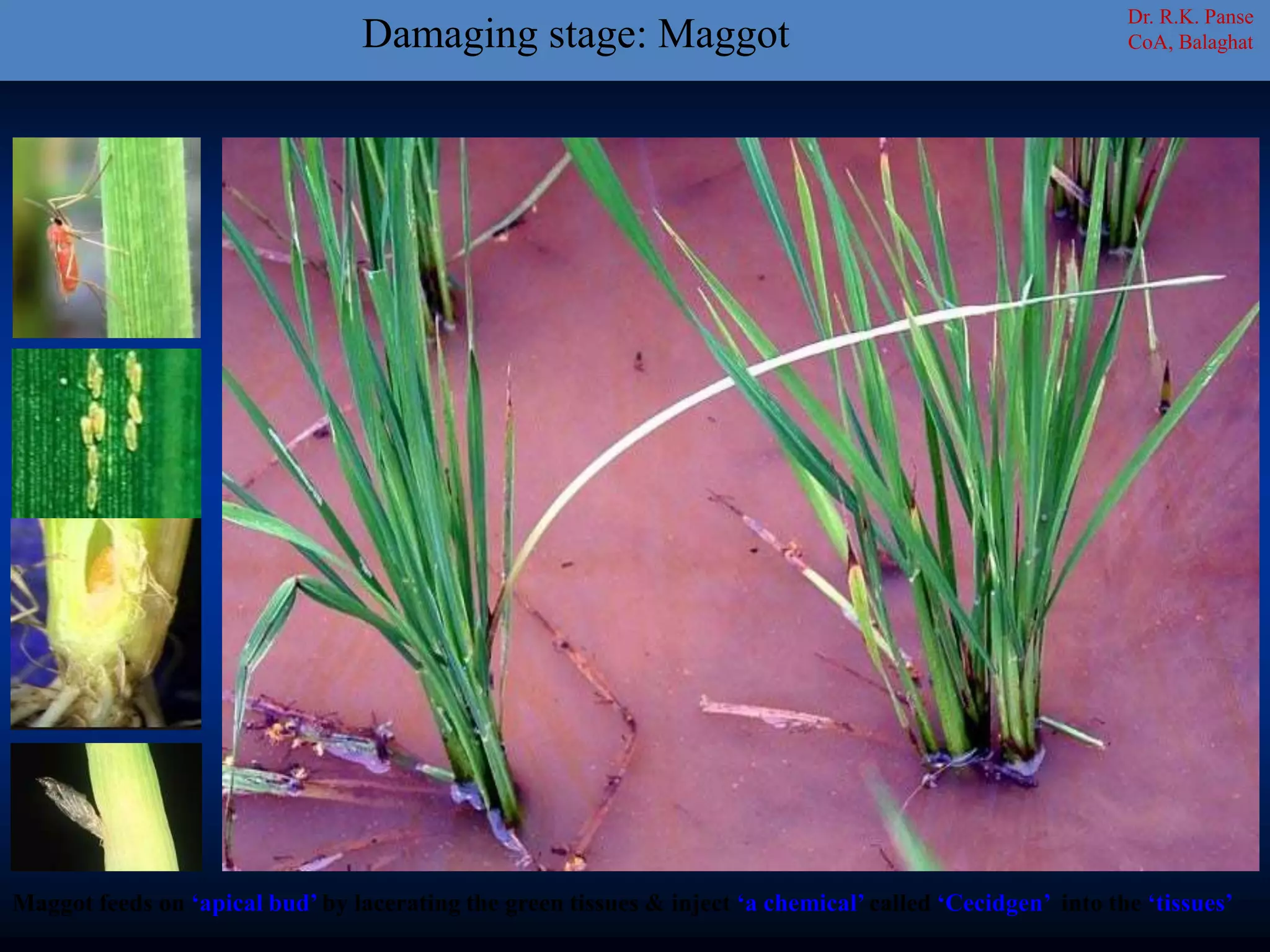
Egg: Reddish, elongate,
tubular eggs just near the
ligula of the leaf blade
Larva: Maggot is pale to
red colour feeds inside
the gall.
Pupa: pupates at the
base of the gall and
moves to tip of the gall
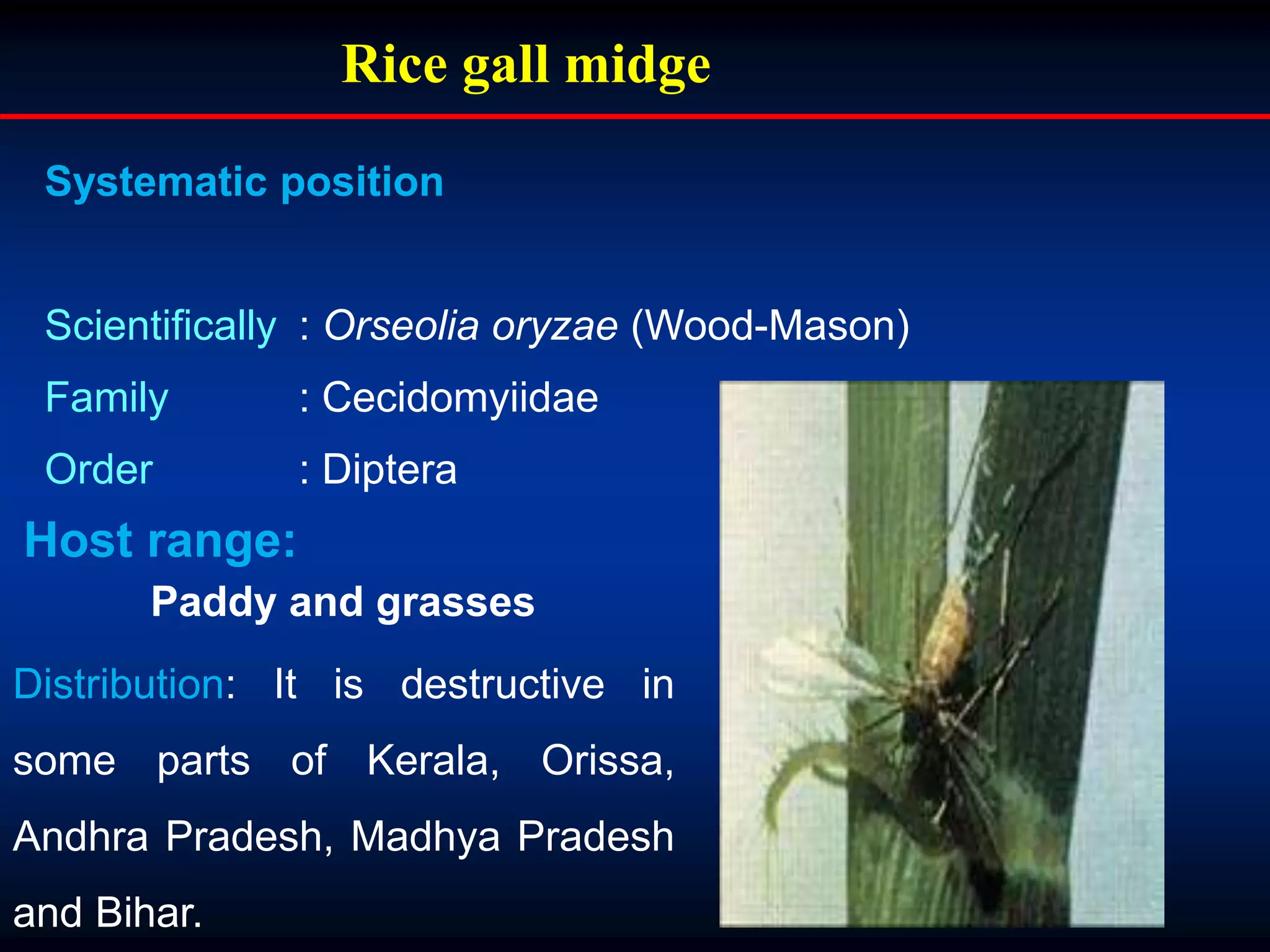
Adult: Adult is orange
coloured mosquito like fly
Biology and Bionomics
Maggot feeds on ‘apical bud’ by lacerating the green tissues & inject ‘a chemical’ called ‘Cecidgen’ into the ‘tissues’
Dr. R.K. Panse
CoA, BalaghatDamaging stage: Maggot
Damage symptoms
‘Gall’ in the form of ‘silver shoot or onion shoot or anekombu’
Contd……….
Gall midge
Dr. R.K. Panse
CoA, Balaghat
Contd……….
ETL: 1 gall/m2 or 5% affected tillers or 5% galls
Management
 Preventive measures
 Avoid late planting
 Cleaning the field bunds
 Drain out water from field and apply following insecticides
 Curative measures
Insecticide Formulation Dosage
Buprofezin 25 EC 1 ml/l
Thiamethoxam 25 WG 0.2g/l
Carbofuran 3G 25 kg/ha
Fipronil 0.3 G 17.5 kg/ha
Dr. R.K. Panse
CoA, Balaghat
Gall midge
Maggot feeds at the base
of the growing shoot
The gall formed by this fly
is popularly known as
‘silver shoot’ or ‘onion shoot’.
 It infests the rice even in the
nursery but usually tillers are
preferred. The loss in yield in
a heavily infested crop may
be up to 50 %.
Nature of damage with symptoms
Management
 Encourage early planting of the crop with quick growing
varieties.
 Plough immediately after crop harvest.
 Remove the alternate host.
 Apply fertilizers in balanced manner.
 Set up light trap @ 1 / ha. Infra red light trap attracts gall midge.
 Release larval parasitoid, Platygaster oryzae through parasitized
galls @ 1 per 10 m2 in the main field at 10 days after
transplanting (DAT).
 Conserve predatory spiders like.
 Apply carbofuran 3G @ 25 kg or fipronil 0.3 G 16.7 - 25.0 kg
or spray quinalphos 25 EC 1.0 L or ethofenprox 10 EC 500-750
ml or fipronil 5 SC 1.0 -1.5 kg or lambda-cyhalothrin 2.5 EC
500 ml / 5 EC 250 ml or thiamethoxam 25 WG 100 g in 500 L
water/ha
ETL: 10% silver shoots.
Rice earhead bug
Systematic position
Scientifically : Leptocorisa acuta (Thunberg)
Family : Coreidae
Order : Hemiptera
Host range:
Paddy
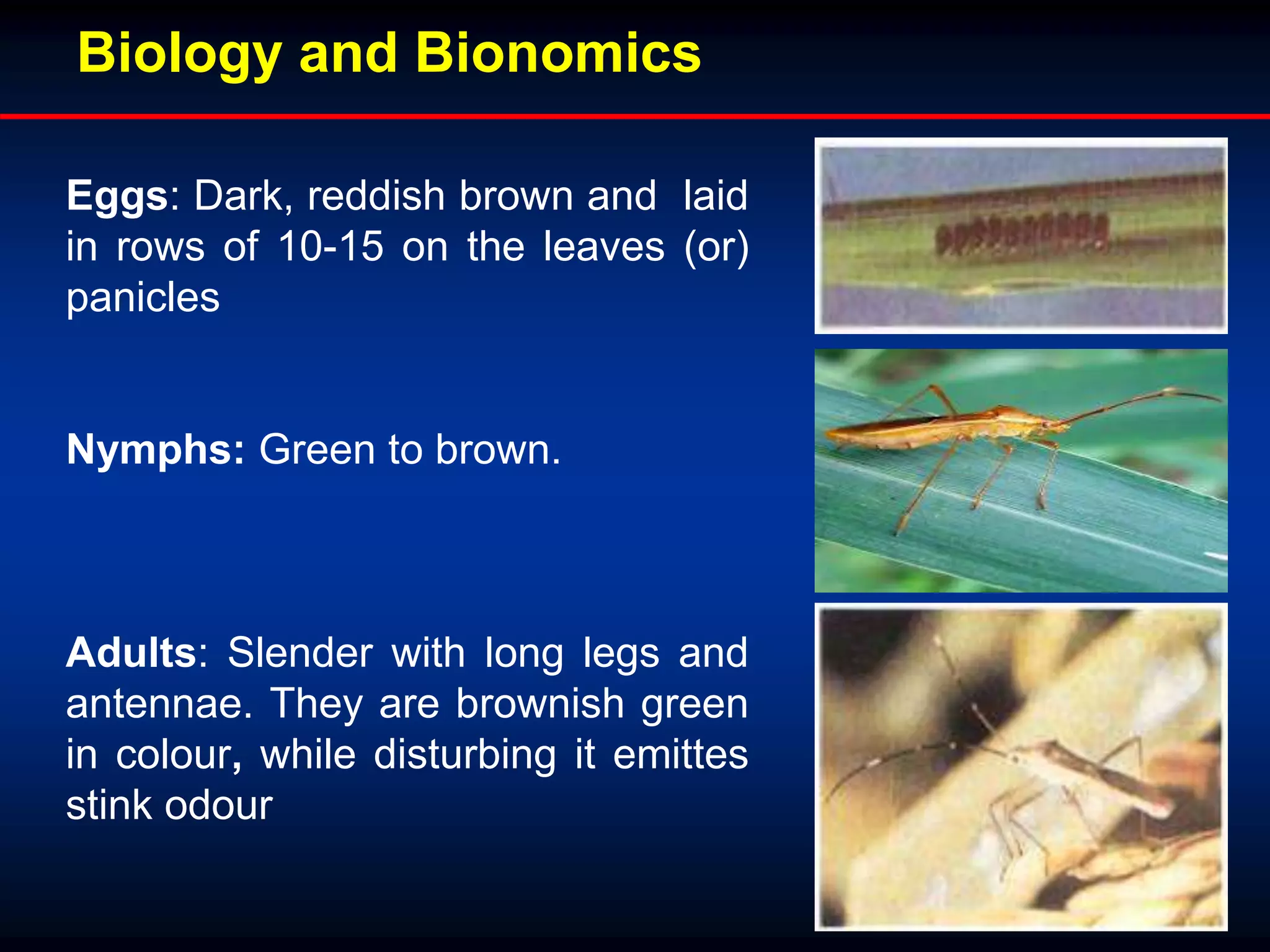
Eggs: Dark, reddish brown and laid
in rows of 10-15 on the leaves (or)
panicles
Nymphs: Green to brown.
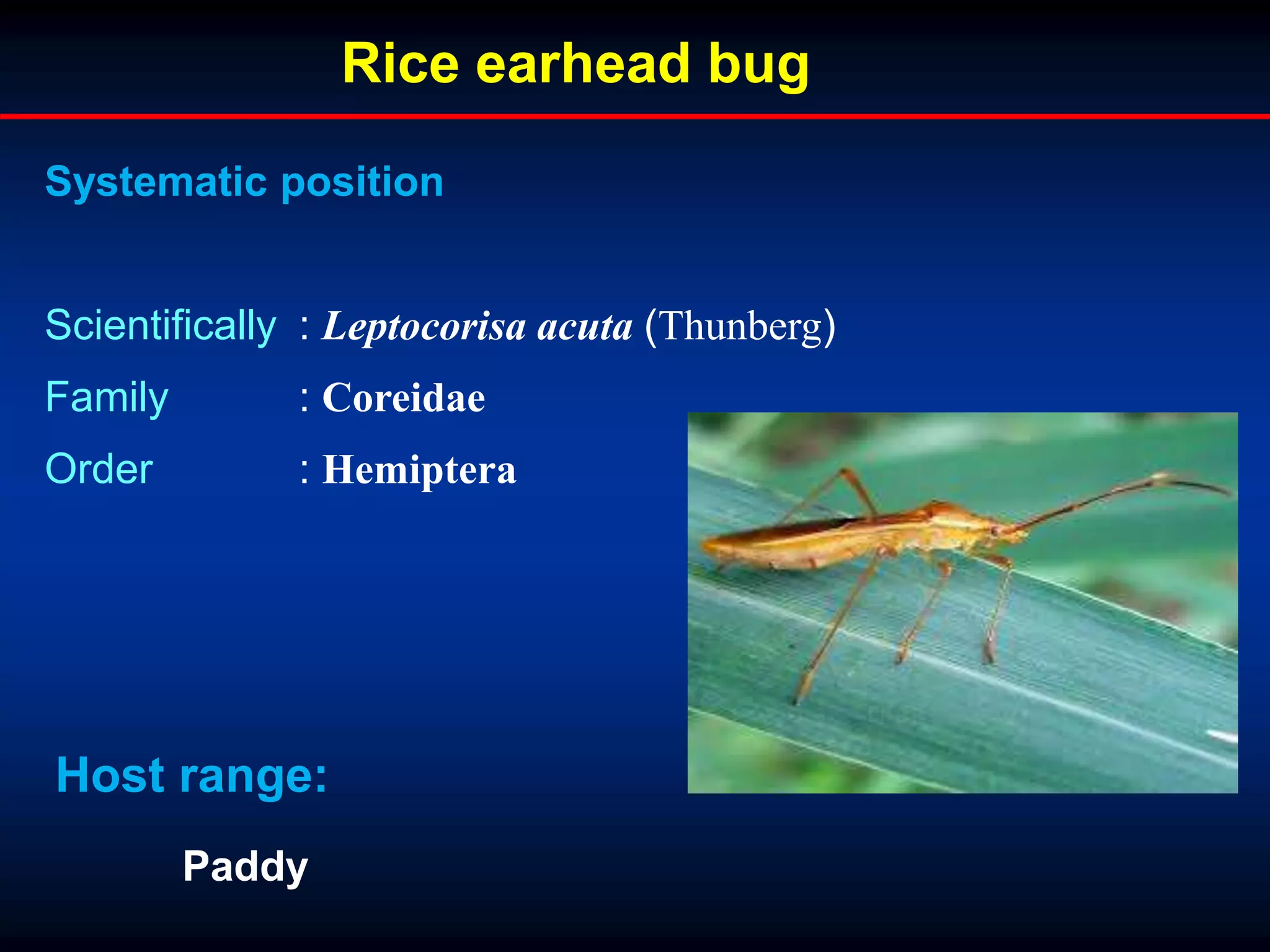
Adults: Slender with long legs and
antennae. They are brownish green
in colour, while disturbing it emittes
stink odour
Biology and Bionomics
 Sucking the sap from individual grains,
which are in milky stage.
 Black spots on the grains at the site of
feeding puncture.
 Buggy odour in rice field during milky
stage
Both the nymphs and adults feed
on the sap of tender milky grains
making them turn chaffy.
Nature of damage with symptoms
Damage symptoms
‘Brownish spot’ on seeds; Further, ‘individual grains’ become ‘brown & discolored, and ‘shriveled’
Contd……….
Gundhi bugs
Dr. R.K. Panse
CoA, BalaghatDamaging stage: Nymph and adults
ETL: 5 bugs/100 panicles or 1 bug/hill - flowering stage; 16
bugs/100 panicles or 3 bug/hill- milky stage.
Management
 Remove alternate host, Echinocloa from bunds and field.
 Ensure synchronous planting on community basis in an
area.
 Use NSKE 5% or or Ipomoea leaf powder extract 5%.
 Dust quinalphos 1.5 D or carbaryl 10 D or malathion 5 D
@ 25 kg/ha or spray malathion 50 EC 500 ml or
monocrotophos 36 WSC 500 ml/ha.
Swarming caterpillar
Systematic position
Scientifically : Spodoptera mauritia (Guenée)
Family : Noctuidae
Order : Lepidoptera
Host range:
Polyphagous
Adult is a medium sized, grey-
brown moth with black spots on
forewings while its hind wings are
whitish brown.
Egg - Laid in masses on leaves and
covered with grey hairs
Larva - cylindrical dark to pale green
with lateral lines along the body
Pupa - Pupates in soil with radish
colour
Biology and Bionomics
Larvae cut the seedlings in large scale
They feed gregariously and march from field to field.
Larvae damage the crop. In the
nursery the seedlings are cut and
completely eaten up as if grazed
by cattle.
Incidence of this pest has been
found to be more after heavy
rains or after floods.
Nature of damage with symptoms
Damaging stage: Larvae
Management
• Conserve larval parasitoids viz., Apanteles and Chelonus sp.
• Protect vertebrate predators of the larvae viz., House Crow,
Jungle Crow and Indian Myna.
• Flood the nursery to expose the hiding larvae to the surface
for birds to pick them up.
• Kerosenate water during irrigation to suffocate and kill the
larvae.
• Allow ducks into the field to feed on the larvae.
• Drain water from nursery and spray chlorpyriphos 20 EC 80
ml during late evening.
White backed plant hopper
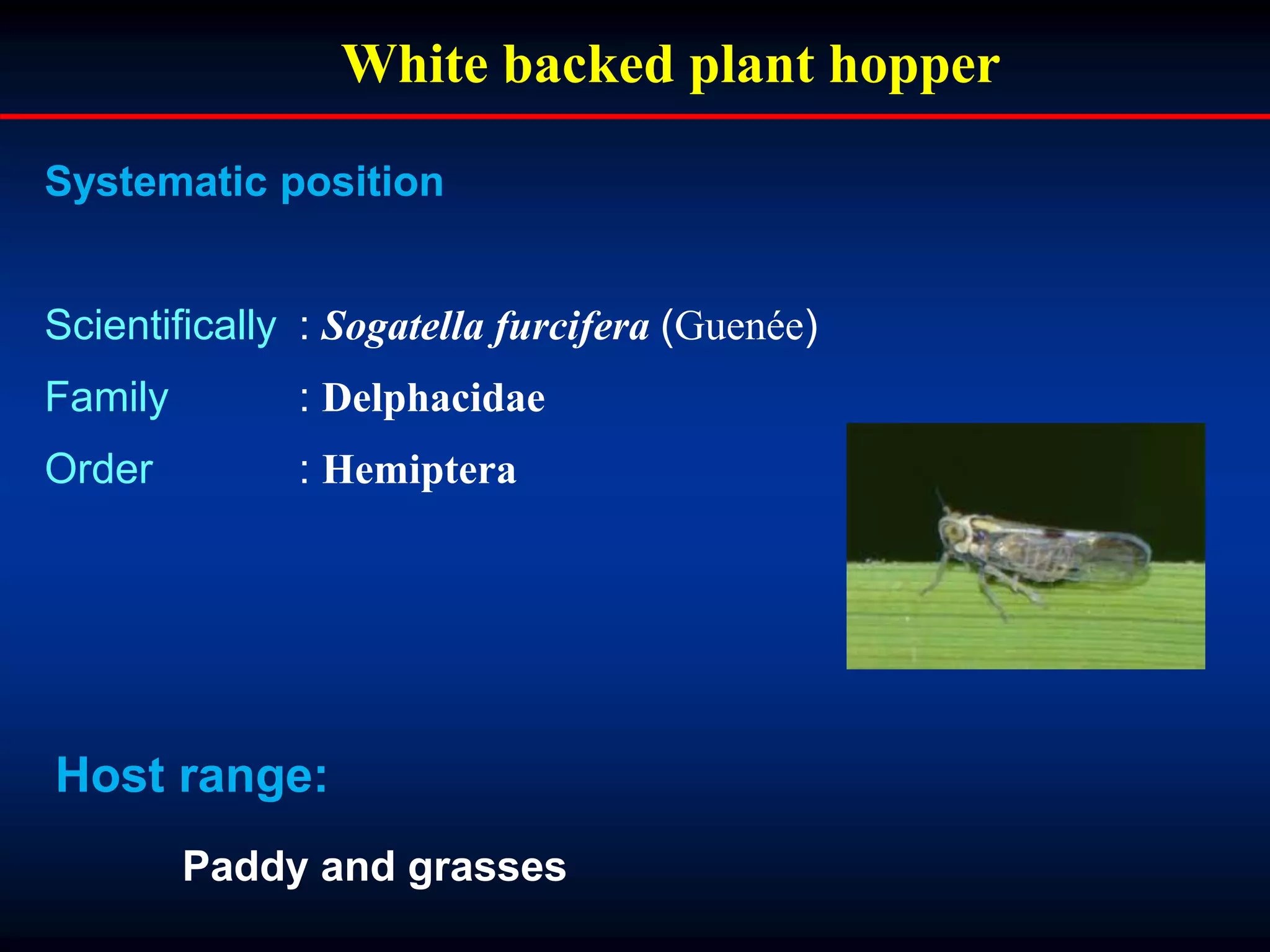
Systematic position
Scientifically : Sogatella furcifera (Guenée)
Family : Delphacidae
Order : Hemiptera
Host range:
Paddy and grasses
•White in colour and pronotum is pale yellow.
Adult - Possess a diamond like marking on the
thorax and ovipositional site is black streaks.
Male
Biology and Bionomics
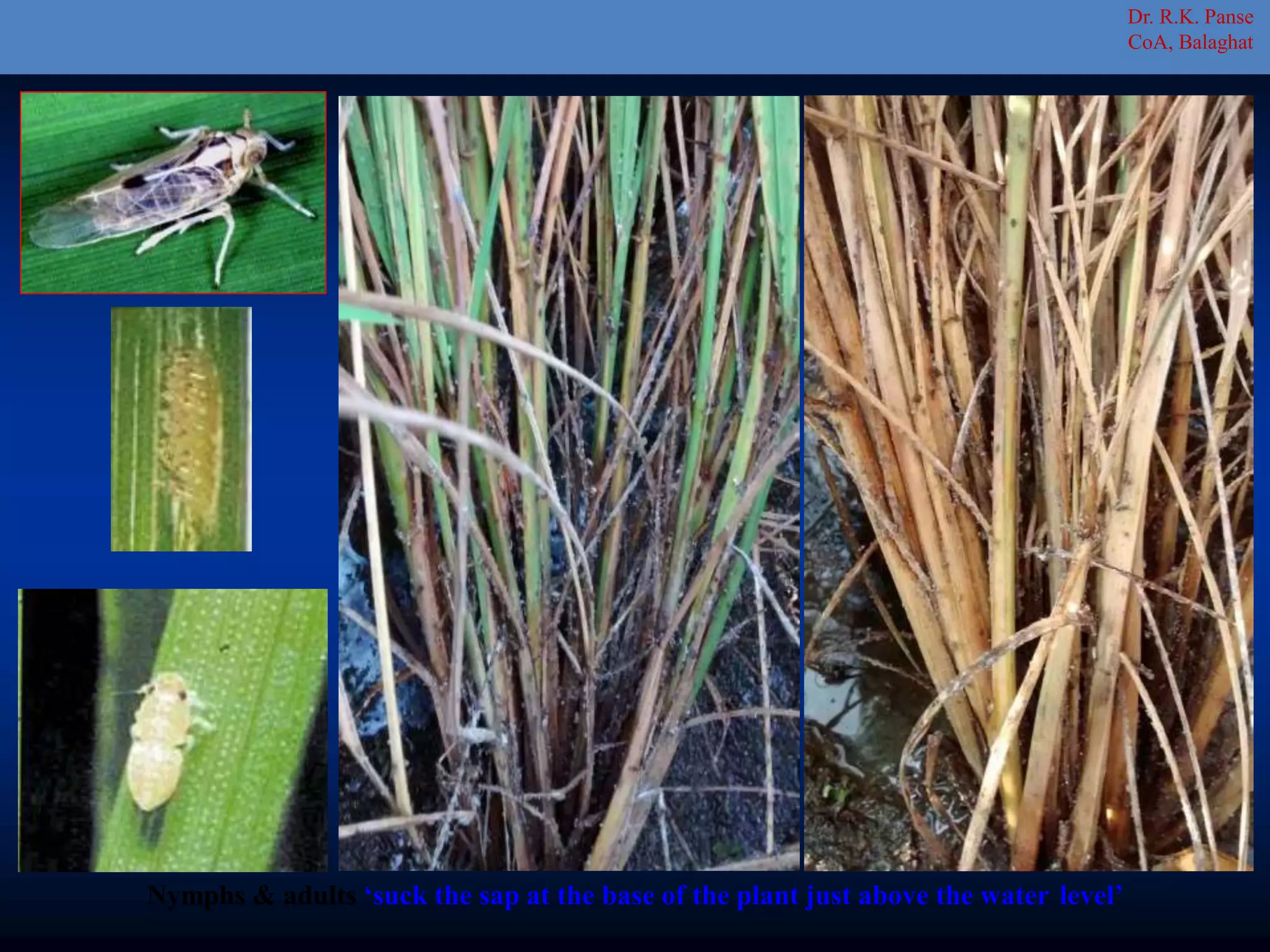
Nymphs & adults ‘suck the sap at the base of the plant just above the water level’
Dr. R.K. Panse
CoA, Balaghat
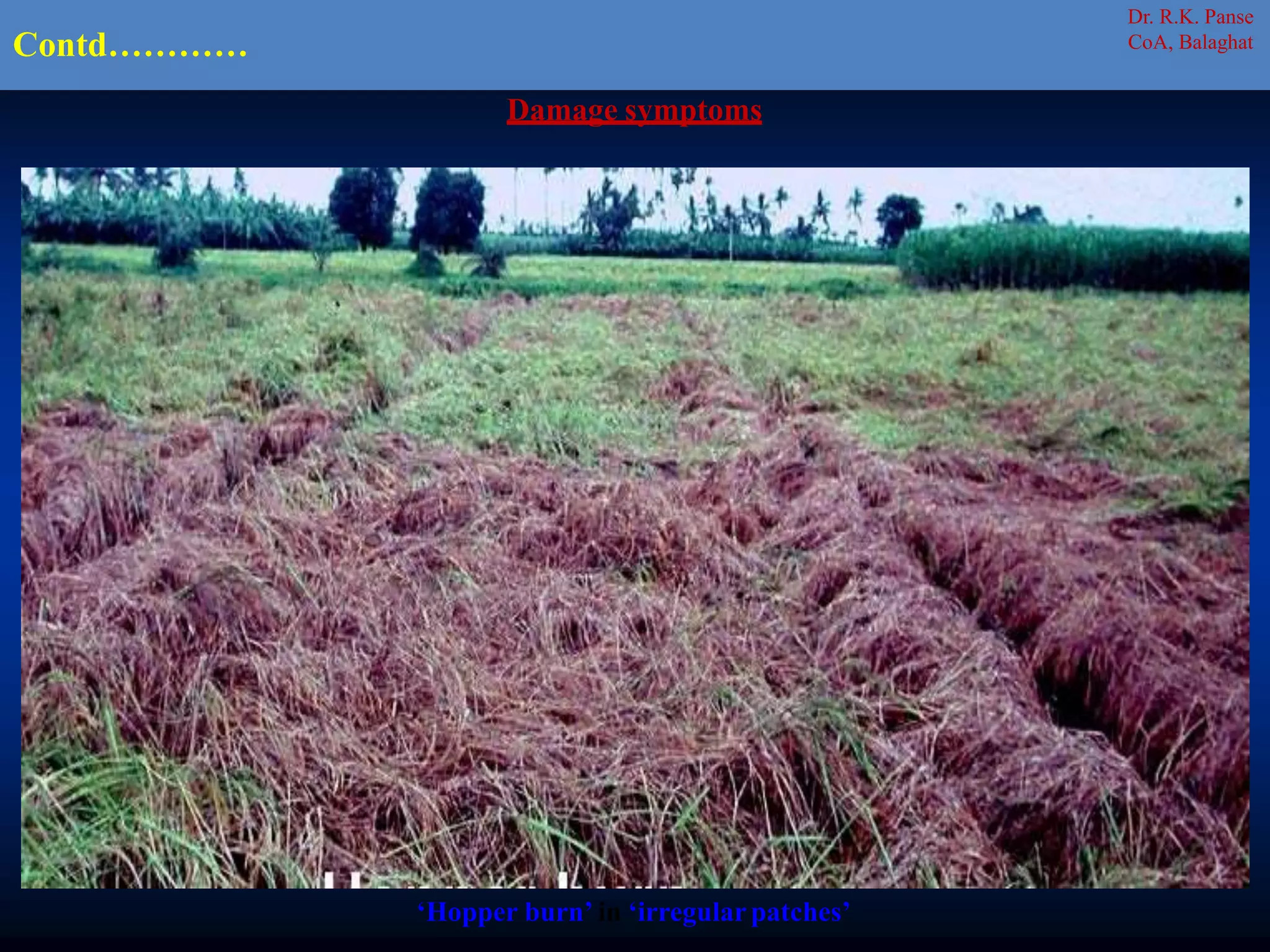
‘Hopper burn’ in ‘irregularpatches’
Damage symptoms
Contd…………
Dr. R.K. Panse
CoA, Balaghat
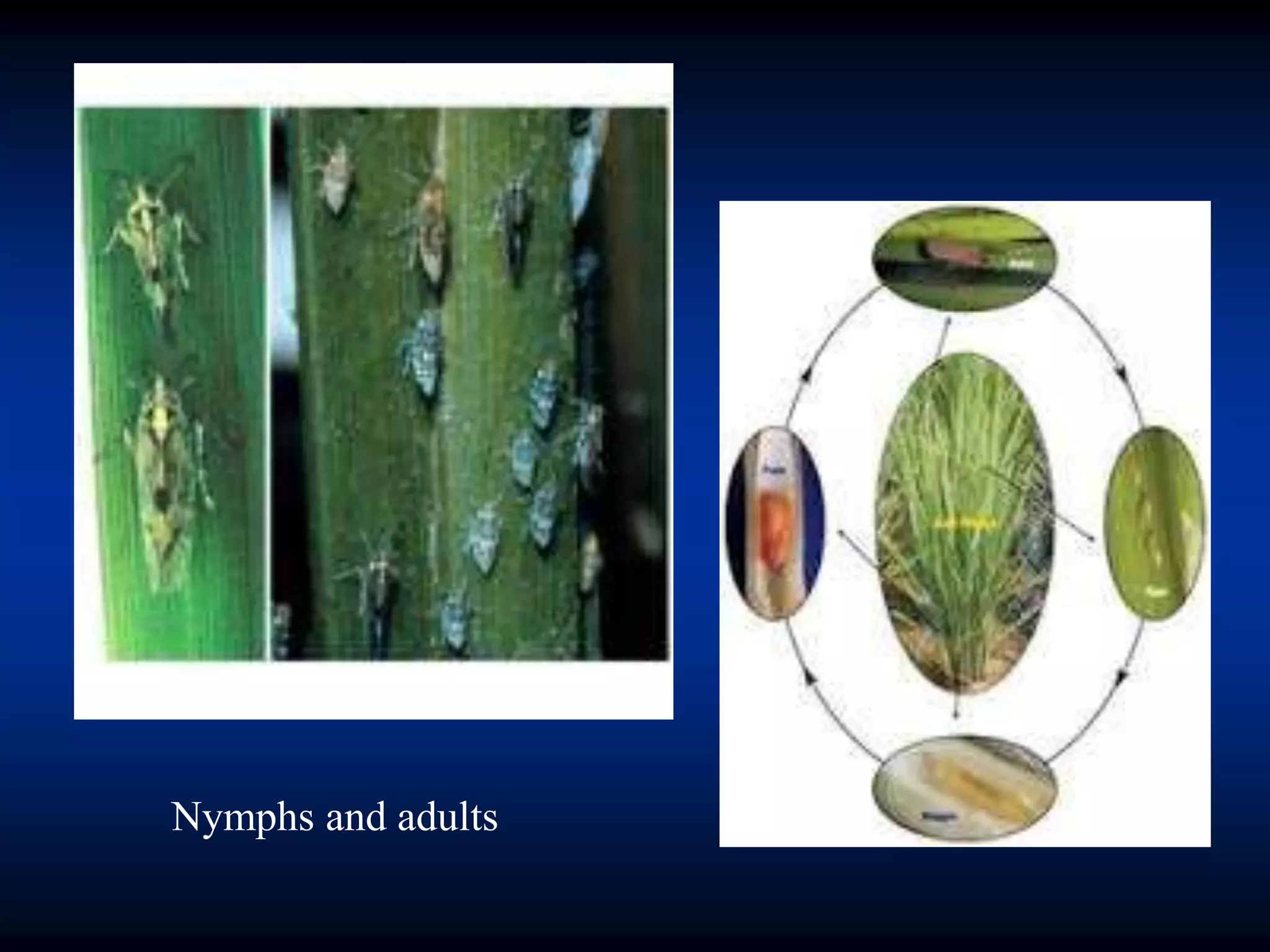
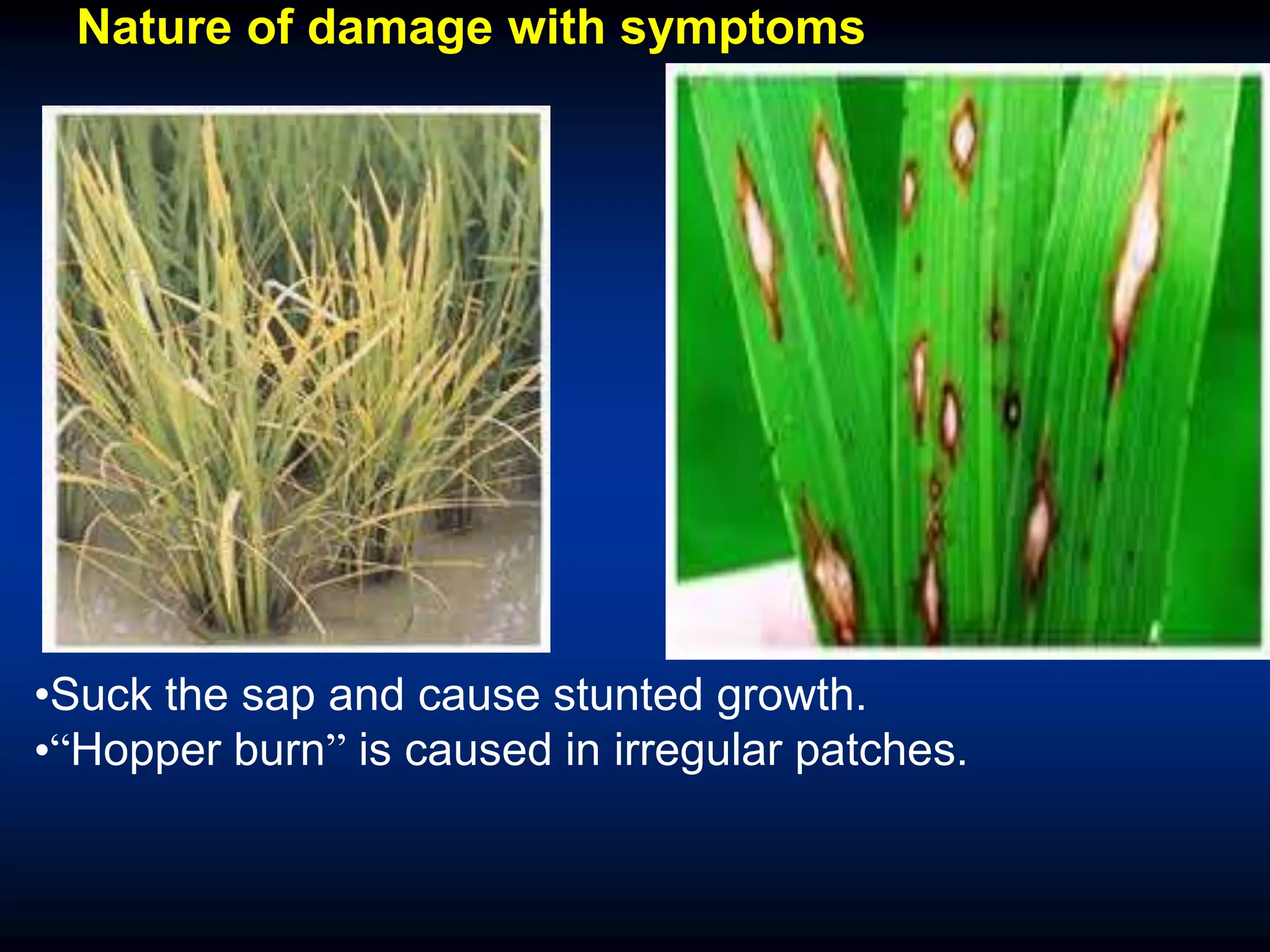
Nymphs and adults
•Suck the sap and cause stunted growth.
•“Hopper burn” is caused in irregular patches.
Nature of damage with symptoms
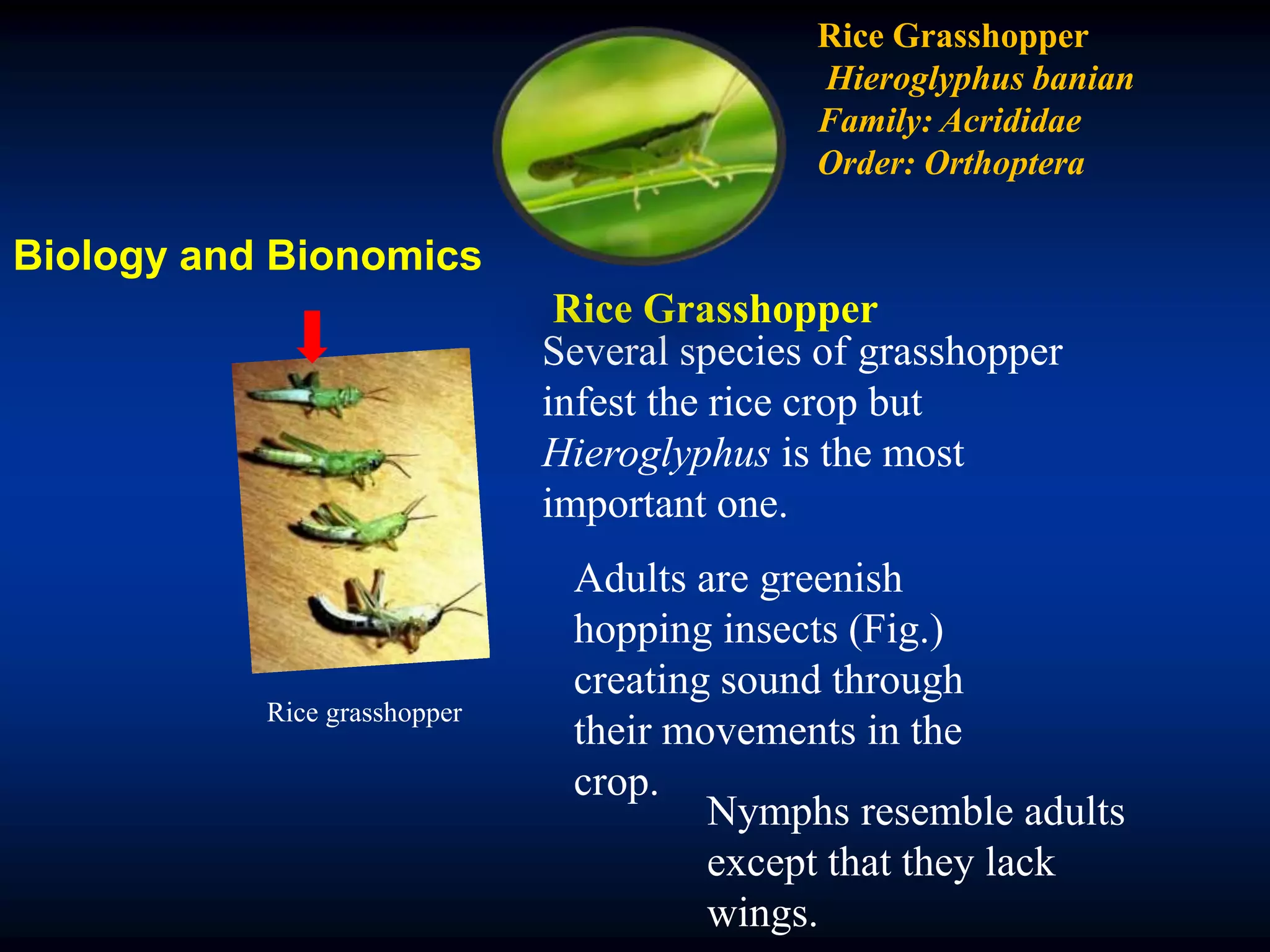
Rice grasshopper
Several species of grasshopper
infest the rice crop but
Hieroglyphus is the most
important one.
Adults are greenish
hopping insects (Fig.)
creating sound through
their movements in the
crop.
Nymphs resemble adults
except that they lack
wings.
Rice Grasshopper
Hieroglyphus banian
Family: Acrididae
Order: Orthoptera
Rice Grasshopper
Biology and Bionomics
Both adult and nymphs
feed on rice foliage.
In severe incidence they
consume the leaves
leaving midribs and
stalks (Fig.).
Notching leaves
Nature of damage with symptoms
IPM (Integrated Pest Management) for Rice
 Avoid use of excess nitrogenous fertilizer which induces BPH and
leaf folder
 Remove/destroy stubbles after harvest
 Trim field bunds and keep field free from weeds
 Control irrigation by intermittent draining to manage BPH
(Alternate wetting and drying of field)
 Avoid close planting, especially in BPH and leaf folder prone
areas/seasons
 Provide rogue spacing of 30 cm at every 2.5 m interval to take up
plant protection operation
 Use light traps to monitor incidence of pests
 Avoid resurgence inducing chemicals against BPH like Methyl
parathion and quinalphos
 Remove stem borer egg masses by dipping off tip of rice
seedling during transplanting
 Select and use resistant varieties against major pests
 Manage caseworm by passing rope on crop and draining
water
 Release egg parasitoid Trichogramma japonicum on 30
and 37th day after planting against stem bore.
 Release egg parasitoid T. chilonis and bacteria Bacillus
thuringiensis against leaf folder
 Use of Neem Seed Kernel Extract 5% (NSKE 5%)
or Neem oil 2% against Earhead bug
• Biocontrol: use of spiders (predators) eg:
Lycosa pseudoannulata (20 BPH/day)
THANKS

Lec. 2 rkp pcgm_paddy

  • 1.
    Lecture - 2 INSECTPESTS OF RICE R K Panse Asstt. Prof. (Entomology) CoA, Balaghat Subject: Pests of crop and stored grain and their Management
  • 2.
    RICE India has largestarea of 44.3 million ha under rice cultivation and stands second in production around 89.09 million t. Yield loss due to insect pests in rice in India is estimated to the tune of 25%. There are over 800 insect species damaging rice in one way or another but in tropical Asia only about 20 species are of major importance and of regular occurrence. Green leaf hopper , Brown plant hopper, Stem borer, Leaf folder, Gall midge, Swarming caterpillar, Rice gandi bug are important pests of rice.
  • 3.
    A. According toeconomic importance: 1. Major pests Stem borer Gall midge Leaf folder Brown plant hopper Green leaf hopper Swarming caterpillar Rice gandi bug 2. Miner pests Rice case worm Thrips White backed plant hopper Grasshopper Rice hispa Rice skipper Insect pests of rice categorized in to three groups
  • 4.
    B. According tofeeding nature: 1. Sap sucking: Green leaf hopper Brown plant leafhopper Rice gandi bug White backed plant hopper Thrips 2. Leaf feeder: Stem borer Leaf folder Gall midge Swarming caterpillar Rice case worm Grasshopper Rice hispa Rice skipper
  • 5.
    C. According todamaging place: 1. Nursery pests: Stem borer Green leaf hopper Case worm Swarming worm Thrips 2. Main field pests: Brown plant hopper Stem borer Leaf folder Gall midge Swarming caterpillar Rice gandi bug White backed plant hopper Thrips Grasshopper Rice hispa Rice skipper
  • 7.
    Systematic position Scientifically :Nephotettix Sp. virescens (Distant) & nigropictus (Stal.) Family : Cicadellidae Order : Homoptera Green leaf hopper Host range: Paddy and grasses
  • 8.
    Biology and Bionomics Female is green  Male has two black spots on the fore wings extending upto the distal portion.  It has a sub-marginal black band on the crown of the head.
  • 9.
     In N.virescens black sub-marginal band on the crown and the black spots on forewings are absent  Distal portion of forewing is brown. Cont..
  • 10.
    Nature of damagewith symptoms Both nymphs and adults suck the plant sap and cause Yellowing of leaves from tip to downwards. Vector for Rice tungro virus, rice yellow & transitory yellowing diseases Damaging stages: Nymph and adults
  • 11.
    ETL: 60 Nos./ 25 sweeping – Nursery 10 Nos. / hill - Flowering stage 5 Nos. / hill - Vegetative stage 2 Nos. / hill - Tungro endemic area •Acephate 75 SP 666-1000 g •Imidacloprid 17.8 SL 100 -125 ml •Fenobucarb (BPMC) 50 EC 500-1500 ml •Quinalphos 25 EC 1000 ml •Buprofezin 25 SC 800 ml •Phosphamidon 40 SL 875 ml •Ethofenoprox 10EC 500-750 ml •Thiamethoxam 25 WG 100 g •Fipronil 5 SC 1-1.5 kg or 0.3 GR 16.7 - 25.0 kg •Lambda-Cyhalothrin 2.5 EC 500 ml or 5 EC 250 ml Management 1. Nursery should not be raised near the lamp posts. 2. Apply neem cake @ 12.5 kg/800 m2 nursery as basal dose. 3. Apply carbofuran 3 G @ 3.5 kg or phorate 10 G @ 1.0 kg or quinalphos 25 EC 80 ml. Maintain the water level at 2.5 cm for 3 days after granular application. 4. Spray any of the following insecticide in 500 L water/ha
  • 12.
    Brown plant hopper Systematicposition Scientifically : Nilaparvata lugens (Stal.) Family : Delphacidae Order : Homoptera Host range: Paddy and grasses
  • 13.
    The brown planthopper has a brown body. Adult measures about 4 - 4.5 mm in length capable of flying a long distance drifting with the wind. Adults are of two forms viz., macropterous (long winged) and brachypterous (short winged). Biology and Bionomics
  • 14.
    Brachypterous - Weakfliers & prolificbreeders Macropterous - Strong fliers Adult identification Dr. R.K. Panse CoA, Balaghat
  • 15.
    Adult Life cycle Egg (5-6 days) Nymph (15-18days) TLC: 20-24days Dr. R.K. Panse CoA, Balaghat BPH
  • 16.
     Affected plantdries up and gives a scorched appearance called “hopper burn”.  Circular patches of drying and lodging of matured plant Nature of damage with symptoms
  • 17.
    Grassy stunt It isvector of grassy stunt, ragged stunt and wilted stunt diseases Nymphs and adults congregate at the base of the plant above the water level Cont.. Damaging stages: Nymph and adults
  • 18.
    Nature of damage Nymphs& adults ‘suck the sap at the base of the plant just above the water level’ Contd……. Dr. R.K. Panse CoA, Balaghat BPH
  • 19.
    Management: Cultural practices Avoid useof excess nitrogen. Monitoring of GLH at base of the plant 30 days after transplanting at weekly interval Alternate wetting and drying the field during peak infestation. Apply split dose of nitrogenous fertilizers Biological control:  Use Mirid bug Cyrtorhinus lividipennis or golf spider Chemical control:  Application of granular phorate 10G@ 4kg/acre or carbofuran 3G@ 10kg/acre . Spray imidacloprid 200 SL @ 0.5ml (125ml/acre) or thiomethaxm 25WG @ 0.5g (125kg/acre) or ETL: 8-10 Nos./hill or 20 Nos./hill when spider is present at 1 No./hill
  • 20.
    Rice stem borer Systematicposition Scientifically : Scirpophaga incertulas (Walker) Family : Pyraustidae (Pyralidae) Order : Lepidoptera Host range: Paddy
  • 21.
    Egg - Laidin a mass and covered with buff coloured hairs. Larva - Pale yellow with dark brown head. Pupa - White silken cocoon. Biology and Bionomics
  • 22.
    Adult Female moth -bright yellowish brown fore wings with a black spot possess a tuft of yellow hairs. Male moth - Smaller with pale yellow forewings without black spot.
  • 23.
    Adult Life cycle Egg (5-8 days) Larva (33-41days) Pupa (6-10 days) TLC: 44-59days
  • 24.
    Larva feeds insidethe stem causing drying of the central shoot called ‘dead heart’ in young plant or drying of the panicle called ‘white ear’ in older plants. Presence of brown coloured egg mass near leaf tip. ETL 2 egg masses/ m2 10% dead hearts - Vegetative stage 2% white ear - Flowering Nature of damage with symptoms
  • 25.
    Nature of damage Larva‘bores into the stem’ & feeds on ‘inter content of the stem’ Dr. R.K. Panse CoA, Balaghat Yellow stem borer Damaging stage: Larvae
  • 26.
    Damage symptoms ‘Dead heart’at vegetative stage ‘White ear’ at reproductive stage Yellow stem borer Dr. R.K. Panse CoA, Balaghat
  • 27.
    Management • Clip theseedling tips. • Avoid close planting & continuous water stagnation at early stages. • Collect and destroy the dead hearts and white ears. • Set up light traps to attract and kill the moths. • Install sex pheromone traps to monitor and mass trap. • Release the egg parasitoid, Trichogramma japonicum twice on 30 and 37 DAT @ 5 cc/ha/release. • Apply Bacillus thuringiensis var kurstaki and neem seed kernel extract in the combination of 2.5 g/L and 1% to reduce the oviposition by the stem borer. • Apply carbofuran 3 G @ 25 kg or chlorantraniliprole 0.4 G 10 kg or fipronil 0.3 G 17-25 kg or cartap hydrochloride 4 G 18.75 kg or spray acephate 75 SP 666-1000 g or monocrotophos 36 SL 1.0 L or quinalphos 25 EC 1.0 L or azadirachtin 5 % 400 ml or carbosulfan 25 EC 800-1000 ml or chlorantraniliprole 18.5 SC 150 ml or ethofenoprox 10 EC 500-750 ml or fipronil 5 SC 1-1.5 L flubendiamide 39.35 M/M SC 50 ml or lambda-cyhalothrin 2.5 EC 500 ml/ 5 EC 250 ml per ha using water @ 500 L/ha • Harvest the crop up to the ground level.
  • 28.
    Rice leaf folder Systematicposition Scientifically : Cnaphalocrocis medinalis (Guen.) Family : Pyraustidae (Pyralidae) Order : Lepidoptera Host range: Polyphagous
  • 29.
  • 30.
    The brownish –orange moth On forewing Two dark wavy lines and one on hind wing. Both wings have a dark brown to grey band on their outer margin. Larva: Greenish translucent Egg - Flat, oval in shape and white in colour. Newly formed pupa is light brown, but turns reddish brown in later stage. Biology and Bionomics
  • 31.
    Leaves fold longitudinally andlarvae remains inside. Larvae scrapes the green tissues of the leaves and becomes white and dry. In a severely infested field the whole crop gives a sickly appearance with white patches. The infestation at boot leaf stage of the crop sometimes results in heavy loss of grain yield. Nature of damage with symptoms
  • 32.
    Larva ‘folds marginsof leaf blade together with its saliva’ & ‘feeds within’ by ‘scrapping green tissues’ Nature of damage Contd…. Dr. R.K. Panse CoA, Balaghat Leaf folder Damaging stage: Larvae
  • 33.
    ‘White / brownpatches’ on upper surface. Under severe infestation, ‘Broom-stick’ appearance of plant Damage symptoms Contd…. Leaf folder Dr. R.K. Panse CoA, Balaghat
  • 34.
    ETL: 2 freshlydamaged leaves / hill or 10% damage to leaves at vegetative stage 5% damage to leaves at boot leaf stage Management  Monitoring  Set-up light traps @ 1 trap / acre  Preventive measures  Avoid excess use of nitrogen fertilizers  Apply ‘K’ at higher dose  Curative measures  Inundative release of Trichogramma chilonis @ 50,000/ha/week for 5-6 times  Spray Metarhizium rileyi @ 2-5g/l (2X10⁸ CFU/g)  Spray B.t. products @ 2g/ml  Spray azadarachtin 1EC @ 2ml/l  Spray flubendiamide 20 WG @ 0.25gl/l or indaxocarb 14.5SC @ 0.5 ml/l Contd…. Dr. R.K. Panse CoA, Balaghat Leaf folder
  • 35.
    Distribution: It isdestructive in some parts of Kerala, Orissa, Andhra Pradesh, Madhya Pradesh and Bihar. Rice gall midge Systematic position Scientifically : Orseolia oryzae (Wood-Mason) Family : Cecidomyiidae Order : Diptera Host range: Paddy and grasses
  • 36.
    Egg: Reddish, elongate, tubulareggs just near the ligula of the leaf blade Larva: Maggot is pale to red colour feeds inside the gall. Pupa: pupates at the base of the gall and moves to tip of the gall Adult: Adult is orange coloured mosquito like fly Biology and Bionomics
  • 37.
    Maggot feeds on‘apical bud’ by lacerating the green tissues & inject ‘a chemical’ called ‘Cecidgen’ into the ‘tissues’ Dr. R.K. Panse CoA, BalaghatDamaging stage: Maggot
  • 38.
    Damage symptoms ‘Gall’ inthe form of ‘silver shoot or onion shoot or anekombu’ Contd………. Gall midge Dr. R.K. Panse CoA, Balaghat
  • 39.
    Contd………. ETL: 1 gall/m2or 5% affected tillers or 5% galls Management  Preventive measures  Avoid late planting  Cleaning the field bunds  Drain out water from field and apply following insecticides  Curative measures Insecticide Formulation Dosage Buprofezin 25 EC 1 ml/l Thiamethoxam 25 WG 0.2g/l Carbofuran 3G 25 kg/ha Fipronil 0.3 G 17.5 kg/ha Dr. R.K. Panse CoA, Balaghat Gall midge
  • 40.
    Maggot feeds atthe base of the growing shoot The gall formed by this fly is popularly known as ‘silver shoot’ or ‘onion shoot’.  It infests the rice even in the nursery but usually tillers are preferred. The loss in yield in a heavily infested crop may be up to 50 %. Nature of damage with symptoms
  • 41.
    Management  Encourage earlyplanting of the crop with quick growing varieties.  Plough immediately after crop harvest.  Remove the alternate host.  Apply fertilizers in balanced manner.  Set up light trap @ 1 / ha. Infra red light trap attracts gall midge.  Release larval parasitoid, Platygaster oryzae through parasitized galls @ 1 per 10 m2 in the main field at 10 days after transplanting (DAT).  Conserve predatory spiders like.  Apply carbofuran 3G @ 25 kg or fipronil 0.3 G 16.7 - 25.0 kg or spray quinalphos 25 EC 1.0 L or ethofenprox 10 EC 500-750 ml or fipronil 5 SC 1.0 -1.5 kg or lambda-cyhalothrin 2.5 EC 500 ml / 5 EC 250 ml or thiamethoxam 25 WG 100 g in 500 L water/ha ETL: 10% silver shoots.
  • 42.
    Rice earhead bug Systematicposition Scientifically : Leptocorisa acuta (Thunberg) Family : Coreidae Order : Hemiptera Host range: Paddy
  • 43.
    Eggs: Dark, reddishbrown and laid in rows of 10-15 on the leaves (or) panicles Nymphs: Green to brown. Adults: Slender with long legs and antennae. They are brownish green in colour, while disturbing it emittes stink odour Biology and Bionomics
  • 44.
     Sucking thesap from individual grains, which are in milky stage.  Black spots on the grains at the site of feeding puncture.  Buggy odour in rice field during milky stage Both the nymphs and adults feed on the sap of tender milky grains making them turn chaffy. Nature of damage with symptoms
  • 45.
    Damage symptoms ‘Brownish spot’on seeds; Further, ‘individual grains’ become ‘brown & discolored, and ‘shriveled’ Contd………. Gundhi bugs Dr. R.K. Panse CoA, BalaghatDamaging stage: Nymph and adults
  • 46.
    ETL: 5 bugs/100panicles or 1 bug/hill - flowering stage; 16 bugs/100 panicles or 3 bug/hill- milky stage. Management  Remove alternate host, Echinocloa from bunds and field.  Ensure synchronous planting on community basis in an area.  Use NSKE 5% or or Ipomoea leaf powder extract 5%.  Dust quinalphos 1.5 D or carbaryl 10 D or malathion 5 D @ 25 kg/ha or spray malathion 50 EC 500 ml or monocrotophos 36 WSC 500 ml/ha.
  • 47.
    Swarming caterpillar Systematic position Scientifically: Spodoptera mauritia (Guenée) Family : Noctuidae Order : Lepidoptera Host range: Polyphagous
  • 48.
    Adult is amedium sized, grey- brown moth with black spots on forewings while its hind wings are whitish brown. Egg - Laid in masses on leaves and covered with grey hairs Larva - cylindrical dark to pale green with lateral lines along the body Pupa - Pupates in soil with radish colour Biology and Bionomics
  • 49.
    Larvae cut theseedlings in large scale They feed gregariously and march from field to field. Larvae damage the crop. In the nursery the seedlings are cut and completely eaten up as if grazed by cattle. Incidence of this pest has been found to be more after heavy rains or after floods. Nature of damage with symptoms Damaging stage: Larvae
  • 50.
    Management • Conserve larvalparasitoids viz., Apanteles and Chelonus sp. • Protect vertebrate predators of the larvae viz., House Crow, Jungle Crow and Indian Myna. • Flood the nursery to expose the hiding larvae to the surface for birds to pick them up. • Kerosenate water during irrigation to suffocate and kill the larvae. • Allow ducks into the field to feed on the larvae. • Drain water from nursery and spray chlorpyriphos 20 EC 80 ml during late evening.
  • 51.
    White backed planthopper Systematic position Scientifically : Sogatella furcifera (Guenée) Family : Delphacidae Order : Hemiptera Host range: Paddy and grasses
  • 52.
    •White in colourand pronotum is pale yellow. Adult - Possess a diamond like marking on the thorax and ovipositional site is black streaks. Male Biology and Bionomics
  • 53.
    Nymphs & adults‘suck the sap at the base of the plant just above the water level’ Dr. R.K. Panse CoA, Balaghat
  • 54.
    ‘Hopper burn’ in‘irregularpatches’ Damage symptoms Contd………… Dr. R.K. Panse CoA, Balaghat
  • 55.
  • 56.
    •Suck the sapand cause stunted growth. •“Hopper burn” is caused in irregular patches. Nature of damage with symptoms
  • 57.
    Rice grasshopper Several speciesof grasshopper infest the rice crop but Hieroglyphus is the most important one. Adults are greenish hopping insects (Fig.) creating sound through their movements in the crop. Nymphs resemble adults except that they lack wings. Rice Grasshopper Hieroglyphus banian Family: Acrididae Order: Orthoptera Rice Grasshopper Biology and Bionomics
  • 58.
    Both adult andnymphs feed on rice foliage. In severe incidence they consume the leaves leaving midribs and stalks (Fig.). Notching leaves Nature of damage with symptoms
  • 59.
    IPM (Integrated PestManagement) for Rice  Avoid use of excess nitrogenous fertilizer which induces BPH and leaf folder  Remove/destroy stubbles after harvest  Trim field bunds and keep field free from weeds  Control irrigation by intermittent draining to manage BPH (Alternate wetting and drying of field)  Avoid close planting, especially in BPH and leaf folder prone areas/seasons  Provide rogue spacing of 30 cm at every 2.5 m interval to take up plant protection operation  Use light traps to monitor incidence of pests  Avoid resurgence inducing chemicals against BPH like Methyl parathion and quinalphos  Remove stem borer egg masses by dipping off tip of rice seedling during transplanting
  • 60.
     Select anduse resistant varieties against major pests  Manage caseworm by passing rope on crop and draining water  Release egg parasitoid Trichogramma japonicum on 30 and 37th day after planting against stem bore.  Release egg parasitoid T. chilonis and bacteria Bacillus thuringiensis against leaf folder  Use of Neem Seed Kernel Extract 5% (NSKE 5%) or Neem oil 2% against Earhead bug
  • 61.
    • Biocontrol: useof spiders (predators) eg: Lycosa pseudoannulata (20 BPH/day)
  • 62.