EHTISHAM ALI HUSSAIN
BAGF15E258
University College Of Agriculture,
University of Sargodha
CLASSIFICATION
 Kingdom:Animalia
 Phylum:Arthropoda
 Class:Insecta
 Order:Coleoptera
 Family:Coccinellidae
 Genus:Epilachna
 Species:E. vigintioctopunctata
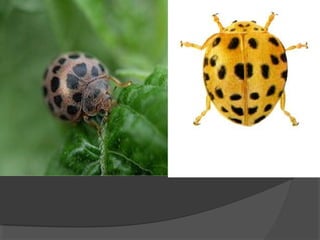
 Henosepilachna vigintioctopunctata is  a 
species  of beetle in  the  family Coccinellidae. 
It  is  commonly  known  as  the 28-spotted
potato ladybird or the Hadda beetle.It feeds 
on  the  foliage  of potatoes and  other 
solanaceous crops.  It  originated  in  the  far 
east  of Russia.  It  was  previously  called 
Epilachna vigintioctopunctata and  is  a 
cryptic species complex
ADULT
 The  body  of  the  28-spotted  potato  ladybird  is 
nearly  round,  convex,  glossy  and  up  to  seven 
millimetres long. It is reddish-brown with thirteen 
black spots on each elytron and one or more on 
each  side  of  the  thorax.  The eggs  are  yellow, 
about 1.5 millimetres long and are placed on the 
undersides of leaves in batches of ten to sixty five 
eggs.  The  oval larvae and pupae are  yellow-
green  decorated  with  black  branched  thorny 
appendices.  The  beetles  and  larvae  live  openly 
on the leaves, eating the soft tissues between the 
veins.  The  female  ladybird  may  produce  300  to 
400 eggs
 The development stages are completed
in four to six weeks under optimal
conditions. The larvae pupate on the
leaves and young beetles of the new
generation feed intensively for one to
two weeks to build up their fatty tissue.
Only adults are capable of over-
wintering. They usually hibernate under
fallen leaves at the edges of woods, in
bushes or under plant residues in fields
DAMAGE
 This species causes damage to agricultural crops in
the three families Solanaceae (potato, tomato,
aubergine and pepper), Cucurbitaceae (cucumber,
melon, water-melon and pumpkin)
andFabaceae (soya and haricot beans). However
the optimal host plant for the reproduction of over-
wintered beetles and the development of their larvae
is the potato. The loss in yield of potato tubers may
reach 25% in heavy infestations. Control is by the
use of resistant varieties of plants, crop rotation, the
growing of solanaceous crops in open windy
locations, the destruction of all plant residues and
the use of pesticides when necessary
Hadda beetle

Hadda beetle

  • 1.
    EHTISHAM ALI HUSSAIN BAGF15E258 UniversityCollege Of Agriculture, University of Sargodha
  • 2.
    CLASSIFICATION  Kingdom:Animalia  Phylum:Arthropoda Class:Insecta  Order:Coleoptera  Family:Coccinellidae  Genus:Epilachna  Species:E. vigintioctopunctata
  • 3.
     Henosepilachna vigintioctopunctata is a  species  of beetle in  the  family Coccinellidae.  It  is  commonly  known  as  the 28-spotted potato ladybird or the Hadda beetle.It feeds  on  the  foliage  of potatoes and  other  solanaceous crops.  It  originated  in  the  far  east  of Russia.  It  was  previously  called  Epilachna vigintioctopunctata and  is  a  cryptic species complex
  • 4.
    ADULT  The  body of  the  28-spotted  potato  ladybird  is  nearly  round,  convex,  glossy  and  up  to  seven  millimetres long. It is reddish-brown with thirteen  black spots on each elytron and one or more on  each  side  of  the  thorax.  The eggs  are  yellow,  about 1.5 millimetres long and are placed on the  undersides of leaves in batches of ten to sixty five  eggs.  The  oval larvae and pupae are  yellow- green  decorated  with  black  branched  thorny  appendices.  The  beetles  and  larvae  live  openly  on the leaves, eating the soft tissues between the  veins.  The  female  ladybird  may  produce  300  to  400 eggs
  • 5.
     The developmentstages are completed in four to six weeks under optimal conditions. The larvae pupate on the leaves and young beetles of the new generation feed intensively for one to two weeks to build up their fatty tissue. Only adults are capable of over- wintering. They usually hibernate under fallen leaves at the edges of woods, in bushes or under plant residues in fields
  • 6.
    DAMAGE  This speciescauses damage to agricultural crops in the three families Solanaceae (potato, tomato, aubergine and pepper), Cucurbitaceae (cucumber, melon, water-melon and pumpkin) andFabaceae (soya and haricot beans). However the optimal host plant for the reproduction of over- wintered beetles and the development of their larvae is the potato. The loss in yield of potato tubers may reach 25% in heavy infestations. Control is by the use of resistant varieties of plants, crop rotation, the growing of solanaceous crops in open windy locations, the destruction of all plant residues and the use of pesticides when necessary