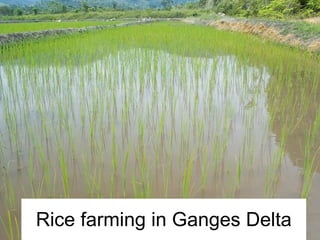
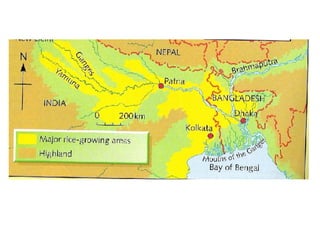
Rice farming in Ganges Delta
 
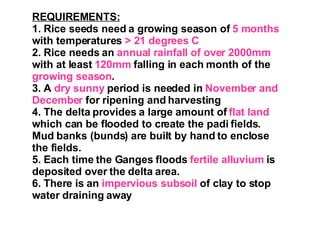
REQUIREMENTS: 1. Rice seeds need a growing season of  5 months  with temperatures  > 21 degrees C 2. Rice needs an  annual rainfall of over 2000mm  with at least  120mm  falling in each month of the  growing season . 3. A  dry sunny  period is needed in  November and December  for ripening and harvesting 4. The delta provides a large amount of  flat land  which can be flooded to create the padi fields.  Mud banks (bunds) are built by hand to enclose the fields. 5. Each time the Ganges floods  fertile alluvium  is deposited over the delta area. 6. There is an  impervious subsoil  of clay to stop water draining away
5 months when T o C > 21 o C 120mm rainfall each month in growing season Nov / Dec dry sunny period
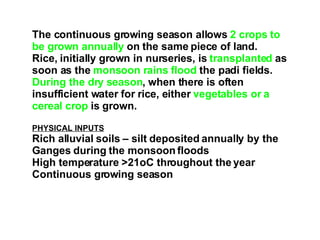
The continuous growing season allows  2 crops to be grown annually  on the same piece of land. Rice, initially grown in nurseries, is  transplanted  as soon as the  monsoon rains flood  the padi fields. During the dry season , when there is often insufficient water for rice, either  vegetables or a cereal crop  is grown. PHYSICAL INPUTS Rich alluvial soils – silt deposited annually by the Ganges during the monsoon floods High temperature >21oC throughout the year Continuous growing season
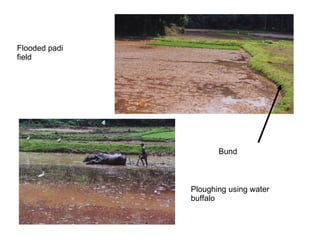
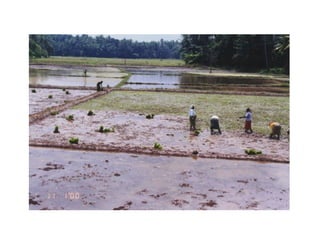
Bund Flooded padi field Ploughing using water buffalo
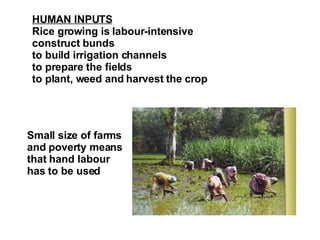
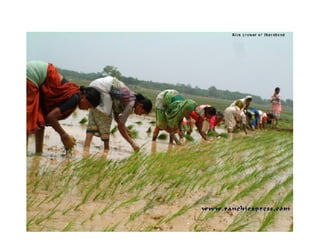
HUMAN INPUTS Rice growing is labour-intensive construct bunds to build irrigation channels to prepare the fields to plant, weed and harvest the crop Small size of farms and poverty means that hand labour has to be used
 
PROCESSESS Planting rice in nursery Ploughing Transplanting rice into padi fields Planting winter wheat Growing vegetables Looking after chickens
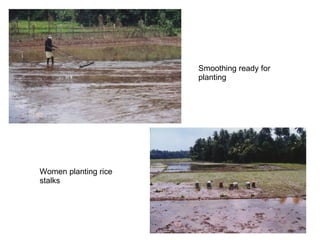
Women planting rice stalks Smoothing ready for planting
Subsistence farming grew up on the flood plain of the Ganges.  It was based on village units of 500 - 5000 people one or two large land owning families several families owning small areas of land several families renting land from the large landowners landless farmers who worked for the landowners when possible 'craftsmen' families. The larger farmers usually produced a surplus which they sold.  Smaller farmers produced a surplus in good years, but often they and the landless farmers fell into debt in bad years.
 
There were occasional famines when the monsoon floods were late. However in 1950s and 1960s the population was increasing rapidly and famine and mass starvation were a serious threat. Problem could be tackled in 2 ways 1. slow down rate of population growth 2. increase food production
 
June 2005 Q4 Explain how physical factors have encouraged the growth of intensive rice cultivation in the area shown 4 marks 2003 SC Q9 The Ganges Delta is an important area for subsistence rice farming. Explain why rice grows well in the tropical monsoon climate of the Ganges Delta   2 marks 2003 Q3  Give three physical reasons why the Ganges Delta is a suitable area for growing rice   3 marks 2002 Q2d There are many advantages for rice farming in the Ganges Delta Explain three of these advantages 6 marks
2001 Q5c Describe the main differences between commercial farming in East Anglia and subsistence farming in the Ganges Delta.  Refer to at least three of the following in your answer Crops and their uses  labour  use of machinery  Government policies 6 marks

Rice Farming

  • 1.
    Rice farming inGanges Delta
  • 2.
  • 3.
    REQUIREMENTS: 1. Riceseeds need a growing season of 5 months with temperatures > 21 degrees C 2. Rice needs an annual rainfall of over 2000mm with at least 120mm falling in each month of the growing season . 3. A dry sunny period is needed in November and December for ripening and harvesting 4. The delta provides a large amount of flat land which can be flooded to create the padi fields. Mud banks (bunds) are built by hand to enclose the fields. 5. Each time the Ganges floods fertile alluvium is deposited over the delta area. 6. There is an impervious subsoil of clay to stop water draining away
  • 4.
    5 months whenT o C > 21 o C 120mm rainfall each month in growing season Nov / Dec dry sunny period
  • 5.
    The continuous growingseason allows 2 crops to be grown annually on the same piece of land. Rice, initially grown in nurseries, is transplanted as soon as the monsoon rains flood the padi fields. During the dry season , when there is often insufficient water for rice, either vegetables or a cereal crop is grown. PHYSICAL INPUTS Rich alluvial soils – silt deposited annually by the Ganges during the monsoon floods High temperature >21oC throughout the year Continuous growing season
  • 6.
    Bund Flooded padifield Ploughing using water buffalo
  • 7.
    HUMAN INPUTS Ricegrowing is labour-intensive construct bunds to build irrigation channels to prepare the fields to plant, weed and harvest the crop Small size of farms and poverty means that hand labour has to be used
  • 8.
  • 9.
    PROCESSESS Planting ricein nursery Ploughing Transplanting rice into padi fields Planting winter wheat Growing vegetables Looking after chickens
  • 10.
    Women planting ricestalks Smoothing ready for planting
  • 11.
    Subsistence farming grewup on the flood plain of the Ganges. It was based on village units of 500 - 5000 people one or two large land owning families several families owning small areas of land several families renting land from the large landowners landless farmers who worked for the landowners when possible 'craftsmen' families. The larger farmers usually produced a surplus which they sold. Smaller farmers produced a surplus in good years, but often they and the landless farmers fell into debt in bad years.
  • 12.
  • 13.
    There were occasionalfamines when the monsoon floods were late. However in 1950s and 1960s the population was increasing rapidly and famine and mass starvation were a serious threat. Problem could be tackled in 2 ways 1. slow down rate of population growth 2. increase food production
  • 14.
  • 15.
    June 2005 Q4Explain how physical factors have encouraged the growth of intensive rice cultivation in the area shown 4 marks 2003 SC Q9 The Ganges Delta is an important area for subsistence rice farming. Explain why rice grows well in the tropical monsoon climate of the Ganges Delta 2 marks 2003 Q3 Give three physical reasons why the Ganges Delta is a suitable area for growing rice 3 marks 2002 Q2d There are many advantages for rice farming in the Ganges Delta Explain three of these advantages 6 marks
  • 16.
    2001 Q5c Describethe main differences between commercial farming in East Anglia and subsistence farming in the Ganges Delta. Refer to at least three of the following in your answer Crops and their uses labour use of machinery Government policies 6 marks