Ribbon
Microphone
By Prof. Hitesh Dholakiya
E
n
g
i
n
e
e
r
i
n
g
F
u
n
d
a
Engineering Funda Android App Audio Video YT Playlist
Outlines
❖ Basics of Ribbon Microphone
❖ Structure of Ribbon Microphone
❖ Elements of Ribbon Microphone
❖ Working of Ribbon Microphone
❖ Directivity of Ribbon Microphone
❖ Characteristics of Ribbon Microphone
❖ Features of Ribbon Microphone
❖ Applications of Ribbon Microphone
E
n
g
i
n
e
e
r
i
n
g
F
u
n
d
a
Engineering Funda Android App Audio Video YT Playlist
Basics
❖ Moving coil Microphone – high frequency response is poor due to
mass of the diaphragm.
❖ Mechanical mass is equivalent to inductance – attenuates higher
frequency.
❖ To increase frequency response – light weight aluminum ribbon is
used in place of diaphragm and coil assembly.
❖ Ribbon acts as a conductor (placed in a magnetic field) as well as a
diaphragm.
E
n
g
i
n
e
e
r
i
n
g
F
u
n
d
a
Engineering Funda Android App Audio Video YT Playlist
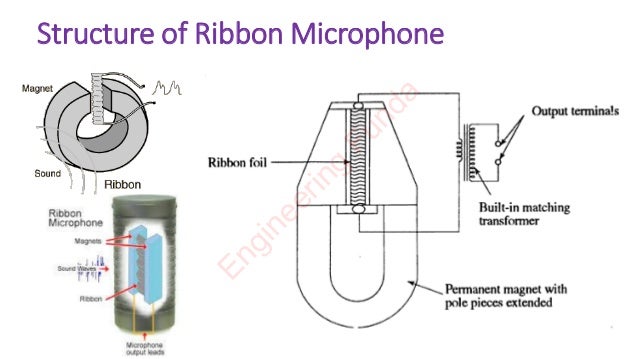
Structure of Ribbon Microphone
E
n
g
i
n
e
e
r
i
n
g
F
u
n
d
a
Elements
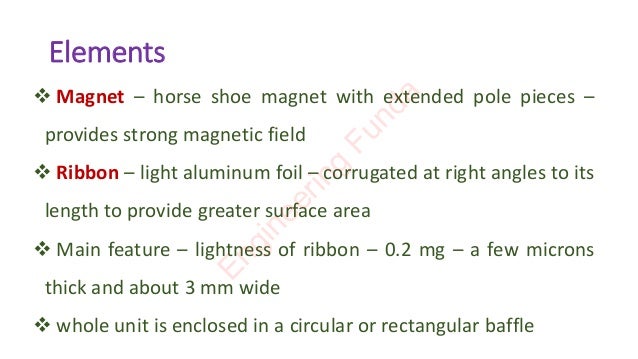
❖ Magnet – horse shoe magnet with extended pole pieces –
provides strong magnetic field
❖ Ribbon – light aluminum foil – corrugated at right angles to its
length to provide greater surface area
❖ Main feature – lightness of ribbon – 0.2 mg – a few microns
thick and about 3 mm wide
❖ whole unit is enclosed in a circular or rectangular baffle
E
n
g
i
n
e
e
r
i
n
g
F
u
n
d
a
Working
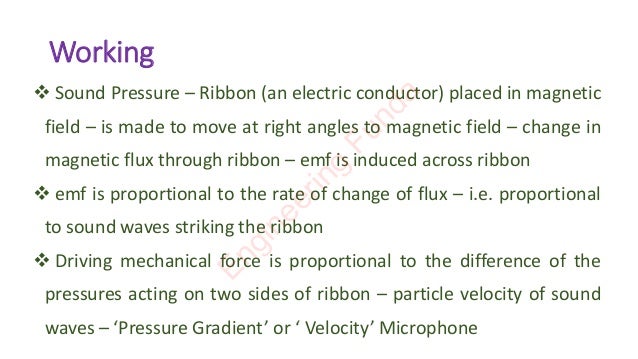
❖ Sound Pressure – Ribbon (an electric conductor) placed in magnetic
field – is made to move at right angles to magnetic field – change in
magnetic flux through ribbon – emf is induced across ribbon
❖ emf is proportional to the rate of change of flux – i.e. proportional
to sound waves striking the ribbon
❖ Driving mechanical force is proportional to the difference of the
pressures acting on two sides of ribbon – particle velocity of sound
waves – ‘Pressure Gradient’ or ‘ Velocity’ Microphone
E
n
g
i
n
e
e
r
i
n
g
F
u
n
d
a
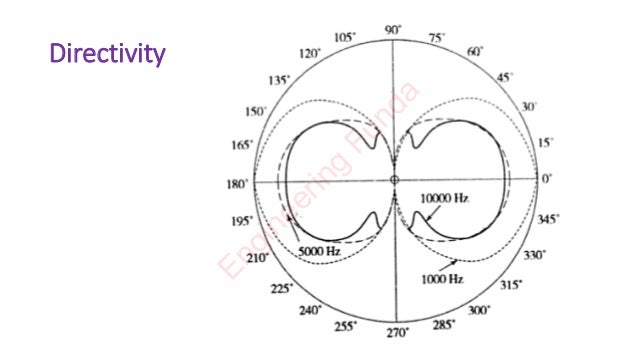
Directivity
E
n
g
i
n
e
e
r
i
n
g
F
u
n
d
a
Characteristics
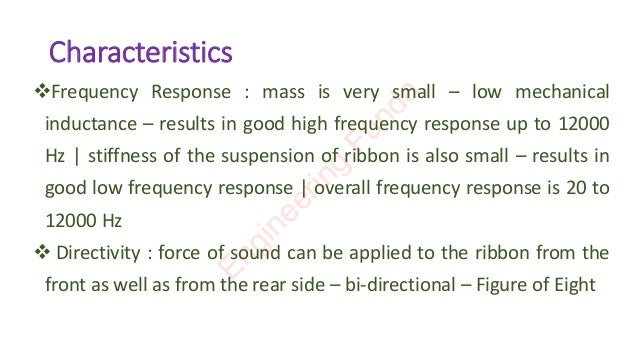
❖Frequency Response : mass is very small – low mechanical
inductance – results in good high frequency response up to 12000
Hz | stiffness of the suspension of ribbon is also small – results in
good low frequency response | overall frequency response is 20 to
12000 Hz
❖ Directivity : force of sound can be applied to the ribbon from the
front as well as from the rear side – bi-directional – Figure of Eight
E
n
g
i
n
e
e
r
i
n
g
F
u
n
d
a
Features
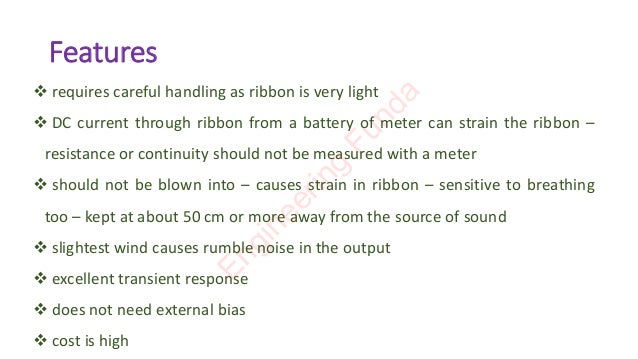
❖ requires careful handling as ribbon is very light
❖ DC current through ribbon from a battery of meter can strain the ribbon –
resistance or continuity should not be measured with a meter
❖ should not be blown into – causes strain in ribbon – sensitive to breathing
too – kept at about 50 cm or more away from the source of sound
❖ slightest wind causes rumble noise in the output
❖ excellent transient response
❖ does not need external bias
❖ cost is high
E
n
g
i
n
e
e
r
i
n
g
F
u
n
d
a
Applications
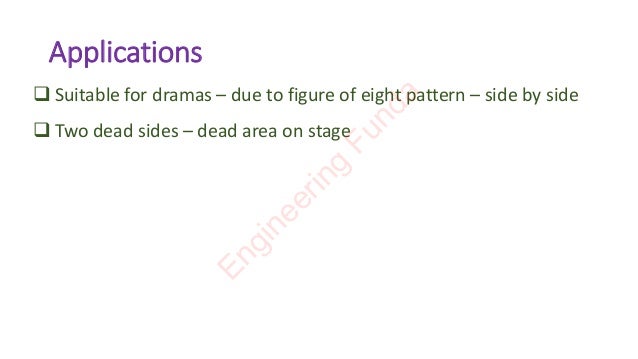
❑ Suitable for dramas – due to figure of eight pattern – side by side
❑ Two dead sides – dead area on stage
E
n
g
i
n
e
e
r
i
n
g
F
u
n
d
a

Ribbon Microphone

  • 1.
    Ribbon Microphone By Prof. HiteshDholakiya E n g i n e e r i n g F u n d a Engineering Funda Android App Audio Video YT Playlist
  • 2.
    Outlines ❖ Basics ofRibbon Microphone ❖ Structure of Ribbon Microphone ❖ Elements of Ribbon Microphone ❖ Working of Ribbon Microphone ❖ Directivity of Ribbon Microphone ❖ Characteristics of Ribbon Microphone ❖ Features of Ribbon Microphone ❖ Applications of Ribbon Microphone E n g i n e e r i n g F u n d a Engineering Funda Android App Audio Video YT Playlist
  • 3.
    Basics ❖ Moving coilMicrophone – high frequency response is poor due to mass of the diaphragm. ❖ Mechanical mass is equivalent to inductance – attenuates higher frequency. ❖ To increase frequency response – light weight aluminum ribbon is used in place of diaphragm and coil assembly. ❖ Ribbon acts as a conductor (placed in a magnetic field) as well as a diaphragm. E n g i n e e r i n g F u n d a Engineering Funda Android App Audio Video YT Playlist
  • 4.
    Structure of RibbonMicrophone E n g i n e e r i n g F u n d a
  • 5.
    Elements ❖ Magnet –horse shoe magnet with extended pole pieces – provides strong magnetic field ❖ Ribbon – light aluminum foil – corrugated at right angles to its length to provide greater surface area ❖ Main feature – lightness of ribbon – 0.2 mg – a few microns thick and about 3 mm wide ❖ whole unit is enclosed in a circular or rectangular baffle E n g i n e e r i n g F u n d a
  • 6.
    Working ❖ Sound Pressure– Ribbon (an electric conductor) placed in magnetic field – is made to move at right angles to magnetic field – change in magnetic flux through ribbon – emf is induced across ribbon ❖ emf is proportional to the rate of change of flux – i.e. proportional to sound waves striking the ribbon ❖ Driving mechanical force is proportional to the difference of the pressures acting on two sides of ribbon – particle velocity of sound waves – ‘Pressure Gradient’ or ‘ Velocity’ Microphone E n g i n e e r i n g F u n d a
  • 7.
  • 8.
    Characteristics ❖Frequency Response :mass is very small – low mechanical inductance – results in good high frequency response up to 12000 Hz | stiffness of the suspension of ribbon is also small – results in good low frequency response | overall frequency response is 20 to 12000 Hz ❖ Directivity : force of sound can be applied to the ribbon from the front as well as from the rear side – bi-directional – Figure of Eight E n g i n e e r i n g F u n d a
  • 9.
    Features ❖ requires carefulhandling as ribbon is very light ❖ DC current through ribbon from a battery of meter can strain the ribbon – resistance or continuity should not be measured with a meter ❖ should not be blown into – causes strain in ribbon – sensitive to breathing too – kept at about 50 cm or more away from the source of sound ❖ slightest wind causes rumble noise in the output ❖ excellent transient response ❖ does not need external bias ❖ cost is high E n g i n e e r i n g F u n d a
  • 10.
    Applications ❑ Suitable fordramas – due to figure of eight pattern – side by side ❑ Two dead sides – dead area on stage E n g i n e e r i n g F u n d a