About this page    Languages       User feedbacks     Citation       Uploads          Related species              FishBase
                                                                                                                  Advertisement
Lactarius lactarius (Bloch & Schneider, 1801)
False trevally Like 0
                                                                                                            You can sponsor this page
                  Upload your photos and videos                                     Add your observation in Fish Watcher
                    | All pictures | Google image |                        | Native range | All suitable habitat | PointMap | Year 2050 |


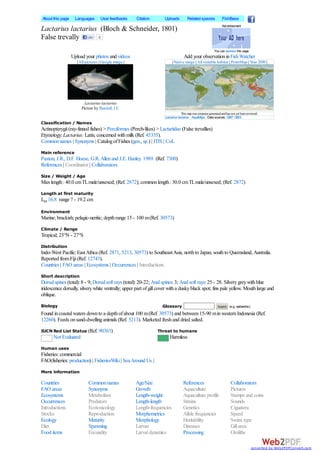
                         Lactarius lactarius
                       Picture by Randall, J.E.
                                                                                  This map was computer-generated and has not yet been reviewed.
                                                                     Lactarius lactarius AquaMaps Data sources: GBIF OBIS
Classification / Names
Actinopterygii (ray-finned fishes) > Perciformes (Perch-likes) > Lactariidae (False trevallies)
Etymology: Lactarius: Latin, concerned with milk (Ref. 45335).
Common names | Synonyms | Catalog of Fishes (gen., sp.) | ITIS | CoL
Main reference
Paxton, J.R., D.F. Hoese, G.R. Allen and J.E. Hanley. 1989. (Ref. 7300)
References | Coordinator | Collaborators
Size / Weight / Age
Max length : 40.0 cm TL male/unsexed; (Ref. 2872); common length : 30.0 cm TL male/unsexed; (Ref. 2872)
Length at first maturity
Lm 16.8 range ? - 19.2 cm

Environment
Marine; brackish; pelagic-neritic; depth range 15 - 100 m (Ref. 30573)
Climate / Range
Tropical; 23°N - 27°S
Distribution
Indo-West Pacific: East Africa (Ref. 2871, 5213, 30573) to Southeast Asia, north to Japan, south to Queensland, Australia.
Reported from Fiji (Ref. 12743).
Countries | FAO areas | Ecosystems | Occurrences | Introductions
Short description
Dorsal spines (total): 8 - 9; Dorsal soft rays (total): 20-22; Anal spines: 3; Anal soft rays: 25 - 28. Silvery grey with blue
iridescence dorsally, silvery white ventrally; upper part of gill cover with a dusky black spot; fins pale yellow. Mouth large and
oblique.
Biology                                                            Glossary                                    Search (e.g. epibenthic)

Found in coastal waters down to a depth of about 100 m (Ref. 30573) and between 15-90 m in western Indonesia (Ref.
12260). Feeds on sand-dwelling animals (Ref. 5213). Marketed fresh and dried salted.
IUCN Red List Status (Ref. 90363)                                Threat to humans
      Not Evaluated                                                     Harmless
Human uses
Fisheries: commercial
FAO(fisheries: production) | FisheriesWiki | Sea Around Us |
More information

Countries                  Common names               Age/Size                     References                            Collaborators
FAO areas                  Synonyms                   Growth                       Aquaculture                           Pictures
Ecosystems                 Metabolism                 Length-weight                Aquaculture profile                   Stamps and coins
Occurrences                Predators                  Length-length                Strains                               Sounds
Introductions              Ecotoxicology              Length-frequencies           Genetics                              Ciguatera
Stocks                     Reproduction               Morphometrics                Allele frequencies                    Speed
Ecology                    Maturity                   Morphology                   Heritability                          Swim. type
Diet                       Spawning                   Larvae                       Diseases                              Gill area
Food items                 Fecundity                  Larval dynamics              Processing                            Otoliths

                                                                                                                                          converted by Web2PDFConvert.com
Food consumption             Eggs                     Recruitment              Mass conversion        Brains
Ration                       Egg development          Abundance                Vision
Tools
E-book | Field guide | Length-frequency wizard | Life-history tool | Point map | Classification Tree | Catch-MSY |
Special reports
Check for Aquarium maintenance | Check for Species Fact Sheets | Check for Aquaculture Fact Sheets
Download XML
Summary page | Point data | Common names | Photos
Internet sources
BHL | BOLDSystems | Check for other websites | Check FishWatcher | CISTI | DiscoverLife | FAO(fisheries: ; publication :
search) | GenBank(genome, nucleotide) | GOBASE | Google Books | Google Scholar | Google | IGFA World Record | iSpecies
| National databases | PubMed | Scirus | SeaLifeBase | Tree of Life | uBio | Wikipedia(Go, Search) | World Records Freshwater
Fishing | Zoological Record | Fishtrace
Estimation of some characteristics with mathematical models

Phylogenetic diversity index (Ref. 82805)
PD50 = 1.5000 many relatives (e.g. carps) 0.5 - 2.0 few relatives (e.g. lungfishes)

Trophic Level (Ref. 69278)
4.0 s.e. 0.57 Based on food items.
Resilience (Ref. 69278)
High, minimum population doubling time less than 15 months (K=0.6)
Vulnerability (Ref. 59153)                                      Price category (Ref. 80766)
Low vulnerability (21 of 100)                                   Low
Entered by Luna, Susan M.                                           Modified by Kesner-Reyes, Kathleen
Back to Search               Fish Forum         Comments & Corrections         Sign our Guest Book       Back to Top
Random Species        Like   0     Send

Accessed through: Not available
FishBase mirror site : Beijing, China
Page last modified by : cmilitante - 03 July 2012
Total processing time for the page : 6.7354 seconds


                                                                                                                  converted by Web2PDFConvert.com

Lactarius lactarius

  • 1.
    About this page Languages User feedbacks Citation Uploads Related species FishBase Advertisement Lactarius lactarius (Bloch & Schneider, 1801) False trevally Like 0 You can sponsor this page Upload your photos and videos Add your observation in Fish Watcher | All pictures | Google image | | Native range | All suitable habitat | PointMap | Year 2050 | Lactarius lactarius Picture by Randall, J.E. This map was computer-generated and has not yet been reviewed. Lactarius lactarius AquaMaps Data sources: GBIF OBIS Classification / Names Actinopterygii (ray-finned fishes) > Perciformes (Perch-likes) > Lactariidae (False trevallies) Etymology: Lactarius: Latin, concerned with milk (Ref. 45335). Common names | Synonyms | Catalog of Fishes (gen., sp.) | ITIS | CoL Main reference Paxton, J.R., D.F. Hoese, G.R. Allen and J.E. Hanley. 1989. (Ref. 7300) References | Coordinator | Collaborators Size / Weight / Age Max length : 40.0 cm TL male/unsexed; (Ref. 2872); common length : 30.0 cm TL male/unsexed; (Ref. 2872) Length at first maturity Lm 16.8 range ? - 19.2 cm Environment Marine; brackish; pelagic-neritic; depth range 15 - 100 m (Ref. 30573) Climate / Range Tropical; 23°N - 27°S Distribution Indo-West Pacific: East Africa (Ref. 2871, 5213, 30573) to Southeast Asia, north to Japan, south to Queensland, Australia. Reported from Fiji (Ref. 12743). Countries | FAO areas | Ecosystems | Occurrences | Introductions Short description Dorsal spines (total): 8 - 9; Dorsal soft rays (total): 20-22; Anal spines: 3; Anal soft rays: 25 - 28. Silvery grey with blue iridescence dorsally, silvery white ventrally; upper part of gill cover with a dusky black spot; fins pale yellow. Mouth large and oblique. Biology Glossary Search (e.g. epibenthic) Found in coastal waters down to a depth of about 100 m (Ref. 30573) and between 15-90 m in western Indonesia (Ref. 12260). Feeds on sand-dwelling animals (Ref. 5213). Marketed fresh and dried salted. IUCN Red List Status (Ref. 90363) Threat to humans Not Evaluated Harmless Human uses Fisheries: commercial FAO(fisheries: production) | FisheriesWiki | Sea Around Us | More information Countries Common names Age/Size References Collaborators FAO areas Synonyms Growth Aquaculture Pictures Ecosystems Metabolism Length-weight Aquaculture profile Stamps and coins Occurrences Predators Length-length Strains Sounds Introductions Ecotoxicology Length-frequencies Genetics Ciguatera Stocks Reproduction Morphometrics Allele frequencies Speed Ecology Maturity Morphology Heritability Swim. type Diet Spawning Larvae Diseases Gill area Food items Fecundity Larval dynamics Processing Otoliths converted by Web2PDFConvert.com
  • 2.
    Food consumption Eggs Recruitment Mass conversion Brains Ration Egg development Abundance Vision Tools E-book | Field guide | Length-frequency wizard | Life-history tool | Point map | Classification Tree | Catch-MSY | Special reports Check for Aquarium maintenance | Check for Species Fact Sheets | Check for Aquaculture Fact Sheets Download XML Summary page | Point data | Common names | Photos Internet sources BHL | BOLDSystems | Check for other websites | Check FishWatcher | CISTI | DiscoverLife | FAO(fisheries: ; publication : search) | GenBank(genome, nucleotide) | GOBASE | Google Books | Google Scholar | Google | IGFA World Record | iSpecies | National databases | PubMed | Scirus | SeaLifeBase | Tree of Life | uBio | Wikipedia(Go, Search) | World Records Freshwater Fishing | Zoological Record | Fishtrace Estimation of some characteristics with mathematical models Phylogenetic diversity index (Ref. 82805) PD50 = 1.5000 many relatives (e.g. carps) 0.5 - 2.0 few relatives (e.g. lungfishes) Trophic Level (Ref. 69278) 4.0 s.e. 0.57 Based on food items. Resilience (Ref. 69278) High, minimum population doubling time less than 15 months (K=0.6) Vulnerability (Ref. 59153) Price category (Ref. 80766) Low vulnerability (21 of 100) Low Entered by Luna, Susan M. Modified by Kesner-Reyes, Kathleen Back to Search Fish Forum Comments & Corrections Sign our Guest Book Back to Top Random Species Like 0 Send Accessed through: Not available FishBase mirror site : Beijing, China Page last modified by : cmilitante - 03 July 2012 Total processing time for the page : 6.7354 seconds converted by Web2PDFConvert.com