METER
Lesson 2
Meter  refers to the repetitive arrangement of strong and weak
pulses or beats in a musical composition.
 comes from the Greek word metron, which means
“measure”.
 Each measure or cluster of notes represents a musical
composition’s rhythm.
 Notated at the beginning of a composition with a time
signature.
 Rhythm in music can be divided into groups called meters
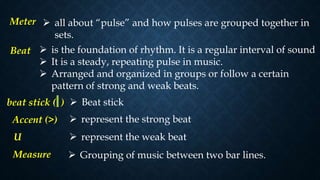
Meter  all about “pulse” and how pulses are grouped together in
sets.
Beat  is the foundation of rhythm. It is a regular interval of sound
 It is a steady, repeating pulse in music.
 Arranged and organized in groups or follow a certain
pattern of strong and weak beats.
 Beat stick
beat stick ( )
Accent (>)  represent the strong beat
U  represent the weak beat
Measure  Grouping of music between two bar lines.
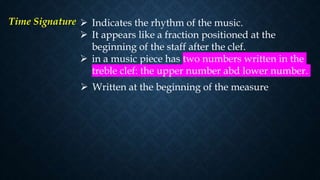
Time Signature  Indicates the rhythm of the music.
 It appears like a fraction positioned at the
beginning of the staff after the clef.
 in a music piece has two numbers written in the
treble clef: the upper number abd lower number.
 Written at the beginning of the measure
2
4
 This number indicates the number of
equal beats in a measure.
 In
2
4
,
3
4
, and
4
4
, the number on top indicates
that a measure will have 2,3, and 4 beats
respectively.
 This number indicates the kind of note that gets one beat.
 In this example, a quarter note ( ) receives one beat.
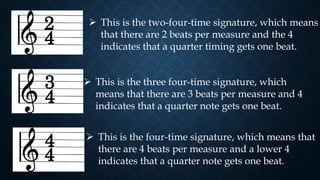
3
4
 This is the three four-time signature, which
means that there are 3 beats per measure and 4
indicates that a quarter note gets one beat.
4
4
 This is the four-time signature, which means that
there are 4 beats per measure and a lower 4
indicates that a quarter note gets one beat.
2
4
 This is the two-four-time signature, which means
that there are 2 beats per measure and the 4
indicates that a quarter timing gets one beat.
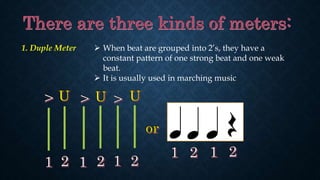
1. Duple Meter  When beat are grouped into 2’s, they have a
constant pattern of one strong beat and one weak
beat.
 It is usually used in marching music
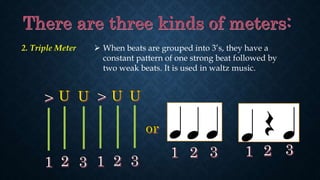
2. Triple Meter  When beats are grouped into 3’s, they have a
constant pattern of one strong beat followed by
two weak beats. It is used in waltz music.
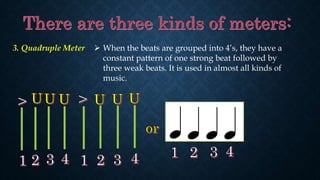
3. Quadruple Meter  When the beats are grouped into 4’s, they have a
constant pattern of one strong beat followed by
three weak beats. It is used in almost all kinds of
music.
Lesson 2_MAPEH 5-W2Q1 Meter .pptx

Lesson 2_MAPEH 5-W2Q1 Meter .pptx

  • 1.
  • 2.
    Meter  refersto the repetitive arrangement of strong and weak pulses or beats in a musical composition.  comes from the Greek word metron, which means “measure”.  Each measure or cluster of notes represents a musical composition’s rhythm.  Notated at the beginning of a composition with a time signature.  Rhythm in music can be divided into groups called meters
  • 3.
    Meter  allabout “pulse” and how pulses are grouped together in sets. Beat  is the foundation of rhythm. It is a regular interval of sound  It is a steady, repeating pulse in music.  Arranged and organized in groups or follow a certain pattern of strong and weak beats.  Beat stick beat stick ( ) Accent (>)  represent the strong beat U  represent the weak beat Measure  Grouping of music between two bar lines.
  • 4.
    Time Signature Indicates the rhythm of the music.  It appears like a fraction positioned at the beginning of the staff after the clef.  in a music piece has two numbers written in the treble clef: the upper number abd lower number.  Written at the beginning of the measure
  • 5.
    2 4  This numberindicates the number of equal beats in a measure.  In 2 4 , 3 4 , and 4 4 , the number on top indicates that a measure will have 2,3, and 4 beats respectively.  This number indicates the kind of note that gets one beat.  In this example, a quarter note ( ) receives one beat.
  • 6.
    3 4  This isthe three four-time signature, which means that there are 3 beats per measure and 4 indicates that a quarter note gets one beat. 4 4  This is the four-time signature, which means that there are 4 beats per measure and a lower 4 indicates that a quarter note gets one beat. 2 4  This is the two-four-time signature, which means that there are 2 beats per measure and the 4 indicates that a quarter timing gets one beat.
  • 7.
    1. Duple Meter When beat are grouped into 2’s, they have a constant pattern of one strong beat and one weak beat.  It is usually used in marching music
  • 9.
    2. Triple Meter When beats are grouped into 3’s, they have a constant pattern of one strong beat followed by two weak beats. It is used in waltz music.
  • 10.
    3. Quadruple Meter When the beats are grouped into 4’s, they have a constant pattern of one strong beat followed by three weak beats. It is used in almost all kinds of music.