External Rhinoplasty
assesment and techniques
Presenter- Dr. Abhineet
Moderator- Dr. R.R. Barle
Indications-
 Elaborate reduction & augmentation.
 Severe nasal trauma.
 Extensive revisions.
 Congenital deformities.
Pre op aesthetic assesment-
 Standard 35 mm photographs taken in
frontal, full lateral, basal and left & right
three qtr. Lateral view as gold standard
for pre op. evaluation.
 5 mega pixel camera with independent
flash lights.
Aesthetic terminology-
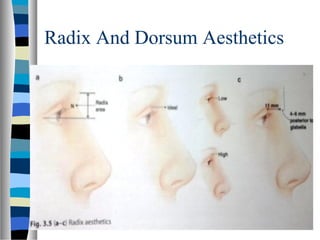
 Nasion-deepest point of NFA.
I. ideal location is set between lash and crease
line of upper lid.
II. Nasion height is measured from vertical
tangent to glabella.
 Dorsum-( on anterior view.)
I. Intercanthal width(EN-EN)
II. Parallel dorsal lines
III.Base bony width(X-X)
IV.Tip defining points / philtrum.
V. Alar width(AC-AC)
VI.Alar flatre(AL-AL)
Cont..
 On lateral view-
I. NFA -36* male/34* female measured from
ideal nasion(Ni) to ideal tip(Ti).
II. Ni to Ti i.e. length of nose is 2/3rd
of mid
facial height.
III. Ti- ideal tip projection(AC-Ti) is 2/3rd
of
length of nose.
IV. Final aesthetic line- concave for female/
flat for male. If a hump is present, the line is
drawn through it.
Radix And Dorsum Aesthetics
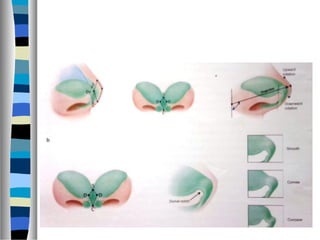
Dorsum And Tip Assesment
Tip aesthetic assesement-
 Intrinsic criterias- alar cartilage config’n.
I. Volume-size & shape of lateral crura.
II. Definition-convex domal & concave lateral
crura.
III.Width-interdomal distance between Ti.
 additional criterias-abutting structures.
I. Projection-intinsic & extrinsic.
II. Rotation- tip angle-105*
female/100*male.has inrinsic and extrinsic
factors.
III.Position- location of tip along the dorsal line.
Base aesthetic assesment-
1. Columella base.
2. Pillar.
3. Infralobule triangle.
4. Soft triangle.
5. Lateral wall.
6. Alar base.
7. Nostrill base.
8. Nostril.
Cont..
 Aesthetics of 4 components assesed-
I. Alar flare/width.
II. Columella.
III.CLA.
IV.Nostril.
ALWAYS
Make the tip fit the ideal dorsum
Operative sequence-
 General anaesthesia & local
anaesthetic injection
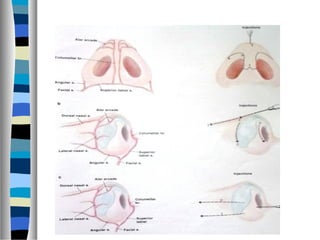
 Open approach incision
 Elevation of skin envelope.
 Septal exposure via transfixion incision.
 Creation of symmetrical alar rim strip.
 Incremental hump reduction.
 Caudal septum & ANS excision.
 Septoplasty.
 Osteotomies.
 Graft preparation
 Spreader grafts
 Columellar strut & sutures
 Tip sutures
 Closure
 Alar base modification
 Alar rim support grafts
 Doyle splint & external & nasal block.
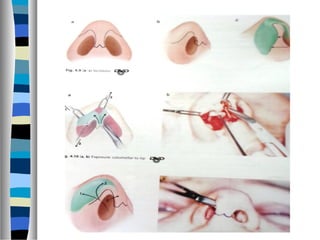
Transcollumellar
 External approach
 Crosses collumella just above flared ends of
the medial crura
 If too close to the lip, “dip” deformity
– No cartilage support to counteract tension
generated by the healing skin
 Notching at the midline – “aggie mark”,
Improved scar camouflage
Radix reduction-
 Intervening soft tissue excise under skin flap
at level of radix & glabella.
 Bony reduction-
I. Separate radix from bony dorsum by a line at
level of lateral canthus.
II. Define ideal nasion/NFA/new dorsal line.
III.Dorsum is lowered 1st
followed by radix up to
NFsuture line.
 NEVER try to do an en bloc reduction as you
will remove too much dorsum & too little
radix.
Radix augmentation-
 As a balancing procedure to minimize
hump reduction thus maintaining both
dorsal height and more natural looking
nose.
 Use of fascia grafts/DC-F/DC+F grafts.
 Most pt. can accept under but not over
correction.
Dorsal reduction
 Incremental approach is followed.
 Bony rasping in subperiosteal tunnel is used
in midline & then progressively on sides. It
continues till height of dorsum as it relates to
nasion has been achieved.
 Cartilaginous vault reduction by-
I. Split hump technique.
II. Transverse en bloc.
 Excision of septum lowers dorsal height while
that of ULC narrows width.
 Once osteotomies completed additional
rasping & excision may be needed.
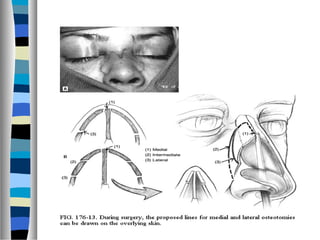
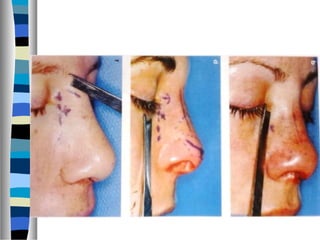
Osteotomies-
 Lateral osreotomies- to achieve movement
of lateral wall to narrow bony width.
 It should go beneath the widest point of
base bony width.
I. Low to high
II. Low to low
 Routes may be intrasal, intraoral,and
percutaneous.
 Intraoral approach to be too low and
inflexible while percutaneous one leads to
too many segmental bony bridges and
mucosal perforations.
 Medial oblique osteotomy- coupled with
low to low ,to narrow broad bony dorsum.
 Double level osteotomy- coupled with low
to low, along inferior border of nasal bone
and parallel to it. Goal is to reduce convexity
of lateral wall.
 Paramedian osteotomy-straight ones
parallel to midline with out changing height.
 Micro osteotomies- to correct intrinsic
bone irregularities.
Spreader grafts
 An integral part of rhinoplasty both for
functional and aesthetic reasons.
 They prevent internal nasal valve collapse &
inverted v deformity of dorsum.
 15-20mm long 3mm high, placed in
extramucosal tunnel with cephalic portion
under bony vault.
 ULC,spreader graft & septum sutured
together.
Dorsal augmentation
 Fascia graft-deep temporal fascia as single
or folded sheet is guided into pocket up to
radix & sutured in supratip area to
cartilaginous vault.
 DC-F Grafts-diced cartilage placed in fascia
pocket.
 Rib grafts-usually 7th
/ 9th
rib crtilage.it provide
excellent structural support with little risk of
warping.
 Septal cartilage- prone to visible edges
under thin skin and difficult to obtain in
secondary cases.
Biomaterials for augmentation.
 Silicone rubber
 PTFE
 High density polyethylene
 Polyester and polyamide mesh
 Titanium
 Ceramic & non ceramic hydroxyapatite.
Nasal Tip
 Dome: formed by the junction of the medial
and lateral crura
– Two point tip: aesthetically pleasing
– Tent deformity: Single point tip
• Overtight suture or poorly placed tip graft
 Sesamoid Cartilage
– Accessory cartilage between lateral crura and
piriform aperture
 Cephalic border of the lower lateral cartilage
forms hinge with upper lateral cartilage
Tip shapes-
Broad tip Ball tip
Bulbous tip
Tip Support
 Anderson: nasal tip similar to a Tripod
– Conjoined medial crura and two lateral crura
represent the three legs of the tripod
 Major support
– Size, shape, resilience of medial and lateral crura
– Fibrous attachment of the medial crura feet to the
caudal septum
– Fibrous attachment of the caudal margin of the
ULC to the cephalic margin of the LLC
Tip Support
 Minor Support
– Ligamentous sling between the alar cartilages
– Cartilaginous septal dorsum
– Sesamoid complex – extending the support of the
lateral crura to the piriform aperture
– Attachment of the alar cartilages to overlying skin
and musculature
– Nasal spine
– Membranous septum
Symmetrical rim strips-
 Cephalic portion excised in all cases to
reduce volume of tip,to increase
malleability.
 Lateral crura is not excised when
major convcavities of lateral crura exist.
 Actual excision begins at domal notch
the progress laterally,preserving 6mm
strip retaining sufficient to support
nostril rim & preventing alar retraction.
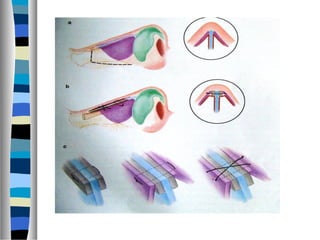
Columellar strut & suture-
 It serves three purpose: tip stability,tip
projection & columellar shape.
 It creates a unified tip complex and
symmetry.
 Create a true pocket between middle
and medial drura while preserving
intercrural fibrous connection.
Domal creation suture-
 To create ideal aesthetic tip anatomy
by creating a convex domal segment
next to a concave lateral crura.
 Too tight- sharp point under thin skin.
 Too loose- failure of tip definition.
 Too medial- snubs off tip .
 Too lateral- lengthen infralobule.
Interdomal suture-
 Controls tip width.
 Too tight creates single pointed tip
while too loose causes a wide tip so
keep in mind “ tip diamond” concept to
preserve normal angle of domal
divergence 30*
Domal equalization suture-
 To insure symmetry of tip.
 It is probably the easiest to insert and
most difficult to do wrong.
Lateral crural mattress suture-
 Widely used in treatment of wide/broad/
boxy/ ball tips.
 It is a better alternative to segmental
excisions that ultimately led to bossa
formation or lat. Crura collapse.
 A simple transverse mattress is placed
at point of max. convexity on lateral
crura.
Tip position suture-
 Achieves tip rotation & tip projection to
create “ supra tip break”.
 It is not done till ideal intrisic tip has
been achieved.
 Most powerful of all tip sutures &
must never be tied too tight …
 No need to include columellar strut.
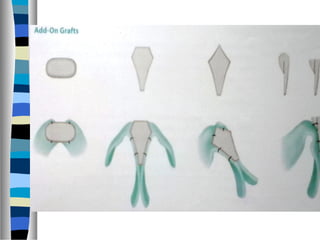
Add on grafts-
 Once suturing is complete ,to add
refinements as enhancement.
 Excised alar cartilage is preferred over
rigid septal / conchal cartilage .
 Accentuate dome defining points and
tip diamond feature.
 5 types-
domal/shield/diamond/folded/combinati
on.
Alar rim grafts-
 To correct alar rim retraction &depression as
subtle effect of tip suturing.
 Grafts 8-12 mm long 2-3 mm wide with
tapering cephalically both in width and
thickness.
 2 types-
 ARG -placed subcut.parallel to rim and 2-
3mm back.
 ARS- sutured to true marginal rim incision .it
is useful in ext. nasal valve collapse.
Base modifications(narrowing)
 Nostril sill excision-to reduce”nostril show”. It is a
vertical trapezoidal wedge excision.
 Alar wedge excision- to reduce alarflare.it is an
elliptical excision wit inferior border placed in alar
crease, down to mid muscle level without penetrating
vestibular skin.
 Combined sill/base excision- to narrow alar base
maximally while reducing alar flare at the same time.
Columellar Labial Angle--
 Surgical modification consists of
preservation,resection,augmentation of either the
columellar/ANS.
 Columella-Vast majority of the problems are due to
caudal septal deviations that needs correction.
 Most common is hanging columella due to
prominent caudal septum that needs resecting lower
half of caudal septum or straight excision of entire
caudal septum to shorten nose.
 Retraction of columella is corrected by long wide
columellar strut.
 ANS- if prominent either shortened or
its underlying bony webb depened.
 Retracted ANS can be isolated or part
of hypoplastic maxilla. It needs a large
columella strut and small cartilage graft
placed subcutaneously in columella
base.
 Need of prepyriform augmentation in
hypoplastic maxilla using diced
cartilage or hydroxyapp. granules
Post op dressing-
Open verses Closed ???
 Open
– Much better exposure of structures
– More accurate placement of grafts
– More accurate structural diagnosis
– Teaching value
 Closed
– Possibly faster than open
– No external scar
– Avoids tip edema
– No loss of tip support
Complications
 Hemorrhage
 Wound infection
 TSS
 Septal haematoma.
 Septal abscess.
 Septal perforation
 Nasal obstruction
 Nasal deformity.
Hemorrhage -
 Intraoperative bleeding- major bleed
follows medial osteotomies or
turbinectomies.
 Controlled by packing by epinephrine
soaked gauze or cauterization.
 Postop. Bleed can be well controlled
with nasal tampoons.
Infection-
 Require aggressive treatment as I&D, gauze packing,
high dose broad spectrum i.v. antibiotics.
 TSS- symptoms
I. Fever/hypotension/ GI symptoms/errythematous
macular rash with desquamation.
II. Admitted to hospital,nasal packs removed and
cleansed.
 scarring,skin necrosis,horrendous appearance are
complications.
 Avoided by at least 5 days of post op. period.
Septal complications-
 Septal hematomas- a unilateral inferior
incision with b/l silastic splints.
 Septal abscess- incision followed by
penrose drain sutured in place for 4
days, along with appropiate antibiotics.
 Septal perforation- poor technique
when perichondrium was removed with
septum on one side / associated friable
mucosa.
Nasal obstruction-
 In early period- mucosal oedema, nasal
crust formation.
I. Judicious use of nasal saline spray and
nasal decongestant.
 In late period- septal deviation,nasal
valve narrowing, vestibular scarring,alar
collapse, overcrowding of intranasal
structures.
Nasal deformity-
 Narrow dorsum.
 Saddle nose.
 Pollybeak tip/ pointed tip.
 Drooping of tip.
 Thick columella.
 Caudal septal deviation.
 Uneven dorsum with show of underlying graft
material.
Thank youThank you

Rhinoplasty approaches ,anatomy,techniques

  • 1.
    External Rhinoplasty assesment andtechniques Presenter- Dr. Abhineet Moderator- Dr. R.R. Barle
  • 2.
    Indications-  Elaborate reduction& augmentation.  Severe nasal trauma.  Extensive revisions.  Congenital deformities.
  • 3.
    Pre op aestheticassesment-  Standard 35 mm photographs taken in frontal, full lateral, basal and left & right three qtr. Lateral view as gold standard for pre op. evaluation.  5 mega pixel camera with independent flash lights.
  • 5.
    Aesthetic terminology-  Nasion-deepestpoint of NFA. I. ideal location is set between lash and crease line of upper lid. II. Nasion height is measured from vertical tangent to glabella.  Dorsum-( on anterior view.) I. Intercanthal width(EN-EN) II. Parallel dorsal lines III.Base bony width(X-X) IV.Tip defining points / philtrum. V. Alar width(AC-AC) VI.Alar flatre(AL-AL)
  • 6.
    Cont..  On lateralview- I. NFA -36* male/34* female measured from ideal nasion(Ni) to ideal tip(Ti). II. Ni to Ti i.e. length of nose is 2/3rd of mid facial height. III. Ti- ideal tip projection(AC-Ti) is 2/3rd of length of nose. IV. Final aesthetic line- concave for female/ flat for male. If a hump is present, the line is drawn through it.
  • 7.
    Radix And DorsumAesthetics
  • 8.
    Dorsum And TipAssesment
  • 9.
    Tip aesthetic assesement- Intrinsic criterias- alar cartilage config’n. I. Volume-size & shape of lateral crura. II. Definition-convex domal & concave lateral crura. III.Width-interdomal distance between Ti.  additional criterias-abutting structures. I. Projection-intinsic & extrinsic. II. Rotation- tip angle-105* female/100*male.has inrinsic and extrinsic factors. III.Position- location of tip along the dorsal line.
  • 12.
    Base aesthetic assesment- 1.Columella base. 2. Pillar. 3. Infralobule triangle. 4. Soft triangle. 5. Lateral wall. 6. Alar base. 7. Nostrill base. 8. Nostril.
  • 13.
    Cont..  Aesthetics of4 components assesed- I. Alar flare/width. II. Columella. III.CLA. IV.Nostril.
  • 21.
    ALWAYS Make the tipfit the ideal dorsum
  • 22.
    Operative sequence-  Generalanaesthesia & local anaesthetic injection  Open approach incision  Elevation of skin envelope.  Septal exposure via transfixion incision.  Creation of symmetrical alar rim strip.  Incremental hump reduction.  Caudal septum & ANS excision.  Septoplasty.  Osteotomies.
  • 23.
     Graft preparation Spreader grafts  Columellar strut & sutures  Tip sutures  Closure  Alar base modification  Alar rim support grafts  Doyle splint & external & nasal block.
  • 25.
    Transcollumellar  External approach Crosses collumella just above flared ends of the medial crura  If too close to the lip, “dip” deformity – No cartilage support to counteract tension generated by the healing skin  Notching at the midline – “aggie mark”, Improved scar camouflage
  • 27.
    Radix reduction-  Interveningsoft tissue excise under skin flap at level of radix & glabella.  Bony reduction- I. Separate radix from bony dorsum by a line at level of lateral canthus. II. Define ideal nasion/NFA/new dorsal line. III.Dorsum is lowered 1st followed by radix up to NFsuture line.  NEVER try to do an en bloc reduction as you will remove too much dorsum & too little radix.
  • 28.
    Radix augmentation-  Asa balancing procedure to minimize hump reduction thus maintaining both dorsal height and more natural looking nose.  Use of fascia grafts/DC-F/DC+F grafts.  Most pt. can accept under but not over correction.
  • 29.
    Dorsal reduction  Incrementalapproach is followed.  Bony rasping in subperiosteal tunnel is used in midline & then progressively on sides. It continues till height of dorsum as it relates to nasion has been achieved.  Cartilaginous vault reduction by- I. Split hump technique. II. Transverse en bloc.  Excision of septum lowers dorsal height while that of ULC narrows width.  Once osteotomies completed additional rasping & excision may be needed.
  • 31.
    Osteotomies-  Lateral osreotomies-to achieve movement of lateral wall to narrow bony width.  It should go beneath the widest point of base bony width. I. Low to high II. Low to low  Routes may be intrasal, intraoral,and percutaneous.  Intraoral approach to be too low and inflexible while percutaneous one leads to too many segmental bony bridges and mucosal perforations.
  • 32.
     Medial obliqueosteotomy- coupled with low to low ,to narrow broad bony dorsum.  Double level osteotomy- coupled with low to low, along inferior border of nasal bone and parallel to it. Goal is to reduce convexity of lateral wall.  Paramedian osteotomy-straight ones parallel to midline with out changing height.  Micro osteotomies- to correct intrinsic bone irregularities.
  • 36.
    Spreader grafts  Anintegral part of rhinoplasty both for functional and aesthetic reasons.  They prevent internal nasal valve collapse & inverted v deformity of dorsum.  15-20mm long 3mm high, placed in extramucosal tunnel with cephalic portion under bony vault.  ULC,spreader graft & septum sutured together.
  • 38.
    Dorsal augmentation  Fasciagraft-deep temporal fascia as single or folded sheet is guided into pocket up to radix & sutured in supratip area to cartilaginous vault.  DC-F Grafts-diced cartilage placed in fascia pocket.  Rib grafts-usually 7th / 9th rib crtilage.it provide excellent structural support with little risk of warping.  Septal cartilage- prone to visible edges under thin skin and difficult to obtain in secondary cases.
  • 39.
    Biomaterials for augmentation. Silicone rubber  PTFE  High density polyethylene  Polyester and polyamide mesh  Titanium  Ceramic & non ceramic hydroxyapatite.
  • 40.
    Nasal Tip  Dome:formed by the junction of the medial and lateral crura – Two point tip: aesthetically pleasing – Tent deformity: Single point tip • Overtight suture or poorly placed tip graft  Sesamoid Cartilage – Accessory cartilage between lateral crura and piriform aperture  Cephalic border of the lower lateral cartilage forms hinge with upper lateral cartilage
  • 42.
  • 43.
  • 44.
    Tip Support  Anderson:nasal tip similar to a Tripod – Conjoined medial crura and two lateral crura represent the three legs of the tripod  Major support – Size, shape, resilience of medial and lateral crura – Fibrous attachment of the medial crura feet to the caudal septum – Fibrous attachment of the caudal margin of the ULC to the cephalic margin of the LLC
  • 45.
    Tip Support  MinorSupport – Ligamentous sling between the alar cartilages – Cartilaginous septal dorsum – Sesamoid complex – extending the support of the lateral crura to the piriform aperture – Attachment of the alar cartilages to overlying skin and musculature – Nasal spine – Membranous septum
  • 46.
    Symmetrical rim strips- Cephalic portion excised in all cases to reduce volume of tip,to increase malleability.  Lateral crura is not excised when major convcavities of lateral crura exist.  Actual excision begins at domal notch the progress laterally,preserving 6mm strip retaining sufficient to support nostril rim & preventing alar retraction.
  • 47.
    Columellar strut &suture-  It serves three purpose: tip stability,tip projection & columellar shape.  It creates a unified tip complex and symmetry.  Create a true pocket between middle and medial drura while preserving intercrural fibrous connection.
  • 49.
    Domal creation suture- To create ideal aesthetic tip anatomy by creating a convex domal segment next to a concave lateral crura.  Too tight- sharp point under thin skin.  Too loose- failure of tip definition.  Too medial- snubs off tip .  Too lateral- lengthen infralobule.
  • 51.
    Interdomal suture-  Controlstip width.  Too tight creates single pointed tip while too loose causes a wide tip so keep in mind “ tip diamond” concept to preserve normal angle of domal divergence 30*
  • 53.
    Domal equalization suture- To insure symmetry of tip.  It is probably the easiest to insert and most difficult to do wrong.
  • 55.
    Lateral crural mattresssuture-  Widely used in treatment of wide/broad/ boxy/ ball tips.  It is a better alternative to segmental excisions that ultimately led to bossa formation or lat. Crura collapse.  A simple transverse mattress is placed at point of max. convexity on lateral crura.
  • 57.
    Tip position suture- Achieves tip rotation & tip projection to create “ supra tip break”.  It is not done till ideal intrisic tip has been achieved.  Most powerful of all tip sutures & must never be tied too tight …  No need to include columellar strut.
  • 59.
    Add on grafts- Once suturing is complete ,to add refinements as enhancement.  Excised alar cartilage is preferred over rigid septal / conchal cartilage .  Accentuate dome defining points and tip diamond feature.  5 types- domal/shield/diamond/folded/combinati on.
  • 61.
    Alar rim grafts- To correct alar rim retraction &depression as subtle effect of tip suturing.  Grafts 8-12 mm long 2-3 mm wide with tapering cephalically both in width and thickness.  2 types-  ARG -placed subcut.parallel to rim and 2- 3mm back.  ARS- sutured to true marginal rim incision .it is useful in ext. nasal valve collapse.
  • 63.
    Base modifications(narrowing)  Nostrilsill excision-to reduce”nostril show”. It is a vertical trapezoidal wedge excision.  Alar wedge excision- to reduce alarflare.it is an elliptical excision wit inferior border placed in alar crease, down to mid muscle level without penetrating vestibular skin.  Combined sill/base excision- to narrow alar base maximally while reducing alar flare at the same time.
  • 65.
    Columellar Labial Angle-- Surgical modification consists of preservation,resection,augmentation of either the columellar/ANS.  Columella-Vast majority of the problems are due to caudal septal deviations that needs correction.  Most common is hanging columella due to prominent caudal septum that needs resecting lower half of caudal septum or straight excision of entire caudal septum to shorten nose.  Retraction of columella is corrected by long wide columellar strut.
  • 66.
     ANS- ifprominent either shortened or its underlying bony webb depened.  Retracted ANS can be isolated or part of hypoplastic maxilla. It needs a large columella strut and small cartilage graft placed subcutaneously in columella base.  Need of prepyriform augmentation in hypoplastic maxilla using diced cartilage or hydroxyapp. granules
  • 71.
  • 74.
    Open verses Closed???  Open – Much better exposure of structures – More accurate placement of grafts – More accurate structural diagnosis – Teaching value  Closed – Possibly faster than open – No external scar – Avoids tip edema – No loss of tip support
  • 75.
    Complications  Hemorrhage  Woundinfection  TSS  Septal haematoma.  Septal abscess.  Septal perforation  Nasal obstruction  Nasal deformity.
  • 76.
    Hemorrhage -  Intraoperativebleeding- major bleed follows medial osteotomies or turbinectomies.  Controlled by packing by epinephrine soaked gauze or cauterization.  Postop. Bleed can be well controlled with nasal tampoons.
  • 77.
    Infection-  Require aggressivetreatment as I&D, gauze packing, high dose broad spectrum i.v. antibiotics.  TSS- symptoms I. Fever/hypotension/ GI symptoms/errythematous macular rash with desquamation. II. Admitted to hospital,nasal packs removed and cleansed.  scarring,skin necrosis,horrendous appearance are complications.  Avoided by at least 5 days of post op. period.
  • 78.
    Septal complications-  Septalhematomas- a unilateral inferior incision with b/l silastic splints.  Septal abscess- incision followed by penrose drain sutured in place for 4 days, along with appropiate antibiotics.  Septal perforation- poor technique when perichondrium was removed with septum on one side / associated friable mucosa.
  • 79.
    Nasal obstruction-  Inearly period- mucosal oedema, nasal crust formation. I. Judicious use of nasal saline spray and nasal decongestant.  In late period- septal deviation,nasal valve narrowing, vestibular scarring,alar collapse, overcrowding of intranasal structures.
  • 80.
    Nasal deformity-  Narrowdorsum.  Saddle nose.  Pollybeak tip/ pointed tip.  Drooping of tip.  Thick columella.  Caudal septal deviation.  Uneven dorsum with show of underlying graft material.
  • 81.

Editor's Notes