Understanding Writing: The Rhetorical Situation Brought to you by the Purdue University Online Writing Lab
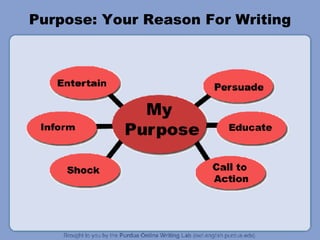
What is a Rhetorical Situation? Rhetoric: Using language effectively to persuade, inform, educate, or entertain Rhetorical Situation: The circumstances in which you communicate.
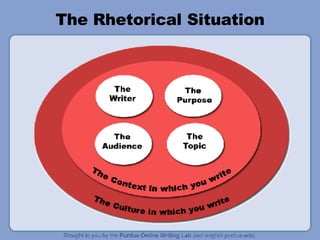
The Rhetorical Situation
The Writer Your culture, personal characteristics and interests affect what you write about and how you write it.
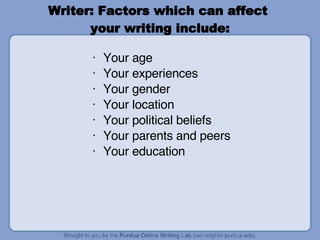
Writer: Factors which can affect  your writing include: Your age Your experiences Your gender Your location Your political beliefs Your parents and peers Your education
Purpose: Your Reason For Writing
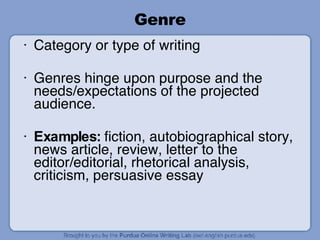
Genre Category or type of writing Genres hinge upon purpose and the needs/expectations of the projected audience. Examples:  fiction, autobiographical story, news article, review, letter to the editor/editorial, rhetorical analysis, criticism, persuasive essay
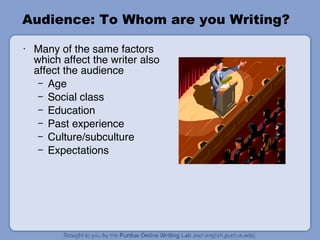
Audience: To Whom are you Writing? Many of the same factors which affect the writer also affect the audience Age Social class Education Past experience Culture/subculture Expectations
Audience: To Whom are you Writing? Audience is that person or group who has the power to enact change. "A rhetorical audience consists only of those persons who are capable of being influenced by discourse and of being mediators of change" (Bitzer, Rhetorical Situation 8). Bitzer, Lloyd F. "The Rhetorical Situation." Philosophy and Rhetoric, 1 (1968): 1-14.
Topic: What you will write about May be broadened or narrowed depending on the length of your writing and your interest Topics should be appropriate to the rhetorical situation you are in
Context The “situation” which generates the need for writing Affected by the  Time period or timing Location Current events Cultural significance
Rhetorical Situation Writer Purpose Audience Topic Context Culture
What this means… You need to be aware that a rhetorical situation exists  every time  you write. You need to adapt your writing depending on your purpose and your audience.
The End This resource was written by Jennifer Liethen Kunka. Last full revision by Dana Lynn Driscoll. Last edited by Dana Lynn Driscoll on October 24th 2006 at 11:29AM Downloaded & adapted by Devon Christopher Adams on June August 31st 2008 at 11:49AM

Rhetorical Situation

  • 1.
    Understanding Writing: TheRhetorical Situation Brought to you by the Purdue University Online Writing Lab
  • 2.
    What is aRhetorical Situation? Rhetoric: Using language effectively to persuade, inform, educate, or entertain Rhetorical Situation: The circumstances in which you communicate.
  • 3.
  • 4.
    The Writer Yourculture, personal characteristics and interests affect what you write about and how you write it.
  • 5.
    Writer: Factors whichcan affect your writing include: Your age Your experiences Your gender Your location Your political beliefs Your parents and peers Your education
  • 6.
  • 7.
    Genre Category ortype of writing Genres hinge upon purpose and the needs/expectations of the projected audience. Examples: fiction, autobiographical story, news article, review, letter to the editor/editorial, rhetorical analysis, criticism, persuasive essay
  • 8.
    Audience: To Whomare you Writing? Many of the same factors which affect the writer also affect the audience Age Social class Education Past experience Culture/subculture Expectations
  • 9.
    Audience: To Whomare you Writing? Audience is that person or group who has the power to enact change. "A rhetorical audience consists only of those persons who are capable of being influenced by discourse and of being mediators of change" (Bitzer, Rhetorical Situation 8). Bitzer, Lloyd F. "The Rhetorical Situation." Philosophy and Rhetoric, 1 (1968): 1-14.
  • 10.
    Topic: What youwill write about May be broadened or narrowed depending on the length of your writing and your interest Topics should be appropriate to the rhetorical situation you are in
  • 11.
    Context The “situation”which generates the need for writing Affected by the Time period or timing Location Current events Cultural significance
  • 12.
    Rhetorical Situation WriterPurpose Audience Topic Context Culture
  • 13.
    What this means…You need to be aware that a rhetorical situation exists every time you write. You need to adapt your writing depending on your purpose and your audience.
  • 14.
    The End Thisresource was written by Jennifer Liethen Kunka. Last full revision by Dana Lynn Driscoll. Last edited by Dana Lynn Driscoll on October 24th 2006 at 11:29AM Downloaded & adapted by Devon Christopher Adams on June August 31st 2008 at 11:49AM

Editor's Notes

  • #2 Rationale: Welcome to “Understanding Writing: The Rhetorical Situation.” This presentation is designed to introduce your students to a variety of factors that contribute to strong, well-organized writing--the rhetorical situation. The twelve slides presented here are designed to aid the facilitator in an interactive presentation of the elements of the rhetorical situation. This presentation is ideal for the beginning of a composition course or the assignment of a writing project. This presentation may be supplemented with an OWL handout, “Higher Order Concerns and Later Order Concerns (HOCs and LOCs)” (http://owl.english.purdue.edu/handouts/general/gl_hocloc.html). Directions: Each slide is activated by a single mouse click, unless otherwise noted in bold at the bottom of each notes page Writer and Designer: Jennifer Liethen Kunka Contributors: Muriel Harris, Karen Bishop, Bryan Kopp, Matthew Mooney, David Neyhart, and Andrew Kunka Revising Author: Dana Lynn Driscoll, 2006 Developed with resources courtesy of the Purdue University Writing Lab Grant funding courtesy of the Multimedia Instructional Development Center at Purdue University © Copyright Purdue University, 2000, 2006