WRA 110.742Week 6: 16 February 2010
Welcome Dr. Geissler!The Rhetorical Situation Room: Purpose, Audience, ContextActivity: Analyzing a sample student essayWrap-upToday’s agenda
writing =composing=makingBy the way
A crash course in rhetoricWRAC= Writing, Rhetoric, & American CulturesWhy do you think these things would be grouped together? So…what is rhetoric?
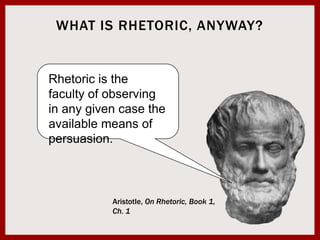
What is Rhetoric, Anyway?Rhetoric is the faculty of observing in any given case the available means of persuasion.Aristotle, On Rhetoric, Book 1, Ch. 1
“Every time we use language--in speech or in writing--we engage in a rhetorical act. Another way of saying this would be that all communication is rhetorical. Whenever we use language, we have an intention--a message to communicate or a goal to achieve. All of us behave rhetorically every time we use language.”LeTourneau University, “Introduction to Rhetoric”
All Texts Have aPurposeAll texts are composed with a purpose, even if that purpose is simply personal entertainment. The purpose is what the text is supposed to do.The text accomplishes its purpose by means of persuasion. All texts can be rhetorical (persuasive with a purpose) because of the way we interact with (read & compose) them.
Let’s do this first one together.What’s the purpose?
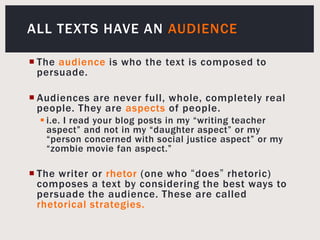
All Texts Have An AudienceThe audience is who the text is composed to persuade.Audiences are never full, whole, completely real people. They are aspects of people.i.e. I read your blog posts in my “writing teacher aspect” and not in my “daughter aspect” or my “person concerned with social justice aspect” or my “zombie movie fan aspect.”The writer or rhetor(one who “does” rhetoric) composes a text by considering the best ways to persuade the audience. These are called rhetorical strategies.
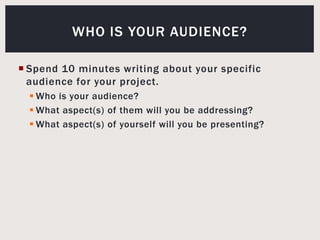
Spend 10 minutes writing about your specific audience for your project.Who is your audience? What aspect(s) of them will you be addressing?What aspect(s) of yourself will you be presenting?Who is your audience?
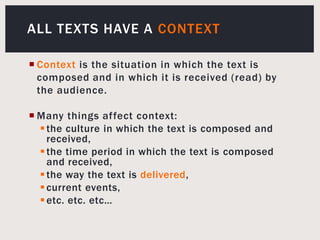
All Texts Have a ContextContext is the situation in which the text is composed and in which it is received (read) by the audience.Many things affect context: the culture in which the text is composed and received, the time period in which the text is composed and received, the way the text is delivered,current events, etc. etc. etc…
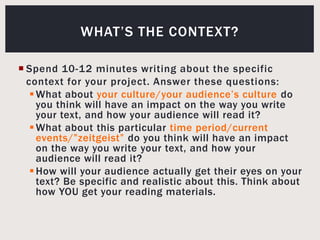
Spend 10-12 minutes writing about the specific context for your project. Answer these questions:What about your culture/your audience’s culture do you think will have an impact on the way you write your text, and how your audience will read it?What about this particular time period/current events/”zeitgeist” do you think will have an impact on the way you write your text, and how your audience will read it?How will your audience actually get their eyes on your text? Be specific and realistic about this. Think about how YOU get your reading materials.What’s the context?
Next challenge: How do we turn all of this brainstorming into specific rhetorical strategies (things you can do with your writing) that accomplish your goals?Let’s look at how one successful student writer did it.Go to your MSU Google Docs account and find “SampleStudentEssay2.pdf”. There’s a link to it on today’s post on our website too.Flip it and reverse it
Carefully read the sample student essay.In your peer review groups, identify the AUDIENCE, and CONTEXT for this essay. THEN, show that you’ve correctly identified these things by identifying particular rhetorical strategies (things the student does with her writing) as proof.Rhetorical strategies
Repent! The Draft is Near!I’m going to change your weekend homework slightly so stay tuned.Next week: More MLA Idol fun, so bring your McGraw-Hill handbookDon’t forget to schedule conferences with me—the F2F conference deadline is approachingGrades are on their way (I promise)Breathe.Wrap-up

Week6revised

  • 1.
    WRA 110.742Week 6:16 February 2010
  • 2.
    Welcome Dr. Geissler!TheRhetorical Situation Room: Purpose, Audience, ContextActivity: Analyzing a sample student essayWrap-upToday’s agenda
  • 3.
  • 4.
    A crash coursein rhetoricWRAC= Writing, Rhetoric, & American CulturesWhy do you think these things would be grouped together? So…what is rhetoric?
  • 5.
    What is Rhetoric,Anyway?Rhetoric is the faculty of observing in any given case the available means of persuasion.Aristotle, On Rhetoric, Book 1, Ch. 1
  • 6.
    “Every time weuse language--in speech or in writing--we engage in a rhetorical act. Another way of saying this would be that all communication is rhetorical. Whenever we use language, we have an intention--a message to communicate or a goal to achieve. All of us behave rhetorically every time we use language.”LeTourneau University, “Introduction to Rhetoric”
  • 7.
    All Texts HaveaPurposeAll texts are composed with a purpose, even if that purpose is simply personal entertainment. The purpose is what the text is supposed to do.The text accomplishes its purpose by means of persuasion. All texts can be rhetorical (persuasive with a purpose) because of the way we interact with (read & compose) them.
  • 8.
    Let’s do thisfirst one together.What’s the purpose?
  • 9.
    All Texts HaveAn AudienceThe audience is who the text is composed to persuade.Audiences are never full, whole, completely real people. They are aspects of people.i.e. I read your blog posts in my “writing teacher aspect” and not in my “daughter aspect” or my “person concerned with social justice aspect” or my “zombie movie fan aspect.”The writer or rhetor(one who “does” rhetoric) composes a text by considering the best ways to persuade the audience. These are called rhetorical strategies.
  • 10.
    Spend 10 minuteswriting about your specific audience for your project.Who is your audience? What aspect(s) of them will you be addressing?What aspect(s) of yourself will you be presenting?Who is your audience?
  • 11.
    All Texts Havea ContextContext is the situation in which the text is composed and in which it is received (read) by the audience.Many things affect context: the culture in which the text is composed and received, the time period in which the text is composed and received, the way the text is delivered,current events, etc. etc. etc…
  • 12.
    Spend 10-12 minuteswriting about the specific context for your project. Answer these questions:What about your culture/your audience’s culture do you think will have an impact on the way you write your text, and how your audience will read it?What about this particular time period/current events/”zeitgeist” do you think will have an impact on the way you write your text, and how your audience will read it?How will your audience actually get their eyes on your text? Be specific and realistic about this. Think about how YOU get your reading materials.What’s the context?
  • 13.
    Next challenge: Howdo we turn all of this brainstorming into specific rhetorical strategies (things you can do with your writing) that accomplish your goals?Let’s look at how one successful student writer did it.Go to your MSU Google Docs account and find “SampleStudentEssay2.pdf”. There’s a link to it on today’s post on our website too.Flip it and reverse it
  • 14.
    Carefully read thesample student essay.In your peer review groups, identify the AUDIENCE, and CONTEXT for this essay. THEN, show that you’ve correctly identified these things by identifying particular rhetorical strategies (things the student does with her writing) as proof.Rhetorical strategies
  • 15.
    Repent! The Draftis Near!I’m going to change your weekend homework slightly so stay tuned.Next week: More MLA Idol fun, so bring your McGraw-Hill handbookDon’t forget to schedule conferences with me—the F2F conference deadline is approachingGrades are on their way (I promise)Breathe.Wrap-up