Shellharbour ED
Orientation
Expectations and a Framework
for working in our ED
Dr Bishan Rajapakse
(FACEM, PhD, MBChB)
Staff Specialist
Emergency Medicine
Update 11-7-22
Introductions and “Knowing thy team…”
Learning works best when you know what your goals are, and
knowing your team ;
1. What do you hope to gain from your SHH ED term?
• How do you plan to add value?
2. What interests and background do you bring to this job?
3. What are your communication and learning styles –what are the
Teaching / Supervision styles of your Seniors and colleagues?
Emergency Medicine=TEAM
Goals : What do you hope to get out of your
term/time in our Peripheral hospital ED TEAM?
• Learning/ Experience?
• Medical Expertise / Team work / Leadership
• EM Specialty training ?
• Other General or Sub-speciaity Medical ?
• Sub-specialty interests with EM?
• Ultrasound
• Geriatric EM
• Global EM care / International Medicine (SHH has diverse international mixed of
doctors and nurse)
• Research Exposure
Our SHH ED
Consultant TEAM
(and interests)
• Simon Keane – ED Director (Leadership/ Retrieval/
Innovation)
• Angelo Abeywickrema – (DEMT / Ultrasound/ Retrieval )
• Phil Manczac – (Co-DEMT / Paeds / Med ED)
• Bish Rajapakse – (Well-being / Research & Med ED /
International EM)
• Kham Saysana - (Clinical Governance/ Policy / Toxicology)
• Ayman Elattar – (Education & Training/ Simulation
• Brona Geary – (Peripheral Hospital Training / Med ED /
Simulation)
• Kris Yuen – ED / Med ED
• Tom Carrigan– Medical leadership/ Research
Professional
Behaviour
Expectations
Be on time
Dress the part
Bring your “A Game”
Be polite, Be Kind (to self and others)
EM Approach - a framework
Risk Management
5 Questions (to ask yourself about
every patient)
1) RESUS or Not
2) IN or OUT
3) Stream
(Med/surg/Paeds/OBG)
4) Sub-spec
5) Specific Dx and DDx
Bio-Psycho-Social
approach
• Biological
• Psychological
• Sociological
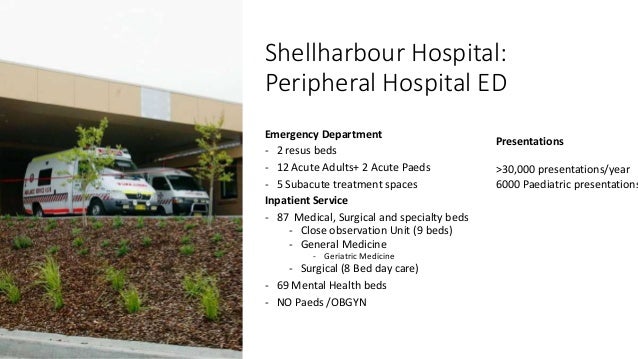
Shellharbour Hospital:
Peripheral Hospital ED
Emergency Department
- 2 resus beds
- 12 Acute Adults+ 2 Acute Paeds
- 5 Subacute treatment spaces
Inpatient Service
- 87 Medical, Surgical and specialty beds
- Close observation Unit (9 beds)
- General Medicine
- Geriatric Medicine
- Surgical (8 Bed day care)
- 69 Mental Health beds
- NO Paeds /OBGYN
Presentations
>30,000 presentations/year
6000 Paediatric presentations
Team Interactions
ED
Psych
Gen Med
SSH
Gen Surg
O&G Paeds
ICU
SHH
TWH
AMAU – acute
medical assessment unit
Department
Spaces –
Types of
patients
ACUTE
• MED/Surg
• Paeds, Psych
• Spaces
• Resus (2 beds) 1 Paeds equip
(NETS cam)
• Acute Bed (Iso or Non-Iso)
• Paeds Bed (2, Isolation
capable)
• Coridoor 2 spaces – bed and
Chair
• Acute Waiting Room patients
• Iso Waiting room (up to
4)
• Rapid Assessment Room (RAT
room) 1 bed, 2 chairs
Sub-Acute
• Fast track waiting
room
• Plaster Room
• Procedure Room
(Nitrous capable)
• Consult Rooms x2
• RAT (room)
Medical Roles
in SHH ED &
On site
Services
ED Staff
• ED Senior /Shift Lead
• FACEM
• CMO / MMO
• Registrars (ACEM AT)
• SRMO
• Varying Seniority
• JMO
• Resident
• Intern
Services
Gen Med Reg
- 24 hour cover
Acute Surg Reg
- M-F (8-4pm) elective surgery
TWH
ICU Reg
General Surgery Reg (24 hours)
- All Surgical Subspecialties
GEN Med Sub specialties
PAEDs and O&G
Nursing
Roles in ED
Nurse Unit Manger (Frank
Testa)
- Daily Huddle 9:45 M-F
Acute Area
• Num1 (Nurse Shift Leaders) /
Nursing Shift in Charge
• Resus Nurse (R1-2 + Quiet
Room)
• Paeds Nurse (P1-2)
• Acute Bed nurses (A1-11,
Iso)
Triage
• Triage Nurse
• CIN nurse (looks after
Acute waiting room
patients – high load)
Fast Track
• Nurse Practitioner
• FT Nurse
• Physio Practitioners
Acute
Waiting
Room
Patients
• Patient’s who need acute work up
but do not warrant a bed (or no
beds available)
• Challenges and Pitfalls
• Get Missed
• Often don’t get picked
up due to not being in
bed
• Decreased care
• High patient to
Nurse(CIN) ratio
• Observations (less
frequent)
• Haven’t had
medications/analgesia
• Strategies
• SAS (senior assessment
• Investigations ordered at
triage
• JMOs and SMOs
• To pick up acute patients by
”Length waiting” not
convenience (ie patients in
bed)
• Ensure investigations are
taken and medications
given
• Support nurses where
possible
• Escalate concerns; Medical
Shift lead & NUM1
Allied Health
& Other
Services
• PACE Nurse (Amy
Purkiss, Jenny Larson)
• Clinical Nurse
specialist
• Part of Emergency
Response team
• Nurse Educator (Ryan
Klogger)
• ASET
• Aged care nurse
• Social Worker
• M-F 8-5pm
• On Call from TWH
• LAB
• 8am - 8pm, onsite (leave at
9pm)
• TWH lab overnight >9pm –
regular collections &
Courier
• Radiology (Xrays and CT)
• 8am-11pm on Site
• >11pm Radiographer Call
back
• Ultrasound
• 8am-4:30pm
• >4:30pm on call
Radiographer (check with
Shift lead before making call
back)
Team vision/
expectations
(every shift)
Safe and efficient patient care
Communicate and collaborate
Look after yourself (take meal breaks),
Learn & have some fun on your shift
Feedback/Debrief at the end of shift to
improve for the next one 
Expectation: Safe and Efficient patient Care
•SAFE = Life and limb threats, Risk Management , Escalation, safe disposition
•To “Care” for the patient ie advocate as one of our own friends or family
SAFETY
•You may see less than this when taking to account complexity, other factures (eg elderly, language issues, health literacy)
•KEY to efficiency Early discussion with Shift Lead to refine/formulate plan;
•Early decisions on INVx, Speciality consults, rough disposition decisions
•Check with Shift lead for picking up next patient – Generally in order of time waiting
Efficiency : (Rough goal – seeing 1 patient per hour)
•Always have an “Impression” (Dx & DDx) and a ”Plan” (what must be done now)
•Even with limited time – can formulate a DDx (Most Serious Dx, most likely/working Dx, and DDx ‘s)
•Document IMP and Plan frequently & Update (also discuss plan with Nurse in Charge)
•Frequent Re-assessments of patients; EM is 4 dimensional (ie responsive to time)
RISK Management & Acute CARE & Timely ACTION
Communication and Collaboration
• Communication with your patient is KEY
• Collaboration & supervision: Every patient gets discussed with the supervising doctor
• Update your patient Frequently & be honest (Don’t promise what you can’t deliver
• Difficult interactions with patients: Listen and acknowledge always. Explain. Be Polite
but firm and/or Get help
Department Behaviour Expectations
• We are an ED Team - There is no job that is “beneath” you or I
• Don’t get into arguments with the nursing staff (any staff)
• Discuss conflict with Seniors (Shift Lead or FACEM mentor)
• Maintain patient confidentiality
Documentation
& EMR
Expectations
• Picking patients
• Check with ED
consultant/shift lead
• Usual order of waiting
time rather than
category
• Don’t skip Acute Waiting
Room patient
• NOTES
• PCx, HPCx, PMHx,
Meds/Allergies, SHx,
Exam, INV, IMP, Plan
• D/w (Surname & Role
& Time)
• Buttons
• Med / Surg Consult
ICON
• Advanced Care Directive
• Medications
• Work certificate / D/c
summary
Choosing Wisely –
Investigation ordering
Shift in Charge/Lead - Black ; need to be
notified of callback (on call radiographer
RED –independent ordering
Yellow – Discuss ordering
Green – No D-dimer
SHIFT
STRUCTURE
MAIN SHIFTS
FOR DOCTORS
Day shift 0800 –
1830hrs
Mid shift 1000 -
2030hrs
PM shift 1400 -
2400hrs
Night shift 2000
(2200) – 0800hrs
ED Handovers
• Dangerous time for gaps in communication between patient
• Ideally don’t pick up a patient at end of shift if not able to clearly manage
• Have clear working diagnosis
• Also clear management plan (what as been done so far)
• Clear disposition plan
• Document discussions
• Eg with ED seniors and Specialty teams (Initial Surname, role)
• Chart Meds for Admitted patients
SHH ED
Education
Program
• Usu 9-10am
Simulation Education every Wed Morning
• Either Thu or Frid
• 2:30 – 3:30
SHH ED Teaching - FACEM led / SRMO run
ED Training :DEMTs – Dr Angelo Abeywickrema / Dr Phil Manczac
SRMO Teaching program : Dr Ayman Elattar
M&M : Dr Kham Saysana
Research – Dr Bish Rajapakse
Make sure you get added to the Education Whats app group
Mentorship program
You will be allocated a mentor at the beginning of term
Mentorship is not supervision, it’s a 2-way street and the relationship can be developed
- Recommendation is that you make contact with your mentor every 4-6 weeks
- Goal is to have a platform to talk about the human side of Medicine, and develop a
relationship with a senior for support
- You many have one formal allocated mentor but many mentors in the department
- Participation is voluntary – will email you for your preferences
• I aim to provide support for the mentorship arrangement
• Bishan.Rajapakse@health.nsw.gov.au
• Your feedback on the program is welcome!
SAFETY
First
Sick Calls
Occ
health
Always
wear
Gloves
COVID
PPE
Testing
Being Ill yourself
Calling Sick
Let Senior Doctor/Shift lead know
As EARLY as possible (any time of day )
Leave,
Rostering and
Overtime
Our aim is for
Rostering and
Leave that satisfies
staff needs
Must be equitable
&
Safe Department
Discuss Early/ Put requests in early - Roster Manager & Department Director
Department
Values and
Dealing with
Conflict
 Department Values (CORE)
 Collaboration
 Openness
 Respect
 Empowerment
• In Conflict –step away, and
always “Talk” to someone
• Director
• Supervisor
• Mentor
• Friend
In Summary
Welcome to our TEAM!
• Get to know your team members, the space, and
the services
Shift Goals
• Safe and efficient patient care
• Communicate and collaborate
• Look after yourselves, learn and grow

Shellharbour ED Orientation July 2022- expectations and aspirations overview

  • 1.
    Shellharbour ED Orientation Expectations anda Framework for working in our ED Dr Bishan Rajapakse (FACEM, PhD, MBChB) Staff Specialist Emergency Medicine Update 11-7-22
  • 2.
    Introductions and “Knowingthy team…” Learning works best when you know what your goals are, and knowing your team ; 1. What do you hope to gain from your SHH ED term? • How do you plan to add value? 2. What interests and background do you bring to this job? 3. What are your communication and learning styles –what are the Teaching / Supervision styles of your Seniors and colleagues? Emergency Medicine=TEAM
  • 3.
    Goals : Whatdo you hope to get out of your term/time in our Peripheral hospital ED TEAM? • Learning/ Experience? • Medical Expertise / Team work / Leadership • EM Specialty training ? • Other General or Sub-speciaity Medical ? • Sub-specialty interests with EM? • Ultrasound • Geriatric EM • Global EM care / International Medicine (SHH has diverse international mixed of doctors and nurse) • Research Exposure
  • 4.
    Our SHH ED ConsultantTEAM (and interests) • Simon Keane – ED Director (Leadership/ Retrieval/ Innovation) • Angelo Abeywickrema – (DEMT / Ultrasound/ Retrieval ) • Phil Manczac – (Co-DEMT / Paeds / Med ED) • Bish Rajapakse – (Well-being / Research & Med ED / International EM) • Kham Saysana - (Clinical Governance/ Policy / Toxicology) • Ayman Elattar – (Education & Training/ Simulation • Brona Geary – (Peripheral Hospital Training / Med ED / Simulation) • Kris Yuen – ED / Med ED • Tom Carrigan– Medical leadership/ Research
  • 5.
    Professional Behaviour Expectations Be on time Dressthe part Bring your “A Game” Be polite, Be Kind (to self and others)
  • 6.
    EM Approach -a framework Risk Management 5 Questions (to ask yourself about every patient) 1) RESUS or Not 2) IN or OUT 3) Stream (Med/surg/Paeds/OBG) 4) Sub-spec 5) Specific Dx and DDx Bio-Psycho-Social approach • Biological • Psychological • Sociological
  • 7.
    Shellharbour Hospital: Peripheral HospitalED Emergency Department - 2 resus beds - 12 Acute Adults+ 2 Acute Paeds - 5 Subacute treatment spaces Inpatient Service - 87 Medical, Surgical and specialty beds - Close observation Unit (9 beds) - General Medicine - Geriatric Medicine - Surgical (8 Bed day care) - 69 Mental Health beds - NO Paeds /OBGYN Presentations >30,000 presentations/year 6000 Paediatric presentations
  • 8.
    Team Interactions ED Psych Gen Med SSH GenSurg O&G Paeds ICU SHH TWH AMAU – acute medical assessment unit
  • 9.
    Department Spaces – Types of patients ACUTE •MED/Surg • Paeds, Psych • Spaces • Resus (2 beds) 1 Paeds equip (NETS cam) • Acute Bed (Iso or Non-Iso) • Paeds Bed (2, Isolation capable) • Coridoor 2 spaces – bed and Chair • Acute Waiting Room patients • Iso Waiting room (up to 4) • Rapid Assessment Room (RAT room) 1 bed, 2 chairs Sub-Acute • Fast track waiting room • Plaster Room • Procedure Room (Nitrous capable) • Consult Rooms x2 • RAT (room)
  • 10.
    Medical Roles in SHHED & On site Services ED Staff • ED Senior /Shift Lead • FACEM • CMO / MMO • Registrars (ACEM AT) • SRMO • Varying Seniority • JMO • Resident • Intern Services Gen Med Reg - 24 hour cover Acute Surg Reg - M-F (8-4pm) elective surgery TWH ICU Reg General Surgery Reg (24 hours) - All Surgical Subspecialties GEN Med Sub specialties PAEDs and O&G
  • 11.
    Nursing Roles in ED NurseUnit Manger (Frank Testa) - Daily Huddle 9:45 M-F Acute Area • Num1 (Nurse Shift Leaders) / Nursing Shift in Charge • Resus Nurse (R1-2 + Quiet Room) • Paeds Nurse (P1-2) • Acute Bed nurses (A1-11, Iso) Triage • Triage Nurse • CIN nurse (looks after Acute waiting room patients – high load) Fast Track • Nurse Practitioner • FT Nurse • Physio Practitioners
  • 12.
    Acute Waiting Room Patients • Patient’s whoneed acute work up but do not warrant a bed (or no beds available) • Challenges and Pitfalls • Get Missed • Often don’t get picked up due to not being in bed • Decreased care • High patient to Nurse(CIN) ratio • Observations (less frequent) • Haven’t had medications/analgesia • Strategies • SAS (senior assessment • Investigations ordered at triage • JMOs and SMOs • To pick up acute patients by ”Length waiting” not convenience (ie patients in bed) • Ensure investigations are taken and medications given • Support nurses where possible • Escalate concerns; Medical Shift lead & NUM1
  • 13.
    Allied Health & Other Services •PACE Nurse (Amy Purkiss, Jenny Larson) • Clinical Nurse specialist • Part of Emergency Response team • Nurse Educator (Ryan Klogger) • ASET • Aged care nurse • Social Worker • M-F 8-5pm • On Call from TWH • LAB • 8am - 8pm, onsite (leave at 9pm) • TWH lab overnight >9pm – regular collections & Courier • Radiology (Xrays and CT) • 8am-11pm on Site • >11pm Radiographer Call back • Ultrasound • 8am-4:30pm • >4:30pm on call Radiographer (check with Shift lead before making call back)
  • 14.
    Team vision/ expectations (every shift) Safeand efficient patient care Communicate and collaborate Look after yourself (take meal breaks), Learn & have some fun on your shift Feedback/Debrief at the end of shift to improve for the next one 
  • 15.
    Expectation: Safe andEfficient patient Care •SAFE = Life and limb threats, Risk Management , Escalation, safe disposition •To “Care” for the patient ie advocate as one of our own friends or family SAFETY •You may see less than this when taking to account complexity, other factures (eg elderly, language issues, health literacy) •KEY to efficiency Early discussion with Shift Lead to refine/formulate plan; •Early decisions on INVx, Speciality consults, rough disposition decisions •Check with Shift lead for picking up next patient – Generally in order of time waiting Efficiency : (Rough goal – seeing 1 patient per hour) •Always have an “Impression” (Dx & DDx) and a ”Plan” (what must be done now) •Even with limited time – can formulate a DDx (Most Serious Dx, most likely/working Dx, and DDx ‘s) •Document IMP and Plan frequently & Update (also discuss plan with Nurse in Charge) •Frequent Re-assessments of patients; EM is 4 dimensional (ie responsive to time) RISK Management & Acute CARE & Timely ACTION
  • 16.
    Communication and Collaboration •Communication with your patient is KEY • Collaboration & supervision: Every patient gets discussed with the supervising doctor • Update your patient Frequently & be honest (Don’t promise what you can’t deliver • Difficult interactions with patients: Listen and acknowledge always. Explain. Be Polite but firm and/or Get help
  • 17.
    Department Behaviour Expectations •We are an ED Team - There is no job that is “beneath” you or I • Don’t get into arguments with the nursing staff (any staff) • Discuss conflict with Seniors (Shift Lead or FACEM mentor) • Maintain patient confidentiality
  • 18.
    Documentation & EMR Expectations • Pickingpatients • Check with ED consultant/shift lead • Usual order of waiting time rather than category • Don’t skip Acute Waiting Room patient • NOTES • PCx, HPCx, PMHx, Meds/Allergies, SHx, Exam, INV, IMP, Plan • D/w (Surname & Role & Time) • Buttons • Med / Surg Consult ICON • Advanced Care Directive • Medications • Work certificate / D/c summary
  • 19.
    Choosing Wisely – Investigationordering Shift in Charge/Lead - Black ; need to be notified of callback (on call radiographer RED –independent ordering Yellow – Discuss ordering Green – No D-dimer
  • 20.
    SHIFT STRUCTURE MAIN SHIFTS FOR DOCTORS Dayshift 0800 – 1830hrs Mid shift 1000 - 2030hrs PM shift 1400 - 2400hrs Night shift 2000 (2200) – 0800hrs
  • 21.
    ED Handovers • Dangeroustime for gaps in communication between patient • Ideally don’t pick up a patient at end of shift if not able to clearly manage • Have clear working diagnosis • Also clear management plan (what as been done so far) • Clear disposition plan • Document discussions • Eg with ED seniors and Specialty teams (Initial Surname, role) • Chart Meds for Admitted patients
  • 22.
    SHH ED Education Program • Usu9-10am Simulation Education every Wed Morning • Either Thu or Frid • 2:30 – 3:30 SHH ED Teaching - FACEM led / SRMO run ED Training :DEMTs – Dr Angelo Abeywickrema / Dr Phil Manczac SRMO Teaching program : Dr Ayman Elattar M&M : Dr Kham Saysana Research – Dr Bish Rajapakse Make sure you get added to the Education Whats app group
  • 23.
    Mentorship program You willbe allocated a mentor at the beginning of term Mentorship is not supervision, it’s a 2-way street and the relationship can be developed - Recommendation is that you make contact with your mentor every 4-6 weeks - Goal is to have a platform to talk about the human side of Medicine, and develop a relationship with a senior for support - You many have one formal allocated mentor but many mentors in the department - Participation is voluntary – will email you for your preferences • I aim to provide support for the mentorship arrangement • Bishan.Rajapakse@health.nsw.gov.au • Your feedback on the program is welcome!
  • 24.
    SAFETY First Sick Calls Occ health Always wear Gloves COVID PPE Testing Being Illyourself Calling Sick Let Senior Doctor/Shift lead know As EARLY as possible (any time of day )
  • 25.
    Leave, Rostering and Overtime Our aimis for Rostering and Leave that satisfies staff needs Must be equitable & Safe Department Discuss Early/ Put requests in early - Roster Manager & Department Director
  • 26.
    Department Values and Dealing with Conflict Department Values (CORE)  Collaboration  Openness  Respect  Empowerment • In Conflict –step away, and always “Talk” to someone • Director • Supervisor • Mentor • Friend
  • 27.
    In Summary Welcome toour TEAM! • Get to know your team members, the space, and the services Shift Goals • Safe and efficient patient care • Communicate and collaborate • Look after yourselves, learn and grow

Editor's Notes

  • #3 Years in medicine (background in medicine, or before medicine if student) What inspires you about medicine/EM Safe space Introductions = Interactive learning
  • #9 EM is not only about a department , but also it’s about