RHABDOMYOLYSIS
DR JAMSHEER V T MBBS MS MCh
SURGICAL ONCOLOGY
• Syndrome Characterized By Muscle Necrosis
And The Release Of Intracellular Muscle
Constituents Into The Circulation.
COMMON CAUSES
• Drugs Of Abuse And Alcohol
• Medications
• Muscle Diseases
• Trauma
• Neuroleptic Malignant Syndrome
• Seizures
• Immobility
• Infection
• Strenuous Physical Activity
• Heat-related Illness
CHILDREN
• Viral Myositis
• Trauma
• Connective Tissue Disease.
• Inherited Metabolic Disorders
DRUGS
• Cyclosporine
• Macrolide Antibiotics
• Warfarin
• Digoxin
• Statin Therapy
CLINICAL MANIFESTATIONS
• Asymptomatic elevations of Enzymes to Life-
threatening disease
• Creatine Kinase (CK)
• Most are nonspecific
TRIAD(1-10%)
• Myalgias
• Muscle weakness
• Red to brown urine
Muscle
• Pain - Thighs And Shoulders, and in the Lower
back and Calves
• Weakness –(12 - 70 %)
• Swelling –(8 to 52%) fluid repletion:
Urine
• Red to brown / Tea-colored /cola-colored
• 100 to 300 mg/Dl
• Orthotolidine/ dipstick - Only 0.5 to 1 mg/Dl
OTHER
Skin — discoloration / blisters
Systemic
• Malaise
• Fever
• Tachycardia
• Nausea & Vomiting
• Abdominal Pain
Fluid And Electrolyte Abnormalities
●Hypovolemia results from "third-spacing“
●Hyperkalemia and hyperphosphatemia
●Hypocalcemia
●Severe hyperuricemia
●Metabolic acidosis.
COMPARTMENT SYNDROME
• Excessive Fluid resuscitation
• Traumatic (eg, tibial fractures)
• Nontraumatic (eg, prolonged limb
compression)
DISSEMINATED INTRAVASCULAR COAGULATION
• Release of thromboplastin and other
prothrombotic substances
Other Organ Involvement
●Liver injury – Liver dysfunction, typically
reversible, occurs in up to 25 percent.
●Neurologic – Altered mental status due to
toxins, drugs, trauma
●Pulmonary – Respiratory failure or ARDS
History And Examination
●Recent trauma
●Prescription medications with attention to
myotoxic agents
●Alcohol and/or substance abuse
●Prolonged immobilization
●Strenuous or unaccustomed physical exertion or
exercise
●Heat exposure or hyperthermia of any cause
●History of myopathy or muscular dystrophy
●Prior episodes of rhabdomyolysis
●Electrocution/ Burn injury
●Convulsive seizure
Examination
• Including muscle weakness
• Tenderness
• Limb edema
• Evidence of trauma
• Compartment syndrome
MANAGEMENT
• INVESTIGATION
• TREATMENT
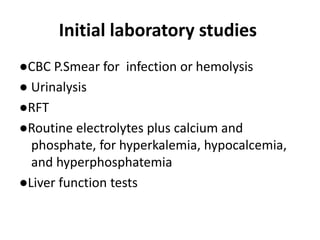
Initial laboratory studies
●CBC P.Smear for infection or hemolysis
● Urinalysis
●RFT
●Routine electrolytes plus calcium and
phosphate, for hyperkalemia, hypocalcemia,
and hyperphosphatemia
●Liver function tests
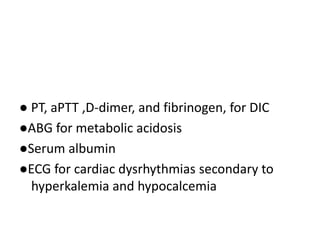
● PT, aPTT ,D-dimer, and fibrinogen, for DIC
●ABG for metabolic acidosis
●Serum albumin
●ECG for cardiac dysrhythmias secondary to
hyperkalemia and hypocalcemia
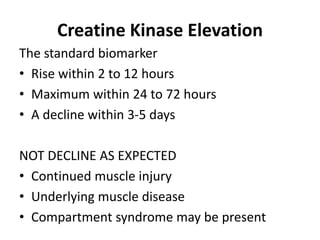
Creatine Kinase Elevation
The standard biomarker
• Rise within 2 to 12 hours
• Maximum within 24 to 72 hours
• A decline within 3-5 days
NOT DECLINE AS EXPECTED
• Continued muscle injury
• Underlying muscle disease
• Compartment syndrome may be present
• Five times the upper limit of normal
• Range from approximately 1500 to over
100,000 units/L.
• Malignant Hyperthermia avg value 60,000
units/L.
PREHOSPITAL CARE
• Early and vigorous IV fluid resuscitation is the
most important treatment to prevent AKI
• Avoid potassium- or lactate-containing
solutions
• Preferred fluid is iv ns
EMERGENCY DEPARTMENT CARE
• Proper history
• Ask for co morbidities / medications
• Vitals
• ECG monitoring
• Catheterisation
• Basic investigation including electrolytes
• Continue aggressive IV rehydration.
• IV crystalloids infusion of 4 ml/kg/h
• Goal of maintaining a minimum urine output
of 200 to 300 ml/ hour.
• No Ideal fluid
• Urine alkalinization (sodium bicarbonate)
• Forced diuresis (mannitol or loop diuretics)
• CK >10000...Mannitol& Bicarbonates
• Hypocalcemia – no treatment needed
• IV-Calcium - hyperkalemia-induced
cardiotoxicity
Hyperkalemia
• Insulin - glucose therapy may not be effective.
• The use of ion-exchange resins (e.g., sodium
polystyrene sulfonate) may be effective.
• hyperphosphatemia - oral phosphate binders
when serum levels are >7 milligrams/Dl
• Avoid prostaglandin inhibitors such as NSAIDs
because of their vasoconstrictive effects on
the kidney.
• Treat the underlying cause
RHABDOMYO.pptx
RHABDOMYO.pptx
RHABDOMYO.pptx
RHABDOMYO.pptx

RHABDOMYO.pptx

  • 1.
    RHABDOMYOLYSIS DR JAMSHEER VT MBBS MS MCh SURGICAL ONCOLOGY
  • 2.
    • Syndrome CharacterizedBy Muscle Necrosis And The Release Of Intracellular Muscle Constituents Into The Circulation.
  • 3.
    COMMON CAUSES • DrugsOf Abuse And Alcohol • Medications • Muscle Diseases • Trauma • Neuroleptic Malignant Syndrome • Seizures • Immobility • Infection • Strenuous Physical Activity • Heat-related Illness
  • 4.
    CHILDREN • Viral Myositis •Trauma • Connective Tissue Disease. • Inherited Metabolic Disorders
  • 5.
    DRUGS • Cyclosporine • MacrolideAntibiotics • Warfarin • Digoxin • Statin Therapy
  • 6.
    CLINICAL MANIFESTATIONS • Asymptomaticelevations of Enzymes to Life- threatening disease • Creatine Kinase (CK) • Most are nonspecific
  • 7.
    TRIAD(1-10%) • Myalgias • Muscleweakness • Red to brown urine
  • 8.
    Muscle • Pain -Thighs And Shoulders, and in the Lower back and Calves • Weakness –(12 - 70 %) • Swelling –(8 to 52%) fluid repletion:
  • 9.
    Urine • Red tobrown / Tea-colored /cola-colored • 100 to 300 mg/Dl • Orthotolidine/ dipstick - Only 0.5 to 1 mg/Dl
  • 10.
    OTHER Skin — discoloration/ blisters Systemic • Malaise • Fever • Tachycardia • Nausea & Vomiting • Abdominal Pain
  • 11.
    Fluid And ElectrolyteAbnormalities ●Hypovolemia results from "third-spacing“ ●Hyperkalemia and hyperphosphatemia ●Hypocalcemia ●Severe hyperuricemia ●Metabolic acidosis.
  • 12.
    COMPARTMENT SYNDROME • ExcessiveFluid resuscitation • Traumatic (eg, tibial fractures) • Nontraumatic (eg, prolonged limb compression)
  • 13.
    DISSEMINATED INTRAVASCULAR COAGULATION •Release of thromboplastin and other prothrombotic substances
  • 14.
    Other Organ Involvement ●Liverinjury – Liver dysfunction, typically reversible, occurs in up to 25 percent. ●Neurologic – Altered mental status due to toxins, drugs, trauma ●Pulmonary – Respiratory failure or ARDS
  • 15.
    History And Examination ●Recenttrauma ●Prescription medications with attention to myotoxic agents ●Alcohol and/or substance abuse ●Prolonged immobilization ●Strenuous or unaccustomed physical exertion or exercise ●Heat exposure or hyperthermia of any cause ●History of myopathy or muscular dystrophy ●Prior episodes of rhabdomyolysis ●Electrocution/ Burn injury ●Convulsive seizure
  • 16.
    Examination • Including muscleweakness • Tenderness • Limb edema • Evidence of trauma • Compartment syndrome
  • 17.
  • 18.
    Initial laboratory studies ●CBCP.Smear for infection or hemolysis ● Urinalysis ●RFT ●Routine electrolytes plus calcium and phosphate, for hyperkalemia, hypocalcemia, and hyperphosphatemia ●Liver function tests
  • 19.
    ● PT, aPTT,D-dimer, and fibrinogen, for DIC ●ABG for metabolic acidosis ●Serum albumin ●ECG for cardiac dysrhythmias secondary to hyperkalemia and hypocalcemia
  • 20.
    Creatine Kinase Elevation Thestandard biomarker • Rise within 2 to 12 hours • Maximum within 24 to 72 hours • A decline within 3-5 days NOT DECLINE AS EXPECTED • Continued muscle injury • Underlying muscle disease • Compartment syndrome may be present
  • 21.
    • Five timesthe upper limit of normal • Range from approximately 1500 to over 100,000 units/L. • Malignant Hyperthermia avg value 60,000 units/L.
  • 22.
    PREHOSPITAL CARE • Earlyand vigorous IV fluid resuscitation is the most important treatment to prevent AKI • Avoid potassium- or lactate-containing solutions • Preferred fluid is iv ns
  • 23.
    EMERGENCY DEPARTMENT CARE •Proper history • Ask for co morbidities / medications • Vitals • ECG monitoring • Catheterisation • Basic investigation including electrolytes
  • 24.
    • Continue aggressiveIV rehydration. • IV crystalloids infusion of 4 ml/kg/h • Goal of maintaining a minimum urine output of 200 to 300 ml/ hour.
  • 25.
    • No Idealfluid • Urine alkalinization (sodium bicarbonate) • Forced diuresis (mannitol or loop diuretics) • CK >10000...Mannitol& Bicarbonates
  • 26.
    • Hypocalcemia –no treatment needed • IV-Calcium - hyperkalemia-induced cardiotoxicity Hyperkalemia • Insulin - glucose therapy may not be effective. • The use of ion-exchange resins (e.g., sodium polystyrene sulfonate) may be effective.
  • 27.
    • hyperphosphatemia -oral phosphate binders when serum levels are >7 milligrams/Dl • Avoid prostaglandin inhibitors such as NSAIDs because of their vasoconstrictive effects on the kidney. • Treat the underlying cause