Data Structures
DataStructure
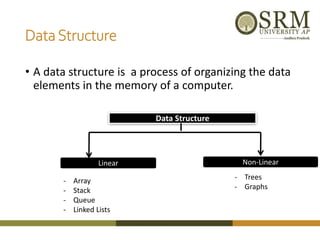
• A data structure is a process of organizing the data
elements in the memory of a computer.
Data Structure
Linear Non-Linear
- Array
- Stack
- Queue
- Linked Lists
- Trees
- Graphs
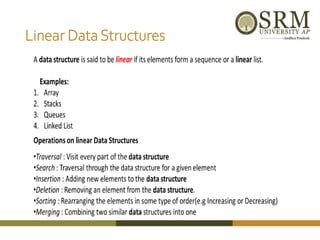
Linear DataStructures
Array
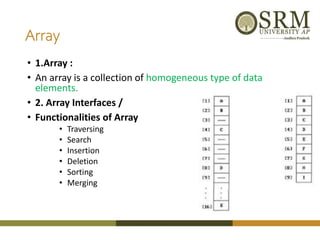
• 1.Array :
• An array is a collection of homogeneous type of data
elements.
• 2. Array Interfaces /
• Functionalities of Array
• Traversing
• Search
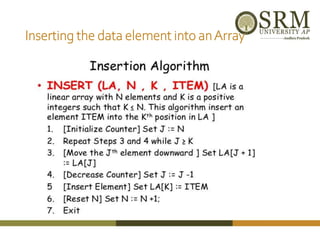
• Insertion
• Deletion
• Sorting
• Merging
Inserting the data element into anArray
#include<iostream>
using namespace std;
int main()
{
int i,a[50],no,pos,size;
cout<<"Enter array size( Max:50 ) :: ";
cin>>size;
cout<<"nEnter array elements :: n";
for(i=0; i<size; i++)
{
cout<<"nEnter arr["<<i<<"] Element :: ";
cin>>a[i];
}
cout<<"nStored Data in Array :: nn";
for(i=0;i<size;i++)
{
cout<<" "<<a[i]<<" ";
}
cout<<"nnEnter position to insert number :: ";
cin>>pos;
if(pos>size)
{
cout<<"nThis is out of range.n";
}
else
{
cout<<"nEnter number to be inserted :: ";
cin>>no;
--pos;
for(i=size;i>=pos;i--)
{
a[i+1]=a[i];
}
a[pos]=no;
cout<<"nNew Array is :: nn";
for(i=0;i<size+1;i++)
{
cout<<" "<<a[i]<<" ";
}
}
cout<<"n";
return 0; }
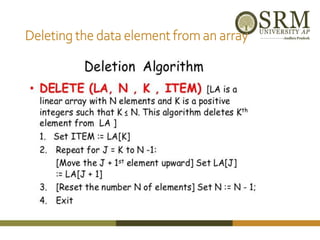
Deleting the data element from an array
#include<iostream>
#include<conio>
void main()
{
int arr[50], size, i, del, count=0;
cout<<"Enter array size : ";
cin>>size;
cout<<"Enter array elements : ";
for(i=0; i<size; i++) {
cin>>arr[i];
}
cout<<"Enter element to be delete : ";
cin>>del;
for(i=0; i<size; i++) {
if(arr[i]==del) {
for(int j=i; j<(size-1); j++) {
arr[j]=arr[j+1];
}
count++;
break;
} }
if(count==0)
{
cout<<"Element not found..!!";
}
else
{
cout<<"Element deleted successfully..!!n";
cout<<"Now the new array is :n";
for(i=0; i<(size-1); i++)
{
cout<<arr[i]<<" ";
}
}
getch();
}
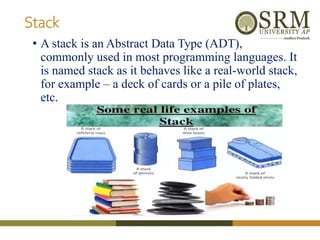
Stack
• A stack is an Abstract Data Type (ADT),
commonly used in most programming languages. It
is named stack as it behaves like a real-world stack,
for example – a deck of cards or a pile of plates,
etc.
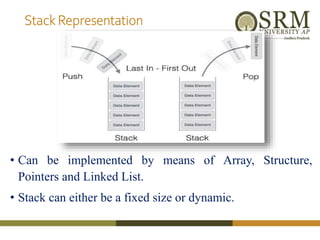
Stack Representation
• Can be implemented by means of Array, Structure,
Pointers and Linked List.
• Stack can either be a fixed size or dynamic.
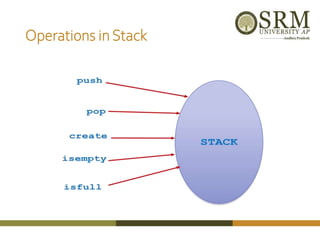
Operations inStack
Stack usingArray
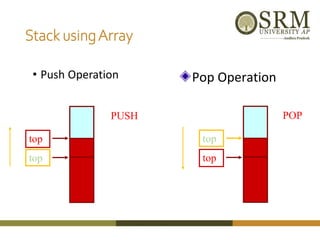
• Push Operation
top
top
PUSH
Pop Operation
top
top
POP
Stack usingArray
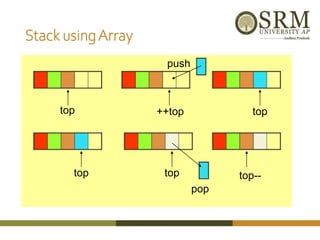
top ++top top
push
pop
top top top--
StackAlgorithms
Algorithm size()
return top +1
Algorithm pop(S[],top,item)
if top=-1 then
print “ stack is underflow”
else
top top - 1
return S[top+1]
Algorithm push(S[],item, max, top)
if top = max-1 then
print “ stack is full”
else
top  top + 1
S[top]  item
Queue
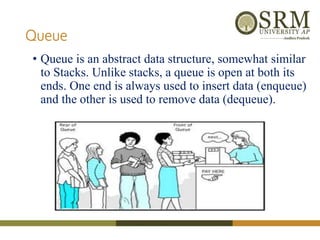
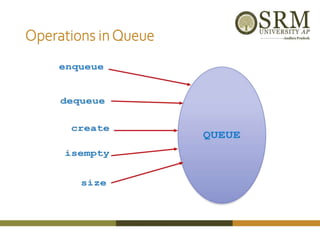
• Queue is an abstract data structure, somewhat similar
to Stacks. Unlike stacks, a queue is open at both its
ends. One end is always used to insert data (enqueue)
and the other is used to remove data (dequeue).
Queue Representation
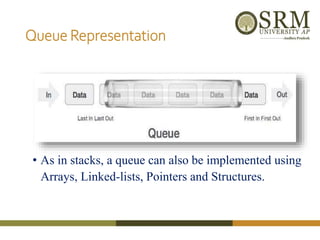
• As in stacks, a queue can also be implemented using
Arrays, Linked-lists, Pointers and Structures.
Operations inQueue
Algorithm enqueue(o)
if rear = N-1 then
print “queue full error”
else
if(front =-1)
front=0
r (f + sz) mod N
Q[r]  o
sz (sz + 1)
Algorithm isfull()
return sz=N
Algorithm size()
return sz
Algorithm isEmpty()
return (sz ==0)
Algorithm dequeue()
if front=rear then
print “ Queue is empty”
else
o Q[f]
f  (f + 1) mod N
sz (sz - 1)
if (front==rear)
front=rear=-1
return o
Linked list
• Linear collection of self-referential class objects,
called nodes Connected by pointer links
• Accessed via a pointer to the first node of the list
• Link pointer in the last node is set to null to mark
the list’s end
• Use a linked list instead of an array when
• You have an unpredictable number of data elements
• You want to insert and delete quickly.
Singly Linked List
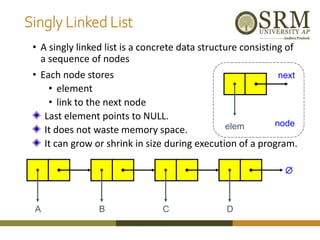
• A singly linked list is a concrete data structure consisting of
a sequence of nodes
• Each node stores
• element
• link to the next node
Last element points to NULL.
It does not waste memory space.
It can grow or shrink in size during execution of a program.
next
elem node
A B C D

Linked List
• Keeping track of a linked list:
• Must know the pointer to the first element of the list (called
start, head, etc.).
• Basic operations commonly include:
• Construction: Allocate and initialize a list object (usually
empty)
• Empty: Check if list is empty
• Insert: Add an item to the list at any point
• Delete: Remove an item from the list at any point
• Traverse: Go through the list or a part of it, accessing and
processing the elements in the order they are stored
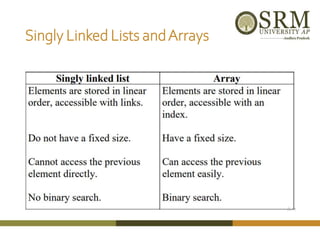
Singly Linked Lists andArrays
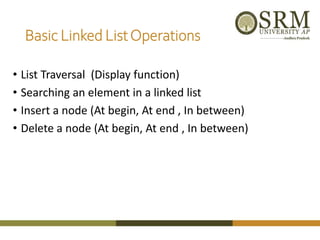
Basic Linked ListOperations
• List Traversal (Display function)
• Searching an element in a linked list
• Insert a node (At begin, At end , In between)
• Delete a node (At begin, At end , In between)
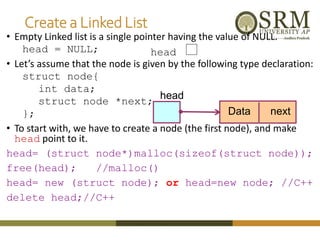
Create a Linked List
• Empty Linked list is a single pointer having the value of NULL.
head = NULL;
• Let’s assume that the node is given by the following type declaration:
struct node{
int data;
struct node *next;
};
• To start with, we have to create a node (the first node), and make
head point to it.
head= (struct node*)malloc(sizeof(struct node));
free(head); //malloc()
head= new (struct node); or head=new node; //C++
delete head;//C++
head
head
Data next
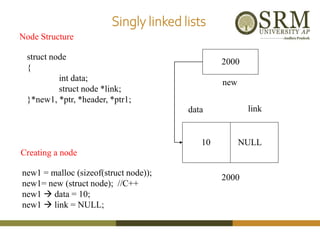
Singly linked lists
Node Structure
struct node
{
int data;
struct node *link;
}*new1, *ptr, *header, *ptr1;
Creating a node
new1 = malloc (sizeof(struct node));
new1= new (struct node); //C++
new1  data = 10;
new1  link = NULL;
data link
2000
10
new
2000
NULL
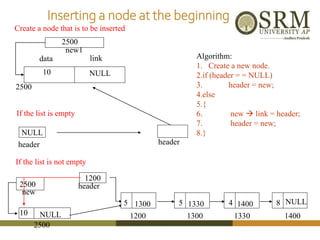
Inserting a node at the beginning
Create a node that is to be inserted
2500
data link
10
new1
2500
NULL
Algorithm:
1. Create a new node.
2.if (header = = NULL)
3. header = new;
4.else
5.{
6. new  link = header;
7. header = new;
8.}
If the list is empty
NULL
header header
If the list is not empty
1200
header
2500
10
new
2500
NULL 1200 1300 1330 1400
NULL
5 5 4 8
1300 1330 1400
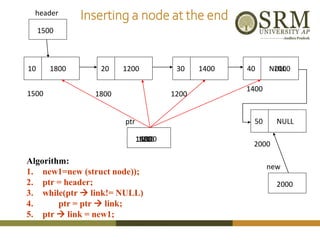
Inserting a node at the end
10 1800 20 1200 30 1400 40 NULL
1500 1800 1200
1400
1500
header
50 NULL
2000
Algorithm:
1. new1=new (struct node));
2. ptr = header;
3. while(ptr  link!= NULL)
4. ptr = ptr  link;
5. ptr  link = new1;
2000
new
1500
ptr
1800
1200
1400
2000
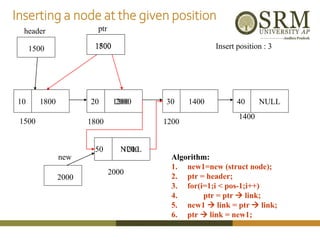
Inserting a node at the given position
10 1800 20 1200 30 1400 40 NULL
1500
header
50 NULL
2000
2000
new Algorithm:
1. new1=new (struct node);
2. ptr = header;
3. for(i=1;i < pos-1;i++)
4. ptr = ptr  link;
5. new1  link = ptr  link;
6. ptr  link = new1;
1500
ptr
1500 1800 1200
1400
Insert position : 3
1800
1200
2000
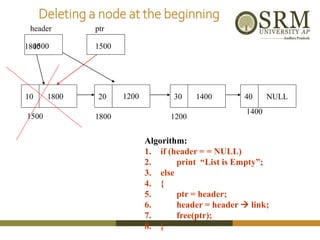
Deleting a node at the beginning
Algorithm:
1. if (header = = NULL)
2. print “List is Empty”;
3. else
4. {
5. ptr = header;
6. header = header  link;
7. free(ptr);
8. }
10 1800 20 30 1400 40 NULL
1500 1800 1200
1400
1200
1500
header
1500
ptr
1800
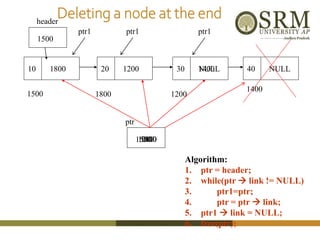
Deleting a node at the end
10 1800 20 1200 30 1400 40 NULL
1500 1800 1200
1400
1500
header
Algorithm:
1. ptr = header;
2. while(ptr  link != NULL)
3. ptr1=ptr;
4. ptr = ptr  link;
5. ptr1  link = NULL;
6. free(ptr);
1500
ptr
1800
1200
NULL
ptr1 ptr1 ptr1
1400
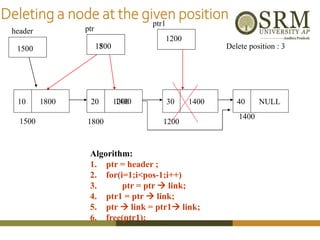
Deleting a node at the given position
10 1800 20 1200 30 1400 40 NULL
1500
header
Algorithm:
1. ptr = header ;
2. for(i=1;i<pos-1;i++)
3. ptr = ptr  link;
4. ptr1 = ptr  link;
5. ptr  link = ptr1 link;
6. free(ptr1);
1500
ptr
1500 1800 1200
1400
Delete position : 3
1800
ptr1
1200
1400
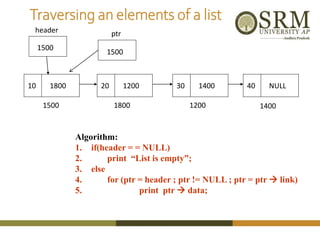
Traversing an elements of a list
10 1800 20 1200 30 1400 40 NULL
1500 1800 1200 1400
1500
header
Algorithm:
1. if(header = = NULL)
2. print “List is empty”;
3. else
4. for (ptr = header ; ptr != NULL ; ptr = ptr  link)
5. print ptr  data;
ptr
1500
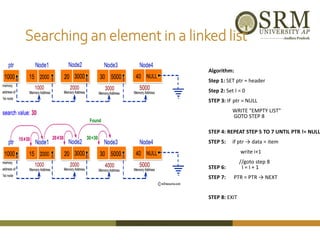
Searching an element in a linked list
Algorithm:
Step 1: SET ptr = header
Step 2: Set I = 0
STEP 3: IF ptr = NULL
WRITE "EMPTY LIST"
GOTO STEP 8
STEP 4: REPEAT STEP 5 TO 7 UNTIL PTR != NULL
STEP 5: if ptr → data = item
write i+1
//goto step 8
STEP 6: I = I + 1
STEP 7: PTR = PTR → NEXT
STEP 8: EXIT
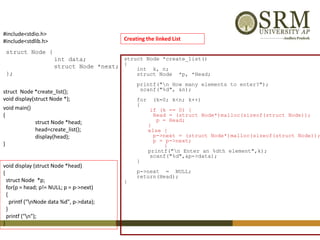
Creating the linked List
struct Node {
int data;
struct Node *next;
};
void main()
{
struct Node *head;
head=create_list();
display(head);
}
struct Node *create_list()
{
int k, n;
struct Node *p, *Head;
printf("n How many elements to enter?");
scanf("%d", &n);
for (k=0; k<n; k++)
{
if (k == 0) {
Head = (struct Node*)malloc(sizeof(struct Node));
p = Head;
}
else {
p->next = (struct Node*)malloc(sizeof(struct Node));
p = p->next;
}
printf("n Enter an %dth element",k);
scanf("%d",&p->data);
}
p->next = NULL;
return(Head);
}
void display (struct Node *head)
{
struct Node *p;
for(p = head; p!= NULL; p = p->next)
{
printf ("nNode data %d", p->data);
}
printf ("n");
}
#include<stdio.h>
#include<stdlib.h>
struct Node *create_list();
void display(struct Node *);
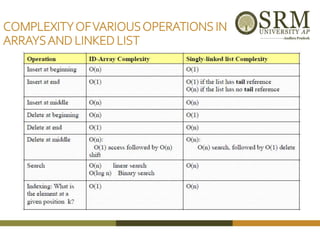
COMPLEXITYOFVARIOUSOPERATIONS IN
ARRAYSAND LINKED LIST
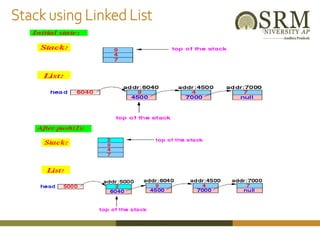
Stack using Linked List
Algorithms –PUSH & POP
• Algorithm PUSH (value)
• Step 1 - Create a newNode with given value.
• Step 2 - Check whether stack is Empty (top == NULL)
• Step 3 - If it is Empty, then set newNode → next = NULL.
• Step 4 - If it is Not Empty, then set newNode → next = top.
• Step 5 - Finally, set top = newNode.
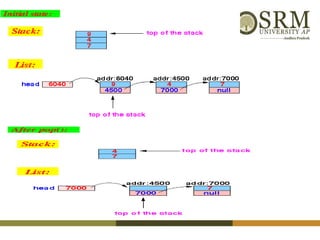
• Algorithm POP
• Step 1 - Check whether stack is Empty (top == NULL).
• Step 2 - If it is Empty, then display "Stack is Empty!!! Deletion is not
possible!!!" and terminate the function
• Step 3 - If it is Not Empty, then define a Node pointer 'temp' and set it to 'top'.
• Step 4 - Then set 'top = top → next'.
• Step 5 - Finally, delete 'temp'. (free(temp)).
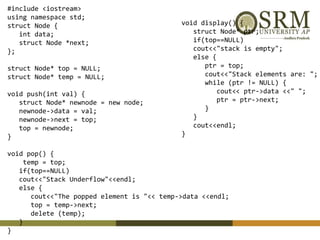
void display() {
struct Node* ptr;
if(top==NULL)
cout<<"stack is empty";
else {
ptr = top;
cout<<"Stack elements are: ";
while (ptr != NULL) {
cout<< ptr->data <<" ";
ptr = ptr->next;
}
}
cout<<endl;
}
#include <iostream>
using namespace std;
struct Node {
int data;
struct Node *next;
};
struct Node* top = NULL;
struct Node* temp = NULL;
void push(int val) {
struct Node* newnode = new node;
newnode->data = val;
newnode->next = top;
top = newnode;
}
void pop() {
temp = top;
if(top==NULL)
cout<<"Stack Underflow"<<endl;
else {
cout<<"The popped element is "<< temp->data <<endl;
top = temp->next;
delete (temp);
}
}
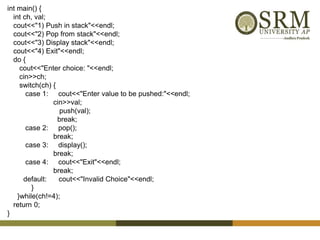
int main() {
int ch, val;
cout<<"1) Push in stack"<<endl;
cout<<"2) Pop from stack"<<endl;
cout<<"3) Display stack"<<endl;
cout<<"4) Exit"<<endl;
do {
cout<<"Enter choice: "<<endl;
cin>>ch;
switch(ch) {
case 1: cout<<"Enter value to be pushed:"<<endl;
cin>>val;
push(val);
break;
case 2: pop();
break;
case 3: display();
break;
case 4: cout<<"Exit"<<endl;
break;
default: cout<<"Invalid Choice"<<endl;
}
}while(ch!=4);
return 0;
}
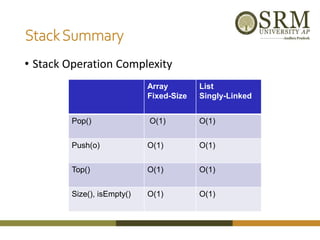
StackSummary
• Stack Operation Complexity
Array
Fixed-Size
List
Singly-Linked
Pop() O(1) O(1)
Push(o) O(1) O(1)
Top() O(1) O(1)
Size(), isEmpty() O(1) O(1)
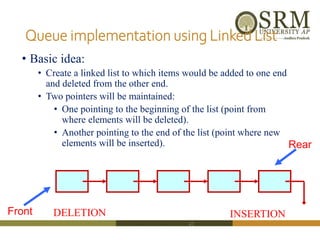
Queue implementation using Linked List
• Basic idea:
• Create a linked list to which items would be added to one end
and deleted from the other end.
• Two pointers will be maintained:
• One pointing to the beginning of the list (point from
where elements will be deleted).
• Another pointing to the end of the list (point where new
elements will be inserted).
42
Front
Rear
DELETION INSERTION
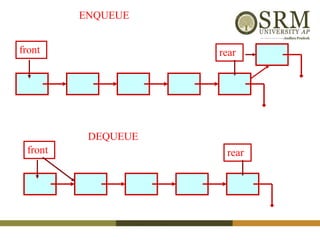
front rear
ENQUEUE
front rear
DEQUEUE
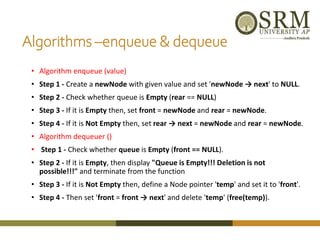
Algorithms –enqueue & dequeue
• Algorithm enqueue (value)
• Step 1 - Create a newNode with given value and set 'newNode → next' to NULL.
• Step 2 - Check whether queue is Empty (rear == NULL)
• Step 3 - If it is Empty then, set front = newNode and rear = newNode.
• Step 4 - If it is Not Empty then, set rear → next = newNode and rear = newNode.
• Algorithm dequeuer ()
• Step 1 - Check whether queue is Empty (front == NULL).
• Step 2 - If it is Empty, then display "Queue is Empty!!! Deletion is not
possible!!!" and terminate from the function
• Step 3 - If it is Not Empty then, define a Node pointer 'temp' and set it to 'front'.
• Step 4 - Then set 'front = front → next' and delete 'temp' (free(temp)).
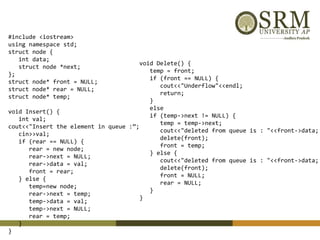
void Delete() {
temp = front;
if (front == NULL) {
cout<<"Underflow"<<endl;
return;
}
else
if (temp->next != NULL) {
temp = temp->next;
cout<<"deleted from queue is : "<<front->data;
delete(front);
front = temp;
} else {
cout<<"deleted from queue is : "<<front->data;
delete(front);
front = NULL;
rear = NULL;
}
}
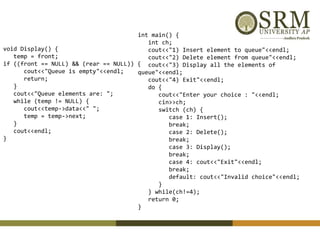
#include <iostream>
using namespace std;
struct node {
int data;
struct node *next;
};
struct node* front = NULL;
struct node* rear = NULL;
struct node* temp;
void Insert() {
int val;
cout<<"Insert the element in queue :”;
cin>>val;
if (rear == NULL) {
rear = new node;
rear->next = NULL;
rear->data = val;
front = rear;
} else {
temp=new node;
rear->next = temp;
temp->data = val;
temp->next = NULL;
rear = temp;
}
}
int main() {
int ch;
cout<<"1) Insert element to queue"<<endl;
cout<<"2) Delete element from queue"<<endl;
cout<<"3) Display all the elements of
queue"<<endl;
cout<<"4) Exit"<<endl;
do {
cout<<"Enter your choice : "<<endl;
cin>>ch;
switch (ch) {
case 1: Insert();
break;
case 2: Delete();
break;
case 3: Display();
break;
case 4: cout<<"Exit"<<endl;
break;
default: cout<<"Invalid choice"<<endl;
}
} while(ch!=4);
return 0;
}
void Display() {
temp = front;
if ((front == NULL) && (rear == NULL)) {
cout<<"Queue is empty"<<endl;
return;
}
cout<<"Queue elements are: ";
while (temp != NULL) {
cout<<temp->data<<" ";
temp = temp->next;
}
cout<<endl;
}
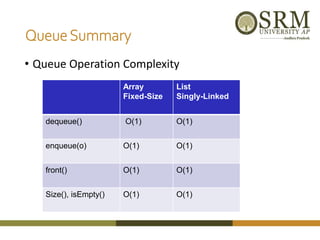
QueueSummary
• Queue Operation Complexity
Array
Fixed-Size
List
Singly-Linked
dequeue() O(1) O(1)
enqueue(o) O(1) O(1)
front() O(1) O(1)
Size(), isEmpty() O(1) O(1)
ThankYou

Revisiting a data structures in detail with linked list stack and queue

  • 1.
  • 2.
    DataStructure • A datastructure is a process of organizing the data elements in the memory of a computer. Data Structure Linear Non-Linear - Array - Stack - Queue - Linked Lists - Trees - Graphs
  • 3.
  • 4.
    Array • 1.Array : •An array is a collection of homogeneous type of data elements. • 2. Array Interfaces / • Functionalities of Array • Traversing • Search • Insertion • Deletion • Sorting • Merging
  • 5.
    Inserting the dataelement into anArray
  • 6.
    #include<iostream> using namespace std; intmain() { int i,a[50],no,pos,size; cout<<"Enter array size( Max:50 ) :: "; cin>>size; cout<<"nEnter array elements :: n"; for(i=0; i<size; i++) { cout<<"nEnter arr["<<i<<"] Element :: "; cin>>a[i]; } cout<<"nStored Data in Array :: nn"; for(i=0;i<size;i++) { cout<<" "<<a[i]<<" "; } cout<<"nnEnter position to insert number :: "; cin>>pos; if(pos>size) { cout<<"nThis is out of range.n"; } else { cout<<"nEnter number to be inserted :: "; cin>>no; --pos; for(i=size;i>=pos;i--) { a[i+1]=a[i]; } a[pos]=no; cout<<"nNew Array is :: nn"; for(i=0;i<size+1;i++) { cout<<" "<<a[i]<<" "; } } cout<<"n"; return 0; }
  • 7.
    Deleting the dataelement from an array
  • 8.
    #include<iostream> #include<conio> void main() { int arr[50],size, i, del, count=0; cout<<"Enter array size : "; cin>>size; cout<<"Enter array elements : "; for(i=0; i<size; i++) { cin>>arr[i]; } cout<<"Enter element to be delete : "; cin>>del; for(i=0; i<size; i++) { if(arr[i]==del) { for(int j=i; j<(size-1); j++) { arr[j]=arr[j+1]; } count++; break; } } if(count==0) { cout<<"Element not found..!!"; } else { cout<<"Element deleted successfully..!!n"; cout<<"Now the new array is :n"; for(i=0; i<(size-1); i++) { cout<<arr[i]<<" "; } } getch(); }
  • 9.
    Stack • A stackis an Abstract Data Type (ADT), commonly used in most programming languages. It is named stack as it behaves like a real-world stack, for example – a deck of cards or a pile of plates, etc.
  • 10.
    Stack Representation • Canbe implemented by means of Array, Structure, Pointers and Linked List. • Stack can either be a fixed size or dynamic.
  • 11.
  • 12.
    Stack usingArray • PushOperation top top PUSH Pop Operation top top POP
  • 13.
    Stack usingArray top ++toptop push pop top top top--
  • 14.
    StackAlgorithms Algorithm size() return top+1 Algorithm pop(S[],top,item) if top=-1 then print “ stack is underflow” else top top - 1 return S[top+1] Algorithm push(S[],item, max, top) if top = max-1 then print “ stack is full” else top  top + 1 S[top]  item
  • 15.
    Queue • Queue isan abstract data structure, somewhat similar to Stacks. Unlike stacks, a queue is open at both its ends. One end is always used to insert data (enqueue) and the other is used to remove data (dequeue).
  • 16.
    Queue Representation • Asin stacks, a queue can also be implemented using Arrays, Linked-lists, Pointers and Structures.
  • 17.
  • 18.
    Algorithm enqueue(o) if rear= N-1 then print “queue full error” else if(front =-1) front=0 r (f + sz) mod N Q[r]  o sz (sz + 1) Algorithm isfull() return sz=N Algorithm size() return sz Algorithm isEmpty() return (sz ==0) Algorithm dequeue() if front=rear then print “ Queue is empty” else o Q[f] f  (f + 1) mod N sz (sz - 1) if (front==rear) front=rear=-1 return o
  • 19.
    Linked list • Linearcollection of self-referential class objects, called nodes Connected by pointer links • Accessed via a pointer to the first node of the list • Link pointer in the last node is set to null to mark the list’s end • Use a linked list instead of an array when • You have an unpredictable number of data elements • You want to insert and delete quickly.
  • 20.
    Singly Linked List •A singly linked list is a concrete data structure consisting of a sequence of nodes • Each node stores • element • link to the next node Last element points to NULL. It does not waste memory space. It can grow or shrink in size during execution of a program. next elem node A B C D 
  • 21.
    Linked List • Keepingtrack of a linked list: • Must know the pointer to the first element of the list (called start, head, etc.). • Basic operations commonly include: • Construction: Allocate and initialize a list object (usually empty) • Empty: Check if list is empty • Insert: Add an item to the list at any point • Delete: Remove an item from the list at any point • Traverse: Go through the list or a part of it, accessing and processing the elements in the order they are stored
  • 22.
  • 23.
    Basic Linked ListOperations •List Traversal (Display function) • Searching an element in a linked list • Insert a node (At begin, At end , In between) • Delete a node (At begin, At end , In between)
  • 24.
    Create a LinkedList • Empty Linked list is a single pointer having the value of NULL. head = NULL; • Let’s assume that the node is given by the following type declaration: struct node{ int data; struct node *next; }; • To start with, we have to create a node (the first node), and make head point to it. head= (struct node*)malloc(sizeof(struct node)); free(head); //malloc() head= new (struct node); or head=new node; //C++ delete head;//C++ head head Data next
  • 25.
    Singly linked lists NodeStructure struct node { int data; struct node *link; }*new1, *ptr, *header, *ptr1; Creating a node new1 = malloc (sizeof(struct node)); new1= new (struct node); //C++ new1  data = 10; new1  link = NULL; data link 2000 10 new 2000 NULL
  • 26.
    Inserting a nodeat the beginning Create a node that is to be inserted 2500 data link 10 new1 2500 NULL Algorithm: 1. Create a new node. 2.if (header = = NULL) 3. header = new; 4.else 5.{ 6. new  link = header; 7. header = new; 8.} If the list is empty NULL header header If the list is not empty 1200 header 2500 10 new 2500 NULL 1200 1300 1330 1400 NULL 5 5 4 8 1300 1330 1400
  • 27.
    Inserting a nodeat the end 10 1800 20 1200 30 1400 40 NULL 1500 1800 1200 1400 1500 header 50 NULL 2000 Algorithm: 1. new1=new (struct node)); 2. ptr = header; 3. while(ptr  link!= NULL) 4. ptr = ptr  link; 5. ptr  link = new1; 2000 new 1500 ptr 1800 1200 1400 2000
  • 28.
    Inserting a nodeat the given position 10 1800 20 1200 30 1400 40 NULL 1500 header 50 NULL 2000 2000 new Algorithm: 1. new1=new (struct node); 2. ptr = header; 3. for(i=1;i < pos-1;i++) 4. ptr = ptr  link; 5. new1  link = ptr  link; 6. ptr  link = new1; 1500 ptr 1500 1800 1200 1400 Insert position : 3 1800 1200 2000
  • 29.
    Deleting a nodeat the beginning Algorithm: 1. if (header = = NULL) 2. print “List is Empty”; 3. else 4. { 5. ptr = header; 6. header = header  link; 7. free(ptr); 8. } 10 1800 20 30 1400 40 NULL 1500 1800 1200 1400 1200 1500 header 1500 ptr 1800
  • 30.
    Deleting a nodeat the end 10 1800 20 1200 30 1400 40 NULL 1500 1800 1200 1400 1500 header Algorithm: 1. ptr = header; 2. while(ptr  link != NULL) 3. ptr1=ptr; 4. ptr = ptr  link; 5. ptr1  link = NULL; 6. free(ptr); 1500 ptr 1800 1200 NULL ptr1 ptr1 ptr1 1400
  • 31.
    Deleting a nodeat the given position 10 1800 20 1200 30 1400 40 NULL 1500 header Algorithm: 1. ptr = header ; 2. for(i=1;i<pos-1;i++) 3. ptr = ptr  link; 4. ptr1 = ptr  link; 5. ptr  link = ptr1 link; 6. free(ptr1); 1500 ptr 1500 1800 1200 1400 Delete position : 3 1800 ptr1 1200 1400
  • 32.
    Traversing an elementsof a list 10 1800 20 1200 30 1400 40 NULL 1500 1800 1200 1400 1500 header Algorithm: 1. if(header = = NULL) 2. print “List is empty”; 3. else 4. for (ptr = header ; ptr != NULL ; ptr = ptr  link) 5. print ptr  data; ptr 1500
  • 33.
    Searching an elementin a linked list Algorithm: Step 1: SET ptr = header Step 2: Set I = 0 STEP 3: IF ptr = NULL WRITE "EMPTY LIST" GOTO STEP 8 STEP 4: REPEAT STEP 5 TO 7 UNTIL PTR != NULL STEP 5: if ptr → data = item write i+1 //goto step 8 STEP 6: I = I + 1 STEP 7: PTR = PTR → NEXT STEP 8: EXIT
  • 34.
    Creating the linkedList struct Node { int data; struct Node *next; }; void main() { struct Node *head; head=create_list(); display(head); } struct Node *create_list() { int k, n; struct Node *p, *Head; printf("n How many elements to enter?"); scanf("%d", &n); for (k=0; k<n; k++) { if (k == 0) { Head = (struct Node*)malloc(sizeof(struct Node)); p = Head; } else { p->next = (struct Node*)malloc(sizeof(struct Node)); p = p->next; } printf("n Enter an %dth element",k); scanf("%d",&p->data); } p->next = NULL; return(Head); } void display (struct Node *head) { struct Node *p; for(p = head; p!= NULL; p = p->next) { printf ("nNode data %d", p->data); } printf ("n"); } #include<stdio.h> #include<stdlib.h> struct Node *create_list(); void display(struct Node *);
  • 35.
  • 36.
  • 38.
    Algorithms –PUSH &POP • Algorithm PUSH (value) • Step 1 - Create a newNode with given value. • Step 2 - Check whether stack is Empty (top == NULL) • Step 3 - If it is Empty, then set newNode → next = NULL. • Step 4 - If it is Not Empty, then set newNode → next = top. • Step 5 - Finally, set top = newNode. • Algorithm POP • Step 1 - Check whether stack is Empty (top == NULL). • Step 2 - If it is Empty, then display "Stack is Empty!!! Deletion is not possible!!!" and terminate the function • Step 3 - If it is Not Empty, then define a Node pointer 'temp' and set it to 'top'. • Step 4 - Then set 'top = top → next'. • Step 5 - Finally, delete 'temp'. (free(temp)).
  • 39.
    void display() { structNode* ptr; if(top==NULL) cout<<"stack is empty"; else { ptr = top; cout<<"Stack elements are: "; while (ptr != NULL) { cout<< ptr->data <<" "; ptr = ptr->next; } } cout<<endl; } #include <iostream> using namespace std; struct Node { int data; struct Node *next; }; struct Node* top = NULL; struct Node* temp = NULL; void push(int val) { struct Node* newnode = new node; newnode->data = val; newnode->next = top; top = newnode; } void pop() { temp = top; if(top==NULL) cout<<"Stack Underflow"<<endl; else { cout<<"The popped element is "<< temp->data <<endl; top = temp->next; delete (temp); } }
  • 40.
    int main() { intch, val; cout<<"1) Push in stack"<<endl; cout<<"2) Pop from stack"<<endl; cout<<"3) Display stack"<<endl; cout<<"4) Exit"<<endl; do { cout<<"Enter choice: "<<endl; cin>>ch; switch(ch) { case 1: cout<<"Enter value to be pushed:"<<endl; cin>>val; push(val); break; case 2: pop(); break; case 3: display(); break; case 4: cout<<"Exit"<<endl; break; default: cout<<"Invalid Choice"<<endl; } }while(ch!=4); return 0; }
  • 41.
    StackSummary • Stack OperationComplexity Array Fixed-Size List Singly-Linked Pop() O(1) O(1) Push(o) O(1) O(1) Top() O(1) O(1) Size(), isEmpty() O(1) O(1)
  • 42.
    Queue implementation usingLinked List • Basic idea: • Create a linked list to which items would be added to one end and deleted from the other end. • Two pointers will be maintained: • One pointing to the beginning of the list (point from where elements will be deleted). • Another pointing to the end of the list (point where new elements will be inserted). 42 Front Rear DELETION INSERTION
  • 43.
  • 44.
    Algorithms –enqueue &dequeue • Algorithm enqueue (value) • Step 1 - Create a newNode with given value and set 'newNode → next' to NULL. • Step 2 - Check whether queue is Empty (rear == NULL) • Step 3 - If it is Empty then, set front = newNode and rear = newNode. • Step 4 - If it is Not Empty then, set rear → next = newNode and rear = newNode. • Algorithm dequeuer () • Step 1 - Check whether queue is Empty (front == NULL). • Step 2 - If it is Empty, then display "Queue is Empty!!! Deletion is not possible!!!" and terminate from the function • Step 3 - If it is Not Empty then, define a Node pointer 'temp' and set it to 'front'. • Step 4 - Then set 'front = front → next' and delete 'temp' (free(temp)).
  • 45.
    void Delete() { temp= front; if (front == NULL) { cout<<"Underflow"<<endl; return; } else if (temp->next != NULL) { temp = temp->next; cout<<"deleted from queue is : "<<front->data; delete(front); front = temp; } else { cout<<"deleted from queue is : "<<front->data; delete(front); front = NULL; rear = NULL; } } #include <iostream> using namespace std; struct node { int data; struct node *next; }; struct node* front = NULL; struct node* rear = NULL; struct node* temp; void Insert() { int val; cout<<"Insert the element in queue :”; cin>>val; if (rear == NULL) { rear = new node; rear->next = NULL; rear->data = val; front = rear; } else { temp=new node; rear->next = temp; temp->data = val; temp->next = NULL; rear = temp; } }
  • 46.
    int main() { intch; cout<<"1) Insert element to queue"<<endl; cout<<"2) Delete element from queue"<<endl; cout<<"3) Display all the elements of queue"<<endl; cout<<"4) Exit"<<endl; do { cout<<"Enter your choice : "<<endl; cin>>ch; switch (ch) { case 1: Insert(); break; case 2: Delete(); break; case 3: Display(); break; case 4: cout<<"Exit"<<endl; break; default: cout<<"Invalid choice"<<endl; } } while(ch!=4); return 0; } void Display() { temp = front; if ((front == NULL) && (rear == NULL)) { cout<<"Queue is empty"<<endl; return; } cout<<"Queue elements are: "; while (temp != NULL) { cout<<temp->data<<" "; temp = temp->next; } cout<<endl; }
  • 47.
    QueueSummary • Queue OperationComplexity Array Fixed-Size List Singly-Linked dequeue() O(1) O(1) enqueue(o) O(1) O(1) front() O(1) O(1) Size(), isEmpty() O(1) O(1)
  • 48.