TAYLOR SWIFT & KENDRICK
LAMAR - BAD BLOOD
Analysed through the four different narrative theories:
https://www.youtube.com/watch?v=QcIy9NiNbmo
PROPP’S CHARACTERS
REPRESENTED IN THE VIDEO:
‘Catastrophe’ represents the
Heroine of Propp’s eight
characters as it is on her that
the narrative focuses.
‘Arsyn’ represents the Villain
and False Hero for the video;
this character fills out the
functions of both of these rolls.
‘Welvin Da Great’ acts as the
role of Father and Dispatcher,
as well as taking on certain
roles of Seeker which is
normally an aspect of the
heroine.
For this video, there are a
number of characters who play
the collective role of the helper;
this shot contains the most of
them you see at any given time.
Many of these ‘Helpers’ also
play the role of ‘Donors’ as they
also prepare the heroine for her
journey as well as helping her
on it.
THE USE OF THE 31 FUNCTIONS:
For this video, not all of the 31 functions are observed primarily to do with the
fact that the narrative does not ‘conclude’ according to these functions. The
narrative comes to a close at roughly the 16th point (according to the standard
narrative). This point is ‘The Struggle’; where the heroine and villain have their
direct confrontation - this video is seen to finish just as this confrontation begins.
However, due to certain functions not appearing in the standard order, there are
certain functions that still appear even though they would be expected to appear
after function 16, i.e function 17.
The first function that we see is very brief, but can
be identified as F.4 ‘Reconnaissance’: The villain
is seen to observe the hero to seek some
information to benefit them. Subsequently leading
to F.5 ‘Delivery’: Where the villain is successful in
their information gathering.
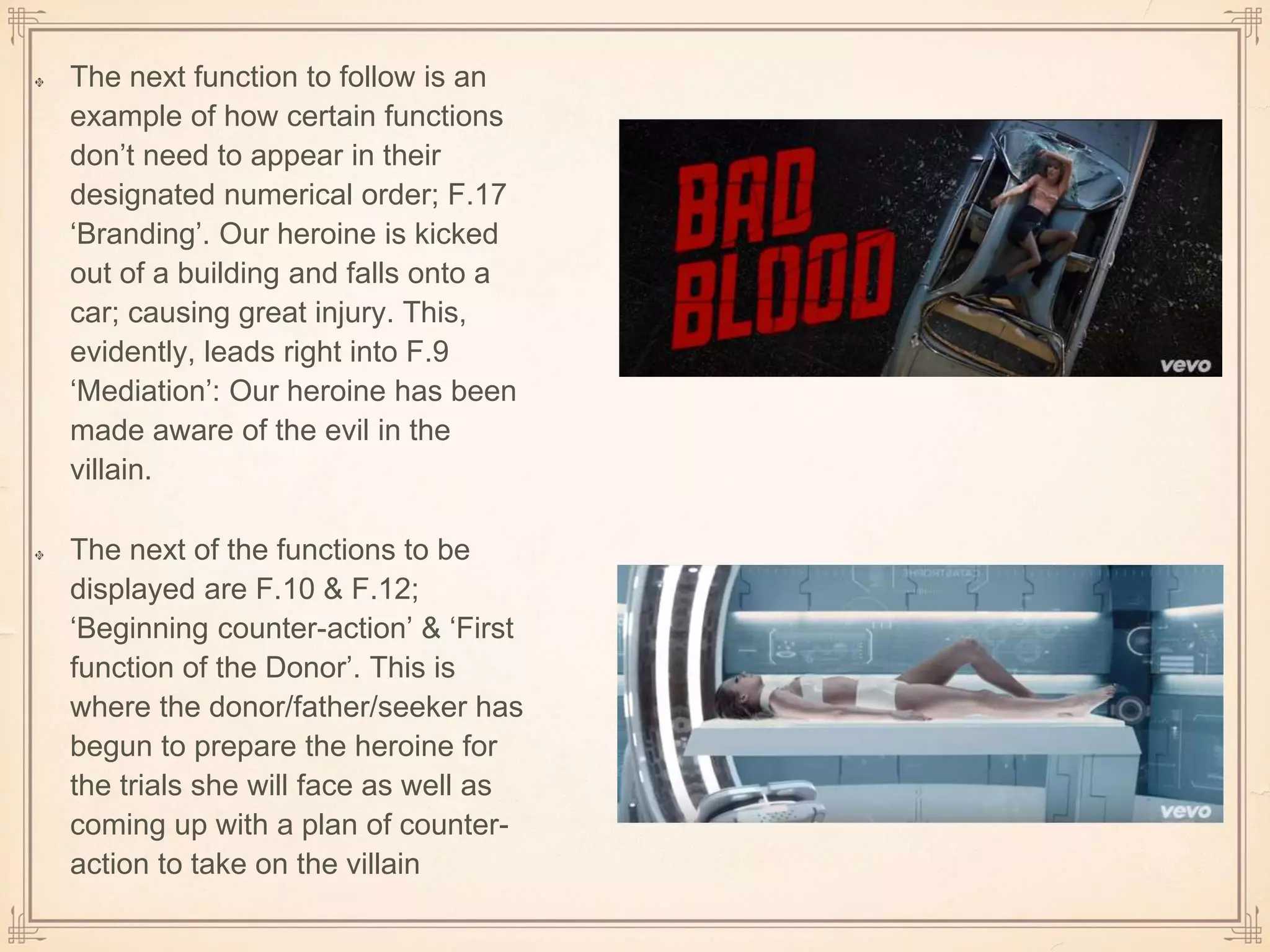
The next function to follow is an
example of how certain functions
don’t need to appear in their
designated numerical order; F.17
‘Branding’. Our heroine is kicked
out of a building and falls onto a
car; causing great injury. This,
evidently, leads right into F.9
‘Mediation’: Our heroine has been
made aware of the evil in the
villain.
The next of the functions to be
displayed are F.10 & F.12;
‘Beginning counter-action’ & ‘First
function of the Donor’. This is
where the donor/father/seeker has
begun to prepare the heroine for
the trials she will face as well as
coming up with a plan of counter-
action to take on the villain
Thus begins F.13 ‘Hero’s
reaction’: The heroine is seen
taking part in the trials of the
donor and successfully completes
them all.
The following functions are F.11
‘Departure’ & F.14 ‘Receipt of
magical agent’. The heroine has
set out to defeat the villain, and
has received her hep in the form
of 6 definitive helpers.
The following and final function is
F.16 ‘Confrontation’; it is here that
we see our heroine and villain
collide and we are led to believe
that fighting and chaos will ensue.
TZVETAN TODOROV’S THEORY:
Todorov’s theory is that there are three basic steps in a narrative and often two smaller
steps, beginning with an equilibrium and series of events follows with disruptions to it;
eventually resulting in the new equilibrium. Our initial equilibrium that we witness is of
these two characters working together for a common goal.
We then see the disruption of the equilibrium in one character kicking the other out
of a window, breaking their short lived alliance.
We then see our ‘Recognition of
the disruption’ when the character
of Catastrophe is brought back to
the base to be made better.
There is then the attempt to repair
the damage done by the
disruption shown in the training
taking place and when the
confrontation takes place at the
end of the video.
We don’t see the ‘new equilibrium’
that is to be established in the
narrative. This is because the
video finishes before the actual
narrative reaches a conclusion.
CLAUDE LÉVI-STRAUSS’ THEORY:
Strauss’ theory of binary opposites has its clearest fingerprint on this video in how
the heroine, Catastrophe, has blonde hair and the villain, Arsyn, has dark
brown/black hair. Adding to this is that Arsyn is in all black and Catastrophe is
wearing beige/cream colours. Displaying the two with opposing colours is
representative of how they oppose each other in the narrative.
Another example of the usage of binary
opposites is when Catastrophe lands on
the car; her and the car are the only two
images of colour on the dark black street,
emphasising their importance as the
subject of the shot.
Another usage of these binary opposites
is when the faces of Catastrophe and
Welvin Da Great are cut next to each
other in the same shot, her being a white
woman and him being a black man
illustrates their differences in role and
character. Added to this is the fact that
only one of them is singing when they are
put together, further illustrating their
different roles and adding to the effect of
binary opposites.
They are also used in highlighting the
importance of one character over others,
seen by how only one person is in black
against an all white room and all other
people being dressed in white as well.
ROLAND BARTHES; APPLICATION OF THE
CODES:
The initial use of Barthes’ Hermeneutic Code is in the unknown relation between the first
two characters (Catastrophe and Arsyn) and what it is they’re doing. They are seen to be
taking on several masked men in suits to obtain whatever was in the case that Arsyn
steals from Catastrophe, but it is never revealed why they are in doing this and to what
end; creating the mystery intended by Hermeneutic Codes.
Unknown suitcase
Masked men
The Enigma/Proairetic code is used in the betrayal by Arsyn, causing a large
build up of suspense and tension as what takes place is a radical and
unforeseen event.
The mechanical qualities in the assembling of
the suit for Catastrophe (post being thrown
from a window) can be seen as a use of the
Semantic Code, suggesting additional
connotations than just a new suit. The
mechanical feature in assembling the suit
creates the idea of the character herself having
to be rebuilt after the incident, no doubt having
suffered incredible injury from it.
There are two parts of the video that can be
seen as Cultural Codes; this is one of them.
The scene where there are two characters
riding on separate motorbikes is a reference to
the Tron franchise particularly to its iconic
scene of the lightbike challenge. This is done
by one bike being displayed with the colours of
red and the other blue as well as their
corresponding riders.
The second of these Cultural Codes displayed
is in the various names of characters in the
narrative; they’re almost all a pun on some
aspect of the viewers life.

Bad blood - Taylor Swift

  • 1.
    TAYLOR SWIFT &KENDRICK LAMAR - BAD BLOOD Analysed through the four different narrative theories: https://www.youtube.com/watch?v=QcIy9NiNbmo
  • 2.
    PROPP’S CHARACTERS REPRESENTED INTHE VIDEO: ‘Catastrophe’ represents the Heroine of Propp’s eight characters as it is on her that the narrative focuses. ‘Arsyn’ represents the Villain and False Hero for the video; this character fills out the functions of both of these rolls. ‘Welvin Da Great’ acts as the role of Father and Dispatcher, as well as taking on certain roles of Seeker which is normally an aspect of the heroine.
  • 3.
    For this video,there are a number of characters who play the collective role of the helper; this shot contains the most of them you see at any given time. Many of these ‘Helpers’ also play the role of ‘Donors’ as they also prepare the heroine for her journey as well as helping her on it.
  • 4.
    THE USE OFTHE 31 FUNCTIONS: For this video, not all of the 31 functions are observed primarily to do with the fact that the narrative does not ‘conclude’ according to these functions. The narrative comes to a close at roughly the 16th point (according to the standard narrative). This point is ‘The Struggle’; where the heroine and villain have their direct confrontation - this video is seen to finish just as this confrontation begins. However, due to certain functions not appearing in the standard order, there are certain functions that still appear even though they would be expected to appear after function 16, i.e function 17. The first function that we see is very brief, but can be identified as F.4 ‘Reconnaissance’: The villain is seen to observe the hero to seek some information to benefit them. Subsequently leading to F.5 ‘Delivery’: Where the villain is successful in their information gathering.
  • 5.
    The next functionto follow is an example of how certain functions don’t need to appear in their designated numerical order; F.17 ‘Branding’. Our heroine is kicked out of a building and falls onto a car; causing great injury. This, evidently, leads right into F.9 ‘Mediation’: Our heroine has been made aware of the evil in the villain. The next of the functions to be displayed are F.10 & F.12; ‘Beginning counter-action’ & ‘First function of the Donor’. This is where the donor/father/seeker has begun to prepare the heroine for the trials she will face as well as coming up with a plan of counter- action to take on the villain
  • 6.
    Thus begins F.13‘Hero’s reaction’: The heroine is seen taking part in the trials of the donor and successfully completes them all. The following functions are F.11 ‘Departure’ & F.14 ‘Receipt of magical agent’. The heroine has set out to defeat the villain, and has received her hep in the form of 6 definitive helpers. The following and final function is F.16 ‘Confrontation’; it is here that we see our heroine and villain collide and we are led to believe that fighting and chaos will ensue.
  • 7.
    TZVETAN TODOROV’S THEORY: Todorov’stheory is that there are three basic steps in a narrative and often two smaller steps, beginning with an equilibrium and series of events follows with disruptions to it; eventually resulting in the new equilibrium. Our initial equilibrium that we witness is of these two characters working together for a common goal. We then see the disruption of the equilibrium in one character kicking the other out of a window, breaking their short lived alliance.
  • 8.
    We then seeour ‘Recognition of the disruption’ when the character of Catastrophe is brought back to the base to be made better. There is then the attempt to repair the damage done by the disruption shown in the training taking place and when the confrontation takes place at the end of the video. We don’t see the ‘new equilibrium’ that is to be established in the narrative. This is because the video finishes before the actual narrative reaches a conclusion.
  • 9.
    CLAUDE LÉVI-STRAUSS’ THEORY: Strauss’theory of binary opposites has its clearest fingerprint on this video in how the heroine, Catastrophe, has blonde hair and the villain, Arsyn, has dark brown/black hair. Adding to this is that Arsyn is in all black and Catastrophe is wearing beige/cream colours. Displaying the two with opposing colours is representative of how they oppose each other in the narrative.
  • 10.
    Another example ofthe usage of binary opposites is when Catastrophe lands on the car; her and the car are the only two images of colour on the dark black street, emphasising their importance as the subject of the shot. Another usage of these binary opposites is when the faces of Catastrophe and Welvin Da Great are cut next to each other in the same shot, her being a white woman and him being a black man illustrates their differences in role and character. Added to this is the fact that only one of them is singing when they are put together, further illustrating their different roles and adding to the effect of binary opposites. They are also used in highlighting the importance of one character over others, seen by how only one person is in black against an all white room and all other people being dressed in white as well.
  • 11.
    ROLAND BARTHES; APPLICATIONOF THE CODES: The initial use of Barthes’ Hermeneutic Code is in the unknown relation between the first two characters (Catastrophe and Arsyn) and what it is they’re doing. They are seen to be taking on several masked men in suits to obtain whatever was in the case that Arsyn steals from Catastrophe, but it is never revealed why they are in doing this and to what end; creating the mystery intended by Hermeneutic Codes. Unknown suitcase Masked men The Enigma/Proairetic code is used in the betrayal by Arsyn, causing a large build up of suspense and tension as what takes place is a radical and unforeseen event.
  • 12.
    The mechanical qualitiesin the assembling of the suit for Catastrophe (post being thrown from a window) can be seen as a use of the Semantic Code, suggesting additional connotations than just a new suit. The mechanical feature in assembling the suit creates the idea of the character herself having to be rebuilt after the incident, no doubt having suffered incredible injury from it. There are two parts of the video that can be seen as Cultural Codes; this is one of them. The scene where there are two characters riding on separate motorbikes is a reference to the Tron franchise particularly to its iconic scene of the lightbike challenge. This is done by one bike being displayed with the colours of red and the other blue as well as their corresponding riders. The second of these Cultural Codes displayed is in the various names of characters in the narrative; they’re almost all a pun on some aspect of the viewers life.