Quantitative Microbial Risk Assessment
Case Study-Yamuna River
In the International Perspectives on QuantitativeMicrobial Risk Assessment-III
At IIPH Hyderabad India
Friday, 27.03.2015
Team Members:
Neethu Puthumadathil
Hima Wani
Nikita Chadha
Dr. Vanisree
Shailender Kumar
Introduction
• River Yamuna, with a total length of around
1370 km is the largest tributary of the Ganges.
• Its source is at Yamunotri in the Uttarakhand
Himalaya regions.
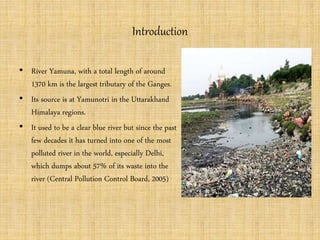
• It used to be a clear blue river but since the past
few decades it has turned into one of the most
polluted river in the world, especially Delhi,
which dumps about 57% of its waste into the
river (Central Pollution Control Board, 2005)
Representation of the SCenario
Problem Statement:
To estimate bacterial risks of infection annually for villagers of village “DD” using
all possible combinations of given activities in a year.
Objectives :
•Assessment of risk with respect to “de minimus” or more substantial
• Groups of people at most risk and activities associated.
• Rank exposure in decreasing order of their annual risks of infection and risk
management approaches for minimizing these exposure risks.
• To assess reduction in fecal coliforms in order to meet the USEPA allowable
annual risks of microbial infection guideline for recreational water contact.
• To check uncertainties in analysis.
Hazard
• Identified biological hazard Shigella spp. and Vibrio. Spp.
• Characteristics
• Gram-negative bacteria with a curved-rod shape
(comma shape)
• It is anaerobic type of microorganism found
in saltwater, and do not form spores.
• Cause acute diarrhoeal disease
Vibrio Spp.
• Gram-negative, facultative anaerobic, nonspore-
forming, nonmotile, rod-shaped bacteria.
• cause serious intestinal diseases, including
bacillary dysentery
Shigella spp.
Source: Guidelines for Drinking Water, WHO (2011)
EXPOSURE PARAMETER
Source
Route of
exposure
Exposure
media
Frequency of
exposure
Duration
Exposed
Populations
Scene 1
Stream
AA
Fecal – Oral
Route
Drinking water 365 days
Adults,
Children,
Pregnant
women
Scene 2
Stream
AA
Fecal – Oral
Route
Drinking water
32 times
(4 months)
45 mins
(for 1 event)
Adults and
Children
DOSE RESPONSE
FC in stream
AA
Pathogen to FC
ratio
Number of
Pathogens Concentration
Ingestion(per
event)
MPN/100 ml MPN/100 ml MPN/100 ml MPN/ml
1.50E+07
Shigella
Children 5.49E-07 8.24E+00 0.08235 37
Shigella adult 0.08235 16
Vibrio children 3.29E-06 4.93E+01 0.49335 37
Vibrio adult 0.49335 16
Dose
Number of days of
exposure α N50 P(daily) infection
P(annually)
infection
3.0469
5 32 2.65E-01 1.48E+03 6.80E-03 0.196247188
1.3176 32 2.65E-01 1.48E+03 2.97E-03 0.090774512
18.253
95 32
2.50E-
01
2.43E+0
2 1.72E-01 0.997611045
7.8936 32
2.50E-
01
2.43E+0
2 9.45E-02 0.958225953
Pant, A. and Mittal, A. K. (2007) Monitoring of pathogenicity of effluents from the UASB based
sewage treatment plant. Environ Monit Assess. 133:43-51.
Exposure Factor Handbook, 2011
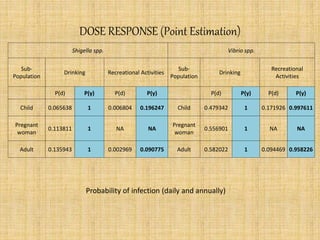
DOSE RESPONSE (Point Estimation)
Shigella spp. Vibrio spp.
Sub-
Population
Drinking Recreational Activities
Sub-
Population
Drinking
Recreational
Activities
P(d) P(y) P(d) P(y) P(d) P(y) P(d) P(y)
Child 0.065638 1 0.006804 0.196247 Child 0.479342 1 0.171926 0.997611
Pregnant
woman
0.113811 1 NA NA
Pregnant
woman
0.556901 1 NA NA
Adult 0.135943 1 0.002969 0.090775 Adult 0.582022 1 0.094469 0.958226
Probability of infection (daily and annually)
Ingestion Parameters for Monte Carlo
Input Parameter Mean STD
Fecal Coliform(FC) –
MPN/100 ml 1.50E+07 8.00E+02
Ingestion Volume –
ml/event 37 26
Example for Recreational Activity in Children
Monte Carlo Analysis
RISK ESTIMATION
Monte Carlo P annual (Recreational activity) P annual (drinking water)
Children Adult Adult Child Pregnant woman
Shigella Vibrio Shigella Vibrio Shigella Vibrio Shigella Vibrio Shigella Vibrio
mean 0.209848 0.993201 0.106854 0.925442 1 1 0.99985 1 0.999998 1
median 0.195849 0.997588 0.090551 0.95794 1 1 1 1 1 1
5th percentile 0.102447 0.970573 0.036228 0.748462 1 1 0.999965 1 1 1
Confidence interval 0.314854 0.999834 0.189348 0.997169 1 1 1 1 1 1
95th percentile 0.364634 0.99994 0.227941 0.998878 1 1 1 1 1 1
99th percentile 0.468347 0.999992 0.324546 0.999865 1 1 1 1 1 1
RISK CHARACTERIZATION
Recreational activity Drinking water
Children Adult Adult Child
Pregnant
woman
Shigella Vibrio Shigella Vibrio Shigella Vibrio Shigella Vibrio Shigella Vibrio
Risk v/s
Concentration
0.04576 0.027921 -0.03347 -0.009 0.009635 - 0.016872 - 0.044285 -
Risk v/s Ingestion 0.993032 0.53566 0.9955520.619868 0.062095 - 0.077462 - 0.070817 -
Correlation of the annual Probability of Risk v/s
Input Parameters
RISK COMMUNICATION
• Survey
Percentage of people boiling or filtering the drinking water
Homes with sanitation facility
Need for sanitation and clean drinking water
• Awareness
Radio and TV announcements
Gram Panchayat meetings
Drinking Water
Pathogen Population
Maximum allowable
concentration
Reduction required
Shigella Children 1.39E+05 1.08E+02
Adults 5.53E+04 2.71E+02
Pregnant 7.05E+04 2.13E+02
Vibrio Children 3.05E+04 4.92E+02
Adults 1.21E+04 1.24E+03
Pregnant 1.54E+03 9.74E+03
Recreational Activity
Shigella Children 1.78E+07 8.43E-01
Adults 4.11E+07 3.65E-01
Vibrio Children 9.02E+07 1.66E-01
Adults 3.90E+05 3.85E+01
RISKMANAGEMENT
RISK MANAGEMENT
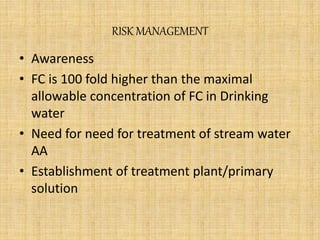
• Awareness
• FC is 100 fold higher than the maximal
allowable concentration of FC in Drinking
water
• Need for need for treatment of stream water
AA
• Establishment of treatment plant/primary
solution
REFERENCES
• Microbial fact sheets, Chapter 11, Guidelines on quality
of Drinking water, WHO, 2011
• Pant, A. and Mittal, A. K. (2007) Monitoring of
pathogenicity of effluents from the UASB based sewage
treatment plant. Environ Monit Assess. 133:43-51.
• EPA. 2011. EPA Exposure Factors Handbook, available
online
at:http://cfpub.epa.gov/ncea/risk/recordisplay.cfm?deid
=236252
THANK YOU

Yamuna ppt

  • 1.
    Quantitative Microbial RiskAssessment Case Study-Yamuna River In the International Perspectives on QuantitativeMicrobial Risk Assessment-III At IIPH Hyderabad India Friday, 27.03.2015 Team Members: Neethu Puthumadathil Hima Wani Nikita Chadha Dr. Vanisree Shailender Kumar
  • 2.
    Introduction • River Yamuna,with a total length of around 1370 km is the largest tributary of the Ganges. • Its source is at Yamunotri in the Uttarakhand Himalaya regions. • It used to be a clear blue river but since the past few decades it has turned into one of the most polluted river in the world, especially Delhi, which dumps about 57% of its waste into the river (Central Pollution Control Board, 2005)
  • 3.
  • 4.
    Problem Statement: To estimatebacterial risks of infection annually for villagers of village “DD” using all possible combinations of given activities in a year. Objectives : •Assessment of risk with respect to “de minimus” or more substantial • Groups of people at most risk and activities associated. • Rank exposure in decreasing order of their annual risks of infection and risk management approaches for minimizing these exposure risks. • To assess reduction in fecal coliforms in order to meet the USEPA allowable annual risks of microbial infection guideline for recreational water contact. • To check uncertainties in analysis.
  • 5.
    Hazard • Identified biologicalhazard Shigella spp. and Vibrio. Spp. • Characteristics • Gram-negative bacteria with a curved-rod shape (comma shape) • It is anaerobic type of microorganism found in saltwater, and do not form spores. • Cause acute diarrhoeal disease Vibrio Spp. • Gram-negative, facultative anaerobic, nonspore- forming, nonmotile, rod-shaped bacteria. • cause serious intestinal diseases, including bacillary dysentery Shigella spp. Source: Guidelines for Drinking Water, WHO (2011)
  • 6.
    EXPOSURE PARAMETER Source Route of exposure Exposure media Frequencyof exposure Duration Exposed Populations Scene 1 Stream AA Fecal – Oral Route Drinking water 365 days Adults, Children, Pregnant women Scene 2 Stream AA Fecal – Oral Route Drinking water 32 times (4 months) 45 mins (for 1 event) Adults and Children
  • 7.
    DOSE RESPONSE FC instream AA Pathogen to FC ratio Number of Pathogens Concentration Ingestion(per event) MPN/100 ml MPN/100 ml MPN/100 ml MPN/ml 1.50E+07 Shigella Children 5.49E-07 8.24E+00 0.08235 37 Shigella adult 0.08235 16 Vibrio children 3.29E-06 4.93E+01 0.49335 37 Vibrio adult 0.49335 16 Dose Number of days of exposure α N50 P(daily) infection P(annually) infection 3.0469 5 32 2.65E-01 1.48E+03 6.80E-03 0.196247188 1.3176 32 2.65E-01 1.48E+03 2.97E-03 0.090774512 18.253 95 32 2.50E- 01 2.43E+0 2 1.72E-01 0.997611045 7.8936 32 2.50E- 01 2.43E+0 2 9.45E-02 0.958225953 Pant, A. and Mittal, A. K. (2007) Monitoring of pathogenicity of effluents from the UASB based sewage treatment plant. Environ Monit Assess. 133:43-51. Exposure Factor Handbook, 2011
  • 8.
    DOSE RESPONSE (PointEstimation) Shigella spp. Vibrio spp. Sub- Population Drinking Recreational Activities Sub- Population Drinking Recreational Activities P(d) P(y) P(d) P(y) P(d) P(y) P(d) P(y) Child 0.065638 1 0.006804 0.196247 Child 0.479342 1 0.171926 0.997611 Pregnant woman 0.113811 1 NA NA Pregnant woman 0.556901 1 NA NA Adult 0.135943 1 0.002969 0.090775 Adult 0.582022 1 0.094469 0.958226 Probability of infection (daily and annually)
  • 9.
    Ingestion Parameters forMonte Carlo Input Parameter Mean STD Fecal Coliform(FC) – MPN/100 ml 1.50E+07 8.00E+02 Ingestion Volume – ml/event 37 26 Example for Recreational Activity in Children
  • 10.
  • 11.
    RISK ESTIMATION Monte CarloP annual (Recreational activity) P annual (drinking water) Children Adult Adult Child Pregnant woman Shigella Vibrio Shigella Vibrio Shigella Vibrio Shigella Vibrio Shigella Vibrio mean 0.209848 0.993201 0.106854 0.925442 1 1 0.99985 1 0.999998 1 median 0.195849 0.997588 0.090551 0.95794 1 1 1 1 1 1 5th percentile 0.102447 0.970573 0.036228 0.748462 1 1 0.999965 1 1 1 Confidence interval 0.314854 0.999834 0.189348 0.997169 1 1 1 1 1 1 95th percentile 0.364634 0.99994 0.227941 0.998878 1 1 1 1 1 1 99th percentile 0.468347 0.999992 0.324546 0.999865 1 1 1 1 1 1
  • 12.
    RISK CHARACTERIZATION Recreational activityDrinking water Children Adult Adult Child Pregnant woman Shigella Vibrio Shigella Vibrio Shigella Vibrio Shigella Vibrio Shigella Vibrio Risk v/s Concentration 0.04576 0.027921 -0.03347 -0.009 0.009635 - 0.016872 - 0.044285 - Risk v/s Ingestion 0.993032 0.53566 0.9955520.619868 0.062095 - 0.077462 - 0.070817 - Correlation of the annual Probability of Risk v/s Input Parameters
  • 13.
    RISK COMMUNICATION • Survey Percentageof people boiling or filtering the drinking water Homes with sanitation facility Need for sanitation and clean drinking water • Awareness Radio and TV announcements Gram Panchayat meetings
  • 14.
    Drinking Water Pathogen Population Maximumallowable concentration Reduction required Shigella Children 1.39E+05 1.08E+02 Adults 5.53E+04 2.71E+02 Pregnant 7.05E+04 2.13E+02 Vibrio Children 3.05E+04 4.92E+02 Adults 1.21E+04 1.24E+03 Pregnant 1.54E+03 9.74E+03 Recreational Activity Shigella Children 1.78E+07 8.43E-01 Adults 4.11E+07 3.65E-01 Vibrio Children 9.02E+07 1.66E-01 Adults 3.90E+05 3.85E+01 RISKMANAGEMENT
  • 15.
    RISK MANAGEMENT • Awareness •FC is 100 fold higher than the maximal allowable concentration of FC in Drinking water • Need for need for treatment of stream water AA • Establishment of treatment plant/primary solution
  • 16.
    REFERENCES • Microbial factsheets, Chapter 11, Guidelines on quality of Drinking water, WHO, 2011 • Pant, A. and Mittal, A. K. (2007) Monitoring of pathogenicity of effluents from the UASB based sewage treatment plant. Environ Monit Assess. 133:43-51. • EPA. 2011. EPA Exposure Factors Handbook, available online at:http://cfpub.epa.gov/ncea/risk/recordisplay.cfm?deid =236252
  • 17.