How to write a review paper
ACADEMIC WRITING
Application Number: 0e4a1f23e9
Vidhya Shangari
UGC
Outline
 What is a review?
 Why should you review?
 How do you review a paper?
 What not to do?
 What are the dilemmas?
 Case study
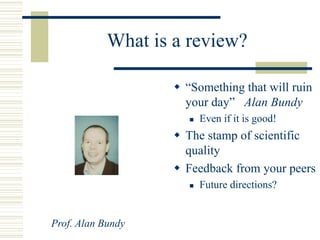
What is a review?
 “Something that will ruin
your day” Alan Bundy
 Even if it is good!
 The stamp of scientific
quality
 Feedback from your peers
 Future directions?
Prof. Alan Bundy
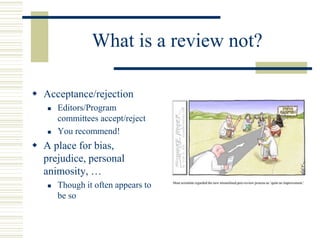
What is a review not?
 Acceptance/rejection
 Editors/Program
committees accept/reject
 You recommend!
 A place for bias,
prejudice, personal
animosity, …
 Though it often appears to
be so
Why should you review?
 You’d much rather
enjoy Paphos
 And so would I!
 But science would
grind to a halt
 Not immediately, of
course
Reasons to review
 Duty
 Fairness
 2-3 reviews written/
paper written
 Promotion
 Education
 Good reviewers write
good papers?
Bad reasons to review
 To settle old scores
 To advance your own
theories/hinder rivals
 To get latest results
 Unpublished papers are
strictly confidential
How do you review?
 Read the paper
 Read the review form
 Useful dimensions to look at
 Novelty, Clarity,
Importance, Timeliness …
 Read the paper
 Wait a few days
 Read paper
 Write review
Everyone has their own method
How do you review?
 Put yourself in author’s
shoes
 Think how you would like to
read this review
 Offer constructive
criticism
 Don’t just tell them
something is inadequate!
 Tell them how they might
fix it
What not to do?
 Miss the deadline
 We all hate late reviews
 Display partiality, bias,
animosity, …
 Destructively criticize
 Always work out what
they would need to do
to fix problems
Collect and share reviews
 Learn if others agree with
your opinions
 Thicken your skin
Clearly, the author fails to
understand the work of
Walsh in this area …
Since they mention no related
work, this paper cannot be
original …
This idea is too simple not to
exist already …
This work is good but I don’t
understand why Bundy
hasn’t done this already?
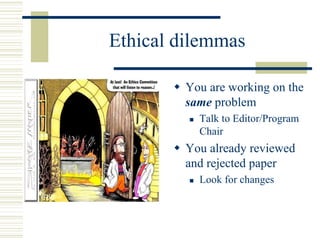
Ethical dilemmas
 You are working on the
same problem
 Talk to Editor/Program
Chair
 You already reviewed
and rejected paper
 Look for changes
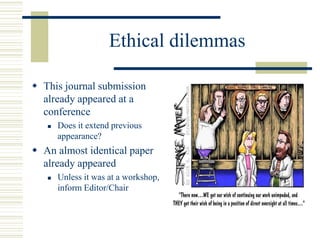
Ethical dilemmas
 This journal submission
already appeared at a
conference
 Does it extend previous
appearance?
 An almost identical paper
already appeared
 Unless it was at a workshop,
inform Editor/Chair
What did reviewer 1 think?
 Appears to like it
 Main criticisms:
 Relationship to
influence diagrams
 Algorithm performance
 Phase transition too
preliminary
“The paper reads well. … I have a number of
remarks though. First, from a probabilistic reasoning
viewpoint, I wonder about the relationship between this
framework and influence diagrams (or decision
diagrams). It appears to me that what you have
defined here is very closely related …Second, from a
constraint satisfaction viewpoint: you gave us no
indication of how well the different algorithms you
presented work in practice. … Third, I think the
discussion on phase transition cannot be left at this
level. It is not surprising that we have a phase transition
here, but what is interesting is the nature of this
transition… I think this topic is too serious to sum it up
in a small Section … [it] deserves a dedicated and more
thorough treatment. I would have preferred to see this
space dedicated to experimental results on the
performance of presented algorithms”
What did reviewer 2 think?
•Appears to like it
 Very relevant
 Moderately significant/original
 Good readability/English
•Minimal comments
What did reviewer 3 think?
 Again appears to like it
 Very relevant, very
original, moderately
significant
 Main criticisms
 Relationship to
influence diagrams
 Phase transition too
preliminary
“Clearly, one could just add constraints to influence
diagram representation and extend algorithms to exploit
them (my preferred approach) but the approach here is
still very valid and could motivate researchers in MDPs
and influence diagrams to treat constraints as special
creatures … so that their special … algorithms
can be exploited.
I think the experimental portion of the paper should have
been to compare the performance of the algorithms with
the performance of traditional MDPs or influence
diagram algorithms applied to this class of problems
and I speculate that gain can be shown.
I don’t find the phase transition experiments of much
value at this stage. So, there may be a phase transition,
so what?
I recommend that the author will carefully analyze their
model against standard influnce diagrams or factored
MDPs and discuss the pros and cons.”
What did the IJCAI PC think?
 Paper was rejected
 Along with 75% of the
other submissions
 A less good paper (my
and reviewers’
opinions) was accepted!
IJCAI 2001 logo
Conclusions
 Reviewing can be
rewarding
 Both to authors and to
reviewers
 Be constructive
 Think how you would react
to the review
 Take on board your
reviews
 Reviewers hate most being
ignored!
Feedback
I would like to thank Swayam for this
wonderful course and the course was
very interesting and the discussions
were truly inspiring.
Please thank on my behalf everyone
who was involved in the course and
execution of the course.

Review writing

  • 1.
    How to writea review paper ACADEMIC WRITING Application Number: 0e4a1f23e9 Vidhya Shangari UGC
  • 2.
    Outline  What isa review?  Why should you review?  How do you review a paper?  What not to do?  What are the dilemmas?  Case study
  • 3.
    What is areview?  “Something that will ruin your day” Alan Bundy  Even if it is good!  The stamp of scientific quality  Feedback from your peers  Future directions? Prof. Alan Bundy
  • 4.
    What is areview not?  Acceptance/rejection  Editors/Program committees accept/reject  You recommend!  A place for bias, prejudice, personal animosity, …  Though it often appears to be so
  • 5.
    Why should youreview?  You’d much rather enjoy Paphos  And so would I!  But science would grind to a halt  Not immediately, of course
  • 6.
    Reasons to review Duty  Fairness  2-3 reviews written/ paper written  Promotion  Education  Good reviewers write good papers?
  • 7.
    Bad reasons toreview  To settle old scores  To advance your own theories/hinder rivals  To get latest results  Unpublished papers are strictly confidential
  • 8.
    How do youreview?  Read the paper  Read the review form  Useful dimensions to look at  Novelty, Clarity, Importance, Timeliness …  Read the paper  Wait a few days  Read paper  Write review Everyone has their own method
  • 9.
    How do youreview?  Put yourself in author’s shoes  Think how you would like to read this review  Offer constructive criticism  Don’t just tell them something is inadequate!  Tell them how they might fix it
  • 10.
    What not todo?  Miss the deadline  We all hate late reviews  Display partiality, bias, animosity, …  Destructively criticize  Always work out what they would need to do to fix problems
  • 11.
    Collect and sharereviews  Learn if others agree with your opinions  Thicken your skin Clearly, the author fails to understand the work of Walsh in this area … Since they mention no related work, this paper cannot be original … This idea is too simple not to exist already … This work is good but I don’t understand why Bundy hasn’t done this already?
  • 12.
    Ethical dilemmas  Youare working on the same problem  Talk to Editor/Program Chair  You already reviewed and rejected paper  Look for changes
  • 13.
    Ethical dilemmas  Thisjournal submission already appeared at a conference  Does it extend previous appearance?  An almost identical paper already appeared  Unless it was at a workshop, inform Editor/Chair
  • 14.
    What did reviewer1 think?  Appears to like it  Main criticisms:  Relationship to influence diagrams  Algorithm performance  Phase transition too preliminary “The paper reads well. … I have a number of remarks though. First, from a probabilistic reasoning viewpoint, I wonder about the relationship between this framework and influence diagrams (or decision diagrams). It appears to me that what you have defined here is very closely related …Second, from a constraint satisfaction viewpoint: you gave us no indication of how well the different algorithms you presented work in practice. … Third, I think the discussion on phase transition cannot be left at this level. It is not surprising that we have a phase transition here, but what is interesting is the nature of this transition… I think this topic is too serious to sum it up in a small Section … [it] deserves a dedicated and more thorough treatment. I would have preferred to see this space dedicated to experimental results on the performance of presented algorithms”
  • 15.
    What did reviewer2 think? •Appears to like it  Very relevant  Moderately significant/original  Good readability/English •Minimal comments
  • 16.
    What did reviewer3 think?  Again appears to like it  Very relevant, very original, moderately significant  Main criticisms  Relationship to influence diagrams  Phase transition too preliminary “Clearly, one could just add constraints to influence diagram representation and extend algorithms to exploit them (my preferred approach) but the approach here is still very valid and could motivate researchers in MDPs and influence diagrams to treat constraints as special creatures … so that their special … algorithms can be exploited. I think the experimental portion of the paper should have been to compare the performance of the algorithms with the performance of traditional MDPs or influence diagram algorithms applied to this class of problems and I speculate that gain can be shown. I don’t find the phase transition experiments of much value at this stage. So, there may be a phase transition, so what? I recommend that the author will carefully analyze their model against standard influnce diagrams or factored MDPs and discuss the pros and cons.”
  • 17.
    What did theIJCAI PC think?  Paper was rejected  Along with 75% of the other submissions  A less good paper (my and reviewers’ opinions) was accepted! IJCAI 2001 logo
  • 18.
    Conclusions  Reviewing canbe rewarding  Both to authors and to reviewers  Be constructive  Think how you would react to the review  Take on board your reviews  Reviewers hate most being ignored!
  • 19.
    Feedback I would liketo thank Swayam for this wonderful course and the course was very interesting and the discussions were truly inspiring. Please thank on my behalf everyone who was involved in the course and execution of the course.