
Surviving Journal Reviewer Feedback
Rosdiadee Nordin
Centre of Advanced Electronic & Communication Engineering
Faculty of Engineering & Built Environment
: adee@ukm.edu.my
: https://sites.google.com/site/rosdiadee/
: http://my.linkedin.com/pub/rosdiadee-nordin
__________________________
Pusat Kejuruteraan Elektronik &
Komunikasi Terkehadapan
Before Peer Review
• … editor made decisions without seeking outside input
• … until 1665, Henry Oldenburg ‘invented’ the academic peer review
for ‘Philosophical Transactions of the Royal Society’
• Current peer review system has been systematically established since
WWII
• The peer review system is very old & doesn’t see much changes
Need for Peer Review
• The heart of scientific publication & critical phase
• Publish or perish – career, academic promoted & won a Nobel prize!
• Peer review reports serve two main functions:
• to inform editor whether work is novel, significant & suitable for publication
• to inform authors on errors, means of improving their manuscript
Drawbacks of Peer Review
• In 1976, editor of ‘Philosophical Transactions’ rejected manuscript
from Edward Jenner on first vaccination
• Failure to identify novel work
• Suffer from intellectual suppression:
• ‘Rich get richer’
• Strong bias against negative studies
• Bias on nationality, gender, language & specialty
Drawbacks of Peer Review
• Reviewer is busy & demotivated person
• Results in publication delay
• However recently emerge few incentives to boost motivation
• Free subscription, acknowledgement & discount for publication charge
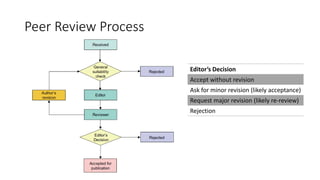
Peer Review Process
Editor’s Decision
Accept without revision
Ask for minor revision (likely acceptance)
Request major revision (likely re-review)
Rejection
Reviewer is a Very Honest Person…
“Since you submitted the paper to a scientific journal: where is the
science?”
“I am not sure why there is a full section about limitations, this in itself
says a lot about the study”
"I’ve never read anything like it & I do not mean it as a compliment”
“Words are used inappropriately – I count, for example, 13 instances of
'unique', but it is used correctly only once”
Need for Peer Review
• Reviewers give recommendations
• Ultimately, editor makes the decision
• Respond to reviewers' comments is a tricky deal
• Get it right –published!
• Get it wrong –rejection!
• Require some ‘art’, negotiation & communication skill!
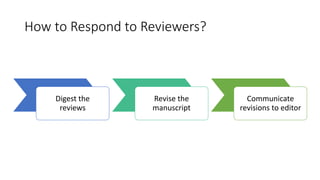
How to Respond to Reviewers?
Digest the
reviews
Revise the
manuscript
Communicate
revisions to editor
Step 1: Digesting the Reviews
• Read the reviews ONCE, and then file them in a SAFE location
• Don’t think about the reviews for few hours/days/week*
• Instead, do fun things like watch movie, sports, holiday, etc**
• Read the reviews again
• Discuss the reviews with your co-authors
• Create plan-of-ATTACK!
*No specific quantity for this…
**Practice with caution
Step 2: Revising your paper
• Address ALL comments
• You can’t pick which comments to address
• Even minor comments need to be addressed
• Address does not always mean change
• You and co-authors should decide what to change, and what to defend
• Often, changing is the easiest route
• Always change errors in references
• Skilled reviewers know the history better than newer authors
• You don’t want to get off on the wrong foot with experts in the field by not
citing the correct papers!
Step 2: Revising your paper
• Change does not always mean revamp
• Easy changes include:
• Rewording
• Adding extra references
• Adding an extra paragraph, table, figure
• Adding an appendix
• Difficult changes include:
• Modifying your central hypothesis
• Modifying your main algorithm
• Redoing an experiment
• Start with easy or difficult changes?
Step 2: Revising your paper
• Change parts which yielded “I didn’t understand”
• If the reviewer didn’t understand it, the readers might not either
• “I didn’t understand” is a polite way of saying “you didn’t explain clearly
enough”
• Even if:
• Requested change unnecessary
• Text is clear (the reviewer simply missed it)
• It is better to revise
• Goal is to tell the reviewer that they were listened to and understood
Step 2: Revising your paper
• Do not pit one reviewer against another!
• Reviewer from different background
• Different view, opinion and expertise – helpful to the editor
• If there’s a conflict, choose one that will improve the paper
Step 2: Revising your paper
• Always change parts which have been mentioned by many reviewers
• If two or more reviewers make similar comments, the readers will likely have
the same comments
• Repeated comments stand out to the editor
• It’s OK if you don’t agree with your reviewer
Step 3: Communicate with Editor/Reviewers
• Letter to the editor & reviewers
• Provide overview & detail of amendment
• Summary of changes/defences
• Write this first/last
• Short & sweet
Step 3: Communicate with Editor/Reviewers
• To help the reviewer navigate your response
• Use changes of font, color, or indenting to discriminate between 3
different elements:
• The review itself
• Your responses to the review
• Changes made to the manuscript
• Make use of track changes & comment box
Step 3: Communicate with Editor/Reviewers
• Make a dialogue-type list of comments and responses
• For changes: Indicate location (page, paragraph & line numbers)
Polite & Respectful
• Even if the reviewer lacks intellectual capacity, please refrain from
conveying this impression to them
• Imagine if you see him in person
• If the reviewer not the expert, but this level of expertise (or lack
thereof) may be representative of journal readers
• Make the work clear and accessible to all readers, not just experts
• Thank the reviewer abundantly
• but don’t overdo
Polite & Respectful
• Do not use AGGRESSIVE or defensive tone
• Example 1:
• What you want to say: That experiment would take forever!
• What you should say: The suggested experiment is interesting and would
provide additional information about..., but we feel that it falls outside the
scope of this study
• Example 2:
• What you want to say: You just didn’t understand what we wrote!
• What you should say: Several statements that we made were more
ambiguous than intended, and we have adjusted the text to be clearer
Make the Response Self-Explanatory
• Quote changes directly in the response letter
• Refer to specific line number where changes applied
• A self-explanatory response letter makes it easier for the
editor/reviewer to understand changes
• No need to go back & forth between manuscript & letter
• Reduce chances editor/reviewer to read full manuscript (or find new
things to complain)
• Editor can make quick decision!
• Only exception is when the modification is large (addition of new
paragraphs, graphs, methodology)
Respond to Every Point
• Often, reviews will be organized into bullet points
• But reviewer may raise two (or more) separate issues within 1 bullet
• Be sure to respond explicitly to all critiques
Begin Response with Direct Answer
• Begin your response to each comment with a direct answer to the
point being raised
• Provide a “yes” or “no” answer
• When the reviewer is correct, state so in your response
Write the Response Twice (At Least!)
• Initial document can be incomplete/inaccurate to address concern
• It can also be a place to vent your frustration!
• Once the initial draft finish, or after several days/weeks later...
• You become rational!
• Eventually, you will write what the reviewers want to see
• You can also write a separate letter to the editor
• Address issues such as potential conflicts of interest, reviewers' requests
conflict with one another or with journal policies
Top 10 Rules
• Rule 1: Provide an overview, then quote the full set of reviews
• Rule 2: Be polite and respectful of all reviewers
• Rule 3: Accept the blame
• Rule 4: Make the response self-explanatory
• Rule 5: Respond to every point raised by the reviewer
• Rule 6: Use typography to help the reviewer navigate your response
• Rule 7: Begin response to each comment with direct answer
• Rule 8: When possible, do what the reviewer asks
• Rule 9: Be clear about what changed relative to the previous version
• Rule 10: Write the response twice
Recap
• When digesting reviews:
• Try not to take things personally
• Expect at least one harsh reviewer
• When revise the paper:
• Divide and conquer (do difficult changes first)
• When addressing the editor/reviewers
• Communicate your changes, making an extra effort to be professional and
thankful
• You can disagree, as long as you explain
Key Takeaway
• Process of responding to reviewer is the stressful part of publication
• But, reviewers volunteering their time to ensure validity of results and
quality in our research area
• Manuscript after review process is an improvement from the original
Thank You!
Q&A

How to Address Reviewer Feedback

  • 1.
    Surviving Journal ReviewerFeedback Rosdiadee Nordin Centre of Advanced Electronic & Communication Engineering Faculty of Engineering & Built Environment : adee@ukm.edu.my : https://sites.google.com/site/rosdiadee/ : http://my.linkedin.com/pub/rosdiadee-nordin __________________________ Pusat Kejuruteraan Elektronik & Komunikasi Terkehadapan
  • 2.
    Before Peer Review •… editor made decisions without seeking outside input • … until 1665, Henry Oldenburg ‘invented’ the academic peer review for ‘Philosophical Transactions of the Royal Society’ • Current peer review system has been systematically established since WWII • The peer review system is very old & doesn’t see much changes
  • 3.
    Need for PeerReview • The heart of scientific publication & critical phase • Publish or perish – career, academic promoted & won a Nobel prize! • Peer review reports serve two main functions: • to inform editor whether work is novel, significant & suitable for publication • to inform authors on errors, means of improving their manuscript
  • 4.
    Drawbacks of PeerReview • In 1976, editor of ‘Philosophical Transactions’ rejected manuscript from Edward Jenner on first vaccination • Failure to identify novel work • Suffer from intellectual suppression: • ‘Rich get richer’ • Strong bias against negative studies • Bias on nationality, gender, language & specialty
  • 5.
    Drawbacks of PeerReview • Reviewer is busy & demotivated person • Results in publication delay • However recently emerge few incentives to boost motivation • Free subscription, acknowledgement & discount for publication charge
  • 6.
    Peer Review Process Editor’sDecision Accept without revision Ask for minor revision (likely acceptance) Request major revision (likely re-review) Rejection
  • 7.
    Reviewer is aVery Honest Person… “Since you submitted the paper to a scientific journal: where is the science?” “I am not sure why there is a full section about limitations, this in itself says a lot about the study” "I’ve never read anything like it & I do not mean it as a compliment” “Words are used inappropriately – I count, for example, 13 instances of 'unique', but it is used correctly only once”
  • 8.
    Need for PeerReview • Reviewers give recommendations • Ultimately, editor makes the decision • Respond to reviewers' comments is a tricky deal • Get it right –published! • Get it wrong –rejection! • Require some ‘art’, negotiation & communication skill!
  • 9.
    How to Respondto Reviewers? Digest the reviews Revise the manuscript Communicate revisions to editor
  • 10.
    Step 1: Digestingthe Reviews • Read the reviews ONCE, and then file them in a SAFE location • Don’t think about the reviews for few hours/days/week* • Instead, do fun things like watch movie, sports, holiday, etc** • Read the reviews again • Discuss the reviews with your co-authors • Create plan-of-ATTACK! *No specific quantity for this… **Practice with caution
  • 11.
    Step 2: Revisingyour paper • Address ALL comments • You can’t pick which comments to address • Even minor comments need to be addressed • Address does not always mean change • You and co-authors should decide what to change, and what to defend • Often, changing is the easiest route • Always change errors in references • Skilled reviewers know the history better than newer authors • You don’t want to get off on the wrong foot with experts in the field by not citing the correct papers!
  • 12.
    Step 2: Revisingyour paper • Change does not always mean revamp • Easy changes include: • Rewording • Adding extra references • Adding an extra paragraph, table, figure • Adding an appendix • Difficult changes include: • Modifying your central hypothesis • Modifying your main algorithm • Redoing an experiment • Start with easy or difficult changes?
  • 13.
    Step 2: Revisingyour paper • Change parts which yielded “I didn’t understand” • If the reviewer didn’t understand it, the readers might not either • “I didn’t understand” is a polite way of saying “you didn’t explain clearly enough” • Even if: • Requested change unnecessary • Text is clear (the reviewer simply missed it) • It is better to revise • Goal is to tell the reviewer that they were listened to and understood
  • 14.
    Step 2: Revisingyour paper • Do not pit one reviewer against another! • Reviewer from different background • Different view, opinion and expertise – helpful to the editor • If there’s a conflict, choose one that will improve the paper
  • 15.
    Step 2: Revisingyour paper • Always change parts which have been mentioned by many reviewers • If two or more reviewers make similar comments, the readers will likely have the same comments • Repeated comments stand out to the editor • It’s OK if you don’t agree with your reviewer
  • 16.
    Step 3: Communicatewith Editor/Reviewers • Letter to the editor & reviewers • Provide overview & detail of amendment • Summary of changes/defences • Write this first/last • Short & sweet
  • 17.
    Step 3: Communicatewith Editor/Reviewers • To help the reviewer navigate your response • Use changes of font, color, or indenting to discriminate between 3 different elements: • The review itself • Your responses to the review • Changes made to the manuscript • Make use of track changes & comment box
  • 18.
    Step 3: Communicatewith Editor/Reviewers • Make a dialogue-type list of comments and responses • For changes: Indicate location (page, paragraph & line numbers)
  • 19.
    Polite & Respectful •Even if the reviewer lacks intellectual capacity, please refrain from conveying this impression to them • Imagine if you see him in person • If the reviewer not the expert, but this level of expertise (or lack thereof) may be representative of journal readers • Make the work clear and accessible to all readers, not just experts • Thank the reviewer abundantly • but don’t overdo
  • 20.
    Polite & Respectful •Do not use AGGRESSIVE or defensive tone • Example 1: • What you want to say: That experiment would take forever! • What you should say: The suggested experiment is interesting and would provide additional information about..., but we feel that it falls outside the scope of this study • Example 2: • What you want to say: You just didn’t understand what we wrote! • What you should say: Several statements that we made were more ambiguous than intended, and we have adjusted the text to be clearer
  • 21.
    Make the ResponseSelf-Explanatory • Quote changes directly in the response letter • Refer to specific line number where changes applied • A self-explanatory response letter makes it easier for the editor/reviewer to understand changes • No need to go back & forth between manuscript & letter • Reduce chances editor/reviewer to read full manuscript (or find new things to complain) • Editor can make quick decision! • Only exception is when the modification is large (addition of new paragraphs, graphs, methodology)
  • 22.
    Respond to EveryPoint • Often, reviews will be organized into bullet points • But reviewer may raise two (or more) separate issues within 1 bullet • Be sure to respond explicitly to all critiques
  • 23.
    Begin Response withDirect Answer • Begin your response to each comment with a direct answer to the point being raised • Provide a “yes” or “no” answer • When the reviewer is correct, state so in your response
  • 24.
    Write the ResponseTwice (At Least!) • Initial document can be incomplete/inaccurate to address concern • It can also be a place to vent your frustration! • Once the initial draft finish, or after several days/weeks later... • You become rational! • Eventually, you will write what the reviewers want to see • You can also write a separate letter to the editor • Address issues such as potential conflicts of interest, reviewers' requests conflict with one another or with journal policies
  • 25.
    Top 10 Rules •Rule 1: Provide an overview, then quote the full set of reviews • Rule 2: Be polite and respectful of all reviewers • Rule 3: Accept the blame • Rule 4: Make the response self-explanatory • Rule 5: Respond to every point raised by the reviewer • Rule 6: Use typography to help the reviewer navigate your response • Rule 7: Begin response to each comment with direct answer • Rule 8: When possible, do what the reviewer asks • Rule 9: Be clear about what changed relative to the previous version • Rule 10: Write the response twice
  • 26.
    Recap • When digestingreviews: • Try not to take things personally • Expect at least one harsh reviewer • When revise the paper: • Divide and conquer (do difficult changes first) • When addressing the editor/reviewers • Communicate your changes, making an extra effort to be professional and thankful • You can disagree, as long as you explain
  • 27.
    Key Takeaway • Processof responding to reviewer is the stressful part of publication • But, reviewers volunteering their time to ensure validity of results and quality in our research area • Manuscript after review process is an improvement from the original
  • 28.