The Increase of Variance in Male
Reproductive Success by Extra-pair
Paternity (EPP) in Birds
University of Puerto Rico – Cayey
RISE Program
Biol. 3095 Seminar Scientific Literature and Bibliography
Félix Vallés
December 6, 2013
Introduction
• Three different monogamous but genetically
polygamous bird species.
• Behavior results towards EPC and EPP by little
auks
• EPP rates between wild and captive zebra
finches.
• Ornamentation in mountain bluebird
• Basic characteristics and sexual selection
features
Aim
• The objective of this paper is to compare the
phenomenon of EPP between the mountain
blue bird (Sialia currucoides), the little auk
(Alle alle) and the zebra finch (Taeniopygia
guttata) for a better understanding of its
purpose and how it increases the variation in
male reproductive success.
Definition of terms
• Socially monogamous birds
• Extra-pair copulation (EPC)
• Extra-pair paternity (EPP)
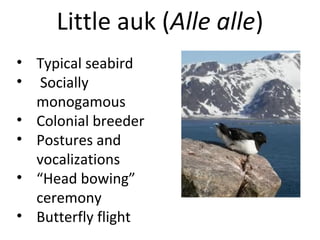
Little auk (Alle alle)
• Typical seabird
• Socially
monogamous
• Colonial breeder
• Postures and
vocalizations
• “Head bowing”
ceremony
• Butterfly flight
Results of Article (Wojczulanis-Jakubas 2008)
• 94% (168/179) of EPC were unsuccessful
• 11 EPC by female acceptance, however 3 without
cloacal contact
• 4% (8/179) were successful.
• Analyses based on 64 families.
• EPC, females ensure against their mate’s infertility.
• High rates of WPC
• Female sperm swamp
• “Extrapair copulations are frequent but unsuccessful in
a highly colonial seabird, the little auk, Alle alle”
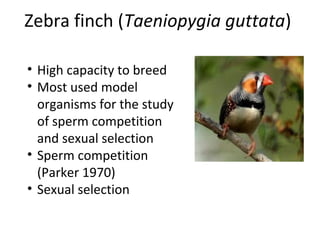
Zebra finch (Taeniopygia guttata)
• High capacity to breed
• Most used model
organisms for the study
of sperm competition
and sexual selection
• Sperm competition
(Parker 1970)
• Sexual selection
Zebra finch (Taeniopygia guttata)
(cont.)
• Ornamental Song (Collins et al. 1994)
• Parental Care (Burley 1988)
 Parental personality traits positive effects on correlates of offspring
fitness
 Parental effects carried over into the next generation
 Important, long-lasting effects on reproductive success, due to reduced
sexual conflict
• Sex Allocation (Burley 1981)
 Parental investment towards offspring of the sex that grants higher
relative fitness on the parent
• Maternal Effects (Gil et al. 1999)
 Offspring phenotype influenced by environmental factors experienced by
the mother
 Mother investment
 Maximize offspring fitness
Results of Article (Griffith 2010)
• EPP of wild zebra finches in Australian desert
• EPP of North American domestic zebra finches in
aviary
• Low levels of EPP in desert (1.7% offspring in 5% of
broods)
• High rates of EPP in aviary (28% of 278 offspring in 37%
of 126 broods fathered by EP sire)
• Cause for difference in EPP rates: artificial selection
imposed by aviculturists ,social or environmental
factors
• “Low level of extra-pair parentage in wild zebra
finches”
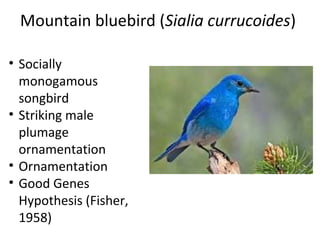
Mountain bluebird (Sialia currucoides)
• Socially
monogamous
songbird
• Striking male
plumage
ornamentation
• Ornamentation
• Good Genes
Hypothesis (Fisher,
1958)
Results of Article (Balenger 2009)
•
•
•
•
•

EPC increases male reproductive success
Results may not be precise:
Exclusion of several males and nestlings
Artificial nest boxes
Elimination of some settled males that were
unsuccessful in WP reproduction.
• Second breeding endeavors not included
• “Extra-pair paternity in the socially monogamous
mountain bluebird Sialia currucoides and its effect on
the potential for sexual selection”
Summary
• EPC common in mountain bluebird
• Higher EPC than eastern (Sialia sialis) and
western bluebirds (Sialia mexicana)
• Little auk shows very low rates of EPP but high
levels of EPC
• Extremely low levels of EPP in Australian
desert but high levels in aviary by zebra
finches
Conlusion
• EPP greatly variation among species
• Male mountain bluebirds presenting
plumage ornamentation
• Vocalizations only genetic trait in little auk
• All traits presented by zebra finch are nongenetic except for ornamental song
• All three species do increase variance in male
reproductive success by participating in EPP
References
• Balenger SL, Johnson LS, Mays HL Jr., Masters BS. 2009. Extra-Pair
Paternity in the Socially Monogamous Mountain Bluebird Sialia
currucoides and its Effect on the Potential for Sexual Selection.
Journal of Avian Biology 40(2): 173-180.
• Griffitha SC, Holleleya CE, Mariettea MM, Prykea SR, Svedina N.
2010. Low level of extrapair parentage in wild zebra finches. Animal
Behaviour Volume 79, Issue 2 p 261–264
• Hoi H, Griggio M.2010. Monogamy and Extra-Pair Parentage.
Encyclopedia of Animal Behavior.p 475–482
• Wan D, Chang P, Yin J. 2013. Causes of extra-pair paternity and its
inter-specific variation in socially monogamous birds. Acta
Ecologica Sinica Volume 33, Issue 3, p 158–166
• Wojczulanis-Jakubas K, Jakubas D, Øigarden T, Lifjeld JT. 2008.
Extrapair copulations are frequent but unsuccessful in a highly
colonial seabird, the little auk, Alle alle. Animal Behaviour: 1-6

Review paper presentation rise.pptx

  • 1.
    The Increase ofVariance in Male Reproductive Success by Extra-pair Paternity (EPP) in Birds University of Puerto Rico – Cayey RISE Program Biol. 3095 Seminar Scientific Literature and Bibliography Félix Vallés December 6, 2013
  • 2.
    Introduction • Three differentmonogamous but genetically polygamous bird species. • Behavior results towards EPC and EPP by little auks • EPP rates between wild and captive zebra finches. • Ornamentation in mountain bluebird • Basic characteristics and sexual selection features
  • 3.
    Aim • The objectiveof this paper is to compare the phenomenon of EPP between the mountain blue bird (Sialia currucoides), the little auk (Alle alle) and the zebra finch (Taeniopygia guttata) for a better understanding of its purpose and how it increases the variation in male reproductive success.
  • 4.
    Definition of terms •Socially monogamous birds • Extra-pair copulation (EPC) • Extra-pair paternity (EPP)
  • 5.
    Little auk (Allealle) • Typical seabird • Socially monogamous • Colonial breeder • Postures and vocalizations • “Head bowing” ceremony • Butterfly flight
  • 6.
    Results of Article(Wojczulanis-Jakubas 2008) • 94% (168/179) of EPC were unsuccessful • 11 EPC by female acceptance, however 3 without cloacal contact • 4% (8/179) were successful. • Analyses based on 64 families. • EPC, females ensure against their mate’s infertility. • High rates of WPC • Female sperm swamp • “Extrapair copulations are frequent but unsuccessful in a highly colonial seabird, the little auk, Alle alle”
  • 7.
    Zebra finch (Taeniopygiaguttata) • High capacity to breed • Most used model organisms for the study of sperm competition and sexual selection • Sperm competition (Parker 1970) • Sexual selection
  • 8.
    Zebra finch (Taeniopygiaguttata) (cont.) • Ornamental Song (Collins et al. 1994) • Parental Care (Burley 1988)  Parental personality traits positive effects on correlates of offspring fitness  Parental effects carried over into the next generation  Important, long-lasting effects on reproductive success, due to reduced sexual conflict • Sex Allocation (Burley 1981)  Parental investment towards offspring of the sex that grants higher relative fitness on the parent • Maternal Effects (Gil et al. 1999)  Offspring phenotype influenced by environmental factors experienced by the mother  Mother investment  Maximize offspring fitness
  • 9.
    Results of Article(Griffith 2010) • EPP of wild zebra finches in Australian desert • EPP of North American domestic zebra finches in aviary • Low levels of EPP in desert (1.7% offspring in 5% of broods) • High rates of EPP in aviary (28% of 278 offspring in 37% of 126 broods fathered by EP sire) • Cause for difference in EPP rates: artificial selection imposed by aviculturists ,social or environmental factors • “Low level of extra-pair parentage in wild zebra finches”
  • 10.
    Mountain bluebird (Sialiacurrucoides) • Socially monogamous songbird • Striking male plumage ornamentation • Ornamentation • Good Genes Hypothesis (Fisher, 1958)
  • 11.
    Results of Article(Balenger 2009) • • • • • EPC increases male reproductive success Results may not be precise: Exclusion of several males and nestlings Artificial nest boxes Elimination of some settled males that were unsuccessful in WP reproduction. • Second breeding endeavors not included • “Extra-pair paternity in the socially monogamous mountain bluebird Sialia currucoides and its effect on the potential for sexual selection”
  • 12.
    Summary • EPC commonin mountain bluebird • Higher EPC than eastern (Sialia sialis) and western bluebirds (Sialia mexicana) • Little auk shows very low rates of EPP but high levels of EPC • Extremely low levels of EPP in Australian desert but high levels in aviary by zebra finches
  • 13.
    Conlusion • EPP greatlyvariation among species • Male mountain bluebirds presenting plumage ornamentation • Vocalizations only genetic trait in little auk • All traits presented by zebra finch are nongenetic except for ornamental song • All three species do increase variance in male reproductive success by participating in EPP
  • 14.
    References • Balenger SL,Johnson LS, Mays HL Jr., Masters BS. 2009. Extra-Pair Paternity in the Socially Monogamous Mountain Bluebird Sialia currucoides and its Effect on the Potential for Sexual Selection. Journal of Avian Biology 40(2): 173-180. • Griffitha SC, Holleleya CE, Mariettea MM, Prykea SR, Svedina N. 2010. Low level of extrapair parentage in wild zebra finches. Animal Behaviour Volume 79, Issue 2 p 261–264 • Hoi H, Griggio M.2010. Monogamy and Extra-Pair Parentage. Encyclopedia of Animal Behavior.p 475–482 • Wan D, Chang P, Yin J. 2013. Causes of extra-pair paternity and its inter-specific variation in socially monogamous birds. Acta Ecologica Sinica Volume 33, Issue 3, p 158–166 • Wojczulanis-Jakubas K, Jakubas D, Øigarden T, Lifjeld JT. 2008. Extrapair copulations are frequent but unsuccessful in a highly colonial seabird, the little auk, Alle alle. Animal Behaviour: 1-6