Education Management:
theory and Practice
CAMUS, RENANTE P.
RUSSIEL C. DAGOHOY
DEPARTMENT OF EDUCATION
It is the main agency tasked to manage and
govern the Philippine system of basic education.
It is the chief formulator of Philippine education
policy and responsible for the Philippine
primaryand secondary school systems. It
has its headquarters at the DepEd Complex in
Meralco Avenue, Pasig City.
Republic Act No. 9155
AN ACT INSTITUTING A FRAMEWORK OF
GOVERNANCE FOR BASIC EDUCTION,
ESTABLISHING AUTHORITY AND
ACCOUNTABILITY, RENAMING THE
DEPARTMENT OF EDUCATION, CULTURE,
AND SPORTS AS THE DEPARTMENT OF
EDUCATION, AND FOR OTHER PURPOSES
This Act shall be known as the “Governance of
Basic Act of 2011”.
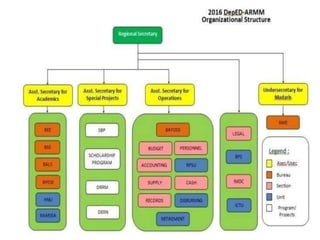
DepEd MANAGEMENT STRUCTURE
To carry out its mandates and objectives, the Department
is organized into two major structural components.
Central Office maintains the overall administration of basic
education at the national level.
The Field Offices are responsible for the regional and local
coordination and administration of the Department’s mandate.
The Secretary of Education shall be assisted by not more than
four (4) undersecretaries and not more than four (4) assistant
secretaries whose assignments, duties and responsibilities shall be
governed by law. There shall be at least one undersecretary and
one assistant secretary who shall be career executive service
officers chosen from among the staff of the Department.
At present, the Department of Education
operates with four Undersecretaries in the
areas of:
1. Programs and Projects;
2. Regional Operations;
3. Finance Administration; and
4. Legal Affairs;
Four Assistant Sectaries in the areas of:
1. Programs and Projects;
2. Regional Operations;
3. Finance Administration; and
4. Legal Affairs.
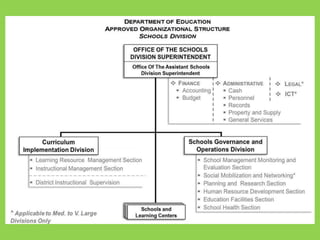
At the sub-national level, the Field Offices consist of
the following:
Sixteen (16) Regional Offices, Including ARMM,
each headed by a Regional Director (a Regional Sectary in
case of ARMM);
One hundred fifty seven (157) Provincial and City
Schools Divisions, each headed by a Schools Division
Superintendent. Assisting the Schools Division
Offices are 2,227 Schools Districts, each headed by a
District Supervisor;
Underthe supervision of the Schools Division
Offices are 48, 446 schools broken down as follows:
•40,763 elementary schools(36,234 public and 4,529 private)
•7,683 secondary schools (4,422 public and 3,261 private)
Governance of Basic Education
It shall be vested with authority, accountability,
and responsibility for ensuring access to,
Promoting equity in, and improving the
quality of basic education.
Implementing Rules and Regulations
Secretary
The Secretary of the Department of
Education shall exercise overall authority and
supervision over the operations of the
Department.
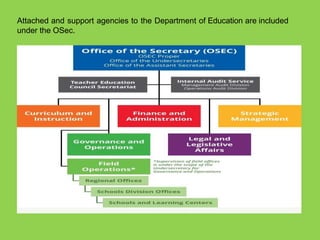
The Office of the Secretary (OSec)
provides overall leadership and direction at
the national level.
Attached and support agencies to the Department of Education are included
under the OSec.
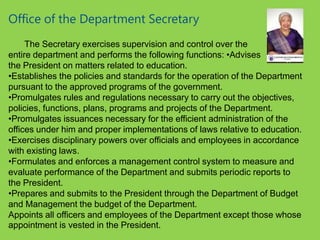
Office of the Department Secretary
The Secretary exercises supervision and control over the
entire department and performs the following functions: •Advises
the President on matters related to education.
•Establishes the policies and standards for the operation of the Department
pursuant to the approved programs of the government.
•Promulgates rules and regulations necessary to carry out the objectives,
policies, functions, plans, programs and projects of the Department.
•Promulgates issuances necessary for the efficient administration of the
offices under him and proper implementations of laws relative to education.
•Exercises disciplinary powers over officials and employees in accordance
with existing laws.
•Formulates and enforces a management control system to measure and
evaluate performance of the Department and submits periodic reports to
the President.
•Prepares and submits to the President through the Department of Budget
and Management the budget of the Department.
Appoints all officers and employees of the Department except those whose
appointment is vested in the President.
Office of the Undersecretaries
At the discretion of the Secretary, each undersecretary
may be assigned to any of the following functions:
•Advise and assist the Secretary in the formulation and
implementation of Department policies, plans and
programs.
•Oversee all the operational activities of the Department for
which he will be assigned and held responsible by the
Secretary.
•Coordinate the programs and projects of the Department.
•On the basis of an official designation, discharge
temporarily the duties of the Secretary in case of the
latter’s inability to discharge his duties or in case of
vacancy of the said office.
Office of the Assistant Secretaries
At the discretion of the Secretary, each assistant
secretary may be assigned to any of the following functions:
•Advise and assist the Secretary and/or Undersecretary in
the formulation and implementation of Department policies,
plans and programs.
•Oversee all the operational activities of the Department for
which he will be assigned and held responsible for by the
Secretary or Undersecretary.
•Coordinate the programs and projects of the Department.
•On the basis of an official designation, discharge temporarily
the duties of the Secretary or Undersecretary in case of the
latter’s inability to discharge his duties or in case of vacancy
of the said office.
INTERNAL AUDIT SERVICE
The Internal Audit Service serves as the
watchdog of the Department through: (a) appraising
existing procedures and related matters as to
efficiency and adequacy; and, (b) detecting and
preventing frauds or dishonesty in verifying the
extent of compliance in a protective nature to the
extent possible.
CURRICULUM AND INSTRUCTION FUNCTIONS
Curriculum and Instruction ensures that the
organization focuses on the delivery of a relevant,
responsive, and effective basic education
curriculum around which all other strands and
offices provide support.
FINANCE AND ADMINISTRATION FUNCTIONS
Finance and Administration ensures the
efficiency to support the organization as a
whole to focus on its core business and thus
attain its targets through the provision of
finance and administrative services.
GOVERNANCE AND OPERATIONS FUNCTIONS
Governance and Operations ensures the
capacity of the organization to continuously
improveand bestrategic in managing the
environment for which “teaching and learning”
takes place.
In accordance with Republic Act (RA) 9155,
the Secretary of Education delegates the
supervision of field offices (regional and schools
division offices) to the Undersecretary supervising
the Governance and Operations strand.
LEGAL AND LEGISLATIVE AFFAIRS FUNCTIONS
Legal and Legislative Affairs enhances
capacity of the organization to deal with
legal matters and to be proactive in moving
forward its legislative agenda.
STRATEGIC MANAGEMENT FUNCTIONS
Strategic Management enables the
organization to focus on long-term directions
and interface with the internal and external
environment and stakeholders.
National Level
The Secretary of the Department of
Education shall exercise overall authority and
supervision over the operations of the
Department. In addition to his/her powers under
existing laws, the Secretary of Education shall
have authority, accountability and responsibility
for the following:
(1) Formulating national educational policies;
(2) Formulating a national basic education plan;
(3) Promulgating national
standards; (4) Monitoring and
educational
assessing
national learning outcomes;
Powers, Duties and Function
educational
National Level
5. Undertaking national
research and studies;
6. Enhancing the employment status,
professional competence, welfare and
working conditions of all personnel of the
Department; and
7. Enhancing the
learners through
total
local
development of
and national
programs and/or projects.
Implementing Rules and
Regulations
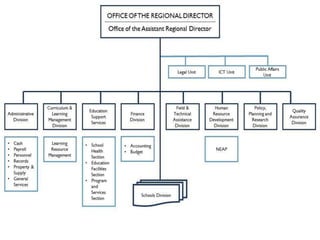
Regional Director
There shall be as many regional offices as may
be provided by law. Each regional office shall
have a director, an assistant director and an
office staff for program promotion and support,
planning, administrative and fiscal services.
Powers, Duties and Function
Regional Level
Consistent with the national educational policies,
plans and standards, the regional director shall have
authority, accountability and responsibility for the
following:
1. Defining a regional educational policy framework
which reflects the values, needs and expectations of the
communities they serve;
2. Developing a regional basic education plan;
3. Developing regional educational standards with a
view towards benchmarking for international
competitiveness;
regional
4. Monitoring, evaluating and assessing
learning outcomes;
Powers, Duties and Function
Regional Level
5. Undertaking research projects and
developing and managing regionwide projects
which may be funded through official development
assistance and/or other funding agencies;
6. Ensuring strict compliance with prescribed
national criteria for the recruitment, selection and
training of all staff in the region and divisions;
7. Formulating, in coordination with the regional
development council, the budget to support the
regional educational plan which shall take into
account the educational plans of the divisions and
districts;
Powers, Duties and Function
Regional Level
8. Determining the organization component of the
divisions and districts and approving the proposed
staffing pattern of all employees in the divisions and
districts;
9. Hiring, placing and evaluating all employees in
the regional office, except for the position of
assistant director;
10. Evaluating
superintendents
all
and
schools
assistant
division
division
superintendents in the region;
Powers, Duties and Function
Regional Level
11. Planning and managing the effective and
efficient use of all personnel, physical and fiscal
resources of the regional office, including
professional staff development;
12.Managing the database and management
information system of the region;
13.Approving the establishment of public and
private elementary and high schools and learning
centers; and
14.Performing such other functions as may be
assigned by proper authorities.
Implementing Rules and Regulation
Schools Division Superintendent
A division shall consist of a province or a
city which shall have a schools division
superintendent, at least one assistant schools
division superintendent and an office staff for
programs promotion, planning, administrative,
fiscal, legal, ancillary and other support
services.
Powers, Duties and Function
Division Level
Consistent with the national educational policies,
plans and standards, the schools division
superintendents shall have authority, accountability
and responsibility for the following:
1. Developing and implementing division education
development plans;
2. Planning and managing the effective and efficient
use of all personnel, physical and fiscal
resources of the division, including professional staff
 3. Hiring, placing and
evaluating all
development;
division
supervisors and schools district supervisors as well
as all employees in the division, both teaching and
non-teaching personnel, including school heads,
except for the assistant division superintendent;
4. Monitoring the utilization of funds provided by the
national government and the local government units
to the schools and learning centers;
5. Ensuring compliance of quality standards for basic
education programs and for this purpose
strengthening the role of division supervisors as
subject area specialists;
Powers, Duties and Function
Division Level
6. Promoting awareness of and adherence by all
schools and learning centers to accreditation
standards prescribed by the Secretary of Education;
7. Supervising the operations of all public and private
elementary, secondary and integrated schools, and
learning centers; and
8.Performing such other functions as may be
assigned by proper authorities.
IMPLEMENTING RULES AND REGULATIONS
Public Schools District Supervisor
Upon the recommendation of the schools
division superintendents, the regional director may
establish additional schools district within a schools
division. Schools districts already existing at the
time of the passage of this law shall be maintained.
district shall have
and an office
a schools district
staff for program
A schools
supervisor
promotion.
Powers, Duties and Function
District level
district supervisor shall be
The schools
responsible for:
1. Providing professional
advice and support to
and instructional
the school heads and
learning
teachers/facilitators of schools and
centers in the district or cluster thereof;
2. Curricula supervision; and
3. Performing such other functions as may be
assigned by proper authorities.
IMPLEMENTING RULES AND REGULATIONS
Principal/School Head
There shall be a school head for all public
elementary schools and public high schools or a
cluster thereof. The establishment of integrated
schools from existing public elementary and public
high schools shall be encouraged.
IMPLEMENTING RULES AND REGULATIONS
Principal/School Head
The school head, who may be assisted by an
assistant school head, shall be both an
instructional leader and administrative manager.
The school head shall form a team with the school
teachers/learning facilitators for delivery of quality
educational programs, projects and services. A
core of non-teaching staff shall handle the school’s
administrative, fiscal and auxiliary services.
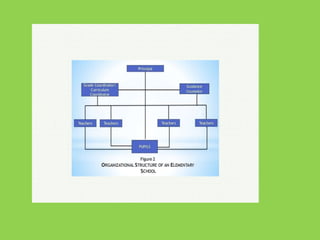
ORGANIZATIONAL STRUCTURE OF SECONDARY SCHOOL
Powers, Duties and Function
School Level
Consistent with the national educational
policies, plans and standards, the school heads
shall have authority, accountability and
responsibility for the following:
1.Setting the mission, vision, goals and
objectives of the school;
2.Creating an environment within the school
that is conducive to teaching and learning;
3. Implementing the school curriculum and being
accountable for higher learning outcomes;
4. Developing the school education program and
school improvement plan;
Powers, Duties and Function
School Level
5. Offering educational programs, projects and
services which provide equitable opportunities
for all learners in the community;
6. Introducing new and innovative modes of
instruction to achieve higher learning outcomes;
7. Administering and managing all personnel,
physical and fiscal resources of the school;
8. Recommending the staffing complement of the
school based on its needs;
Powers, Duties and Function
School Level
9. Encouraging staff development;
10.Establishing school and community networks
and encouraging the active participation of
teachers’ organizations, non-academic personnel
of public schools, and parents-teachers-
community associations;
Powers, Duties and Function
School Level
11. Accepting donations, gifts, bequests and grants
for the purpose of upgrading teachers’/learning
facilitators’ competencies, improving and expanding
school facilities and providing instructional materials
and equipment. Such donations or grants must be
reported to the appropriate district supervisors and
division superintendents; and
12. Performing such other functions as may be
assigned by proper authorities.

go.pptx

  • 1.
    Education Management: theory andPractice CAMUS, RENANTE P. RUSSIEL C. DAGOHOY
  • 2.
    DEPARTMENT OF EDUCATION Itis the main agency tasked to manage and govern the Philippine system of basic education. It is the chief formulator of Philippine education policy and responsible for the Philippine primaryand secondary school systems. It has its headquarters at the DepEd Complex in Meralco Avenue, Pasig City.
  • 3.
    Republic Act No.9155 AN ACT INSTITUTING A FRAMEWORK OF GOVERNANCE FOR BASIC EDUCTION, ESTABLISHING AUTHORITY AND ACCOUNTABILITY, RENAMING THE DEPARTMENT OF EDUCATION, CULTURE, AND SPORTS AS THE DEPARTMENT OF EDUCATION, AND FOR OTHER PURPOSES This Act shall be known as the “Governance of Basic Act of 2011”.
  • 4.
    DepEd MANAGEMENT STRUCTURE Tocarry out its mandates and objectives, the Department is organized into two major structural components. Central Office maintains the overall administration of basic education at the national level. The Field Offices are responsible for the regional and local coordination and administration of the Department’s mandate. The Secretary of Education shall be assisted by not more than four (4) undersecretaries and not more than four (4) assistant secretaries whose assignments, duties and responsibilities shall be governed by law. There shall be at least one undersecretary and
  • 5.
    one assistant secretarywho shall be career executive service officers chosen from among the staff of the Department. At present, the Department of Education operates with four Undersecretaries in the areas of: 1. Programs and Projects; 2. Regional Operations; 3. Finance Administration; and 4. Legal Affairs; Four Assistant Sectaries in the areas of:
  • 6.
    1. Programs andProjects; 2. Regional Operations; 3. Finance Administration; and 4. Legal Affairs. At the sub-national level, the Field Offices consist of the following: Sixteen (16) Regional Offices, Including ARMM, each headed by a Regional Director (a Regional Sectary in case of ARMM); One hundred fifty seven (157) Provincial and City Schools Divisions, each headed by a Schools Division
  • 7.
    Superintendent. Assisting theSchools Division Offices are 2,227 Schools Districts, each headed by a District Supervisor; Underthe supervision of the Schools Division Offices are 48, 446 schools broken down as follows: •40,763 elementary schools(36,234 public and 4,529 private) •7,683 secondary schools (4,422 public and 3,261 private) Governance of Basic Education It shall be vested with authority, accountability, and responsibility for ensuring access to, Promoting equity in, and improving the quality of basic education.
  • 8.
    Implementing Rules andRegulations Secretary The Secretary of the Department of Education shall exercise overall authority and supervision over the operations of the Department. The Office of the Secretary (OSec) provides overall leadership and direction at the national level.
  • 9.
    Attached and supportagencies to the Department of Education are included under the OSec.
  • 11.
    Office of theDepartment Secretary The Secretary exercises supervision and control over the entire department and performs the following functions: •Advises the President on matters related to education. •Establishes the policies and standards for the operation of the Department pursuant to the approved programs of the government. •Promulgates rules and regulations necessary to carry out the objectives, policies, functions, plans, programs and projects of the Department. •Promulgates issuances necessary for the efficient administration of the offices under him and proper implementations of laws relative to education. •Exercises disciplinary powers over officials and employees in accordance with existing laws. •Formulates and enforces a management control system to measure and evaluate performance of the Department and submits periodic reports to the President. •Prepares and submits to the President through the Department of Budget and Management the budget of the Department. Appoints all officers and employees of the Department except those whose appointment is vested in the President.
  • 12.
    Office of theUndersecretaries At the discretion of the Secretary, each undersecretary may be assigned to any of the following functions: •Advise and assist the Secretary in the formulation and implementation of Department policies, plans and programs. •Oversee all the operational activities of the Department for which he will be assigned and held responsible by the Secretary. •Coordinate the programs and projects of the Department. •On the basis of an official designation, discharge temporarily the duties of the Secretary in case of the latter’s inability to discharge his duties or in case of vacancy of the said office.
  • 13.
    Office of theAssistant Secretaries At the discretion of the Secretary, each assistant secretary may be assigned to any of the following functions: •Advise and assist the Secretary and/or Undersecretary in the formulation and implementation of Department policies, plans and programs. •Oversee all the operational activities of the Department for which he will be assigned and held responsible for by the Secretary or Undersecretary. •Coordinate the programs and projects of the Department. •On the basis of an official designation, discharge temporarily the duties of the Secretary or Undersecretary in case of the latter’s inability to discharge his duties or in case of vacancy of the said office.
  • 14.
    INTERNAL AUDIT SERVICE TheInternal Audit Service serves as the watchdog of the Department through: (a) appraising existing procedures and related matters as to efficiency and adequacy; and, (b) detecting and preventing frauds or dishonesty in verifying the extent of compliance in a protective nature to the extent possible.
  • 15.
    CURRICULUM AND INSTRUCTIONFUNCTIONS Curriculum and Instruction ensures that the organization focuses on the delivery of a relevant, responsive, and effective basic education curriculum around which all other strands and offices provide support.
  • 16.
    FINANCE AND ADMINISTRATIONFUNCTIONS Finance and Administration ensures the efficiency to support the organization as a whole to focus on its core business and thus attain its targets through the provision of finance and administrative services.
  • 17.
    GOVERNANCE AND OPERATIONSFUNCTIONS Governance and Operations ensures the capacity of the organization to continuously improveand bestrategic in managing the environment for which “teaching and learning” takes place. In accordance with Republic Act (RA) 9155, the Secretary of Education delegates the supervision of field offices (regional and schools division offices) to the Undersecretary supervising the Governance and Operations strand.
  • 18.
    LEGAL AND LEGISLATIVEAFFAIRS FUNCTIONS Legal and Legislative Affairs enhances capacity of the organization to deal with legal matters and to be proactive in moving forward its legislative agenda.
  • 19.
    STRATEGIC MANAGEMENT FUNCTIONS StrategicManagement enables the organization to focus on long-term directions and interface with the internal and external environment and stakeholders.
  • 20.
    National Level The Secretaryof the Department of Education shall exercise overall authority and supervision over the operations of the Department. In addition to his/her powers under existing laws, the Secretary of Education shall have authority, accountability and responsibility for the following: (1) Formulating national educational policies; (2) Formulating a national basic education plan;
  • 21.
    (3) Promulgating national standards;(4) Monitoring and educational assessing national learning outcomes; Powers, Duties and Function educational National Level 5. Undertaking national research and studies; 6. Enhancing the employment status, professional competence, welfare and working conditions of all personnel of the Department; and
  • 22.
    7. Enhancing the learnersthrough total local development of and national programs and/or projects.
  • 25.
    Implementing Rules and Regulations RegionalDirector There shall be as many regional offices as may be provided by law. Each regional office shall have a director, an assistant director and an office staff for program promotion and support, planning, administrative and fiscal services. Powers, Duties and Function
  • 26.
    Regional Level Consistent withthe national educational policies, plans and standards, the regional director shall have authority, accountability and responsibility for the following: 1. Defining a regional educational policy framework which reflects the values, needs and expectations of the communities they serve; 2. Developing a regional basic education plan; 3. Developing regional educational standards with a view towards benchmarking for international competitiveness;
  • 27.
    regional 4. Monitoring, evaluatingand assessing learning outcomes; Powers, Duties and Function Regional Level 5. Undertaking research projects and developing and managing regionwide projects which may be funded through official development assistance and/or other funding agencies; 6. Ensuring strict compliance with prescribed national criteria for the recruitment, selection and training of all staff in the region and divisions;
  • 28.
    7. Formulating, incoordination with the regional development council, the budget to support the regional educational plan which shall take into account the educational plans of the divisions and districts; Powers, Duties and Function Regional Level 8. Determining the organization component of the divisions and districts and approving the proposed staffing pattern of all employees in the divisions and districts;
  • 29.
    9. Hiring, placingand evaluating all employees in the regional office, except for the position of assistant director; 10. Evaluating superintendents all and schools assistant division division superintendents in the region; Powers, Duties and Function Regional Level 11. Planning and managing the effective and efficient use of all personnel, physical and fiscal
  • 30.
    resources of theregional office, including professional staff development; 12.Managing the database and management information system of the region; 13.Approving the establishment of public and private elementary and high schools and learning centers; and 14.Performing such other functions as may be assigned by proper authorities.
  • 32.
    Implementing Rules andRegulation Schools Division Superintendent A division shall consist of a province or a city which shall have a schools division superintendent, at least one assistant schools division superintendent and an office staff for programs promotion, planning, administrative, fiscal, legal, ancillary and other support services.
  • 33.
    Powers, Duties andFunction Division Level Consistent with the national educational policies, plans and standards, the schools division superintendents shall have authority, accountability and responsibility for the following: 1. Developing and implementing division education development plans; 2. Planning and managing the effective and efficient use of all personnel, physical and fiscal
  • 34.
    resources of thedivision, including professional staff  3. Hiring, placing and evaluating all development; division supervisors and schools district supervisors as well as all employees in the division, both teaching and non-teaching personnel, including school heads, except for the assistant division superintendent;
  • 35.
    4. Monitoring theutilization of funds provided by the national government and the local government units to the schools and learning centers; 5. Ensuring compliance of quality standards for basic education programs and for this purpose strengthening the role of division supervisors as subject area specialists; Powers, Duties and Function Division Level 6. Promoting awareness of and adherence by all schools and learning centers to accreditation
  • 36.
    standards prescribed bythe Secretary of Education; 7. Supervising the operations of all public and private elementary, secondary and integrated schools, and learning centers; and 8.Performing such other functions as may be assigned by proper authorities. IMPLEMENTING RULES AND REGULATIONS Public Schools District Supervisor Upon the recommendation of the schools division superintendents, the regional director may establish additional schools district within a schools
  • 37.
    division. Schools districtsalready existing at the time of the passage of this law shall be maintained. district shall have and an office a schools district staff for program A schools supervisor promotion.
  • 38.
    Powers, Duties andFunction District level district supervisor shall be The schools responsible for: 1. Providing professional advice and support to and instructional the school heads and learning teachers/facilitators of schools and centers in the district or cluster thereof; 2. Curricula supervision; and 3. Performing such other functions as may be assigned by proper authorities.
  • 39.
    IMPLEMENTING RULES ANDREGULATIONS Principal/School Head There shall be a school head for all public elementary schools and public high schools or a cluster thereof. The establishment of integrated schools from existing public elementary and public high schools shall be encouraged.
  • 41.
    IMPLEMENTING RULES ANDREGULATIONS Principal/School Head The school head, who may be assisted by an assistant school head, shall be both an instructional leader and administrative manager. The school head shall form a team with the school teachers/learning facilitators for delivery of quality educational programs, projects and services. A core of non-teaching staff shall handle the school’s administrative, fiscal and auxiliary services. ORGANIZATIONAL STRUCTURE OF SECONDARY SCHOOL
  • 42.
    Powers, Duties andFunction School Level Consistent with the national educational policies, plans and standards, the school heads shall have authority, accountability and responsibility for the following: 1.Setting the mission, vision, goals and objectives of the school; 2.Creating an environment within the school that is conducive to teaching and learning;
  • 43.
    3. Implementing theschool curriculum and being accountable for higher learning outcomes; 4. Developing the school education program and school improvement plan; Powers, Duties and Function School Level 5. Offering educational programs, projects and services which provide equitable opportunities for all learners in the community; 6. Introducing new and innovative modes of
  • 44.
    instruction to achievehigher learning outcomes; 7. Administering and managing all personnel, physical and fiscal resources of the school; 8. Recommending the staffing complement of the school based on its needs; Powers, Duties and Function School Level 9. Encouraging staff development; 10.Establishing school and community networks and encouraging the active participation of
  • 45.
    teachers’ organizations, non-academicpersonnel of public schools, and parents-teachers- community associations; Powers, Duties and Function School Level 11. Accepting donations, gifts, bequests and grants for the purpose of upgrading teachers’/learning facilitators’ competencies, improving and expanding school facilities and providing instructional materials and equipment. Such donations or grants must be
  • 46.
    reported to theappropriate district supervisors and division superintendents; and 12. Performing such other functions as may be assigned by proper authorities.