International Research Journal of Engineering and Technology (IRJET) e-ISSN: 2395 -0056
Volume: 04 Issue: 01 | Jan -2017 www.irjet.net p-ISSN: 2395-0072
© 2017, IRJET | Impact Factor value: 5.181 | ISO 9001:2008 Certified Journal | Page 1723
REVIEW ON RAILWAY TRACK CRACK DETECTION USING IR
TRANSMITTER AND RECEIVER
Rakesh V. Pise1, Parag D. Nikhar2, Prof. Avinash H. Shelar3
1 DES’s College of Engineering & Technology Dhamangaon (Rly), Amravati
2DES’s College of Engineering & Technology Dhamangaon (Rly), Amravati
3Professor, Dept. of electrical(E&p) Engineering, DES’s College of Engineering & Technology Dhamangaon (Rly),
Maharashtra, India
---------------------------------------------------------------------***---------------------------------------------------------------------
Abstract – The IR transmitter and receiver total stationfor
railway track geometry surveying system. Railway Crack
Inspection is dedicated as a measure of railway safety. The
defect information can be wirelessly transferred to railway
safety management centre using a GSMmoduleanditincludes
defect level and location information which is acquired by
embedded GPS receiver. In terms of the reliability and safety
parameters, Indian railway has not yet reached the
international standards. The main problem about railway
analysis detection of cracks in the structure. This work
proposes a cost effective solution to the problem of railway
track crack detection utilizing IR transmitter and receiver
which tracks the location of faulty track which then mended
immediately so that many lives will be saved. If these
deficiencies are not controlled at early stages they might lead
to a number of derailments resulting in a heavy loss of life and
property has train derailment can be avoided and chance of
loss of human life and economy can be minimized.
Key Words: IR transmitter and receiver, Crack detection,
GPS, GSM, PIC Microcontroller and LCD
1. INTRODUCTION
Transport has throughout history been a spur to
expansion as better transport leads to moretrade.Economic
prosperity has always been dependent on increasing the
capacity and rationality of transport. But the infrastructure
and operation of transport has a great impact on the land
and is the largest drainer of energy, making transport
sustain ability and safety a major issue. In India, we find that
rail transport occupies a prominentpositioninproviding the
necessary transport infrastructuretosustainand quench the
ever-burgeoning needs of a rapidly growing economy.
Today, India possesses the fourth largest railwaynetwork in
the world. Today, India possesses the fourth largest railway
network in the world. However, in terms of the reliability
and safety parameters, we have not yet reached truly global
standards. The principal problem has been the lack of cheap
and efficient technology to detect problems in the rail tracks
and of course, the lack of proper maintenance of rails which
have resulted in the formation of cracks in the rails and
other similar problems causedbyanti-social elementswhich
jeopardize the security of operation of rail transport. In the
past, this problem has lead to a number of derailments
resulting in a heavy loss of life and property. Cracks in rails
have been identified to be the main cause of derailments in
the past, yet there have been no cheap automated solutions
available for testing purposes. The new method which
utilizes simple components inclusive of a GPS module, GSM
Modem, IR Transmitter and Receiver based crack detector
assembly is very useful in railway crack detection. proposed
a system that utilises LED-LDR configuration for railway
crack detection. RRCDS utilisessimplecomponentsinclusive
of a GPS module, GSM Modem and LED-LDR based crack
detector assembly.
The pro- posed broken rail detection system
automatically detectsthefaultyrail track withoutanyhuman
intervention techniques. The advantages include less cost,
low power consumption and less analysis time. By this
proposed system the exact location of the faulty rail track
can easily be located which will mended immediatelysothat
man lives can be saved. Processes theimagesignal collected,
judges out the crack signal, and displays the curve through
the LCD, and gives off the alarm. The system essential
modules such as, the CCD timing generator, A/D converter
timing generator, address generator, RAM memory all are
realized on CPLD. It adopts the improved classical algorithm
and morphology algorithm to perform noiseelimination, the
edge detection, the image segmentation and the edgelinking
to the railway surface crack image, which obtains the good
detection result.
The whole system is fixed on the vehicle-hold
system, travelling along the railway, then conveniently
examines the crack position, thus may promptly carry
through track maintenance, avoidingtheaccident.Moreover,
the system can connect with the PC, transforming the
sampling data to PC to further analysis.Inanother method K.
Vijayakumar et.al [5] has investigated crack detection using
microwave sensors. It describes how a Microwave horn
antenna can be used to detect the cracksina rail track.Based
on the simulation results obtained from the High Frequency
Simulation Structure (HFSS), it has been shown that the
design of the Microwave sensor has the potential for
detecting defects in the rail surfaceincludingminorcracksas
well as more serious as well as. In another method RichardJ.
Greene et.al [6] have presented a new crack detection
International Research Journal of Engineering and Technology (IRJET) e-ISSN: 2395 -0056
Volume: 04 Issue: 01 | Jan -2017 www.irjet.net p-ISSN: 2395-0072
© 2017, IRJET | Impact Factor value: 5.181 | ISO 9001:2008 Certified Journal | Page 1724
method, for rail which utilizes the change in infrared
emission of the rail surface during the passage of a train
wheel. Initial data from this infrared method are presented,
from studies of both a laboratory-based three-point bend
specimen and a short section of rail. The results of these two
studies confirm the ability of the proposed method to locate
and quantify Surface-connected notchesandcracks.Richard
J. Greene et.al [6] developed an improved version of
infrared-based method for surface crack quantification at
conventional train speeds which delivers crack detection
capability over the full depth of the rail section, with a crack
resolution capability comparable to competing detection
techniques.
Experimental results are presented fora laboratory
three-point bend notched specimen, the geometry of which
is representative of surface-connected cracks with lengths
below 2 mm in sections of rail. Two analyses are considered
a simulated trackside system, wheretheobservationpointis
fixed and the repeated loading event experienced by a
section of rail during the passage of multi-carriage rolling
stock is considered; and a simulated train-based system,
where the observation point moves along the rail and the
loading event produced by the passage of a single train
wheel is considered. Data from the track side simulation
system clearly identifies the precise location and severity of
an artificially introduced notch on the upper surface of the
specimen. Initial data the train-based simulation system
identifies the notch location precisely, but is unable to
quantify the magnitude of the flaw using the current
processing method. The paper then describes modifications
to the testing and data processing methods required to
improve the performance of both system. After going
through all these papers, we came to a conclusion to do a
project which would provide better safety standards in a
cost effective way for railway crack detection. The method
utilises IR transmitter and receiver for thepurposeandhave
many advantages compared to the traditional technique.
2. LITERATURE SURVEY
A. RAILWAY TRACK
Track-caused derailments are often caused bywide
gauge. Proper gauge, the distance between rails, is 56.5
inches (four feet, eight-and-a-half inches) onstandardgauge
track. As tracks wear from train traffic, the rails can develop
a wear pattern that is somewhat uneven.Unevenwearinthe
tracks can result in periodic oscillations in the truck, called
'truck hunting.' Truck hunting can be a contributing cause of
derailments. A rail breaks cleanly, it is relatively easy to
detect. A track occupancy light will light up in the signal
tower indicating that a track circuit has been interrupted. If
there is no train in the section, the signallermustinvestigate.
One possible reason is a clean rail break. For detecting the
rail break this way, one has to use signal bonds that are
welded or pin brazed on the head of the rail. If one uses
signal bonds that are on the web of the rail, one will have a
continued track circuit. If a rail is merely cracked or has an
internal fissure, the track circuit will not detect it, because a
partially-broken rail will continue to conduct electricity.
Partial breaks are particularly dangerous because they
create the worst kind of weak point in the rail. The rail may
then easily break under load--while a train is passing over it
at the point of prior fissure.
B. DIFFERENT METHOD OF CRACK
DETECTION
A. CRACKDETECTIONUSING ULTRASONICANDPIR
SENSOR
In this detection of the rail road crack, measuring
distance for two rail road and also measure the pursuing
human in the railway track. When IR sensor are used for
detect the crack in the track and ultrasound sensor measure
the distance between the two track and also PIR sensor are
used to detect human being pursuing in the track. If any
crack are occurred in the track means longitude andlatitude
of the place are messaged to the nearest station and
ultrasonic sensor are measure the distance betweenthetwo
track if any small variance means theydetectandmessageto
the nearest station using GPS and GSM modem. When PIR
sensor are detect the human being and animals on the
railway track, if any one pursuing on the track means they
stop the surveying work after crossing rail road they are
detect the track.
B. CRACK DETECTION USING LED-LDR
The principle involved in crack detection is the
concept of LDR. In the proposed design, the LED will be
attached to one side of the rails and the LDR to the opposite
side. During normal operation, when thereare nocracks,the
LED light does not fall on the LDR and hence the LDR
resistance is high. Subsequently, when the LED light falls on
the LDR, the resistance of the LDR gets reduced and the
amount of reduction will be approximately proportional to
the intensity of the incident light. As a consequence, when
light from the LED deviates from its path duetothepresence
of a crack or a break, a sudden decrease in the resistance
value of the LDR ensues. This change in resistance indicates
the presence of a crack or some other similar structural
defect in the rails. In order to detect the current location of
the device in case of detection of a crack, a GPS receiver
whose function is to receive the current latitude and
longitude data is used. To communicate the received
information, a GSM modem has been utilized. The GSM
modem transfers the received Information to the GPRS
which then shows the exact location of the faultyrail track in
the mobile. The proposed rail track detection system
architectureconsistsofARM7controller,GPS,GSM,LED-LDR
Assembly, and GPRS, DC Motor
International Research Journal of Engineering and Technology (IRJET) e-ISSN: 2395 -0056
Volume: 04 Issue: 01 | Jan -2017 www.irjet.net p-ISSN: 2395-0072
© 2017, IRJET | Impact Factor value: 5.181 | ISO 9001:2008 Certified Journal | Page 1725
C. INTELLIGENT RAILWAY CRACK DEFECT
INSPECTION
The proposed system consists of mainly three
components that are Micro-controller,IR moduleandZigbee
module. IR sensor is used to detectthecrack inrailwaytrack.
Infrared (IR) transmitter is one type of LED which emits
infrared rays generally called as IR Transmitter. The
transmitted light rays are received by IR receiver on
adjacent side. IR transmitter and receiver should be kept
parallel and adjacent to each other so that transmitted light
can fall on receiver straight. Then the LCD display is used to
view the result.
4. PROPOSED SYSTEM
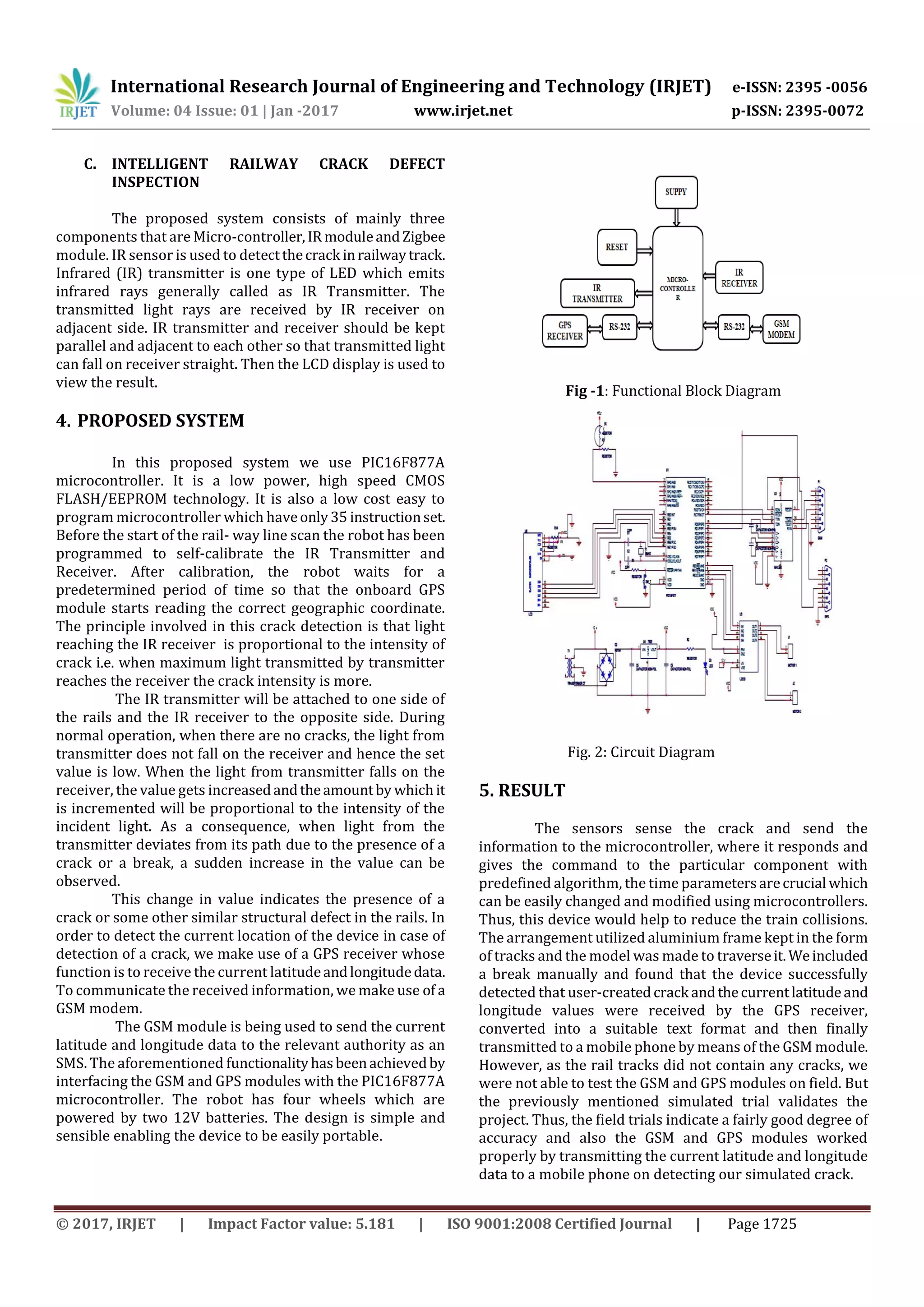
In this proposed system we use PIC16F877A
microcontroller. It is a low power, high speed CMOS
FLASH/EEPROM technology. It is also a low cost easy to
program microcontroller which haveonly35 instructionset.
Before the start of the rail- way line scan the robot has been
programmed to self-calibrate the IR Transmitter and
Receiver. After calibration, the robot waits for a
predetermined period of time so that the onboard GPS
module starts reading the correct geographic coordinate.
The principle involved in this crack detection is that light
reaching the IR receiver is proportional to the intensity of
crack i.e. when maximum light transmitted by transmitter
reaches the receiver the crack intensity is more.
The IR transmitter will be attached to one side of
the rails and the IR receiver to the opposite side. During
normal operation, when there are no cracks, the light from
transmitter does not fall on the receiver and hence the set
value is low. When the light from transmitter falls on the
receiver, the value gets increasedandtheamountby whichit
is incremented will be proportional to the intensity of the
incident light. As a consequence, when light from the
transmitter deviates from its path due to the presence of a
crack or a break, a sudden increase in the value can be
observed.
This change in value indicates the presence of a
crack or some other similar structural defect in the rails. In
order to detect the current location of the device in case of
detection of a crack, we make use of a GPS receiver whose
function is to receive the current latitudeandlongitudedata.
To communicate the received information, we make use of a
GSM modem.
The GSM module is being used to send the current
latitude and longitude data to the relevant authority as an
SMS. The aforementioned functionalityhasbeenachievedby
interfacing the GSM and GPS modules with the PIC16F877A
microcontroller. The robot has four wheels which are
powered by two 12V batteries. The design is simple and
sensible enabling the device to be easily portable.
Fig -1: Functional Block Diagram
Fig. 2: Circuit Diagram
5. RESULT
The sensors sense the crack and send the
information to the microcontroller, where it responds and
gives the command to the particular component with
predefined algorithm, the time parametersarecrucial which
can be easily changed and modified using microcontrollers.
Thus, this device would help to reduce the train collisions.
The arrangement utilized aluminium frame kept in the form
of tracks and the model was made to traverseit. Weincluded
a break manually and found that the device successfully
detected that user-createdcrack andthecurrentlatitudeand
longitude values were received by the GPS receiver,
converted into a suitable text format and then finally
transmitted to a mobile phone by means of the GSM module.
However, as the rail tracks did not contain any cracks, we
were not able to test the GSM and GPS modules on field. But
the previously mentioned simulated trial validates the
project. Thus, the field trials indicate a fairly good degree of
accuracy and also the GSM and GPS modules worked
properly by transmitting the current latitude and longitude
data to a mobile phone on detecting our simulated crack.
International Research Journal of Engineering and Technology (IRJET) e-ISSN: 2395 -0056
Volume: 04 Issue: 01 | Jan -2017 www.irjet.net p-ISSN: 2395-0072
© 2017, IRJET | Impact Factor value: 5.181 | ISO 9001:2008 Certified Journal | Page 1726
6. CONCLUSIONS
Railway crack detection byusingIR transmitterand
receiver robot is an eminent way to detect the crack in the
railway track. The defect information which includes GPS
value is wirelessly transmitted to the railway safety
management centre through GSM Module and the alert can
be given to the next approachingtrain.Theproposedscheme
possesses many advantages such as fast monitoring and
reporting system, low cost, low power consumptionandless
analysis time. Also the easy availability of the components
make an ideal project for industrial use withverylittleinitial
investment. So the current location device on rail track can
easily be measured from home station. By this proposed
model many lives can be saved by avoiding accidents. The
idea can be implemented in large scale in the long run to
facilitate better safety standards for rail tracks and provide
effective testing infrastructure for achievingbetterresultsin
the future.
ACKNOWLEDGEMENT
I express my sense of gratitude and sincere regards to my
guide Prof. A. H. Shelar for guiding me properlyinmy project
work and for helping to solve the project work difficulties. I
would also like to thanks all the staff members of Electrical
(Electronics & Power) Department for supporting and
guiding me in my project work whenever required.
REFERENCES
[1] Rennu George, Divya Jose, Gokul T.G., Keerthana Sunil,
Varun A.G. “Automatic Broken Track Detection Using IR
Transmitter and Receiver”, International Journal of
Advanced Research in Electrical, Electronics and
Instrumentation Engineering, Vol.4, Issue 4, April 2015,
pp-2301-2304.
[2] Pravinram, Prasath, Nanda Gopal, Haribabu, “Railway
Track Crack Detection Robot using IR and GSM”,
International Journal for Scientific Research and
Development, Vol. 4,Issue 02, 2016, pp-652-657.
[3] QiaoJian-hua; Li Lin-sheng; Zhang Jing-gang; “Design of
Rail Surface Crack detecting System Based on Linear
CCD Sensor,” IEEE Int. Conf. on Networking,Sensingand
Control, vol. 14, no. 4, pp-961-970, April 2008.
[4] P. Navaraja, “Crack Detection System for Railway Track
by using Ultrasonic and PIR sensor”, International
Journal of Advanced Information Science and
Technology, Vol.1, Isuue-1, May , 2014, pp-126-130.
[5] K. Vijayakumar, S.R. Wylie, J. D. Cullen, C.C. Wright, A.I.
Shammaa, “ Non invasive rail track detection system
using Microwave sensor,” Journal of App. Phy., vol. 9,
issue 11June 2009, pp- 1743-1749.
[6] Richard J. Greene, John R. Yates and Eann A. Patterson,
“Crack detection in rail using infrared methods,” Opt.
Eng. 46, 051013, May 2007.

Review on Railway track crack detection using ir transmitter and receiver

  • 1.
    International Research Journalof Engineering and Technology (IRJET) e-ISSN: 2395 -0056 Volume: 04 Issue: 01 | Jan -2017 www.irjet.net p-ISSN: 2395-0072 © 2017, IRJET | Impact Factor value: 5.181 | ISO 9001:2008 Certified Journal | Page 1723 REVIEW ON RAILWAY TRACK CRACK DETECTION USING IR TRANSMITTER AND RECEIVER Rakesh V. Pise1, Parag D. Nikhar2, Prof. Avinash H. Shelar3 1 DES’s College of Engineering & Technology Dhamangaon (Rly), Amravati 2DES’s College of Engineering & Technology Dhamangaon (Rly), Amravati 3Professor, Dept. of electrical(E&p) Engineering, DES’s College of Engineering & Technology Dhamangaon (Rly), Maharashtra, India ---------------------------------------------------------------------***--------------------------------------------------------------------- Abstract – The IR transmitter and receiver total stationfor railway track geometry surveying system. Railway Crack Inspection is dedicated as a measure of railway safety. The defect information can be wirelessly transferred to railway safety management centre using a GSMmoduleanditincludes defect level and location information which is acquired by embedded GPS receiver. In terms of the reliability and safety parameters, Indian railway has not yet reached the international standards. The main problem about railway analysis detection of cracks in the structure. This work proposes a cost effective solution to the problem of railway track crack detection utilizing IR transmitter and receiver which tracks the location of faulty track which then mended immediately so that many lives will be saved. If these deficiencies are not controlled at early stages they might lead to a number of derailments resulting in a heavy loss of life and property has train derailment can be avoided and chance of loss of human life and economy can be minimized. Key Words: IR transmitter and receiver, Crack detection, GPS, GSM, PIC Microcontroller and LCD 1. INTRODUCTION Transport has throughout history been a spur to expansion as better transport leads to moretrade.Economic prosperity has always been dependent on increasing the capacity and rationality of transport. But the infrastructure and operation of transport has a great impact on the land and is the largest drainer of energy, making transport sustain ability and safety a major issue. In India, we find that rail transport occupies a prominentpositioninproviding the necessary transport infrastructuretosustainand quench the ever-burgeoning needs of a rapidly growing economy. Today, India possesses the fourth largest railwaynetwork in the world. Today, India possesses the fourth largest railway network in the world. However, in terms of the reliability and safety parameters, we have not yet reached truly global standards. The principal problem has been the lack of cheap and efficient technology to detect problems in the rail tracks and of course, the lack of proper maintenance of rails which have resulted in the formation of cracks in the rails and other similar problems causedbyanti-social elementswhich jeopardize the security of operation of rail transport. In the past, this problem has lead to a number of derailments resulting in a heavy loss of life and property. Cracks in rails have been identified to be the main cause of derailments in the past, yet there have been no cheap automated solutions available for testing purposes. The new method which utilizes simple components inclusive of a GPS module, GSM Modem, IR Transmitter and Receiver based crack detector assembly is very useful in railway crack detection. proposed a system that utilises LED-LDR configuration for railway crack detection. RRCDS utilisessimplecomponentsinclusive of a GPS module, GSM Modem and LED-LDR based crack detector assembly. The pro- posed broken rail detection system automatically detectsthefaultyrail track withoutanyhuman intervention techniques. The advantages include less cost, low power consumption and less analysis time. By this proposed system the exact location of the faulty rail track can easily be located which will mended immediatelysothat man lives can be saved. Processes theimagesignal collected, judges out the crack signal, and displays the curve through the LCD, and gives off the alarm. The system essential modules such as, the CCD timing generator, A/D converter timing generator, address generator, RAM memory all are realized on CPLD. It adopts the improved classical algorithm and morphology algorithm to perform noiseelimination, the edge detection, the image segmentation and the edgelinking to the railway surface crack image, which obtains the good detection result. The whole system is fixed on the vehicle-hold system, travelling along the railway, then conveniently examines the crack position, thus may promptly carry through track maintenance, avoidingtheaccident.Moreover, the system can connect with the PC, transforming the sampling data to PC to further analysis.Inanother method K. Vijayakumar et.al [5] has investigated crack detection using microwave sensors. It describes how a Microwave horn antenna can be used to detect the cracksina rail track.Based on the simulation results obtained from the High Frequency Simulation Structure (HFSS), it has been shown that the design of the Microwave sensor has the potential for detecting defects in the rail surfaceincludingminorcracksas well as more serious as well as. In another method RichardJ. Greene et.al [6] have presented a new crack detection
  • 2.
    International Research Journalof Engineering and Technology (IRJET) e-ISSN: 2395 -0056 Volume: 04 Issue: 01 | Jan -2017 www.irjet.net p-ISSN: 2395-0072 © 2017, IRJET | Impact Factor value: 5.181 | ISO 9001:2008 Certified Journal | Page 1724 method, for rail which utilizes the change in infrared emission of the rail surface during the passage of a train wheel. Initial data from this infrared method are presented, from studies of both a laboratory-based three-point bend specimen and a short section of rail. The results of these two studies confirm the ability of the proposed method to locate and quantify Surface-connected notchesandcracks.Richard J. Greene et.al [6] developed an improved version of infrared-based method for surface crack quantification at conventional train speeds which delivers crack detection capability over the full depth of the rail section, with a crack resolution capability comparable to competing detection techniques. Experimental results are presented fora laboratory three-point bend notched specimen, the geometry of which is representative of surface-connected cracks with lengths below 2 mm in sections of rail. Two analyses are considered a simulated trackside system, wheretheobservationpointis fixed and the repeated loading event experienced by a section of rail during the passage of multi-carriage rolling stock is considered; and a simulated train-based system, where the observation point moves along the rail and the loading event produced by the passage of a single train wheel is considered. Data from the track side simulation system clearly identifies the precise location and severity of an artificially introduced notch on the upper surface of the specimen. Initial data the train-based simulation system identifies the notch location precisely, but is unable to quantify the magnitude of the flaw using the current processing method. The paper then describes modifications to the testing and data processing methods required to improve the performance of both system. After going through all these papers, we came to a conclusion to do a project which would provide better safety standards in a cost effective way for railway crack detection. The method utilises IR transmitter and receiver for thepurposeandhave many advantages compared to the traditional technique. 2. LITERATURE SURVEY A. RAILWAY TRACK Track-caused derailments are often caused bywide gauge. Proper gauge, the distance between rails, is 56.5 inches (four feet, eight-and-a-half inches) onstandardgauge track. As tracks wear from train traffic, the rails can develop a wear pattern that is somewhat uneven.Unevenwearinthe tracks can result in periodic oscillations in the truck, called 'truck hunting.' Truck hunting can be a contributing cause of derailments. A rail breaks cleanly, it is relatively easy to detect. A track occupancy light will light up in the signal tower indicating that a track circuit has been interrupted. If there is no train in the section, the signallermustinvestigate. One possible reason is a clean rail break. For detecting the rail break this way, one has to use signal bonds that are welded or pin brazed on the head of the rail. If one uses signal bonds that are on the web of the rail, one will have a continued track circuit. If a rail is merely cracked or has an internal fissure, the track circuit will not detect it, because a partially-broken rail will continue to conduct electricity. Partial breaks are particularly dangerous because they create the worst kind of weak point in the rail. The rail may then easily break under load--while a train is passing over it at the point of prior fissure. B. DIFFERENT METHOD OF CRACK DETECTION A. CRACKDETECTIONUSING ULTRASONICANDPIR SENSOR In this detection of the rail road crack, measuring distance for two rail road and also measure the pursuing human in the railway track. When IR sensor are used for detect the crack in the track and ultrasound sensor measure the distance between the two track and also PIR sensor are used to detect human being pursuing in the track. If any crack are occurred in the track means longitude andlatitude of the place are messaged to the nearest station and ultrasonic sensor are measure the distance betweenthetwo track if any small variance means theydetectandmessageto the nearest station using GPS and GSM modem. When PIR sensor are detect the human being and animals on the railway track, if any one pursuing on the track means they stop the surveying work after crossing rail road they are detect the track. B. CRACK DETECTION USING LED-LDR The principle involved in crack detection is the concept of LDR. In the proposed design, the LED will be attached to one side of the rails and the LDR to the opposite side. During normal operation, when thereare nocracks,the LED light does not fall on the LDR and hence the LDR resistance is high. Subsequently, when the LED light falls on the LDR, the resistance of the LDR gets reduced and the amount of reduction will be approximately proportional to the intensity of the incident light. As a consequence, when light from the LED deviates from its path duetothepresence of a crack or a break, a sudden decrease in the resistance value of the LDR ensues. This change in resistance indicates the presence of a crack or some other similar structural defect in the rails. In order to detect the current location of the device in case of detection of a crack, a GPS receiver whose function is to receive the current latitude and longitude data is used. To communicate the received information, a GSM modem has been utilized. The GSM modem transfers the received Information to the GPRS which then shows the exact location of the faultyrail track in the mobile. The proposed rail track detection system architectureconsistsofARM7controller,GPS,GSM,LED-LDR Assembly, and GPRS, DC Motor
  • 3.
    International Research Journalof Engineering and Technology (IRJET) e-ISSN: 2395 -0056 Volume: 04 Issue: 01 | Jan -2017 www.irjet.net p-ISSN: 2395-0072 © 2017, IRJET | Impact Factor value: 5.181 | ISO 9001:2008 Certified Journal | Page 1725 C. INTELLIGENT RAILWAY CRACK DEFECT INSPECTION The proposed system consists of mainly three components that are Micro-controller,IR moduleandZigbee module. IR sensor is used to detectthecrack inrailwaytrack. Infrared (IR) transmitter is one type of LED which emits infrared rays generally called as IR Transmitter. The transmitted light rays are received by IR receiver on adjacent side. IR transmitter and receiver should be kept parallel and adjacent to each other so that transmitted light can fall on receiver straight. Then the LCD display is used to view the result. 4. PROPOSED SYSTEM In this proposed system we use PIC16F877A microcontroller. It is a low power, high speed CMOS FLASH/EEPROM technology. It is also a low cost easy to program microcontroller which haveonly35 instructionset. Before the start of the rail- way line scan the robot has been programmed to self-calibrate the IR Transmitter and Receiver. After calibration, the robot waits for a predetermined period of time so that the onboard GPS module starts reading the correct geographic coordinate. The principle involved in this crack detection is that light reaching the IR receiver is proportional to the intensity of crack i.e. when maximum light transmitted by transmitter reaches the receiver the crack intensity is more. The IR transmitter will be attached to one side of the rails and the IR receiver to the opposite side. During normal operation, when there are no cracks, the light from transmitter does not fall on the receiver and hence the set value is low. When the light from transmitter falls on the receiver, the value gets increasedandtheamountby whichit is incremented will be proportional to the intensity of the incident light. As a consequence, when light from the transmitter deviates from its path due to the presence of a crack or a break, a sudden increase in the value can be observed. This change in value indicates the presence of a crack or some other similar structural defect in the rails. In order to detect the current location of the device in case of detection of a crack, we make use of a GPS receiver whose function is to receive the current latitudeandlongitudedata. To communicate the received information, we make use of a GSM modem. The GSM module is being used to send the current latitude and longitude data to the relevant authority as an SMS. The aforementioned functionalityhasbeenachievedby interfacing the GSM and GPS modules with the PIC16F877A microcontroller. The robot has four wheels which are powered by two 12V batteries. The design is simple and sensible enabling the device to be easily portable. Fig -1: Functional Block Diagram Fig. 2: Circuit Diagram 5. RESULT The sensors sense the crack and send the information to the microcontroller, where it responds and gives the command to the particular component with predefined algorithm, the time parametersarecrucial which can be easily changed and modified using microcontrollers. Thus, this device would help to reduce the train collisions. The arrangement utilized aluminium frame kept in the form of tracks and the model was made to traverseit. Weincluded a break manually and found that the device successfully detected that user-createdcrack andthecurrentlatitudeand longitude values were received by the GPS receiver, converted into a suitable text format and then finally transmitted to a mobile phone by means of the GSM module. However, as the rail tracks did not contain any cracks, we were not able to test the GSM and GPS modules on field. But the previously mentioned simulated trial validates the project. Thus, the field trials indicate a fairly good degree of accuracy and also the GSM and GPS modules worked properly by transmitting the current latitude and longitude data to a mobile phone on detecting our simulated crack.
  • 4.
    International Research Journalof Engineering and Technology (IRJET) e-ISSN: 2395 -0056 Volume: 04 Issue: 01 | Jan -2017 www.irjet.net p-ISSN: 2395-0072 © 2017, IRJET | Impact Factor value: 5.181 | ISO 9001:2008 Certified Journal | Page 1726 6. CONCLUSIONS Railway crack detection byusingIR transmitterand receiver robot is an eminent way to detect the crack in the railway track. The defect information which includes GPS value is wirelessly transmitted to the railway safety management centre through GSM Module and the alert can be given to the next approachingtrain.Theproposedscheme possesses many advantages such as fast monitoring and reporting system, low cost, low power consumptionandless analysis time. Also the easy availability of the components make an ideal project for industrial use withverylittleinitial investment. So the current location device on rail track can easily be measured from home station. By this proposed model many lives can be saved by avoiding accidents. The idea can be implemented in large scale in the long run to facilitate better safety standards for rail tracks and provide effective testing infrastructure for achievingbetterresultsin the future. ACKNOWLEDGEMENT I express my sense of gratitude and sincere regards to my guide Prof. A. H. Shelar for guiding me properlyinmy project work and for helping to solve the project work difficulties. I would also like to thanks all the staff members of Electrical (Electronics & Power) Department for supporting and guiding me in my project work whenever required. REFERENCES [1] Rennu George, Divya Jose, Gokul T.G., Keerthana Sunil, Varun A.G. “Automatic Broken Track Detection Using IR Transmitter and Receiver”, International Journal of Advanced Research in Electrical, Electronics and Instrumentation Engineering, Vol.4, Issue 4, April 2015, pp-2301-2304. [2] Pravinram, Prasath, Nanda Gopal, Haribabu, “Railway Track Crack Detection Robot using IR and GSM”, International Journal for Scientific Research and Development, Vol. 4,Issue 02, 2016, pp-652-657. [3] QiaoJian-hua; Li Lin-sheng; Zhang Jing-gang; “Design of Rail Surface Crack detecting System Based on Linear CCD Sensor,” IEEE Int. Conf. on Networking,Sensingand Control, vol. 14, no. 4, pp-961-970, April 2008. [4] P. Navaraja, “Crack Detection System for Railway Track by using Ultrasonic and PIR sensor”, International Journal of Advanced Information Science and Technology, Vol.1, Isuue-1, May , 2014, pp-126-130. [5] K. Vijayakumar, S.R. Wylie, J. D. Cullen, C.C. Wright, A.I. Shammaa, “ Non invasive rail track detection system using Microwave sensor,” Journal of App. Phy., vol. 9, issue 11June 2009, pp- 1743-1749. [6] Richard J. Greene, John R. Yates and Eann A. Patterson, “Crack detection in rail using infrared methods,” Opt. Eng. 46, 051013, May 2007.