4/27/2015 CL436 TRANSPORT
ENGINEERING
LIGHT RAIL PROPOSAL
GORDON BEST 201109204
Gordon Best 201109204
UNIVERSITY OF STRATHCLYDE
CL436 TRANSPORT ENGINEERING LIGHT RAIL PROPOSAL | GORDON BEST 201109204
1.1 Introduction
Transport planners face a multitude of challenges when seeking to design the
optimum transport network for an area. In a time where population and city
sizes are rising significantly, m ore and more emphasis is being placed on
ensuring that transport networks will accommodate this sharp growth. In
addition, the increased importance of sustainability and in providing an
environmentally friendly design is shaping the strategic planning and design
process, where emphasis is being placed on public transport to reduce
congestion and harmful vehicle emissions . Light rail is becoming a hugely
popular solution to the above issues, with a vast number of projects underway,
particularly in North America ( 1 ) .
This proposal puts forward plans to construct a light rail s ystem to replace the
existing Cathcart Circle heavy rail network. The factors which shaped the
design process will be outlined, and the benefits of the system shall be
reviewed.
2. Design Factors
2.1-Capacity and Frequency
The first set of factors considered were the capacity and frequency of the
proposed network. In order to comprehensively design the most efficient
system, the expected line passenger capacity (C) and vehicle capacity (CV)
must be established. This is done by analysing figures from the current heavy
rail network, and accommodating the expected increase in patronage due to
the attraction of a new and efficient network. The frequency (f) can be initially
gathered from the usage values of the existing system, but can be calculated
and optimised by analysing existing light rail projects, for instance the
Manchester Metro Link.
Moving the service from the existing heavy rail system to a light rail system
will have the effect of increasing passenger capacity on the line. Although light
rail systems generally carry fewer passengers per carriage, is it probable that
there will be more frequent trips due to the more efficient acceleration and
braking distances of each vehicle , permitting a shorter time between arrivals
at each station.
In addition to more frequent trips, light rail systems have the advantage of
lower dwelling times at each station, attributed mainly to having quicker
passenger loading times, with the ground le vel loading particularly beneficial
to disabled users of the light rail system ( 9 ) .
CL436 TRANSPORT ENGINEERING LIGHT RAIL PROPOSAL | GORDON BEST 201109204
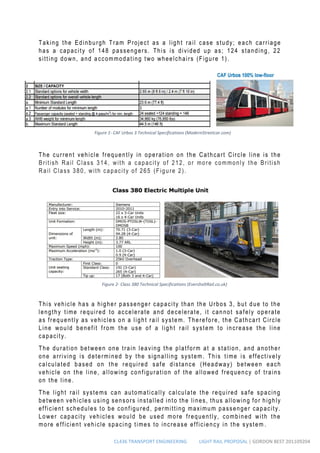
Taking the Edinburgh Tram Project as a light rail case study; each carriage
has a capacity of 148 passengers. This is divided up as; 124 standing, 22
sitting down, and a ccommodating two wheelchairs (Figure 1).
The current vehicle frequently in operation on the Cathcart Circle line is the
British Rail Class 314, with a capacity of 212, or more commonly the British
Rail Class 380, with capacity of 265 (Figure 2).
This vehicle has a higher passenger capacity than the Urbos 3, but due to the
lengthy time required to accelerate and decelerate, it cannot safely operate
as frequently as vehicles on a light rail system. Therefore, the Cathcart Circle
Line would benefit from the use of a light rail system to increase the line
capacity.
The duration between one train leaving the platform at a station, and another
one arriving is determined by the signalling system. This time is effectively
calculated based on the required safe distance (Headway) between each
vehicle on the line, a llowing configuration of the allowed frequency of trains
on the line.
The light rail systems can automatically calculate the required safe spacing
between vehicles using sensors installed into the lines, thus allowing for highly
efficient schedules to be configured, permitting maximum passenger capacity.
Lower capacity vehicles would be used more frequently, combined with the
more efficient vehicle spacing times to increase efficiency in the system .
Figure 2- Class 380 Technical Specifications (EversholtRail.co.uk)
Figure 1- CAF Urbos 3 Technical Specifications (ModernStreetcar.com)
CL436 TRANSPORT ENGINEERING LIGHT RAIL PROPOSAL | GORDON BEST 201109204
Light rail systems use a much more sophisticated method of signal system,
due to the permanently electronic nature of the train’s propulsion. Heavy rail
systems frequently use a diesel method of propulsion, making it less possible
to determine, and analyse, the exact spacing and speed required of the
following vehicle to maximise efficiency.
Transit Capacity Manual, 3 r d Edition suggests a maximum line capacity of 20
trains per hour for light rail (3 minute headways) at peak time, and 12 trains
per hour during off peak times of operation (5 minute headways). Heavy rail
line capacities vary significantly due to the variation in distance between
stations, and average speed. However, it is significantly lower than the line
capacity estimate of 20 trains per hour for light rail, and relies on its high
vehicle capacity for efficiency. The line capacity can be configured by
establishing the time taken for each journey, and therefore the number of trips
which can safely run simultaneously.
To calculate the line capacity for system, the existing layout must be
examined. This will help to configure the acceleration and deceleration of the
vehicles between each station, in addition to finding the time required to load
and unload passengers at each stop. Once these values are found, the entire
journey time can be configured, leading to the line capacity when the number
of trips per hour is known. The TCRP Report 5:16 provided estimates for
passenger loading times, and the light rail technical handbook prov ided
estimates for door operating times.
The line capacity for the proposed light rail system is calculated later in this
report.
S 1.6km
A 5.5km/h/h
B 5.5km/h/h
Vtop 70km/h
Pon/off Table below
Ton/off Table below
Station YearlyUsers Exits/EntriesPerTrip LoadingTime(Seconds) DwellTime LoadingTime(Mins)
PollokshawsEast 166273 17.76231172 62.16809102 64.16809102 1.069468184 1.5
Queen'sPark(Glasgow) 302395 32.30370687 113.062974 115.062974 1.917716234 2
Crosshill 149338 15.95321013 55.83623544 57.83623544 0.963937257 1
MountFlorida 535844 57.24217498 200.3476124 202.3476124 3.372460207 4
Cathcart 271416 28.99433821 101.4801837 103.4801837 1.724669729 2
Langside 115174 13.38921181 46.86224134 48.86224134 0.814370689 1
PollokshieldsEast 179972 20.92211114 73.22738898 75.22738898 1.253789816 1.5
Shawlands 72506 8.428970007 29.50139502 31.50139502 0.52502325 1
MaxwellPark 73343 8.52627296 29.84195536 31.84195536 0.530699256 1
PollokshieldsWest 84358 9.806789119 34.32376192 36.32376192 0.605396032 1
Figure 3- Light Rail Dwell Time Calculations (Existing Stations)
253workingdays@37journeysperdayfromNewton,34perdayfromNeilston
Assumesimilardatainotherdirection Assume2secondtoopen/closedoors
Newton-9361tripsperyear Assume3.5secondstoloadeachpassenger
Neilston-8602tripsperyear Source:TCRPReport 5:16
CL436 TRANSPORT ENGINEERING LIGHT RAIL PROPOSAL | GORDON BEST 201109204
2.2 –Accessibility Improvements
The second factor considered is how the light rail scheme can improve
accessibility for all those using it . This factor can be analysed and
incorporated into the design by analysing public feedback from existing
networks, and by using tram carriage design data to observe how the vehicles
can improve accessibility for the public ( 3 ) . Information such as comfort ratings
and passenger loading times can permi t this feedback to be quantified.
The quality of the passenger experience relates to the patronage of the light
rail system. With an effective and comfortable system in place, passenger
levels will almost certainly be high, leading to further investment i n the system.
There is a risk that such a high quality system could lead to excessive
passenger levels, where capacity is outweighed by demand. However, the cost
of the light rail system can be adjusted, and the frequency of the trips can be
optimised to best suit the passenger demand and improve passenger
capacities.
The light rail system should fully comply with the Rail Vehicle Accessibility
Regulations 1998, and follow the steps outlined in the Disability Discrimination
Act (DDA) 2005 to ensure safe an d efficient accessibility for all using the
system. It must also be regulated by the Railways and Other Guided Transport
Systems (Safety) Regulations 2006, (ROGS), which requires that a light rail
system is approved by Her Majesty’s Railway Inspectorate (H MRI) before
public use. HMRI demands that all risks are identified and mitigated before
inspection, and assesses the safety of the system according to HMRI
Inspection Guidelines ( 4 ) .
In addition, the system should function alongside the recommendations of the
British Transport Police (BTP), to reduce the risk of crime and unsociable
behaviour during light rail operation times . These measures are in place to
provide reassurances to passengers and staff of their safety, and t o ensure
adequate security systems are in place to minimise anti -social behaviour on
board light rail systems. The BTP also require that a policing system should
be put in place to ensure the light rail network is maintained to a high standard
of security, and passengers remain reassured of their safety. This system will
be decided by the local policing force, working alongside the BTP ( 6 ) .
The rail network should function under th e recommendations of the
Department’s Transport Security and Contingencies Directorate, TRANSEC,
which promotes a comprehensive security strategy for light rail networks,
aiming to deliver an efficient and cost effective system.
As mentioned in Section 2.1, light rail systems utilise efficient carriage
layouts, ground level entry and wider doors to minimise passenger loading
times. This is calculated in Section 2.3 by using Chapter 4 of TCRP Report 13,
“Rail Transit Capacity .”
CL436 TRANSPORT ENGINEERING LIGHT RAIL PROPOSAL | GORDON BEST 201109204
2.3- Access Improvements
This section will consider access improvements. For example, where is best
to locate the stops, and how this decision will translate to the ease of access
to public areas. Data will be required to show where the population requires
trips most frequently, to permit large scale travel to these destinations. The
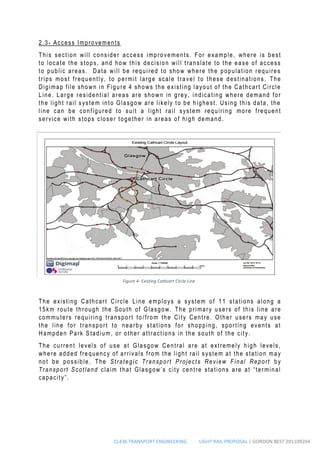
Digimap file shown in Figure 4 shows the existing layout of the Cathcart Circle
Line. Large residential areas are shown in grey, indicating where demand for
the light rail system into Glasgow are likely to be highest. Using this data, the
line can be configured to suit a light rail system requiring more frequent
service with stops closer together in areas of high demand .
The existing Cathcart Circle Line employs a system of 11 stations along a
15km route through the South of Glasgow. The primary users of this line are
commuters requiring transport to /from the City Centre. Other users may use
the line for transport to nearby stations for shopping, sporting events at
Hampden Park Stadium, or other attractions in the south of the city.
The current levels of use at Glasgow Central are at extremely high levels,
where added frequency of arrivals from the light rail system at the station may
not be possible. The Strategic Transport Projects Review Final Report by
Transport Scotland claim that Glasgow’s city centre stations are at “terminal
capacity”.
Figure 4- Existing Cathcart Circle Line
CL436 TRANSPORT ENGINEERING LIGHT RAIL PROPOSAL | GORDON BEST 201109204
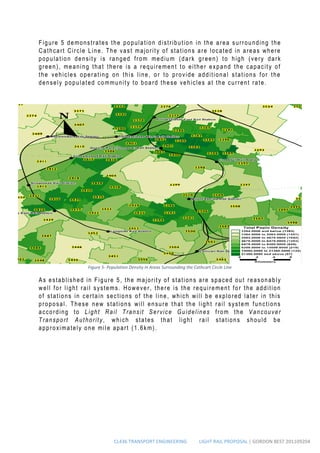
Figure 5 demonstrates the population distribution in the area surrounding the
Cathcart Circle Line. The vast majority of stations are located in areas where
population density is ranged from medium (dark green) to high (very dark
green), meaning that there is a requirement to either expand the capacity of
the vehicles operating on this line, or to provide additional stations for the
densely populated community to board these vehicles at the current rate.
As established in Figure 5, the majority of stations are spaced out reasonably
well for light rail systems. However, there is the requirement for the addition
of stations in certain sections of the line, which will be explored later in this
proposal. These new stations will ensure that the light rail system functions
according to Light Rail Transit Service Guidelines from the Vancouver
Transport Authority, which states that light rail stations should be
approximately one mile apart (1.6km).
Figure 5- Population Density in Areas Surrounding the Cathcart Circle Line
CL436 TRANSPORT ENGINEERING LIGHT RAIL PROPOSAL | GORDON BEST 201109204
Figure 6 shows the percentages of passenger use for each mode of transport,
as calculated from responses by members of the public in the areas
surrounding the Cathcart Circle Line.
This analysis shows that there is considerable reliance on the rail network,
but also that there is a large number of potential passengers which can be
attracted to the network to reduce reliance on cars, and ease congestion
levels.
As demonstrated in Figure 7, all existing stations in the Cathcart Circle are
used frequently by large numbers of passengers , according to the 2011 station
footfall data.
Since these stations are clearly located in accessible areas, this report
proposes that the Cathcart Circle Line should undergo conversion to a
Karlsruhe model based light rail system , since the cost of changing the station
facilities would be minimised co mpared to undertaking an expensive complete
overhaul of the system. The stations will be required to accommodate vehicles
which implement ground level entry, so will need to either reduce the height
of the platforms or slightly incline the lines.
Figure 7- Footfall of Cathcart Circle Line Stations per Year
Figure 6- Favoured Transport Modes in Areas Surrounding the Cathcart Circle Line
CL436 TRANSPORT ENGINEERING LIGHT RAIL PROPOSAL | GORDON BEST 201109204
Assuming consistent heights of 1m for the platforms, and assuming heavy and
light rail vehicle entry heights are similar, the line should incline at 1.1 ° for
the 50m section before, and decline for 50m after each station , to ensure the
platforms can accommodate ground level entry, without changing the gradient
of the entire line.
To accommodate the existing high passenger numbers on the Cathcart Circle
Line, and to optimise the layout for a light rail system , a number of additions
are required to the existing facilities on the line.
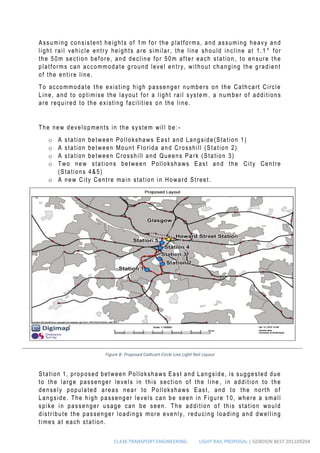
The new developments in the system will be: -
o A station between Pollokshaws East and Langside(Station 1)
o A station between Mount Florida and Crosshill (Station 2)
o A station between Crosshill and Queens Park (Station 3)
o Two new stations between Pollokshaws East and the City Centre
(Stations 4&5)
o A new City Centre main station in Howard Street.
Station 1, proposed between Pollokshaws East and Langside, is suggested due
to the large passenger levels in this section of the line , in addition to the
densely populated areas near to Pollokshaws East, and to the north of
Langside. The high passenger levels can be seen in Figure 10, where a small
spike in passenger usage can be seen. The addition of this station would
distribute the passenger loadings more evenly, reducing loading and dwelling
times at each station.
Figure 8- Proposed Cathcart Circle Line Light Rail Layout
CL436 TRANSPORT ENGINEERING LIGHT RAIL PROPOSAL | GORDON BEST 201109204
Similarly, Station 2, between Mount Florida and Crosshill, where a larger spike
can be seen in passenger usage. This increase is attributed to the densely
populated areas near to the existing Mount Florida station. Mount Florida
station operates over one million passengers per year, therefore requiring the
development of a new station to distribute passenger loading and unloading
more evenly at peak times on the east side of the Cathcart Circle, increasing
line efficiency.
There is a particular requirement for an additional station near to Mount
Florida, due to the proposed station’s close proximity to the Victoria Hospital,
and Hampden Park Stadium, which causes massive increases in passenger
levels before and after football games.
Station 3, between Crosshill and Queens Park accommodates the very densely
populated area to the north of Crosshill, which should help to distribute
passenger loadings more evenly between both stations, in particular, Queens
Park station, which observes high annual passenger footfall.
Stations 4 & 5 are added to the line to ensure an even distribution of stations
to the City Centre through the Gorbals and Tradeston area. Th e addition of
these stations may, however, compete with the existing tram system, so data
should be further gathered to examine the necessity of constructing stations
closer to the City Centre than the Cathcart Circle Line commuter zone.
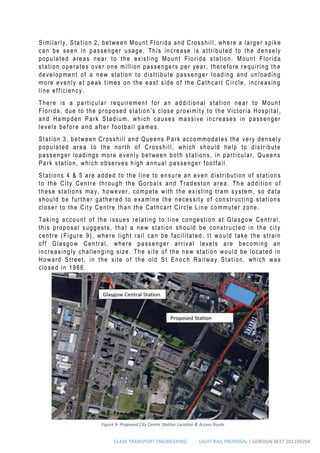
Taking account of the issues relating to line congestion at Glasgow Central,
this proposal suggests, that a new station should be constructed in the city
centre (Figure 9), where light rail can be facilitated. It would take the strain
off Glasgow Central, where passenger arrival levels are becoming an
increasingly challenging size. The site of the new station would be located in
Howard Street, in the site of the old St Enoc h Railway Station, which was
closed in 1966.
Figure 9- Proposed City Centre Station Location & Access Route
CL436 TRANSPORT ENGINEERING LIGHT RAIL PROPOSAL | GORDON BEST 201109204
It would follow the existing, heavy rail overnight freight diversion route from
the Cathcart Circle to the Howard Street Station, while utilising the existing
line currently in use. This route would: maximise design efficiency by reducing
construction costs; acquiring suitable land which is currently underused, and
provide a centralised and advantageous location for commuters to travel to.
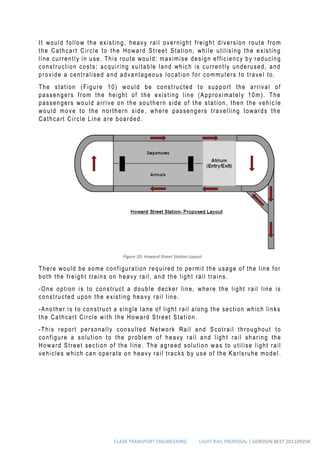
The station (Figure 10) would be constructed to support the arrival of
passengers from the height of the existing line (Approximately 10m). The
passengers would arrive on the southern side of the station, then the vehic le
would move to the northern side, where passengers travelling towards the
Cathcart Circle Line are boarded.
There would be some configuration required to permit the usage of the line for
both the freight trains on heavy rail, and the light rail trains.
-One option is to construct a double decker line, where the light rail line is
constructed upon the existing heavy rail line.
-Another is to construct a single lane of light rail along the section which links
the Cathcart Circle with the Howard Street Station.
-This report personally consulted Network Rail and Scotrail throughout to
configure a solution to the problem of heavy rail and light rail sharing the
Howard Street section of the line . The agreed solution was to utilise light rail
vehicles which can operate on heavy rail tracks by use of the Karlsruhe model.
Figure 10- Howard Street Station Layout
CL436 TRANSPORT ENGINEERING LIGHT RAIL PROPOSAL | GORDON BEST 201109204
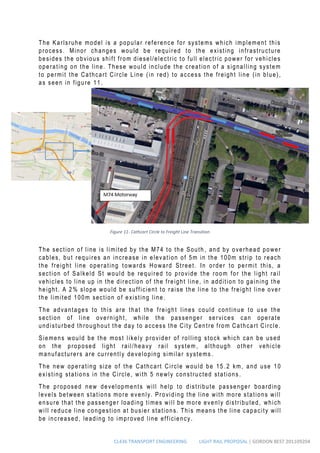
The Karlsruhe model is a popular reference for systems which implement this
process. Minor changes would be required to the existing infrastructure
besides the obvious shift from diesel/electric to full electric power for vehicles
operating on the line. These would include the creation of a signalling system
to permit the Cathcart Circle Line (in red) to access the freight line (in blue),
as seen in figure 11.
The section of line is limited by the M74 to the South , and by overhead power
cables, but requires an increase in elevation of 5m in the 100m strip to reach
the freight line operating towards Howard Street. In order to permit this, a
section of Salkeld St would be required to provide the room for the light rail
vehicles to line up in the direction of the freight line, in addition to gaining the
height. A 2% slope would be sufficient to raise the line to the freight line over
the limited 100m section of existing line.
The advantages to this are that the freight lines could continue to use the
section of line overnight, while the passenger services can operate
undisturbed throughout the day to access the City Centre from Cathcart Circle.
Siemens would be the most likely provider of rolling stock which can be used
on the proposed light rail/heavy rail system , although other vehicle
manufacturers are currently developing similar systems .
The new operating size of the Cathcart Circle would be 15 .2 km, and use 10
existing stations in the Circle, with 5 newly constructed stations .
The proposed new developments will help to distribute passenger boarding
levels between stations more evenly. Providing the line with more stations will
ensure that the passenger loading times will be more evenly distributed, which
will reduce line congestion at busier stations. This means the line capacity will
be increased, leading to improved line efficiency.
Figure 11- Cathcart Circle to Freight Line Transition
CL436 TRANSPORT ENGINEERING LIGHT RAIL PROPOSAL | GORDON BEST 201109204
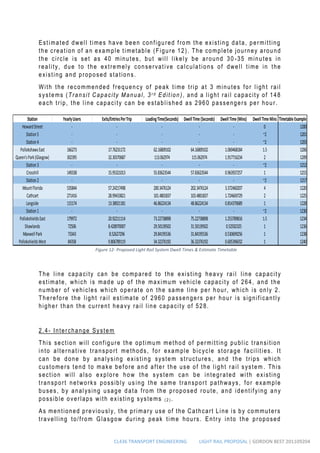
Estimated dwell times have been configured from the existing data, permitting
the creation of an example timetable (Figure 12). The complete journey around
the circle is set as 40 minutes, but will likely be around 30 -35 minutes in
reality, due to the extremely conservative calculations of dwell time in the
existing and proposed stations.
With the recommended frequency of peak time trip at 3 minutes for light rail
systems (Transit Capacity Manual, 3 r d Edition), and a light rail capacity of 148
each trip, the line capacity can be established as 2960 passengers per hour.
The line capacity can be compared to the existing heavy rail line capacity
estimate, which is made up of the maximum vehicle capacity of 264, and the
number of vehicles which operate on the same line per hour, which is only 2.
Therefore the light rail estimate of 2960 passengers per hour is significantly
higher than the current heavy rail line capacity of 528.
2.4- Interchange System
This section will configure the optimum method of permitting public transition
into alternative transport methods, for example bicycle storage facilities. It
can be done by analysing existing system structures , and the trips which
customers tend to make before and after the use of the light rail system . This
section will also explore how the system can be integrated with existing
transport networks possibly us ing the same transport pathways, for example
buses, by analysing usage data from the proposed route, and identifying any
possible overlaps with existing systems ( 2 ) .
As mentioned previously, the primary use of the Cathcart Line is by commuters
travelling to/from Glasgow during peak time hours. Entry into the proposed
Station YearlyUsers Exits/EntriesPerTrip LoadingTime(Seconds) DwellTime(Seconds) DwellTime(Mins) DwellTimeMins TimetableExample
HowardStreet - - - - - 0 1200
Station5 - - - - - ~2 1201
Station4 - - - - - ~2 1203
PollokshawsEast 166273 17.76231172 62.16809102 64.16809102 1.069468184 1.5 1206
Queen'sPark(Glasgow) 302395 32.30370687 113.062974 115.062974 1.917716234 2 1209
Station3 - - - - - ~2 1212
Crosshill 149338 15.95321013 55.83623544 57.83623544 0.963937257 1 1215
Station2 - - - - ~2 1217
MountFlorida 535844 57.24217498 200.3476124 202.3476124 3.372460207 4 1220
Cathcart 271416 28.99433821 101.4801837 103.4801837 1.724669729 2 1225
Langside 115174 13.38921181 46.86224134 48.86224134 0.814370689 1 1228
Station1 - - - - - ~2 1230
PollokshieldsEast 179972 20.92211114 73.22738898 75.22738898 1.253789816 1.5 1234
Shawlands 72506 8.428970007 29.50139502 31.50139502 0.52502325 1 1236
MaxwellPark 73343 8.52627296 29.84195536 31.84195536 0.530699256 1 1238
PollokshieldsWest 84358 9.806789119 34.32376192 36.32376192 0.605396032 1 1240
Figure 12- Proposed Light Rail System Dwell Times & Estimate Timetable
CL436 TRANSPORT ENGINEERING LIGHT RAIL PROPOSAL | GORDON BEST 201109204
Howard Street Station using the light rail system permits excellent access to
the city centre, where the vast majority of commuters are employed. In
addition, the site is near to other modes of transport, for example the St Enoch
Subway Station, and Glasgow Central Station if further trips are required. This
allows for the implementation of appropriate links to be created between the
Howard Street Station, and other modes of transport which ma y be used before
or after light rail use.
The Howard Street Station may have the issue of insufficient parking spaces
for vehicles, but can link with parking used for the St Enoch Shopping Centre,
and other city centre parking facilities nearby. Demand for car parking spaces
at near Glasgow Central will likely decline due to the more even distribution
of passenger access to stations in the city centre caused by the Howard Street
development, therefore increasing parking availability in the city centre.
The site has the advantage of locating in an underused part of the city, where
land is generally cheaper than in the City Centre, due to the brownfield nature
of the land.
The Howard Street station is proposed to encourage and develop bicycle
storage facilities, to promote environmentally friendly transport within the city
centre and link with the existing Next Bike system, allowing users to rent
bicycles for a short period of time.
Currently, only the Cathcart Circle Line is planned for light rail developmen t,
but since the light rail vehicles are designed to function on a heavy rail track,
funding can be put in place to extend the electrification of the lines as far as
Newton and Neilston to ensure the entirety of the current rail users can use
the light rail system under the Karlsruhe model. If a feasibility study suggests
that the expansion of the light rail network to these lines would be beneficial
and cost effective, this proposal can be implemented using a revision of this
document.
Additionally, if th e light rail system proves to be effective, and expansion of
the Howard Street Station is required, then negotiations can also be entered
with the City Council to determine if nearby brownfield sites can be acquired
for development.
Furthermore, if there is potential for the light rail network to extend towards
the East of Glasgow, by following the line which is situated next to the
proposed Howard Street Station, this may be investigated.
2.5- Engineering Challenges & Solutions
The fifth section comprehen sively studies the challenges which the project will
face, and how these can be resolved using engineering based problem solving
processes. It can be conducted by analysing : public feedback regarding
potential problems, and existing projects using similar techniques to evaluate
the most effective solution ( 4 ) . The primary challenge facing this project is how
to implement a light rail network into a city which is mostly configured to use
a heavy rail network. The strategy implemented must reconfigure both stations
CL436 TRANSPORT ENGINEERING LIGHT RAIL PROPOSAL | GORDON BEST 201109204
and tracks, and develop a working light rail system which incorporates these
existing systems, and maximises potential benefits.
The light rail project successfully negotiates this challenge by breaking the
problem up into smaller and more manageable issues.
The heavy rail tracks can remain in place, while the rolling stock and powering
mechanism (overhead wires) is changed to permit light rail use on a heavy rail
track using the Karlsruhe model.
Each station can be modified to accommodate light rail vehicles; in means of
propulsion where required, and in terms of platform height to permit ground
level entry to vehicles.
The challenge relating to accommodating additional arrivals in the city centre
from the light rail system was successfully solved by proposing a new station
in Howard Street, where an existing overnight freight line can incorporate light
rail transit under the Karlsruhe model. It would redistribute passenger entry
into the city more evenly, and will ease the strain on the two major city centre
stations, Glasgow Central and Glasgow Queen Street , and the lines which
supply them.
The new station addresses the concern of how the light rail system can
successfully cross the River Clyde . The lines currently used to enter Glasgow
Central over the rail bridge are used too frequently by vital long distance rail
users to permit changing these to light rail tracks. Therefore, to accommodate
these additional lines, a costly bridge expansion would most likely be required.
The proposed plan negates this requirement, and efficiently optimises existing
infrastructure to resolve technical challenges. It is also unlikely that the
development of the new line from the e xisting Cathcart Circle Line to the
proposed Howard Street station will disrupt existing transport modes
significantly during construction or operation . This work can be minimised by
working with the Scottish Railway Service (Scotrail) to suggest measures
which can be applied to reduce disruption whil st working adjacent to
operational lines.
Implementing an existing line into the design eradicates the need to construct
pathways to lay track, albeit with changes being required to transfer the
Cathcart Circle line to Howard Street with a 3° slope in track for the 100m
leading up to the freight line, and by claiming some of Salkeld St to permit the
direction and height changes required.
In order to ensure the project is implemented in the correct manner, existing
light rail infrastructure projects should be consulted, For example, the
Manchester Metrolink or Docklands Light Railway (DLR) in London should be
studied to examine the methods and measures which were taken to ensure an
efficient and socially responsible solution can be implemented into the
Cathcart Circle project.
The main social impact which must be considered during project planning is
how disruption to the public can be minimised in the construction phase, in
particular for regular users of the existing system. It could be solved by
CL436 TRANSPORT ENGINEERING LIGHT RAIL PROPOSAL | GORDON BEST 201109204
feasibility tests evaluating whether additional temporary bus services could
accommodate those who normally use the Cathcart Circle Line to access the
City Centre by rail. If this is unfeasible, then the possibility of developing the
two lines which make up the Cathcart Circ le Line separately could be explored.
It would cause slight disruption to rail users, who would have to travel to
Cathcart, or alternatively to a station on the operational line to access the city
centre by train, but would preven t large scale disruption to all rail users on
the south side of the city.
The logistical challenges of how the light rail system should run must be
configured to implement upon completion of the infrastructure . The most
efficient frequency and speed of ve hicle must be applied to the design to
ensure line capacity is at an optimal level. To calculate this value, the
passenger loading times must be known for each stop , leading to a calculation
of how long is required at each stop throughout the day, and the time taken
for travel between stops to determine total journey time. Once a
comprehensive system is in place for each line, the logistics can be configured
to evaluate how many trains can run simultaneously.
It is expected that the vast majority of commute rs will continue to use the
Cathcart Circle upon conversion to light rail. In terms of affecting other modes
of transport in the area, it is expected that the additional stations on the
Cathcart Circle Line will: lead to greater accessibility; increase the reliance
on the light rail, and reduce usage of other transport modes.
Studies conducted by the Journal of Transport Geography suggest that the
implementation of a light rail system does relatively little to inf luence car
users, but significantly decreases the use of buses. Their study suggested a
20% increase in the number of rail passengers , 18% reduction in bus trips,
and a 2% decline in car trips upon the completion of a light rail project. By
entering the results of the study into the data relating to this project, these
early projections can be made. With the current rail usage levels for all areas
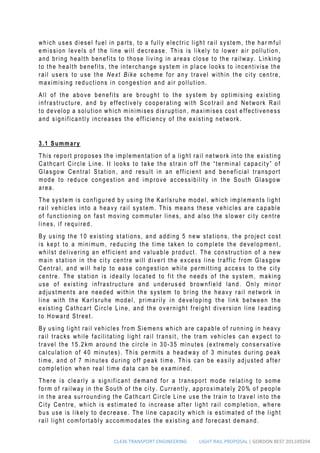
near the line at 865 passengers for the 6191 respondents, inflated by 20% for
the estimated rise in patronage to 1038, the estimated line capacity of 2960
comfortably accommodates the existing and forecast demand.
These estimates for commuter usage were derived from the percentage of
people who use the three most popular modes of transport per area, and
multiplied by the 2011 population to create the most recent dataset. This was
then increased or decreased by the l evels which the Journal of Transport
Geography suggested was reasonable for a new light rail development to
Figure 13- Projections in Transport Mode Usage Before and After Light Rail Development
CL436 TRANSPORT ENGINEERING LIGHT RAIL PROPOSAL | GORDON BEST 201109204
establish the level of demand which each mode of transport could expect upon
completion of the light rail development (Figure 13).
Naturally, there are limitations to this data, due to the original results being
taken relating to an area with different social conditions and geography. In
addition, the projections are for a completely new light rail development rather
than a heavy rail conversion, so r ealistic fluctuations between transport mode
choices would likely be less severe than those projected .
2.6- Benefits & Problem Mitigation
The final section will outline the social and environmental benefits to the
project, and how any negative social impa cts can be mitigated to ensure the
project brings widespread positives consequences to the area. This will utilise
data from existing light rail projects to detail the potential benefits which can
be brought to the area, and how these problems were successfully managed.
The light rail system brings a vast array of benefits to the South Glasgow area,
in addition to the wider community.
Firstly, the system increases the line capacity, meaning that there will be more
frequent services to the city centre, leading to increased line efficiency and
more evenly distributed loading capacities. This leads to reduced passenger
loading and dwelling times at each station, boosting efficiency further. The
light rail system also has the added benefit of being able to optimise line
capacity levels much more effectively than in heavy rail, where headway is
much less simple to calculate due to more variable vehicle acceleration and
deceleration values. A development strategy will be implemented using the
Transit Capacity Manual, 3 r d Edition, which will ensure the line is designed to
support capacities which are calculated effectively and accurately.
Secondly, the light rail system will reduce congestion in the city centre, both
in terms of line usage at stations, and general vehicle use by commuters. The
proposal to implement the light rail system into a new station in the city centre
will lead to reduced strain on the lines in operation to Glasgow Central, while
attracting commuters to using the ra ilway network. Any potential negative
impacts will be mitigated by working with Scotrail to pursue a development
strategy which minimises disruption to existing lines .
Thirdly, the proposed additional stations on the line lead to greater
accessibility to the community, meaning that more people can travel to a
station, and access the city centre for jobs and other reasons for travel.
Furthermore, the construction of new stations will lead to job creation,
reducing unemployment in the area and boosting t he economy. This financial
growth in the community can lead to further development , modernising and
rejuvenating the South Glasgow area. The project will work with council
representatives and community groups to ensure all developments are socially
responsible and beneficial.
In addition to the social and economic benefits, the light rail system brings
significant benefits to the environment. By converting the heavy rail system,
CL436 TRANSPORT ENGINEERING LIGHT RAIL PROPOSAL | GORDON BEST 201109204
which uses diesel fuel in parts, to a fully electric light rail system, the har mful
emission levels of the line will decrease. This is likely to lower air pollution,
and bring health benefits to those living in areas close to the railway. Linking
to the health benefits, the interchange system in place looks to incentivise the
rail users to use the Next Bike scheme for any travel within the city centre,
maximising reductions in congestion and air pollution.
All of the above benefits are brought to the system by optimising existing
infrastructure, and by effectively cooperating with Sco trail and Network Rail
to develop a solution which minimises disruption, maximises cost effectiveness
and significantly increases the efficiency of the existing network.
3.1 Summary
This report proposes the implementation of a light rail network into the existing
Cathcart Circle Line. It looks to take the strain off the “terminal capacity” of
Glasgow Central Station, and result in an efficient and beneficial transport
mode to reduce congestion and improve accessibility in the South Glasgow
area.
The system is configured by using the Karlsruhe model, which implements light
rail vehicles into a heavy rail system. This means these vehicles are capable
of functioning on fast moving commuter lines, and also the slower city centre
lines, if required.
By using the 10 existing stations, and adding 5 new stations, the project cost
is kept to a minimum, reducing the time taken to complete the development ,
whilst delivering an efficient and valuable product . The construction of a new
main station in the cit y centre will divert the excess line traffic from Glasgow
Central, and will help to ease congestion while permitting access to the city
centre. The station is ideally located to fit the needs of the system, making
use of existing infrastructure and underus ed brownfield land. Only minor
adjustments are needed within the system to bring the heavy rail network in
line with the Karlsruhe model, primarily in developing the link between the
existing Cathcart Circle Line, and the overnight freight diversion line l eading
to Howard Street.
By using light rail vehicles from Siemens which are capable of running in heavy
rail tracks while facilitating light rail transit , the tram vehicles can expect to
travel the 15.2km around the circle in 30-35 minutes (extremely conservative
calculation of 40 minutes). This permits a headway of 3 minutes during peak
time, and of 7 minutes during off peak time. This can be easily adjusted after
completion when real time data can be examined.
There is clearly a significant demand for a transport mode relating to some
form of railway in the South of the city. Currently, approximately 20% of people
in the area surrounding the Cathcart Circle Line use the train to travel into the
City Centre, which is estimated to increase after light rail completion, where
bus use is likely to decrease. The line capacity which is estimated of the light
rail light comfortably accommodates the existing and forecast demand.
CL436 TRANSPORT ENGINEERING LIGHT RAIL PROPOSAL | GORDON BEST 201109204
The project is cost effective, and extremely successful in improving the
network to deliver the following benefits:
 Increased line capacity
 Reduced strain on Glasgow Central Station capacity
 Improved accessibility to residents of the South Side of Glasgow
 Social and environmental benefits from reducing diesel based emissions
4.1- References
1. Does Light Rail Really Encourage People to Stop Driving? - CityLab.
2015. Does Light Rail Really Encourage People to Stop Driving? - City
Lab. [ONLINE] Available at:
http://www.citylab.com/commute/2013/02/does -light-rail-encourage-
people-stop-driving/4800/. [Accessed 13 April 2015].
2. Technical Specifications [ONLINE] Available at:
https://www.eversholtrail.co.uk/upload/class -380.pdf. [Accessed 08
April 2015].
3. CAF URBOS 3 TECHNICAL SPECIFICATIONS . 2015 [ONLINE] Available
at:
http://www.modernstreetcar.org/pdf/APTA%20Streetcar%20Carbuilder%
20Survey%20Rev%20130117%20Draft%20CAF%20Urbos%20100%25%2
0LF.pdf. [Accessed 08 April 2015].
4. International Service Guidelines. [ONLINE] Available at:
http://nacto.org/docs/usdg/lrtserviceguidelines_vta. pdf.
[Accessed 10 April 2015].
5. Improving public transport in England through light rail - National Audit
Office (NAO). 2015. Improving public transport in England through light
rail - National Audit Office (NAO). [ONLINE] Available at:
http://www.nao.org.uk/report/improving -public-transport-in-england-
through-light-rail/#. [Accessed 27 February 2015].
6. All Aboard for Light Rail - Railway Technology. 2015. All Aboard for
Light Rail - Railway Technology. [ONLINE] Available
at: http://www.railway-technology.com/features/feature125693/ .
[Accessed 27 February 2015].
7. Karlsruhe Light/Heavy Rail - Railway Technology. 2015. Karlsruhe
Light/Heavy Rail – Railway Technology. [ONLINE] Available at:
http://www.railway-technology.com/projects/karlsruhe/ . [Accessed 24
April 2015].
CL436 TRANSPORT ENGINEERING LIGHT RAIL PROPOSAL | GORDON BEST 201109204
8. Guidance Notes. 2015. Guidance Notes. [ONLINE] Available
at:http://www.uktram.co.uk/Pages/GuidanceNotes.aspx . [Accessed 27
February 2015].
9. Accessibility: Bus and Light Rail - Policies. 2015. Accessibility: Bus and
Light Rail - Policies. [ONLINE] Available at: http://www.vta.org/getting -
around/paratransit/accessibility -bus-and-light-rail-policies. [Accessed
27 February 2015].
5.1 Appendices
Appendix 1- Commuting Figures- Transport Mode Breakdown
Appendix 2- Light Rail Trip Detail
Appendix 3- Station Annual Footfall
Name Work or study mainly at or from homeUnderground, metro, light rail or tramTrain Bus, minibus or coachTaxi or minicabDriving a car or vanPassenger in a car or vanMotorcycle, scooter or mopedBicycle On foot Other
Cathcart 11.67701863 1.242236 9.192546584 22.98137 0.372671 33.41615 4.347826 0 1.987578 13.78882 0.993789
Langside 16.89655172 1.551724 11.89655172 12.75862 0.344828 27.24138 9.482759 0.344828 2.758621 16.37931 0.344828
Pollokshaws East 14.31578947 0.631579 11.78947368 26.52632 0.631579 22.10526 2.736842 0 3.157895 17.05263 1.052632
Shawlands 15.91962906 1.236476 11.12828439 5.564142 0.15456 43.27666 13.7558 0 1.081917 6.800618 1.081917
Maxwell Park 14.09395973 1.342282 16.77852349 4.362416 0.503356 40.77181 8.389262 0 1.677852 11.24161 0.838926
Pollokshaws West 12.34567901 1.028807 17.0781893 8.230453 0.411523 34.97942 6.17284 0.205761 3.08642 16.46091 0
Pollokshaws East 10.43613707 0 13.08411215 17.44548 0.46729 35.98131 6.386293 0.155763 2.024922 13.08411 0.934579
Queens Park 9.756097561 0.187617 13.32082552 7.879925 0.375235 41.65103 11.25704 0 2.251407 13.13321 0.187617
Crosshill 7.294117647 0.705882 19.76470588 12.70588 0.235294 41.41176 4.470588 0 0.941176 12 0.470588
Mount Florida 7.956318253 0.780031 24.49297972 15.44462 0.312012 27.4571 4.524181 0 2.4961 15.60062 0.936037
Regime Time in Regime (s) Distance in Regime (m)
Acceleration 12.72727273 445.4545455
Constant Speed 22.85714286 709.0909091
Deceleration 12.72727273 445.4545455
48.31168831 1600
Dwell Time 0
Station Name Passenger Numbers Per Year
Glasgow Central 27152622
Pollokshaws East 166273
Pollokshaws West 134624
Maxwell Park 146686
Shawlands 145012
Pollokshaws East 332546
Langside 230348
Cathcart 542832
Mount Florida 1071688
Crosshill 298676
Queens Park 604790
Glasgow Central 27152622

CL436 Transport Planning Final Submission

  • 1.
    4/27/2015 CL436 TRANSPORT ENGINEERING LIGHTRAIL PROPOSAL GORDON BEST 201109204 Gordon Best 201109204 UNIVERSITY OF STRATHCLYDE
  • 2.
    CL436 TRANSPORT ENGINEERINGLIGHT RAIL PROPOSAL | GORDON BEST 201109204 1.1 Introduction Transport planners face a multitude of challenges when seeking to design the optimum transport network for an area. In a time where population and city sizes are rising significantly, m ore and more emphasis is being placed on ensuring that transport networks will accommodate this sharp growth. In addition, the increased importance of sustainability and in providing an environmentally friendly design is shaping the strategic planning and design process, where emphasis is being placed on public transport to reduce congestion and harmful vehicle emissions . Light rail is becoming a hugely popular solution to the above issues, with a vast number of projects underway, particularly in North America ( 1 ) . This proposal puts forward plans to construct a light rail s ystem to replace the existing Cathcart Circle heavy rail network. The factors which shaped the design process will be outlined, and the benefits of the system shall be reviewed. 2. Design Factors 2.1-Capacity and Frequency The first set of factors considered were the capacity and frequency of the proposed network. In order to comprehensively design the most efficient system, the expected line passenger capacity (C) and vehicle capacity (CV) must be established. This is done by analysing figures from the current heavy rail network, and accommodating the expected increase in patronage due to the attraction of a new and efficient network. The frequency (f) can be initially gathered from the usage values of the existing system, but can be calculated and optimised by analysing existing light rail projects, for instance the Manchester Metro Link. Moving the service from the existing heavy rail system to a light rail system will have the effect of increasing passenger capacity on the line. Although light rail systems generally carry fewer passengers per carriage, is it probable that there will be more frequent trips due to the more efficient acceleration and braking distances of each vehicle , permitting a shorter time between arrivals at each station. In addition to more frequent trips, light rail systems have the advantage of lower dwelling times at each station, attributed mainly to having quicker passenger loading times, with the ground le vel loading particularly beneficial to disabled users of the light rail system ( 9 ) .
  • 3.
    CL436 TRANSPORT ENGINEERINGLIGHT RAIL PROPOSAL | GORDON BEST 201109204 Taking the Edinburgh Tram Project as a light rail case study; each carriage has a capacity of 148 passengers. This is divided up as; 124 standing, 22 sitting down, and a ccommodating two wheelchairs (Figure 1). The current vehicle frequently in operation on the Cathcart Circle line is the British Rail Class 314, with a capacity of 212, or more commonly the British Rail Class 380, with capacity of 265 (Figure 2). This vehicle has a higher passenger capacity than the Urbos 3, but due to the lengthy time required to accelerate and decelerate, it cannot safely operate as frequently as vehicles on a light rail system. Therefore, the Cathcart Circle Line would benefit from the use of a light rail system to increase the line capacity. The duration between one train leaving the platform at a station, and another one arriving is determined by the signalling system. This time is effectively calculated based on the required safe distance (Headway) between each vehicle on the line, a llowing configuration of the allowed frequency of trains on the line. The light rail systems can automatically calculate the required safe spacing between vehicles using sensors installed into the lines, thus allowing for highly efficient schedules to be configured, permitting maximum passenger capacity. Lower capacity vehicles would be used more frequently, combined with the more efficient vehicle spacing times to increase efficiency in the system . Figure 2- Class 380 Technical Specifications (EversholtRail.co.uk) Figure 1- CAF Urbos 3 Technical Specifications (ModernStreetcar.com)
  • 4.
    CL436 TRANSPORT ENGINEERINGLIGHT RAIL PROPOSAL | GORDON BEST 201109204 Light rail systems use a much more sophisticated method of signal system, due to the permanently electronic nature of the train’s propulsion. Heavy rail systems frequently use a diesel method of propulsion, making it less possible to determine, and analyse, the exact spacing and speed required of the following vehicle to maximise efficiency. Transit Capacity Manual, 3 r d Edition suggests a maximum line capacity of 20 trains per hour for light rail (3 minute headways) at peak time, and 12 trains per hour during off peak times of operation (5 minute headways). Heavy rail line capacities vary significantly due to the variation in distance between stations, and average speed. However, it is significantly lower than the line capacity estimate of 20 trains per hour for light rail, and relies on its high vehicle capacity for efficiency. The line capacity can be configured by establishing the time taken for each journey, and therefore the number of trips which can safely run simultaneously. To calculate the line capacity for system, the existing layout must be examined. This will help to configure the acceleration and deceleration of the vehicles between each station, in addition to finding the time required to load and unload passengers at each stop. Once these values are found, the entire journey time can be configured, leading to the line capacity when the number of trips per hour is known. The TCRP Report 5:16 provided estimates for passenger loading times, and the light rail technical handbook prov ided estimates for door operating times. The line capacity for the proposed light rail system is calculated later in this report. S 1.6km A 5.5km/h/h B 5.5km/h/h Vtop 70km/h Pon/off Table below Ton/off Table below Station YearlyUsers Exits/EntriesPerTrip LoadingTime(Seconds) DwellTime LoadingTime(Mins) PollokshawsEast 166273 17.76231172 62.16809102 64.16809102 1.069468184 1.5 Queen'sPark(Glasgow) 302395 32.30370687 113.062974 115.062974 1.917716234 2 Crosshill 149338 15.95321013 55.83623544 57.83623544 0.963937257 1 MountFlorida 535844 57.24217498 200.3476124 202.3476124 3.372460207 4 Cathcart 271416 28.99433821 101.4801837 103.4801837 1.724669729 2 Langside 115174 13.38921181 46.86224134 48.86224134 0.814370689 1 PollokshieldsEast 179972 20.92211114 73.22738898 75.22738898 1.253789816 1.5 Shawlands 72506 8.428970007 29.50139502 31.50139502 0.52502325 1 MaxwellPark 73343 8.52627296 29.84195536 31.84195536 0.530699256 1 PollokshieldsWest 84358 9.806789119 34.32376192 36.32376192 0.605396032 1 Figure 3- Light Rail Dwell Time Calculations (Existing Stations) 253workingdays@37journeysperdayfromNewton,34perdayfromNeilston Assumesimilardatainotherdirection Assume2secondtoopen/closedoors Newton-9361tripsperyear Assume3.5secondstoloadeachpassenger Neilston-8602tripsperyear Source:TCRPReport 5:16
  • 5.
    CL436 TRANSPORT ENGINEERINGLIGHT RAIL PROPOSAL | GORDON BEST 201109204 2.2 –Accessibility Improvements The second factor considered is how the light rail scheme can improve accessibility for all those using it . This factor can be analysed and incorporated into the design by analysing public feedback from existing networks, and by using tram carriage design data to observe how the vehicles can improve accessibility for the public ( 3 ) . Information such as comfort ratings and passenger loading times can permi t this feedback to be quantified. The quality of the passenger experience relates to the patronage of the light rail system. With an effective and comfortable system in place, passenger levels will almost certainly be high, leading to further investment i n the system. There is a risk that such a high quality system could lead to excessive passenger levels, where capacity is outweighed by demand. However, the cost of the light rail system can be adjusted, and the frequency of the trips can be optimised to best suit the passenger demand and improve passenger capacities. The light rail system should fully comply with the Rail Vehicle Accessibility Regulations 1998, and follow the steps outlined in the Disability Discrimination Act (DDA) 2005 to ensure safe an d efficient accessibility for all using the system. It must also be regulated by the Railways and Other Guided Transport Systems (Safety) Regulations 2006, (ROGS), which requires that a light rail system is approved by Her Majesty’s Railway Inspectorate (H MRI) before public use. HMRI demands that all risks are identified and mitigated before inspection, and assesses the safety of the system according to HMRI Inspection Guidelines ( 4 ) . In addition, the system should function alongside the recommendations of the British Transport Police (BTP), to reduce the risk of crime and unsociable behaviour during light rail operation times . These measures are in place to provide reassurances to passengers and staff of their safety, and t o ensure adequate security systems are in place to minimise anti -social behaviour on board light rail systems. The BTP also require that a policing system should be put in place to ensure the light rail network is maintained to a high standard of security, and passengers remain reassured of their safety. This system will be decided by the local policing force, working alongside the BTP ( 6 ) . The rail network should function under th e recommendations of the Department’s Transport Security and Contingencies Directorate, TRANSEC, which promotes a comprehensive security strategy for light rail networks, aiming to deliver an efficient and cost effective system. As mentioned in Section 2.1, light rail systems utilise efficient carriage layouts, ground level entry and wider doors to minimise passenger loading times. This is calculated in Section 2.3 by using Chapter 4 of TCRP Report 13, “Rail Transit Capacity .”
  • 6.
    CL436 TRANSPORT ENGINEERINGLIGHT RAIL PROPOSAL | GORDON BEST 201109204 2.3- Access Improvements This section will consider access improvements. For example, where is best to locate the stops, and how this decision will translate to the ease of access to public areas. Data will be required to show where the population requires trips most frequently, to permit large scale travel to these destinations. The Digimap file shown in Figure 4 shows the existing layout of the Cathcart Circle Line. Large residential areas are shown in grey, indicating where demand for the light rail system into Glasgow are likely to be highest. Using this data, the line can be configured to suit a light rail system requiring more frequent service with stops closer together in areas of high demand . The existing Cathcart Circle Line employs a system of 11 stations along a 15km route through the South of Glasgow. The primary users of this line are commuters requiring transport to /from the City Centre. Other users may use the line for transport to nearby stations for shopping, sporting events at Hampden Park Stadium, or other attractions in the south of the city. The current levels of use at Glasgow Central are at extremely high levels, where added frequency of arrivals from the light rail system at the station may not be possible. The Strategic Transport Projects Review Final Report by Transport Scotland claim that Glasgow’s city centre stations are at “terminal capacity”. Figure 4- Existing Cathcart Circle Line
  • 7.
    CL436 TRANSPORT ENGINEERINGLIGHT RAIL PROPOSAL | GORDON BEST 201109204 Figure 5 demonstrates the population distribution in the area surrounding the Cathcart Circle Line. The vast majority of stations are located in areas where population density is ranged from medium (dark green) to high (very dark green), meaning that there is a requirement to either expand the capacity of the vehicles operating on this line, or to provide additional stations for the densely populated community to board these vehicles at the current rate. As established in Figure 5, the majority of stations are spaced out reasonably well for light rail systems. However, there is the requirement for the addition of stations in certain sections of the line, which will be explored later in this proposal. These new stations will ensure that the light rail system functions according to Light Rail Transit Service Guidelines from the Vancouver Transport Authority, which states that light rail stations should be approximately one mile apart (1.6km). Figure 5- Population Density in Areas Surrounding the Cathcart Circle Line
  • 8.
    CL436 TRANSPORT ENGINEERINGLIGHT RAIL PROPOSAL | GORDON BEST 201109204 Figure 6 shows the percentages of passenger use for each mode of transport, as calculated from responses by members of the public in the areas surrounding the Cathcart Circle Line. This analysis shows that there is considerable reliance on the rail network, but also that there is a large number of potential passengers which can be attracted to the network to reduce reliance on cars, and ease congestion levels. As demonstrated in Figure 7, all existing stations in the Cathcart Circle are used frequently by large numbers of passengers , according to the 2011 station footfall data. Since these stations are clearly located in accessible areas, this report proposes that the Cathcart Circle Line should undergo conversion to a Karlsruhe model based light rail system , since the cost of changing the station facilities would be minimised co mpared to undertaking an expensive complete overhaul of the system. The stations will be required to accommodate vehicles which implement ground level entry, so will need to either reduce the height of the platforms or slightly incline the lines. Figure 7- Footfall of Cathcart Circle Line Stations per Year Figure 6- Favoured Transport Modes in Areas Surrounding the Cathcart Circle Line
  • 9.
    CL436 TRANSPORT ENGINEERINGLIGHT RAIL PROPOSAL | GORDON BEST 201109204 Assuming consistent heights of 1m for the platforms, and assuming heavy and light rail vehicle entry heights are similar, the line should incline at 1.1 ° for the 50m section before, and decline for 50m after each station , to ensure the platforms can accommodate ground level entry, without changing the gradient of the entire line. To accommodate the existing high passenger numbers on the Cathcart Circle Line, and to optimise the layout for a light rail system , a number of additions are required to the existing facilities on the line. The new developments in the system will be: - o A station between Pollokshaws East and Langside(Station 1) o A station between Mount Florida and Crosshill (Station 2) o A station between Crosshill and Queens Park (Station 3) o Two new stations between Pollokshaws East and the City Centre (Stations 4&5) o A new City Centre main station in Howard Street. Station 1, proposed between Pollokshaws East and Langside, is suggested due to the large passenger levels in this section of the line , in addition to the densely populated areas near to Pollokshaws East, and to the north of Langside. The high passenger levels can be seen in Figure 10, where a small spike in passenger usage can be seen. The addition of this station would distribute the passenger loadings more evenly, reducing loading and dwelling times at each station. Figure 8- Proposed Cathcart Circle Line Light Rail Layout
  • 10.
    CL436 TRANSPORT ENGINEERINGLIGHT RAIL PROPOSAL | GORDON BEST 201109204 Similarly, Station 2, between Mount Florida and Crosshill, where a larger spike can be seen in passenger usage. This increase is attributed to the densely populated areas near to the existing Mount Florida station. Mount Florida station operates over one million passengers per year, therefore requiring the development of a new station to distribute passenger loading and unloading more evenly at peak times on the east side of the Cathcart Circle, increasing line efficiency. There is a particular requirement for an additional station near to Mount Florida, due to the proposed station’s close proximity to the Victoria Hospital, and Hampden Park Stadium, which causes massive increases in passenger levels before and after football games. Station 3, between Crosshill and Queens Park accommodates the very densely populated area to the north of Crosshill, which should help to distribute passenger loadings more evenly between both stations, in particular, Queens Park station, which observes high annual passenger footfall. Stations 4 & 5 are added to the line to ensure an even distribution of stations to the City Centre through the Gorbals and Tradeston area. Th e addition of these stations may, however, compete with the existing tram system, so data should be further gathered to examine the necessity of constructing stations closer to the City Centre than the Cathcart Circle Line commuter zone. Taking account of the issues relating to line congestion at Glasgow Central, this proposal suggests, that a new station should be constructed in the city centre (Figure 9), where light rail can be facilitated. It would take the strain off Glasgow Central, where passenger arrival levels are becoming an increasingly challenging size. The site of the new station would be located in Howard Street, in the site of the old St Enoc h Railway Station, which was closed in 1966. Figure 9- Proposed City Centre Station Location & Access Route
  • 11.
    CL436 TRANSPORT ENGINEERINGLIGHT RAIL PROPOSAL | GORDON BEST 201109204 It would follow the existing, heavy rail overnight freight diversion route from the Cathcart Circle to the Howard Street Station, while utilising the existing line currently in use. This route would: maximise design efficiency by reducing construction costs; acquiring suitable land which is currently underused, and provide a centralised and advantageous location for commuters to travel to. The station (Figure 10) would be constructed to support the arrival of passengers from the height of the existing line (Approximately 10m). The passengers would arrive on the southern side of the station, then the vehic le would move to the northern side, where passengers travelling towards the Cathcart Circle Line are boarded. There would be some configuration required to permit the usage of the line for both the freight trains on heavy rail, and the light rail trains. -One option is to construct a double decker line, where the light rail line is constructed upon the existing heavy rail line. -Another is to construct a single lane of light rail along the section which links the Cathcart Circle with the Howard Street Station. -This report personally consulted Network Rail and Scotrail throughout to configure a solution to the problem of heavy rail and light rail sharing the Howard Street section of the line . The agreed solution was to utilise light rail vehicles which can operate on heavy rail tracks by use of the Karlsruhe model. Figure 10- Howard Street Station Layout
  • 12.
    CL436 TRANSPORT ENGINEERINGLIGHT RAIL PROPOSAL | GORDON BEST 201109204 The Karlsruhe model is a popular reference for systems which implement this process. Minor changes would be required to the existing infrastructure besides the obvious shift from diesel/electric to full electric power for vehicles operating on the line. These would include the creation of a signalling system to permit the Cathcart Circle Line (in red) to access the freight line (in blue), as seen in figure 11. The section of line is limited by the M74 to the South , and by overhead power cables, but requires an increase in elevation of 5m in the 100m strip to reach the freight line operating towards Howard Street. In order to permit this, a section of Salkeld St would be required to provide the room for the light rail vehicles to line up in the direction of the freight line, in addition to gaining the height. A 2% slope would be sufficient to raise the line to the freight line over the limited 100m section of existing line. The advantages to this are that the freight lines could continue to use the section of line overnight, while the passenger services can operate undisturbed throughout the day to access the City Centre from Cathcart Circle. Siemens would be the most likely provider of rolling stock which can be used on the proposed light rail/heavy rail system , although other vehicle manufacturers are currently developing similar systems . The new operating size of the Cathcart Circle would be 15 .2 km, and use 10 existing stations in the Circle, with 5 newly constructed stations . The proposed new developments will help to distribute passenger boarding levels between stations more evenly. Providing the line with more stations will ensure that the passenger loading times will be more evenly distributed, which will reduce line congestion at busier stations. This means the line capacity will be increased, leading to improved line efficiency. Figure 11- Cathcart Circle to Freight Line Transition
  • 13.
    CL436 TRANSPORT ENGINEERINGLIGHT RAIL PROPOSAL | GORDON BEST 201109204 Estimated dwell times have been configured from the existing data, permitting the creation of an example timetable (Figure 12). The complete journey around the circle is set as 40 minutes, but will likely be around 30 -35 minutes in reality, due to the extremely conservative calculations of dwell time in the existing and proposed stations. With the recommended frequency of peak time trip at 3 minutes for light rail systems (Transit Capacity Manual, 3 r d Edition), and a light rail capacity of 148 each trip, the line capacity can be established as 2960 passengers per hour. The line capacity can be compared to the existing heavy rail line capacity estimate, which is made up of the maximum vehicle capacity of 264, and the number of vehicles which operate on the same line per hour, which is only 2. Therefore the light rail estimate of 2960 passengers per hour is significantly higher than the current heavy rail line capacity of 528. 2.4- Interchange System This section will configure the optimum method of permitting public transition into alternative transport methods, for example bicycle storage facilities. It can be done by analysing existing system structures , and the trips which customers tend to make before and after the use of the light rail system . This section will also explore how the system can be integrated with existing transport networks possibly us ing the same transport pathways, for example buses, by analysing usage data from the proposed route, and identifying any possible overlaps with existing systems ( 2 ) . As mentioned previously, the primary use of the Cathcart Line is by commuters travelling to/from Glasgow during peak time hours. Entry into the proposed Station YearlyUsers Exits/EntriesPerTrip LoadingTime(Seconds) DwellTime(Seconds) DwellTime(Mins) DwellTimeMins TimetableExample HowardStreet - - - - - 0 1200 Station5 - - - - - ~2 1201 Station4 - - - - - ~2 1203 PollokshawsEast 166273 17.76231172 62.16809102 64.16809102 1.069468184 1.5 1206 Queen'sPark(Glasgow) 302395 32.30370687 113.062974 115.062974 1.917716234 2 1209 Station3 - - - - - ~2 1212 Crosshill 149338 15.95321013 55.83623544 57.83623544 0.963937257 1 1215 Station2 - - - - ~2 1217 MountFlorida 535844 57.24217498 200.3476124 202.3476124 3.372460207 4 1220 Cathcart 271416 28.99433821 101.4801837 103.4801837 1.724669729 2 1225 Langside 115174 13.38921181 46.86224134 48.86224134 0.814370689 1 1228 Station1 - - - - - ~2 1230 PollokshieldsEast 179972 20.92211114 73.22738898 75.22738898 1.253789816 1.5 1234 Shawlands 72506 8.428970007 29.50139502 31.50139502 0.52502325 1 1236 MaxwellPark 73343 8.52627296 29.84195536 31.84195536 0.530699256 1 1238 PollokshieldsWest 84358 9.806789119 34.32376192 36.32376192 0.605396032 1 1240 Figure 12- Proposed Light Rail System Dwell Times & Estimate Timetable
  • 14.
    CL436 TRANSPORT ENGINEERINGLIGHT RAIL PROPOSAL | GORDON BEST 201109204 Howard Street Station using the light rail system permits excellent access to the city centre, where the vast majority of commuters are employed. In addition, the site is near to other modes of transport, for example the St Enoch Subway Station, and Glasgow Central Station if further trips are required. This allows for the implementation of appropriate links to be created between the Howard Street Station, and other modes of transport which ma y be used before or after light rail use. The Howard Street Station may have the issue of insufficient parking spaces for vehicles, but can link with parking used for the St Enoch Shopping Centre, and other city centre parking facilities nearby. Demand for car parking spaces at near Glasgow Central will likely decline due to the more even distribution of passenger access to stations in the city centre caused by the Howard Street development, therefore increasing parking availability in the city centre. The site has the advantage of locating in an underused part of the city, where land is generally cheaper than in the City Centre, due to the brownfield nature of the land. The Howard Street station is proposed to encourage and develop bicycle storage facilities, to promote environmentally friendly transport within the city centre and link with the existing Next Bike system, allowing users to rent bicycles for a short period of time. Currently, only the Cathcart Circle Line is planned for light rail developmen t, but since the light rail vehicles are designed to function on a heavy rail track, funding can be put in place to extend the electrification of the lines as far as Newton and Neilston to ensure the entirety of the current rail users can use the light rail system under the Karlsruhe model. If a feasibility study suggests that the expansion of the light rail network to these lines would be beneficial and cost effective, this proposal can be implemented using a revision of this document. Additionally, if th e light rail system proves to be effective, and expansion of the Howard Street Station is required, then negotiations can also be entered with the City Council to determine if nearby brownfield sites can be acquired for development. Furthermore, if there is potential for the light rail network to extend towards the East of Glasgow, by following the line which is situated next to the proposed Howard Street Station, this may be investigated. 2.5- Engineering Challenges & Solutions The fifth section comprehen sively studies the challenges which the project will face, and how these can be resolved using engineering based problem solving processes. It can be conducted by analysing : public feedback regarding potential problems, and existing projects using similar techniques to evaluate the most effective solution ( 4 ) . The primary challenge facing this project is how to implement a light rail network into a city which is mostly configured to use a heavy rail network. The strategy implemented must reconfigure both stations
  • 15.
    CL436 TRANSPORT ENGINEERINGLIGHT RAIL PROPOSAL | GORDON BEST 201109204 and tracks, and develop a working light rail system which incorporates these existing systems, and maximises potential benefits. The light rail project successfully negotiates this challenge by breaking the problem up into smaller and more manageable issues. The heavy rail tracks can remain in place, while the rolling stock and powering mechanism (overhead wires) is changed to permit light rail use on a heavy rail track using the Karlsruhe model. Each station can be modified to accommodate light rail vehicles; in means of propulsion where required, and in terms of platform height to permit ground level entry to vehicles. The challenge relating to accommodating additional arrivals in the city centre from the light rail system was successfully solved by proposing a new station in Howard Street, where an existing overnight freight line can incorporate light rail transit under the Karlsruhe model. It would redistribute passenger entry into the city more evenly, and will ease the strain on the two major city centre stations, Glasgow Central and Glasgow Queen Street , and the lines which supply them. The new station addresses the concern of how the light rail system can successfully cross the River Clyde . The lines currently used to enter Glasgow Central over the rail bridge are used too frequently by vital long distance rail users to permit changing these to light rail tracks. Therefore, to accommodate these additional lines, a costly bridge expansion would most likely be required. The proposed plan negates this requirement, and efficiently optimises existing infrastructure to resolve technical challenges. It is also unlikely that the development of the new line from the e xisting Cathcart Circle Line to the proposed Howard Street station will disrupt existing transport modes significantly during construction or operation . This work can be minimised by working with the Scottish Railway Service (Scotrail) to suggest measures which can be applied to reduce disruption whil st working adjacent to operational lines. Implementing an existing line into the design eradicates the need to construct pathways to lay track, albeit with changes being required to transfer the Cathcart Circle line to Howard Street with a 3° slope in track for the 100m leading up to the freight line, and by claiming some of Salkeld St to permit the direction and height changes required. In order to ensure the project is implemented in the correct manner, existing light rail infrastructure projects should be consulted, For example, the Manchester Metrolink or Docklands Light Railway (DLR) in London should be studied to examine the methods and measures which were taken to ensure an efficient and socially responsible solution can be implemented into the Cathcart Circle project. The main social impact which must be considered during project planning is how disruption to the public can be minimised in the construction phase, in particular for regular users of the existing system. It could be solved by
  • 16.
    CL436 TRANSPORT ENGINEERINGLIGHT RAIL PROPOSAL | GORDON BEST 201109204 feasibility tests evaluating whether additional temporary bus services could accommodate those who normally use the Cathcart Circle Line to access the City Centre by rail. If this is unfeasible, then the possibility of developing the two lines which make up the Cathcart Circ le Line separately could be explored. It would cause slight disruption to rail users, who would have to travel to Cathcart, or alternatively to a station on the operational line to access the city centre by train, but would preven t large scale disruption to all rail users on the south side of the city. The logistical challenges of how the light rail system should run must be configured to implement upon completion of the infrastructure . The most efficient frequency and speed of ve hicle must be applied to the design to ensure line capacity is at an optimal level. To calculate this value, the passenger loading times must be known for each stop , leading to a calculation of how long is required at each stop throughout the day, and the time taken for travel between stops to determine total journey time. Once a comprehensive system is in place for each line, the logistics can be configured to evaluate how many trains can run simultaneously. It is expected that the vast majority of commute rs will continue to use the Cathcart Circle upon conversion to light rail. In terms of affecting other modes of transport in the area, it is expected that the additional stations on the Cathcart Circle Line will: lead to greater accessibility; increase the reliance on the light rail, and reduce usage of other transport modes. Studies conducted by the Journal of Transport Geography suggest that the implementation of a light rail system does relatively little to inf luence car users, but significantly decreases the use of buses. Their study suggested a 20% increase in the number of rail passengers , 18% reduction in bus trips, and a 2% decline in car trips upon the completion of a light rail project. By entering the results of the study into the data relating to this project, these early projections can be made. With the current rail usage levels for all areas near the line at 865 passengers for the 6191 respondents, inflated by 20% for the estimated rise in patronage to 1038, the estimated line capacity of 2960 comfortably accommodates the existing and forecast demand. These estimates for commuter usage were derived from the percentage of people who use the three most popular modes of transport per area, and multiplied by the 2011 population to create the most recent dataset. This was then increased or decreased by the l evels which the Journal of Transport Geography suggested was reasonable for a new light rail development to Figure 13- Projections in Transport Mode Usage Before and After Light Rail Development
  • 17.
    CL436 TRANSPORT ENGINEERINGLIGHT RAIL PROPOSAL | GORDON BEST 201109204 establish the level of demand which each mode of transport could expect upon completion of the light rail development (Figure 13). Naturally, there are limitations to this data, due to the original results being taken relating to an area with different social conditions and geography. In addition, the projections are for a completely new light rail development rather than a heavy rail conversion, so r ealistic fluctuations between transport mode choices would likely be less severe than those projected . 2.6- Benefits & Problem Mitigation The final section will outline the social and environmental benefits to the project, and how any negative social impa cts can be mitigated to ensure the project brings widespread positives consequences to the area. This will utilise data from existing light rail projects to detail the potential benefits which can be brought to the area, and how these problems were successfully managed. The light rail system brings a vast array of benefits to the South Glasgow area, in addition to the wider community. Firstly, the system increases the line capacity, meaning that there will be more frequent services to the city centre, leading to increased line efficiency and more evenly distributed loading capacities. This leads to reduced passenger loading and dwelling times at each station, boosting efficiency further. The light rail system also has the added benefit of being able to optimise line capacity levels much more effectively than in heavy rail, where headway is much less simple to calculate due to more variable vehicle acceleration and deceleration values. A development strategy will be implemented using the Transit Capacity Manual, 3 r d Edition, which will ensure the line is designed to support capacities which are calculated effectively and accurately. Secondly, the light rail system will reduce congestion in the city centre, both in terms of line usage at stations, and general vehicle use by commuters. The proposal to implement the light rail system into a new station in the city centre will lead to reduced strain on the lines in operation to Glasgow Central, while attracting commuters to using the ra ilway network. Any potential negative impacts will be mitigated by working with Scotrail to pursue a development strategy which minimises disruption to existing lines . Thirdly, the proposed additional stations on the line lead to greater accessibility to the community, meaning that more people can travel to a station, and access the city centre for jobs and other reasons for travel. Furthermore, the construction of new stations will lead to job creation, reducing unemployment in the area and boosting t he economy. This financial growth in the community can lead to further development , modernising and rejuvenating the South Glasgow area. The project will work with council representatives and community groups to ensure all developments are socially responsible and beneficial. In addition to the social and economic benefits, the light rail system brings significant benefits to the environment. By converting the heavy rail system,
  • 18.
    CL436 TRANSPORT ENGINEERINGLIGHT RAIL PROPOSAL | GORDON BEST 201109204 which uses diesel fuel in parts, to a fully electric light rail system, the har mful emission levels of the line will decrease. This is likely to lower air pollution, and bring health benefits to those living in areas close to the railway. Linking to the health benefits, the interchange system in place looks to incentivise the rail users to use the Next Bike scheme for any travel within the city centre, maximising reductions in congestion and air pollution. All of the above benefits are brought to the system by optimising existing infrastructure, and by effectively cooperating with Sco trail and Network Rail to develop a solution which minimises disruption, maximises cost effectiveness and significantly increases the efficiency of the existing network. 3.1 Summary This report proposes the implementation of a light rail network into the existing Cathcart Circle Line. It looks to take the strain off the “terminal capacity” of Glasgow Central Station, and result in an efficient and beneficial transport mode to reduce congestion and improve accessibility in the South Glasgow area. The system is configured by using the Karlsruhe model, which implements light rail vehicles into a heavy rail system. This means these vehicles are capable of functioning on fast moving commuter lines, and also the slower city centre lines, if required. By using the 10 existing stations, and adding 5 new stations, the project cost is kept to a minimum, reducing the time taken to complete the development , whilst delivering an efficient and valuable product . The construction of a new main station in the cit y centre will divert the excess line traffic from Glasgow Central, and will help to ease congestion while permitting access to the city centre. The station is ideally located to fit the needs of the system, making use of existing infrastructure and underus ed brownfield land. Only minor adjustments are needed within the system to bring the heavy rail network in line with the Karlsruhe model, primarily in developing the link between the existing Cathcart Circle Line, and the overnight freight diversion line l eading to Howard Street. By using light rail vehicles from Siemens which are capable of running in heavy rail tracks while facilitating light rail transit , the tram vehicles can expect to travel the 15.2km around the circle in 30-35 minutes (extremely conservative calculation of 40 minutes). This permits a headway of 3 minutes during peak time, and of 7 minutes during off peak time. This can be easily adjusted after completion when real time data can be examined. There is clearly a significant demand for a transport mode relating to some form of railway in the South of the city. Currently, approximately 20% of people in the area surrounding the Cathcart Circle Line use the train to travel into the City Centre, which is estimated to increase after light rail completion, where bus use is likely to decrease. The line capacity which is estimated of the light rail light comfortably accommodates the existing and forecast demand.
  • 19.
    CL436 TRANSPORT ENGINEERINGLIGHT RAIL PROPOSAL | GORDON BEST 201109204 The project is cost effective, and extremely successful in improving the network to deliver the following benefits:  Increased line capacity  Reduced strain on Glasgow Central Station capacity  Improved accessibility to residents of the South Side of Glasgow  Social and environmental benefits from reducing diesel based emissions 4.1- References 1. Does Light Rail Really Encourage People to Stop Driving? - CityLab. 2015. Does Light Rail Really Encourage People to Stop Driving? - City Lab. [ONLINE] Available at: http://www.citylab.com/commute/2013/02/does -light-rail-encourage- people-stop-driving/4800/. [Accessed 13 April 2015]. 2. Technical Specifications [ONLINE] Available at: https://www.eversholtrail.co.uk/upload/class -380.pdf. [Accessed 08 April 2015]. 3. CAF URBOS 3 TECHNICAL SPECIFICATIONS . 2015 [ONLINE] Available at: http://www.modernstreetcar.org/pdf/APTA%20Streetcar%20Carbuilder% 20Survey%20Rev%20130117%20Draft%20CAF%20Urbos%20100%25%2 0LF.pdf. [Accessed 08 April 2015]. 4. International Service Guidelines. [ONLINE] Available at: http://nacto.org/docs/usdg/lrtserviceguidelines_vta. pdf. [Accessed 10 April 2015]. 5. Improving public transport in England through light rail - National Audit Office (NAO). 2015. Improving public transport in England through light rail - National Audit Office (NAO). [ONLINE] Available at: http://www.nao.org.uk/report/improving -public-transport-in-england- through-light-rail/#. [Accessed 27 February 2015]. 6. All Aboard for Light Rail - Railway Technology. 2015. All Aboard for Light Rail - Railway Technology. [ONLINE] Available at: http://www.railway-technology.com/features/feature125693/ . [Accessed 27 February 2015]. 7. Karlsruhe Light/Heavy Rail - Railway Technology. 2015. Karlsruhe Light/Heavy Rail – Railway Technology. [ONLINE] Available at: http://www.railway-technology.com/projects/karlsruhe/ . [Accessed 24 April 2015].
  • 20.
    CL436 TRANSPORT ENGINEERINGLIGHT RAIL PROPOSAL | GORDON BEST 201109204 8. Guidance Notes. 2015. Guidance Notes. [ONLINE] Available at:http://www.uktram.co.uk/Pages/GuidanceNotes.aspx . [Accessed 27 February 2015]. 9. Accessibility: Bus and Light Rail - Policies. 2015. Accessibility: Bus and Light Rail - Policies. [ONLINE] Available at: http://www.vta.org/getting - around/paratransit/accessibility -bus-and-light-rail-policies. [Accessed 27 February 2015]. 5.1 Appendices Appendix 1- Commuting Figures- Transport Mode Breakdown Appendix 2- Light Rail Trip Detail Appendix 3- Station Annual Footfall Name Work or study mainly at or from homeUnderground, metro, light rail or tramTrain Bus, minibus or coachTaxi or minicabDriving a car or vanPassenger in a car or vanMotorcycle, scooter or mopedBicycle On foot Other Cathcart 11.67701863 1.242236 9.192546584 22.98137 0.372671 33.41615 4.347826 0 1.987578 13.78882 0.993789 Langside 16.89655172 1.551724 11.89655172 12.75862 0.344828 27.24138 9.482759 0.344828 2.758621 16.37931 0.344828 Pollokshaws East 14.31578947 0.631579 11.78947368 26.52632 0.631579 22.10526 2.736842 0 3.157895 17.05263 1.052632 Shawlands 15.91962906 1.236476 11.12828439 5.564142 0.15456 43.27666 13.7558 0 1.081917 6.800618 1.081917 Maxwell Park 14.09395973 1.342282 16.77852349 4.362416 0.503356 40.77181 8.389262 0 1.677852 11.24161 0.838926 Pollokshaws West 12.34567901 1.028807 17.0781893 8.230453 0.411523 34.97942 6.17284 0.205761 3.08642 16.46091 0 Pollokshaws East 10.43613707 0 13.08411215 17.44548 0.46729 35.98131 6.386293 0.155763 2.024922 13.08411 0.934579 Queens Park 9.756097561 0.187617 13.32082552 7.879925 0.375235 41.65103 11.25704 0 2.251407 13.13321 0.187617 Crosshill 7.294117647 0.705882 19.76470588 12.70588 0.235294 41.41176 4.470588 0 0.941176 12 0.470588 Mount Florida 7.956318253 0.780031 24.49297972 15.44462 0.312012 27.4571 4.524181 0 2.4961 15.60062 0.936037 Regime Time in Regime (s) Distance in Regime (m) Acceleration 12.72727273 445.4545455 Constant Speed 22.85714286 709.0909091 Deceleration 12.72727273 445.4545455 48.31168831 1600 Dwell Time 0 Station Name Passenger Numbers Per Year Glasgow Central 27152622 Pollokshaws East 166273 Pollokshaws West 134624 Maxwell Park 146686 Shawlands 145012 Pollokshaws East 332546 Langside 230348 Cathcart 542832 Mount Florida 1071688 Crosshill 298676 Queens Park 604790 Glasgow Central 27152622