Bees enemies
and its
management
DURGESHKUMARPATIDAR@
GMAIL.COM
Bees Enemies
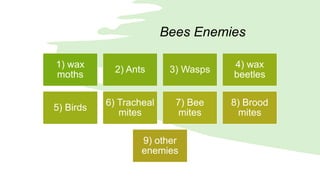
1) wax
moths
2) Ants 3) Wasps
4) wax
beetles
5) Birds
6) Tracheal
mites
7) Bee
mites
8) Brood
mites
9) other
enemies
1) Wax moths
• The greater wax moth, Galleria mellonella
L. (Galleriidae) enjoys world wide
distribution and its occurrences has been
noted from the very early days of Aristotle
(38322 B.C.). In South India it is seen
causing severe damage in the plains and
lower altitudes but it is rare in high
altitudes. It is one of the most observed
throughout the year but more common and
severe during July to October and
November to December. Combs of all the
species of Apis are freely attacked. It is
one of the most important enemies of the
bee colony causing serious damage
particularly to weak colonies where the
number of bees are not sufficient enough
to cover all the combs.
2) Ants
• The black ant, Camponotus
compressus, the-household red
ant, Dorylus
labiams and Monomorium spp. are
dangerous enemies of the bee. They
attack weak colonies and carry away the
honey, pollen and the brood. Strong
colonies are able to withstand the ants, but
in weak colonies ant attack will result in
destruction and end of the colony. By
providing ant pans around the bases of the
stand or oil bands over the stands ants can
be kept away. Underground ant nests are
eliminated by dusting of Methyl parathion
or carbaryl or pouring 0.1% chlorpyriphos
solution.
3) Wasps
• The yellow banded hornet, Vespa cincta F., is a large wasp
with a broad transverse yield band on the abdomen. It is a
social insect constructing papery nests in hollow spaces. It
waits area the entrance of the hive, catches bees as they
come out, macerates them for feeding the juice to its young. It
captures bee in the field also. By reducing the width of the
alighting board of the hive, the wasps can be prevented from
sitting near the entrance Wasp nests should be destroyed by
burning them. V. tropica vat, haemotoides B. is also known to
attack bees in India.
• The bee hunter wasp, Palarus orientalis Kohl., is black in
colour with transverse yellow lines on the abdomen. It
catches bees while they are on flight. A wasp can collect
about 20 bees a day, stings and carries them to its
underground nest and places one in each of the
compartments of the nest before laying an egg on the back of
each bee. The grub on hatching feeds on the bee.
• In hilly regions another bee hunter
wasp, Phyllanthus ramakrishnae T. attacks and carries away
bees.
4 ) Wax beetles & 5)
Birds
Wax beetles:- The tenebrionid beetle, Platybolium alvearium B., is found
in the hives under unhygienic conditions feeding on the debris and on
old combs in weak colonies. Periodical examination of empty combs
and regular cleaning of the bottom boards will control the enemy.
Birds :- King crow Dicrucus sp. and the bee cavers Merops spp. capture
bees and devour them.
6) Tracheal
mites
• The tracheal mite, Acarapis woodi, causes
Acarine disease of adults. The adult mites
infest the prothoracic tracheae i.e. the first
pair found on the thorax, and complete
their life cycle there. They feed on the
blood (haemolymph) by piercing with their
mouthparts through the tracheal walls. It
causes ‘K’ winged condition in bees, where
the wings are held at unusual angle and
bees are unable to fly. Bees are seen
crawling in front of the hive.
7) Bees mites & 8)
Brood mites
Bee mites:- Mites are microscopic and are ecto or endo
parasites of honeybees.
Brood mites :- Tropilaelaps clareaeThese mites are serious
ectoparasites on brood and adults of Apis mellifera. They attack
the brood and cause larval death. Perforations are seen on the
brood cells. The adult mites are longer than brood.
9) Other
enemies
• The 'death's head' moth, Acherontia
styx enters hive and consumes honey.
Occasionally cockroaches enter weak
colonies and impart a foul smell to the hive.
The Robber bee, the leaf cutter
bee Megachile disjuncta, dragon flies and
preying mantids capture bees and feed upon
them. Lizards, frogs toads capture bees at
hive entrances. Bears dismantle the hives
and eat upon honey, pollen, brood and the
bees. Termites damagewooden parts of the
hive; to check this the stands should be
painted with coal tar. The termite mounds
seen near the apiary-aid be destroyed by
applying 0.1% Chlorpyriphos solution into the
nests. The nymphs and adults of the
Arachnid, Ellingsenius indicus C., cling to
adult workers in hilly regions.
TNAU
Reference

Honey bees enemies and its management

  • 1.
  • 2.
    Bees Enemies 1) wax moths 2)Ants 3) Wasps 4) wax beetles 5) Birds 6) Tracheal mites 7) Bee mites 8) Brood mites 9) other enemies
  • 3.
    1) Wax moths •The greater wax moth, Galleria mellonella L. (Galleriidae) enjoys world wide distribution and its occurrences has been noted from the very early days of Aristotle (38322 B.C.). In South India it is seen causing severe damage in the plains and lower altitudes but it is rare in high altitudes. It is one of the most observed throughout the year but more common and severe during July to October and November to December. Combs of all the species of Apis are freely attacked. It is one of the most important enemies of the bee colony causing serious damage particularly to weak colonies where the number of bees are not sufficient enough to cover all the combs.
  • 4.
    2) Ants • Theblack ant, Camponotus compressus, the-household red ant, Dorylus labiams and Monomorium spp. are dangerous enemies of the bee. They attack weak colonies and carry away the honey, pollen and the brood. Strong colonies are able to withstand the ants, but in weak colonies ant attack will result in destruction and end of the colony. By providing ant pans around the bases of the stand or oil bands over the stands ants can be kept away. Underground ant nests are eliminated by dusting of Methyl parathion or carbaryl or pouring 0.1% chlorpyriphos solution.
  • 5.
    3) Wasps • Theyellow banded hornet, Vespa cincta F., is a large wasp with a broad transverse yield band on the abdomen. It is a social insect constructing papery nests in hollow spaces. It waits area the entrance of the hive, catches bees as they come out, macerates them for feeding the juice to its young. It captures bee in the field also. By reducing the width of the alighting board of the hive, the wasps can be prevented from sitting near the entrance Wasp nests should be destroyed by burning them. V. tropica vat, haemotoides B. is also known to attack bees in India. • The bee hunter wasp, Palarus orientalis Kohl., is black in colour with transverse yellow lines on the abdomen. It catches bees while they are on flight. A wasp can collect about 20 bees a day, stings and carries them to its underground nest and places one in each of the compartments of the nest before laying an egg on the back of each bee. The grub on hatching feeds on the bee. • In hilly regions another bee hunter wasp, Phyllanthus ramakrishnae T. attacks and carries away bees.
  • 6.
    4 ) Waxbeetles & 5) Birds Wax beetles:- The tenebrionid beetle, Platybolium alvearium B., is found in the hives under unhygienic conditions feeding on the debris and on old combs in weak colonies. Periodical examination of empty combs and regular cleaning of the bottom boards will control the enemy. Birds :- King crow Dicrucus sp. and the bee cavers Merops spp. capture bees and devour them.
  • 7.
    6) Tracheal mites • Thetracheal mite, Acarapis woodi, causes Acarine disease of adults. The adult mites infest the prothoracic tracheae i.e. the first pair found on the thorax, and complete their life cycle there. They feed on the blood (haemolymph) by piercing with their mouthparts through the tracheal walls. It causes ‘K’ winged condition in bees, where the wings are held at unusual angle and bees are unable to fly. Bees are seen crawling in front of the hive.
  • 8.
    7) Bees mites& 8) Brood mites Bee mites:- Mites are microscopic and are ecto or endo parasites of honeybees. Brood mites :- Tropilaelaps clareaeThese mites are serious ectoparasites on brood and adults of Apis mellifera. They attack the brood and cause larval death. Perforations are seen on the brood cells. The adult mites are longer than brood.
  • 9.
    9) Other enemies • The'death's head' moth, Acherontia styx enters hive and consumes honey. Occasionally cockroaches enter weak colonies and impart a foul smell to the hive. The Robber bee, the leaf cutter bee Megachile disjuncta, dragon flies and preying mantids capture bees and feed upon them. Lizards, frogs toads capture bees at hive entrances. Bears dismantle the hives and eat upon honey, pollen, brood and the bees. Termites damagewooden parts of the hive; to check this the stands should be painted with coal tar. The termite mounds seen near the apiary-aid be destroyed by applying 0.1% Chlorpyriphos solution into the nests. The nymphs and adults of the Arachnid, Ellingsenius indicus C., cling to adult workers in hilly regions.
  • 10.