Reversing soil erosion trends by
acting at the river basin scale
A del Valle, W Blake, C Kelly, C Bravo, A Izquierdo, F Carvajal
U. Plymouth (UK), U Austral (Chile), Foundation for Participatory
Innovation (Chile)
1
2
Project’s Theses
1. Soil is being globally lost to erosion much faster than recovered, with
deep impacts upon climate, food, water, biodiversity, health and local
economies
2. Acting at the river basin scale, with an appropriate approach, could be
highly effective to build resilience to soil erosion and to accelerate its
reversal
3. Our project is developing and pilot-testing a systemic and participatory
approach to soil erosion reversal that can make this transformation
feasible
4. We are looking for partners into an initiative to disseminate, transfer
and apply this approach in several river basins around the world
3
Thesis 1
Soil is being globally lost to erosion much faster than recovered,
with deep impacts upon climate, food, water, biodiversity,
health and local economies
 Every year 10,000,000 hectares of cropland are lost to erosion
worldwide (Pimentel 2006)
 Over the last few decades around 6.000.000 hectares of soil have
been recovered through farmer-led re-greening efforts in several
countries in Africa (Reij and Winterbottom 2015)
 What reversal speed do we need for Earth to become resilient to soil
erosion?
 How could we accelerate soil erosion reversal?
4
Thesis 2
Acting at the river basin scale, with an appropriate
approach, could be highly effective to build resilience to soil
erosion and to accelerate its reversal
 This is the scale of the concrete actors whose daily actions and
complex interactions give rise to soil erosion: farmers, technical
advisors, water and power suppliers, government agencies, etc.
 Reversing soil erosion requires transformation of such actions and
interactions, and of their cultural grounds
 The farmer’s scale is too small to consider the whole complexity
of the challenge
 The national scale is too distant and prone to abstractions to be
transformative
5
Thesis 3
Our project is developing and pilot-testing a systemic and
participatory approach to soil erosion reversal that can make
this transformation feasible
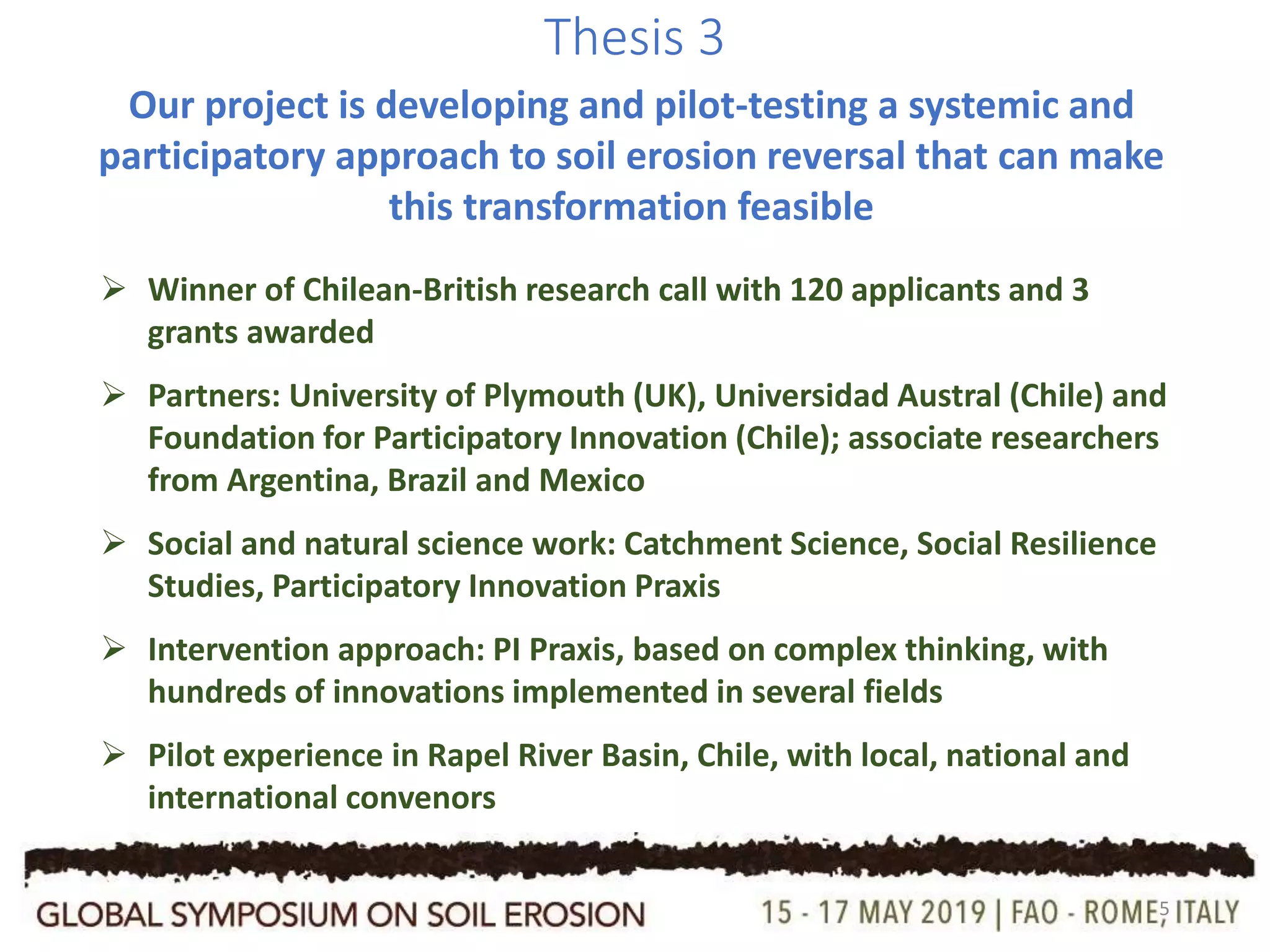
 Winner of Chilean-British research call with 120 applicants and 3
grants awarded
 Partners: University of Plymouth (UK), Universidad Austral (Chile) and
Foundation for Participatory Innovation (Chile); associate researchers
from Argentina, Brazil and Mexico
 Social and natural science work: Catchment Science, Social Resilience
Studies, Participatory Innovation Praxis
 Intervention approach: PI Praxis, based on complex thinking, with
hundreds of innovations implemented in several fields
 Pilot experience in Rapel River Basin, Chile, with local, national and
international convenors
6
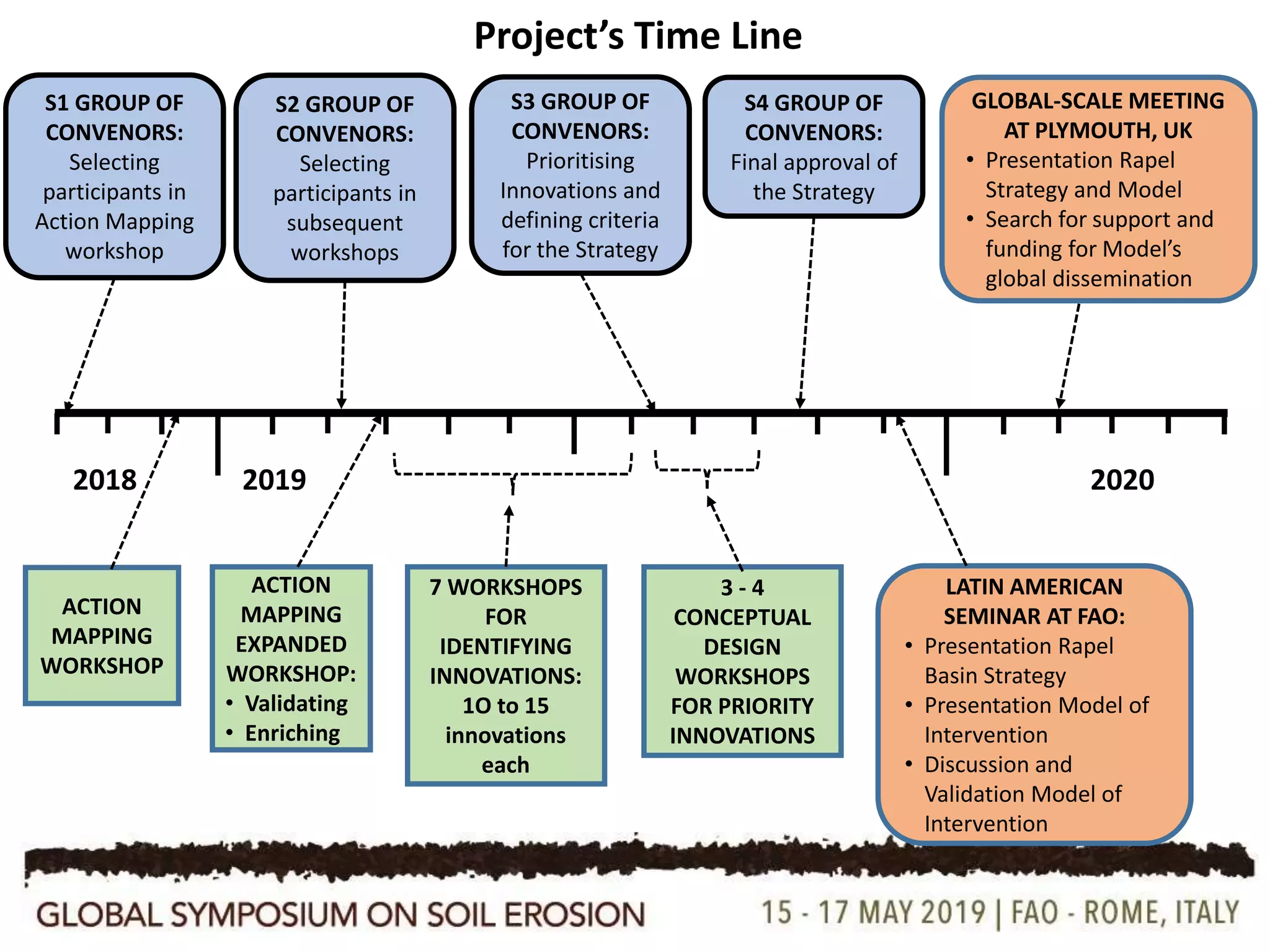
2018 2019 2020
S1 GROUP OF
CONVENORS:
Selecting
participants in
Action Mapping
workshop
S2 GROUP OF
CONVENORS:
Selecting
participants in
subsequent
workshops
S3 GROUP OF
CONVENORS:
Prioritising
Innovations and
defining criteria
for the Strategy
S4 GROUP OF
CONVENORS:
Final approval of
the Strategy
ACTION
MAPPING
WORKSHOP
ACTION
MAPPING
EXPANDED
WORKSHOP:
• Validating
• Enriching
7 WORKSHOPS
FOR
IDENTIFYING
INNOVATIONS:
1O to 15
innovations
each
3 - 4
CONCEPTUAL
DESIGN
WORKSHOPS
FOR PRIORITY
INNOVATIONS
LATIN AMERICAN
SEMINAR AT FAO:
• Presentation Rapel
Basin Strategy
• Presentation Model of
Intervention
• Discussion and
Validation Model of
Intervention
GLOBAL-SCALE MEETING
AT PLYMOUTH, UK
• Presentation Rapel
Strategy and Model
• Search for support and
funding for Model’s
global dissemination
Project’s Time Line
8
Thesis 4
We are looking for partners into an initiative to
disseminate, transfer and apply this approach in several
river basins around the world
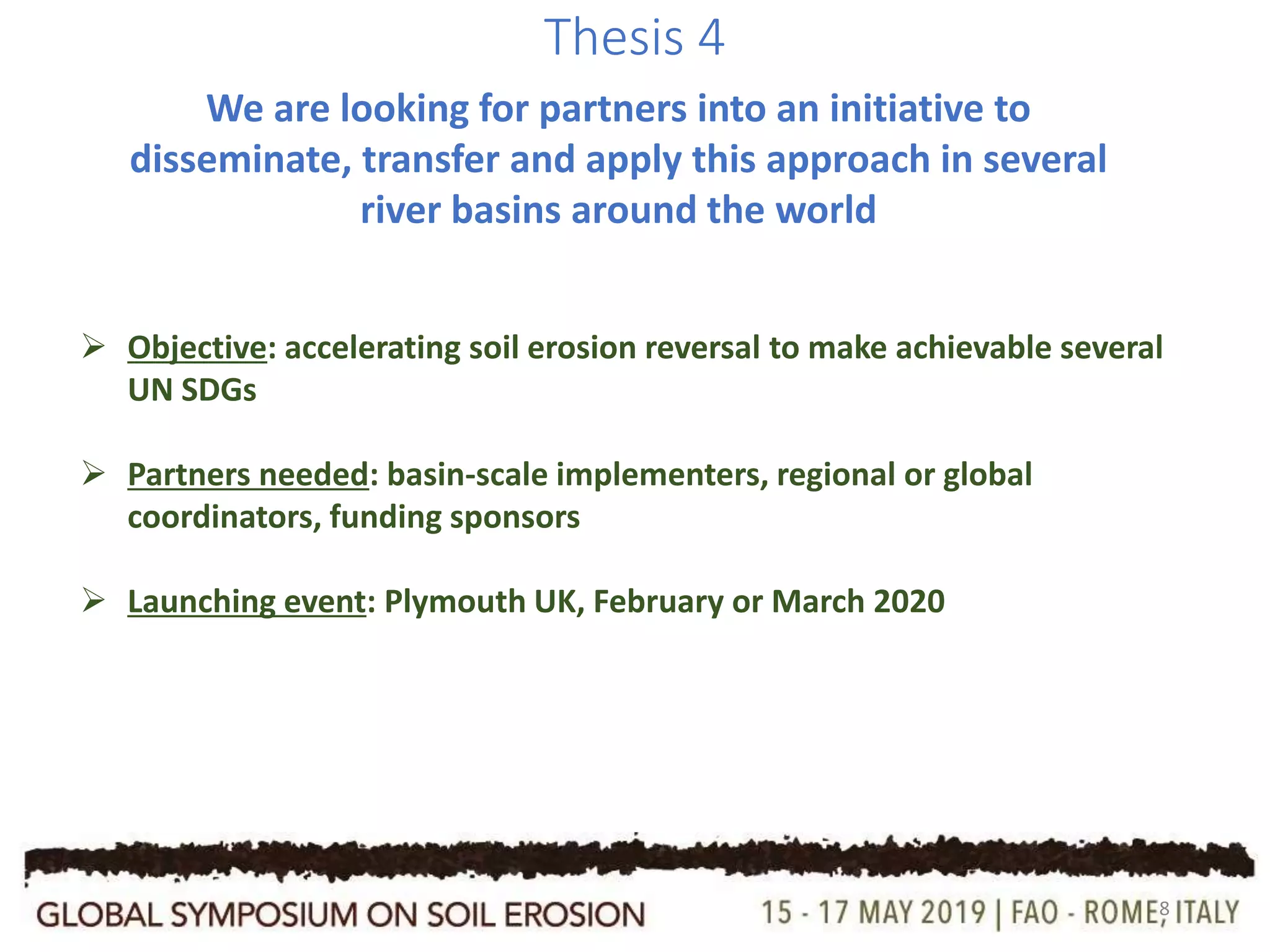
 Objective: accelerating soil erosion reversal to make achievable several
UN SDGs
 Partners needed: basin-scale implementers, regional or global
coordinators, funding sponsors
 Launching event: Plymouth UK, February or March 2020
Reversing soil erosion trends at the river basin scale: A participatory model of intervention for building resilience in developing countries

Reversing soil erosion trends at the river basin scale: A participatory model of intervention for building resilience in developing countries

  • 1.
    Reversing soil erosiontrends by acting at the river basin scale A del Valle, W Blake, C Kelly, C Bravo, A Izquierdo, F Carvajal U. Plymouth (UK), U Austral (Chile), Foundation for Participatory Innovation (Chile) 1
  • 2.
    2 Project’s Theses 1. Soilis being globally lost to erosion much faster than recovered, with deep impacts upon climate, food, water, biodiversity, health and local economies 2. Acting at the river basin scale, with an appropriate approach, could be highly effective to build resilience to soil erosion and to accelerate its reversal 3. Our project is developing and pilot-testing a systemic and participatory approach to soil erosion reversal that can make this transformation feasible 4. We are looking for partners into an initiative to disseminate, transfer and apply this approach in several river basins around the world
  • 3.
    3 Thesis 1 Soil isbeing globally lost to erosion much faster than recovered, with deep impacts upon climate, food, water, biodiversity, health and local economies  Every year 10,000,000 hectares of cropland are lost to erosion worldwide (Pimentel 2006)  Over the last few decades around 6.000.000 hectares of soil have been recovered through farmer-led re-greening efforts in several countries in Africa (Reij and Winterbottom 2015)  What reversal speed do we need for Earth to become resilient to soil erosion?  How could we accelerate soil erosion reversal?
  • 4.
    4 Thesis 2 Acting atthe river basin scale, with an appropriate approach, could be highly effective to build resilience to soil erosion and to accelerate its reversal  This is the scale of the concrete actors whose daily actions and complex interactions give rise to soil erosion: farmers, technical advisors, water and power suppliers, government agencies, etc.  Reversing soil erosion requires transformation of such actions and interactions, and of their cultural grounds  The farmer’s scale is too small to consider the whole complexity of the challenge  The national scale is too distant and prone to abstractions to be transformative
  • 5.
    5 Thesis 3 Our projectis developing and pilot-testing a systemic and participatory approach to soil erosion reversal that can make this transformation feasible  Winner of Chilean-British research call with 120 applicants and 3 grants awarded  Partners: University of Plymouth (UK), Universidad Austral (Chile) and Foundation for Participatory Innovation (Chile); associate researchers from Argentina, Brazil and Mexico  Social and natural science work: Catchment Science, Social Resilience Studies, Participatory Innovation Praxis  Intervention approach: PI Praxis, based on complex thinking, with hundreds of innovations implemented in several fields  Pilot experience in Rapel River Basin, Chile, with local, national and international convenors
  • 6.
  • 7.
    2018 2019 2020 S1GROUP OF CONVENORS: Selecting participants in Action Mapping workshop S2 GROUP OF CONVENORS: Selecting participants in subsequent workshops S3 GROUP OF CONVENORS: Prioritising Innovations and defining criteria for the Strategy S4 GROUP OF CONVENORS: Final approval of the Strategy ACTION MAPPING WORKSHOP ACTION MAPPING EXPANDED WORKSHOP: • Validating • Enriching 7 WORKSHOPS FOR IDENTIFYING INNOVATIONS: 1O to 15 innovations each 3 - 4 CONCEPTUAL DESIGN WORKSHOPS FOR PRIORITY INNOVATIONS LATIN AMERICAN SEMINAR AT FAO: • Presentation Rapel Basin Strategy • Presentation Model of Intervention • Discussion and Validation Model of Intervention GLOBAL-SCALE MEETING AT PLYMOUTH, UK • Presentation Rapel Strategy and Model • Search for support and funding for Model’s global dissemination Project’s Time Line
  • 8.
    8 Thesis 4 We arelooking for partners into an initiative to disseminate, transfer and apply this approach in several river basins around the world  Objective: accelerating soil erosion reversal to make achievable several UN SDGs  Partners needed: basin-scale implementers, regional or global coordinators, funding sponsors  Launching event: Plymouth UK, February or March 2020