REVERSE
OSMOSIS
Presented by
Imtisal Zahid
TABLE OF
CONTENTS
Introduction
RO Membrane Fabrication
Limtations
Membrane Selectivity
Membrane Modules
RO Applications
Membrane Fouling
Fouling Mitigation
INTRODUCTION
Reverse osmosis (RO) is achieved by applying a pressure in
excess of the osmotic pressure gradient to drive the water to flow
from the high solute concentration side to the low solute
concentration side.
Surface pore size (nm) = <2
Operating pressure (bar)= 10–100
Water permeability (L/m2 h/bar)= 0.5–10
Targeted contaminants = Dissolved ions, small molecules
Membrane materials = Thin-film composite polyamide, cellulose
acetate
Baker, Richard W. Membrane technology and applications. John Wiley & Sons, 2012.
INTRODUCTION
Lu, Xinglin, and Menachem Elimelech. "Fabrication of desalination membranes by interfacial polymerization: history, current
efforts, and future directions." Chemical Society Reviews 50.11 (2021): 6290-6307.
Historical timeline of the development of membrane-based desalination processes.
RO MEMBRANE FABRICATION
Wang, Yi-Ning, and Rong Wang. "Reverse osmosis membrane separation technology." Membrane separation
principles and applications. Elsevier, 2019. 1-45.
LIMITATIONS
• Cellulosic membrane are relatively low mechanical strength
• Limited ability to withstand high operating pressures and
flow rates
• Limited chemical resistance restrict their use in certain
applications (strong acid and bases)
• Noncellulosic polymer membranes operates at low flux and
difficult to remove certain ions or contaminants after fouling.
Most of the limitation resolved by replacing membranes with
Interfacial composite membranes (ICMs). These membranes
have emerged as a promising alternative to traditional
polymeric and ceramic membranes in desalination and other
separation processes due to their high selectivity, stability, and
flexibility.
Schematic of a thin-film composite (TFC)
membrane, and typical characteristics of
its layers.
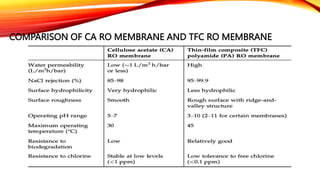
COMPARISON OF CA RO MEMBRANE AND TFC RO MEMBRANE
MEMBRANE
SELECTIVITY
Multivalent ions are retained better than monovalent ions. Although the absolute
values of the salt rejection vary over a wide range, the ranking for the different
salts is the same for all membranes.
For cations: Fe3+ > Ni2+ ≈ Cu2+ > Mg2+ > Ca2+ > Na+ > K+
For anions: PO4
3− > SO4
2− > HCO3− > Br− > Cl− > NO3− ≈ F−
Dissolved gases such as ammonia, carbon dioxide, sulfur dioxide, oxygen, chlorine
and hydrogen sulfide always permeate well.
Rejection of weak acids and bases is highly pH dependent. When the acid or base
is in the ionized form the rejection will be high, but in the nonionized form
rejection will be low.
Rejection of neutral organic solutes generally increases with the molecular weight
(or diameter) of the solute. Components with molecular weights above 100 are well
rejected by all reverse osmosis membranes.
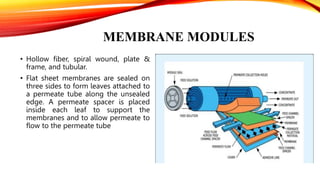
MEMBRANE MODULES
• Hollow fiber, spiral wound, plate &
frame, and tubular.
• Flat sheet membranes are sealed on
three sides to form leaves attached to
a permeate tube along the unsealed
edge. A permeate spacer is placed
inside each leaf to support the
membranes and to allow permeate to
flow to the permeate tube
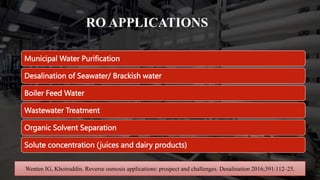
RO APPLICATIONS
Municipal Water Purification
Desalination of Seawater/ Brackish water
Boiler Feed Water
Wastewater Treatment
Organic Solvent Separation
Solute concentration (juices and dairy products)
Wenten IG, Khoiruddin. Reverse osmosis applications: prospect and challenges. Desalination 2016;391:112–25.
MEMBRANE FOULING
FOULING
MITIGATION
Jiang S, Li Y, Ladewig BP. A review of reverse osmosis membrane fouling and control strategies. Sci Total Environ
2017;595:567–83.
Properly designed RO system and operating
conditions.
Enhancing antifouling property of the membrane. To
make membrane surface smoother and more
hydrophilic through coating and grafting.
Pretreatment of feed solution
Use of chemicals during RO process to reduce free
calcium ions which is helpful in fouling control.
Physical cleaning and chemical cleaning are the
common methods used for RO membranes.
THANK YOU
Any questions?

Reverse Osmosis final.pptx

  • 1.
  • 2.
    TABLE OF CONTENTS Introduction RO MembraneFabrication Limtations Membrane Selectivity Membrane Modules RO Applications Membrane Fouling Fouling Mitigation
  • 3.
    INTRODUCTION Reverse osmosis (RO)is achieved by applying a pressure in excess of the osmotic pressure gradient to drive the water to flow from the high solute concentration side to the low solute concentration side. Surface pore size (nm) = <2 Operating pressure (bar)= 10–100 Water permeability (L/m2 h/bar)= 0.5–10 Targeted contaminants = Dissolved ions, small molecules Membrane materials = Thin-film composite polyamide, cellulose acetate Baker, Richard W. Membrane technology and applications. John Wiley & Sons, 2012.
  • 4.
    INTRODUCTION Lu, Xinglin, andMenachem Elimelech. "Fabrication of desalination membranes by interfacial polymerization: history, current efforts, and future directions." Chemical Society Reviews 50.11 (2021): 6290-6307. Historical timeline of the development of membrane-based desalination processes.
  • 5.
    RO MEMBRANE FABRICATION Wang,Yi-Ning, and Rong Wang. "Reverse osmosis membrane separation technology." Membrane separation principles and applications. Elsevier, 2019. 1-45.
  • 6.
    LIMITATIONS • Cellulosic membraneare relatively low mechanical strength • Limited ability to withstand high operating pressures and flow rates • Limited chemical resistance restrict their use in certain applications (strong acid and bases) • Noncellulosic polymer membranes operates at low flux and difficult to remove certain ions or contaminants after fouling. Most of the limitation resolved by replacing membranes with Interfacial composite membranes (ICMs). These membranes have emerged as a promising alternative to traditional polymeric and ceramic membranes in desalination and other separation processes due to their high selectivity, stability, and flexibility. Schematic of a thin-film composite (TFC) membrane, and typical characteristics of its layers.
  • 7.
    COMPARISON OF CARO MEMBRANE AND TFC RO MEMBRANE
  • 8.
    MEMBRANE SELECTIVITY Multivalent ions areretained better than monovalent ions. Although the absolute values of the salt rejection vary over a wide range, the ranking for the different salts is the same for all membranes. For cations: Fe3+ > Ni2+ ≈ Cu2+ > Mg2+ > Ca2+ > Na+ > K+ For anions: PO4 3− > SO4 2− > HCO3− > Br− > Cl− > NO3− ≈ F− Dissolved gases such as ammonia, carbon dioxide, sulfur dioxide, oxygen, chlorine and hydrogen sulfide always permeate well. Rejection of weak acids and bases is highly pH dependent. When the acid or base is in the ionized form the rejection will be high, but in the nonionized form rejection will be low. Rejection of neutral organic solutes generally increases with the molecular weight (or diameter) of the solute. Components with molecular weights above 100 are well rejected by all reverse osmosis membranes.
  • 9.
    MEMBRANE MODULES • Hollowfiber, spiral wound, plate & frame, and tubular. • Flat sheet membranes are sealed on three sides to form leaves attached to a permeate tube along the unsealed edge. A permeate spacer is placed inside each leaf to support the membranes and to allow permeate to flow to the permeate tube
  • 10.
    RO APPLICATIONS Municipal WaterPurification Desalination of Seawater/ Brackish water Boiler Feed Water Wastewater Treatment Organic Solvent Separation Solute concentration (juices and dairy products) Wenten IG, Khoiruddin. Reverse osmosis applications: prospect and challenges. Desalination 2016;391:112–25.
  • 11.
  • 12.
    FOULING MITIGATION Jiang S, LiY, Ladewig BP. A review of reverse osmosis membrane fouling and control strategies. Sci Total Environ 2017;595:567–83. Properly designed RO system and operating conditions. Enhancing antifouling property of the membrane. To make membrane surface smoother and more hydrophilic through coating and grafting. Pretreatment of feed solution Use of chemicals during RO process to reduce free calcium ions which is helpful in fouling control. Physical cleaning and chemical cleaning are the common methods used for RO membranes.
  • 13.