1
Department of Chemical Engineering
Universiti Teknologi PETRONAS (UTP).Malaysia
2
Background
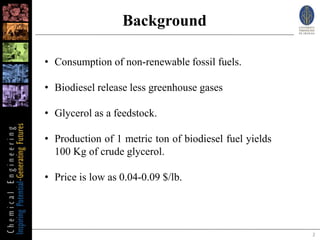
• Consumption of non-renewable fossil fuels.
• Biodiesel release less greenhouse gases
• Glycerol as a feedstock.
• Production of 1 metric ton of biodiesel fuel yields
100 Kg of crude glycerol.
• Price is low as 0.04-0.09 $/lb.
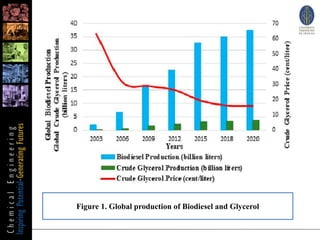
Figure 1. Global production of Biodiesel and Glycerol
4
Applications
• Cosmetic, soap and pharmaceutical industries.
• Most promising glycerol applications as a fuel/chemical
intermediates.
• Solketal is used as a fuel additives by blending with
gasoline or biodiesel.
• Improves the octane number, control the emissions and
enhance the cold flow properties.
• It is used as a plasticizer and versatile solvent in the
polymer industry.
5
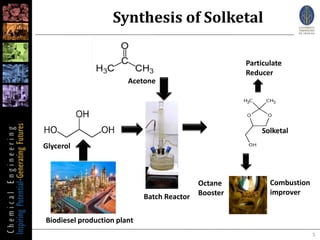
Synthesis of Solketal
Biodiesel production plant
Batch Reactor
Glycerol
Acetone
Particulate
Reducer
Solketal
Octane
Booster
Combustion
improver
6
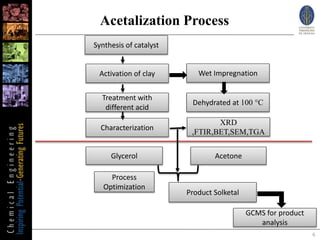
Acetalization Process
Synthesis of catalyst
Activation of clay Wet Impregnation
Characterization
XRD
,FTIR,BET,SEM,TGA
Treatment with
different acid
Dehydrated at 100 °C
Glycerol Acetone
Process
Optimization
Product Solketal
GCMS for product
analysis
7
Experimental Work
Montmorillonite clay Activated with
different acids
5 g of clay was suspended in 150 cm3 of
1–3.0 mol/dm3 H2SO4 and HCl aqueous
solutions .Catalyst is separated and
washed with distilled water
Dehydrated at 100 °C to remove moisture
Characterization of catalyst
Acid Activation of clay catalyst
8
Experimental work
• Reaction of glycerol with Acetone:
2.3 g (25 mmol) of glycerol, 5.8 g (100 mmol) of acetone
with a 1:2 ratio molar and 0.2 g of clay catalyst (Aluminium
pillared clay and montmorillonite) without solvent were
introduced into the reactor equipped with reflux condenser
and magnetic stirrer.
• Operational Conditions
Temp range : 25-60°C
Time : 30 mins
Acetone to glycerol (A/G) ratio =2/1
Catalyst loading (wt%) =1 wt.%
Fig 2: Batch
Reactor Setup
9
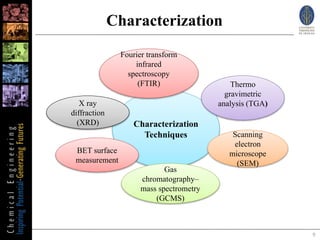
Characterization
Characterization
Techniques
X ray
diffraction
(XRD)
Thermo
gravimetric
analysis (TGA)
BET surface
measurement
Fourier transform
infrared
spectroscopy
(FTIR)
Gas
chromatography–
mass spectrometry
(GCMS)
Scanning
electron
microscope
(SEM)
10
Results and Discussions
Figure 3. Effect of reaction temperature on the
solketal yield (Reaction conditions: acetone/glycerol
molar ratio, 2:1; catalyst amount, 1 wt. %; reaction
time: 30 min; at 25°C temperature). APS (Aluminium
pillared Clay), Mk-10 (Montmorillonite), Bt
(Bentonite).
Figure 4. Effect of reaction temperature on the yield
of solketal (Reaction conditions: acetone/glycerol
molar ratio, 2:1; catalyst amount, 1 wt. %; reaction
time: 30 min; at 40°C).
Influence of Temperature on synthesis of solketal
11
Results and Discussions
Figure 5. Effect of reaction temperature on the yield of
solketal (Reaction conditions: acetone/glycerol molar ratio,
2:1; catalyst amount, 1 wt. %; reaction time: 30 min; at
50°C and 60℃).
Yield (%) =
(1)
Conversion (%) =
(2)
Yield % =
Conversion % =
• For the acetalization process, the
preferable temperature was lower than
acetone boiling point.
• Aluminum pillared clay catalyst gave the
good performance at 25°C during the
ketalization of glycerol with acetone.
• On the other hand montmorillonite reveal
highest yield at 40°C .
0
10
20
30
40
APC MK-10
solketal
yield
%
Different clay catalysts
Temp 50℃ Temp 60℃
12
Catalyst Conversion of
Glycerol %
2,2-Dimethyl-1,3-
dioxolane-4-
methanol
(5 membered
solketal) %
2,2-Dimethyl-
dioxane-5-ol
(6 membered
acetal) %
Aluminum
pillared clay
85 60 1.6
Montmorillonite 94 58 1.3
Table 1. Effect of catalyst on the yield of Solketal.
• Band 3432 cm−1 reveals axial
deformation in (-O-H) bond.
• 2986 and 2983 cm−1 refers to axial
deformation of methyl bonds (-C-
H) .
• 1456 cm−1 band showed water
angular deformation.
• band at 1372 cm−1 belongs to
ketone group methyls.
• Band 1211 cm−1 and 1046 cm−1
represents the dioxolane (five-
membered ring) -C-O bonds.
• bands 1158 cm−1 represents
solketal bonds (-C-O-C-O-C-) [6].
13
Results and Discussions
Fig 6.FTIR graph of sample product
compare with Sigma Aldrich Sample.
 Glycerol conversion with acetone in the presence of
heterogeneous catalyst to yield solketal was optimized by
varying temperature.
 In the synthesis of solketal from glycerol over Aluminum
pillared clay catalysts reveals the best performance with
60% yield and 85% conversion without solvent. However,
the solketal yield was 58% and 94% conversion with Mk-
10 catalyst at 40℃ for 30min reaction time.
 It is expected that by varying the molar ration of A/G and
catalyst loading the yield will increase in solvent free
process. Comparing it with its commercial counterpart, the
solketal developed in this work was distinguished by
obtaining very similar characteristics.
14
Conclusion
1. Vicente G, Melero JA, Morales G, Paniagua M, Martin E. Acetalization of
bio glycerol with acetone to produce solketal over sulfonic mesostructured
silicas. Green Chem 2010;12:899–907.
2. Nanda M. R, Yuan Z, Qin W, Ghaziaskar H.S, Poirier M. A, Charles Xu C.
Thermodynamic and kinetic studies of a catalytic process to convert glycerol
into solketal as an oxygenated fuel additive: Fuel 117 (2014) 470–477
3. Kowalska-Kus J , Frankowski M, Nowinska K. Solketal formation from
glycerol and acetone over hierarchical zeolites of different structure as
catalysts. Chemical 426 (2017) 205–212.
4. Menezes FDL, Guimaraes MDO, da Silva MJ. Highly selective SnCl2 –
catalyzed solketal synthesis at room temperature. Ind Eng
ChemRes2013;52:16709–13.
5. Timofeeva M. N, Panchenko V. N, Krupskaya V. N, Gil A, Vicente M. A
Effect of nitric acid modification of montmorillonite clay on synthesis of
solketal from glycerol and acetone: Catalysis Communications 90 (2017) 65–
69.
6. Rossa, V., et al., Production of Solketal Using Acid Zeolites as Catalysts, in
Glycerine Production and Transformation-An Innovative Platform for
Sustainable Biorefinery and Energy. 2019, Intech Open.
15
References
16

Biofuel additives.ppt

  • 1.
    1 Department of ChemicalEngineering Universiti Teknologi PETRONAS (UTP).Malaysia
  • 2.
    2 Background • Consumption ofnon-renewable fossil fuels. • Biodiesel release less greenhouse gases • Glycerol as a feedstock. • Production of 1 metric ton of biodiesel fuel yields 100 Kg of crude glycerol. • Price is low as 0.04-0.09 $/lb.
  • 3.
    Figure 1. Globalproduction of Biodiesel and Glycerol
  • 4.
    4 Applications • Cosmetic, soapand pharmaceutical industries. • Most promising glycerol applications as a fuel/chemical intermediates. • Solketal is used as a fuel additives by blending with gasoline or biodiesel. • Improves the octane number, control the emissions and enhance the cold flow properties. • It is used as a plasticizer and versatile solvent in the polymer industry.
  • 5.
    5 Synthesis of Solketal Biodieselproduction plant Batch Reactor Glycerol Acetone Particulate Reducer Solketal Octane Booster Combustion improver
  • 6.
    6 Acetalization Process Synthesis ofcatalyst Activation of clay Wet Impregnation Characterization XRD ,FTIR,BET,SEM,TGA Treatment with different acid Dehydrated at 100 °C Glycerol Acetone Process Optimization Product Solketal GCMS for product analysis
  • 7.
    7 Experimental Work Montmorillonite clayActivated with different acids 5 g of clay was suspended in 150 cm3 of 1–3.0 mol/dm3 H2SO4 and HCl aqueous solutions .Catalyst is separated and washed with distilled water Dehydrated at 100 °C to remove moisture Characterization of catalyst Acid Activation of clay catalyst
  • 8.
    8 Experimental work • Reactionof glycerol with Acetone: 2.3 g (25 mmol) of glycerol, 5.8 g (100 mmol) of acetone with a 1:2 ratio molar and 0.2 g of clay catalyst (Aluminium pillared clay and montmorillonite) without solvent were introduced into the reactor equipped with reflux condenser and magnetic stirrer. • Operational Conditions Temp range : 25-60°C Time : 30 mins Acetone to glycerol (A/G) ratio =2/1 Catalyst loading (wt%) =1 wt.% Fig 2: Batch Reactor Setup
  • 9.
    9 Characterization Characterization Techniques X ray diffraction (XRD) Thermo gravimetric analysis (TGA) BETsurface measurement Fourier transform infrared spectroscopy (FTIR) Gas chromatography– mass spectrometry (GCMS) Scanning electron microscope (SEM)
  • 10.
    10 Results and Discussions Figure3. Effect of reaction temperature on the solketal yield (Reaction conditions: acetone/glycerol molar ratio, 2:1; catalyst amount, 1 wt. %; reaction time: 30 min; at 25°C temperature). APS (Aluminium pillared Clay), Mk-10 (Montmorillonite), Bt (Bentonite). Figure 4. Effect of reaction temperature on the yield of solketal (Reaction conditions: acetone/glycerol molar ratio, 2:1; catalyst amount, 1 wt. %; reaction time: 30 min; at 40°C). Influence of Temperature on synthesis of solketal
  • 11.
    11 Results and Discussions Figure5. Effect of reaction temperature on the yield of solketal (Reaction conditions: acetone/glycerol molar ratio, 2:1; catalyst amount, 1 wt. %; reaction time: 30 min; at 50°C and 60℃). Yield (%) = (1) Conversion (%) = (2) Yield % = Conversion % = • For the acetalization process, the preferable temperature was lower than acetone boiling point. • Aluminum pillared clay catalyst gave the good performance at 25°C during the ketalization of glycerol with acetone. • On the other hand montmorillonite reveal highest yield at 40°C . 0 10 20 30 40 APC MK-10 solketal yield % Different clay catalysts Temp 50℃ Temp 60℃
  • 12.
    12 Catalyst Conversion of Glycerol% 2,2-Dimethyl-1,3- dioxolane-4- methanol (5 membered solketal) % 2,2-Dimethyl- dioxane-5-ol (6 membered acetal) % Aluminum pillared clay 85 60 1.6 Montmorillonite 94 58 1.3 Table 1. Effect of catalyst on the yield of Solketal.
  • 13.
    • Band 3432cm−1 reveals axial deformation in (-O-H) bond. • 2986 and 2983 cm−1 refers to axial deformation of methyl bonds (-C- H) . • 1456 cm−1 band showed water angular deformation. • band at 1372 cm−1 belongs to ketone group methyls. • Band 1211 cm−1 and 1046 cm−1 represents the dioxolane (five- membered ring) -C-O bonds. • bands 1158 cm−1 represents solketal bonds (-C-O-C-O-C-) [6]. 13 Results and Discussions Fig 6.FTIR graph of sample product compare with Sigma Aldrich Sample.
  • 14.
     Glycerol conversionwith acetone in the presence of heterogeneous catalyst to yield solketal was optimized by varying temperature.  In the synthesis of solketal from glycerol over Aluminum pillared clay catalysts reveals the best performance with 60% yield and 85% conversion without solvent. However, the solketal yield was 58% and 94% conversion with Mk- 10 catalyst at 40℃ for 30min reaction time.  It is expected that by varying the molar ration of A/G and catalyst loading the yield will increase in solvent free process. Comparing it with its commercial counterpart, the solketal developed in this work was distinguished by obtaining very similar characteristics. 14 Conclusion
  • 15.
    1. Vicente G,Melero JA, Morales G, Paniagua M, Martin E. Acetalization of bio glycerol with acetone to produce solketal over sulfonic mesostructured silicas. Green Chem 2010;12:899–907. 2. Nanda M. R, Yuan Z, Qin W, Ghaziaskar H.S, Poirier M. A, Charles Xu C. Thermodynamic and kinetic studies of a catalytic process to convert glycerol into solketal as an oxygenated fuel additive: Fuel 117 (2014) 470–477 3. Kowalska-Kus J , Frankowski M, Nowinska K. Solketal formation from glycerol and acetone over hierarchical zeolites of different structure as catalysts. Chemical 426 (2017) 205–212. 4. Menezes FDL, Guimaraes MDO, da Silva MJ. Highly selective SnCl2 – catalyzed solketal synthesis at room temperature. Ind Eng ChemRes2013;52:16709–13. 5. Timofeeva M. N, Panchenko V. N, Krupskaya V. N, Gil A, Vicente M. A Effect of nitric acid modification of montmorillonite clay on synthesis of solketal from glycerol and acetone: Catalysis Communications 90 (2017) 65– 69. 6. Rossa, V., et al., Production of Solketal Using Acid Zeolites as Catalysts, in Glycerine Production and Transformation-An Innovative Platform for Sustainable Biorefinery and Energy. 2019, Intech Open. 15 References
  • 16.