Reverse Engineering
Linux binary exploitation
"the process of analyzing a subject system to identify the system's components
and their interrelationships, and to create representations of the system in another
form or at a higher level of abstraction"
IEEE
Arcangelo Saracino
Who am I ?
Arcangelo Saracino
Third year Computer Science student, at Uniba.
Participant of cyberchallenge course.
Work experiences(Full-stack Web developer):
● Aryma
● Enterprise Digital Solutions
Cybersecurity and Linux appasionate.
Linux Day Bari 2019 speaker, on October26h
Pre-Requisites
● An Understanding of x86-64 Assembly
● Familiarity with GDB
● Familiarity with C and Python
● Familiarity with the Standard Jump to
Shellcode Exploits
● Rop (return oriented programming)
Assembly Language
An assembly language is any low-level
programming language in which there is a very
strong correspondence between the
instructions in the language and the
architecture's machine code instructions.
Assembly Language - 2
A program written in assembly language
consists of a series of mnemonic processor
instructions and meta-statements (known
variously as directives, pseudo-instructions
and pseudo-ops), comments and data.
Assembly language instructions usually
consist of an opcode mnemonic followed by a
list of data, arguments or parameters.
What is GDB?
GDB, the GNU Project debugger,
allows you to see what is going on
`inside' another program while it
executes -- or what another program
was doing at the moment it crashed.
What GDB can do ?
GDB can do four main kinds of things (plus other
things in support of these) to help you catch bugs in
the act:
● Start your program, specifying anything that might
affect its behavior.
● Make your program stop on specified conditions.
● Examine what has happened, when your program
has stopped.
● Change things in your program, so you can
experiment with correcting the effects of one bug
and go on to learn about another.
What GDB can do ? - 2
Note :
Those programs might be executing
on the same machine as GDB (native),
on another machine (remote), or on a
simulator. GDB can run on most
popular UNIX and Microsoft Windows
variants, as well as on Mac OS X.
Peda
PEDA - Python Exploit Development
Assistance for GDB
● Enhance the display of gdb: colorize
and display disassembly codes,
registers, memory information during
debugging.
● Add commands to support debugging
and exploit development
C and Python Language
Why C language is so important?
It was designed to be compiled using a relatively
straightforward compiler to provide low-level access to
memory and language constructs that map efficiently to
machine instructions, all with minimal runtime support.
Why Python in reverse engineering ?
Pwntools is the answer !
The Standard Jump to Shellcode
Exploits
You need to control EIP and you want
to jump to your shellcode.
Each technique has different
conditions and see if you can make it
work to reach your shellcode.
Src: https://www.abatchy.com/2017/05/jumping-to-
shellcode.html
Return Oriented Programming
Return-oriented programming (ROP) is
a computer security exploit technique
that allows an attacker to execute
code in the presence of security
defenses such as executable space
protection and code signing.
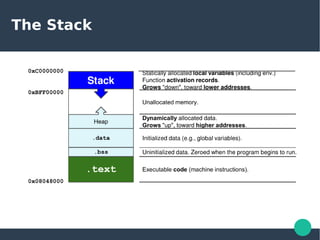
The Stack
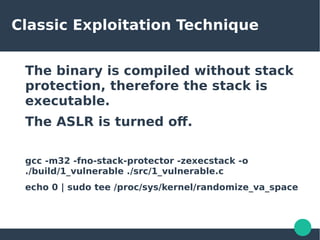
Classic Exploitation Technique
The binary is compiled without stack
protection, therefore the stack is
executable.
The ASLR is turned off.
gcc -m32 -fno-stack-protector -zexecstack -o
./build/1_vulnerable ./src/1_vulnerable.c
echo 0 | sudo tee /proc/sys/kernel/randomize_va_space
Linux Binary Protections
● ASLR
● NX
● Stack Canary
ASLR
Address Space Layout Randomization
is a memory-protection process for
operating system(OSes) that guards
against buffer-overflow attack by
randomizing the location where
system executables are loaded into
memory
NX
No Execute Bit is a technology used in
CPUs to segregate areas of memory
for use by either storage of processor
instructions or for storage of data.
In OSes the technique is known as
executable space protection, is used
to prevent certain types of malicious
software
Stack Canary
Stack Canaries are used to detect a stack
buffer overflow before execution of malicious
code can occur.
This method works by placing a small integer,
the value of which is randomly chosen at
program start, in memory just before the
stack return pointer. The canary value must
also be overwritten. This value is checked to
make sure it has not changed before a
routine uses the return pointer on the stack.
Bypass NX with Rop
Ropchain : chain made with gadgets
(chunk ) of code instruction inside
libraries, to exec syscall or call library
function.
Tools: ropgadget , ropper
Bypass ASLR/NX with Ret2PLT
PLT stands for Procedure Linkage
Table which is, put simply, used to call
external procedures/functions whose
address isn't known in the time of
linking, and is left to be resolved by
the dynamic linker at run time.
Bypass ASLR/NX with GOT
Overwrite
GOT stands for Global Offsets Table
and is similarly used to resolve
addresses.
Questions ?
Src:
● wikipedia,
● beginners.re,
● https://github.com/nnamon/linux-exploitation-course
Thank You

Linux binary Exploitation

  • 1.
    Reverse Engineering Linux binaryexploitation "the process of analyzing a subject system to identify the system's components and their interrelationships, and to create representations of the system in another form or at a higher level of abstraction" IEEE Arcangelo Saracino
  • 2.
    Who am I? Arcangelo Saracino Third year Computer Science student, at Uniba. Participant of cyberchallenge course. Work experiences(Full-stack Web developer): ● Aryma ● Enterprise Digital Solutions Cybersecurity and Linux appasionate. Linux Day Bari 2019 speaker, on October26h
  • 3.
    Pre-Requisites ● An Understandingof x86-64 Assembly ● Familiarity with GDB ● Familiarity with C and Python ● Familiarity with the Standard Jump to Shellcode Exploits ● Rop (return oriented programming)
  • 4.
    Assembly Language An assemblylanguage is any low-level programming language in which there is a very strong correspondence between the instructions in the language and the architecture's machine code instructions.
  • 5.
    Assembly Language -2 A program written in assembly language consists of a series of mnemonic processor instructions and meta-statements (known variously as directives, pseudo-instructions and pseudo-ops), comments and data. Assembly language instructions usually consist of an opcode mnemonic followed by a list of data, arguments or parameters.
  • 6.
    What is GDB? GDB,the GNU Project debugger, allows you to see what is going on `inside' another program while it executes -- or what another program was doing at the moment it crashed.
  • 7.
    What GDB cando ? GDB can do four main kinds of things (plus other things in support of these) to help you catch bugs in the act: ● Start your program, specifying anything that might affect its behavior. ● Make your program stop on specified conditions. ● Examine what has happened, when your program has stopped. ● Change things in your program, so you can experiment with correcting the effects of one bug and go on to learn about another.
  • 8.
    What GDB cando ? - 2 Note : Those programs might be executing on the same machine as GDB (native), on another machine (remote), or on a simulator. GDB can run on most popular UNIX and Microsoft Windows variants, as well as on Mac OS X.
  • 9.
    Peda PEDA - PythonExploit Development Assistance for GDB ● Enhance the display of gdb: colorize and display disassembly codes, registers, memory information during debugging. ● Add commands to support debugging and exploit development
  • 10.
    C and PythonLanguage Why C language is so important? It was designed to be compiled using a relatively straightforward compiler to provide low-level access to memory and language constructs that map efficiently to machine instructions, all with minimal runtime support. Why Python in reverse engineering ? Pwntools is the answer !
  • 11.
    The Standard Jumpto Shellcode Exploits You need to control EIP and you want to jump to your shellcode. Each technique has different conditions and see if you can make it work to reach your shellcode. Src: https://www.abatchy.com/2017/05/jumping-to- shellcode.html
  • 12.
    Return Oriented Programming Return-orientedprogramming (ROP) is a computer security exploit technique that allows an attacker to execute code in the presence of security defenses such as executable space protection and code signing.
  • 13.
  • 15.
    Classic Exploitation Technique Thebinary is compiled without stack protection, therefore the stack is executable. The ASLR is turned off. gcc -m32 -fno-stack-protector -zexecstack -o ./build/1_vulnerable ./src/1_vulnerable.c echo 0 | sudo tee /proc/sys/kernel/randomize_va_space
  • 16.
    Linux Binary Protections ●ASLR ● NX ● Stack Canary
  • 17.
    ASLR Address Space LayoutRandomization is a memory-protection process for operating system(OSes) that guards against buffer-overflow attack by randomizing the location where system executables are loaded into memory
  • 18.
    NX No Execute Bitis a technology used in CPUs to segregate areas of memory for use by either storage of processor instructions or for storage of data. In OSes the technique is known as executable space protection, is used to prevent certain types of malicious software
  • 19.
    Stack Canary Stack Canariesare used to detect a stack buffer overflow before execution of malicious code can occur. This method works by placing a small integer, the value of which is randomly chosen at program start, in memory just before the stack return pointer. The canary value must also be overwritten. This value is checked to make sure it has not changed before a routine uses the return pointer on the stack.
  • 20.
    Bypass NX withRop Ropchain : chain made with gadgets (chunk ) of code instruction inside libraries, to exec syscall or call library function. Tools: ropgadget , ropper
  • 21.
    Bypass ASLR/NX withRet2PLT PLT stands for Procedure Linkage Table which is, put simply, used to call external procedures/functions whose address isn't known in the time of linking, and is left to be resolved by the dynamic linker at run time.
  • 22.
    Bypass ASLR/NX withGOT Overwrite GOT stands for Global Offsets Table and is similarly used to resolve addresses.
  • 23.
    Questions ? Src: ● wikipedia, ●beginners.re, ● https://github.com/nnamon/linux-exploitation-course
  • 24.