Rethinking rural services Simon Berry ruralnet|uk [email_address]
Objectives To present a framework for planning the future delivery of rural services To put ICT in its place This presentation is backed by a DRAFT paper which is in your delegate pack
Rural services the status quo won't do Access to rural services continues to decline High cost of delivery Falling demand as mobility increases Access to services is crucial in tackling deprivation and social exclusion If we are serious about reducing deprivation and increasing social inclusion we need to  think differently
But we have been thinking differently . . . Joint provision of services from a single location was suggested as long ago as 1981 - 23 years ago The Rural Development Commission's report on the joint provision of services in 1998 ruralnet|uk vision also published in 1998 'Make the pub the hub' in 2001 Defra's policy work on Multi-Service Outlets (MSOs) But has it made a difference?
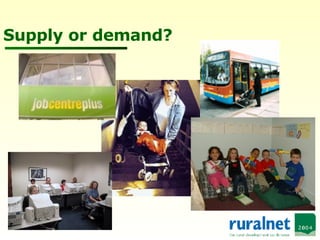
Supply or demand?
Joint provision - two powerful forces The joint provision of services also  makes sense from the consumer's point of view   The joint provision of services  saves money  for those delivering the services (the usual focus)
Joint provision - the point of no return A departmental approach  + focus on cost cutting  = the closure of single-service outlets 1 by 1 Loss of 'last outlet' = no community space =  the point of no return > interest in MSOs
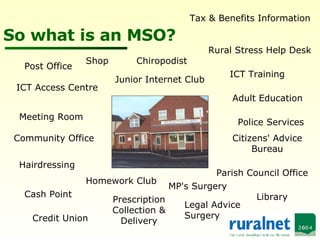
So what is an MSO? Post Office ICT Access Centre Meeting Room Community Office ICT Training Adult Education Police Services Citizens' Advice Bureau Library Legal Advice Surgery Prescription Collection & Delivery Hairdressing Credit Union Homework Club MP's Surgery Junior Internet Club Rural Stress Help Desk Chiropodist Tax & Benefits Information Parish Council Office Cash Point Shop
Is the focus on location helpful? Do we need locations at all? A focus on location is problematic a single location will not suit everyone setting up a 'super' MSO may contribute to the closure of other venues restricts our thinking Do we need locations at all? Yes, but not for all elements of all services
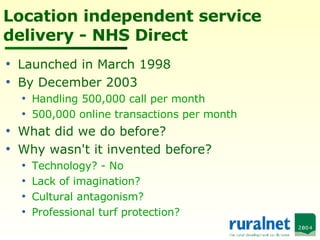
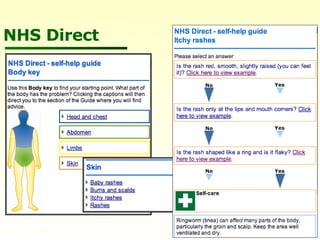
Location independent service delivery - NHS Direct Launched in March 1998 By December 2003 Handling 500,000 call per month 500,000 online transactions per month What did we do before? Why wasn't it invented before? Technology? - No Lack of imagination? Cultural antagonism? Professional turf protection?
NHS Direct - consumer focus Consumer focus . . . "It is likely that NHS Direct would have been set up a lot sooner if our primary focus had been on the effective delivery of the services that people need rather than other factors."   
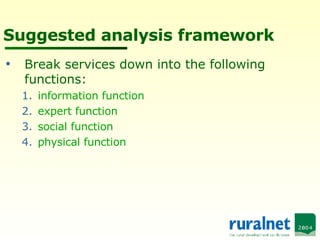
Suggested analysis framework Break services down into the following functions: information function expert function social function physical function
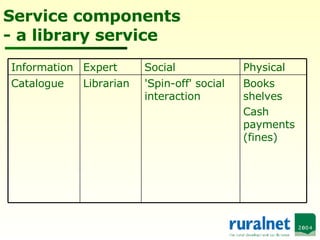
Service components - a library service Books shelves Cash payments (fines) 'Spin-off' social interaction Librarian Catalogue Physical Social Expert Information
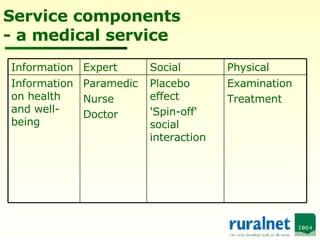
Service components - a medical service Examination Treatment Placebo effect 'Spin-off' social interaction Paramedic Nurse Doctor Information on health and well-being Physical Social Expert Information
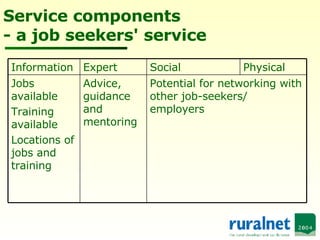
Service components - a job seekers' service Potential for networking with other job-seekers/ employers Advice, guidance and mentoring Jobs available Training available Locations of jobs and training Physical Social Expert Information
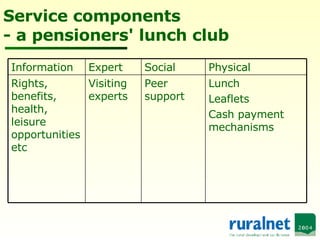
Service components - a pensioners' lunch club Lunch Leaflets  Cash payment mechanisms Peer support Visiting experts Rights, benefits, health, leisure opportunities etc Physical Social Expert Information
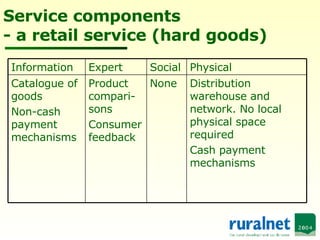
Service components - a retail service (hard goods) Distribution warehouse and network. No local physical space required Cash payment mechanisms None Product compari-sons Consumer feedback Catalogue of goods  Non-cash payment mechanisms Physical Social Expert Information
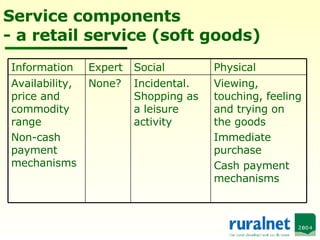
Service components - a retail service (soft goods) Viewing, touching, feeling and trying on the goods Immediate purchase Cash payment mechanisms Incidental. Shopping as a leisure activity None? Availability, price and commodity range Non-cash payment mechanisms Physical Social Expert Information
 What's the point of all this? Virtual reality? Peer to peer online forums Online dating Online expert systems Experts Online Website Email Ezines Community spaces Retail spaces Service spaces Clubs Workshops Courses Face to face meetings Editorial Adverts Leaflets Newsletters Physical Social Expert Information
Analysis before integration - why? Analysis of services before integration shows the elements of a service which: need local, physical space Note: this is a permanent not passing requirement do not require a local, physical space the telephone and ICT can be used used to deliver the non-physical elements So we know as a result of this analysis: what needs to be co-located in an MSO what can be delivered using ICT
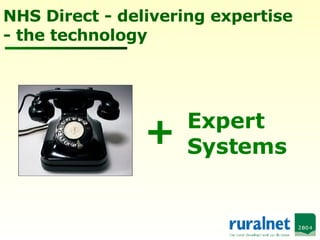
NHS Direct - delivering expertise - the technology + Expert Systems   
NHS Direct
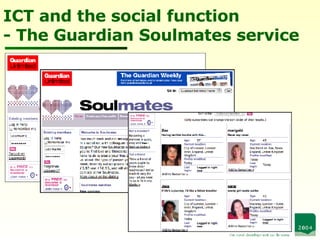
ICT and the social function - The Guardian Soulmates service
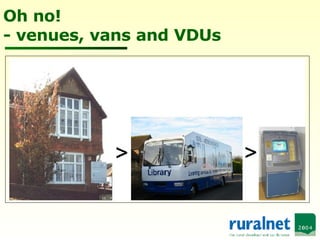
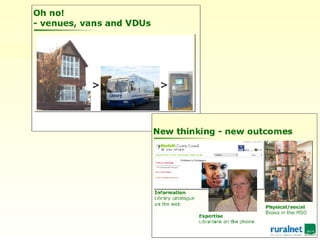
Oh no! - venues, vans and VDUs
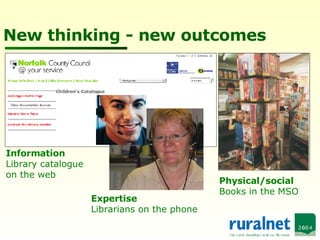
New thinking - new outcomes Information Library catalogue on the web Expertise Librarians on the phone Physical/social Books in the MSO
 
24/7 librarians announced! 5. 'Can We Help You?' - 24/7 Librarians  The next phase of the hugely popular People's Network project is a suite of online services providing a national web presence for England's public libraries. The first of these, the People's Network Online Enquiry Service, will be launched to the public in 2005. Using chat and email technology it will deliver a real-time information service by providing 'live' access to library and information professionals across the internet. Country/Regional Focus: England Themes: libraries, culture, ICT Web: http://www.mla.gov.uk/news/snippets.asp?month=10&year=2004#733 04 October 2004  © Museums, Libraries and Archives Council Item 5, xPRESS Digest, Tuesday 05/10/04
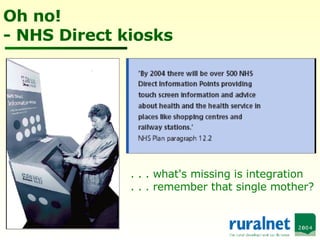
Oh no! - NHS Direct kiosks . . . what's missing is integration . . . remember that single mother?
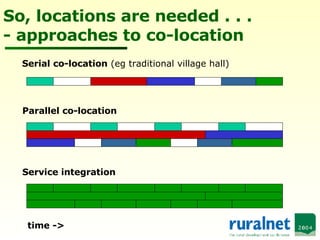
So, locations are needed . . . - approaches to co-location Serial co-location  (eg traditional village hall) Parallel co-location Service integration time ->
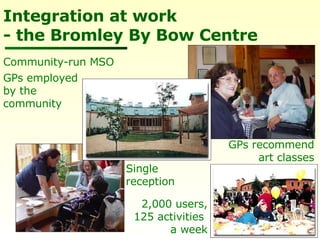
Integration at work - the Bromley By Bow Centre GPs employed by the community Community-run MSO GPs recommend art classes Single reception 2,000 users, 125 activities  a week
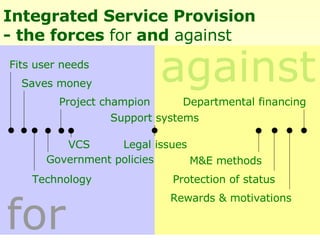
Integrated Service Provision - the forces  for  and  against against for Fits user needs Saves money Rewards & motivations Protection of status Project champion M&E methods Technology Government policies Support systems Departmental financing Legal issues VCS
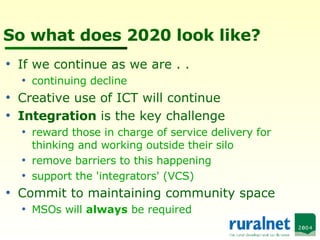
So what does 2020 look like? If we continue as we are . .  continuing decline Creative use of ICT will continue Integration  is the key challenge  reward those in charge of service delivery for thinking and working outside their silo remove barriers to this happening support the 'integrators' (VCS) Commit to maintaining community space MSOs will  always  be required
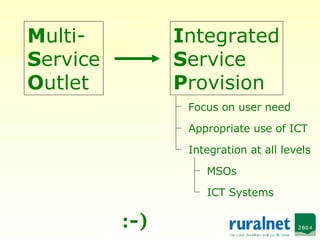
M ulti- S ervice O utlet I ntegrated S ervice P rovision Focus on user need Appropriate use of ICT Integration at all levels MSOs ICT Systems :-)
Focus on meeting the integrated needs of service users
True service integration vs co-location Starts from the integrated needs of users Doesn't focus on location and just co-locate Analyses component services first Re-engineers component services before integrating them

Rethinking Services

  • 1.
    Rethinking rural servicesSimon Berry ruralnet|uk [email_address]
  • 2.
    Objectives To presenta framework for planning the future delivery of rural services To put ICT in its place This presentation is backed by a DRAFT paper which is in your delegate pack
  • 3.
    Rural services thestatus quo won't do Access to rural services continues to decline High cost of delivery Falling demand as mobility increases Access to services is crucial in tackling deprivation and social exclusion If we are serious about reducing deprivation and increasing social inclusion we need to think differently
  • 4.
    But we havebeen thinking differently . . . Joint provision of services from a single location was suggested as long ago as 1981 - 23 years ago The Rural Development Commission's report on the joint provision of services in 1998 ruralnet|uk vision also published in 1998 'Make the pub the hub' in 2001 Defra's policy work on Multi-Service Outlets (MSOs) But has it made a difference?
  • 5.
  • 6.
    Joint provision -two powerful forces The joint provision of services also makes sense from the consumer's point of view The joint provision of services saves money for those delivering the services (the usual focus)
  • 7.
    Joint provision -the point of no return A departmental approach + focus on cost cutting = the closure of single-service outlets 1 by 1 Loss of 'last outlet' = no community space = the point of no return > interest in MSOs
  • 8.
    So what isan MSO? Post Office ICT Access Centre Meeting Room Community Office ICT Training Adult Education Police Services Citizens' Advice Bureau Library Legal Advice Surgery Prescription Collection & Delivery Hairdressing Credit Union Homework Club MP's Surgery Junior Internet Club Rural Stress Help Desk Chiropodist Tax & Benefits Information Parish Council Office Cash Point Shop
  • 9.
    Is the focuson location helpful? Do we need locations at all? A focus on location is problematic a single location will not suit everyone setting up a 'super' MSO may contribute to the closure of other venues restricts our thinking Do we need locations at all? Yes, but not for all elements of all services
  • 10.
    Location independent servicedelivery - NHS Direct Launched in March 1998 By December 2003 Handling 500,000 call per month 500,000 online transactions per month What did we do before? Why wasn't it invented before? Technology? - No Lack of imagination? Cultural antagonism? Professional turf protection?
  • 11.
    NHS Direct -consumer focus Consumer focus . . . "It is likely that NHS Direct would have been set up a lot sooner if our primary focus had been on the effective delivery of the services that people need rather than other factors."   
  • 12.
    Suggested analysis frameworkBreak services down into the following functions: information function expert function social function physical function
  • 13.
    Service components -a library service Books shelves Cash payments (fines) 'Spin-off' social interaction Librarian Catalogue Physical Social Expert Information
  • 14.
    Service components -a medical service Examination Treatment Placebo effect 'Spin-off' social interaction Paramedic Nurse Doctor Information on health and well-being Physical Social Expert Information
  • 15.
    Service components -a job seekers' service Potential for networking with other job-seekers/ employers Advice, guidance and mentoring Jobs available Training available Locations of jobs and training Physical Social Expert Information
  • 16.
    Service components -a pensioners' lunch club Lunch Leaflets Cash payment mechanisms Peer support Visiting experts Rights, benefits, health, leisure opportunities etc Physical Social Expert Information
  • 17.
    Service components -a retail service (hard goods) Distribution warehouse and network. No local physical space required Cash payment mechanisms None Product compari-sons Consumer feedback Catalogue of goods Non-cash payment mechanisms Physical Social Expert Information
  • 18.
    Service components -a retail service (soft goods) Viewing, touching, feeling and trying on the goods Immediate purchase Cash payment mechanisms Incidental. Shopping as a leisure activity None? Availability, price and commodity range Non-cash payment mechanisms Physical Social Expert Information
  • 19.
    What's thepoint of all this? Virtual reality? Peer to peer online forums Online dating Online expert systems Experts Online Website Email Ezines Community spaces Retail spaces Service spaces Clubs Workshops Courses Face to face meetings Editorial Adverts Leaflets Newsletters Physical Social Expert Information
  • 20.
    Analysis before integration- why? Analysis of services before integration shows the elements of a service which: need local, physical space Note: this is a permanent not passing requirement do not require a local, physical space the telephone and ICT can be used used to deliver the non-physical elements So we know as a result of this analysis: what needs to be co-located in an MSO what can be delivered using ICT
  • 21.
    NHS Direct -delivering expertise - the technology + Expert Systems   
  • 22.
  • 23.
    ICT and thesocial function - The Guardian Soulmates service
  • 24.
    Oh no! -venues, vans and VDUs
  • 25.
    New thinking -new outcomes Information Library catalogue on the web Expertise Librarians on the phone Physical/social Books in the MSO
  • 26.
  • 27.
    24/7 librarians announced!5. 'Can We Help You?' - 24/7 Librarians The next phase of the hugely popular People's Network project is a suite of online services providing a national web presence for England's public libraries. The first of these, the People's Network Online Enquiry Service, will be launched to the public in 2005. Using chat and email technology it will deliver a real-time information service by providing 'live' access to library and information professionals across the internet. Country/Regional Focus: England Themes: libraries, culture, ICT Web: http://www.mla.gov.uk/news/snippets.asp?month=10&year=2004#733 04 October 2004 © Museums, Libraries and Archives Council Item 5, xPRESS Digest, Tuesday 05/10/04
  • 28.
    Oh no! -NHS Direct kiosks . . . what's missing is integration . . . remember that single mother?
  • 29.
    So, locations areneeded . . . - approaches to co-location Serial co-location (eg traditional village hall) Parallel co-location Service integration time ->
  • 30.
    Integration at work- the Bromley By Bow Centre GPs employed by the community Community-run MSO GPs recommend art classes Single reception 2,000 users, 125 activities a week
  • 31.
    Integrated Service Provision- the forces for and against against for Fits user needs Saves money Rewards & motivations Protection of status Project champion M&E methods Technology Government policies Support systems Departmental financing Legal issues VCS
  • 32.
    So what does2020 look like? If we continue as we are . . continuing decline Creative use of ICT will continue Integration is the key challenge reward those in charge of service delivery for thinking and working outside their silo remove barriers to this happening support the 'integrators' (VCS) Commit to maintaining community space MSOs will always be required
  • 33.
    M ulti- Service O utlet I ntegrated S ervice P rovision Focus on user need Appropriate use of ICT Integration at all levels MSOs ICT Systems :-)
  • 34.
    Focus on meetingthe integrated needs of service users
  • 35.
    True service integrationvs co-location Starts from the integrated needs of users Doesn't focus on location and just co-locate Analyses component services first Re-engineers component services before integrating them

Editor's Notes

  • #2 This short paper builds on the booklet prepared by ruralnet|uk in October 1998 at the request of the Labour Group of Rural MPs called 'A vision for the future of rural services' (NREC 1999)*. That document was distributed widely and was also used as the basis for a workshop hosted by Peter Bradley MP in Telford which led to the establishment of a steering group which went on to support the implementation of the Waters Upton national co-location demonstration project (see Appendix 1). The objective of the present paper is to provide a framework for policy makers and service deliverers who need to review service delivery on an ongoing basis with the overall aim of achieving the more efficient and effective delivery of rural services better suited to the needs of rural people. This paper is not prescriptive but seeks to stimulate new thinking in the area of rural service delivery and helps to put ICT in its place in terms of its actual and potential role. It updates the 1998 vision and the most significant change since that time has been the increased pervasiveness of the internet and a better understanding of the impact it will have on service delivery. * This is now out of print but a PDF version is available on request