
Herbert Leitold , E-Government Innovation Center (EGIZ), Austria. SPOCS - Second generation PSCs Dinand Tinholt Programme Director SPOCS   The European e-Identity Management Conference 2010
Table of contents The EC’s digital agenda Services Directive Formal compliance but room for improvements The Services Directive today How to achieve this? Why is SPOCS important for you? The SPOCS Big Picture SPOCS draft specifications   The SPOCS methodology Extensions to STORK solution  Participate
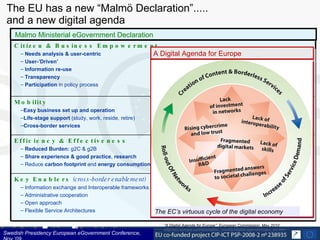
The EU has a new “Malmö Declaration”.....  and a new digital agenda Swedish Presidency European eGovernment Conference, Nov ‘09 Malmo Ministerial eGovernment Declaration The EC’s virtuous cycle of the digital economy Citizen & Business Empowerment Needs analysis &   user-centric User-’Driven’ Information re-use   Transparency Participation  in policy process  Mobility Easy business set up and operation Life-stage support  (study, work, reside, retire)  Cross-border services Efficiency & Effectiveness Reduced Burden:  g2C & g2B Share experience & good practice ,  research Reduce  carbon footprint  and  energy consumption Key Enablers   (cross-border enablement) Information exchange and Interoperable frameworks Administrative cooperation Open approach Flexible Service Architectures “ A Digital Agenda for Europe”: European Commission, May 2010 http://ec.europa.eu/information_society/digital-agenda/index_en.htm   A Digital Agenda for Europe
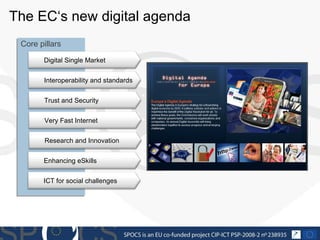
The EC‘s new digital agenda Core pillars Digital Single Market Interoperability and standards Trust and Security Very Fast Internet Research and Innovation Enhancing eSkills ICT for social challenges
About the Services Directive The implementation of the Services Directive concerns a large variety of economic activities (about 40% of EU GDP), requires important legislative changes in all Member States and the undertaking of a number of ambitious projects, such as the setting up of the "Points of Single Contact".  The three year implementation period ended on 28 December 2009. WHERE DO THINGS STAND? 20 Member States have by now adopted their horizontal legislation. There are now 12 Member States who have indicated to the Commission that they have completed their changes in sector specific legislation. A solid basis of PSCs -a so-called "first generation" of PSCs- now appears to be in place in 22  Member States. 14  appear to allow for the actual online completion of procedures, to varying degrees, while the remaining 8 PSCs seem to be limited to the provision of information. At the end of April 2010, more than 4600 authorities were registered in the IMI system to deal with issues relating to the Services Directive.
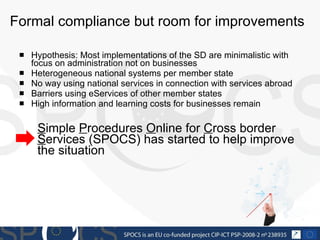
Formal compliance but room for improvements Hypothesis: Most implementations of the SD are minimalistic with focus on administration not on businesses Heterogeneous national systems per member state No way using national services in connection with services abroad Barriers using eServices of other member states High information and learning costs for businesses remain S imple  P rocedures  O nline for  C ross border  S ervices (SPOCS) has started to help improve the situation
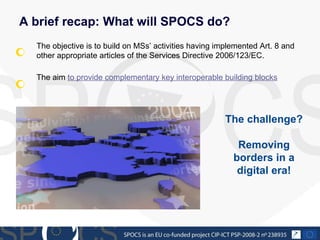
A brief recap: What will SPOCS do? The objective is to build on MSs’ activities having implemented Art. 8 and other appropriate articles of the Services Directive 2006/123/EC. The aim  to provide complementary key interoperable building blocks   The challenge?  Removing borders in a digital era!
Digital natives / governors convergence Doing business in Europe….
But that has all changed now! Or has it?
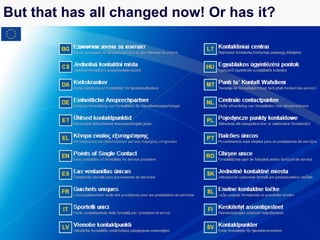
SPOCS will help realise  the Next Generation PSC!!
Where we started at….
What we aim to accomplish together…
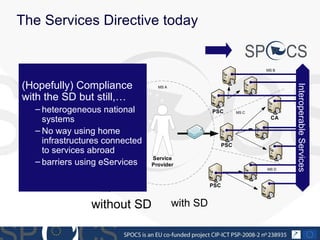
The Services Directive today without SD (Hopefully) Compliance with the SD but still,… heterogeneous national systems No way using home infrastructures connected to services abroad barriers using eServices with SD Interoperable Services
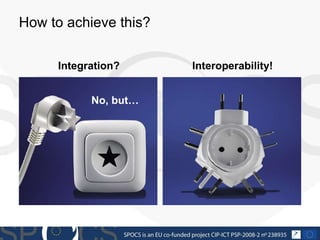
How to achieve this? Integration? Interoperability! No, but…
Why is SPOCS important for you? Cut red-tape, increase transparency for undertakings and service recipients, and streamline electronic procedures Administrative simplification and modernisation will enable you to save money and use your resources more efficiently  Improve efficiency of cross border cooperation between Member States -Foster pan EU cooperation Increase cross border activities  Less misuse/ fraud Improve usability and attractiveness of PSC’s Foster competitiveness Achieve interoperability
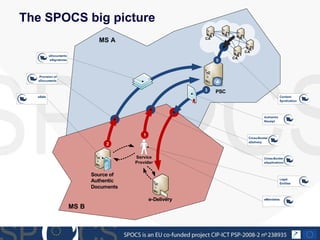
The SPOCS big picture
SPOCS draft specifications (1)  Contents syndication, multilingual issues and glossary (WP1) Deliverable D1.3 contains the technical specifications, standards and recommendations to be used for content syndication within SPOCS. It will also contain the architecture description of the SPOCS syndication modules. eDocuments (WP2) Deliverable D2.2 gives a multi-layered interoperability concept for cross-border exchange of electronic documents. Although the concept focuses on the use-cases required by the SPOCS pilot scenarios it aims to serve a multipurpose format for any kind of information exchange on the basis of electronic documents. The document container concept introduced in this specification is called Omnifarious Container for e-Documents (OCD). Interoperable delivery, eSafe, secure and interoperable exchanges and acknowledgement of receipt  (WP3) Deliverable D3.2 describes specifications for the interoperability layer to connect existing eDelivery and eSafe solutions based on a common eSecuriity architecture. Based on the specifications open modules will be developed.
SPOCS draft specifications (2)  Interoperable eService Directories (WP4) Deliverable D4.3 describes specifications for the access to eService directories and the exchange of information about eServices. It also includes an architectural approach for the SPOCS interoperability level regarding eService directories. Based on the specifications the guidelines and governance schemes as well as the open modules will be developed. Experimenting  with Professions  (WP5) Deliverable D5.2 includes the SPOCS reference process model, the functional requirements for the WP1, WP2, WP3, WP4, the specific piloting country functional requirements as well as the material collected for the specific piloting profession(s) per piloting country that is the followed process, the templates of the required documents, the application and the permission.
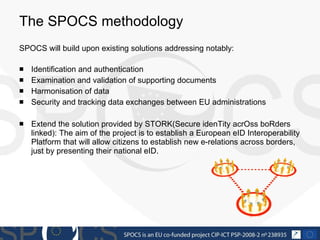
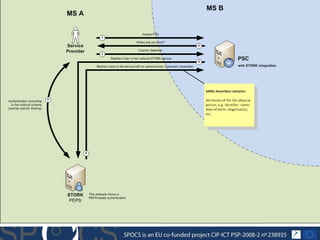
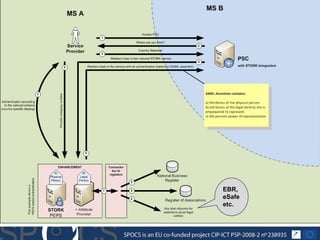
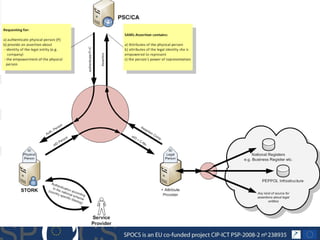
The SPOCS methodology SPOCS will build upon existing solutions addressing notably: Identification and authentication Examination and validation of supporting documents Harmonisation of data  Security and tracking data exchanges between EU administrations Extend the solution provided by STORK (Secure idenTity acrOss boRders linked): The aim of the project is to establish a European eID Interoperability Platform that will allow citizens to establish new e-relations across borders, just by presenting their national eID.
 
EBR, eSafe etc.
 
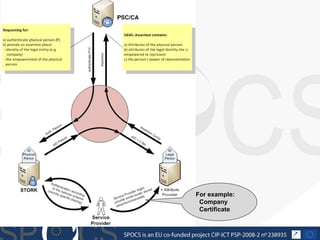
For example:  Company    Certificate
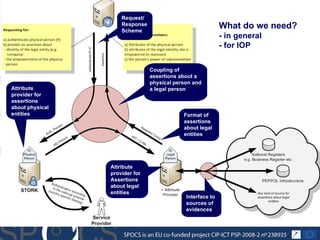
What do we need? - in general - for IOP Coupling of assertions about a physical person and a legal person Format of assertions about legal entities Attribute provider for Assertions about legal entities Interface to sources of evidences Attribute provider for assertions about physical entities Request/Response Scheme
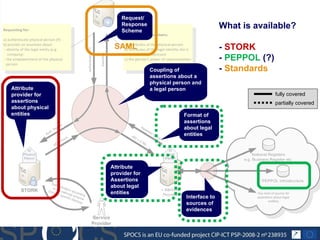
Coupling of assertions about a physical person and a legal person Format of assertions about legal entities Attribute provider for Assertions about legal entities Interface to sources of evidences Attribute provider for assertions about physical entities Request/Response Scheme What is available? -  STORK -  PEPPOL  (?) -  Standards SAML partially covered fully covered
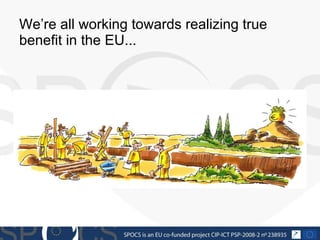
We’re all working towards realizing true benefit in the EU...
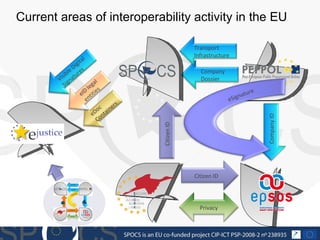
Current areas of interoperability activity in the EU Company  Dossier Citizen ID Citizen ID Company ID eSignature Privacy Visible Digital Signatures eDoc Containers Transport Infrastructure eID legal entities
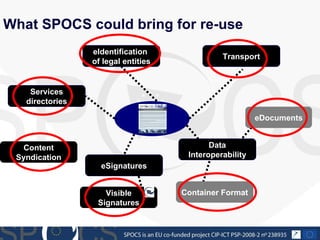
What SPOCS could bring for re-use eSignatures Container Format eIdentification  of legal entities Visible Signatures Data Interoperability eDocuments Transport Services directories Content Syndication
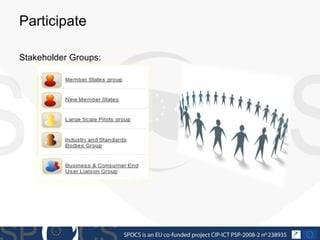
Participate  Stakeholder Groups:
Further information visit our website www.eu-spocs.eu [email_address] Twitter: @tinholt

Using eID for business startup in Europe

  • 1.
    Herbert Leitold ,E-Government Innovation Center (EGIZ), Austria. SPOCS - Second generation PSCs Dinand Tinholt Programme Director SPOCS The European e-Identity Management Conference 2010
  • 2.
    Table of contentsThe EC’s digital agenda Services Directive Formal compliance but room for improvements The Services Directive today How to achieve this? Why is SPOCS important for you? The SPOCS Big Picture SPOCS draft specifications The SPOCS methodology Extensions to STORK solution Participate
  • 3.
    The EU hasa new “Malmö Declaration”..... and a new digital agenda Swedish Presidency European eGovernment Conference, Nov ‘09 Malmo Ministerial eGovernment Declaration The EC’s virtuous cycle of the digital economy Citizen & Business Empowerment Needs analysis & user-centric User-’Driven’ Information re-use Transparency Participation in policy process Mobility Easy business set up and operation Life-stage support (study, work, reside, retire) Cross-border services Efficiency & Effectiveness Reduced Burden: g2C & g2B Share experience & good practice , research Reduce carbon footprint and energy consumption Key Enablers (cross-border enablement) Information exchange and Interoperable frameworks Administrative cooperation Open approach Flexible Service Architectures “ A Digital Agenda for Europe”: European Commission, May 2010 http://ec.europa.eu/information_society/digital-agenda/index_en.htm A Digital Agenda for Europe
  • 4.
    The EC‘s newdigital agenda Core pillars Digital Single Market Interoperability and standards Trust and Security Very Fast Internet Research and Innovation Enhancing eSkills ICT for social challenges
  • 5.
    About the ServicesDirective The implementation of the Services Directive concerns a large variety of economic activities (about 40% of EU GDP), requires important legislative changes in all Member States and the undertaking of a number of ambitious projects, such as the setting up of the "Points of Single Contact". The three year implementation period ended on 28 December 2009. WHERE DO THINGS STAND? 20 Member States have by now adopted their horizontal legislation. There are now 12 Member States who have indicated to the Commission that they have completed their changes in sector specific legislation. A solid basis of PSCs -a so-called "first generation" of PSCs- now appears to be in place in 22 Member States. 14 appear to allow for the actual online completion of procedures, to varying degrees, while the remaining 8 PSCs seem to be limited to the provision of information. At the end of April 2010, more than 4600 authorities were registered in the IMI system to deal with issues relating to the Services Directive.
  • 6.
    Formal compliance butroom for improvements Hypothesis: Most implementations of the SD are minimalistic with focus on administration not on businesses Heterogeneous national systems per member state No way using national services in connection with services abroad Barriers using eServices of other member states High information and learning costs for businesses remain S imple P rocedures O nline for C ross border S ervices (SPOCS) has started to help improve the situation
  • 7.
    A brief recap:What will SPOCS do? The objective is to build on MSs’ activities having implemented Art. 8 and other appropriate articles of the Services Directive 2006/123/EC. The aim to provide complementary key interoperable building blocks The challenge? Removing borders in a digital era!
  • 8.
    Digital natives /governors convergence Doing business in Europe….
  • 9.
    But that hasall changed now! Or has it?
  • 10.
    SPOCS will helprealise the Next Generation PSC!!
  • 11.
  • 12.
    What we aimto accomplish together…
  • 13.
    The Services Directivetoday without SD (Hopefully) Compliance with the SD but still,… heterogeneous national systems No way using home infrastructures connected to services abroad barriers using eServices with SD Interoperable Services
  • 14.
    How to achievethis? Integration? Interoperability! No, but…
  • 15.
    Why is SPOCSimportant for you? Cut red-tape, increase transparency for undertakings and service recipients, and streamline electronic procedures Administrative simplification and modernisation will enable you to save money and use your resources more efficiently Improve efficiency of cross border cooperation between Member States -Foster pan EU cooperation Increase cross border activities Less misuse/ fraud Improve usability and attractiveness of PSC’s Foster competitiveness Achieve interoperability
  • 16.
  • 17.
    SPOCS draft specifications(1) Contents syndication, multilingual issues and glossary (WP1) Deliverable D1.3 contains the technical specifications, standards and recommendations to be used for content syndication within SPOCS. It will also contain the architecture description of the SPOCS syndication modules. eDocuments (WP2) Deliverable D2.2 gives a multi-layered interoperability concept for cross-border exchange of electronic documents. Although the concept focuses on the use-cases required by the SPOCS pilot scenarios it aims to serve a multipurpose format for any kind of information exchange on the basis of electronic documents. The document container concept introduced in this specification is called Omnifarious Container for e-Documents (OCD). Interoperable delivery, eSafe, secure and interoperable exchanges and acknowledgement of receipt (WP3) Deliverable D3.2 describes specifications for the interoperability layer to connect existing eDelivery and eSafe solutions based on a common eSecuriity architecture. Based on the specifications open modules will be developed.
  • 18.
    SPOCS draft specifications(2) Interoperable eService Directories (WP4) Deliverable D4.3 describes specifications for the access to eService directories and the exchange of information about eServices. It also includes an architectural approach for the SPOCS interoperability level regarding eService directories. Based on the specifications the guidelines and governance schemes as well as the open modules will be developed. Experimenting with Professions (WP5) Deliverable D5.2 includes the SPOCS reference process model, the functional requirements for the WP1, WP2, WP3, WP4, the specific piloting country functional requirements as well as the material collected for the specific piloting profession(s) per piloting country that is the followed process, the templates of the required documents, the application and the permission.
  • 19.
    The SPOCS methodologySPOCS will build upon existing solutions addressing notably: Identification and authentication Examination and validation of supporting documents Harmonisation of data Security and tracking data exchanges between EU administrations Extend the solution provided by STORK (Secure idenTity acrOss boRders linked): The aim of the project is to establish a European eID Interoperability Platform that will allow citizens to establish new e-relations across borders, just by presenting their national eID.
  • 20.
  • 21.
  • 22.
  • 23.
    For example: Company Certificate
  • 24.
    What do weneed? - in general - for IOP Coupling of assertions about a physical person and a legal person Format of assertions about legal entities Attribute provider for Assertions about legal entities Interface to sources of evidences Attribute provider for assertions about physical entities Request/Response Scheme
  • 25.
    Coupling of assertionsabout a physical person and a legal person Format of assertions about legal entities Attribute provider for Assertions about legal entities Interface to sources of evidences Attribute provider for assertions about physical entities Request/Response Scheme What is available? - STORK - PEPPOL (?) - Standards SAML partially covered fully covered
  • 26.
    We’re all workingtowards realizing true benefit in the EU...
  • 27.
    Current areas ofinteroperability activity in the EU Company Dossier Citizen ID Citizen ID Company ID eSignature Privacy Visible Digital Signatures eDoc Containers Transport Infrastructure eID legal entities
  • 28.
    What SPOCS couldbring for re-use eSignatures Container Format eIdentification of legal entities Visible Signatures Data Interoperability eDocuments Transport Services directories Content Syndication
  • 29.
  • 30.
    Further information visitour website www.eu-spocs.eu [email_address] Twitter: @tinholt

Editor's Notes

  • #3 http://register.consilium.europa.eu/pdf/en/10/st09/st09475.en10.pdf
  • #4 Copyright © 2009 Capgemini. All rights reserved.
  • #6 http://register.consilium.europa.eu/pdf/en/10/st09/st09475.en10.pdf
  • #9 © 2006 Capgemini - All rights reserved
  • #31 Copyright © 2009 Capgemini. All rights reserved.