RETENTION IN
MAXILLO FACIAL
PROSTHESIS
INDIAN DENTAL ACADEMY
Leader in continuing Dental Education
RETENTION IN MFP
Intra oral prosthesis: Anatomic retention
Mechanical retention
Extra oral prosthesis: Anatomic retention
Mechanical retention
INTRODUCTION
RETENTION IN MFP
ANATOMIC MECHANICAL ADHESIVES IMPLANTS OCCLUSI
ON
ANATOMIC RETENTION
 Residual maxillary retention
Teeth
Alveolar ridge
 Within the defect retention
 Residual hard palate
 Residual soft palate
Anterior nasal aperture
Lateral scar band
Floor of the orbit
Lateral Pterygoid plate
Nasal septum
Residual maxilla retention:
Teeth:
Alveolar ridge:
• Utilization of the
physical properties
• Ridge size and shape
• The palatal contour
• premaxillary segment
or the tuberosity
Within-the-defect retention:
 Large defects contribute intrinsically to the
retention of the obturator prosthesis
 There are intrinsic areas within and around the
defect that can provide retention
The residual soft palate
The residual hard palate
The anterior nasal aperture
The lateral scar band
Residual soft palate:
Extension of the obturator prosthesis on to the
nasopharyngeal side of the soft palate will
provide retention.
Residual hard palate:
 Depending on the of the line of palatal
resection
 Undercut along this line into the nasal or
paranasal cavity.
 Engagement of the medial wall of the defect
can increase retention.
Anterior nasal aperture:
This can be entered unilaterally or bilaterally.
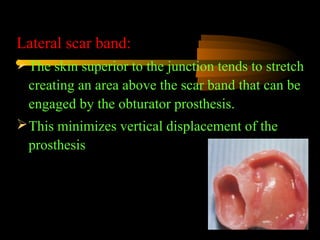
Lateral scar band:
The skin superior to the junction tends to stretch
creating an area above the scar band that can be
engaged by the obturator prosthesis.
This minimizes vertical displacement of the
prosthesis
Retention is like a castle held together by proper
Support and Stability.if any one fails the whole
castle comes crumbling down….
SUPPORT
It is the resistance to movement of a
prosthesis toward the tissue.
The support available from the
residual maxilla and
from within the defect
Within-the- defect support:
 Positive support within the defect to
prevent rotation of the prosthesis into it
must be considered.
This support can be achieved by contact of
the prosthesis with any anatomic structure
that provides a firm base.
the floor of the orbit,
the bony structures of the Pterygoid plate,
the anterior surface of the temporal bone
The nasal septum
STABILITY
 It is the resistance to prosthesis
displacement by functional forces.
Residual maxilla stability:
If natural teeth remain, the bracing
components of the prosthesis framework
can be used to minimize movement in all 3
directions.
In edentulous patients, maximal extension
into the mucobuccal fold
Within-the defect stability:
 Maximal extension of the prosthesis in all lateral
directions must be provided.
 Maximum contact possible with the medial line of
resection, the anterior and lateral walls of the defect,
the pterygoid plates, and the residual softpalate must be
established.
Occlusion:
 The most important aspect of stability is
occlusion.
Maximal distribution of the occlusal force in
centric and eccentric jaw positions is imperative
to minimize the movement of the prosthesis and
the resultant forces to individual structures.
The patient with an acquired maxillary defect
should not masticate over the defect.
MECHANICAL RETENTION
Under this category, the operator has a
myriad of devices and proven techniques to
consider or use as the case demands.
TEMPORARY PERMANENT
Temporary mechanical retention:
ORTHODONTIC BANDS AND
PREWELDED BRACKETS TO
RETAIN TEMPORARY
PROSTHESIS
PERMANENT MECHANICAL
RETENTION
Cast clasps:
 Most common method for retaining a
prosthesis is using a cast metal clasp which
enters a undercut.
Properly designed clasp will provide
stability, splinting, bilateral bracing, and
reciprocation, as well as retention.
CAST CIRCUMFERENTIAL
CLASP
WROUGHT-CAST COMBINATION
AKERS CLASP
CAST ROACH-AKERS
COMBINATION CLASP
MANDIBULAR MOLAR RING
CLASP
PRECISION ATTACHMENTS
These prefabricated attachments can be
placed into cast crowns for the best in
esthetic and mechanical retention.
SEMIPRECISION ATTACHMENTS,
CUSTOM MADE
This attachment is formed in the wax
pattern, using a specially shaped mandrel
mounted on the parallelometer.
SNAP-ON ATTACHMENT
It is a preformed precious- metal precision piece
designed to retain and to stabilize a
prosthesis.
A Baker bar or Anderson bar is the rod
connecting two abutment crowns, and the clip
engages this rod.
BAKER SNAP-ON
ATTACHMENTS SOLDERED
TO THE CAST FRAMEWORK
CROSS-ARCH
SPLINTING USING
11-GAUGE BAR
SNAP-ON ATTACHMENT
MAGNETS
Magnets have been
used since 1950
1970 rare earth magnets
were used clinically
for denture retention.
Magnetic systems used in dentistry
Closed Field Systems
• Soft magnetic
material is cemented
to the root and a
closed field magnet
is set into the denture
base
MAGNETS
BAR ENGAGED IMPLANT FIXTURE
TO PREVENT ROTATION OF BAR
AND LOOSENING OF SCREW
POSTERIOR SURFACE
OF NASAL PROSTHESIS.
NOTE: MAGNETIC
ATTACHMENTS
BAR ENGAGING
PROSTHESIS
PROSTHESIS IN
POSITION
Advantage of magnets
 Have no moving parts to fatigue and break
 Are self seating
 require no paralleling
 Transmit no damaging lateral forces to
compromised abutments.
Disadvantages of magnets:
Possibility of corrosion if the capsule leaks
or wears through
GATE TYPE OR SWING LOCK
DEVICE
This retentive aid
helps gain partial
retention for many
loose or
periodontally
involved teeth.
AUXILIARY RETENTIVE
DEVICES
Buccal-lingual continuous clasp,
Guide planes,
Screws: they are specially made custom parts.
Suction cups: Inflatable balloon suction cups are
used for maxillary retention.
Spectacle retained
ADHESIVES-Intra oral
They enhance retention through optimizing interfacial
force by
(1) Increasing adhesive and cohesive properties and
viscocity of the medium lying between the denture and
its basal seal.
(2) Eliminating void between the tissue surface of the
prosthesis and the area on which it rests.
 Pastes
 Liquid emulsions
 Spray on
 Double sided tape
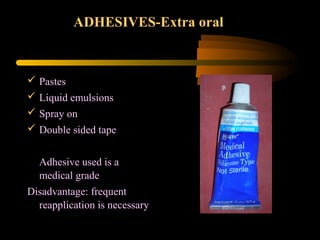
Adhesive used is a
medical grade
Disadvantage: frequent
reapplication is necessary
ADHESIVES-Extra oral
PROSTHESIS RETAINED
WITH SKIN ADHESIVE
TISSUE CONDITIONERS
They can increase retention of the prosthesis
by engaging undercuts, which normally are
difficult to cover.
Relining is necessary
IMPLANTS
The retention provided by the implants makes it
possible to fabricate large prosthesis that rests
on movable tissues.
Patient acceptance is significantly enhanced
Help to fabricate thin margins in silicone which
blend and move more effectively with the
mobile peripheral tissues.
CT SCAN USED TO
LOCATE POSSIBLE
IMPLANT SITES
STEREOLITHOGRAPHICALLY
FABRICATED 3-D MODEL
USED TO ASSESS IMPLANT
SITES
• Skin and soft tissues overlying the proposed
implant sites require careful examination.
• The health of the soft tissues circumscribing
the implants are easier to maintain if these
tissues are thin (less than 5mm) and
attached to the underlying periosteum.
SURGICAL PLACEMENT
• Craniofacial implant fixtures are fabricated from
pure titanium.
• Available in 3 or 5mm lengths and
5mm diameter flange.
• 2- stage surgical procedure, is employed.
AURICULAR
DEFECT
WAX SCULPTING
FITTED TO IDENTIFY
PROPER IMPLANT
PLACEMENT
SURGICAL
TEMPLATE
FLAP
REFLECTED
TEMPLATE USED TO LOCATE
PROPER IMPLANT POSITIONS
MASTOID EXPOSED
AND SITES
PREPARED FOR 3
IMPLANTS
IMPLANT
FIXTURES PLACED
INTO PREPARED
SITES
WOUND CLOSED I
N 3 LAYERS
Second surgical stage
• Second surgical stage is performed 3 to 4
months after the first stage.
IMPLANTS BEING
EXPOSED
TISSUES FLAP IS
THINNED AND
PERFORATED OVER
IMPLANT SITES
ABUTMENT
CYLINDERS
ATTACHED
HEALING CAPS
SECURED
PRESSURE DRESSING
APPLIED
ONE WEEK LATER,
PRESSURE DRESSING
REMOVED
SITES HEALED 4 WEEK
FOLLOWING
EXPOSURE
SILICONE TEMPLATE FABRICATED AS AN AID TO
FABRICATE RETENTION BAR
FIT OF BAR IS VERIFIED ON PATIENT
ACRYLIC RESIN
SUBSTRUCTURE TO BE
EMBEDDED WITHIN SILICONE
PROSTHESIS
PLASTIC SUBSTRUCTURE
CONTAINS RETENTIVE
ELEMENTS
OSSEOINTEGRATED IMPLANTS WERE REQUIRED
TO RETAIN THIS LARGE ORBITAL PROSTHESIS
THESE IMPLANTS EXIT
THROUGH MOBILE LIP TISSUES,
INCREASING RISK OF
PERIIMPLANTITIS
THESE IMPLANTS ARE
POSITIONED TOO FAR
POSTERIORLY, MAKING
ACCESS FOR HYGIENE
DIFFICULT
BAR-CLIP DESIGN
BARS WITH VERTICAL AND HORIZONTAL
COMPONENTS
POSTERIOR SURFACE OF
NASAL PROSTHESIS. CLIPS
ARE EMBEDDED IN
ACRYLIC RESIN
SUBSTRUCTURE WITHIN
PROSTHESIS
BAR ENGAGING
PROSTHESIS
COMPLETED PROSTHESIS IN
POSITION
Conclusion….
References
1 1.Sudarat kiat-annuay,Lawrence Gettlemanet et al.
Effect of adhesive retention of maxillofacial
prostheses.J Prosthet Dent 2001;85:438-41
2. Mark A.Pigno and Jeff J.Funk. Augmentation
of obturator retention by extention into the nasal
aperture.J Prosthet Dent 2001;85;349-51
3. James C.Lemon,Jack W.Martin. Technique for
magnet replacement in silicone facial prostheses.J
Prosthet Dent 1995;73:166-8
• 4. Ikuya watanabe,yasuhiroTanaka et al.
Application of cast magnetic attachments to
sectional complete dentures for patient with
microstomia. J Prosthet Dent2002;88:573-77
• 5. Jafferey E.Rubenstein. Attachments used for
implant supported facial prostheses. J Prosthet
Dent 1995;73:262-6
• 6. Yuki Kokubo and Shunji Fukushima.
Magnetic attachments for esthetic management of
an overdenture. J Prosthet Dent 2002;88:354-5
Thank you….

Retention mfp/dental courses

  • 1.
    RETENTION IN MAXILLO FACIAL PROSTHESIS INDIANDENTAL ACADEMY Leader in continuing Dental Education
  • 2.
    RETENTION IN MFP Intraoral prosthesis: Anatomic retention Mechanical retention Extra oral prosthesis: Anatomic retention Mechanical retention INTRODUCTION
  • 3.
    RETENTION IN MFP ANATOMICMECHANICAL ADHESIVES IMPLANTS OCCLUSI ON
  • 4.
    ANATOMIC RETENTION  Residualmaxillary retention Teeth Alveolar ridge  Within the defect retention  Residual hard palate  Residual soft palate
  • 5.
    Anterior nasal aperture Lateralscar band Floor of the orbit Lateral Pterygoid plate Nasal septum
  • 6.
    Residual maxilla retention: Teeth: Alveolarridge: • Utilization of the physical properties • Ridge size and shape • The palatal contour • premaxillary segment or the tuberosity
  • 7.
    Within-the-defect retention:  Largedefects contribute intrinsically to the retention of the obturator prosthesis
  • 8.
     There areintrinsic areas within and around the defect that can provide retention The residual soft palate The residual hard palate The anterior nasal aperture The lateral scar band
  • 9.
    Residual soft palate: Extensionof the obturator prosthesis on to the nasopharyngeal side of the soft palate will provide retention.
  • 10.
    Residual hard palate: Depending on the of the line of palatal resection  Undercut along this line into the nasal or paranasal cavity.  Engagement of the medial wall of the defect can increase retention.
  • 11.
    Anterior nasal aperture: Thiscan be entered unilaterally or bilaterally.
  • 12.
    Lateral scar band: Theskin superior to the junction tends to stretch creating an area above the scar band that can be engaged by the obturator prosthesis. This minimizes vertical displacement of the prosthesis
  • 13.
    Retention is likea castle held together by proper Support and Stability.if any one fails the whole castle comes crumbling down….
  • 14.
    SUPPORT It is theresistance to movement of a prosthesis toward the tissue. The support available from the residual maxilla and from within the defect
  • 16.
    Within-the- defect support: Positive support within the defect to prevent rotation of the prosthesis into it must be considered. This support can be achieved by contact of the prosthesis with any anatomic structure that provides a firm base.
  • 17.
    the floor ofthe orbit, the bony structures of the Pterygoid plate, the anterior surface of the temporal bone The nasal septum
  • 18.
    STABILITY  It isthe resistance to prosthesis displacement by functional forces.
  • 19.
    Residual maxilla stability: Ifnatural teeth remain, the bracing components of the prosthesis framework can be used to minimize movement in all 3 directions. In edentulous patients, maximal extension into the mucobuccal fold
  • 20.
    Within-the defect stability: Maximal extension of the prosthesis in all lateral directions must be provided.  Maximum contact possible with the medial line of resection, the anterior and lateral walls of the defect, the pterygoid plates, and the residual softpalate must be established.
  • 21.
    Occlusion:  The mostimportant aspect of stability is occlusion. Maximal distribution of the occlusal force in centric and eccentric jaw positions is imperative to minimize the movement of the prosthesis and the resultant forces to individual structures. The patient with an acquired maxillary defect should not masticate over the defect.
  • 22.
    MECHANICAL RETENTION Under thiscategory, the operator has a myriad of devices and proven techniques to consider or use as the case demands. TEMPORARY PERMANENT
  • 23.
  • 24.
    ORTHODONTIC BANDS AND PREWELDEDBRACKETS TO RETAIN TEMPORARY PROSTHESIS
  • 25.
    PERMANENT MECHANICAL RETENTION Cast clasps: Most common method for retaining a prosthesis is using a cast metal clasp which enters a undercut. Properly designed clasp will provide stability, splinting, bilateral bracing, and reciprocation, as well as retention.
  • 26.
    CAST CIRCUMFERENTIAL CLASP WROUGHT-CAST COMBINATION AKERSCLASP CAST ROACH-AKERS COMBINATION CLASP MANDIBULAR MOLAR RING CLASP
  • 27.
    PRECISION ATTACHMENTS These prefabricatedattachments can be placed into cast crowns for the best in esthetic and mechanical retention.
  • 28.
    SEMIPRECISION ATTACHMENTS, CUSTOM MADE Thisattachment is formed in the wax pattern, using a specially shaped mandrel mounted on the parallelometer.
  • 29.
    SNAP-ON ATTACHMENT It isa preformed precious- metal precision piece designed to retain and to stabilize a prosthesis. A Baker bar or Anderson bar is the rod connecting two abutment crowns, and the clip engages this rod.
  • 30.
    BAKER SNAP-ON ATTACHMENTS SOLDERED TOTHE CAST FRAMEWORK CROSS-ARCH SPLINTING USING 11-GAUGE BAR SNAP-ON ATTACHMENT
  • 31.
    MAGNETS Magnets have been usedsince 1950 1970 rare earth magnets were used clinically for denture retention.
  • 32.
  • 33.
    Closed Field Systems •Soft magnetic material is cemented to the root and a closed field magnet is set into the denture base
  • 34.
    MAGNETS BAR ENGAGED IMPLANTFIXTURE TO PREVENT ROTATION OF BAR AND LOOSENING OF SCREW POSTERIOR SURFACE OF NASAL PROSTHESIS. NOTE: MAGNETIC ATTACHMENTS
  • 35.
  • 36.
    Advantage of magnets Have no moving parts to fatigue and break  Are self seating  require no paralleling  Transmit no damaging lateral forces to compromised abutments. Disadvantages of magnets: Possibility of corrosion if the capsule leaks or wears through
  • 37.
    GATE TYPE ORSWING LOCK DEVICE This retentive aid helps gain partial retention for many loose or periodontally involved teeth.
  • 38.
    AUXILIARY RETENTIVE DEVICES Buccal-lingual continuousclasp, Guide planes, Screws: they are specially made custom parts. Suction cups: Inflatable balloon suction cups are used for maxillary retention.
  • 39.
  • 41.
    ADHESIVES-Intra oral They enhanceretention through optimizing interfacial force by (1) Increasing adhesive and cohesive properties and viscocity of the medium lying between the denture and its basal seal. (2) Eliminating void between the tissue surface of the prosthesis and the area on which it rests.
  • 42.
     Pastes  Liquidemulsions  Spray on  Double sided tape Adhesive used is a medical grade Disadvantage: frequent reapplication is necessary ADHESIVES-Extra oral
  • 43.
  • 44.
    TISSUE CONDITIONERS They canincrease retention of the prosthesis by engaging undercuts, which normally are difficult to cover. Relining is necessary
  • 45.
  • 46.
    The retention providedby the implants makes it possible to fabricate large prosthesis that rests on movable tissues. Patient acceptance is significantly enhanced Help to fabricate thin margins in silicone which blend and move more effectively with the mobile peripheral tissues.
  • 47.
    CT SCAN USEDTO LOCATE POSSIBLE IMPLANT SITES STEREOLITHOGRAPHICALLY FABRICATED 3-D MODEL USED TO ASSESS IMPLANT SITES
  • 48.
    • Skin andsoft tissues overlying the proposed implant sites require careful examination. • The health of the soft tissues circumscribing the implants are easier to maintain if these tissues are thin (less than 5mm) and attached to the underlying periosteum.
  • 49.
    SURGICAL PLACEMENT • Craniofacialimplant fixtures are fabricated from pure titanium. • Available in 3 or 5mm lengths and 5mm diameter flange. • 2- stage surgical procedure, is employed.
  • 50.
    AURICULAR DEFECT WAX SCULPTING FITTED TOIDENTIFY PROPER IMPLANT PLACEMENT SURGICAL TEMPLATE
  • 51.
    FLAP REFLECTED TEMPLATE USED TOLOCATE PROPER IMPLANT POSITIONS
  • 52.
    MASTOID EXPOSED AND SITES PREPAREDFOR 3 IMPLANTS IMPLANT FIXTURES PLACED INTO PREPARED SITES WOUND CLOSED I N 3 LAYERS
  • 53.
    Second surgical stage •Second surgical stage is performed 3 to 4 months after the first stage.
  • 54.
    IMPLANTS BEING EXPOSED TISSUES FLAPIS THINNED AND PERFORATED OVER IMPLANT SITES ABUTMENT CYLINDERS ATTACHED
  • 55.
  • 56.
    ONE WEEK LATER, PRESSUREDRESSING REMOVED SITES HEALED 4 WEEK FOLLOWING EXPOSURE
  • 57.
    SILICONE TEMPLATE FABRICATEDAS AN AID TO FABRICATE RETENTION BAR
  • 58.
    FIT OF BARIS VERIFIED ON PATIENT
  • 59.
    ACRYLIC RESIN SUBSTRUCTURE TOBE EMBEDDED WITHIN SILICONE PROSTHESIS PLASTIC SUBSTRUCTURE CONTAINS RETENTIVE ELEMENTS
  • 60.
    OSSEOINTEGRATED IMPLANTS WEREREQUIRED TO RETAIN THIS LARGE ORBITAL PROSTHESIS
  • 61.
    THESE IMPLANTS EXIT THROUGHMOBILE LIP TISSUES, INCREASING RISK OF PERIIMPLANTITIS THESE IMPLANTS ARE POSITIONED TOO FAR POSTERIORLY, MAKING ACCESS FOR HYGIENE DIFFICULT
  • 62.
    BAR-CLIP DESIGN BARS WITHVERTICAL AND HORIZONTAL COMPONENTS POSTERIOR SURFACE OF NASAL PROSTHESIS. CLIPS ARE EMBEDDED IN ACRYLIC RESIN SUBSTRUCTURE WITHIN PROSTHESIS
  • 63.
  • 64.
  • 65.
    References 1 1.Sudarat kiat-annuay,LawrenceGettlemanet et al. Effect of adhesive retention of maxillofacial prostheses.J Prosthet Dent 2001;85:438-41 2. Mark A.Pigno and Jeff J.Funk. Augmentation of obturator retention by extention into the nasal aperture.J Prosthet Dent 2001;85;349-51 3. James C.Lemon,Jack W.Martin. Technique for magnet replacement in silicone facial prostheses.J Prosthet Dent 1995;73:166-8
  • 66.
    • 4. Ikuyawatanabe,yasuhiroTanaka et al. Application of cast magnetic attachments to sectional complete dentures for patient with microstomia. J Prosthet Dent2002;88:573-77 • 5. Jafferey E.Rubenstein. Attachments used for implant supported facial prostheses. J Prosthet Dent 1995;73:262-6 • 6. Yuki Kokubo and Shunji Fukushima. Magnetic attachments for esthetic management of an overdenture. J Prosthet Dent 2002;88:354-5
  • 67.