Surgical Techniques to Enhance
Prosthetic Rehabilitation -- Oral
and Dental Oncologic Principles

      Michael E. Decherd, MD
         December 8, 1999
Maxillofacial Prosthetics for the
       Otolaryngologist

      Michael E. Decherd, MD
        Anna M. Pou, MD
         December 8, 1999
History
• Artificial facial parts found on Egyptian
  mummies
• Ancient Chinese known to have made facial
  restorations
• Grover Cleveland and Sigmund Freud
• 1953 -- American Academy of
  Maxillofacial Prosthetics founded
Overview
• Maxillofacial prosthetics a branch of
  prosthodontics
• General prosthodontics a branch of
  dentistry
• Goal is functional and cosmetic
  rehabilitation
Maxillofacial Prosthetics
• “the art and science of anatomic, functional,
  or cosmetic reconstruction by means of
  nonliving substitutes of those regions in the
  maxilla, mandible, and face that are missing
  or defective because of surgical
  intervention, trauma, pathology, or
  developmental or congenital
  malformations”
Types of Rehabilitation
•   Preventative
•   Restorative
•   Supportive
•   Palliative
Prosthetic vs. Surgical
           Rehabilitation
• Individualized decision between patient and
  doctor
• Removable prosthesis allows for cancer
  surveillance
• Not mutually exclusive
Intraoral versus Extraoral
• Intraoral -- mostly functional
  – Mandible
  – Maxilla
• Extraoral -- cosmetic
  – Ear
  – Nose
  – Orbit
Psychosocial Issues
• Ultimate goal is restoration of quality of life
• Functional deficits may be as isolating as
  cosmetic ones (i.e. has to eat alone)
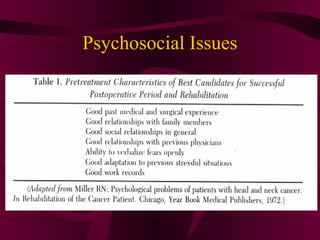
Psychosocial Issues
Psychosocial Issues
Preoperative Evaluation
• Discussion of patient’s expectations and
  desires
• Consultation with appropriate services
• Preoperative imaging
• Status of current teeth and XRT
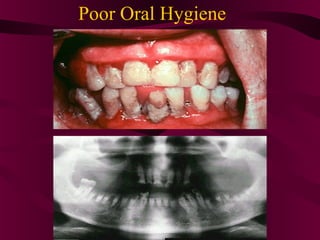
Poor Oral Hygiene
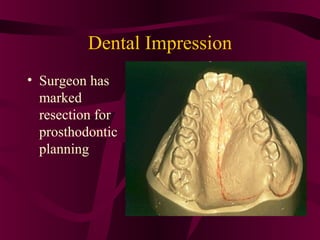
Dental Impression
• Surgeon has
  marked
  resection for
  prosthodontic
  planning
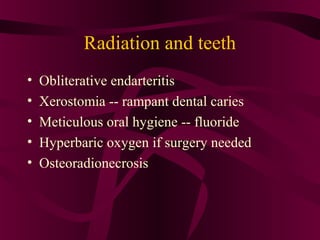
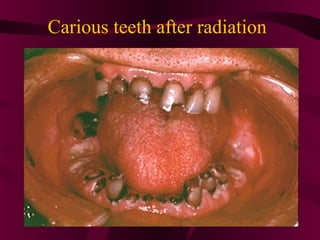
Radiation and teeth
•   Obliterative endarteritis
•   Xerostomia -- rampant dental caries
•   Meticulous oral hygiene -- fluoride
•   Hyperbaric oxygen if surgery needed
•   Osteoradionecrosis
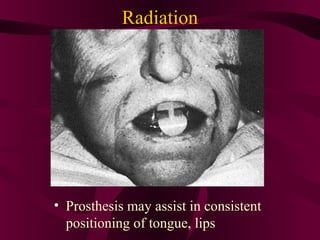
Radiation


• Prosthesis may assist in consistent
  positioning of tongue, lips
Carious teeth after radiation
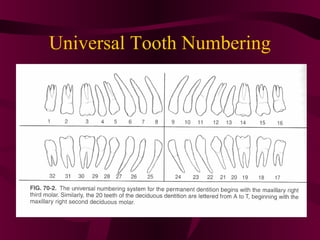
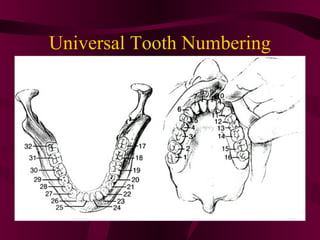
Universal Tooth Numbering
Normal function of Oral Cavity
• Speech
• Mastication
• Deglutition
Speech
• Complex process
• Oral-nasal partition
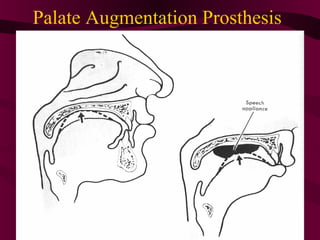
• Palatal augmentation prosthesis can lower
  palate to provide better function for a
  compromised tongue
Deglutition (Swallowing)
•   Tongue pulsion
•   Nasopharyngeal closure
•   Pharyngeal clearance
•   Airway protection
•   UES opening
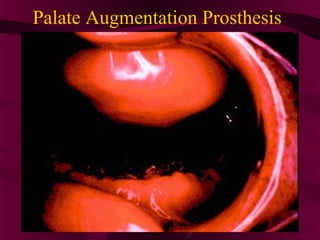
Palate Augmentation Prosthesis
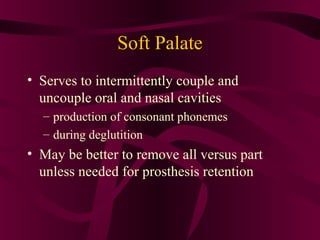
Soft Palate
• Serves to intermittently couple and
  uncouple oral and nasal cavities
  – production of consonant phonemes
  – during deglutition
• May be better to remove all versus part
  unless needed for prosthesis retention
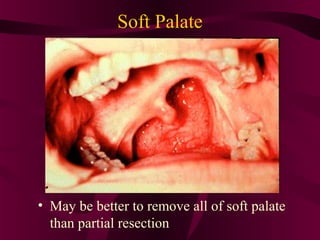
Soft Palate


• May be better to remove all of soft palate
  than partial resection
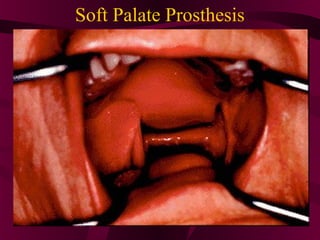
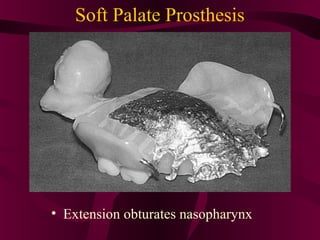
Soft Palate Prosthesis


• Extension obturates nasopharynx
Soft Palate
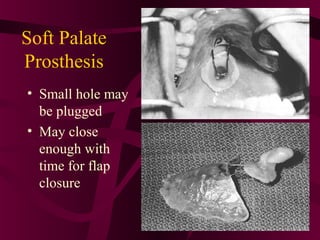
Prosthesis
• Small hole may
  be plugged
• May close
  enough with
  time for flap
  closure
Mastication
• Precursor to deglutition
• Involves
  – Reduction of food particle size
  – Sorting of food particles
• Masticatory efficiency = ability to reduce
  food to a given size in a given time
Mastication
• Masticatory efficiency related to occlusal
  surface
• Superior masticatory efficiency leads to
  greater reduction of particle size at
  swallowing threshold
• Afferent sensory input improves efficiency
  – Experiment: unilateral anesthesia
Prosthetic Teeth and Masticatory
           Efficiency
• Fixed partial, rigid support
• Removable partial supported by
  – teeth only
  – teeth and edentulous ridge
  – edentulous ridge only
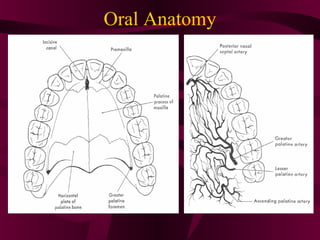
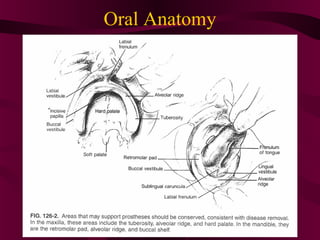
Oral Anatomy
Oral Anatomy
Maxillary defects
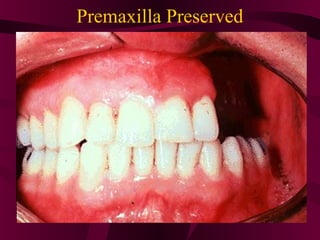
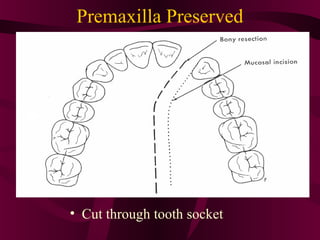
• Maintain Premaxilla
  – can clasp teeth further apart
  – force distributed among more teeth
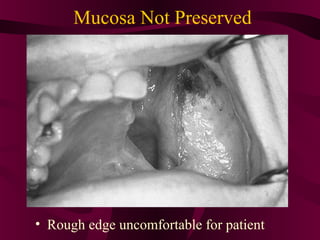
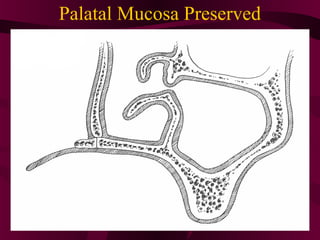
• Use palatal mucosa if possible
• May need to take turbinates
Premaxilla Preserved


• Cut through tooth socket
Palatal Mucosa Preserved
Mucosa Not Preserved


• Rough edge uncomfortable for patient
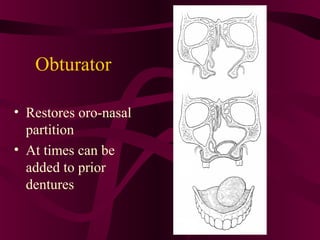
Obturator

• Restores oro-nasal
  partition
• At times can be
  added to prior
  dentures
Skin Grafting of Defect
• Less pain while healing
• Less contracture of scar band which
  obscures cancer surveillance
• Accomodates obturator better
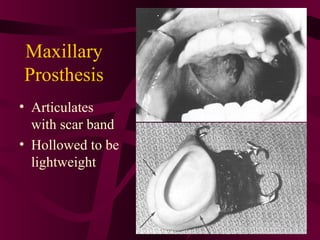
Maxillary
Prosthesis
• Articulates
  with scar band
• Hollowed to be
  lightweight
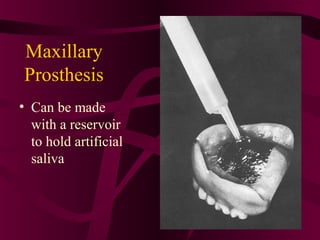
Maxillary
Prosthesis
• Can be made
  with a reservoir
  to hold artificial
  saliva
Timing
• Immediate (Intraoperative)
  – hold in packs
  – provide early function
• Interim
• Definitive
  – 3 to 6 months
Prosthetic Materials
• Acrylics
• Polyurethanes
• Silicone Elastomers
  – Room-temperature vulcanizing
  – High-temperature vulcanizing
Mandible
• Mandibular reconstruction revolutionized
  by microvascular and plating techniques
• Prosthetics mainly restore occlusion and
  occlusal surface
• Implants able to restore high degree of
  function
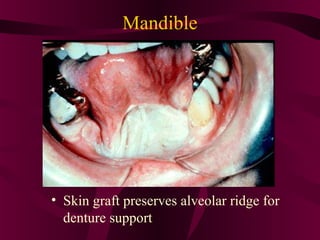
Mandible


• Skin graft preserves alveolar ridge for
  denture support
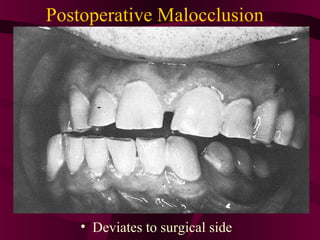
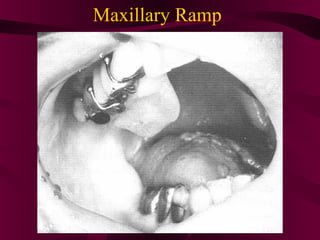
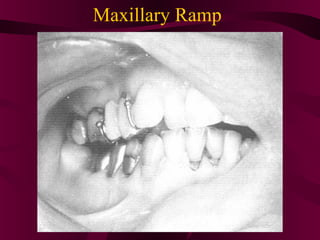
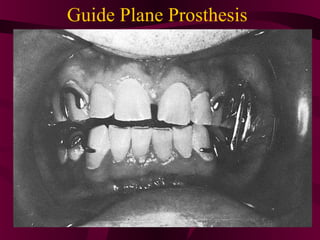
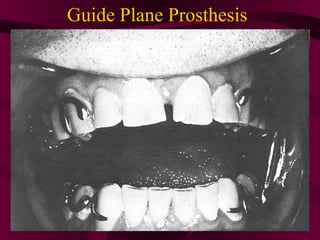
Postoperative Malocclusion


    • Deviates to surgical side
Maxillary Ramp
Maxillary Ramp
Guide Plane Prosthesis
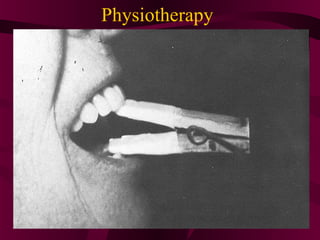
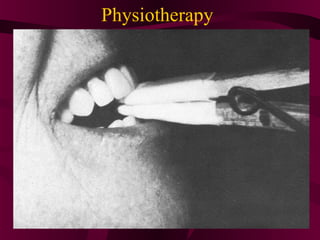
Physiotherapy
Physiotherapy
Adjunctive Preprosthetic
           Measures
• Vestibuloplasty
• Lowering of Floor of Mouth
• Implants
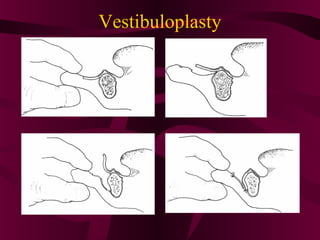
Vestibuloplasty
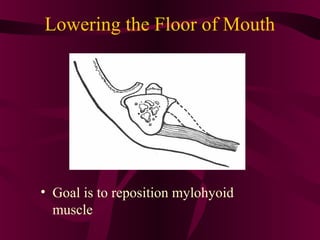
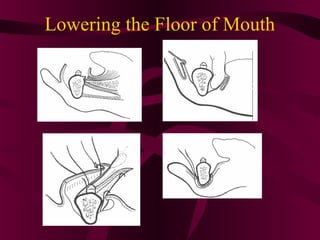
Lowering the Floor of Mouth


• Goal is to reposition mylohyoid
  muscle
Lowering the Floor of Mouth
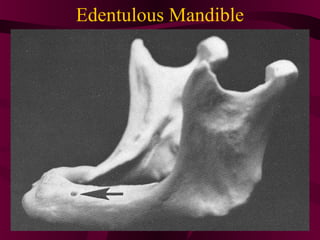
Edentulous Mandible
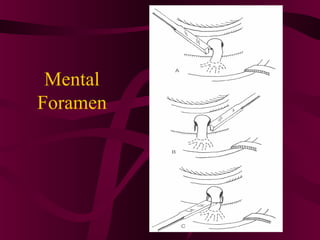
Mental
Foramen
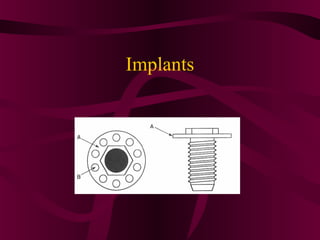
Implants
Implants
• Branemark in the 50’s studying bone temp
  during drilling
• Found temp probes couldn’t be removed
  from bone without fracturing
• Led to study of osseointegration
Implants
•   Made of titanium
•   Have to be drilled at low speed
•   Oxide on metallic surface is dipole
•   Plasma proteins adhere
Implants
• Implant placed first -- closed primarily
• Abutment placed 4-6 mo later
• Appliance attached
  – rigidly
  – removable
  – samarium-cobalt magnets
Implants
• Factors that influence success
  –   material
  –   macrostructure
  –   microstructure
  –   implant bed
  –   surgical technique
  –   loading conditions
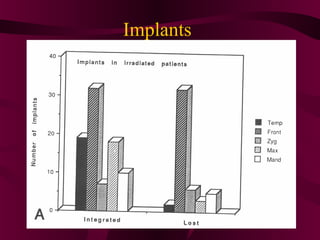
Implants
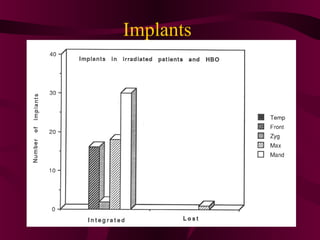
Implants
Implants


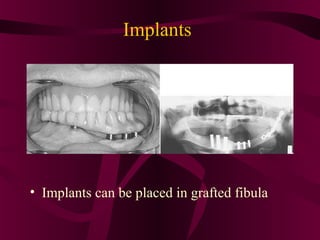
• Implants can be placed in grafted fibula
Implants


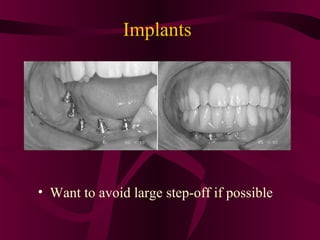
• Want to avoid large step-off if possible
Extraoral Prostheses
Extraoral Prostheses -- General
            Principles
• Goal is cosmetic
• Retained with
  – adhesives
  – implants
• Skin grafting may help
• Smooth edges
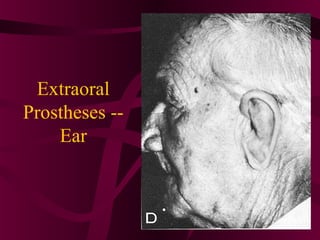
Extraoral Prostheses -- Ear
• Retain tragus if possible to camouflage
  anterior border
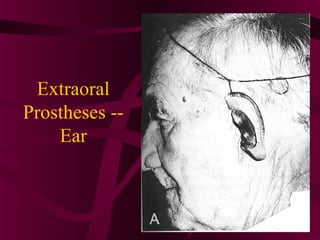
Extraoral
Prostheses --
    Ear
Extraoral
Prostheses --
    Ear
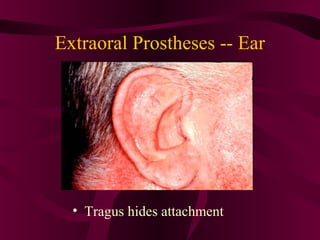
Extraoral Prostheses -- Ear


  • Tragus hides attachment
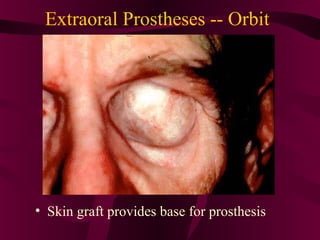
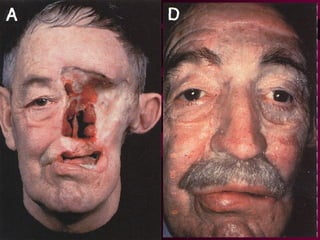
Extraoral Prostheses -- Orbit


• Skin graft provides base for prosthesis
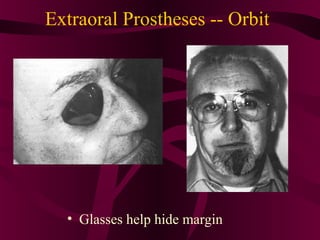
Extraoral Prostheses -- Orbit


  • Glasses help hide margin
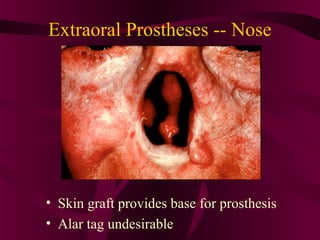
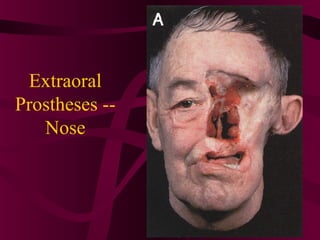
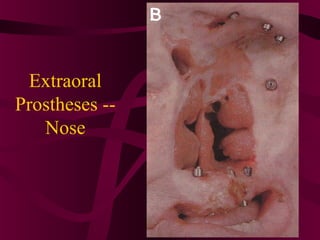
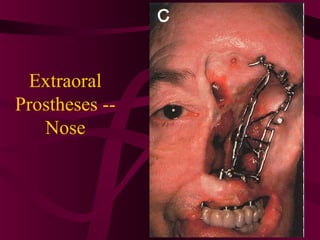
Extraoral Prostheses -- Nose


• Skin graft provides base for prosthesis
• Alar tag undesirable
Extraoral
Prostheses --
   Nose
Extraoral
Prostheses --
   Nose
Extraoral
Prostheses --
   Nose
Extraoral
Prostheses --
   Nose
Conclusion
• Restore function and cosmesis
• Use techniques during surgery to aid
  prosthetic management
• Consultation with maxillofacial
  prosthodontist for optimal rehabilitation
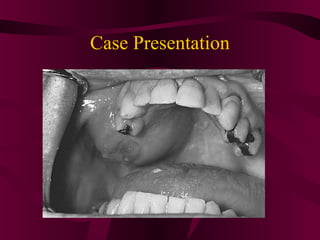
Case Presentation
• 30 yo WM with palatal tumor
• Otherwise healthy
• Path SCCa
Case Presentation

Maxillofacial prosthodontics