1
EXCELLENCE IN
RETAILING
2
What’s Retailing All About?
• It’s about reaching out to consumers first
hand!!
– Through Formats that differentiate offerings
to suit customer needs to fulfill them every
time
– Through formats that (one or a
combination) provide true shopping value
3
What’s Retailing All About?
• It’s about efficiently providing a vehicle
for mediation with the customers.
– With the right merchandise at the right
place in the right quantities at the right price
at the right time.
4
Evolution of Retailing in India
• Emergence of Channels of Distribution
• Retailing & its Evolution
– From Shanties (temporary sheds) to
Professional Retailing
– Agrarianism to Industrialization to Mature
Markets to Global Competitiveness
5
From Evolution to Revolution
• It’s not just the evolution of retailing
in India.
• It’s a revolution.
– To get the customer’s heart-share and
not even the mind-share.
6
Retail Formats
7
Formats of
Physical Store Retailing
• Formats by Size
• Departmental Stores / Super Markets
• Bazaar or Discount Formats
• Specialty Formats
• Category Killer Formats
Large Formats
8
Formats of
Physical Store Retailing
• Stop Over Formats
• Kiosks & Dispensing Formats
Small Formats
9
Conglomerates
• Malls
• Hyper Markets
• Plazas
• Bulk Marts
• Warehouse Formats
10
Characteristics of
Retail Formats
• Store Image
• Location
• Service Type
• Merchandising Mix
• Presentation
11
Key Attributes in
Customer Satisfaction
• Merchandise Assortment / Selection
• Merchandise Quality
• Pricing
• Locational Convenience
• Customer Service
12
The Retail Environment
(Macro)
• The Composition of Retail Environment
• Factors Governing & Influencing Retail
Environment
– Political Factors (WTO)
– Economic Factors (FDI)
• Retailing & its Industry Status in India
13
The Retail Environment Model
(Micro)
Staff Space
Stock
Customer
14
• Customer focused not Real Estate
focused
• Facilities & Concessionaries
• Differentiate to Niche Retailing
• Concept Retailing
Current Retail Trends
15
• Store Image, Type and Density
• Store Space Planning
• Store Circulation
Store Operations
Store Planning
16
60%
15%
25% Selling
Circulation
Back Areas
Area Mix
17
• Free Flow
• Grid
• Race Track
• Herringbone
• Spine
The Circulation Plan –
The “Silent Guide”
18
• Store Location
Strategy
High Street
Destination
Mall Partners
• Determinants of Store
Location
Accessibility
Surroundings &
catchment profile
Availability Facilities
Store Location
19
Functions of Store Operations
Planning
Organizing
Co-ordinating
Implementing
Controlling
Role of Store Operations
20
• Licenses & Permissions
• Legal Compliance
• Routine Administration
Administrative Process
21
• Sales Planning
• Personal Selling
Cross Selling
Upselling
• Sales Reports
Sales Process
22
• Cashiering System Sequence
• Customer Check Out Strategy
• Cashier’s Role
Cashiering Process
23
• Customer Service Vision & Strategy
• Customer Service Standards Determination
• Benchmarking
• MOT & Expectation Analysis
Customer Service Process
24
• Staffing & Scheduling
• Grooming
• Floor Meeting
• Training
• Performance Management
• Personal Development
HR & Welfare Process
25
• House Keeping
• Security
• Maintenance
Facilities & Concessions
Management Process
26
• Key Successful
Parameters
Space Oriented
Stock Oriented
Staff Oriented
Customer Oriented
• Parameters Analysis,
Conclusions, Decisions
& Actions
(What Should Be
Those For In &
Out?)
Store Operating Parameters
27
• Customer Segmentation
• Range Structure
• Merchandise Hierarchy & Merchandise
Planning
Buying & Merchandising
Creating the Merchandising & Buying
Vision
28
• What is Buying & Merchandising
• Significance of Buying & Merchandising
• Sourcing & Vendor Management
• Trends & Forecasting Techniques
Principles of Buying
& Merchandising
29
• Category Vision
• Category Definition
• Category Scorecard
• Category Review
• Category Functions
Category Management
30
• Merchandise & Assortment Planning
• Micro-merchandising
• Line Presentation
• Replenishment Planning
Designing Merchandising
Working Practices
31
• OTB
• Mark Down Planning
• Planogram (Sample sheet integrating
base stock, fixture mapping, etc.)
Designing Merchandising
Working Practices
32
• Existing Measures of Performance
Store wise Performance (Stocks,
Space, Sales)
Partner Performance & Assessment
Dealer
Alliance Partner
Determining Key Performance
Indicators (KPIs)
33
• Connect’s Ownership
• Business Manager
Business Estimates and Achievement
• Operations Manager
Category / Processes Ownership
• Trainer
RCC’s Role
34
• Contribution of Technology to Retail Process
Speed, Accuracy
Data in required form for decision making
Customer satisfaction through Technology
The Role of Technology in
Retailing
35
• Business Needs to Drive Technology
Requirements, not otherwise
• Deploy Instore Technologies for Customer
Convenience
Customer – Technology Adopters
• Deploy Technology for Speed, Accuracy & Total
Customer Satisfaction
Retail Technology
Implementation Factors
36
• Review Technology Performance
• Innovate & Deploy New Technologies to
Stay Ahead of Competition
• Technology Scalability
Retail Technology Implementation
Factors (contd..)
37
SERVICE MANAGEMENT
RETAIL STORES
38
DISCIPLINE OF MARKET LEADERS
• Product Leadership
• Operational Excellence
• Customer Intimacy
Service Quality --- Why?
39
• Intangibility
• Inseparability
• Heterogeneity
• Perishability
• Ownership
Characteristics of Service
40
• Services are things a company
does / offers its customers
• Service is how well a company
does / offers what it does / offers
to its customers
Service Vs. Services
41
• Product
• Price
• Promotion
• Place
• People in Services
• Physical Evidence in Services
• Process in Services
Services Marketing Mix
Beyond The Four P’s
42
The Service Triangle
People Service
Strategy
Systems
Customer
43
• Putting people
behind products and
services
• Treating customers
with respect,
individuality and
personal attention
What is Customer Service?
44
• The Customer is the Business’s Biggest Asset
• The Customer pays all salaries, wages and
dividends
• The Customer will go where s/he receives the
best attention
• You must be your customer’s best choice ! !
Obsession With Customer
45
• Not necessarily those who pay but all those
whom we serve
Who Is Our Customer?
• Paying Customer
• Colleagues
• Wife
• Parents
• Neighbors
• Boss
• Subordinates
• Children
• Relatives
• Environment
• Fellow Human Beings
46
The Spirit of Service
Is an attitude based on
certain values & beliefs
about people, life and
work, that leads a
person to willingly serve
others and take pride in
his or her work.
47
• People’s Skills
• Product
• Presentation
• Process
4 P’s Which Shape Customer’s
Decision to Buy
48
• Dependability (Did the service provider do what
was promised?)
• Responsiveness (Was the service provided in a
timely manner?)
• Authority (Did the service provider elicit a
feeling of confidence in the customer during the
service delivery process?)
Five Universal Dimensions of
Service Process Quality
49
• Empathy (Was the service provider able to take the
customer’s point of view?)
• Tangible Evidence (Was evidence left that the service
was indeed performed?)
Five Universal Dimensions of
Service Process Quality
50
• Friendliness
• Understanding
• Fairness
• Control
• Options & Alternatives
• Information
Six Basic Customer Needs
51
Bad Service v/s Good Service
My Expectations
My Treatment
My Treatment
Is less thanWhen
When exceeds
My Expectations This
=
Good
Service
This
=
Bad
Service
GOOD SERVICE IS GIVING CUSTOMERS A LITTLE
MORE THAN WHAT THEY EXPECT
52
• The best service companies have a passion for
service excellence!!
• Providers of service excellence do it with
energy and enthusiasm
• Excellent service is a win-win experience!!
• In today’s competitive market place the
customer decides who wins and who loses
Excellent Service = Enjoying Giving People
Little More Than They Expect
Excellent Service
53
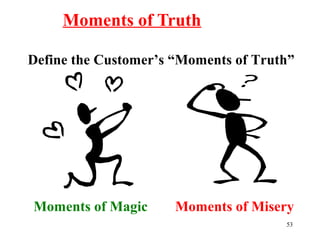
Define the Customer’s “Moments of Truth”
Moments of Magic Moments of Misery
Moments of Truth
54
The Customer is Respected
And Understood
And treated Genuinely
The foundations are laid for Quality Service
When what is
communicated at
Moments of Truth is that:
Moments of Truth & Service
Quality
55
Perceived Value =
Services X Service
-----------------------
Price
Expectations & Perceived Value
56
IMPORTANCE OF COMPLAINTS
Gives us another chance of improve our service
Doing the
job right
the first
time
Effective
Complaint
Handling
+ =
Increased
Customer
Satisfaction
& Brand
Loyalty
Handling Customer Complaints
57
Do not return anger for anger
Avoid fuelling the anger
Keep control of the situation
Be quiet and listen
Do not make excuses
Managing Yourself
58
Recognize the customer’s feelings
Probe
Solve problem
Soothe problem
Apologise whenever required
Managing Yourself
59
• Attention
• Interest
• Desire
• Conviction
• Action
Stage of Selling
60
• Pre-approach
• Approach
• Identifying wants & needs
• Presenting the Product or Service
Steps of Sale
61
• Answering questions and objections
• Suggestion Selling
• Closing the Sale
• Post Sale Services
Steps of Sale
62
• Zone of Recommendation
• Zone of Normality
• Zone of Tolerance
• Zone of Rejection
Four Zones of Customer Influence
63
• When you are serving a customer, you
are on stage, so…..
• Are your dressed for the part?
• Do you know your lines?
• Do you understand the play?
You Are On Stage

Retailing

  • 1.
  • 2.
    2 What’s Retailing AllAbout? • It’s about reaching out to consumers first hand!! – Through Formats that differentiate offerings to suit customer needs to fulfill them every time – Through formats that (one or a combination) provide true shopping value
  • 3.
    3 What’s Retailing AllAbout? • It’s about efficiently providing a vehicle for mediation with the customers. – With the right merchandise at the right place in the right quantities at the right price at the right time.
  • 4.
    4 Evolution of Retailingin India • Emergence of Channels of Distribution • Retailing & its Evolution – From Shanties (temporary sheds) to Professional Retailing – Agrarianism to Industrialization to Mature Markets to Global Competitiveness
  • 5.
    5 From Evolution toRevolution • It’s not just the evolution of retailing in India. • It’s a revolution. – To get the customer’s heart-share and not even the mind-share.
  • 6.
  • 7.
    7 Formats of Physical StoreRetailing • Formats by Size • Departmental Stores / Super Markets • Bazaar or Discount Formats • Specialty Formats • Category Killer Formats Large Formats
  • 8.
    8 Formats of Physical StoreRetailing • Stop Over Formats • Kiosks & Dispensing Formats Small Formats
  • 9.
    9 Conglomerates • Malls • HyperMarkets • Plazas • Bulk Marts • Warehouse Formats
  • 10.
    10 Characteristics of Retail Formats •Store Image • Location • Service Type • Merchandising Mix • Presentation
  • 11.
    11 Key Attributes in CustomerSatisfaction • Merchandise Assortment / Selection • Merchandise Quality • Pricing • Locational Convenience • Customer Service
  • 12.
    12 The Retail Environment (Macro) •The Composition of Retail Environment • Factors Governing & Influencing Retail Environment – Political Factors (WTO) – Economic Factors (FDI) • Retailing & its Industry Status in India
  • 13.
    13 The Retail EnvironmentModel (Micro) Staff Space Stock Customer
  • 14.
    14 • Customer focusednot Real Estate focused • Facilities & Concessionaries • Differentiate to Niche Retailing • Concept Retailing Current Retail Trends
  • 15.
    15 • Store Image,Type and Density • Store Space Planning • Store Circulation Store Operations Store Planning
  • 16.
  • 17.
    17 • Free Flow •Grid • Race Track • Herringbone • Spine The Circulation Plan – The “Silent Guide”
  • 18.
    18 • Store Location Strategy HighStreet Destination Mall Partners • Determinants of Store Location Accessibility Surroundings & catchment profile Availability Facilities Store Location
  • 19.
    19 Functions of StoreOperations Planning Organizing Co-ordinating Implementing Controlling Role of Store Operations
  • 20.
    20 • Licenses &Permissions • Legal Compliance • Routine Administration Administrative Process
  • 21.
    21 • Sales Planning •Personal Selling Cross Selling Upselling • Sales Reports Sales Process
  • 22.
    22 • Cashiering SystemSequence • Customer Check Out Strategy • Cashier’s Role Cashiering Process
  • 23.
    23 • Customer ServiceVision & Strategy • Customer Service Standards Determination • Benchmarking • MOT & Expectation Analysis Customer Service Process
  • 24.
    24 • Staffing &Scheduling • Grooming • Floor Meeting • Training • Performance Management • Personal Development HR & Welfare Process
  • 25.
    25 • House Keeping •Security • Maintenance Facilities & Concessions Management Process
  • 26.
    26 • Key Successful Parameters SpaceOriented Stock Oriented Staff Oriented Customer Oriented • Parameters Analysis, Conclusions, Decisions & Actions (What Should Be Those For In & Out?) Store Operating Parameters
  • 27.
    27 • Customer Segmentation •Range Structure • Merchandise Hierarchy & Merchandise Planning Buying & Merchandising Creating the Merchandising & Buying Vision
  • 28.
    28 • What isBuying & Merchandising • Significance of Buying & Merchandising • Sourcing & Vendor Management • Trends & Forecasting Techniques Principles of Buying & Merchandising
  • 29.
    29 • Category Vision •Category Definition • Category Scorecard • Category Review • Category Functions Category Management
  • 30.
    30 • Merchandise &Assortment Planning • Micro-merchandising • Line Presentation • Replenishment Planning Designing Merchandising Working Practices
  • 31.
    31 • OTB • MarkDown Planning • Planogram (Sample sheet integrating base stock, fixture mapping, etc.) Designing Merchandising Working Practices
  • 32.
    32 • Existing Measuresof Performance Store wise Performance (Stocks, Space, Sales) Partner Performance & Assessment Dealer Alliance Partner Determining Key Performance Indicators (KPIs)
  • 33.
    33 • Connect’s Ownership •Business Manager Business Estimates and Achievement • Operations Manager Category / Processes Ownership • Trainer RCC’s Role
  • 34.
    34 • Contribution ofTechnology to Retail Process Speed, Accuracy Data in required form for decision making Customer satisfaction through Technology The Role of Technology in Retailing
  • 35.
    35 • Business Needsto Drive Technology Requirements, not otherwise • Deploy Instore Technologies for Customer Convenience Customer – Technology Adopters • Deploy Technology for Speed, Accuracy & Total Customer Satisfaction Retail Technology Implementation Factors
  • 36.
    36 • Review TechnologyPerformance • Innovate & Deploy New Technologies to Stay Ahead of Competition • Technology Scalability Retail Technology Implementation Factors (contd..)
  • 37.
  • 38.
    38 DISCIPLINE OF MARKETLEADERS • Product Leadership • Operational Excellence • Customer Intimacy Service Quality --- Why?
  • 39.
    39 • Intangibility • Inseparability •Heterogeneity • Perishability • Ownership Characteristics of Service
  • 40.
    40 • Services arethings a company does / offers its customers • Service is how well a company does / offers what it does / offers to its customers Service Vs. Services
  • 41.
    41 • Product • Price •Promotion • Place • People in Services • Physical Evidence in Services • Process in Services Services Marketing Mix Beyond The Four P’s
  • 42.
    42 The Service Triangle PeopleService Strategy Systems Customer
  • 43.
    43 • Putting people behindproducts and services • Treating customers with respect, individuality and personal attention What is Customer Service?
  • 44.
    44 • The Customeris the Business’s Biggest Asset • The Customer pays all salaries, wages and dividends • The Customer will go where s/he receives the best attention • You must be your customer’s best choice ! ! Obsession With Customer
  • 45.
    45 • Not necessarilythose who pay but all those whom we serve Who Is Our Customer? • Paying Customer • Colleagues • Wife • Parents • Neighbors • Boss • Subordinates • Children • Relatives • Environment • Fellow Human Beings
  • 46.
    46 The Spirit ofService Is an attitude based on certain values & beliefs about people, life and work, that leads a person to willingly serve others and take pride in his or her work.
  • 47.
    47 • People’s Skills •Product • Presentation • Process 4 P’s Which Shape Customer’s Decision to Buy
  • 48.
    48 • Dependability (Didthe service provider do what was promised?) • Responsiveness (Was the service provided in a timely manner?) • Authority (Did the service provider elicit a feeling of confidence in the customer during the service delivery process?) Five Universal Dimensions of Service Process Quality
  • 49.
    49 • Empathy (Wasthe service provider able to take the customer’s point of view?) • Tangible Evidence (Was evidence left that the service was indeed performed?) Five Universal Dimensions of Service Process Quality
  • 50.
    50 • Friendliness • Understanding •Fairness • Control • Options & Alternatives • Information Six Basic Customer Needs
  • 51.
    51 Bad Service v/sGood Service My Expectations My Treatment My Treatment Is less thanWhen When exceeds My Expectations This = Good Service This = Bad Service GOOD SERVICE IS GIVING CUSTOMERS A LITTLE MORE THAN WHAT THEY EXPECT
  • 52.
    52 • The bestservice companies have a passion for service excellence!! • Providers of service excellence do it with energy and enthusiasm • Excellent service is a win-win experience!! • In today’s competitive market place the customer decides who wins and who loses Excellent Service = Enjoying Giving People Little More Than They Expect Excellent Service
  • 53.
    53 Define the Customer’s“Moments of Truth” Moments of Magic Moments of Misery Moments of Truth
  • 54.
    54 The Customer isRespected And Understood And treated Genuinely The foundations are laid for Quality Service When what is communicated at Moments of Truth is that: Moments of Truth & Service Quality
  • 55.
    55 Perceived Value = ServicesX Service ----------------------- Price Expectations & Perceived Value
  • 56.
    56 IMPORTANCE OF COMPLAINTS Givesus another chance of improve our service Doing the job right the first time Effective Complaint Handling + = Increased Customer Satisfaction & Brand Loyalty Handling Customer Complaints
  • 57.
    57 Do not returnanger for anger Avoid fuelling the anger Keep control of the situation Be quiet and listen Do not make excuses Managing Yourself
  • 58.
    58 Recognize the customer’sfeelings Probe Solve problem Soothe problem Apologise whenever required Managing Yourself
  • 59.
    59 • Attention • Interest •Desire • Conviction • Action Stage of Selling
  • 60.
    60 • Pre-approach • Approach •Identifying wants & needs • Presenting the Product or Service Steps of Sale
  • 61.
    61 • Answering questionsand objections • Suggestion Selling • Closing the Sale • Post Sale Services Steps of Sale
  • 62.
    62 • Zone ofRecommendation • Zone of Normality • Zone of Tolerance • Zone of Rejection Four Zones of Customer Influence
  • 63.
    63 • When youare serving a customer, you are on stage, so….. • Are your dressed for the part? • Do you know your lines? • Do you understand the play? You Are On Stage