Chapter 5
International
sales
management
In this chapter we will discuss:
• Role of the sales manager in the international
market
• International sales and marketing
opportunities
• Challenges in international sales
management
• Strategic issues for international sales and
marketing
• International sales techniques
• Structures for international sales
organizations
• International sales management practices
Role of the sales manager in the
international market
• Basic level functions
– Training
– Evaluating
– Planning
– Compensation
• Advanced level functions
– Strategic account management
– Conducting negotiations
– Arranging agreements with distributors
– Developing relations and network locally
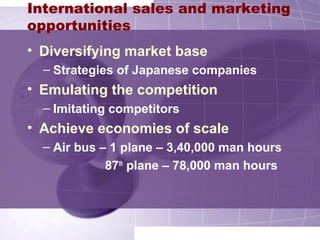
International sales and marketing
opportunities
• Diversifying market base
– Strategies of Japanese companies
• Emulating the competition
– Imitating competitors
• Achieve economies of scale
– Air bus – 1 plane – 3,40,000 man hours
87th
plane – 78,000 man hours
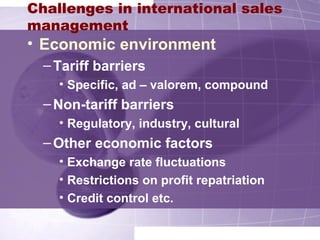
Challenges in international sales
management
• Economic environment
–Tariff barriers
• Specific, ad – valorem, compound
–Non-tariff barriers
• Regulatory, industry, cultural
–Other economic factors
• Exchange rate fluctuations
• Restrictions on profit repatriation
• Credit control etc.
Continued ……
• Legal environment
– Partnership laws
– Anti Corruption laws
– Intellectual property rights
• Cultural environment
– Language
– Religion
– Education
– Social attitudes & behavior
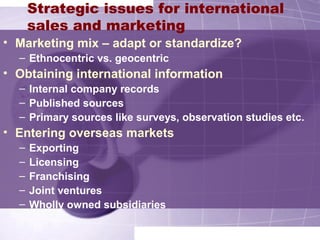
Strategic issues for international
sales and marketing
• Marketing mix – adapt or standardize?
– Ethnocentric vs. geocentric
• Obtaining international information
– Internal company records
– Published sources
– Primary sources like surveys, observation studies etc.
• Entering overseas markets
– Exporting
– Licensing
– Franchising
– Joint ventures
– Wholly owned subsidiaries
International sales techniques
• Personal selling process
– Preliminary selling
• Identify prospects
• Approach
– Advanced selling
• Sales interview
• Flexible presentation
• Product demonstrations
• Handling objections
• Close
• After sales techniques
• Time and territory management
– Proper routing & scheduling
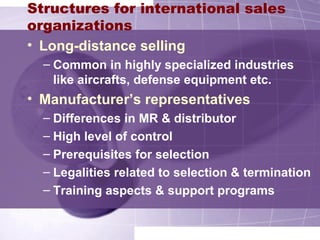
Structures for international sales
organizations
• Long-distance selling
– Common in highly specialized industries
like aircrafts, defense equipment etc.
• Manufacturer’s representatives
– Differences in MR & distributor
– High level of control
– Prerequisites for selection
– Legalities related to selection & termination
– Training aspects & support programs
• Piggybacking
– Low cost entry
– It involves a rider & a carrier
– Whirlpool & Sony, AT&T and Toshiba in Japan
– Some times it can be a reciprocal
• Intermediaries
– Merchants
– Independent agents
– Facilitating intermediaries
• Transporting & warehousing
• Market research / advertising
Continued…….
Continued…….
• Establishing direct sales force abroad
– Useful when grater commitment and
control is needed
– Sales force structure
(standard/customized)
– Size of sales force
– Market similarities
– Company operations
International sales management
practices
• Recruitment of sales personnel
– Selling approach
• Canada - no aggressive selling
• Mexico – personal relations
– Origin of sales personnel
• Home country people if the product is high value
technical product
• Host country people for quicker establishment
• Third country people where similarities exists
– Sources of recruitment
Selection of sales personnel
• Education
– In Germany Ph. D. holders are selected to sell
chemical equipment
– Pfizer selects MBBS candidates to promote their
specialty products in India
• Religion
– Muslim – Buddhist in Malaysia, Indonesia, Hindu
Muslim in India & Pakistan, Sunni – Shia in
middle east
• Ethnic composition
Continued…..
• Social stratification
– USA wealth based, India caste based,
seniority in Japan
– Different criterions for different products
& industries
• Socio-economic development
– Education, religion, nepotism, talent,
references, psychological tests plays
different roles in different countries
Training & development of sales
personnel
• Changing role, attitudes and perceptions
– Differences in selling approaches
– In Europe relations are more formal
– Business lunch & different protocols
• Flexibility in training content and
methodology
– Modifications to suit cultural &regional factors
– Length of training schedule
– Use of female sales persons in video modules
– Shaking hands & implications in various
countries
Sales incentives and compensation
• Uniform / Discriminating
• It needs to be tailor made
• Often Linked with organization
performance
• Weight age of incentive component
• Influence as motivating factor in different
countries
• Alignment of management practices with
other countries is needed

international sales management

  • 1.
  • 2.
    In this chapterwe will discuss: • Role of the sales manager in the international market • International sales and marketing opportunities • Challenges in international sales management • Strategic issues for international sales and marketing • International sales techniques • Structures for international sales organizations • International sales management practices
  • 3.
    Role of thesales manager in the international market • Basic level functions – Training – Evaluating – Planning – Compensation • Advanced level functions – Strategic account management – Conducting negotiations – Arranging agreements with distributors – Developing relations and network locally
  • 4.
    International sales andmarketing opportunities • Diversifying market base – Strategies of Japanese companies • Emulating the competition – Imitating competitors • Achieve economies of scale – Air bus – 1 plane – 3,40,000 man hours 87th plane – 78,000 man hours
  • 5.
    Challenges in internationalsales management • Economic environment –Tariff barriers • Specific, ad – valorem, compound –Non-tariff barriers • Regulatory, industry, cultural –Other economic factors • Exchange rate fluctuations • Restrictions on profit repatriation • Credit control etc.
  • 6.
    Continued …… • Legalenvironment – Partnership laws – Anti Corruption laws – Intellectual property rights • Cultural environment – Language – Religion – Education – Social attitudes & behavior
  • 7.
    Strategic issues forinternational sales and marketing • Marketing mix – adapt or standardize? – Ethnocentric vs. geocentric • Obtaining international information – Internal company records – Published sources – Primary sources like surveys, observation studies etc. • Entering overseas markets – Exporting – Licensing – Franchising – Joint ventures – Wholly owned subsidiaries
  • 8.
    International sales techniques •Personal selling process – Preliminary selling • Identify prospects • Approach – Advanced selling • Sales interview • Flexible presentation • Product demonstrations • Handling objections • Close • After sales techniques • Time and territory management – Proper routing & scheduling
  • 9.
    Structures for internationalsales organizations • Long-distance selling – Common in highly specialized industries like aircrafts, defense equipment etc. • Manufacturer’s representatives – Differences in MR & distributor – High level of control – Prerequisites for selection – Legalities related to selection & termination – Training aspects & support programs
  • 10.
    • Piggybacking – Lowcost entry – It involves a rider & a carrier – Whirlpool & Sony, AT&T and Toshiba in Japan – Some times it can be a reciprocal • Intermediaries – Merchants – Independent agents – Facilitating intermediaries • Transporting & warehousing • Market research / advertising Continued…….
  • 11.
    Continued……. • Establishing directsales force abroad – Useful when grater commitment and control is needed – Sales force structure (standard/customized) – Size of sales force – Market similarities – Company operations
  • 12.
    International sales management practices •Recruitment of sales personnel – Selling approach • Canada - no aggressive selling • Mexico – personal relations – Origin of sales personnel • Home country people if the product is high value technical product • Host country people for quicker establishment • Third country people where similarities exists – Sources of recruitment
  • 13.
    Selection of salespersonnel • Education – In Germany Ph. D. holders are selected to sell chemical equipment – Pfizer selects MBBS candidates to promote their specialty products in India • Religion – Muslim – Buddhist in Malaysia, Indonesia, Hindu Muslim in India & Pakistan, Sunni – Shia in middle east • Ethnic composition
  • 14.
    Continued….. • Social stratification –USA wealth based, India caste based, seniority in Japan – Different criterions for different products & industries • Socio-economic development – Education, religion, nepotism, talent, references, psychological tests plays different roles in different countries
  • 15.
    Training & developmentof sales personnel • Changing role, attitudes and perceptions – Differences in selling approaches – In Europe relations are more formal – Business lunch & different protocols • Flexibility in training content and methodology – Modifications to suit cultural &regional factors – Length of training schedule – Use of female sales persons in video modules – Shaking hands & implications in various countries
  • 16.
    Sales incentives andcompensation • Uniform / Discriminating • It needs to be tailor made • Often Linked with organization performance • Weight age of incentive component • Influence as motivating factor in different countries • Alignment of management practices with other countries is needed