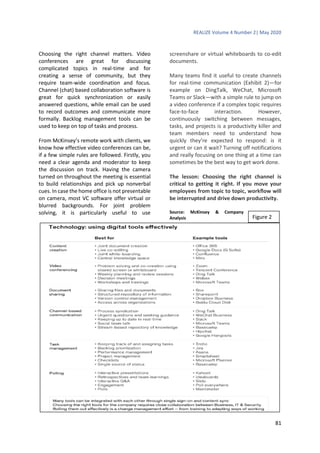
REALIZE Volume 4 Number 2| May-Jun 2020
1
www.cgl.credotrust.org Volume 4 Number 2 | Jun 2020
REALIZE is published by Cambridge Global Learning (EU) which is registered as a learning provider under the UK Department of Business, Innovation &
Skills – B.I.S (Reg.1004713). This Magazine incorporates much of the content of the former International Journal of Interdisciplinary Learning (IJIL)
published by Cambridge Global Learning (CGL). ©Copyright and All rights reserved for publishing, with CREDO Trust and Foundation registered in Dublin,
Ireland. Design is a copyright by Ahmed Javaid (Media Manager). Advertising; Please contact pscredotrust@gmail.com to advertise your products or
services in future issues. Information from this e-zine and the Board Members is available at www.credotrust.org.
REALIZE Volume 4 Number 2| May-Jun 2020
2
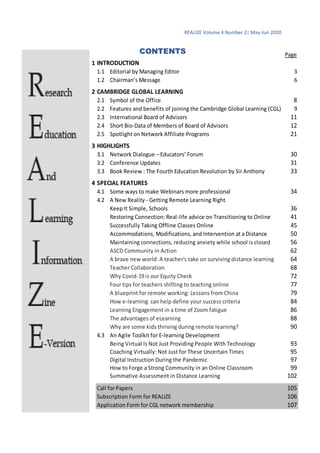
CONTENTS Page
1 INTRODUCTION
1.1 Editorial by Managing Editor 3
1.2 Chairman’s Message 6
2 CAMBRIDGE GLOBAL LEARNING
2.1 Symbol of the Office 8
2.2 Features and benefits of joining the Cambridge Global Learning (CGL) 9
2.3 International Board of Advisors 11
2.4 Short Bio-Data of Members of Board of Advisors 12
2.5 Spotlight on Network Affiliate Programs 21
3 HIGHLIGHTS
3.1 Network Dialogue – Educators’ Forum 30
3.2 Conference Updates 31
3.3 Book Review : The Fourth Education Revolution by Sir Anthony 33
4 SPECIAL FEATURES
4.1 Some ways to make Webinars more professional 34
4.2 A New Reality - Getting Remote Learning Right
Keep It Simple, Schools 36
Restoring Connection: Real-life advice on Transitioning to Online 41
Successfully Taking Offline Classes Online 45
Accommodations, Modifications, and Intervention at a Distance 50
Maintaining connections, reducing anxiety while school is closed 56
ASCD Community in Action 62
A brave new world: A teacher's take on surviving distance learning 64
Teacher Collaboration 68
Why Covid-19 is our Equity Check 72
Four tips for teachers shifting to teaching online 77
A blueprint for remote working: Lessons from China 79
How e-learning can help define your success criteria 84
Learning Engagement in a time of Zoom fatigue 86
The advantages of eLearning 88
Why are some kids thriving during remote learning? 90
4.3 An Agile Toolkit for E-learning Development
Being Virtual Is Not Just Providing People With Technology 93
Coaching Virtually: Not Just for These Uncertain Times 95
Digital Instruction During the Pandemic 97
How to Forge a Strong Community in an Online Classroom 99
Summative Assessment in Distance Learning 102
Call for Papers 105
Subscription Form for REALIZE 106
Application Form for CGL network membership 107
REALIZE Volume 4 Number 2| May-Jun 2020
3
From the Managing Editor
Welcome to the
May 2020 edition of
REALIZE. The theme
and focus for this
month is on e-
Learning or on-
line learning. This is
not a traditional
editorial as I also want to add my own
pennyworth of ideas on this theme that has
suddenly become more apt, due to the COVID-
19 Pandemic. Let us start first with the various
definitions or buzz words that seem to be now
more widely and randomly used among the
learning community. We hear words like
remote learning, digital learning and formerly
open or distance learning. And, we have virtual
learning and virtual classrooms, and
sometimes we talk of virtual reality,
augmented reality and the increasing use of
Artificial Intelligence (AI).
I am especially interested in the terminology.
For example, back in the 50’s and 60s there
were correspondence courses. I recall pursuing
a certificate course using the International
Correspondence School or ICS which operated
from the UK. Here the emphasis was on
correspondence and then we used airmail. As
I was studying overseas, I would be sent an
assignment, together with reference material,
through airmail and this would take 5 to 7 days
to reach me. Then I would have one month to
work on this assignment, after which I would
then airmail my completed work or answers to
questions, back to ICS in the UK. This would
continue for the next 12 months and finally I
would receive my certificate of achievement.
Then in the 70’s there was teleconferencing,
another form of communication using
satellites. During the 70s, with the opening up
of ‘Open’ Universities, I found myself giving a
lecture in a real classroom full of students and
being filmed onto a 16mm reel, so my lecture
could be viewed on a special TV channel. This
channel was made available to hundreds of
students many miles away, up and down the
country. This was of course before computers
and the internet became a way of life. We
called this open or distance learning.
Shortly after, in the 80s and 90s, we still had
distance learning, but this was blended into
classroom learning. This became known as’
blended’ learning, but the question was, “what
should be the ideal ratio between the e-
learning and face to face teacher contact in the
classroom”? One study done by Motorola
University found that once there was less than
50 percent classroom contact learning (which
by the way gave rise to the term contact hours)
the effectiveness of the learning decreased.
There is also ‘Web-based’ learning and one of
our members in Australia provides a tuition
center that provides math, English and Science
lessons to help thousands of high school
students study. It is all web-based and all
students need is a password to access his
website.
Yet today, one of our affiliate institutions, the
Chartered Institute for Personnel and
Development or CIPD, in the UK, offer their
professional certification courses 100 percent
online. And, this is a growing trend due
primarily to the COVID-19 ‘Lockdown or ‘stay
at home’ policies. Up to recently, Skype was
the norm. Then, with newer technologies we
had cloud computing and masses of data
stored in the cloud that we can access almost
instantly. Podcasts are a good example of this.
Just the other day I wanted to find a podcast of
a radio interview I did 8 years ago, to send to a
colleague. Thanks to the cloud and the
internet, I found it on my tablet and zapped it
to him. Of course, there is also the incredible
‘You tube’, with millions of video clips on
almost anything you want to do, make, or
learn. For the more serious professionals there
are the famous ‘Ted Talks’.
With COVID-19 causing millions of people to
stay at home, being forced to learn remotely,
enter ‘zoom’. Personally, and almost daily,
after several weeks, I have been the recipient
REALIZE Volume 4 Number 2| May-Jun 2020
4
of ‘zoom’ learning. We also have ‘Google Meet’
as an alternative method. I joined many groups
from different countries featuring the many
aspects of what we now might call remote
learning.
If we were to go back to the Motorola
university studies, the question then is how to
make what maybe 100% of our learning being
virtual, effective? With the use of webcams or
smart phones, we now can still see our learning
facilitators face to face or F2F, for short. Yet,
how do we simulate and immerse the learners,
so their experience is truly interactive and
inspiring and ensure they become and remain
fully engaged?
For this issue, we have provided a wide range
of articles, which we hope will help you make
your remote learning sessions much more
effective. It may be also useful to consider the
diverse makeup of our audience of learners.
We will need to cater for the physically active
type of person, for the social or interactive, for
the visual, the more passive auditory and the
younger digital generation, many of whom
tend to have a shorter attention span.
Activities like quizzes, polls, PowerPoint slides,
cartoons, quick sketching graphic art, video
clips and animation software are all going to
provide variety to the digital learning
experience. We can augment with the use of
mind maps, metaphors, models, charts, and
graphs.
Perhaps also, time for reflection is important,
as research shows this helps consolidate one
set of learnings before adding any more. This
can be done individually or for small group
sharing. In addition, we need to allow enough
time for Q&A. Of course, we need to have
breaks for a physical activity and time for the
learner to take their eyes off the computer
screen periodically and focus on some objects
far away. Ideally of course, if we have a
window to gaze out of, we can exercise our
long-distance vision, which is important for the
eyes and brain. Better still, if there are scenes
of nature, like trees, hills, the clouds in the sky
or birds, this all will enrich the learning
environment.
Among the several articles, there is one that I
would recommend you read. It is titled “We
are doing webinars all wrong, by Joe Urbanski,
where he suggests that teachers, lecturers, or
facilitators should stand up while speaking or
showing visuals, among other points that he
covers. Remember, we are trying to replace
the training or classroom.
Increasingly, we are using more and more
technology to enhance the learning, yet we
must appreciate that our learners are mere
mortal human beings, so timing is of the
essence. People need to eat, sleep and
exercise, to compensate for sitting with their
eyes glued to a computer screen. I am sure you
have come across various formulae for how
long we can focus or pay attention to what we
are learning.
Professor John Medina, in his book ‘Brain
Rules’ maintains that even when we are
aroused and absorbed, our brain can usually
only focus for around 10 minutes. This can be
our guideline for when to introduce an activity,
like a poll, quiz, or game etc. Even when we are
actively using our keyboard or reading
something on our PC or smartphone, we
should get up, walk around, do some beep
breathing and stretching.
Earlier I mentioned the CIPD professional
certification courses. These can take 3, 6 or
even 12 months to complete. The learning is
self-paced and self-directed. They provide
weekly bite sized chunks of learning and easy
to navigate modules developed by content
experts. The technology is also optimized for
use on mobile phone. That then gives us the
term ‘mobile learning’.
This also reminds me of the need for giving
progressive feedback. There are fast learners
or high achievers who are impatient for
feedback on their results. Just as there are slow
learners, who may need help and
encouragement, yet with a form of feedback
that does not cause them to lose face,
especially if they are not learning as well or as
fast as others. Self-checking of results
progressively, can be of benefit here. This was
REALIZE Volume 4 Number 2| May-Jun 2020
5
found to be the key to the success in
‘Programmed Instruction’, where regular
progressive checking on the learning was used
before the learner moved on. There was no
embarrassment if you did not understand
something, you merely went back to see where
you went wrong, until your understood it.
Finally, to wrap up on a slightly different note,
I find that the use of language and grammar
can either speed up or retard the learning
process. If we are using a lot of technical terms
or jargon, it can be useful to provide a glossary
of terms that people can refer to. For example,
if one does not understand the language, they
may not be comfortable asking the lecturer to
clarify meanings or repeat words.
In fact, this reminds me of something that has
been bugging me or many years. The use of
“he/she” or “his/hers” is often replaced with
the words “they, them, and theirs”. The US
dictionary Merriam Webster has added the
word “they” as a non-binary pronoun that can
refer to just one genderless person. So, it is
now officially permissible to no longer identify
gender. Even apple has added neutral emojis,
which do not distinguish between gender, so
the English language is still evolving and what
may have been incorrect 10 years ago, may
now be acceptable today.
Then, there is the decision to use US or UK
spelling. But that is a whole new topic for a
later issue! For this issue we are more U.S.
centric than usual. However, we officially use
“Globlish” – Global English! So, Happy Reading.
Managing Editor
Email: pscredotrust@gmail.com
Blog: learningmattersed@blogspot.com
REALIZE Volume 4 Number 2| May 2020
6
Chairman’s Message
Welcome to our May-
June issue of Cambridge
Global Learning's
periodical magazine.
Now, as you will know
from the theme for this
issue, which is on what I
have traditionally
referred to as distance
learning. If you have read our editorial, you will
see that we now hear a lot more about remote
or online learning. What I also talked about
then in my message, was that education and
schooling would embrace more online
learning.
The theme of this month’s magazine is how
online learning has zoomed (pardon the
metaphor). As most of us are now aware,
technology that has produced zoom and other
similar technologies like Google meet, Cisco’s
WebEx, Go to Meeting etc., have all enabled
thousands of people to receive continuing
education. And, this may be the ‘New Normal’.
So, as we move forward, we in Cambridge
Global Learning are supporting many of our
organizational members, such as academies
and colleges who are turning towards the use
of more online learning. We are doing this by
helping them get their new programs
accredited and recognized.
And, on this note of accreditation, I would like
to mention that we have partnered with a new
prestigious professional body in the UK, called
the Oxbridge Trust. This is no doubt due in part
to one of our Trustees who has been appointed
as their Chairman. Yes, it is no less than Prof Dr.
Peter Shephard, I would like to personality
congratulate him on this appointment. This will
enable CGL members to save costs and speed
up the accreditation process.
The Oxbridge Trust has an impressive panel of
assessors who will certify the quality of our
members’ professional programs. In addition,
these will be listed in the British Professional
Qualifications Register. This indeed is splendid
news for many of our new members. What also
is worthy news for our many graduates from
various professional certification programs, is
that they can now apply to get a professional
doctoral level membership award from the
Oxbridge Trust. Please note the use of the
word professional. This is not an academic
award but a membership award upon joining
Oxbridge, yet it is still recognized as a specialist
Doctoral award (DR.S).
What interested members will need to do is
complete an application form listing all their
past professional work experience under the
RPL (Recognized Prior Learning) scheme. They
may use their Continuing Professional
Development (CPD) credit points and if still
these are insufficient, they would need to write
a 3000-word portfolio report. We talk about a
new normal and for those senior and
experienced people who do not have the time,
interest or money to enroll in a traditional
University Ph.D. or DBA degree course, this is a
practical alternative towards achieving a
doctoral level award. I am sure that Dr
Shephard will be informing readers more
about this new membership opportunity for
increased professional recognition.
On the note of new members, I should like to
welcome aboard the following people. Of
significance is a Japanese lady and
entrepreneur now living in Virginia USA who
has a TVET program called the ‘Art of Gift
Wrapping. Her name is Shiho Masuka and is an
excellent example of someone who will train
certify people in this art, from all over the
world, by distance learning. (or should I call it
online learning?). Another new member, our
first from Egypt, is Dr Amr Sadik, the Principal
of Quodrat Consulting. Then there is Prof Dr
Bhuyan from Pakistan, a college Principal who
sent 12 graduates to our International Forum
on Learning (IFoL) in Kuala Lumpur, last
November. They all received their Senior
Fellow award at this event. Most of them were
Medical teaching Doctors. I would like to also
REALIZE Volume 4 Number 2| May 2020
7
recognize Priscilla Jacey Jihen, a Co-Principal of
Trail Blazers Global Leadership Academy who
has been training youth leaders in Malaysia
and contributing significantly to poor rural
community development.
Priscilla, together with her partner Philix Joe
Anak Joses, have also been turning their skills
towards producing more online training
programs. And what we hear from them, is
that the Malaysian Government Human
Resource Development Fund (HRDF) has now
produced guidelines for Trainers who seek to
produce more online learning programs. This is
very much in line with the theme of this issue
of REALIZE, which we hope will help enlighten
all our readers on the many challenges facing
the transition from traditional ways of learning
to the increase in remote learning and a digital
experience that may be new for many of us.
Some of our members have commented that
we have been more Euro and Eastern centered
in our past selection of writers and materials.
This time we have much more from the USA.
Many of the articles have a focus on e-learning
in schools, so this will be of interest to parents.
Let me conclude here, on a note of optimism,
that this current problem with COVID-19 has
not totally upset the need to continue
education, learning and training, albeit with a
greater emphasis on remote learning. Now our
challenge globally is on economic
development yet saving time and cost from
travelling and hiring training venues. The
Learning and Development profession will play
their vital part in reducing costs, while
continuing with human capital development.
To all those in the profession of enhancing and
facilitating learning, please keep up your Noble
contribution to Human Development.
Sincerely, Kevin Couling
Lord of Little Neston cum Hargrave and Chairman:
Cambridge Global Learning
REALIZE Volume 4 Number 2| May 2020
8
Symbol of Office
Coat of Arms for Cambridge Global Learning – EU
The Crest: Oak Wreath symbolizing the Tree of Knowledge.
The Globe representing our global network.
The Shield: In Azure (Blue) and Argent (White)
designed to look like the back of an
Academic Gown.
The Mortarboard representing
Graduation as an achievement of
excellence.
The Book representing the
Knowledge from which we learn -
including electronic books and the
internet.
The Torch representing the
Education and Knowledge that is
passed on from one generation to
the next generation.
The Motto: Knowledge and Wisdom Globally
REALIZE Volume 4 Number 2| May 2020
9
Features & Benefits of Joining the Cambridge Global Learning (CGL)
1. A global virtual network of scientists and practitioners in learning and strategic alliance affiliates.
2. CGL is registered in the UK as an Approved Learning Provider listed with the UK Department of
Business Innovation and Skills and supported by the Department of Employment and Learning
(UK). A division of CREDO Trust and Foundation – registered in Ireland.
3. Qualified members are awarded Fellowships – thus enhancing their image, branding and status.
4. CGL is a not-for-Profit, non-sectarian, non-political, non-partisan and non-hierarchical network.
5. CGL undertakes charitable and philanthropic work – related to learning or facilitation of learning.
6. Learning Centers and programs can be accredited in the UK by CGL.
7. Members share research, knowledge, expertise and best practices, related to Learning. CGL
publishes an E-Magazine – REALIZE. Members receive this inclusive with their subscription.
8. Members, when asked, are paid for assessment of programs being presented for accreditation
and recognition.
9. Members can promote their own expertise, products or services, globally.
10. Members can be invited to submit proposals for consulting work or projects that are made
available to CGL.
11. CGL offers its own professional Certification and a Post Graduate level, Diploma via E-Learning (up
to Level VII – UK Educational framework).
12. Members can earn Continuing Professional Development (CPD) credits toward these and other
awards, including the Professional Doctoral level (DR.S) award from our new UK partner the
OXBRIDGE TRUST and other Academic degrees from partnership University programs.
13. Members can benefit from student counseling services, including the profiling of their learning
style preferences.
14. Members can both receive mentoring or provide a mentoring service.
15. Strategic Alliance Network Affiliates who nominate new members receive a ‘finder’s fee’, upon
their joining as a CGL Network Affiliate.
16. Members can become social entrepreneurs dedicated to philanthropic projects in emergent
economies.
17. CGL has an International Board of Advisors of ‘Distinguished Fellows’, chaired by Lord Kevin
Couling, from the UK.
18. CGL is funded from Professional Certification Fees, Fellowship Awards, Training and Consultancy,
Research Grants, Magazine Subscriptions, Conference and Seminar Fees, Sponsorships and
Donations.
REALIZE Volume 4 Number 2| May 2020
10
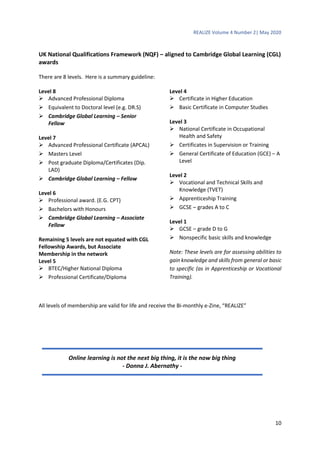
UK National Qualifications Framework (NQF) – aligned to Cambridge Global Learning (CGL)
awards
There are 8 levels. Here is a summary guideline:
Level 8
 Advanced Professional Diploma
 Equivalent to Doctoral level (e.g. DR.S)
 Cambridge Global Learning – Senior
Fellow
Level 7
 Advanced Professional Certificate (APCAL)
 Masters Level
 Post graduate Diploma/Certificates (Dip.
LAD)
 Cambridge Global Learning – Fellow
Level 6
 Professional award. (E.G. CPT)
 Bachelors with Honours
 Cambridge Global Learning – Associate
Fellow
Remaining 5 levels are not equated with CGL
Fellowship Awards, but Associate
Membership in the network
Level 5
 BTEC/Higher National Diploma
 Professional Certificate/Diploma
Level 4
 Certificate in Higher Education
 Basic Certificate in Computer Studies
Level 3
 National Certificate in Occupational
Health and Safety
 Certificates in Supervision or Training
 General Certificate of Education (GCE) – A
Level
Level 2
 Vocational and Technical Skills and
Knowledge (TVET)
 Apprenticeship Training
 GCSE – grades A to C
Level 1
 GCSE – grade D to G
 Nonspecific basic skills and knowledge
Note: These levels are for assessing abilities to
gain knowledge and skills from general or basic
to specific (as in Apprenticeship or Vocational
Training).
All levels of membership are valid for life and receive the Bi-monthly e-Zine, “REALIZE”
Online learning is not the next big thing, it is the now big thing
- Donna J. Abernathy -
REALIZE Volume 4 Number 2| May 2020
11
International Board of Advisors
We formally recognize the following members of our Board of Advisors and we thank them for their
continuing support. They are:
1. Dr. Asma Abdullah (Malaysia)
2. Dr. Balaji Varadarajan (India)
3. Prof. Dr. Cameron Richards (Australia)
4. Dr. David Chiew* (China/Taiwan)
5. Ms. Elmarie Potgieter (South Africa)
6. Mr. Fredrick Mandizvidza (Zimbabwe)
7. Dr. Jeannette Vos (Canada/ USA)
8. Lord Kevin Couling (U.K.)
9. Mr. Mark Treadwell (New Zealand)
10. Dr. Michel Gagne (Canada)
11. Dr. Peter Kline (USA)
12. Prof. Dr. Peter Shephard (U.K.)
13. Dr. Suresh Marcandan (Indonesia)
14. Dr. Svend Hollenson (Denmark)
15. Prof. Dr. T.V. Rao (India)
16. Dr. Will Fastiggi * (UK/Brazil)
*Awaiting acceptance, after nomination
NOTE: We are open for more nominations to join the Board, especially from other countries and
disciplines.
How CGL and its Board of Advisors evolved
In 2010, a then small group of learning professionals, became involved in organizing an International
Conference on Learning and Thinking (ILAT). ILAT had invited 10 speakers, from 10 countries to come
together in Kuala Lumpur on the tenth day of the tenth month (10/10/10). These speakers were
professionals in various aspects of Learning – from Neuroscience, Culture, Coaching, Creativity in
Learning and the Facilitation of group learning. Several of them subsequently were invited to join
CGL’s International Board of Advisors, of whom four were also contributors, in the first issue of IJIL.
So, the idea to build CGL, which was mainly more than a certification body, into a global network,
really took off after ILAT. And now we have representatives (Strategic Network Affiliates) in over 30
countries. And, as a result CGL was constituted in the UK, as a ‘hub’ for the network and decided to
become a virtual global network, and a not-for-Profit, non-sectarian, non-partisan body that is
egalitarian and non-hierarchical. CGL is also registered as an approval learning provider, with the UK
Department of Business and Innovation Skills and supported by the UK Department of Employment
and Learning. In 2017, CGL was acquired by the CREDO Trust and Foundation (registered in Ireland)
as a fully autonomous division and retains its own Board of Trustees. CREDO hosts its Secretariat.
REALIZE Volume 4 Number 2| May 2020
12
Short Bio-Data of Members of Board of Advisors
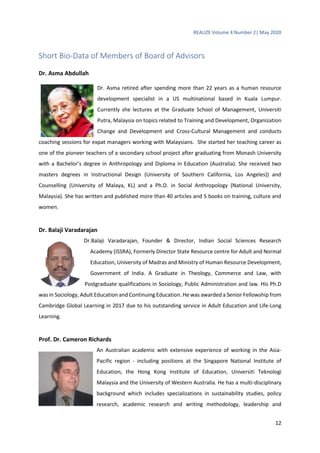
Dr. Asma Abdullah
Dr. Asma retired after spending more than 22 years as a human resource
development specialist in a US multinational based in Kuala Lumpur.
Currently she lectures at the Graduate School of Management, Universiti
Putra, Malaysia on topics related to Training and Development, Organization
Change and Development and Cross-Cultural Management and conducts
coaching sessions for expat managers working with Malaysians. She started her teaching career as
one of the pioneer teachers of a secondary school project after graduating from Monash University
with a Bachelor’s degree in Anthropology and Diploma in Education (Australia). She received two
masters degrees in Instructional Design (University of Southern California, Los Angeles)) and
Counselling (University of Malaya, KL) and a Ph.D. in Social Anthropology (National University,
Malaysia). She has written and published more than 40 articles and 5 books on training, culture and
women.
Dr. Balaji Varadarajan
Dr.Balaji Varadarajan, Founder & Director, Indian Social Sciences Research
Academy (ISSRA), Formerly Director State Resource centre for Adult and Normal
Education, University of Madras and Ministry of Human Resource Development,
Government of India. A Graduate in Theology, Commerce and Law, with
Postgraduate qualifications in Sociology, Public Administration and law. His Ph.D
was in Sociology, Adult Education and Continuing Education. He was awarded a Senior Fellowship from
Cambridge Global Learning in 2017 due to his outstanding service in Adult Education and Life-Long
Learning.
Prof. Dr. Cameron Richards
An Australian academic with extensive experience of working in the Asia-
Pacific region - including positions at the Singapore National Institute of
Education, the Hong Kong Institute of Education, Universiti Teknologi
Malaysia and the University of Western Australia. He has a multi-disciplinary
background which includes specializations in sustainability studies, policy
research, academic research and writing methodology, leadership and
REALIZE Volume 4 Number 2| May 2020
13
organizational learning, educational technologies, intercultural communication, curriculum
innovation, and new literacies. As well as a long-term interest in teaching, curriculum design and
assessment strategies for ‘active learning’ (especially in relation to new digital technologies and the
use of ‘e-portfolios’) his work has also focused on educational policy change and innovation –
especially in relation to higher education internationalization and continuing Professional education.
Dr. David Chiew
Heavily involved in tertiary education in China and Taiwan, believing in exposing business students to
overseas travel and study, having led them in seminars in other countries. He is also involved in
publishing, lecturing and facilitating workshops. He currently resides in both China and Taiwan, where
he established an International University with students from China, Japan, Malaysia and Indonesia.
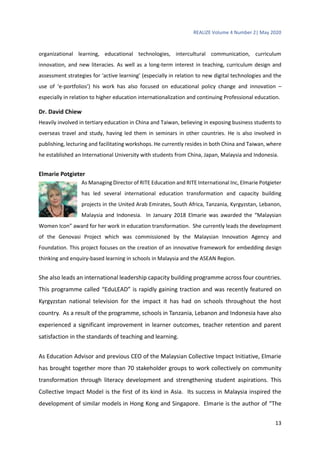
Elmarie Potgieter
As Managing Director of RITE Education and RITE International Inc, Elmarie Potgieter
has led several international education transformation and capacity building
projects in the United Arab Emirates, South Africa, Tanzania, Kyrgyzstan, Lebanon,
Malaysia and Indonesia. In January 2018 Elmarie was awarded the “Malaysian
Women Icon” award for her work in education transformation. She currently leads the development
of the Genovasi Project which was commissioned by the Malaysian Innovation Agency and
Foundation. This project focuses on the creation of an innovative framework for embedding design
thinking and enquiry-based learning in schools in Malaysia and the ASEAN Region.
She also leads an international leadership capacity building programme across four countries.
This programme called “EduLEAD” is rapidly gaining traction and was recently featured on
Kyrgyzstan national television for the impact it has had on schools throughout the host
country. As a result of the programme, schools in Tanzania, Lebanon and Indonesia have also
experienced a significant improvement in learner outcomes, teacher retention and parent
satisfaction in the standards of teaching and learning.
As Education Advisor and previous CEO of the Malaysian Collective Impact Initiative, Elmarie
has brought together more than 70 stakeholder groups to work collectively on community
transformation through literacy development and strengthening student aspirations. This
Collective Impact Model is the first of its kind in Asia. Its success in Malaysia inspired the
development of similar models in Hong Kong and Singapore. Elmarie is the author of “The
REALIZE Volume 4 Number 2| May 2020
14
Trust School Standards and Principles” and was also the chief architect of the AMIR
Foundation Trust Schools Programme, which aims at finding a sustainable solution to
transformation of Malaysian public schools. This programme is currently implemented in
more than 100 Malaysian public schools nationwide. Elmarie also led the development of
education projects involving 426 national Principals and Coaches and Project GUSTO, a
collaborative project with Teach For Malaysia and the AMIR Foundation.
Her company, RITE Education, also led the development and implementation of other
nationwide leadership and teacher development programmes in collaboration with the
PINTAR Foundation. She is the Ideator and co-author of “ThinkWise”, a thinking skills
curriculum and development programme for Early Years Education. Her work in the
development of thinking skills is widely recognised and as a result she is a regular guest
speaker and panellist in international events; on emotional intelligence, mindfulness and
positive behaviour management. She is a passionate student of neuroscience and the impact
that this growing field has on teaching and learning.
Elmarie is the president of a chapter of the Soroptimist International organization, a member of the
2017 Science Outlook Committee and in her spare time also a keen photographer, jewellery designer
and performing artist. She holds a BA Hons and a Post-Grad Diploma from the University of Pretoria,
South Africa. She is a Six Seconds Accredited Emotional Intelligence Coach and a Kagan Institute
Scholarship Winner. She has attended numerous courses across the world in education leadership,
change management, neuroscience in education and emotional intelligence.
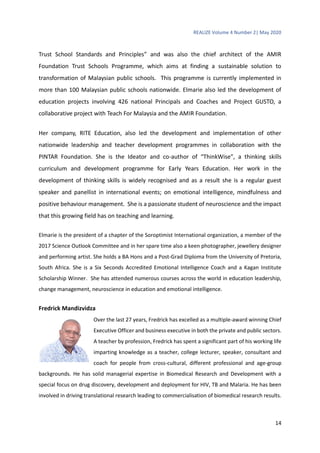
Fredrick Mandizvidza
Over the last 27 years, Fredrick has excelled as a multiple-award winning Chief
Executive Officer and business executive in both the private and public sectors.
A teacher by profession, Fredrick has spent a significant part of his working life
imparting knowledge as a teacher, college lecturer, speaker, consultant and
coach for people from cross-cultural, different professional and age-group
backgrounds. He has solid managerial expertise in Biomedical Research and Development with a
special focus on drug discovery, development and deployment for HIV, TB and Malaria. He has been
involved in driving translational research leading to commercialisation of biomedical research results.
REALIZE Volume 4 Number 2| May 2020
15
As a Certified Wealth Creation Coach and an International Labour Organisation (ILO) Certified
Consultant for the premium Expand Your Business (EYB) programme, Fredrick worked with several
international corporates as well as the United Nations Development Program (UNDP), SNV
Netherlands, MS Demark, among others.
Fredrick has authored four best-selling books, three of them in emerging technologies, covering the
Cyber-Physical System and digital era talent pipeline development. A savvy blogger and conversational
leader in emerging technologies, Fredrick offers fresh perspectives and deep insights into global next
generation business and industry leadership. His interest in, and deep knowledge of, emerging
technologies has seen him undertaking pioneering work in Africa’s human capital development for
Industry 4.0 and digital transformation with 21st century leadership in mind.
Fredrick holds a Licentiate Degree in Education – Biological Sciences (Lic. Ed., Bio. Sci.), a Bachelor in
Business Administration (BBA) and a Master in Business Administration (MBA) in Strategic
Management. He is currently pursuing a Doctorate in Business Administration with a prestigious
university from Malaysia. Fredrick sits on the boards of several companies.
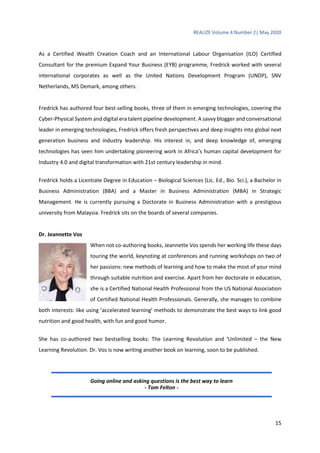
Dr. Jeannette Vos
When not co-authoring books, Jeannette Vos spends her working life these days
touring the world, keynoting at conferences and running workshops on two of
her passions: new methods of learning and how to make the most of your mind
through suitable nutrition and exercise. Apart from her doctorate in education,
she is a Certified National Health Professional from the US National Association
of Certified National Health Professionals. Generally, she manages to combine
both interests: like using ‘accelerated learning’ methods to demonstrate the best ways to link good
nutrition and good health, with fun and good humor.
She has co-authored two bestselling books: The Learning Revolution and ‘Unlimited – the New
Learning Revolution. Dr. Vos is now writing another book on learning, soon to be published.
Going online and asking questions is the best way to learn
- Tom Felton -
REALIZE Volume 4 Number 2| May 2020
16
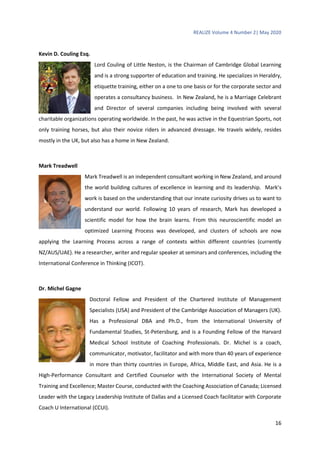
Kevin D. Couling Esq.
Lord Couling of Little Neston, is the Chairman of Cambridge Global Learning
and is a strong supporter of education and training. He specializes in Heraldry,
etiquette training, either on a one to one basis or for the corporate sector and
operates a consultancy business. In New Zealand, he is a Marriage Celebrant
and Director of several companies including being involved with several
charitable organizations operating worldwide. In the past, he was active in the Equestrian Sports, not
only training horses, but also their novice riders in advanced dressage. He travels widely, resides
mostly in the UK, but also has a home in New Zealand.
Mark Treadwell
Mark Treadwell is an independent consultant working in New Zealand, and around
the world building cultures of excellence in learning and its leadership. Mark’s
work is based on the understanding that our innate curiosity drives us to want to
understand our world. Following 10 years of research, Mark has developed a
scientific model for how the brain learns. From this neuroscientific model an
optimized Learning Process was developed, and clusters of schools are now
applying the Learning Process across a range of contexts within different countries (currently
NZ/AUS/UAE). He a researcher, writer and regular speaker at seminars and conferences, including the
International Conference in Thinking (ICOT).
Dr. Michel Gagne
Doctoral Fellow and President of the Chartered Institute of Management
Specialists (USA) and President of the Cambridge Association of Managers (UK).
Has a Professional DBA and Ph.D., from the International University of
Fundamental Studies, St-Petersburg, and is a Founding Fellow of the Harvard
Medical School Institute of Coaching Professionals. Dr. Michel is a coach,
communicator, motivator, facilitator and with more than 40 years of experience
in more than thirty countries in Europe, Africa, Middle East, and Asia. He is a
High-Performance Consultant and Certified Counselor with the International Society of Mental
Training and Excellence; Master Course, conducted with the Coaching Association of Canada; Licensed
Leader with the Legacy Leadership Institute of Dallas and a Licensed Coach facilitator with Corporate
Coach U International (CCUI).
REALIZE Volume 4 Number 2| May 2020
17
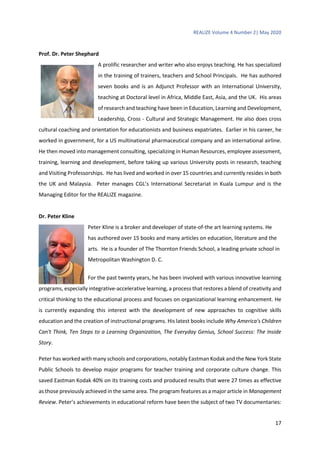
Prof. Dr. Peter Shephard
A prolific researcher and writer who also enjoys teaching. He has specialized
in the training of trainers, teachers and School Principals. He has authored
seven books and is an Adjunct Professor with an International University,
teaching at Doctoral level in Africa, Middle East, Asia, and the UK. His areas
of research and teaching have been in Education, Learning and Development,
Leadership, Cross - Cultural and Strategic Management. He also does cross
cultural coaching and orientation for educationists and business expatriates. Earlier in his career, he
worked in government, for a US multinational pharmaceutical company and an international airline.
He then moved into management consulting, specializing in Human Resources, employee assessment,
training, learning and development, before taking up various University posts in research, teaching
and Visiting Professorships. He has lived and worked in over 15 countries and currently resides in both
the UK and Malaysia. Peter manages CGL’s International Secretariat in Kuala Lumpur and is the
Managing Editor for the REALIZE magazine.
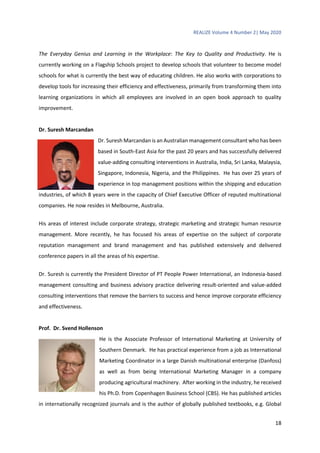
Dr. Peter Kline
Peter Kline is a broker and developer of state-of-the art learning systems. He
has authored over 15 books and many articles on education, literature and the
arts. He is a founder of The Thornton Friends School, a leading private school in
Metropolitan Washington D. C.
For the past twenty years, he has been involved with various innovative learning
programs, especially integrative-accelerative learning, a process that restores a blend of creativity and
critical thinking to the educational process and focuses on organizational learning enhancement. He
is currently expanding this interest with the development of new approaches to cognitive skills
education and the creation of instructional programs. His latest books include Why America's Children
Can't Think, Ten Steps to a Learning Organization, The Everyday Genius, School Success: The Inside
Story.
Peter has worked with many schools and corporations, notably Eastman Kodak and the New York State
Public Schools to develop major programs for teacher training and corporate culture change. This
saved Eastman Kodak 40% on its training costs and produced results that were 27 times as effective
as those previously achieved in the same area. The program features as a major article in Management
Review. Peter’s achievements in educational reform have been the subject of two TV documentaries:
REALIZE Volume 4 Number 2| May 2020
18
The Everyday Genius and Learning in the Workplace: The Key to Quality and Productivity. He is
currently working on a Flagship Schools project to develop schools that volunteer to become model
schools for what is currently the best way of educating children. He also works with corporations to
develop tools for increasing their efficiency and effectiveness, primarily from transforming them into
learning organizations in which all employees are involved in an open book approach to quality
improvement.
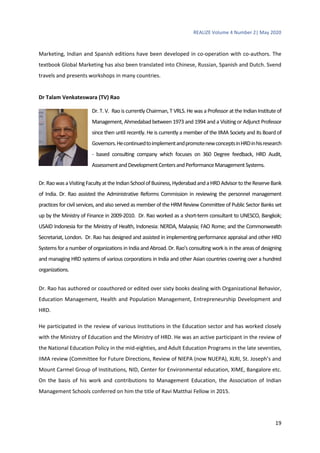
Dr. Suresh Marcandan
Dr. Suresh Marcandan is an Australian management consultant who has been
based in South-East Asia for the past 20 years and has successfully delivered
value-adding consulting interventions in Australia, India, Sri Lanka, Malaysia,
Singapore, Indonesia, Nigeria, and the Philippines. He has over 25 years of
experience in top management positions within the shipping and education
industries, of which 8 years were in the capacity of Chief Executive Officer of reputed multinational
companies. He now resides in Melbourne, Australia.
His areas of interest include corporate strategy, strategic marketing and strategic human resource
management. More recently, he has focused his areas of expertise on the subject of corporate
reputation management and brand management and has published extensively and delivered
conference papers in all the areas of his expertise.
Dr. Suresh is currently the President Director of PT People Power International, an Indonesia-based
management consulting and business advisory practice delivering result-oriented and value-added
consulting interventions that remove the barriers to success and hence improve corporate efficiency
and effectiveness.
Prof. Dr. Svend Hollenson
He is the Associate Professor of International Marketing at University of
Southern Denmark. He has practical experience from a job as International
Marketing Coordinator in a large Danish multinational enterprise (Danfoss)
as well as from being International Marketing Manager in a company
producing agricultural machinery. After working in the industry, he received
his Ph.D. from Copenhagen Business School (CBS). He has published articles
in internationally recognized journals and is the author of globally published textbooks, e.g. Global
REALIZE Volume 4 Number 2| May 2020
19
Marketing, Indian and Spanish editions have been developed in co-operation with co-authors. The
textbook Global Marketing has also been translated into Chinese, Russian, Spanish and Dutch. Svend
travels and presents workshops in many countries.
Dr Talam Venkateswara (TV) Rao
Dr. T. V. Rao is currently Chairman, T VRLS. He was a Professor at the Indian Institute of
Management, Ahmedabad between 1973 and 1994 and a Visiting or Adjunct Professor
since then until recently. He is currently a member of the IIMA Society and its Board of
Governors.HecontinuedtoimplementandpromotenewconceptsinHRDinhisresearch
- based consulting company which focuses on 360 Degree feedback, HRD Audit,
AssessmentandDevelopmentCentersandPerformanceManagementSystems.
Dr.RaowasaVisitingFacultyattheIndianSchoolofBusiness, HyderabadandaHRDAdvisor totheReserveBank
of India. Dr. Rao assisted the Administrative Reforms Commission in reviewing the personnel management
practices for civil services, and also served as member of the HRM Review Committee of Public Sector Banks set
up by the Ministry of Finance in 2009-2010. Dr. Rao worked as a short-term consultant to UNESCO, Bangkok;
USAID Indonesia for the Ministry of Health, Indonesia: NERDA, Malaysia; FAO Rome; and the Commonwealth
Secretariat, London. Dr. Rao has designed and assisted in implementing performance appraisal and other HRD
Systems for a number of organizations in India and Abroad. Dr. Rao’s consulting work is inthe areas of designing
and managing HRD systems of various corporations in India and other Asian countries covering over a hundred
organizations.
Dr. Rao has authored or coauthored or edited over sixty books dealing with Organizational Behavior,
Education Management, Health and Population Management, Entrepreneurship Development and
HRD.
He participated in the review of various Institutions in the Education sector and has worked closely
with the Ministry of Education and the Ministry of HRD. He was an active participant in the review of
the National Education Policy in the mid-eighties, and Adult Education Programs in the late seventies,
IIMA review (Committee for Future Directions, Review of NIEPA (now NUEPA), XLRI, St. Joseph’s and
Mount Carmel Group of Institutions, NID, Center for Environmental education, XIME, Bangalore etc.
On the basis of his work and contributions to Management Education, the Association of Indian
Management Schools conferred on him the title of Ravi Matthai Fellow in 2015.
REALIZE Volume 4 Number 2| May 2020
20
Will Fastiggi
Will Fastiggi has worked in schools in the UK, China, Guatemala, El Salvador, and
Brazil in roles as a teacher, trainer and ICT Coordinator. Graduating with a
master’s in digital technologies, communication & education, from the University
of Manchester (UK). Will has a keen interest in developing the Computing & ICT
curriculum in primary school education and making practical use of digital
technologies for schools. You can find out more about Will from his blog:
technologyforlearners.com. He has been invited to join Cambridge Global Learning’s Board of Advisors
with the award of Distinguished Fellow.
REALIZE Volume 4 Number 2| May 2020
21
Spotlight on Network Affiliate Programs
The main or more popular programs are:
1. Certified Professional Trainer (CIPT)
2. Advanced Professional Certificate in Accelerative Learning (APCAL)
3. Post Graduate Diploma in Learning and Development (PG. Dip. LAD)
4. Certified International Professional Coach™ (CIPC)
5. Certified International Professional Leader (CIPL)
6. Certified International Professional Strategist™ (CIPS)
7. Certified International Professional Facilitator (CIPF)
8. Certified Professional Learning Interventionist (CPLI)
The Certified International Professional Trainer
(CIPT-UK) course provides a pragmatic
approach by providing a batch of learners to
train. Upon completion of your assessment a
(VIVA Presentation) which demonstrates the
competencies learned throughout the
program, certification is awarded by CGL. The
CIPT also receives UK accreditation. Turn
theory to practice with your own training
people.
The modules expand on a well accepted the
tested model which consists of Analysis,
Design, Development, Implementation and
Evaluation, combining other surrounding tasks
and responsibilities of a trainer, such as
reporting and demonstration, marketing as a
trainer, client relationships and presentation
techniques, some of which are rarely included
as part of other ‘Train-The-Trainer programs’.
This is designed as a 2-3 months intensive
program, subject to client’s needs. There is
also a CGL ‘On-Line’ Individual, Professional
Certification version, using Skype, Assignments
and Project Based Learning (PBL). There is also
a CPT available for those without the
exposure to the international/intercultural
content.
The Professional Certificate is accredited by
Oxbridge-UK and listed in the British
Professional Qualifications Register. It is
recognized by Cambridge Global Learning and
graduates receive a Fellow Award from CGL
APCAL is offered as a ‘Distance Learning’ online
program. It focuses on a range of techniques
from the Accelerative Learning repertoire.
These include uses of: Music, Visualization,
Peripherals, Body Sculpturing, Idea Mapping,
N.L.P. and Learning Styles. Also Breathing,
Relaxation, Cross- Lateral Physiological
Movement and Exercises, Multi-modal, Multi-
sensory stimuli and the ‘Multiple Intelligences’
model. It is divided into 4 modules, expected to
be completed by self-study and research, each
taking 1 – 2 months on average. Each module
uses a ‘Project Based Learning’ approach (PBL)
with project reports being evaluated by a panel
of qualified assessors. The modules are:
Project 1: Analyzing Individual Learning
Needs and Styles
Project 2: Designing and Developing a Full
Accelerative Learning Program
Project 3: Facilitating Group Learning
(With Many Accelerative Learning
Techniques)
2. Advanced Professional
Certificate in Accelerative
Learning (APCAL)
1. Certified International
Professional Trainer (CIPT)
REALIZE Volume 4 Number 2| May 2020
22
Project 4: Evaluating Effectiveness and
Results of Learning Programs
The Professional Certificate is accredited by
Oxbridge-UK and listed in the British
Professional Qualifications Register. It is
recognized by Cambridge Global Learning and
graduates receive a Fellow Award from CGL
Can be completed in 6 – 8 months. Credits can
through RPL and transferred to Diploma Level.
This is offered in a ‘Distance Learning/Action
Research Mode’. It comprises Action Research
projects, which include:
Project 1: Focuses on the role of Learning and
Development
Project 2: In depth study of Applied Behavioral
Science in Learning
Project 3: Action Research Assignment
presented in a 3000-word report.
Can all be done ‘online’ with guided
supervision and materials are provided.
Completion is usually in 9 – 12 months.
The Professional Certificate is accredited by
Oxbridge-UK and listed in the British
Professional Qualifications Register. It is
recognized by Cambridge Global Learning and
graduates receive a Fellow Award from CGL
THE NEXT 3 CERTIFICATES ARE NEW
With the current emphasis on helping
individual employees to realize their full
potential, the techniques of coaching are fast
becoming essential tools for those responsible
for the growth and development of others.
Coaching is the world’s second fastest growing
business skill, after IT and yet in Africa, Asia,
and the Middle East, it is still in its infancy. It
has been found to give an ROI of 7 times that
of training. This program will also help build
skills needed to enhance the future
performance and the career of individuals or
teams, especially relating to the feedback of
progress.
Coaching essentially relates to helping others
develop skills and attitudes that the coach can
develop that others do not have or have not
yet developed well enough. Mentoring on the
other hand deals more with Advice, knowledge
and confidence building for longer term career
development.
 Influence of Personality, Gender, Needs,
and Culture on Thinking and Learning.
 Defining Coaching versus Counselling,
Training, Mentoring and Facilitating.
 Coaching Individuals versus Groups/Teams
 Why Coaching is So Important and Useful
 Overcoming Barriers to Coaching
 The Coaching Process – The GROW Model
 Coaching Styles versus Learning Styles
 Coaching is about Questioning & Listening
 The Role of Giving Feedback and Appraisal
 Skills in Dealing with Self-limiting Beliefs
 Maximizing Human Potential
 Mentoring Skills and Styles
 Cross Cultural Factors & individual Values
 Overcoming Personal and Cultural Barriers
 Skills in Dealing with Difficult People
 Self-Assessment of own Coaching Styles
and Receiving Constructive Feedback
 Personal Development Action Plan (PDAP)
A key and unique feature of this program is
that all participants will complete a personality
traits survey form, resulting in a detailed
personality profile. This will enable
participants to discover their thinking and
learning relating to their own coaching styles.
3. Post Graduate Diploma in
Learning and Development
(PG. Dip. LAD)
Program Contents
Program Methodology4. Certified International
Professional Coach™ (CIPC)
REALIZE Volume 4 Number 2| May 2020
23
The CIPC program is accredited in the UK by
The Oxbridge Trust and listed in the British
Professional Qualifications Register. It is
recognized by Cambridge Global Learning
(CGL) and graduates, also receive a Fellowship
Award from CGL
Program design incorporates a variety of
methods to both stimulate active learning and
appeal to the mix of participants preferred
learning styles. Building on participants’
personality profiles, several interactive
exercises, games, and group discussion help
them to understand the different thinking skills
needed. Where appropriate, selected
multimedia, video or power point visuals
augment a comprehensive manual of notes.
The workbooks are professionally laid out,
appealing to the learner, and capturing key
learning points and post program actions. In
addition to the 40 contact hours, students also
require 40 hours of coaching practice with
successful evaluation & feedback.
This can also be designed as a Professional
Certificate course or a less intensive 60 hours
in house program, subject to the client’s needs.
Roles of Neuroscience, Culture, Gender and
Personality in Leadership
There has been more written about the topic
of leadership, than any other subject in
business, management, education, or politics.
And, a more recent paradigm is to differentiate
Leading from Managing. Sometimes we find
people who are great managers, but not so
good at leading, and vice-versa. This gives rise
to the question “are leaders more born or
developed”. Here, Neuroscience comes into
the picture.
Research shows that it can be both, but if the
needed basic innate traits do not exist, then
there are not enough raw materials to develop.
Studies show there is a strong correlation
between certain personality traits and
effective leadership.
That is personality, which is more ‘inborn’ and
to an extent, style preferences. Gender is also
critical. However, culture is another major
influence on style and gender roles. There are
some distinct differences between African,
Asian, Middle Eastern and Western leadership
styles.
There are some of the core issues that are
addressed in this program.
 Influence of Personality, Gender and
Culture on thinking and Leadership
Behavior
 The Importance of Neuroscience in
Leadership
 Leadership: an overview
- Defining leadership
- Leadership as both a science and art
- Leading as more right brained
- Managing as more left brained
- Alignment of vision, values, and mission
 Leading versus managing
 Gender differences and Leadership Styles
 Your job as a leader and/or a manager
 Leaders: Born or made
- Nature versus Nurture
- Learning to Lead
- Qualities of Leadership
 Leadership and Personality
- Intelligence, talent, and traits
- Motivation, Drives, and charisma
- Leadership styles
 Leadership Motivation
- Leadership and Motivation are
inseparable
 Cultural models of leadership
- Eastern versus Western models
 Other Leadership Theories and Models
 Leading a Learning Organization
 Assessing leadership development needs
 Personal Development Action Plan (PDAP)
Program Duration
5. Certified International
Professional Leader (CIPL)
Program Contents
REALIZE Volume 4 Number 2| May 2020
24
A key and unique feature of this program is
that all participants complete a series of self-
assessment survey forms, resulting in a
detailed profile of personality traits,
motivational drives and competencies. This
will enable participants to discover their own
preferred cognitive and emotional styles,
which in turn can strongly influence the
dynamics of thinking and learning, relating to
this program.
Program design incorporates a variety of
methods to both stimulate active learning and
appeal to the mix of participants preferred
learning styles. Building on participants’
personality profiles, a number of interactive
exercises, games and group discussion help
them to understand the different thinking skills
needed. Where appropriate, selected
multimedia, video or power point visuals
augment a comprehensive textbook. The book
is professionally laid out, appealing to the
learner and capturing key learning points and
post program actions.
The Professional Certificate is accredited by
Oxbridge-UK and listed in the British
Professional Qualifications Register. It is
recognized by Cambridge Global Learning and
graduates receive a Fellow Award from CGL
This is designed as a 2-3 months intensive
program, subject to client’s needs. There is
also a CGL ‘On-Line’ Individual, Professional
Certification version, using Skype, Assignments
and Project Based Learning (PBL). There is also
a CPL available for those without the exposure
to the international/intercultural content.
Strategic Thinking and Leading in
Management Strategy
The word strategy comes from the Greek word
‘strategos’ which means ‘general’, and later
became the name for the ‘leader’ of an army
or a strategist.
A strategy is a general program of actions
directed toward the attainment of goals or
objectives, with commitment to resource
utilization and how this will be applied. It is a
type of ‘Future’ oriented and ‘Big Picture’
thinking, which emerges as a Strategic Plan.
However, not all people naturally think this
way. Although, if senior managers and
professionals are selected and promoted
correctly, these traits will have been identified
as ones’ they possess. Next come the
techniques and skills and then motivation to
use them. But what happens if this personality
trait is weak? Then the skills may even be more
important.
How to formulate, plan, lead, execute and
evaluate strategy in a VUCA (Volatile,
Uncertain, Complex and Ambiguous) world is
fully explored in this program.
 Influence of Personality, Gender and
Culture on Thinking, Learning and strategic
leadership
 Types of thinking required for strategic
leadership, management, development,
execution & evaluation
 Assessing one’s own style preferences and
how these apply to strategic thinking. The
5 P’s of strategy
 The what & the why of strategy
formulation
 Various schools of thought on strategic
management
 Levels of strategy and different concepts of
strategy
 The process of strategy: fitting values,
vision, mission, goals, planning and
controls in strategic management
 Types of strategy: differentiation &
diversification.
 Stakeholder external/internal analysis, and
integration
Program Methodology
Program Duration
6. Certified International
Professional Strategist™ (CIPS)
REALIZE Volume 4 Number 2| May 2020
25
 Human Capital/Resource Management
and strategy
 Organizational culture, change, growth,
and decline
 Generic strategy: Competitive advantages
& costings
 Globalization, geo-centricity &
international strategy
 Strategy, systems, structure & McKinsey’s
7-S model
 Assessing own competencies in strategic
management
 Personal Development Action Plan (PDAP)
A key and unique feature of this program is
that all participants will complete a personality
traits survey form, resulting in a detailed
personality profile. This will enable
participants to discover their own preferred
cognitive and emotional styles, which in turn
can strongly influence the dynamics of thinking
and learning relating to this program.
Program design incorporates a variety of
methods to both stimulate active learning and
appeal to the mix of participants preferred
learning styles. Building on participant
personality profiles, several interactive
exercises, games and group discussion help
them to understand the different thinking skills
needed. Where appropriate, selected
multimedia, video or power point visuals
augment a comprehensive manual of notes.
The workbooks are professionally laid out,
appealing to the learner, and capturing key
learning points and post program actions.
The Professional Certificate is accredited by
Oxbridge-UK and listed in the British
Professional Qualifications Register. It is
recognized by Cambridge Global Learning and
graduates receive a Fellow Award from CGL
This is designed as a 40-contact hour intensive
program, spread over 2-3 months, subject to
client needs. It is also offered as an On-Line,
Professional Certification course, using Skype,
and Project Based Learning (PBL) assignments.
This must be completed in six months. There is
also a CPS where strategy is only localized
WHAT IS FACILITATION AND A FACILITATOR?
Facilitation comes from the word to
“Facilitate”, which means to make possible or
to make easy, to help progress. Thus, a
facilitator is anyone who helps others to
progress, learn and do their work easier or
better. Facilitators are not “Teachers” or
“Trainers”; they merely help to provide
conditions where learning is made easier and
more effective. Facilitators assume
“experimental” learning in more effective and
as such encourage “self-directed” learning and
a group to responsibly achieve their goals.
By the end of this program, participants will be
able to:
 Ensure their roles are clear at the
beginning of a session
 Help group clarify their goals and
expectations
 Help individuals clarify their own roles,
needs, priorities, goals, and expectations
 Maintain a natural and objective position
 Help group stay on target and not digress
 Give feedback on group’s leadership,
working processes and communication
styles (called Interactive Process Analysis)
 Protect and enhance group members self-
esteem and protect individual from
personal attack or defensiveness
 Encourage open and frank – but
constructive – communication between
members (intra) and groups (extra)
 Use different types of questioning skills,
including open, closed, and reflective.
 Identify and select different listening skills,
including critical, biased, discriminative,
evaluative, empathetic and deep listening.
Program Methodology
Program Duration
Learning Objectives
7. Certified International
Professional Facilitator (CIPF)
REALIZE Volume 4 Number 2| May 2020
26
 Observe whether the group spends time
deciding on process before launching into
their task and feedback the observation
 Summarize possible new learnings and
their on-the-job applicability
 Observe interactions and report
observations
 Evaluate actions of group only, and do it
cautiously and from a personal frame of
reference
 Build on ideas and observations brought
up by the participants. Make comments or
ask questions that cause the group to
really explore the implications of various
comments
 Encourage the participants to take more
responsibility for their learning (i.e.
throwing questions back to the group as
much as possible).
 Assess their own levels of competence in
facilitating diverse types of groups
 Develop a Personal Development Action
Plan (PDAP)
 Receive a Professional Certification and
Fellow award from Cambridge Global
Learning (UK/UE) and Oxbridge
Professional Qualification Panel
recognition
 Influence of Personality, Gender and
Culture on Thinking and Behavior
 The importance of Neuroscience in
Facilitation
 Cultural models of Facilitations
- Asian versus Western models
- Other theories on models
- Culture, diversity & corporate culture
- High performance teamwork
- Learning organizations
- Assessing future development needs
 Comparing the ‘GROW’ Model with other
theories or models
 Differences between Training Facilitating,
Consulting, Teaching, Lecturing, Training,
Coaching, Counselling & Mentoring
 How Facilitators are effective in
communication and truly ‘deep’ and
empathetic listeners
 Questioning techniques are skills
 Importance of clarifying goals, roles, and
expectations
 Ensuring groups meet their objectives and
outcomes
 How to maintain objectivity and
impartiality
 The role ‘Unconscious Bias’s
 Helping navigate the group through their
journey
 Balancing Content and Processes
 Ensuring individuals remain committed to
the tasks
 Protecting individual group members’ self
esteem
 The role of feedback and ways to provide
it constructively
 Importance of use of questions and
observing behavioral interactions and who
is enabling or inhibiting
 Reporting back to groups on their
interactional effects and drawing out the
shared wisdom of the group
 Skills in ‘Norming, Storming and Forming’
group progress and use of clarifying and
summarizing
 Monitoring the energy of the group and
pacing it
 Helping groups ‘manage’ their problems or
conflict and productive decision-making
 Encouraging group members to take on
more responsibility for their learning and
constant awareness of their behavioral
changes and organizational effectiveness
 Personal Development Action Plan (PDAP)
 Your CIPF award by Cambridge Global
Learning
 Evaluating progress and learning among
individuals
A key and unique feature or this program is
that all participants complete a series of self-
assessment survey forms, resulting in a
Program Contents
Program Methodology
REALIZE Volume 4 Number 2| May 2020
27
detailed profile of personality traits,
motivational drivers and competencies. This
will enable participants to discover their own
preferred cognitive and emotional styles,
which in turn can strongly influence the
dynamics of thinking and learning relating to
this program.
Program design incorporate a variety of
methods to both stimulate active learning and
appeal to the mix of participants’ preferred
learning styles. Building on participant
personality profiles, several interactive
exercises, games and group discussions help
them to understand the different thinking skills
needed. Where appropriate, selected
multimedia, video or power-point visuals
augment a comprehensive textbook. The book
is professionally laid out, appealing to the
learner and capturing key learning points and
post program actions.
The Professional Certificate is accredited by
Oxbridge-UK and listed in the British
Professional Qualifications Register. It is
recognized by Cambridge Global Learning and
graduates receive a Fellow Award from CGL
This is designed as a 40-contact hour program
which can be extended over 2 to 3 months,
subject to client’s needs. There is also an On-
line, Professional Certification version, using
Skype, Assignments and Project Based
Learning (PBL). This must be completed in six
months. There is a CPF for localized candidates
WHAT IS LEARNING INTERVENTION
The notion of a teacher as a professional who
is the repository of knowledge is now being
challenged with the advent of Internet where
information is easily available and, in many
instances, free. What is essential is to have a
professional who can help learners to bridge
the gaps in their acquisition of knowledge and
skills. This is the framework of learning
intervention where learners become educated
in areas that they need to take them to the
next level. The professional is the enabler for
the learner to achieve the goals in a specific
area.
By the end of this program, participants will be
able to:
 Ensure their roles as enablers are clear and
concrete
 Help learners to clarify their goals and
expectations
 Help the organization to clarify its own
roles, needs, priorities, goals, and
expectations
 Maintain a natural and objective position
 Help learners to stay on target and not
digress
 Give feedback on learners’ progress and
challenges
 Protect and enhance learners’ self-esteem
and enthusiasm
 Encourage open and constructive
communication by learners
 Provide the tools for the learners to do
reflective feedback
 Show how any new learning has an on-the-
job (OTJ) applicability
 Observe workplace interactions and
impact of the learning intervention
 Create a learning platform that allows
learners to take more responsibility for
their learning
 Assess their own levels of competence in
as professionals
 Develop a Personal Development Action
Plan (PDAP)
 Receive a Professional Certification and A
Fellowship award from Cambridge Global
Learning (UK/UE)
Workshop/Program Duration
Learning Objectives
8. Certified Professional
Learning Interventionist (CPLI)
REALIZE Volume 4 Number 2| May 2020
28
 Influence of Personality, Gender and
Culture on Thinking and Behavior
 The importance of Neuroscience in
Learning and Development
 Diagnostic meetings and Initial Assessment
 Mapping the Learning Intervention
Landscape
 Intrinsic and Extrinsic Motivation
 The ADDIE Model
 The Dick and Carey Systems Approach
 The Rapid Prototyping Model
 Successive Approximation Model
 The new Bloom’s Taxonomy
 Questioning techniques are skills
 Importance of clarifying goals, roles, and
expectations
 How to maintain objectivity and
impartiality
 Blended Learning Framework
 Planning the Intervention in Bite size
 Gagne’s Nine Events in Learning
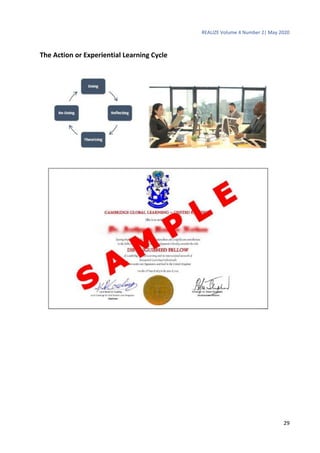
 KOLB’s Experiential Learning Cycle
 Balancing Content and Processes
 The role of reflective feedback with double
loop feedback
 A Toolbox of Tips and Techniques for
effective learning
 Monitoring and Pacing the energy of the
learner
 The Gig Learning Practitioner
 Monitoring and Evaluation of the learner
and the learning and development
profession.
 Personal Development Action Plan (PDAP)
 Award by Cambridge Global Learning
(CGL) as a Certified Professional Learning
Interventionist. (CPLI)
A key and unique feature of this program is
that all participants complete a series of self-
assessment survey forms, resulting in a
detailed profile of personality traits,
motivational drives, and competencies. This
will enable participants to discover their own
preferred cognitive and emotional styles,
which in turn can strongly influence the
dynamics of thinking and learning relating to
this program.
Program design incorporate a variety of
methods to both stimulate active learning and
appeal to the mix of participants’ preferred
learning styles. They are expected to put
together a portfolio of lesson plans,
assessments, and reflections of their
intervention experience. Where appropriate,
selected multimedia, video or power-point
visuals augment a comprehensive manual. The
book is professionally laid out, appealing to the
learner, and capturing key learning points and
post program actions.
The Professional Certificate is accredited by
Oxbridge-UK and listed in the British
Professional Qualifications Register. It is
recognized by Cambridge Global Learning and
graduates receive a Fellow Award from CGL
This is designed as a 40-contact hour program
which can be extended over 2 to 3 months,
subject to client’s needs. There is also an On-
line, Professional Certification version, using
Skype, Assignments and Project Based
Learning (PBL). This must be completed in six
months.
The Certificates and Diploma curricula and assessment are accredited in the UK by the Oxbridge Trust and recognized,
by CGL–UK, as an approved Learning Provider, who also is the awarding body. All the above programs can earn
exemptions, under the Approved Prior Experiential Learning (APEL) or Recognition of Prior Learning (RPL) schemes.
Thus, experienced Learning & Development or Teaching Practitioners may be able to use ‘Continuing Professional
Development (CPD) and APEL/RPL to gain up to 80% credits, or 50% in fee exemptions. The term ‘Recognized Prior
Learning’ (RPL) is used in the UK and many other countries. Institutional members may also provide these programs.
Program Contents Program Methodology
Workshop/Program Duration
REALIZE Volume 4 Number 2| May 2020
29
The Action or Experiential Learning Cycle
REALIZE Volume 4 Number 2| May 2020
30
Network Dialogue – Educators Forum
THE PURPOSE OF LEARNING - Your Thoughts Please!
To explore some of these issues, discussion and answers are welcomed on any of the questions below.
This is a network – member interactive page. Please send us your thoughts on this topic. Here we
pose 10 questions, to which any reader is invited to contribute their answers.
Here we pose 10 questions, to which any reader is invited to contribute their answers.
1. Why do we learn? (See diagram below and, also IJIL Vol.1 No.2.)
2. What do we need to learn from birth (or before) to survive and grow? (See Vol.2 No.2)
3. What are the basic or primary purposes of learning? (See Vol.2 No.1)
4. Is learning instinctively and innately inborn? (See Vol.2. No.1.)
5. Is the brain ‘hardwired’ for all people to learn some skills?
6. What is the role of language learning?
7. How critical is early language development to successive learning?
8. What are the higher purposes that come later in life?
9. Is there a hierarchy of learning needs or purposes – and how might it look?
10. Can we create a hybrid model – using for example “Maslow’s Motivational Hierarchy of Needs,”
or “Bloom’s Taxonomy” or Gagne’s “Hierarchy of Learning”?
For your thoughts, ideas or more questions – please email to pscredotrust@gmail.com
REALIZE Volume 4 Number 2| May 2020
31
Conference Updates
1. 15th ICTEL 2020 – International Conference on Teaching, Education & Learning
The conference will be held at NH Hotel Amsterdam-Zuid, Van
Leijenberghlaan 221, 1082 GG Amsterdam from 10-11 August 2020.
For more information, go to:
https://teraevents.org/conference/amsterdam-ictel-10-11-aug-2020
Or Contact E-Mail ID: convener@eurasiaresearch.info
2. The Osaka Conference on Education (OCE)
The OCE will be held at The Osaka University Nakanoshima Center,
Japan from 03-06 August 2020
The Osaka Conference on Education (OCE) is held in partnership with the IAFOR Research Centre at
the Osaka School of International Public Policy (OSIPP) at Osaka University.
In keeping with the IAFOR 2020 theme of “Embracing Diversity”, the conference will draw on the rich
local context for contextualization and inspiration, and invite scholars from the region and around
the world to come together to meet and exchange the latest ideas and research, at the time of the
Tokyo Olympic and Paralympic Games, an event that welcomes the world to celebrate peace and
unity
IAFOR's unique global platform facilitates discussion around specific subject areas, with the goal of
generating new knowledge and understanding, as well as forging and expanding new international,
intercultural and interdisciplinary research networks and partnerships. It is hoped that OCE2020 will
offer a remarkable opportunity for the sharing of research and best practice and for the meeting of
people and ideas. For more information, go to: https://oce.iafor.org/
3. International Society for Exploring Teaching and Learning (ISETL)
The 51st
Conference on Innovative Higher Education Pedagogy will
be held in Tempe Mission Palm, 60 East Fifth Street Tempe, AZ
85281 Arizona, USA from 8-10 October 2020.
ISETL encourages college and university faculty and practitioners from all disciplines to develop, study,
and apply learner-centered principles of teaching, learning, and assessment in innovative, yet effective
and practical ways. They are especially interested in presentations that demonstrate practical and
creative teaching and learning techniques that are grounded in literature and based on relevant best
practices and/or research that will appeal to colleagues in several disciplines. Preference will be given
REALIZE Volume 4 Number 2| May 2020
32
to presentations that promise to model alternative teaching methods and engage their audiences in
activity and dialogue.
ISETL conferences provide a professional forum for those who have something to share, and the
informal and interactive nature of the presentations makes learners and teachers of us all.
http://www.isetl.org/
4. 6th SIETAR Polska Congress
The congress will be held at Pałac Wielopolskich (Urząd
Miasta) plac Wszystkich Świętych 3/4, 31-004 Kraków,
Poland from 16-17 October 2020.
The theme of this year’s congress: ‘Identities in the VUCA
World’ calls attention to the challenges and opportunities of
managing and negotiating identities in today’s rapidly changing and unpredictable environments. By
including the acronym ‘VUCA’ in their conference theme they would like to invite you to join their
comprehensive discussions and reflect on the conditions of ‘volatility’, ‘uncertainty’, ‘complexity’ and
‘ambiguity’, which characterize our modern-day cultures. They want to explore how people are
adapting to the age of change and acceleration and how the demands placed on them by growing
inter-connectivity and technological advances affect their personal, business, political and social
identities.
For more information, go to: congress@sietar.pl
REALIZE Volume 4 Number 2| May 2020
33
Book Review
The Fourth Education Revolution
By Sir Anthony Seldon
AI will offer every child ‘an Eton education’
Review by Kaya Burgess
The Times newspaper, London, UK
Artificial intelligence will soon provide “an Eton
education for all” children, allowing every
school pupil to learn from their own
personalised device rather than from a
classroom teacher, a former headmaster has
said.
Sir Anthony Seldon,
now vice-chancellor
of the University of
Buckingham (UK)
was head at both
Brighton College and
Wellington College.
He said that the
education system in
Britain is well suited
to the 20th
century but is vastly underprepared
for the 21st
century and the “revolution” that
has already begun through artificial
intelligence.
Giving each pupil a computer or tablet in the
classroom could provide “one-on-one learning
individualised to the needs of every child in
every subject and developed to suit that child’s
learning”, Sir Anthony said.
He was discussing his book The Fourth
Education Revolution at the Henley Literary
Festival.
Sir Anthony Seldon with Oladimeji Abidoye,
the co-author of the book.
REALIZE Volume 4 Number 2| May 2020
34
Special Features
SOME WAYS TO MAKE WEBINARS MORE PROFESSIONAL
By Joe Urbanski
First, we said our heads were “in the clouds.”
Then, it was our data that was stored in the
cloud. Now, it seems like our lives are taking
place in the cloud—via the Internet. The novel
coronavirus has changed how we do business,
how we lead our teams, how we develop our
people, and even how we raise our families—
and this trend is likely going to continue into
the foreseeable future because, number one,
it’s not all that bad and, number two, people
are going to get used to it. The only thing I
cannot get used to is how companies and
trainers have used this as an excuse to be lazy.
I do not mean lazy in the typical sense.
Companies are doing more than usual to
support their people and their communities.
Businesses large and small are contributing
where they can. And you have been invited to
136 webinars so far.
So then, how do I mean lazy? Why are talent
development “professionals” delivering
webinars while sitting in chairs? What the
heck is that about? It is either lazy, naïve, or
disrespectful. Is that how we create high
energy? Is that how we interact with an
audience? Is that how we engage with the
human soul from the platform? No way! And it
is certainly not as much fun—for them or for
us.
Professionals do not sit on stage; we are not
reading the news. We are up. We are
energized. We are ready to inspire
participation. And I do not mean just in a Q&A
section at the backend of the webinar.
Let us start there: What is a webinar? There is
no Latin root for the word; we have only been
using it since the 1990s. A webinar is a seminar
on the web. What is a seminar? It is a meeting
or conference for discussion or training.
Discussion. It is not a lecture (which is an
educational talk).
What does this mean? The same strategies that
we deploy to create a high energy, interactive,
engaging, and fun experience for a stage
performance are the ones we should use for a
digital experience. We need to change our
mindsets, our approaches, and our language.
1. It is not just a webinar; it is a digital
experience. Think about how you can
transform this simple online training into
an event that people experience feelings
instead of only thoughts. Use our Learn-
Say-Do-Reflect (LSDR) model to make your
training a want-to, not a have-to. (See
graphic and get to this session.)
2. It is not just a presentation; it is a
performance. Do not just provide a chatty
lecture with graphs and charts that you
think are interesting. Stand up and give
your learners the energy they deserve. Do
more than just provide information. Get
yourself engaged to get everyone else
engaged. (Again, see the LSDR model.)
3. It is not just a group of attendees; it is a
community. If a seminar is a “meeting for
discussion or training,” we need to make
certain the lines of communication are
open during the entirety of the event. If
you create the space for conversation, it
will happen. Find ways to create
connection between everyone’s insights
and actions so they help you co-create the
experience.
4. It is not just your home office; it is your
studio. Get the right staging and lighting
and sound equipment to look like a pro. If
you are on camera and you have a window
behind you, it is time to redesign your
office. This is a new skill that you are going
to need as a trainer as the world gets used
to working from home and remote
REALIZE Volume 4 Number 2| May 2020
35
experiences, so be ready. And do not
worry, a beautiful front stage usually looks
ugly backstage.
This all sounds nice, but does it work? Of
course, it does. We at the Total Solutions
Group have been providing remote culture-
driven solutions for businesses since 2004, and
we have been deploying these strategies for
creating an energizing participant experience
since computers and smartphones had HD
cameras.
Join us in transforming the standard and less-
than-satisfying sit-down webinars and remote
training into standup experiences that
maintain the same approach you would in live
learning experiences.
ABOUT THE AUTHOR
Joe Urbanski is the
COO of the Total
Solutions Group
(TSG), a strategic
consulting, training,
and coaching firm
committed to driving
a transformative
impact to what’s
really most important to an organization’s
value proposition
and results. TSG’s core focus areas are
organizational and culture transformation,
strategic planning and business growth,
leadership development programs, and train-
the-trainer certifications. When it comes to
empowering people and organizations, Joe is
committed to helping you co-create your own
learning experience. For more than a decade,
he has honed his electrifying facilitation style,
performing for as many as 2,400 participants
during full-day training sessions, three-day
retreats, and multiyear programs. He has
delivered more than 525 on-site and online
workshops for more than 400,000 participants,
including executive leaders, corporate trainers,
and everyone in between. Joe is honored to be
ranked among the top 10 percent of speakers
in the Society for Human Resource
Management and ATD.
REALIZE Volume 4 Number 2| May 2020
36
A NEW REALITY - GETTING REMOTE LEARNING RIGHT
Keep It Simple, Schools
By Justin Reich
To ensure equity and engagement in remote learning, schools
need to zero in on key priorities, including enrichment and
manageable projects.
On March 26, Massachusetts’ Education
Commissioner Jeff Riley released a thoughtful
pathway forward for remote learning during a
pandemic (2020). The plan has three main
principles. First, care for students. Prioritize
keeping students fed and sheltered, supporting
emotional needs and mental health, and
attending to the most vulnerable students.
Second, create opportunities for projects and
enrichment. The state recommends that
schools focus on student interests, family
projects, and reinforcing previously taught
skills over addressing new material or learning
objectives. Third, set realistic expectations. The
state suggests that schools aim for about one-
half of a typical school day of learning time,
with a combination of student-driven learning,
educator-recommended activities, teacher
check-ins, physical activity, arts, and play. For
credit-bearing classes that do continue, the
state recommends switching to credit/no
credit grading for work.
My intuition is that whether by fiat, by
recommendation, or by necessity, most school
districts across the country will adopt similar
models that focus on projects and enrichment
over trying to maintain a regular schedule of
classes. The vast majority of American schools
are not set up to rapidly switch to remote,
online learning in the midst of a pandemic.
Many families lack access to devices and
broadband internet, and even families that do
have a computer at home often don’t have one
for each school-age child. Meanwhile, many
teachers are not familiar with digital learning
pedagogies, and some districts don’t have the
curriculum resources prepared to support
remote teaching. As growing economic
uncertainty raises anxiety and causes hardship
in families and the pandemic potentially causes
widespread illness among students and
teachers, the barriers to remote education will
grow.
Even in the best of circumstances, effective
distance learning can be difficult to accomplish.
Research suggests that young people have
great capacity for online learning, but much
less facility and persistence with online
schooling. Young people are remarkably facile
at using the internet to learn how to cook a
new recipe, beat a level in a video game, or
explore their interests (Ito et al., 2012).
Unfortunately, the research on pursuing
formal schooling and courses online provides
much less cause for optimism.
Over the last decade, researchers have
identified a kind of “online penalty” in terms of
grades and dropout rates when students
switch from face-to-face to online learning
(Dynarski, 2018). High achieving, affluent
REALIZE Volume 4 Number 2| May 2020
37
learners tend to be minimally affected by this
penalty: students who do fine anywhere will do
fine online. But most students do worse in
online courses, and the online penalty is more
severe for vulnerable and struggling
students—students with low prior
achievement, ethnic and racial minorities, and
younger students. These are the same groups
of students most likely to be hit hard by COVID-
19 and a possible economic recession. In the
best of circumstances, we’d expect these
students to struggle in a transition to online
learning, and we can expect yawning gaps in
outcomes to emerge during a pandemic. As a
result, a focus on projects and enrichment is
probably not only the most equitable way
forward for the weeks and months ahead, but
likely the most effective for keeping students
learning and engaged in school.
Even in the best of circumstances,
effective distance learning can be difficult
to accomplish. Schools now pivoting to
online learning can learn from the
experiences of virtual schools already in
operation.
Key Questions to Address for Remote
Learning
For schools and districts that want to adopt
Massachusetts’ proposed remote learning
model—one based on projects and
enrichment—there are four big questions to
address:
How will you publish good projects and
enrichment activities?
Schools now pivoting to online learning can
learn from the experiences of virtual schools
already in operation. Full-time virtual schools
typically operate with an asynchronous
learning model that depends upon parents and
caregivers acting as coaches. Schools publish
curriculum materials, parents help their
students proceed through these materials, and
teachers provide assessment of student work
and coaching to students and parents. At
younger ages, more of this happens with
students working under the direct supervision
of parents (a tremendous challenge during a
pandemic), but as students get older, there is a
greater expectation for independence and
synchronous learning with teachers and peers.
To simplify, virtual schools do two things: they
publish curriculum materials and they coach
students and families. For regular public
schools and district to pivot to distance
learning, they’ll need to become good at the
same two things.
For students to pursue projects and
enrichment, schools need to recommend and
distribute them. As much as possible, these
curriculum materials should be accessible to
learners in every dimension. They should be
designed so that students can pursue them
independently, with limited support from busy
parents who may be working, caring for other
children, or sick. Instructions should be simple,
with realistic expectations as well as
opportunities for extension. They should be
disseminated in as many ways as possible:
printed and mailed packets, online document
downloads, text message broadcasts, pre-
recorded phone messages, and radio or
television broadcasts. Schools should prioritize
low-bandwidth options for families with
limited internet access. Materials should be
translated into multiple languages and adhere
to accessibility guidelines for disabled learners.
REALIZE Volume 4 Number 2| May 2020
38
At every level of schools, we need to find
new ways to listen to each other at a
distance.
I appreciated a remote learning lesson plan
from Kelly Gallagher, an English Language Arts
high school teacher in Anaheim, California. He
encouraged his students to journal two pages
a day about their experiences and to seed their
writings with interesting readings, news
reports, or stories from the pandemic. He
promised to share his own writing, and he also
encouraged students to read for 30 minutes
each day. That’s it. While he published more
details online, the gist of his syllabus fits into a
text message.
Given all of the complexities of curating,
translating, screening for accessibility, and
publishing projects and enrichment activities,
teachers and schools should focus on these
kinds of activities, which are simple, rich,
extensible, reinforce important skills, and tap
into student interests and agency.
How will teachers remotely coach students?
Teachers will need guidelines about how to
support students and families safely,
compassionately, and regularly. There are four
categories of ways teachers can engage
students: (1) whole-class broadcasts, (2)
individual coaching and check-ins, (3)
synchronous meetings, and (4) facilitating
small group and peer learning. Schools should
provide teachers with guidance for how best to
approach these four modes in their local
context.
Teachers will need to regularly send messages
to their students to provide support, offer
feedback, celebrate progress, mourn loss as
illnesses and deaths mount, and offer
guidance. In an Advance Placement class, this
might mean recording lectures for students
who are determined to take the tests this
spring. In an elementary class, teachers might
read chapters of the class book. Again,
teachers should prioritize accessibility: making
materials available in simple, low-bandwidth
communications with attention to translations
and accessibility. In contexts with diverse
learners, this may mean that whole class
broadcasts will need to be limited (weekly
rather than daily), as it can be time consuming
to produce accessible materials.
Teachers should check in with their students as
regularly as possible; the best virtual
schoolteachers report that they spend most of
their time reaching out to students
individually. These communications could
happen by phone calls, messaging services, or
video conferences, but districts will need to
provide guidance about how to safely facilitate
the communications and how to keep parents
and caregivers informed and involved. During
check-ins, teachers can offer tutorials,
feedback on projects and enrichment work, or
just support, care, and listening during a
challenging time. There are major obstacles to
how much educators can teach and instruct at
a distance during a pandemic, but hopefully
many schools can find coaching and support
models that work.
Since we know that students who struggle
academically and who have unstable home
lives will be the most severely affected by the
transition to online learning, teachers should
make a special effort to reach out and connect
with these students. The students who need
the most help during these challenging times
may be the least likely to reach out.
The last two communication modes—
facilitating whole class and small group/peer to
peer meetings— will be the most challenging.
Not only is it logistically difficult to have
REALIZE Volume 4 Number 2| May 2020
39
students meet at the same time, but there are
privacy issues with having cameras turned on
(and potentially recording) in teacher and
student homes across the country.
Synchronous meetings can be a powerful time
for celebrations and community building, but
they raise challenging issues. In the early days
of the pandemic, online college courses were
beset with trolls interrupting lectures, sharing
pornographic images, making vile comments in
chat boards, and so forth. Teachers face
additional risks of having their teaching
recorded and broadcast without permission, of
witnessing abuse in homes, and other potential
issues. With strong cultural norms, thoughtful
selection of technology tools, careful attention
to default settings, and clear guidance for
teachers, these can be powerful modes of
learning, but they come with risks that schools
need to understand and address.
How will you partner with students, teachers,
and families?
The coronavirus pandemic feels like something
that is being done to us. There is a sense of
powerlessness as we watch our worlds
contract to our homes, apartments, and
temporary shelters. But our response to the
crisis can be something that we can do
together. At every level of schools, we need to
find new ways to listen to each other at a
distance. If school leaders haven’t surveyed
teachers, students, and families about how
things are going, today is the day to start. Even
a simple three question survey can gather
valuable data: “How are you? What has been
going well for you? What could we do more of,
or do better, to help your learning?” Teachers
can ask these questions of students; schools
can ask these questions of parents; districts
can ask these questions of faculty and families.
Asking these questions will do two things. First,
the answers to these questions may provide
useful new ideas. Perhaps more important, the
more that stakeholders feel like they are
partners co-constructing a response, the more
invested they will be in learning.
How will you plan for re-entry?
In its guidance, the state of Massachusetts
recommends that schools aim to get in about
50 percent of the typical amount of learning
time. Many students facing difficult home lives,
poverty, disengagement, or illness will simply
miss all or most of their learning during the
next few weeks or months of school closures.
While schools are understandably scrambling
to set up modes of remote learning, perhaps
the most important work of this period should
be planning ahead. What gets taught in your
school during the spring quarter that students
really need to be successful in future years?
What do students learn at the end of 3rd grade
or the end of a pre-calculus course that they
will need in the beginning of 4th grade or the
beginning of a calculus class?
Grade-level teams, department heads,
curriculum coordinators, and coaches should
be looking ahead to these challenges. How can
you make more time for that urgent material in
the fall? How can courses be rearranged so that
if a fall class typically starts with 1 day for
review on an important topic, teachers can
make time for 3 or 4 days? With federal and
state stimulus money for schools, what might
be possible for summer school in August or
extended-day time in the fall?
In the current scramble to remote learning, it
may feel like nothing is more important than
making something that works for tomorrow or
next week. But given all of the challenges that
schools will have in teaching during a crisis in
REALIZE Volume 4 Number 2| May 2020
40
April and May, it may be more productive to
invest substantial time in planning for making
things up in summer and fall.
A Cautious Approach to Experimentation
I have spent the last ten years studying
education technology and online learning, and
yet I have written very little about fancy digital
tools in my advice here. That’s because
spinning up new school technology initiatives
during the best of times is challenging; during
a pandemic it is just extraordinarily difficult. As
much as possible, schools should try to publish
materials and check in with students using
their existing technology infrastructure. How
much can you publish and disseminate through
phone trees, text messages, email, simple
webpages, or your existing online
infrastructure? How much coaching and
checking in can be done with tools that
students are already using? It may be that after
days or weeks of remote learning, a glaring
weakness in the distance learning
infrastructure emerges, where some kind of
new technology might be worth introducing.
But generally, keep it simple.
Publish good projects and learning resources.
Make them accessible. Disseminate widely.
Check in with students. Solicit feedback. Plan
for re-entry.
Schools that do a few simple things well, listen
to stakeholders, and plan for the future will
likely be in the best position on the other side
of this crisis. My hat is off, and my heart is with,
all of the teachers and administrators serving
students and families in these difficult times.
References
Dynarski, S. (2018, January 19). Online Courses
Are Harming the Students Who Need the Most
Help. The New York Times.
Ito, M., Gutierrez, K., Livingstone, S., Penuel, B.,
Rhodes, J., Salen, K., Schor, J., Sefton-Green, J.,
& Watkins, S. C. (2012). Connected Learning:
An Agenda for Research and Design. DML
Research Hub.
Massachusetts Department of Elementary and
Secondary Education. (2020). Remote Learning
Recommendations During COVID-19 School
Closures.
About the Author
Justin Reich (jreich@mit.edu) is an assistant
professor at MIT and the director of the MIT
Teaching Systems Lab. He hosts the TeachLab
podcast (teachlabpodcast.com) and is the
author of the forthcoming book Failure to
Disrupt: Why Technology Alone Can’t
Transform Education from Harvard University
Press. Follow him on Twitter at @bjfr.
REALIZE Volume 4 Number 2| May 2020
41
RESTORING CONNECTION: Real-Life Advice on Transitioning to Online
Learning
A distance-learning expert shares tips on moving to teaching online in a
difficult time.
Mike Flynn, a former 2nd grade teacher, is the
director of Mathematics Leadership Programs
at Mount Holyoke College in Massachusetts,
where he and his colleagues have created an
innovative and highly regarded onlinelearning
system for graduate students in math
education. He is also a widely sought distance-
learning trainer who has worked with K–12
school districts and higher education faculty
around the country on best practices for online
instruction. He recently launched a popular
online teacher support group based on a series
of free video training sessions.
With many schools making the transition to
onlinelearning platforms in response to the
coronavirus outbreak, we talked with Flynn
about what school leaders and teachers need
to know.
What should schools or educators be looking
for in an online-learning platform, especially
if we’re talking about a fairly quick transition?
The first thing I always recommend is to think
about what teaching practices or pedagogy
you want to leverage—that’s the priority.
Often people will make the mistake of looking
at online learning from the perspective of
what’s available in terms of technology and
then figuring out how to use that as a teacher.
It’s more important to look at how do you want
to teach and what’s out there to help you do
that. So what I find easiest—the combination
that causes the least amount of disruption—is
to use some kind of videoconferencing
platform, along with the Google Suite, because
those applications are so easy to use. For the
video conferencing, in some ways it doesn’t
matter which one you use—it’s a matter of
finding the one that has the features you want.
Do you have any advice for school leaders on
rolling out a new platform for a large group of
teachers? What would you focus on in
training?
In a time like this, people are going to be
scrambling, and there’s a steep learning curve.
In the short term, I think one important piece
of advice is to help teachers prioritize what’s
the most important for them with students.
Everyone’s going to be operating on limited
amounts of time—elementary teachers in
particular might just be meeting with students
for a short period of time. So you need to figure
out what are the most important things to
cover.
The other important advice is to be mindful of
our learners, who are all going to be nervous
currently. At this point, there is probably a little
bit of fear and uncertainty setting in. So
whatever bit of normalcy teachers can inject
into these live online settings is important. For
elementary teachers, that might mean holding
your morning meeting, or in kindergarten, you
might have a morning song. Or for high school
teachers, think about an engaging or
interactive routine that you always do with
your class that you can bring into this new
setting. The point is to help students see that
we’re still a class. Yes, we’re in a different
space, but there’s still some familiarity to what
we’re doing. And then as you move forward,
you start thinking about how do we leverage
REALIZE Volume 4 Number 2| May 2020
42
those live online times we have together—and
what are some meaningful, creative ways that
you can create work for kids to do when you’re
not on camera with them, because a lot of the
work is going to be independent.
What are some ways that teachers can ensure
that kind of ongoing engagement?
Part of this is to use the live time to make sure
kids have a sense of what’s expected when
they are working on their own. You also need
to make sure that the independent work is
something the students have some level of
familiarity with, so that what they’re doing is
working on practice—basically, we’re talking
good homework strategies, which means not
giving new learning for homework. That’s a big
piece of it. Another strategy is to think of other
creative ways that you can mix up the kinds of
work kids are doing outside the live class time,
so it’s not all just paper and pencil. Maybe the
students can create a slideshow to show their
learning, or maybe they could collaborate
using Google apps. If you have some 8th
graders who are doing a project based on a
book they just read, you might have them
create a presentation using Google Slides.
That’s a good way for them to synthesize their
learning in a new medium. This kind of thing
mixes it up for kids so they get different
experiences.
The point is to help students see that we’re
still a class. Yes, we’re in a different space, but
there’s still some familiarity to what we’re
doing.
You emphasize the importance of providing
guidelines for students for working in an
online learning environment. What would
that look like?
A teacher who is beginning to teach online
should think about what a week looks like,
what a day looks like in this class. What’s
happening live versus asynchronously? What’s
the schedule? What technology is going to be
used when? So, these are the things that
teachers and school leaders need to be
thinking about, in effect putting the pieces of
the puzzle in place. Therefore I always say less
is more: The fewer platforms you’re using, the
less confusion there is.
Once teachers know what they’re going to do,
they need to create a concrete way for kids and
their parents to be able reference the plan and
procedures. It could be in a Google Doc, it
could be a slideshow, or even a short video.
The point is just to explain, here’s what we’ll
do at this time, you’ll get on, you’ll log-in here,
or you’ll open up this Google Drive folder and
see today’s work in there. Having a good,
sharable plan makes it easier to have everyone
on the same page.
What kind of tech support do teachers and
students need in transitioning to an online
setting? How best can schools prepare for and
troubleshoot problems?
Most schools have some IT folks on board, and
this is where they step up. Working with school
leaders, they should know what platforms are
going to be used and then try to anticipate the
common tech problems. These are fairly
predictable—there are connectivity issues,
there are microphone problems, there are
difficulties locating particular features. So you
identify the most common tech issues that are
going to come up and you put those in a table.
Then you have separate troubleshooting
columns for what the students are supposed to
do, what the parents are supposed to do, and
what the teacher is supposed to do when these
issues come up. For instance, if the tech issue
is that a student’s internet goes down, then the
parents and students can look at the table and
figure out, “Oh, my job is to continue with the
assignments that I printed out and to let the
teacher know by texting them.”
REALIZE Volume 4 Number 2| May 2020
43
You can’t predict everything, but the nice thing
when you do this sort of contingency planning
is that you predict most of the things. Then if
something out of the ordinary happens, you
have the brain space to address it because you
don’t have 20 emails from people saying, “Hey,
my internet’s down,” or “I can’t find the Google
folder.” You’ve already taken care of a lot of
that stuff.
Are there effective ways schools can address
access or resource disparities within a class—
for example, if some students don’t have
regular access to the internet or to a
computer?
One good rule of thumb is to design the
materials based on the lowest level of access.
So if one of your students doesn’t have
internet access, you essentially proceed as if no
one did. This might mean distributing packets
of materials and assignments to students’
homes. But you could also have students
connect to online experiences by phone—for
example, students can call in to a Zoom
meeting if it’s set up for that. So the teacher
can design the lesson to be more of an auditory
experience. Another option—assuming kids
have at least limited access to a computer or
cell phone—is to record lessons and distribute
them by email or text or even snail mail. To
avoid privacy issues, you can record the lesson
with the students’ images and voices turned
off. Or you can pre-record the lesson. My son’s
middle school language arts teacher records
read-alouds for his class—she’s reading To Kill
a Mockingbird and then asking questions
which the kids respond to in writing
afterwards. So students are still getting the
teacher’s voice, clarity, and direction, but they
don’t have to be able to attend a live online
class.
How do you approach assessment in an
online class?
That’s a big question. With the assessment
piece, we’re going to have to recognize that
we’re not going to have the same sort of
control we’re accustomed to—because it’s
done asynchronously, and we can’t necessarily
see what students are doing. There are some
software programs that students can log-in to
to take tests, but there’s still really no way to
verify that they don’t have someone else doing
it for them or aren’t looking at course
materials. So, opinions differ, but my stance is
that at a time like this, the most important
thing for us to focus on is the continuation of
actual teaching and learning. Assessment is
part of that process in terms of helping find out
what kids are learning, but we need to look at
it through that formative lens, and we need to
have a level of trust in students that they will
do the work on their own to show us what they
understand. It’s that feedback that’s
important. The alternative is the accountability
lens, where we focus on whether a kid is
cheating, but I think we need to suspend that
view of assessment in the present context.
There’s just not a place for it.
Many parents and caregivers are also feeling
overwhelmed by the transition to remote
learning. Are their ways teachers can help
them or make things a little easier on them?
I think a big part of this is being mindful about
communication. We need to recognize that
parents have a flood of emails coming in every
day from schools right now, on top of their
regular work emails. So we need to try to be
super concise and to the point in our emails.
Use bulleted lists and take out extraneous text
and narrative. It’s just really helpful for families
if they can scan your email and get what they
need to know.
I’d also recommend limiting emails to parents
to one a week. If possible, send it as team and
REALIZE Volume 4 Number 2| May 2020
44
break it down by subject matter with bulleted
list for each subject on what to do when. One
step better is to provide checklists. This can
save parents a lot of time. I’d also emphasize
again the need to follow the general rules of
good homework. If we’re giving assignments or
tasks that allow kids to practice skills and
synthesize their learning and not have to learn
new content on their own, it’s going to
eliminate the need for them to have to
constantly get help from their parents. This is
really an equity issue as well. If I’m assigning a
project that has kids working with their parents
for 45 minutes, that’s going to be unfair to kids
whose parents have to go to work or who have
multiple children.
So, we need to think hard about workload
management. It’s also important for kids to
have some quality time doing things other than
sitting in front of a screen—whether it’s going
outside in the yard or getting some exercise or
doing something creative on their own. I
recently saw a great quote on Twitter about
how what we’re doing right now isn’t really
home schooling or even distance learning, it’s
crisis learning. We have to keep that in mind.
We need to design instructional experiences
that move kids along but also take into account
that we’re in just a really weird time right now
and need to be flexible.
We need to think hard about workload
management. It’s important for kids to have
some quality time doing things other than
sitting in front of a screen.
Any other general tips for educators who are
facing this transition right now?
The biggest thing is to work together—to find
communities of educators in spaces where you
can collaborate, where you can share
resources and share ideas. My other advice is
for everyone to please practice self-
forgiveness. You’re going to make mistakes in
the platform, things aren’t going to work the
right way, you’re going to try to do something
that you think will be very fun and interactive,
and the kids will get confused. There’s going to
be a level of frustration, but as long as the
choices we’re making are what’s in the best
interests of students and their learning in this
time of crisis, then we’re making the right
decisions, even if they don’t work out
perfectly. Forgive yourself. We’re all learning
and we’re all going to get better.
REALIZE Volume 4 Number 2| May 2020
45
Successfully Taking OFFLINE Classes ONLINE
By Catlin R. Tucker
The keys are prioritizing community and designing student-centered lessons.
Teachers who have taught exclusively offline in
a traditional school setting may find the
transition to teaching online daunting and
foreign. As educators navigate this new reality
of school closures, social isolation, and remote
learning, it’s important to remember that
education and learning encompass more than
disseminating and collecting assignments.
Learning, at its core, is a social endeavor.
People learn through their interactions with
each other and the world around them.
Given the social nature of learning, educators
who are moving their classes online must
prioritize community building to ensure their
students thrive online.
Creating a Community of Learners
The Community of Inquiry theoretical
framework underpins much of the research on
online and blended learning and is grounded in
collaborative constructivism (Swan, Garrison,
& Richardson, 2009). Given the concerns many
teachers have about the isolating nature of
online courses, I appreciate the focus that the
Community of Inquiry places on creating a
community of learners who can make meaning
while interacting online. This framework
provides a structure for teachers to design and
facilitate an online course to effectively engage
students in active learning.
The Community of Inquiry framework is
composed of three interconnected
presences—social presence, teaching
presence, and cognitive presence. The social
presence refers to the learners’ ability to assert
their social and emotional selves, view their
classmates as real people, and communicate
openly online. The teaching presence
encompasses the design, instruction, and
facilitation of learning in the course. Finally,
the cognitive presence is learners’ ability to
construct meaning through a process of
inquiry, dialogue, and reflection (Garrison,
Anderson, & Archer, 2000). Understanding the
interplay between these presences can help
teachers transitioning their courses online
create learning experiences that are engaging,
student-centered, and leverage the class’
collective intelligence.
The Social Presence: Cultivating an Online
Community
As teachers move online, a critical first step is
to create a safe virtual space that will help
students develop their social presence.
Traditional teachers shifting classes online
mid-year due to school closures may assume
that their students know each other and will
feel comfortable participating in academic
conversations and collaborative tasks online.
But I would caution teachers not to assume
that the community they have established in-
person will automatically translate to the
online environment. There are likely students
in our classes who have shared the physical
classroom all year but who may have never
spoken or collaborated on a shared task. The
transition to learning online presents an
opportunity for teachers to make sure that
everyone in the class community knows each
other and forms relationships with their peers
online that will make their interactions more
respectful and rewarding.
REALIZE Volume 4 Number 2| May 2020
46
A staple of any online course is discussion, and
a good online discussion can be a great way
to build community and communication skills.
The first step in establishing open, honest, and
respectful communication in an online
community is to clearly define the
expectations for behavior in the online
environment. Teachers concerned about what
students might say or do online should ask
their classes to think about and articulate the
behaviors they believe will help them to feel
comfortable engaging with peers and sharing
ideas. Teachers can ask the class to articulate
these expectations on a shared digital
document.
Asking students to craft the norms and
expectations for their online interactions gives
them ownership of the space and creates an
incentive for them to abide by these
guidelines. Teachers can add additional items
to the list or ask students to consider specific
behaviors to ensure the guidelines address the
teacher’s concerns about online interactions.
Once a clear guide has been established,
teachers can pose questions about what
consequences are appropriate when the
expectations for online communication have
been violated. This places the responsibility on
the community to think through the
appropriate response to missteps, and
students are more likely to internalize these
expectations and think about what they say
and do online.
A staple of any online course is discussion, and
a good online discussion can be a great way to
build community and communication skills.
Icebreaker discussion questions, like the ones
in Figure 1, can help students learn about their
peers and help them to view their virtual
classmates as real people with feelings, values,
and beliefs.
Research has established that higher levels of
perceived social presence in an online course
yield higher levels of interaction, engagement,
and satisfaction with that course (Tu &
McIsaac, 2002). This suggests that the
investment teachers make in building a
cohesive online community with a strong social
presence will pay dividends.
The Teaching Presence: Designing and
Facilitating Online Learning Experiences
Teaching online is obviously different from
teaching in a physical classroom, yet there are
areas of overlap that may help traditional
teachers feel more comfortable making the
move online. When I work with teachers who
are teaching a blended or entirely online
course for the first time, I encourage them to
treat their Google Classroom or learning-
management system (like Schoology or
Canvas) as their online classroom—to think of
it as a place where students engage and learn,
not just a place to just post things. This is the
place where students will access information
and resources, engage with their teacher and
their peers, and submit their work for feedback
and evaluation.
Once teachers begin to treat their learning
management system as their virtual classroom,
they can begin to think about their roles and
REALIZE Volume 4 Number 2| May 2020
47
responsibilities in this online environment. The
Community of Inquiry framework specifically
identifies course design, direct instruction, and
facilitation of learning as central to the
teaching presence in an online course (Swan et
al., 2009).
Traditional teachers must think differently
about the organization and design of their
online courses. It is a mistake to think that K–
12 students who spend seven hours a day in a
traditional classroom can spend that same
amount of time in front of a computer at
home. That is an unrealistic, and frankly
unhealthy, expectation. Students who are
isolated at home because of school closures
and social distancing mandates are juggling a
lot mentally and emotionally. They are
negotiating a shared space with their family.
They may be sharing devices and limited
bandwidth with parents and siblings. They may
also be dealing with fear and anxiety about the
current health crisis.
It’s important to adopt a modular approach to
designing distance-learning experiences.
Teachers must break up the learning activities
into smaller parts and give students time to
self-pace through those activities. The beauty
of online learning lies in the flexibility it affords
learners. I would encourage teachers to plan a
week at a time and post all of the videos,
articles, podcasts, online discussion questions,
and assignments that students will need at the
start of the week. When teachers post the
week’s work, they should clearly identify the
learning objectives for the week, due dates for
specific tasks, and times when the teacher will
be available for “office hours” via video
conferencing tools like Google Meet or Zoom.
This approach allows learners the luxury of
completing tasks at a time and pace that works
for them.
The Cognitive Presence: Engaging the Class in
Meaning Making
If teachers think about the building blocks of a
traditional lesson, they will begin to see how
those modular activities (direct instruction,
discussion, collaborative group work, and
others) can be shifted online using a variety of
tools, many of which are probably already
embedded into their learning-management
system. Figure 2 breaks down some of the
basic building blocks that educators use to
design offline lessons and describes how
teachers can use technology tools to engage
students in these activities online.
As teachers think about how these individual
building blocks fit together to form a learning
experience that extends over a week or several
weeks, it is helpful to consider using the 5Es
instructional model—engage, explore, explain,
elaborate, and evaluate—as a guide when
arranging these building blocks (Bybee, 2015).
This model provides teachers with a clear path
to designing a learning experience that will
develop the cognitive presence in a distance
learning community. It prioritizes inquiry,
exploration, collaboration, and
communication.
Teachers begin by engaging students in a
conversation about what they think or wonder,
what they already know, or what they would
like to find out about a particular topic. Then
students explore the topic. Teachers can
provide links to articles, videos, and podcasts
about a topic, or students can conduct their
own research. The “explain” phase of this cycle
encourages students to share what they have
learned, and the elaborate phase encourages
students to make connections between what
they are learning and other concepts covered
in the course as well as their lives beyond the
classroom. It also gives them opportunities to
practice, review, and apply what they learned.
The learning cycle ends with an evaluation
activity to assess what students learned or to
ask them to engage in a reflective activity
thinking about what they learned to develop
their metacognitive muscles.
The beauty of the 5Es instructional model is
that it emphasizes the role of the learner in the
process of making meaning in a course.
REALIZE Volume 4 Number 2| May 2020
48
Source: Catlin R Tucker
REALIZE Volume 4 Number 2| May 2020
49
Student-Centered Online Learning
Just because learning is moving online does not
mean that students should be relegated to the
role of passive receivers of information.
Instead, I would like to see teachers prioritize
student-centered learning by developing
online communities and designing lessons that
leverage technology tools and instructional
models that actively engage students in each
part of the learning process.
About the Author
Catlin R. Tucker (CatlinTucker.com) is a bestselling author, international
trainer, and keynote speaker. Catlin is pursuing her doctorate in
learning technologies at Pepperdine University and working as a
blended learning coach. She has published several books on blended
learning, including Balance with Blended Learning (Corwin, 2020).
Follow her on Twitter @Catlin Tucker.
References
Bybee, R. (2015). The BSCS 5E instructional model: Creating teachable moments. Arlington, VA:
National Science Teachers Association.
Garrison, D. R., Anderson, T, & Archer, W. (2000). Critical inquiry in a text-based environment:
Computer conferencing in higher education. The Internet and Higher Education, 2, 87–105.
Swan, K., Garrison, D. R., & Richardson, J. C. (2009). A constructivist approach to online learning: The
Community of Inquiry framework. In C. R. Payne (Ed.), Information technology and constructivism in
higher education: Progressive learning frameworks. Hershey, PA: IGI Global, 43–57.
Tu, C. H., & McIsaac, M. (2002). The relationship of social presence and interaction in online classes.
The American Journal of Distance Education, 16(3), 131–150.
REALIZE Volume 4 Number 2| May 2020
50
Accommodations, Modifications, and Intervention at a Distance
By Lee Ann Jung
To support special education
students during school shutdowns,
educators need careful coordination
and a focus on what matters most.
Never in our lifetime has a global health crisis
caused the need for such a broad swath of
long-term school closings as we are
experiencing with the novel coronavirus
outbreak. Teachers who have experimented
with “flipping” their classrooms and other ways
to teach online probably have a certain level of
confidence in this sudden shift to remote
learning. But for those who’ve never
experienced online learning or teaching or feel
less confident with digital technology, this can
be an unwelcome and stressful change. The
challenges are particularly steep for educators
working with students with disabilities.
The good news for teachers new to some of the
online technology is that we haven’t moved
purely to “online school,” but rather to remote
learning. Within remote learning, the options
for connection with students and families
include online videoconferencing, phone calls,
video calls to an individual, texting, email, and
mail. From an equity standpoint, it’s necessary
that we’re prepared to use any of these
methods to support connecting (first) and
learning.
Yet the unprecedented nature of this health
crisis leaves us with new questions about how
to provide special services to students, not for
a few days, but for weeks and months. The U.S.
Department of Education’s Office of Special
Education Programs has responded with online
documents and videos and has also been clear
that if a school moves to remote learning, it
must ensure that students who have IEPs have
access to that instruction (OSEP, 2020). Many
special educators have implemented
homebased instruction and interventions in
the past, but never have they been forced to
do so with no in-person contact and for the
entire population of students with IEPs.
Urgent questions are circulating. “How do we
deliver intervention at a distance?”, “How do
we provide accommodations and
modifications to online work?”, “How do I
measure progress?”, “What about students
with severe disabilities?”, and “How can we
support families?” Some support and
intervention can be provided by shifting to web
conferencing and phone calls, but direct,
online services often aren’t an option for our
youngest learners and students with more
significant intellectual disabilities. In this “new
normal,” special educators are charged with
serving many students solely through
consulting with their classroom teachers and
families. For students whose supports are now
provided mainly through such educator-to-
educator consultation, the families are now an
even more important part of the equation.
How do we do this in a way that supports
families, rather than burdening them with
overwhelming responsibility?
As we’re already seeing, the move to remote
learning exacerbates pre-existing issues of
equity in schools. Delivering instruction at a
distance isn’t simple, even when students have
REALIZE Volume 4 Number 2| May 2020
51
no difficulties with learning, a dedicated device
in a quiet space, a household with low stress
levels, and parents able to support learning.
But this ideal situation is far from ubiquitous.
The proportion of families who are currently
unemployed or underemployed, food
insecure, and experiencing high levels of stress
is higher than we’ve ever seen. We have
students who require accommodations,
modifications, and intervention now at home
with their families— many of whom are unsure
of how to provide the support they need.
While the situation is unprecedented, there
are steps schools can take to support students
who have IEPs in remote-learning settings. We
will no doubt learn a great deal from one
another and from our students and families in
the coming months. In the meantime, the
following suggestions can be a way to start
thinking about some of the many service-
delivery questions our teams are facing.
First, Support the Family
Families are in some ways being put in the role
of “learning coach” now, and for some, this
role is uncomfortable. We want to maximize
the time families have to give to supporting
their child’s learning, streamline it as much as
possible with their lives, and minimize their
feeling like a full-time teacher or therapist.
Already under enormous pressure, millions of
people have lost their jobs. Millions more are
tasked with working full-time at home in a new
way and supporting their children in online
learning. Those of you who are both educators
and parents no doubt feel this. By now, you’ve
probably seen on social media the phrase, “We
have to Maslow before we Bloom,” meaning
we must attend to the needs identified by
Maslow’s hierarchy before we can engage
students in the levels of learning shown in
Bloom’s taxonomy. This has never been truer
than now. To support students, we must
connect with them and their families to learn
more about their resources, priorities, and
concerns. So our first task is to reach out to
families to build relationships and find out how
they’re doing as a family.
Schools can make a plan for teachers to reach
out to each family individually by phone call or
video call. There should be a primary contact
teacher or counselor for each family. With
younger students, this primary person will be
easier to identify. In secondary schools,
teachers can divide the students among
themselves for making the first call. If there is
a special connection that has been established
between a student and a teacher, this is a good
REALIZE Volume 4 Number 2| May 2020
52
reason to attach the student to that teacher’s
list. Special educators should reach out in the
same way to all the families they serve
individually. Are there basic needs and
worries—and can we help in any way? How is
the student coping with the change? Do they
have internet connection and devices? If so,
how many devices? Can the student use the
available online tools? What is their preferred
way to communicate? To the extent to which
real-time communication, such as video and
phone calls can be used, we reduce the
“transactional distance” (Moore, 2007)
families and students feel.
This health crisis leaves us with new questions
about how to provide special services to
students—not for a few days, but for weeks
and months.
All this information can inform how we then
support the student and family—and how
much we ask them to take on. We need to find
out what the family’s main priorities are right
now, for their family and their child.
Purposefully focusing on families’ priorities will
go a long way in building a collaborative
partnership. Just as we give students as much
choice as possible, let’s give families choices in
what we support and how.
For teachers who already have an excellent
relationship with a family, this information may
flow freely. But for connections that are a bit
more distant or new, it may take time to
establish a trusting relationship in which
families feel comfortable being vulnerable
enough to express what they need and fear
and worry about. Share some of what you are
experiencing personally and remove the
formality we might display in a school setting.
Keep reaching out and checking on them. This
emotional support may be the most important
of the services you provide during this time.
Focus on What Learning Matters Most
In this time of crisis, educators are doing our
best to keep the learning happening. But we
are in no way trying to recreate the classroom
in students’ homes. There has been a seismic
shift in context, not only physical environment,
but also emotional environment. Recreating
lessons at home isn’t our task.
Classroom teachers should be working quickly
to highlight the most critical elements of the
curriculum, possibly through vertical teams
that are identifying the most crucial skills for
success in the following grade. These essential
skills and understandings will be the focus of
the remainder of the school year. Specialists
who work to serve students who have IEPs
must be part of these teams, since their job will
be to help classroom teachers ensure all
students have access to this leaner curriculum
in a distance format. Leaders and teachers
must remember to include special educators in
planning discussions, collaborating with them
to generate ideas for accommodations and
modifications and to ensure instruction is
accessible.
Although classroom teachers and specialists
must implement each student’s full IEP, the
focus may shift, and our methods most likely
will, depending on how the curriculum shifts
and on family priorities. A student may, for
example, be feeling a lot of anxiety about the
change in routines. So, we may need to support
the family to help their child adjust to a new
way of doing school. It’s OK to press pause right
now to refocus. When I teach people to write
IEPs, I ask them to think about the student and
complete this sentence: “If the student could
only do ___, it would change their life forever.”
By considering with students, families, and
classroom teachers what would be life
changing for a student to learn to do, we can
focus on what matters most. When we can add
more, fantastic. But in the beginning, we may
need to focus our efforts differently and on
fewer, life-changing outcomes.
Problem Solve to Make the
Learning Accessible
For students who have been included in
general education classrooms and have the
ability to connect online, we want to find out
from them where they need support to access
the online learning. How are they accessing
REALIZE Volume 4 Number 2| May 2020
53
web-based content? What is working well?
What’s frustrating? What do they wish their
classroom teachers knew? How does the
assistive technology they already use work
within the new online environment, and is any
new technology needed?
It’s best for students to tell their classroom
teachers where they need additional support
or access points, but special educators can
facilitate this by talking through with students
the tasks teachers have assigned and asking
questions relative to students’ past needs for
accommodations or modifications. For
example, a student may have needed
clarification and visuals to support learning
during in-person lessons. By thinking through
the new way content is presented by each
teacher in the online environment, we can
guide students to identify where supports are
missing and what might be added to help them
learn better. Such support may be as simple as
recording the online meeting with a teacher for
replay or providing clearer organization within
the learning management software. It may
involve working with the family and student to
organize their day or materials in a new way.
When we have information from each student
on their new needs for support, we can
problem solve with their teachers to make the
learning environment and its demands
accessible and beneficial. For example, we may
need to orient students to any technology that
is new or different, or to changes remote
learning makes in the demands on their
abilities. Or they may need captioning for
online videos. Converting from excellent
classroom teaching practices to presenting
content through many pages of online text
without in-person support introduces new
barriers for many students, especially those
who have reading comprehension difficulties.
If we are expecting students to use a new
learning-management system, or particular
websites, or videos, these must be accessible
to all students using them. Measuring progress
may involve reviewing products, having
reflective conversations with students and
families, or using technology in creative ways.
Either way, we will be looking to families and
students to participate in evaluating progress,
which can absolutely create a positive shift in
assessment for the future.
In terms of the specialized interventions we
deliver, there may be clear options for
providing those online. There may also be
options for supporting families in
implementing an intervention the team
designs. But not all students have internet or
device access. Although we will be able to
continue providing much of the support at
home that was delivered in school, there may
be insurmountable barriers to delivering some
of the interventions students were receiving in
school, or the importance of those
interventions may have changed. The U.S.
Department of Education acknowledges there
could be exceptional circumstances that affect
service delivery during this time. But the
department also compels us to prepare to
address gaps, should any result from school
closures (OSEP, 2020), so educators will need
to figure out ways to address these issues
promptly as schools reopen.
Keep Friendships Going
Students are, no doubt, missing the social
connections they have at school. The ability to
be with their friends in and out of the
classroom is suspended, and this is tough for
students and their families. Many students
REALIZE Volume 4 Number 2| May 2020
54
with disabilities have received support at
school to interact socially and have friends;
some of them are now isolated from these
friendships and aren’t used to keeping them up
through technology.
This social interaction is critically important for
all students’ social-emotional well-being, but it
doesn’t naturally occur for everyone. When
possible, we can use technology to
intentionally facilitate connections between
students and between families, so this
interaction can continue. The social groups
students had in person can likely continue
online or via phone. For students who have
limited access to technology, we can arrange
“pen pals” for exchange of letters, drawings,
and photos. Receiving a real letter from a
friend can be novel and exciting in 2020. Be
sure to adhere to IDEA rules for confidentiality
in making these connections by obtaining
consent if disability status is in any way to be
disclosed. But do make the connections.
Try a Routines-Based Approach
For very young students and students with
more significant disabilities, our support may
move from direct delivery of an intervention to
helping families in supporting the student.
Accessing curriculum online may not be a
possibility. In this case, a routines-based
approach may be the right way to go. Routines-
based intervention is a common way of
supporting young children with developmental
delays and disabilities in a home setting. In this
consultative way of delivering services,
teachers use a routines-based interview to find
out about what a family typically does on a
given day. We find out how the student
engages in each routine, how interaction and
communication look in the routines, what the
student can do independently, and where he
or she needs help. We can identify learning
opportunities embedded in these routines and
design ways families can connect elements of
their everyday routines to the student’s
learning targets and IEP goals (McWilliam,
2010).
For instance, we may find out that a student
with a single parent wakes up, has breakfast,
and then spends time watching TV or playing
with her older sister. The parent keeps her as
occupied as possible while he works online, but
the older sister is largely in charge of watching
her. But this sibling is also trying to do her
schoolwork. Lunch is rushed, but the family
does have lunch together. At about 4:00 p.m.,
the parent finishes work and spends some time
with the girls, then begins to prepare a meal.
They hang out after dinner, and he helps the
girls with their schoolwork. This is the schedule
of the day, but with more questions, we can
identify where the learning opportunities are,
and where they are not. We may find that
during dinner preparation, there is a great
chance to help the student work on grouping
and sorting and counting. But we aren’t going
to suggest this at lunch, because it’s a hectic
time. We may also find suggestions we might
present to her older sister to build vocabulary
in a fun way during TV watching time.
If there are significant behavior or
communication difficulties during routines, we
can identify strategies to make these times
easier for families. The idea is, we don’t want
to add too many “to dos” and additional stress
for families right now, but to find small ways to
tweak existing routines to find learning
opportunities. We want to focus on their
priorities and needs to the greatest extent
possible.
Take Care of Yourself
During this time, all teachers are feeling
pressure to carry out instruction in a new way
within a difficult context. Your family may be
enduring a great deal of stress, too. Special
educators, without a doubt, are concerned
about making the new learning methods,
instruction, and materials accessible—and the
legal implications of the changes. There is little
guidance to be found on providing intervention
at a distance.
However, don’t neglect your own worklife
balance. Sure, we may have to connect with
families after hours, as they may not be
REALIZE Volume 4 Number 2| May 2020
55
available during the typical school day. We may
need to adjust our schedules to accommodate
families, because it’s even more important
than usual to make the connection with them.
But shifting doesn’t mean working all day and
night, as some no doubt are feeling the
pressure to do. Breathe. Pat yourself on the
back for all the effort you are giving. Be sure to
take time for yourself.
Teachers who serve students with learning
differences are being forced to build new skills
in supporting families and students online.
Crisis and Opportunity
We are in a time of crisis and uncertainty in our
world. Teachers who serve students with
learning differences are being forced to build
new skills and creativity in family support,
collaboration with classroom teachers, and
consultative service delivery.
It’s been said that the Chinese written word for
crisis is composed of two characters, one
representing danger and the other
opportunity—and this crisis presents
opportunities for us as well as danger. We may
not have the same number of hours and
materials and interaction we had a few weeks
ago, but that reality presents an opportunity to
grow closer and more personal relationships
with students and families. And out of this
trying time, we will absolutely develop new
tools that will help us serve students more
holistically and with greater focus going
forward; that’s key because peer-reviewed
studies and recommendations for remote
delivery of special education services are
currently very limited.
So, let’s see the hope in this time; let’s see the
opportunity to grow and learn together as
teams of students, families, classroom
teachers, and specialists. Future generations of
students (with and without learning
differences) will benefit from what we learn
and how we grow in providing more accessible
and equitable instruction and intervention.
About the Author
Lee Ann Jung (jung@leadinclusion.org; www. leadinclusion.org) is an
educator, author, and consultant specializing in inclusion and assessment
and grading for students with disabilities. She is clinical professor at San
Diego State University and CEO of Lead Inclusion, an international
consulting company that supports schools in the areas of equitable and
inclusive schools. She is author of many books, most recently, Your
Students, My Students, Our Students: Rethinking Equitable and Inclusive
Classrooms (ASCD, 2019). Follow her on Twitter @leeannjung.
References
McWilliam, R. A. (2010). Assessing families’ needs with the routines-based interview. In R. A.
McWilliam (Ed.). Working with families of young children with special needs (pp. 27–59). New York:
Guilford Press.
Moore, M. G. (2007). The theory of transactional distance. In M.G. Moore (Ed.) The handbook of
distance education, 2nd edition (pp. 89–108). Mahwah, NJ: Lawrence Erlbaum Associates.
Office of Special Education Programs, U.S. Department of Education. (March, 2020). Questions and
answers on providing services to children with disabilities during the coronavirus disease 2019
outbreak.
REALIZE Volume 4 Number 2| May 2020
56
Maintaining Connections, Reducing Anxiety While School Is Closed
By Jessica Minahan
Teachers can play a huge role in
helping students with anxiety or
trauma histories feel safe right now—
even from a distance.
Seemingly overnight, the world changed.
Teachers and school leaders have had to
revamp their entire instructional systems with,
in many instances, only a day’s notice. To say
many of us are experiencing whiplash,
disorientation, and anxiety is an
understatement.
Our students are feeling it too. Typically,
nationwide, one in three teenagers has
experienced clinically significant anxiety in
their lifetime (Merikangas et al., 2010). It’s
probable that during a pandemic that heavily
impacts everyday life, levels of anxiety in
children and teens are even higher, and the
possibility of subsequent trauma greater.
In these unprecedented times, teachers are
rising to the occasion creatively and quickly to
shift to remote learning amidst school
closures. Even in a traditional classroom, it can
be a challenge to support students with anxiety
and trauma histories to stay calm and learn.
With distance learning, this difficulty is
magnified. However, there is much teachers
can do to reduce anxiety in students even
while teaching remotely. During this crisis, we
need to prioritize students’ mental health over
academics. The impact of trauma can be
lifelong, so what students learn during this
time ultimately won’t be as important as
whether they feel safe.
Typically, nationwide, one in three teenagers
has experienced clinically significant anxiety
in their lifetime. It’s likely that during a
pandemic, anxiety levels in children and teens
are even higher.
Essential: Maintaining Connections
In a time of crisis and change, when students
are separated from their school adults, it’s
paramount to help them continue to feel safe,
cared for, and connected. Strong relationships
with teachers can insulate anxious students
from escalating.
Teachers across the country are finding
creative ways to stay connected with students.
For example, many communities have held a
“teacher parade,” with educators driving
through the neighborhood while students
waved from their doorsteps. Teachers have
also, with precautions for safety, delivered
school lunches door-to-door.
Connecting doesn’t have to be time consuming
to be effective. Providing a video of yourself
explaining a concept, posing a challenge
question, or doing a read aloud is a fabulous
way to help students feel connected to you and
the class. In any video, greeting the students
and explicitly telling them you miss being with
them and can’t wait to see them again is a
powerful way to help them feel cared for.
REALIZE Volume 4 Number 2| May 2020
57
Whenever possible, make the effort to connect
with each student individually. One supportive
adult can help a student overcome a very
difficult home situation and shield them from
resultant anxiety (Brooks, 2003). A connection
with a caring teacher can be a lifeline for a
vulnerable student. For students who don’t
have internet access, try a cell phone based
messaging communication system like
Remind—or traditional mail. Other strategies
for making these individual connections
include:
 Send individual messages. Instead of
sending a group email to students, copy
and paste the content and send it
individually to each student, using their
name in the opening. When
communicating individually with a student
(through Google Classroom, email, etc.),
use the student’s name often in the
correspondence. It will make them feel
special.
 Make phone calls. Receiving a call at home
can cheer up not only the student, but the
parents as well, and provides tangible
proof that you care. Creating a Google
Voice account will allow parents and
students to leave voicemails for you. You
can also send and receive texts with a
family in their home language using
this app.
 Send a brief letter to each of your students
and include a stamped envelope so they
can respond. This is a nice way to start a
dialogue. Jotting a personal note back to a
student who responds can mean the world
to that student if she’s feeling isolated and
anxious. You can do a similar thing via
email, but sending letters through the mail
can ensure equity for students who may
not have consistent computer access. A
letter is also something concrete a student
can save and refer to when feeling
stressed.
 Use a folder in Google Classroom or other
file-sharing program for students to share
art and other work. This allows you to
provide personal positive feedback, which
is essential for students who don’t receive
acknowledgement from their caregivers.
 Hold “office hours” during which students
and caretakers can check in through
messaging, a conferencing app, or a phone
call to ask for help or to connect. For older
learners, you might schedule small-group
Zoom, Skype, or Google Hangouts
meetings for students who need help with
content, creating another opportunity to
provide more individual attention.
 Create routines. Consistency helps
students feel safe and calm. Having
something like a recorded video morning
greeting or a Zoom help session at the
same time each day gives structure to the
day and is helpful when things feel
unpredictable.
 Establish daily check-ins. Have students
show you how they are feeling. For young
students, this might mean sending an
emoji during morning meeting with the
option of sharing publicly or just with you,
or at any age students can signal a thumbs
up or thumbs down before a distance-
learning lesson. Students in upper
elementary through high school could use
a private Google form to check in each day
(see an example from the Association of
Middle Level Education). If a student
indicates distress in his or her check-in,
follow up through email, one-on-one
conferencing, or a phone call.
 Use the village. Give each member of the
school community who isn’t involved in
distance learning (such as
paraprofessionals, school nurses, or
counselors) a list of families to call weekly.
REALIZE Volume 4 Number 2| May 2020
58
It would be helpful to give each caller a
reference sheet for how to respond to
anxiety in students (using the suggestions
below).
Students with anxiety and trauma histories
tend to think negatively. Scary information
can be magnified.
Responding to Anxiety, Fear, or Panic
As we keep lines of communication and
connection open, educators need to be
prepared to respond to difficult questions from
stressed and traumatized students. Students
with anxiety and trauma histories tend to think
negatively. Scary information can be
magnified. Here are some suggestions for
responding most helpfully:
 Validate feelings. Before you make any
suggestions, reflect back something like “It
sounds like you’re scared” or “I’m sorry
you are so worried.” Tell the student it’s
normal to feel anxious when routines have
changed.
 Stay calm. Sometimes it’s not what you
say, but how you say it. When reassuring
students, have the cadence, intonation,
and volume of your voice on the phone or
video mimic the way you would read a
story to a youngster. Students are
watching us. If we seem anxious, it could
confirm their worst fears.
 Be truthful. Being vague or minimizing the
facts can be unsettling to young children—
and send older kids searching online for
more information, which sometimes
creates greater anxiety. We want to make
sure they don’t overestimate the danger or
underestimate their ability to protect
themselves—or the need to do so. Tell
them the basic facts, including that young
people don’t typically get sick with the
virus and that washing hands and social
distancing are the best courses of action.
Be optimistic, but don’t overpromise when
asked about school closings. “I can’t wait
to be all together again” is more
appropriate than “I’ll see you soon.”
 Reframe negative comments. When a
student makes an inaccurate or overly
negative comment like “We’ve been in the
house forever” or “We can’t ever see my
grandmother again,” respond with an
accurate and more positive reframe: “You
have been in the house for 10 days, but it’s
so nice you are all healthy and together” or
“It’s so important that you are taking care
of your grandmother by staying away. It’s
wonderful that she’s healthy and you can
connect over FaceTime.” For more ideas
on reframing, see “Mindset Shift During a
Pandemic” by mental health advocate
Sumaira Z, and for more on reframing
negative thoughts, see my 2019 article
“Tackling Negative Thinking in the
Classroom.”
 Remind students to look for the helpers.
Mr. Rogers famously said that when
frightening information is on the news,
children should look for the helpers. This
positive focus helps deter negative
thinking. A wonderful suggestion to give
students after they report an upsetting
news story is to ask them to count the
helpers mentioned, focusing them on the
good that often far outnumbers the bad.
Young students can be asked to list five
helpers supporting people at this time.
Teens might write a letter to—or an essay
about—a helper. Encourage students to
access positive news stories at
REALIZE Volume 4 Number 2| May 2020
59
goodnewsnetwork.org or
inspiremore.com.
 Notify a caretaker if a student expresses
serious fear and anxiety. If you have
significant concerns regarding panic, self-
harm, or aggressive behaviors, you may
want to— with the guidance of the school
counselor— recommend a parent seek the
help of a therapist for their child (many are
practicing through remote sessions).
Giving Students a Sense of Control
One of the most terrifying aspects of the
pandemic is that it’s out of our control.
Typically, people have a baseline belief that
bad things (like car crashes) are unlikely to
happen to them, which stops us from being in
a constant state of anxiety. When a crisis
affects us all, we can feel that any bad thing is
now possible and experience catastrophic
thinking (“everyone I love could die!”).
Particularly for anxious students and students
with trauma histories, maintaining a sense of
even limited control can ease this pervasive
anxiety. Here are several ways teachers can
empower students:
 Remind them of what they can control.
Remind students that by following health
guidelines like washing hands, getting
adequate nutrition, and practicing social
distancing, they are protecting themselves
and others—and sacrificing for others,
which is what heroes do.
 Suggest journaling. Students of all ages can
be empowered by keeping a journal about
their experience of this unprecedented
time (which may even someday be a
primary source for historical research).
 Encourage helping others. Research
suggests that a focus on helping others is
empowering and can help us all feel better
in times of crisis (Bokszczanin, 2012).
“Distance” volunteering ideas include
starting a story and sending it to an elderly
neighbor to finish, creating posters to
combat racism resulting from COVID-19,
reading to younger children via video chat,
and making birthday cards for foster
children who are celebrating in isolation.
Dosomething.org is a great place to find
structured online volunteering
opportunities for youth.
Remember, Behavior Is Communication
Many students will communicate their feelings
through changes in behavior. Not all children
and teens react to stress the same way, but the
Centers for Disease Control and Prevention
lists common behavior changes to look out for
during this crisis, when interacting with
students:
 Excessive crying or irritation in younger
children.
 Returning to behaviors they have
outgrown (for example, bedwetting).
 Excessive worry or sadness.
 Unhealthy eating or sleeping habits.
 Irritability and “acting out” behaviors in
teens.
 Difficulty with attention and
concentration.
 Avoidance of activities enjoyed in the past.
 Unexplained headaches or body pain.
 Use of alcohol, tobacco, or other drugs.
When you see students disengage from
activities, mention alcohol use, or write an
irritable note, respond with compassion. Their
behavior is their way of telling you “I’m scared,
nervous, or uneasy.” It’s helpful to share this
information with caretakers, who may
misunderstand the student’s behavior as just
being lazy or having an attitude. For a detailed
list of common anxiety-related behaviors by
age, with suggestions of how families can
respond, refer to the National Child Traumatic
Stress Network’s factsheet.
Teach Emotional- and Behavioral-Regulation
Strategies
Even when we aren’t physically with students,
teachers can provide much-needed instruction
in emotional-regulation strategies. Students
with anxiety and those who are experiencing
trauma require specific instruction on how to
manage anxious feelings. Their feelings are too
big for them to regulate without such
guidance, and the student may not have a
supportive caretaker.
REALIZE Volume 4 Number 2| May 2020
60
 Share strategies. In a recorded video
greeting or letter, mention strategies that
you used that day. Create a shared folder
on Google Classroom so students can
share their own emotional-regulation
strategies, like distracting themselves with
an engrossing movie. Sharing experiences
reduces stigma and normalizes needing
strategies or support.
 Give reminders. At the end of a lesson,
remind students of a strategy they can use
if they’re feeling overwhelmed. Tell them
you can’t wait to connect again tomorrow.
 Limit exposure to news, including news or
discussions about the pandemic on social
media. Suggest parameters around
watching/reading the news, such as not
more than 20 minutes per day or only
watching the evening news with your
family. To shield younger students from
scary information, provide caretakers links
on how to set up parent controls on
devices. Encourage older students to avoid
triggering apocalyptic online games like
Pandemic.
 Teach media literacy. Help students
develop skills in evaluating information
they read or hear. Teens can complete an
assignment about discerning fake news
from facts about COVID-19 specifically, or
more broadly. Younger students can listen
to podcasts on the subject, such as this
four-part series from Brains On.
 Teach “channel switching.” Teach students
that their brain is like a remote control that
they can use to “switch the channel” to
help them calm down when they’re feeling
anxious. Cognitive distractions or thought
breaks are incompatible with negative
thinking and can break the cycle of anxiety.
Suggest listening to an audiobook or a
“find the picture” book for younger
children, or Mad Libs, trivia, or saying the
alphabet backwards for older ones.
 Strengthen independent work skills. We’re
asking a lot of our anxious students—to
work in a whole new way at a time when
they may be flooded by negative thoughts
and worry. Self-pacing, organizing
materials, initiation, and persistence are
challenging tasks for anxious students
under typical circumstances. They may
actually be dependent on teachers to
support them in getting work done. It’s
helpful to explicitly teach these skills.
Suggestions on how to embed specific
teaching and strategies for initiation,
persistence, and help-seeking behaviors
are included in my 2017 Educational
Leadership article “Helping Anxious
Students Move Forward.”
 Encourage grounding and mindfulness.
Mindfulness practices can protect
students from being overcome with
anxiety. Being outdoors can be a
grounding experience. So whenever
possible, embed outdoor activities in
science and math lessons and remind
students that while they are working on
the assignment, outdoors is a great place
to practice mindfulness activities (some
free resources are available from Mindful).
 Focus on gratitude. Gratitude reduces
anxiety and increases well-being (Jans-
Beken et al., 2018). Have students keep a
gratitude journal or prompt them to write
five things they’re grateful for as an
assignment.
 Develop emotional identification. Giving
young students activities that will help
them identify the emotions they may be
feeling makes the internal experience less
scary and more normalized. Whenever
possible have read alouds, online games,
and videos involve emotional
identification and emotional-regulation
strategies. Give all students productive
ideas for how to express their feelings,
such as drawing or talking to a close friend.
On the Front Lines Against Anxiety
During this crisis, teachers must perform a
critical role in combatting trauma and anxiety.
While academics are important, our most
important task is supporting the mental health
of students, especially our most vulnerable
students. By maintaining connections,
teaching key coping strategies, listening and
responding to students’ behavior, and helping
students feel in control, we can help them
REALIZE Volume 4 Number 2| May 2020
61
come through this challenging time feeling
resilient and supported. When the crisis is
over, students won’t remember what you
taught them—they’ll remember that you made
them feel safe and cared for.
About the Author
Jessica Minahan is a behavior analyst, special educator, and
international consultant to schools on supporting students exhibiting
challenging behavior. She is coauthor of The Behavior Code: A Practical
Guide to Understanding and Teaching the Most Challenging Students
(Harvard Education Press, 2012) and author of The Behavior Code
Companion: Strategies, Tools, and Interventions for Supporting
Students with Anxiety Related or Oppositional Behaviors (Harvard
Education Press, 2014). Follow her on Twitter @jessica_minahan.
References
Bokszczanin, A. (2012). Social support provided by adolescents following a disaster and perceived
social support, sense of community at school, and proactive coping. Anxiety, stress, and coping, 25(5),
575–592.
Brooks, R. (2003). Self-worth, resilience, and hope: The search for islands of competence. Metairie, LA:
The Center for Development and Learning.
Jans-Beken, L., Lataster, J., Peels, D., Lechner, L., & Jacobs, N. (2018). Gratitude, psychopathology, and
subjective well-being: Results from a 7.5- month prospective general population study. Journal of
Happiness Studies, 19(6), 1673–1689.
Merikangas, K. R., He, J.-P., Burnstein, M., Swanson, S. A., Avenevoli, S., Cui, L., et al. (2010). Lifetime
prevalence of mental disorders in U.S. adolescents: Results from the national comorbidity
studyadolescent supplement. Journal of the American Academy of Child and Adolescent Psychiatry,
49(10), 980–989.
REALIZE Volume 4 Number 2| May 2020
62
ASCD Community in ACTION
ASCD’s mission—to empower educators to
achieve excellence in learning, teaching, and
leading so that every child is healthy, safe,
engaged, supported, and challenged—has
never been more important. So we are grateful
to see that school districts across the country
are leveraging ASCD’s digital resources to
provide professional learning during school
closures. Below are some insights from district
PD directors on how they are using ASCD’s
Activate and PD In Focus® products to provide
customized, remote-access support to
teachers.
Glenda Horner, executive director of staff
development in the Cypress-Fairbanks
Independent School District in Texas, on
ASCD’s Activate Professional Learning Library:
How was Activate used to support staff’s
professional learning prior to the COVID-19-
related closures?
Initially, Activate provided us the convenience
of accessing high-quality professional
development in an online environment with
24/7 access. For our educators, the
nontraditional idea of “pulling” what you need
when you need it, rather than the traditional
method of “pushing” professional
development toward them, was very inviting.
We layered it onto existing practices and used
it to promote and enhance professional
learning that integrates with campus initiatives
and meets individual teacher needs
How has Activate been able to continue to
support professional learning for your staff
during the COVID-19 crisis?
In our current reality, Activate has moved from
a convenience to a necessity. Just as the
district provides continuity of instruction for
our students, Activate allows us to offer
professional-learning continuity for our
educators. Providing relevant and purposeful
professional development is a hallmark of our
district, and the digital tools within Activate
allow us to continue to do so.
What aspects of Activate are of most value to
you today?
The most-used tools continue to be PD In Focus
and PD Online. We affectionately refer to PD In
Focus as the Netflix of professional
development because the online platform
features short video segments showing
research-based teaching practices in action. PD
Online features courses that are built on the
work of some of ASCD’s top experts and
authors. Both tools allow educators to
personalize their learning and even break that
learning into smaller bite-sized pieces.
What are three adjectives you would use to
describe Activate?
Engaging, relevant, and research based.
To learn more about Activate, visit
www.ascd.org/ activate.
Carmen S. Concepción, executive director of
teacher leadership and development in the
Miami-Dade County Public Schools in Florida,
on ASCD’s PD In Focus video-based online
learning platform.
How was PD In Focus used to support staff’s
professional learning prior to the COVID-19
crisis?
PD In Focus was primarily used as a resource
for school and district-based collaborative
professional development opportunities. It is a
resource used by teachers as part of their
REALIZE Volume 4 Number 2| May 2020
63
Deliberate Practice Growth Target to continue
to grow their expertise. Individual channels
have been created to highlight distinct district
initiatives. Some of the videos included in the
district channels were recorded in Miami-Dade
County Public Schools and highlight the work
of our teachers.
Professional learning support teams at each
school have created channels and uploaded
personalized videos that meet the needs of the
teachers at their school. We have also used PD
In Focus to host webinars developed by the
district on best resources for promoting ethical
standards. Finally, we’ve used PD In Focus as a
resource platform to further enhance the
district’s partnership with the local institutions
of higher education that prepare our pre-
service teachers.
How has PD In Focus been able to continue to
support professional learning for your staff
during COVID-19 closures?
Undoubtedly, the global novel coronavirus
pandemic has changed the manner in which
teachers participate in professional learning.
To provide instructional personnel additional
support, six online professional learning
courses have been developed using videos and
resources from PD In Focus that are aligned to
our district’s Framework of Effective
Instruction. We are also extending the
availability of PD In Focus to our entire
workforce for training and development. We
are in turn transforming the remote work
environment into one that allows us to focus
on capacity building via online learning to our
employees across the school district. Our goal
is to continue to work with PD In Focus to
secure additional resources for our school
support personnel as we are rolling out a
districtwide professional development menu
for our paraprofessionals, temporary
instructors, interventionists, custodians,
security monitors, food service personnel, and
clerical workers.
What aspects of PD In Focus are of most value
today?
The most important aspect of PD In Focus is
that our teachers have access to a myriad of
research-based videos and resources 24/7. The
videos and resources can be differentiated to
meet the individual needs of each teacher and
are aligned to our district’s Framework of
Effective Instruction. They can be used to
personalize professional learning within a safe
platform.
What are three adjectives to describe
PD In Focus?
Accessible, personalized, differentiated.
To learn more about PD In Focus, visit www.
ascd.org/pdinfocus
REALIZE Volume 4 Number 2| May 2020
64
A BRAVE NEW WORLD: A Teacher’s Take on Surviving Distance Learning
Alexis Wiggins
How to preserve your
curriculum—and sanity— in this
unprecedented time.
These past weeks have felt like months as
we’ve struggled to adapt to this new global
reality. For many of us in education, it has also
meant adapting to new ways of teaching,
learning, and communicating. I have been
forced to learn or figure out how to use more
technology in the past two weeks than I
probably have in the past two years of
classroom teaching. Necessity is the mother of
invention.
While I think of myself as an educator who is
open to technology, I have been surprised by
how time-consuming full-time online teaching
can be. A simple check for understanding in the
classroom that takes seconds can now take
hours—or even days. For example, it takes
longer to get in touch with a student online
who hasn’t turned in her homework. Before I
could just see her in class and ask her to stay
after with me to work on it or submit it to me
by the end of the day. As we adapt to new
communication modes, as well as new
methods of teaching and assessing, we spend
enormous amounts of time and energy
acclimating. I don’t know about other
educators, but I’m sleeping more hours at
night, and I believe it’s due to the heavy
cognitive load I’m processing day in and out
with remote learning.
There are, however, bright spots in this brave
new world of distance education: I’ve never
been so grateful for my colleagues and team
members; I am buoyed by the enthusiasm of
students when we meet online; and I’m
learning a lot of new skills that I think will
benefit my classroom in the long run.
Four Lessons Learned
Our private preK–12 school outside of
Houston, Texas, was on spring break when the
decision was made not to return to school. The
administration first decided to close for one
week and then reassess based on state and
local recommendations. But within that first
week, it was evident that we’d need to shut
down for longer. Therefore, the administrators
devised a plan to ease us all into online
learning in three phases.
In Phase 1, our first week of distance learning,
teachers had Monday and Tuesday to begin to
learn technology like Zoom and Microsoft
Teams to help us prepare and meet together
online. By Wednesday, we were asked to post
3–4 hours of work for students to be able to do
on their own through that first weekend. Phase
2 began in our second week of distance
learning: we planned one synchronous
meeting per class based on our actual bell
schedule to avoid overlap. This allowed us to
REALIZE Volume 4 Number 2| May 2020
65
virtually check in with our students. The
following week launched Phase 3: The Upper
School deans designed a modified schedule
with (3) 45-minute class periods a day of
synchronous class time via Zoom or other
platforms that we had already been using in
the classroom.
When we transitioned to online learning, it
was a stressful time and I didn’t know how I’d
handle the volume of work while also
managing homeschooling for my two
children.
This slow rollout helped us transition to this
new mode of teaching and learning more
smoothly. We’re currently well into Phase 3,
and things are chugging along. While we’ve
had some tech pitfalls and teaching challenges
over the past month, I feel we’ve grown a lot
from this experience. To that end, I’d like to
share what’s worked and how I have adapted
my planned curriculum to a virtual
environment.
Here are a few of the salient insights I’ve
gained:
1. Relying on a Team Reduces Work and
Stress
Having a team with
which to share a lot of
this planning is a boon.
I work on a team with
three other teachers
for a 10th grade
English course. We are used to meeting
weekly to plan, calibrate assessments, and
debrief together. I didn’t realize how
helpful it would be to have a team to rely
on to share the load in this new
environment. The sudden shift to online
teaching was incredibly time consuming:
typing all the instructions, adding rubrics
to grading programs like Turnitin, posting
assignments on course learning
management systems, and linking
resources on hyperdocs can take up a
whole day.
In our first Zoom meeting, my 10th grade
team and I planned out a unit, and we
naturally fell into different roles: one
teacher, Ginger, took notes in a Google
Doc pacing guide so we could keep track of
our thinking and new schedule; another
colleague, Katie, added links to outside
resources that we wanted to share with
students; and a third teacher, Stephen,
shared tools and tutorials to get us up to
speed. I recall coming away from that first
meeting feeling such relief that I could
share this work with a trusted group of
professionals to ease some of the burden.
I wasn’t alone in my “social isolation.”
Now, this isn’t always possible. I teach a
senior English course as well, and I’m on
my own for that class, so I sympathize with
the many educators who aren’t part of a
team. I have to spend more time working
through those lesson plans. If this is the
case for you, consider reaching out to
administrators, instructional coaches, tech
coaches, and librarians who can help you,
especially if the tech is overwhelming.
Recently, I scheduled a Zoom meeting with
my whole department, during which our
school librarian helped us test out Zoom’s
features like breakout rooms, chats, and
whiteboards.
I am already a stronger, nimbler, more
adaptable teacher today than I was a few
weeks ago.
2. Connecting with Students Boosts Morale
Leading up to our first online class with
students, my colleagues and I were feeling
a bit exhausted from the increased screen
time and the frantic learning of new
technology. But that first connection with
students left all of us feeling buoyed. “This
is why we do our jobs!” we remembered.
It isn’t about the curriculum, the
assessment, or the tech; it’s about the kids.
Seeing the students in real time and
listening to their stories, questions, and
concerns helped remind us of that.
REALIZE Volume 4 Number 2| May 2020
66
Use any technology available, even snail
mail, to try to connect with your students.
I have heard uplifting stories of teachers in
under-resourced schools writing letters or
delivering supplies to students at home
who can’t connect online. I have also heard
from so many of my students—who all
have laptops available to them—that they
had never realized how much they could
miss their classes, peers, and teachers until
reuniting with them again online.
3. Learning New Technology Isn’t So Bad
I consider myself a somewhat enthusiastic
tech adopter in the regular classroom; I’m
no stranger to hyperdocs, online grading,
or Twitter chats, but I’m not usually the
first to adopt a new tech tool or the most
enthusiastic cheerleader for classroom-
technology use. While I like how
technology has enhanced what I do in the
classroom, sometimes I feel a sense of
fatigue at the thought of learning another
new platform.
That has changed pretty quickly in these
past few weeks. Now I need as many tools
as possible to help us carry out the skills we
were able to do easily in the classroom
together. Thanks to my colleague
Stephen’s tech savviness, I have ventured
into the world of Microsoft Teams, one-
take-videos, and screencasts, and I will
never look back. The initial inertia I felt at
adopting new formats was quickly
overridden by watching other colleagues
around me adopt these platforms and get
them up and running in no time. I was able
to check in with Stephen and our equally
tech-savvy librarian several times a day to
troubleshoot as I tried out these new tools,
making the process relatively painless.
Adopting new tech tools with colleagues’
support has helped our 10th grade team
keep our original curriculum running
pretty smoothly.
For example, around this time of year, our
team asks students to do a media bias
workshop during class, then we
“think/pair/share” for a bit and have a
large class discussion of the students’
takeaways. We didn’t want to give up on
this essential lesson and its deep learning
ahead of a big research paper assignment,
so we worked together to adapt the lesson
to a digital format.
Our team decided to have students
complete the workshop for homework
instead of in class. The students submitted
their answers to Microsoft Teams so we
could get a sense of their individual
learning. From there, we wanted them to
share their takeaways, and Stephen
introduced us to the concept of a “one-
take” video—a short, unpolished video
that students make of their key
understandings from a resource or
assignment. We researched the best
technology for students to do this and
landed on FlipGrid, which we all set up
within a half hour. Several of us had heard
of FlipGrid from colleagues but hadn’t had
a moment to test it out or use it in the
classroom. Finally, we met with our classes
either live in Zoom or on a discussion-
board platform called Parlay Ideas to share
and discuss students’ takeaways and
questions.
The learning was just as strong, if not
better, than in our live classroom setting
from past years. We feel that we didn’t
sacrifice many of the understandings or
key takeaways; rather, students were able
to show their learning in new ways that
they found fun and engaging, deepening
the experience.
REALIZE Volume 4 Number 2| May 2020
67
4. Model Being a Lifelong Learner
When we transitioned to online learning, it
was a stressful time and I didn’t know how
I’d handle the volume of work while also
managing homeschooling for my two
children. Still, when my administration
suggested we sign up for a course on
designing online learning from the Global
Online Academy (GOA), I decided to
enroll—and I’m glad now that I did. I
learned quite a bit in that first week that
directly informed my online teaching for
the better, and it was well worth the 20–
30 minutes a day I spent on the course. For
example, a colleague and I were
introduced to Loom on the GOA’s course
and I used it to make my first screencast to
show students how to do an annotated
bibliography.
If taking a full online course isn’t an option
for you, GOA also has a COVID-19 Resource
Page with practical suggestions, graphics,
and articles.
Additionally, if you are an educator and
haven’t yet joined Twitter, you’re missing
out on tons of excellent, free professional
development. Some of my best lessons
have come from ideas educators and
consultants have shared on Twitter
(currently, #distancelearning is a useful
hashtag to follow.
Finally, included here is a brief list of my
favorite tech tools. While some I have been
using for years, their utility now has never
been more apparent.
That first connection with students left all of
us feeling buoyed. “This is why we do our
jobs!” we remembered.
None of this work has come without a
good amount of time and frustration, but
I’ve been pleasantly surprised to see a
clear silver lining: I am already a stronger,
nimbler, more adaptable teacher today
than I was a few weeks ago. We are all
feeling the worry and strain, but I feel
certain that when we find our even keel
again, as a world and a profession, many of
us will return to the classroom better
poised to help our students learn.
About the Author
Alexis Wiggins is the
founder and director
of the Cohort of
Educators for
Essential Learning and
the author of The Best
Class You Never Taught: How Spider Web
Discussion Can Turn Students into Learning
Leaders (ASCD, 2017). Alexis currently serves
as the English Department Chair at The John
Cooper School in The Woodlands, TX. Follow
her on Twitter @AlexisWiggins or subscribe to
her newsletter.
REALIZE Volume 4 Number 2| May 2020
68
TEACHER COLLABORATION
By Andrea Honigsfeld and Jon Nordmeyer
During a Global Pandemic Five
tips for virtual planning from
international educators.
How can staying farther apart bring us closer
together? Millions of families around the
world—and the many dedicated educators
who continue to serve them—are navigating
school closures and sudden shifts to new ways
of learning due to the novel coronavirus
outbreak. We are also seeing unprecedented
global cooperation among educators. While
collaboration in virtual spaces might not
happen the same way as it does in person,
connecting with each other, planning around
diverse student needs, and figuring out what
works has become essential in our current
environment.
In many parts of the United States, remote
learning has only just started; elsewhere it has
become the new normal. We have been
working to support professional learning in
independent K–12 international schools
around the world, many of which have been
teaching and learning virtually for months.
Both nationally and internationally, educators
have been generously sharing what they have
learned with us, as well as on Twitter,
Facebook, FlipGrid, YouTube, and other digital
platforms.
Below, we outline five key takeaways from this
work. While these recommendations initially
grew out of teaching English learners, we
believe they can serve all learners.
Physical distancing cannot and should not
mean professional isolation.
1. Take Care of Each Other
First and foremost, let’s acknowledge that
this new normal is not normal. As human
beings we seem to be more vulnerable
than ever before. As educators, this time
we really do not have all the answers.
What we do have, however, is each other.
Physical distancing cannot and should not
mean professional isolation. Just the
opposite: We need to start by supporting
each other, our students, and their
families. As we work together, we not only
need to focus on student learning, but also
on the overall well-being of our colleagues
through empathy, honesty, and
generosity.
As we collaborate with colleagues, we can
offer social-emotional support and lead
honest conversations about what works
and what doesn’t in this new learning
environment. We can share everything:
teacher-created materials, freely available
resources, curated course content,
successes, challenges, and even total fails.
REALIZE Volume 4 Number 2| May 2020
69
For example, Alycia Owen, at the American
International School of Guangzhou, China,
recently shared best-practice ideas on
Twitter for staying connected with
students and families, as
well as maintaining personal
and professional
interactions with colleagues.
Many educators have looked
to their professional learning
networks on social media for
encouragement through virtual book
clubs, Twitter chats, or wellness
challenges.
In the weeks and months ahead, we must
consider: What can we do for others? and
How can we fully embrace the ethics of
care? (Held, 2006) At the core of this
principle is educational altruism, or selfless
concern for other educators, students, and
their families.
2. Plan to Collaborate and
Collaborate to Plan
In the past, some teachers might have
appreciated the autonomy that closing
their classroom door provided them. But in
this new context, most teachers don’t
want to go it alone. As a result, we have
witnessed a seismic shift toward a more
collaborative mindset. To both support
and learn from colleagues, teachers can
build in time each week to plan together.
Whether working with a grade-level team,
department colleague, or support
specialist, two heads are better than one.
This is especially true when navigating new
waters.
A simple co-planning protocol (Dove &
Honigsfeld, 2018) has helped many
international educators to structure this
shared planning time more efficiently:
a) Pre-planning to agree on norms: When
and how will we meet online, by text,
phone, or other modalities? What will
we discuss?
b) Co-planning to ideate: What will we
teach and how will we assess? What
will be the sequence of learning
experiences?
c) Post-planning to divide tasks: Who will
find or create specific resources? How
will we differentiate?
Because digital practices are so portable,
teachers can easily share resources with
colleagues within the same school and
across schools, countries, and even
continents. We seem to have entered a
new reality in which collaboration is no
longer a luxury; instead, it is a lifeline that
allows for teachers to learn about new
digital tools, to integrate new teaching
activities (both high-tech and low-tech),
and to share responsibility for creating
online or take-home resources.
In this video, Alexandra Gustad from the
American School of Bombay explains how
teachers at her school co-plan. And in this
video, Gina Ballesteros from the
International School of Beijing shares how
she co-plans to support multilingual
learners in 2nd grade.
Collaboration is no longer a luxury. It is a
lifeline
3. Take an Asset-Based Approach
Rather than focusing on “remote” or
“distance” or “virtual” classrooms, we can
leverage teaching and learning from home
as an asset. It is important to shift from a
deficit-based view of the “challenge” of
translating face-to-face instruction into an
online classroom, to an asset-based view:
finding new and different opportunities in
home learning. When we highlight the
assets of parents, siblings, pets, and the
things around us that make up a home—
rather than just a lonely student stuck in
front of a screen—it helps us build on what
we know about culturally sustaining
pedagogy, place-based learning, and funds
of knowledge. For example, when a
student’s home is multilingual, teachers
can build on this resource by encouraging
parents to read aloud or discuss
REALIZE Volume 4 Number 2| May 2020
70
assignments in their home language and
inviting students to create multilingual
projects. This approach helps us to
recognize what we can do when learning
goes home.
How can we make “learning at home” feel
more real than virtual? What kinds of
offline activities might support students?
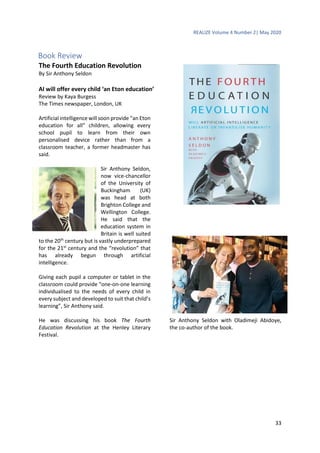
Teachers can find opportunities to connect
curriculum and concepts to students’ lived
experiences and immediate environment.
For example, students might interview
siblings for a project or parents can join the
classroom morning meeting. Students can
also use pets or nearby objects to make
connections with their learning. Meghan
Wilson at Shekou International School in
China shared on Twitter how her students
and colleagues are staying connected,
active, and creative at home.
4. Think in Chunks: Link Lessons, Resources,
and Communication
Most teachers are in the process of
building an entirely new online learning
ecosystem, or, in the best-case scenario,
repurposing an online platform that used
to complement face-to-face teaching
before the novel coronavirus-related
school closures. Since there are so many
resources available, teachers often utilize a
combination of multiple apps, media,
websites, and teacher-created content.
This can get overwhelming fast. In order to
avoid fragmentation or confusion,
teachers can build connections across
resources, activities, and lessons.
Building a one-stop shop and sharing a
weekly learning plan with students and
parents gives them a birds-eye view and
road map of the curriculum. Tan Huynh at
Saigon South International School in
Vietnam shared how he uses a weekly
learning plan or “week at a glance” to
prepare students and parents for what lies
ahead.
5. One Size Does Not Fit All
We know that every student is different.
We also know that teaching a class with a
variety of languages, cultures, abilities, and
identities enriches the experience for all
learners. In online classrooms, teachers
must recognize the unique strengths and
needs of every student by providing both
high challenge and high support (Mariani,
1997). Every teacher and every school will
adapt to the current reality differently
based on their unique context and
available resources. Teachers recognize
the need to collaborate across borders and
boundaries, to share what works and what
doesn’t. As teachers pay attention to
linguistic diversity and neurodiversity in
their classes, they can rely on the global
education community to help provide
options for students.
Equity is a critical consideration for online
learning: Not all students have the same
access to technology, and consistent high-
speed internet may not be available in all
homes. How can teachers collaborate to
ensure learning activities and materials
meet the needs of all learners? To ensure
they’re accessible and mobile-friendly? For
example, PDFs are generally more
accessible for students with disabilities
who may rely on screen-readers.
Choices are an important key to unlocking
access for all students in a virtual
classroom. Universal Design for Learning
(UDL) is a framework that helps teachers to
plan for multiple means of engagement,
REALIZE Volume 4 Number 2| May 2020
71
multiple modes of representations, and
multiple ways for students to take action
or express themselves. For example,
Chelsea Wilson from Nansha College
Preparatory Academy in China explains
how she makes complex texts more
accessible by using multilingual and
multimodal resources. And Lindsay Kuhl
from Seoul Foreign School in Korea shares
how she scaffolds texts by using
screencasting for guided reading.
Continue the Conversation
As the global K–12 landscape continues to
evolve online, collaboration holds the
promise of transforming professional
relationships, with profound implications
for everyone’s learning (Nordmeyer,
2015). In the current circumstances, a
historical preference for independence
and autonomy may be replaced by
reciprocal learning. So let’s all continue the
conversation. Teachers from four
continents are sharing their experiences
teaching and collaborating on this FlipGrid
page. As we learn together at home and
around the world, join these global
colleagues and share your insights,
questions, or feedback.
About the Authors
Andrea Honigsfeld (ahonigsfeld@gmail.com) is associate dean and
professor in the School of Education and Human Services at Molloy College
in New York.
Jon Nordmeyer (jon.nordmeyer@ wisc.edu) is the international program
director at WIDA, a non-profit research center at the University of Wisconsin-
Madison, where his research focuses on teacher collaboration and global
learning networks. He has taught in international schools in the Netherlands,
Taiwan, Turkey, China, and Thailand.
Follow them on Twitter @AndreaHonigsfel and @nordmeyerj
References
Dove, M. G., & Honigsfeld, A. (2018). Co-teaching for English learners: A guide to collaborative
planning, instruction, assessment, and reflection. Thousand Oaks, CA: Corwin Press
Held, V. (2006). The ethics of care. New York: Oxford University Press.
Mariani, L. (1997). Teacher support and teacher challenge in promoting learner autonomy.
Perspectives, 23(2).
Nordmeyer, J. (2015). Collaboration: Scaffolding student learning and teacher learning. EARCOS Tri-
Annual Journal. East Asia Council of Overseas Schools.
REALIZE Volume 4 Number 2| May 2020
72
Why COVID-19 Is Our EQUITY CHECK
By Dena Simmons
With students dispersed,
schools and our society must
confront long-simmering
inequities.
During my childhood summers, my sisters and
I stayed inside our one-bedroom apartment for
days on end. Nice weather in our Bronx
neighbourhood meant more people socializing
at bodegas and on building stoops, which often
led to more troublemaking. If we ventured
outside, there was always the chance of being
hit by a stray bullet. Today, more than two
decades later, the world is different, and
though I am light years away from the one-
bedroom apartment on Creston Avenue, I still
carry with me the fear and anxiety from my
own and our nation’s past traumas.
As I sit in my apartment after days inside,
having developed the stamina for a life
indoors, I cannot help but thinking of our
young people, who’ve grown up in a time of
rampant school shootings, and who are now
enduring the COVID-19 pandemic. Their school
lessons ended abruptly—projects unfinished,
conversations pending, graduations cancelled,
and pivotal experiences stolen. I worry about
how our youth are feeling as they adjust to all
their recent losses and our new normal, one
characterized by social distancing.
With our new reliance on caregivers to
support student learning, the urgency for
schools to be more welcoming to families as
partners has become far greater.
And social distancing is not the same for
everyone—for our students and adults alike.
Although I was fortunate to grow up in a loving
and nurturing home, some children risk abuse
and violence more frequently now that they
may be in the constant presence of their
perpetrators. Others might have small homes
like I did as a child, leaving little room to do
anything without the distraction of relatives or
siblings and the resulting frustration of having
no personal space. Some students, conversely,
are home all alone, since their caregivers do
not have the privilege of jobs that keep them
safely inside. A few might feel alienated by
embarrassment about where they live, as I did
during my boarding school years when my
classmates’ parents forbade them from
dropping me off in what they referred to as my
“dangerous” neighborhood.
Magnifying Existing Problems
Most of all, the novel coronavirus outbreak has
put a mirror in front of our faces, magnifying
the inequities in our school systems—and in
our society—that too many of us have allowed
to exist without question. Districts like New
York City agonized over closing schools for far
longer than they should have because officials
had to confront an ethical dilemma: risk
greater infections or put millions of children
out on the streets, since many of them depend
on schools not only for an education but also
for food and basic supports, and some even for
REALIZE Volume 4 Number 2| May 2020
73
safe shelter during the day. The fact that
closing schools presented such a challenge for
districts nationally should be something that
upsets us greatly.
Fortunately, many districts and schools are still
offering free meals, but the safe haven and the
opportunities for academic, social, and
emotional learning are a bit more difficult to
provide when everyone is dispersed. Some
districts have provided children tablets, but
there are still far too many students without
the necessary tools for distance learning,
including reliable internet service. For
example, I recently heard about a 4th grade girl
in Georgia named Trinity who started selling
lemonade in her neighbourhood to earn
money for a computer so that she could
participate in schoolwork. Jasmine Crowe,
founder of Goodr, which aims to end hunger
through minimizing food waste, encountered
Trinity’s stand and put her plea on Twitter.
Within a day, people from across the country
made donations, helping Trinity raise sufficient
funds, and my friend Mary Jo Madda of Google
even bought her a tablet. This is one beautiful
story of the human spirit, but many more
children will not be as lucky as Trinity. We
should not have had to wait until a pandemic
to provide all children with what they need to
thrive as learners in and out of school.
Building Partnerships
During this fragile time, collaborations like the
one that amplified Trinity’s story are crucial.
Thankfully, organizations like PCs for People
and EveryoneOn have always worked to
connect families to free and affordable
computers and internet service. And now
phone and cable and internet companies are
stepping up to fill the digital gaps. But it is
difficult not to wonder why we haven’t
invested in our young people’s educational
resources and access more generously before.
This is a question we must ponder and
continue to ask on the other side of the
pandemic, especially since educational equity
requires partnerships between groups—inside
and outside of the school system.
One such partnership is with our students’
families. With our new reliance on caregivers
to support student learning, the urgency to be
more welcoming to families as partners has
become far greater, as has eradicating the
obstacles that get in the way of family
engagement: language barriers, the digital
divide, and the fact that some caregivers have
been failed by inadequate schooling or suffer
from learning challenges. How can we begin to
prioritize the goal of making academic content
and school resources more accessible? And
how can we provide information in easy and
comprehensible ways, so that any caregiver
can support their young family members?
What will COVID-19 teach us? What will it
inspire us to change? What will we have to
improve to engage our students and families
more meaningfully and equitably?
Despite all that we do to help families, despite
trying to get children the digital resources they
need, not all children are capable of learning
online, especially since many of the online
learning options do not take into account
children who are hard of hearing, visually
impaired, physically challenged, or have
developmental delays. And some distance-
learning resources are not translated into
REALIZE Volume 4 Number 2| May 2020
74
students’ home languages, nor do they take
into account scholars who aren’t yet meeting
grade-level requirements.
Therefore, as we embark on figuring out
distance learning at scale, we must consider a
variety of methods for engaging learners—
calling students by phone, sending tutorial
videos, and allowing students to demonstrate
their understanding through varied methods.
As we come up with remote-learning lessons,
let’s consider employing projects that rely on
what families have at their disposal (resources
and capabilities), and invite students to select
topics that are not only relevant and
interesting to them, but also tied to devising
solutions to their current realities.
Another helpful idea is to create school
projects that are relevant to the whole family
and allow family members to do activities
together (if safe and possible)—like making
bread or using math to convert the portions for
more or less people (for middle schoolers), or
organizing a closet by color and texture (for
younger students). Additionally, part of our
support to families must include social and
emotional resources for managing
uncomfortable feelings, as well as giving
families the brave space to feel and
communicate their feelings—and ways to opt
out of activities and assignments that cause
too much strain on everyone in the home.
Learning from the Pauses
In the end, I do not have all the answers to the
questions that this pandemic has forced
educators to contemplate—but I know that
there was a time before computers, tablets,
and cell phones when teaching and learning
happened, when we figured out how to lead a
life. I know that we are capable of ingenuity, of
adapting, and of healing. I know that we can
learn from the pauses in our lives and use them
as opportunities to reflect and re-evaluate
what’s important to us. What will COVID-19
teach us? What will it inspire us to change?
What will we have to improve to engage our
students and families more meaningfully and
equitably?
In the coming months, when we return to
some level of normalcy, we will not be the
same. We will be a bit shaken, maybe even a
bit more paranoid about germs, but I hope we
will have learned to be more deliberate about
human connection, more purposeful about
educating all children well, more aware of the
power of human goodness, and more focused
on partnering with families and organizations
to educate all youth.
On some level, COVID-19 is our equity check,
reminding us of who we could be if we valued
equity as much as we say we do. Let’s not wait
until the next pandemic to get it right. If we do,
the ones who will suffer will be the ones who
always suffer—the people most in need. This
novel virus is a wake-up call, an opportunity for
us to come together to do and be better for
every single child.
About the Author
Dena Simmons is a
lifelong learner,
educator, and activist
who supports schools
throughout the nation
in implementing social
and emotional learning
and culturally
responsive and
equitable practices.
She is the author of the forthcoming book,
White Rules for Black People (St. Martin’s
Press, 2021). Follow her on Twitter
@DenaSimmons.
REALIZE Volume 4 Number 2| May 2020
75
Four Tips for Teachers Shifting to Teaching Online
By Kareem Farah
An educator with experience in distance
learning shares what he’s learned: Keep it
simple and build in as much contact as
possible.
The coronavirus has caused widespread school
closures for an unknown duration. Teachers
are scrambling to find ways to support
students from afar through distance and online
learning. If you’re feeling overwhelmed by
this daunting task, you’re certainly not alone
I’ve also struggled to reach students outside of
class. For several years, I taught in
communities where students struggled to
attend school consistently. To help absent
students access my courses, I developed
a blended, self-paced, mastery-based
instructional model that empowered all my
students to learn, whether they were in my
room or not. Today, I run The Modern
Classrooms Project, where I help other
teachers do the same.
Through teaching students and training
educators, I’ve learned a lot about how to
effectively create and implement digital
instruction and self-paced learning. I’ll share a
few tips below, and if you’re looking for further
support on developing effective distance
learning beyond what I discuss in this piece,
explore the resources on our website or start
our free online course, Building Modern
Classrooms.
Here are some pointers that can help you
create a sustainable and engaging distance
learning experience for your students.
1. SIMPLICITY IS KEY
Every teacher knows what it’s like to explain
new instructions to their students. It usually
starts with a whole group walk-through,
followed by an endless stream of questions
from students to clarify next steps. While this
process can be frustrating at times, students
can always rely on each other and the teacher
in the room when they’re stuck.
One of the challenges of distance learning is
that you and your students are no longer in the
same room to collectively tackle
misconceptions. Instead, the large bulk of
learning time is inevitably going to be driven by
tasks that require a high level of self-direction.
As a result, simplicity is key. It is critical to
design distance learning experiences that have
very clear instructions and utilize only one or
two resources. It’s also best, when possible,
to provide resources like readings as PDFs that
students can always access.
Keep in mind that simple structures can still
require rigorous work: Tasks with few
instructions often lead to the greatest amount
of higher-order thinking, as students figure out
what to do within defined parameters.
Distance learning should push educators to
think about how they can be leaner and more
concise with their delivery of new information.
REALIZE Volume 4 Number 2| May 2020
76
2. ESTABLISH A DIGITAL HOME BASE
In the spirit of simplicity, it’s vital to have a
digital home base for your students. This can
be a district-provided learning management
system like Canvas or Google Classrooms, or it
can be a self-created class website. I
recommend Google Sites as a simple, easy-to-
set-up platform.
You need a single digital platform that your
students can always visit for the most recent
and up-to-date information. It can be tempting
to jump around between all the cool edtech
applications out there—especially as so many
of them are offering free services right now—
but simplicity and familiarity are invaluable.
Students need to feel comfortable going to the
same place to access the same tools. The
farther away you are from your students, the
more important it is to cultivate stability and
practice norms.
Additionally, if attendance was a challenge
before, distance learning is going to magnify it.
So students need a place to go when they fall
out of the loop. Filling in gaps is only going to
get harder when the teacher cannot quickly
engage in individual or small group instruction.
Your students are going to need to take control
of their own learning. Your goal is to create a
clear framework that allows them to do that.
You might want to check out a unit I created on
probability and statistics to see how I provided
instructions and set up checkpoints for my
students.
3. PRIORITIZE LONGER, STUDENT-DRIVEN
ASSIGNMENTS
Efficiency is key when designing distance
learning experiences. Planning is going to take
more time and require a high level of attention
to detail. You will not be able to correct
mistakes on the fly or suddenly pivot when kids
are disengaged.
To effectively manage your time and sanity,
you will want to prioritize longer, student-
driven assignments and tasks that buy you
time to keep planning future units—and that
get your students off the computer. Focus on
building toward long-term projects where
students have autonomy and a clear set of
checkpoints and deadlines that need to be
met. When possible, create opportunities for
students to discuss what they’re learning with
their families and include an element of
student choice to really build engagement.
Check out a project set up by Modern
Classrooms’ co-founder, Robert Barnett, that
integrates choice and family
engagement: Demographer Challenge.
4. INDIVIDUAL TOUCHPOINTS ARE GAME-
CHANGER
What your students will miss the most is the
human connection that is cultivated in your
classroom. The little interactions you have with
them in the hallways, before and after class or
during breaks in lessons, are irreplaceable.
While it can be tempting to focus on content in
your distance learning assignments and
instructional videos, what matters more is
creating structures for personalized
touchpoints with your students
You can create these touchpoints through any
medium you like: emails, video messages,
phone calls, messages through your learning
management system, comments on shared
documents, etc. Create a structure and stick to
it. Your students will see your investment and
know that you care about them.
It’s important to bear in mind that cultivating
an engaging distance learning experience is
hard. It takes time and an incredible amount of
patience. If you are new to the experience,
you’re probably going to feel like a first-year
teacher again. That’s OK! Tackle the challenges
step by step, keep your students updated on
your progress, and stay positive.
You can do this!
REALIZE Volume 4 Number 2| May 2020
77
A Blueprint for Remote Working: Lessons from China
By Raphael Bick, Michael Chang, Kevin Wei Wang, and Tianwen Yu
As home to some of the world’s largest
firms, China offers lessons for those that
are just now starting to embrace the shift
to remote working.
From Alibaba to Ping An and Google to
Ford, companies around the globe are telling
staff to work from home in a bid to stem the
spread of COVID-19.
Such remote working at scale is
unprecedented and will leave a lasting
impression on the way people live and work for
many years to come. China, which felt the first
impact of the pandemic, was an early mover in
this space. As home to some of the world’s
largest firms, it offers lessons for those that are
just now starting to embrace the shift.
Working from home skyrocketed in China3
in
the wake of the COVID-19 crisis as companies
told their employees to stay home. Around 200
million people were working remotely by the
end of the Chinese New Year holiday. While
this arrangement has some benefits, such as
avoiding long commutes, many employees and
companies found it challenging. One employee
at an internet company quipped his work day
changed from ‘996’ to ‘007,’ meaning from
nine to nine, 6 days a week, to all the time. On
the personal front, employees found it difficult
to manage kids’ home-schooling via video
conference while coordinating with remote
colleagues. At a company level, many felt that
productivity rapidly tailed off if not managed
properly.
This article brings together our experience
helping clients navigate remote working, in-
house analysis, and insights from
conversations with executives in China as they
responded to the situation and addressed the
challenges.
Done right, remote working can boost
productivity and morale; done badly, it can
breed inefficiency, damage work relationships,
and demotivate employees. Here are eight
learnings from China that may be applicable
around the world, depending on the
circumstances:
1. Designing an effective structure
Teams or whole business units working
remotely can quickly result in confusion and a
lack of clarity. Being isolated leads to
uncertainty about who to talk to on specific
issues and how and when to approach them,
leading to hold-ups and delays.
That’s why establishing a structure and
architecture for decision making and effective
communication is key. Here, smaller cross-
functional teams can be helpful, each with a
clear mission and reporting line, where
directions and tasks are easy to implement.
This also simplifies on-boarding new hires, who
can integrate faster in a tight-knit group, at a
REALIZE Volume 4 Number 2| May 2020
78
time when the broad sweep of the
organization isn’t visible or easy to feel. With
fewer in each team, there is more time to get
to know each other and build the trust that
would grow more organically in the office.
At Ping An Insurance, workers are typically
grouped in project teams of, at most, 30
members, while larger business units are
divided up to help them stay agile.
Strong company-wide foundations underpin
this, such as having a common purpose and
unified goals. Providing clarity on what
decisions to escalate and which ones can be
tackled at team level helps drive progress.
To mitigate the effects of closed
retail stores, one leading fashion
company set up a strategy
control room and redeployed
staff into four cross-functional
squads to support its front-line. It
designed standard ways for live
broadcasting and established
internal best practices to
encourage front-line staff to use
new retail tools to drive sales
remotely.
The lesson: Setting up small,
cross-functional teams with
clear objectives and a common
purpose keeps everyone on the
same strategic course.
2. Leading from afar
Managing people is one of the
most difficult elements of
remote working, not least
because everyone will respond differently to
the cultural shift and challenges of the home-
working environment.
Leaders need to energize the whole
company by setting a clear direction and
communicating it effectively. Offering a strong
vision and a realistic outlook can have a
powerful effect on motivation across the
organization. It’s essential to foster an
outcome-driven culture that empowers and
holds teams accountable for getting things
done, while encouraging open, honest, and
productive communication.
Empowering your team in this way pays
dividends. WeSure, part of leading internet
company Tencent, assembled a COVID-19
response team at the start of the year to offer
insurance coverage, free of charge, to front-
line medical workers. Alan Lau, CEO of WeSure,
credited his team, saying they had worked
nonstop, many from remote locations while on
leave during the Chinese New Year break,
demonstrating how responsive they were to
the vision.
For managers, the challenge is to lead, inspire,
and direct their team in their daily course of
work, while being physically remote. Upping
the levels of interaction can also work well
here.
One chief information officer, responding to
a McKinsey survey, said he’s texting the entire
REALIZE Volume 4 Number 2| May 2020
79
company with regular updates because it’s a
more human way of communicating than via
the official corporate channels.
When working within distributed teams, e-
commerce giant Alibaba increases the
frequency of its one-to-one communications
with employees to a weekly basis and, in some
teams, members submit a weekly report for
their colleagues, complete with plans for the
week ahead. Alibaba’s productivity app
DingTalk (Ding Ding) has features built in to
facilitate this by allowing managers to send
voice-to-text messages to their teams, and to
check in on progress.
The lesson: Determining how you
communicate is just as important as what’s
being said, and it needs to be done
confidently, consistently, and reliably.
3. Instilling a caring culture
As companies transition to the new normal, it’s
important to acknowledge that some
employees may be facing other pressures at
home, including caring for their children when
schools are shut, leading to feelings of isolation
and insecurity. Business leaders need to
respect and address these additional needs.
Empathy is a crucial tool here, offering a way
to connect, promote inclusiveness, and create
a sense of community in a void of physical
interaction. Increasing social interactions
within the team, particularly through one-on-
one catchups, guards against feelings of
isolation and demoralization and creates space
for people to speak up and share their
thoughts. By creating a sense of psychological
safety for their colleagues, being inclusive in
decision making, and offering perspective in
challenging moments, managers can stay
closer to what is going on, surface issues, and
help their teams solve problems effectively.
A similar approach is important when dealing
with customers and clients, providing valuable
stability and enabling them to navigate
unknown waters with confidence. For
example, one global bank asked their
relationship managers to connect with small-
business customers via WeChat and video-calls
to understand their situation and help them
weather the crisis. To do so effectively at scale,
the managers are supported through
dedicated product programs, online articles,
scripts for communicating with clients, and
internal trainings.
Inclusion is the ultimate show of empathy.
Creating outlets for sharing best practices,
success stories, challenges, and water-cooler
chat is vital to creating a human connection.
Giving employees space to pursue personal or
social endeavors, providing a clear span of
control, and assigning meaningful tasks can
also spur motivation.
The lesson: Connecting on a personal level
and instilling empathy within the culture is
doubly important when working remotely.
REALIZE Volume 4 Number 2| May 2020
80
4. Finding a new routine
Moving to remote working risks disrupting the
office-based flows and rhythms and it can be
easy to hit the wrong note or miss important
virtual meetings due to packed schedules.
Spend time with your team addressing the nuts
and bolts of how you will work together. Cover
the daily rhythm, individual constraints, and
specific norms you will commit to and
anticipate what might go wrong and how you
will mitigate it.
How companies plan and review their
workflows needs to change to reflect this. The
challenges of the new working pattern and of
not being in one room together can be
overcome by creating a digitally facilitated
cadence of meetings. One leading insurance
company adopted agile practices across its
teams, with a daily and weekly ritual of check-
ins, sprint planning, and review sessions.
As Alibaba embraced remote working, it also
made sure its meetings were more tightly run.
One person is assigned to track time and
manage the outcomes. Team members can
rate a meeting’s usefulness using a five-star
system that offers immediate feedback and
positive ways forward.
To address the challenge of launching a digital
business with a large remote team, one
company created a new workflow for product
requirements that clearly outlined use of
digital tools, roles, and responsibilities as
requirements moved from ideation to
validation to delivery stages. Reiteration of
decision-making structures like this isn’t
always necessary when people can
communicate directly, but their absence can
be keenly felt when remote working kicks in.
The lesson: Establishing robust working
norms, workflows, and lines of authority is
critical, but all too easy to skimp on.
5. Supercharging ways of communicating
Poor communication is one of the key reasons
remote offices are not productive.
How staff interact needs to be completely
rethought using a full arsenal of channels and
tools (Exhibit 1). Getting it right is tricky and
requires experimentation.
Exhibit 1
REALIZE Volume 4 Number 2| May 2020
81
Choosing the right channel matters. Video
conferences are great for discussing
complicated topics in real-time and for
creating a sense of community, but they
require team-wide coordination and focus.
Channel (chat) based collaboration software is
great for quick synchronization or easily
answered questions, while email can be used
to record outcomes and communicate more
formally. Backlog management tools can be
used to keep on top of tasks and process.
From McKinsey’s remote work with clients, we
know how effective video conferences can be,
if a few simple rules are followed. Firstly, you
need a clear agenda and moderator to keep
the discussion on track. Having the camera
turned on throughout the meeting is essential
to build relationships and pick up nonverbal
cues. In case the home office is not presentable
on camera, most VC software offer virtual or
blurred backgrounds. For joint problem
solving, it is particularly useful to use
screenshare or virtual whiteboards to co-edit
documents.
Many teams find it useful to create channels
for real-time communication (Exhibit 2)—for
example on DingTalk, WeChat, Microsoft
Teams or Slack—with a simple rule to jump on
a video conference if a complex topic requires
face-to-face interaction. However,
continuously switching between messages,
tasks, and projects is a productivity killer and
team members need to understand how
quickly they’re expected to respond: is it
urgent or can it wait? Turning off notifications
and really focusing on one thing at a time can
sometimes be the best way to get work done.
The lesson: Choosing the right channel is
critical to getting it right. If you move your
employees from topic to topic, workflow will
be interrupted and drive down productivity.
Source: McKinsey & Company
Analysis Figure 2
REALIZE Volume 4 Number 2| May 2020
82
6. Harnessing the power of technology
Effective remote working starts with the
basics—including a fast, stable, and secure
internet connection, as well as setting up an
ergonomic home office environment.
Expanding VPN (virtual private network) access
and bandwidth is one of the first steps many
CIOs took to enable their employees to access
systems remotely. Remote working is also
empowered by a suite of SaaS (Software as a
Service) technology tools that allow teams to
effectively co-create, communicate, share
documents, and manage processes.
A single, digitally accessible source of
information—be it a performance dashboard,
sprint backlog, or business plan—keeps
everybody aligned.
Many Chinese companies have rapidly
adopted local productivity solutions such as
Alibaba’s DingTalk or WeChat Work to
communicate and deliver weekly meetings,
training, and lectures. For example, as COVID-
19 spread, monthly active users of DingTalk
jumped by 66 percent to more than 125
million. Many multinational firms accelerated
roll-out of productivity solutions they were
already using elsewhere, like Slack, Microsoft
Teams, or Zoom. Effective use of these tools
required a change management effort
including training teams on how to use
them and defining new ways of working.
Defining new ways of working with digital tools
by collating best practices from various teams
in the company can help to speed up adoption.
At McKinsey, we created an internal portal on
great remote working that brought together
learnings from across the firm, from how to run
collaborative problem-solving sessions to
effective decision meetings with clients while
on VC.
In addition, many companies created special
applications to allow their front-line teams to
remain effective during remote work. For
example, one big-four bank created a special
WeChat mini-program to enable their
relationship managers to interact with
customers and generate leads. They then used
bank-approved programs to engage with
customers, and access bank systems from their
laptops.
Trip.com, China’s largest online travel agency,
has long enabled its contact-center staff to
work from home, which paid off in the recent
crisis as it was able to deliver a high quality of
service during widespread travel disruptions.
The lesson: Using technology can be vital in
keeping everyone on track, but it’s important
to get the basics right.
7. Taking security seriously
Security concerns add a layer of complexity to
the technological side of remote working and
can have serious consequences, in particular
when employees are not aware of safe
practices or switch to unauthorized tools to get
their work done.
Adopting a strong yet practical approach is not
easy. Doing it right requires giving employees
the tools they need to be productive while
managing data confidentiality and access.
Leading players such as Ping An have
addressed the security issue head-on through
a set of mechanisms: establishing a
confidentiality culture, mandating awareness
training, and limiting data access to a need-to-
know basis. For example, sensitive information
such as customer data can be displayed with
watermarks so that any leaks are traceable.
Alibaba uses its own software Alilang to
manage network and device security.
The lesson: Make it easy for employees to
comply with security requirements while
investing in strong safeguards.
REALIZE Volume 4 Number 2| May 2020
83
8. Adopting a ‘test and learn’ mentality
The final lesson: Being ready to recognize what
isn’t working and changing it fast.
Leadership teams that continuously learn,
actively identify best practices, and rapidly set
up mechanisms to share ideas across the
organization tend to be most successful in the
long run. R&D teams at one leading high-tech
manufacturer created a productivity target for
remote work by estimating their productivity
each week relative to onsite work and
identifying levers to improve it.
Within four weeks, they had progressed from
50 percent to 88 percent of their baseline.
As China’s workforce begins to return to
offices, these lessons from some of its leading
companies help to illustrate how—with the
right structure, culture, processes, and
technology—working remotely can boost
productivity and morale. Employees who
spend less time travelling or commuting and
have a better work-life balance are likely to be
happier, more motivated, and ready to
mobilize in extreme situations.
Embracing remote working allows companies
to define a new normal that drives productivity
and employee satisfaction into the future.
Alibaba launched TaoBao, by now the world’s
biggest e-commerce website, while staff were
working remotely on quarantine during the
2003 SARS outbreak. For Trip.com, a remote
working experiment in 2014 established the
foundations for great customer service and
flexible working culture. Hence, bringing
together all the elements can enable a new
way of working that will make your company
fit for the future—whatever that may hold.
About the author(s)
Raphael Bick is a partner in McKinsey &
Company’s Shanghai office, where Tianwen
Yu is an associate partner. Michael Chang is an
associate partner in McKinsey’s Beijing
office. Kevin Wei Wang is a senior partner in
McKinsey’s Hong Kong office.
The authors wish to thank Lihong Pan and
Glenn Leibowitz for their contributions to this
article. They’d also like to thank Enoch Chan,
Natalie Chu, Desiree El Chebeir, Karel Eloot,
Jeff Galvin, Alexei Korkmazov, Xu Lei, Nick
Leung, Liesje Meijknecht, Kate Smaje, Hugo
Sarrazin, Anand Swaminathan, Sha Sha, Gregor
Theisen, Joe Zachariah, Rodney Zemmel, and
Haimeng Zhang for their insights.
Location of:
REALIZE Volume 4 Number 2| May 2020
84
How eLearning can help define your success criteria
By Thomas Buus Madsen
At times, as learning professionals, it can
feel as though we work in an intangible
industry. This is because of the common
misconception that learning itself cannot
be easily seen or measured making it
difficult to prove the ROI of the launch of
a learning program to stakeholders and
decision-makers. However, by defining
the success criteria of a learning
solution launch, L&D professionals can
easily prove its impact and show its very
tangible and positive effects on
the organisation. Here are 7 ways to
define what a successful launch looks like and how to measure the impact of learning in
your organisation.
Usage rates
One of the most definite determining factors of
whether a learning platform is being
successfully adopted within an organisation is
how often it is being used by employees. Some
modern eLearning platforms offer specific
analytics so L&D managers can determine how
often the platform is being used as well as
exactly what it is being used
for. Positive statistics and usage rates are a
great way to prove just how necessary your
eLearning platform is to the learners within
your organisation.
Net promoter score
Digital learning platforms with a built-in net
promoter tool are essential in determining the
success of a learning solution. Net promoter
scores give L&D professionals direct
insight into whether employees find their
learning solution helpful in their day-to-day
lives and give employees the chance to give
their opinions on how the solution impacts
them as well as how it could improve. A high
net promoter score is a great indicator that a
learning solution was a good investment.
Feedback
In the same way that a learning platform
measures usage and suggests which content
users are proactively engaging with, L&D
managers doing some qualitative research of
their own by interviewing or surveying users is
a fantastic way to measure and track the
success of a learning solution. Good employee
feedback is a direct indicator of whether a
learning solution rollout is successful.
Tests and quizzes
At the end of the day, the purpose of any
learning solution is to give employees the
opportunity to develop their skills. One great
way to measure the success of a training
platform is by assessing whether employees
are indeed learning through quizzes and tests.
Many digital learning platforms offer optional
exams during or following the completion of
learning materials so employees can test their
knowledge. Presenting the results of
employees’ successful quizzes is an easy and
accurate way to show stakeholders and
decision-makers just how impactful their
investment in development has been on
the organisation.
Productivity levels and process optimisation
A company is only as productive as the people
working for it and an increase in organisation-
wide productivity is a key defining feature of
the success of a learning solution. According to
a study by National Center on the Educational
Quality of the Workforce, organisations that
REALIZE Volume 4 Number 2| May 2020
85
increase workplace learning by 10% will, in
turn, receive an increase of an average of 8.6%
in productivity levels (1). When productivity
rises, processes are often optimised meaning
business goals are completed more effectively
and efficiently. Looking at the time it takes
from a project’s beginning to its point of
completion compared to before the launch of
a learning solution is a useful and tangible way
to determine its success.
Employee retention
Employee turnover is one of the highest cost
factors of any organisation but it is also an
easily measurable factor. Linkedin’s 2018
Workplace Learning Report suggests that 94%
of employees would prolong their stay in an
organisation that invests in their career
development (2). Comparing employee
retention rates after introducing an eLearning
solution versus before rolling it out is an
impactful way to measure how successful it
has been.
Customer satisfaction
When it comes down to the most important
factor for business success, high customer
satisfaction cannot be beaten. Especially when
an organisation’s digital learning platform
focuses on developing soft skills such as
communication, investing in L&D
can positively impact customer service and
client satisfaction. A fantastic way to measure
the level of customer satisfaction is by
requesting that clients complete a survey or
rate their level of customer service and present
the findings to budget holders.
Although tight budgets have contributed to an
ongoing struggle for L&D professionals when
defending the importance of development
within an organisation, when all is said and
done, defining what a successful learning
platform means really comes down to is our
employees and whether they are growing and
learning new skills that will benefit themselves
and their organisation. Choosing an eLearning
platform that provides tools and feedback to
help organisations define success criteria and
present an ROI will make all the difference in
convincing securing a budget and continuing to
provide employees with a quality learning
experience.
REALIZE Volume 4 Number 2| May 2020
86
Learning Engagement in a Time of Zoom Fatigue
By Declan Fox
Along with hand washing, disinfecting, and
social distancing, Zoom has become part of life
for many during the pandemic. The platform,
along with other video services, has been a
lifeline for those working, learning, socializing,
exercising, and worshipping from home.
However, for many of us, the initial thrill of
seeing distant colleagues on video conferences
has given way to fatigue, anxiety, and
distraction as we struggle to stay engaged. This
level of disengagement is worrying for any
aspect of business but is especially concerning
for the success of workplace learning.
Move Online, Leave Learning Behind?
In the rush to move training operations online,
learning can get left behind. As leaders retreat
to command and control in a time of crisis,
workplace learning gets pushed down the list
of priorities. When learning is addressed, the
response often is the hasty introduction of
technology that emphasizes business
continuity over actual learning. Setting up a
Zoom account and attempting business as
usual can defeat the purpose of learning new
ways to cope and succeed in a distributed work
environment. The result is what Educause’s
Susan Grajek describes as a “ quick, ad hoc,
low-fidelity mitigation strategy” that cannot
compare with “well-considered, durable online
learning.”
Bringing Cognitive and Socioemotional
Learning Together
There’s a myth that only cognitive learning is
possible online. Organizations have disproved
this by demonstrating success in integrating
the socioemotional as well as the cognitive
aspects of learning online. Strategic
capabilities such as leadership, design thinking,
and digital transformation require mastery of
new information and technologies. But they
also require new mindsets and ways to learn
and work together. For these efforts to be
successful requires a focus not just on the
content of learning but also on establishing
online learning environments that are learner-
centered and psychologically safe.
Learner-centered environments accommodate
the preferences and needs of the learner. In
online learning, this can mean enabling
asynchronous participation in discussions and
collaborative projects that involve social
interaction. This allows the learner to proceed
through the experience at their own pace
while still benefitting from collaboration.
The other fundamental element of successful
learning environments is psychological safety.
In safe learning environments learners can be
more reflective and open to constructive
criticism. Practice and roleplay come more
naturally in the presence of trusted colleagues
and coaches. Candid conversations about
sensitive work topics presume some level of
confidentiality.
How to Enable Online Collaborative Learning?
The move from classroom training to online
collaborative learning involves changes to how
learning is designed and practiced. However,
the shift is not as daunting as it may seem.
Moving in-person workshops online can be
achieved in four steps:
1. Spread the Learning Over Time: For
example, a one- to two-day on-site
workshop can be rolled into a three- to six-
week online experience with a two-hour
commitment to learning per week.
2. Design Learning Experiences for
Application: Ensure your learners build
capabilities through opportunities to apply
the learning in authentic work situations.
REALIZE Volume 4 Number 2| May 2020
87
Missions and projects allow learners to
practice and apply learning to their jobs
within the safe space of a learning
environment.
3. Create and Curate Content: Enrich and
contextualize learning experiences with a
combination of existing and new content.
In addition to the PowerPoint decks that
are the staple of in-person workshops, you
can also use internal and external videos,
infographics, text, documents, and other
learning content.
4. Preserve the Social Learning
Experience: The group connections and
accountability of in-person experiences
can be maintained by keeping learners in
cohorts with deadlines. Collaboration can
be stimulated by including discussions,
sharing assignments, and providing
informal and formal feedback.
Choosing the Right Tool for the Job
If the purpose of your online training is to
simply share information, video conferencing
may be perfectly adequate. If the training is
strategically important and involves learners
engaging with each other in sustained efforts
to build capabilities, additional learning
modalities may be required. This does not rule
out synchronous video conference sessions
within extended learning experiences.
However, by spreading the learning over a
range of interaction types, stress on learners
can be reduced, resulting in higher
engagement and better business outcomes.
ABOUT THE AUTHOR
Declan Fox is a
product marketer at
NovoEd with over a
decade’s experience
bringing learning
technology products
to market for learners
of all ages. He is
passionate about
using technology to engage learners and
provide opportunities for learning and growth.
REALIZE Volume 4 Number 2| May 2020
88
The advantages of eLearning
By Tim Harnett
When building an eLearning program, take a strategic approach to boost employee engagement,
collaboration and retention
These days, there is an increased focus on
employee engagement and retention, and as
the labor market tightens, organizations should
prioritize keeping high value employees in-
house. At the same time, changing market
conditions mean all employees will need new
skills and competencies. Creating ongoing
competency groups for increased knowledge
retention should be a priority. However, these
learning objectives can’t always be addressed
with in-person training, which can be time
consuming and costly to deliver. In this context,
eLearning takes on greater importance, as
organizations look for more efficient ways to
train their high-value employees and align
eLearning objectives to corporate goals.
Going forward, organizational spending on
virtual learning will increase. Recent Chief
Learning Officer research suggests that half of
all organizations will target eLearning delivery
as a top priority for L&D technology spending
over the next 18 months.1
While eLearning has
long been a tool for compliance training and
education, Bryna Dash, vice president of
corporate and government sales for
Blackboard, believes eLearning can and should
be used to train high-value employees. “You
want workers to collaborate and work more
effectively, no matter where they are,” Dash
says. “Blackboard training experts can help
design leadership training courses for high-
value employees, to develop those skills in this
subset of the employee base. These employees
might be very mobile within an organization, so
being able to reach them anywhere and
anytime is crucial to providing them with the
skills they need.”
How can organizations leverage their eLearning
programs for maximum value? Dash suggests
building up virtual teams, using the metrics
most aligned with your business goals and
ensuring learning continues after courses are
complete.
Solidify your virtual teams
Reaching high-value employees with learning
and development programs should be central
to any organization’s learning strategy.
Allowing employees to work together and
collaborate is just as important in a virtual
environment as an offline one and will
contribute to a culture of learning at any
organization. “When you give employees time
and a place to gather and learn from each other,
they become a force multiplier within the
company,” Dash says. The research agrees:
placing employees into online communities of
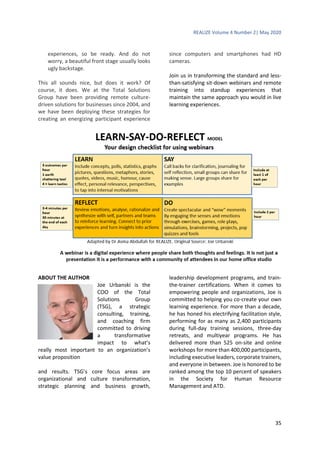
practice through knowledge management
systems leaves workers feeling more
productive and engaged.2
“With engaging eLearning experiences, you
help create that tipping point where learning
transfers to on-the-job knowledge.”
One of the greatest challenge’s organizations
face is employee engagement, which remains
stubbornly low.3
Giving employees the
opportunity to work in teams on eLearning
courses can help increase those engagement
levels. “At Blackboard, we have a robust
methodology designed to give our customers
the templates they need to create meaningful
REALIZE Volume 4 Number 2| May 2020
89
programs,” Dash says. “By engaging your
learners, you help create that tipping point
where learning transfers to on-the-job
knowledge.”
Blackboard
Blackboard is a global leader in lifelong
learning. With over 100 million learners and 20
years of experience, we’ve perfected the art of
effective learning. We’ve helped over 1,600
corporate and government organizations
around the world deliver outcomes-based
learning that drives employee growth in a
measurable way. Our ed tech platform of
products and services provides a trusted one
stop solution that powers learning programs
that make employees and organizations thrive.
Blackboard.com/Business
Measure the metrics that matter
One of the greatest challenges to
understanding the impact eLearning has on the
organization comes in using the right metrics
for eLearning programs. More than 58 percent
of organizations agree that their overall
measurement strategy is fully aligned to the
learning strategy,4
but there’s still much to do,
particularly in measuring the impact of
eLearning. Metrics can be broad or specific, but
in all instances, they should be tied to
organizational goals. “The metrics you take
away from your eLearning course should be tied
to the goals of your business,” Dash says,
“whether that’s a broad objective like bettering
employee engagement or a specific goal like
providing employees with the exact tools they
need to do their work. Virtual courses give you
access to a wealth of data, but you need a plan
to know both what data you have and how it
impacts your business. Be thoughtful about
what you’re trying to achieve and make sure
you have the right resources to go there.”
Learning continues even after the course is
over
Learning doesn’t end once the webinar finishes
or the training is complete. Dash advises
organizations to continue to assess employees
to ensure they have internalized the material.
“There’s always a bit of a dropoff once learners
have finished a course,” Dash says, “so it’s
important to allow for repeat learning to ensure
employees have really internalized the
material. This in turn helps retention because
employees have the knowledge necessary for
use in their job.”
As high-value employees become more
essential to solving business challenges, being
able to train employees virtually on high-impact
skills will be critical to organizational success.
Learn more about how Blackboard can develop
an eLearning program for your organization at
blackboard.com.
1
2018 Chief Learning Officer State of the Industry survey
2
Oesch, T. (2017). “Online communities of practice support social learning among knowledge workers.” Training Industry.
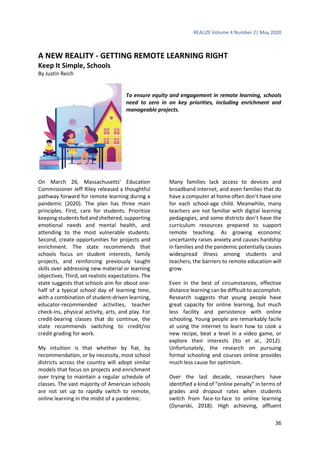
3
Harter, J. (2017). Dismal employee engagement is a sign of global mismanagement. Gallup.
4
2018 Chief Learning Officer State of the Industry survey.
REALIZE Volume 4 Number 2| May 2020
90
Why Are Some Kids Thriving During Remote Learning?
By Nora Fleming
Though remote learning has
brought many challenges,
some students seem to be
thriving in the new
circumstances. What can we
learn from them?
All school year, Montenique Woodard’s
seventh period, her last class of the day, has
been her hardest. “I feel like I don't know what
to do with them,” she said of her middle school
science class when Edutopia first talked to her
back in the fall. One boy in particular, the “class
clown,” was a persistent challenge, and his
behavior influenced his 23 peers, 15 of whom
are boys.
But reconnecting months later during the
coronavirus closures, Woodard shared some
surprising news: the same boy was “thriving”
during remote learning. “I think not having
those everyday distractions in school has really
allowed for kids like him to focus on the work
and not necessarily all the social things going
on because some kids can't separate that out,”
said Woodard, who teaches in Washington,
D.C.
We’ve been hearing that a lot. Increasingly,
teachers in our audience are reporting that a
handful of their students—shy kids,
hyperactive kids, highly creative kids—are
suddenly doing better with remote learning
than they were doing in the physical
classroom. “It’s been awesome to see some of
my kids finally find their niche in education,”
said Holli Ross, a first-year high school teacher
in northern California, echoing the sentiments
of dozens of teachers we’ve heard from.
That’s not to say it’s the norm. Many students
are struggling to adapt to remote learning:
Digital access and connectivity remain a
pervasive equity issue; stay-at-home orders
have magnified existing problems in familial
dynamics; and, universally, teachers and
students grapple with how to replicate the
engagement and discourse from an in-person
classroom.
But it’s not a tiny handful, either, and the
unplanned break from the physical classroom
may be bringing to light hidden reasons some
kids struggle while others succeed. In the
responses we gathered from our educators, we
found recurring themes—like social
situations and the inflexible bell schedule—
that simply don’t work well for all kids. For a
few of the teachers, at least, it’s inspired them
to consider making permanent changes when
they return to the classroom.
THE BENEFITS OF SELF-PACING
On average, the typical high school
student starts school at 8:00 a.m. While school
schedules differ by district, many students
then face back-to-back classes with little
reprieve. But during the pandemic, school
schedules have suddenly become more fluid,
allowing students more choice over when and
how they do their school work.
“I think a few of mine are doing really well
getting a taste of more independence,” said
REALIZE Volume 4 Number 2| May 2020
91
Lauren Huddleston, a middle school English
teacher in Memphis, Tennessee. “They’re
taking ownership a bit more because they’re
no longer under the micromanagement of the
school day.”
Teachers told us that many of their students
like working at their own pace during school
closures, an insight some say they'll take back
to their classrooms when they return.
This flexibility to make their own hours is also
giving students a chance to exercise, take
breaks, or even be bored, all of which research
shows is beneficial. High school English
teacher Ashlee Tripp speculated these kids
were doing well because, “they enjoy the
freedom to work at their own pace and decide
how they want their day to look,” and students
seem to agree.
“The reason I enjoy online learning is because
of the opportunity to structure my day
efficiently,” wrote a 10th grade
student in English teacher Katie Burrows-
Stone’s class survey. “I am able to workout,
relax, and complete the work in a timely
manner, with no distractions.”
TIME TO RETHINK THE OVER-EXTENDED KID
During the school day, many students remain
constantly on the go. Lunches are often filled
with club meetings. After school, many
participate in extra-curriculars or sports—
often to impress colleges—or work a part-time
job. On average, high school students spend a
minimum of seven and a half hours a week on
homework at night.
After enrichment activities were cancelled due
to shelter-in-place orders, our teachers say
they also saw a difference in some students’
performance.
“For my students, there are some that are
thriving. I think it is partly because so many
things like sports and social activities are no
longer happening and they have more time
than they ever had to work on school work,”
said Kasey Short, a middle school English and
social studies teacher in Charlotte, North
Carolina, by way of explanation.
Research has found jam-packed schedules can
be a significant challenge for a child to juggle:
Students who are over-committed, especially if
they feel obligated to take certain courses or
participate in activities, are more likely
to experience unhealthy anxiety levels.
“This has given me so much pause about what
we are doing in education: Is our current model
way too much? Why would anyone need to
have seven classes? Why does the school day
need to be so long?" said Rosie Reid, a high
school English teacher and the 2019 California
Teacher of the Year. “I can't say enough about
how this closure has changed my entire
approach to teaching because I see how it has
been an amazing respite for so many
students.”
LOWERING THE STAKES
Other teachers point to the changing academic
expectations during the pandemic as a causal
link. Given the structure of home learning—
and pervasive equity issues—many school
systems have encouraged teachers to be more
lenient with coursework and grading.
“I think a huge part of [some students’ work
improving] is that we’ve dramatically
ratcheted down the total workload in order to
make tasks accessible rather than
overwhelming,” said Mark Gardner, high
school English teacher in Camas, Washington.
REALIZE Volume 4 Number 2| May 2020
92
According to a Pew Research Center study,
teens cite academic pressure as the top
pressure they face, with 61 percent of teens
reporting they feel the heat to achieve at a
certain level academically. Teachers too, have
also been under increasing scrutiny in the last
decade-plus to prepare students to hit
benchmarks on standardized testing, pressure
that trickles down to students, who are twice
as likely to report unhealthy levels of stress
during the school year compared to the
summer.
“One student told me he likes remote learning
better because he no longer feels the extreme
pressure of failing,” said Cathleen Beachboard,
a middle school English teacher in Fauquier
County, Virginia, who says other students in
her class have expressed similar sentiments.
“He says that now that the pressure of state
testing is off, he feels he can really learn.”
REDUCING THE CHATTER
Though we’ve seen many comments—from
both students and teachers—about missing
the in-person connections and relationships at
school, for some students, school socialization
may be fraught with anxiety, our teachers
suggest.
“Students who have been victims of physical or
verbal bullying while at school are likely to be
relieved to be home in a safe space,” said Elena
Spathis, high school Spanish teacher in
Hillsdale, New Jersey.
According to the National Center for Education
Statistics, in 2017, at least 20 percent of
students ages 12-18 reported being bullied at
school. Students who are the most bullied have
also been found to have lower academic
performance than their non-bullied peers.
For other students, socialization at school may
not be negative per se, just distracting or
intimidating. Nearly a third of teens have
reported feeling pressure to “look good” or “fit
in socially” at school, which can influence their
participation and focus in class. “The online
environment may allow for voices to be heard
without the added bit of social anxiety,” said
Blake Harvard, a psychology teacher in
Madison, Alabama.
GETTING ENOUGH Z'S
Lastly, teachers commented that the
difference they’ve observed in some students’
performance may be tied, simply, to sleep.
Like many teachers—and workers across the
country—most students are no longer waking
up to a very early alarm clock.
“I have the time to sleep eight hours a night
every night [now],” said Ingrid, a high school
junior in California, when asked what she likes
about remote learning.
While the American Academy of Pediatrics
recommends 8-10 hours a night for teens ages
12-18 and 12 hours for children ages 6-12,
a 2018 study of high school students across 30
states found more than 70 percent of students
were not getting enough sleep during the
school year.
Though the long-standing debate over school
start times never seems to end, when the
Seattle school district delayed school start
times by an hour at one school in 2016-2017,
researchers found students’ sleep increased
and grades improved.
“There are kids who have a hard time getting
to class at 8:30, but they might do really well
getting their work done at 10:30 at night or
even 10:30 in the morning. They just need a
couple extra hours,” said Ross.
Youki Terada contributed research
insights to this article.
REALIZE Volume 4 Number 2| May 2020
93
AN AGILE TOOLKIT FOR E-LEARNING DEVELOPMENT
Being Virtual Is Not Just Providing People With Technology
By David Smith
Too often organizations provide a web
conferencing platform (the toolset) to allow
their people and teams to meet, present, or
train virtually and either believe these tools are
easy to use (many are, but that's not the point)
and neglect addressing the two other critical
factors crucial to virtual event success.
We have seen a tremendous surge in how the
lockdowns and social distancing policies have
moved everyone online onto platforms like
Adobe Connect, Zoom, Teams, and many more
web conferencing tools so we can meet,
present, sell, or train virtually.
Toolset
Organizations need their people to still
connect, communicate, and collaborate and
the toolsets that are being provided range
from the free to use offerings from many
vendors (such Teams as part of O365, Zoom,
GoToMeeting), trial versions of the more
advanced offerings (such as Adobe Connect,
WebEx, and others), and all of these platforms
have one thing in common: They can all host a
virtual event. But that is where the similarities
and differences start to develop.
The platforms themselves vary between
screen-sharing technology like Zoom, Skype,
and GoToMeeting, and platform-based
offerings like Adobe Connect and WebEx. Why
should that matter, you may ask? Well, if you
are using a screen-sharing platform, you are
sharing anything that may pop up on your
screen, so that could cause some issues. The
platform-based offerings allow the flexibility of
loading content into an online room that
everyone accesses and the host then controls
what is shown.
It does not matter if we are using the toolset to
conduct virtual meetings, present virtual
presentations, run marketing webinars, or
deliver virtual classroom training—you still
need to address the two other critical factors:
mindset and skillset.
Mindset
In the COVID-19 online world that we are now
all working in, mindset is key to how we turn
up for the event. There are plenty of videos like
this one where the attendee forgets they are
on webcam and shows a little more than they
probably intended.
Developing a virtual mindset is getting your
people to think, “If I were in the office, how
would I . . . ” and apply that same thinking to
being virtual. Just because we are working
from home does not mean we should not
appear professional and business-like.
Skillset
We all know how to meet, present, and train
when we are co-located with our peers in the
office, but do we have the skills to engage that
invisible group online? Can we leverage (not
just use) the toolset effectively so we still
achieve the intended purpose we have for our
virtual event, professionally and seamlessly?
This video from Tripp and Tyler is a great
example of our people lacking virtual mindset
and skillset as many of these challenges and
issues should never happen if we are prepared,
planned, and enabled to run and participate
effectively in virtual events.
REALIZE Volume 4 Number 2| May 2020
94
We have been working virtually for years by
conducting telephone calls and conference
calls, so adding a visual element should not be
much different—but it is and that means we
need a slightly different skillset.
Right now, in our lockdown situation, we may
not have the same time or opportunities to
learn how to develop mindset and skillset, but
these resources should help.
For a deeper dive, check out ATD Virtual
Conference, June 1–5.
About the Author
David Smith is global
director and co-founder of
Virtual Gurus, a company
dedicated to supporting
individuals and
organizations in harnessing
the potential of virtual
classroom technologies as part of their digital
learning journeys. He is a skilled facilitator and
organization development consultant. He has
more than 25 years of solid business
experience and takes great enjoyment and
pride in helping private, public sector, and not-
for-profit organizations implement training
and development initiatives that produce
results.
His passion is the transfer of learning, one of
his favorite quotations being “Knowing is not
enough we must apply, willing is not enough,
we must do!” - Goethe
His ability to craft engaging and interactive
training sessions has been his mainstay and his
passion for learning is evident in any
engagement that he undertakes with his many
global clients.
David is a certified virtual classroom facilitator
and instructional designer and regularly speaks
at global conferences and training events on
the subject of live online learning and how
organizations can leverage the learning
technologies of today. One of his greatest
achievements was leading a group of 18
multilingual European facilitators in delivering
sales training to a group of 10,000 account
managers and 2,500 business managers over a
three-month period using WebEx Training
Center.
REALIZE Volume 4 Number 2| May 2020
95
Coaching Virtually: Not Just for These Uncertain Times
By Sophie Oberstein
Lately I’ve been invited to attend several
webcasts for coaches offering to help us
transition from in-person to remote coaching
during the COVID-19 crisis. I’d been a fan of
virtual coaching for years before this pandemic
befell us—and not just virtual coaching that
looks a lot like face-to-face coaching (for
instance, on a video conferencing platform),
but asynchronous virtual coaching as well.
I didn’t start out feeling that way. Many of the
fellow coaches in my certification program and
I used to think that coaching face-to-face was
far preferable to remote coaching. After all, we
thought, how could we connect with another
individual on a deeper level from afar? How
could we clue in to the dynamics that are
present when we are physically there with
someone when we are not in the same space
as them?
Our instructors told us that coaching remotely
(in those days, it was primarily by phone) could
be even more effective than in-person
coaching because when you couldn’t see the
coachee, you could hear them better. Over the
phone, you might listen more deeply and catch
the hesitation in their response or that deep
sigh. Additionally, they posited, coachees may
feel freer to share some things they wouldn’t
feel as comfortable sharing in-person. Studies
backed up my instructors’ claims, including one
from 2011 by Berry et al. that showed that
coaching long-distance is just as effective as
face-to-face.
In recent years, when much of my coaching has
been conducted remotely both “live” and
asynchronously, I’ve noticed a few additional
benefits: Synchronous technological tools
allow the coach and coachee to connect from
wherever they are in the world. Asynchronous
opportunities allow coachees to access
coaching on their own schedule, in doses that
are large or small, depending on what the
coachee needs in the moment, and, most
importantly, give the coachee an opportunity
to think through what they want to say before
they submit any response. I’ve found that this
has given my coachees chances to reflect more
deeply and to more clearly articulate what is
happening for them. Additionally, remote
coaching can eliminate unconscious facial cues
or gestures of your own that you that show
whether you like or dislike what your coachee
is telling you.
The fundamentals of coaching are the same
whether you are doing it in person or using
technology. You will still want to embrace basic
principles of how people make positive
behavior changes; you still want to create a
trusting, collaborative relationship; and you
still want to agree on how you will work
together—when, where, how often, and for
how long. And you may wish to consider these
additional aspects of remote coaching:
Be Flexible About Which Remote Coaching
Technology to Use: Base your decision about
whether to coach via email, phone, or video
considering what works best given the
situation or the content, not based on your
own preferences or what’s easiest for you. For
example, if I’m coaching someone on how to
secure a promotion, I might coach primarily by
email and also do a session via Zoom to
conduct a mock interview. Email is great for
posing questions to ponder or activities to try
but doesn’t work for in-the-moment feedback.
You also need to be flexible to migrate to a
different platform when you or your coachee
has a poor Internet connection or are on the
road without your familiar technology.
REALIZE Volume 4 Number 2| May 2020
96
Agree That Neither of You Will Multitask: The
distractions technology offers are plentiful.
When you are establishing agreements for
working together remotely, include that you
both will shut off distractions—like incoming
texts and emails or multiple open windows on
the computer—and focus on the conversation.
If watching yourself on camera is a distraction
for you, hide that view.
Consider Your Surroundings: Just as you would
find a private and quiet spot for in-person
coaching, do the same for synchronous remote
coaching. Make sure that you can’t be
overheard to maintain confidentiality and that
there is no background noise. If you do
anticipate a possible interruption—from a
doorbell, pet, or person—explain that at the
start of your session and deal with it quickly
and professionally if it does occur. With video
coaching, also check the lighting (Is there a
shadow across your face?) and audio.
Narrate What Is Happening: If something the
coachee has said makes you smile, say so. If
you are taking notes and not able to speak for
a moment, make sure they know why you are
looking down and not making eye contact.
Some things that they would be able to see
were you together will require explicit
explanation when you are apart.
Allow Additional Time to Build Trust: If you
haven’t worked together before, you may
need to allow for more time to build trust and
define the relationship before you will be able
to discuss complex or sensitive issues
remotely.
Many of us have turned to remote coaching
given the current situation. Maybe remote
coaching is one of the positive things from this
time that we’ll wish to carry forward when
things are back to normal.
About the Author
As founder of Full
Experience Coaching,
Sophie Oberstein
currently coaches
individuals across the
country. Her background
includes consulting for
numerous Fortune 500 companies, a master's
degree in human resources management,
postgraduate certification in training and
development, college-level teaching, and
certifications by the Coaches Training Institute
and International Coach Federation.
REALIZE Volume 4 Number 2| May 2020
97
Digital Instruction During the Pandemic
By Miriam Plotinsky
Teaching virtually comes with its own set
of challenges—especially during a
pandemic. Use these strategies to focus
on specific goals, embrace uncertainty,
and keep communication open.
As school systems nationwide remain closed,
educators feel a collective undercurrent of
uncertainty from Covid-19, but also from the
burden of providing quality online instruction.
The responsibility of ensuring that kids do not
fall irreparably behind during a months-long
closure is daunting. Simple interventions and
strategies may be the most effective in these
challenging times.
PRIORITIZE SPECIFIC GOALS
Though it is easy to become mired in the
details of each day’s lesson, digital instruction
can be made less stressful by thinking more
broadly about long-term learning. Making a list
of non-negotiables for the remainder of the
school year centres focus on what matters. For
example, when I taught AP Language, my
highest priority was that students focus their
energy on improving their writing skills in the
three types of essays that occur on the test. If
students showed mastery toward that writing
goal, they then focused on secondary goals
such as the acquisition of specific contextual
vocabulary words or an increase in writing
voice.
Identify the most pressing needs by using
available information, such as student
performance data or exit ticket indicators of
student understanding during remote
learning. The decision about what to consider
non-negotiable should be a collaborative effort
among members of teaching teams, with
consideration of ways to emphasize standards.
For example, a ninth-grade Algebra team
might select a focus from the Standards for
Mathematical Practice and require students to
demonstrate proficiency before progressing.
Think about how non-negotiable instruction is
delivered: Is there an entry point to learning
that all students can access with options for
growth? For example, if students are writing
about their experiences during the pandemic,
some essential goals for their work, such as
writing with a clear central message, can be
set. Then teachers can identify additional
options, like strengthening writing voice, to
stretch student growth.
MEET STUDENTS WHERE THEY ARE
Beginning with non-academic interaction can
help remind students that the relationship is a
priority, and it can also help us better
understand and serve all students. Find ways
to bridge into the lesson with relatable
concepts. Using items from their current
environment is one way to help students
transition to online instruction. For example, if
students are learning about fractions, ask them
to gather items from home, such as a cookie, a
sandwich, or a straw, and break them apart to
create tangible fractions. Engage students as
you move into direct instruction by asking
questions that activate knowledge and
conversation. In the example of teaching
fractions, a useful question might be, “Let’s
share stories about a time when we had to
divide a snack or a toy with someone else.” By
REALIZE Volume 4 Number 2| May 2020
98
connecting a personal experience to an
academic concept, teachers give students an
accessible entry point to learning.
In a classroom, our carefully laid-out plans fail
all the time, but we learn to accept the
problems and gain knowledge from the
experiences. The ability to accept these
challenges is also important in digital learning,
as video calls may fail, students may not be
able to join from a distance, or our own
children are clamoring for attention in the
background. Embrace the chaos and take
advantage of unpredictable moments.
If students want to pause the lesson to discuss
a concern, allow for the time and space to talk.
If your toddler dumps food on his head while
you try to teach a history lesson, ask a class
participant to facilitate the conversation while
you clean up. By keeping calm and adjusting to
the situation, we model to students’ ways to
cope with disruption.
In addition to adjusting to unexpected
changes, find ways to plan for the
unpredictable circumstances of remote
teaching. Creating opportunities for
asynchronous instruction and learning can
help mitigate some of the challenges. Flip the
classroom by sending content through a
Screencastify or other video that reinforces
concepts. Recording lessons can be especially
beneficial for students whose real-life conflicts
interfere with attending class.
MAINTAIN OPEN COMMUNICATION
Keeping in touch with parents or guardians is
always important, and it is especially critical for
digital instruction. Vary the forms of
communication when possible. Taking time for
phone calls may help facilitate more direct
interaction with parents or guardians.
Prioritize contacting families where the highest
concerns arise first. Designating specific times
for calls can make the task more manageable.
While communicating with the parents or
guardians of struggling students is important,
speaking with the families of students who are
thriving can provide a touchstone to share
positive news. Hearing about a child’s success
amid distance learning challenges brings
positivity to a trying situation and helps
facilitate deeper relationships.
Maintain contact with students through text,
email, or chat. Services such as Google Voice
allow teachers to make contact without using
a personal number. In written communication,
such as email, text, or chat, add
encouragement to temper constructive
criticism. Communicating in a way that
separates the student as a person from his or
her work habits shows that while we may have
concerns, we still appreciate the individual.
About the Author
Miriam Plotinsky is a
learning and
achievement specialist
with Montgomery
County Public Schools
in Maryland, where
she has worked for
nearly 20 years as an
English teacher, staff
developer, and department chair. She is a
National Board–certified teacher, and recently
earned her certification in education
administration and supervision.
REALIZE Volume 4 Number 2| May 2020
99
How to Forge a Strong Community in an Online Classroom
By Caitlin Krause
With teachers and students separated, maintaining
a sense of community relies on some of the same
practices they used in the classroom.
When I moved a large part of my curriculum
online a decade ago, I had to become more
flexible and creative in my teaching. I used
every tool at my disposal to increase my
connection with my students: We live-shared
in an online text editor called TitanPad, a
predecessor of Padlet. We also used blogs and
responded to each other one-to-one, and I
encouraged rigorous journaling, debates, and
questioning.
I changed grading to verbal feedback,
conversations, and self-assessments through
reflections, and I flipped the majority of
readings and longer writing exercises into
asynchronous modes. The learning space
bloomed—and not because of the tech. It
bloomed because of our mutual care and
enthusiasm for the community connection.
I share five methods here that I have found
useful for building or maintaining a strong
sense of community.
1. SECURE YOUR SAFETY BELT FIRST
I’ve seen many articles that put self-care at
the end of a long list of tips and
considerations for educators. I’m putting it
first because it’s that essential. Learning is,
after all, an experience where quality
matters. Your personal practices in self-
care have a lasting effect, whether they
take the form of a mindfulness meditation,
a few moments to stretch, a reflective
practice, or a few deep breaths in the
middle of a challenging day.
Don’t wait for the time to do this to
emerge. Defend it as the first priority for
your health and well-being, and your
virtual learning space will also notice your
greater capacity for responding to the
uncertainty that’s systemic right now.
2. INFUSE EXERCISES THAT INVOLVE
CONNECTEDNESS
Your emphasis at this stage should be
about connection over content. It’s all
about relational trust and establishing a
virtual community that is like a tree: deeply
rooted, with a sense of groundedness, and
also flexible in its branches, so that you’re
adapting to changing conditions. I use this
tree metaphor all the time, and also refer
to it as gravity (grounded and going
deeper, like roots) and levity (lifting,
stretching, playful, curious, moving, like
branches).
Intentionally begin each synchronous
session online with a connection exercise:
doing a physical stretch together, playing
music, taking a collective three breaths.
There are many grounding connection
exercises you can do. Then, use an
icebreaker that is a storytelling exercise
you build in as a connection check-in. This
primes the group for quality sharing.
3. LET EVERYONE PLAY A ROLE
In my virtual teaching, each student had
access to content asynchronously. They
REALIZE Volume 4 Number 2| May 2020
100
each had online “journal spaces” to collect
their thoughts and reflect, and to share
and build maps of ideas, collaborating in a
way that reduced the need for live
meetings.
You can keep a flow without everyone
working at the same time by setting up
groups in which everyone has a role of
authority. My students changed jobs at
times so they could explore the different
roles. Some preferred to play the “lexicon
builder,” collecting new terms we
encountered and finding out the
etymology, definition, and connotations.
Others were “reference archivists,”
collecting useful related websites,
readings, and sources. Others chose to be
“curators” who researched the sites and
evaluated their validity and sources,
further placing them in context of the
learning focus. Some preferred to create
mind maps of related terms and links to
increase their relevance, or artistic models
and creations inspired by responses to the
learning.
You send a message when you set up
learning this way: Everyone matters, and
everyone can contribute to creating and
developing the learning space.
4. EMBRACE QUESTIONS
The questions are often more important
and revealing than the answers. Have an
online space design that encourages open
wondering, questioning, and going
through processes of inquiry, research,
and documentation of discovery.
Meaningful learning isn’t structured
around static knowns and regurgitation of
expected answers. Students will get
excited about being on an investigation
journey with you, and while you, the
mentor, certainly play a role in illuminating
considerations and resources, students
will be much more enthusiastic if they are
creating combined knowledge that is
richer for its complexity.
This type of interaction builds social and
emotional learning skills and trust, which
are complementary to this type of
interactive, insightful learning. Document
the journey and encourage risk-taking and
daring along the way—show that you value
each member’s curiosity-driven
contribution.
5. PRACTICE THE ART OF LISTENING
As a teacher, I knew that I could speak to
the room, but could I listen to what the
room was communicating? And how could
I do this in an online space?
I found the answer in active listening,
which is being intentionally open and
receptive to what is emerging in the
present moment. It is a mindfulness
activity, increasing our awareness and
focus on the speaker and their purpose,
instead of thinking about what we are
about to say next.
You can incorporate this into interactions
with remote learners by encouraging
everyone to start each session by
minimizing distractions and putting away
other devices. When there’s an exercise
involving group sharing, you can start with
smaller breakout groups—where it’s
easier to make sure everyone
contributes—or try partner sharing that
involves a “mirroring” activity, where
students take turns listening to the other’s
story or reflection. The listener is silent
while the speaker shares, and at the end of
a minute or two, reflects back the key
words that stood out, and some of what
they heard, without judgment. Then, the
two students switch roles.
In larger groups, you can plan the order of
sharing in advance and post this order in
the chat window of your remote learning
conference space, to make the transitions
smooth. Along the way, keep encouraging
listening without judgment.
REALIZE Volume 4 Number 2| May 2020
101
These approaches to build connection are all
about trying to offer what is needed in each
evolving moment. I share these considerations
with the intention of increasing the well-being
of virtual learning worlds, which are
wonderfully rich, diverse, creative spaces.
About the Author
Caitlin Krause is the Founder/director at
MindWise; Education Consultant; Leadership
Strategist & Keynote Speaker; author of
Mindful by Design.
Her mission is to empower humanity through
connection. In her book Mindful by Design and
through her work as founder of the MindWise
consultancy, she helps individuals and groups
leverage mindfulness, storytelling, SEL, and
design principles to connect more deeply with
their audiences. She is a keynote speaker who
has served as a curriculum designer and
teacher for two decades, and she works with
leadership and wellbeing in virtual reality and
XR environments. Caitlin teaches online
courses at the SF Creative Writing Institute,
including Mindful by Design mindfulness and
SEL and a course teaching how to lead virtual
learning.
REALIZE Volume 4 Number 2| May 2020
102
Summative Assessment in Distance Learning
By Andrew Miller
Whether schools are using regular grades or
not, teachers need to accurately assess
learning while their students are at home.
These are some helpful ideas to consider.
All of us are challenged with trying to
implement effective teaching in this distance
learning environment, and assessment is
certainly part of that. Many schools are
wrestling with grading practices, with some
choosing pass/fail structures and others are
sticking with traditional grading practices. And
of course, there are others who are
somewhere in between. But all of us will need
summative assessments of student learning,
whether we report them as a grade or
pass/fail.
It’s important that we not rely solely on tried-
and-true summative assessment practices and
strategies during this time—we should reflect
on those practices and strategies and approach
assessment differently. Some of our practices
may shift. Here are some points to consider as
you reflect on the shifts needed to arrive at
effective summative assessments of your
students’ learning.
IMPLEMENTING SUMMATIVE ASSESSMENT
IN DISTANCE LEARNING
Stop assessing everything: By everything, I
mean every single content standard. In order
to make a “guaranteed and viable curriculum,”
we need to make strategic decisions about
what is “need to know” and what is “nice to
know.”
This is an idea we should apply in both in-
person and distance learning. However, with
distance learning, this is a further call to distill
our curriculum to essential learning and target
specific standards and outcomes. All of us in
the distance learning world know it will take
much longer to move through our curriculum,
so there is not enough time to cover what we
intended when we had being in the classroom
in mind.
Take this time to work with teams to further
clarify which standards are priorities to ensure
that you’re assessing the essentials. Consider
using the R.E.A.L. criteria—Readiness,
Endurance, Assessed, and Leverage—to help
you make those decisions. These criteria were
developed by Larry Ainsworth, an expert in
curriculum design and power standards.
Assigning performance tasks and performance
items: This isn’t a new practice for assessment,
but in these times of distance learning, it’s
important that the assessments we design for
students demand that they apply their
knowledge to new and novel situations.
Performance tasks do that, and they create
engaging multistep opportunities for students
to show what they know. Performance items
are similar, appearing in many traditional
exams. Both require students to perform by
applying their thinking; performance items are
more limited in scope and often assess a single
standard or skill.
When teachers express concerns around
cheating or academic honesty, I recommend
that they change their assessments to be more
performance-based. Teachers can also
REALIZE Volume 4 Number 2| May 2020
103
consider long-term PBL projects that also
leverage performance tasks.
Moving from one big event to a series of
smaller events: Performance tasks are a
research-based practice to assess student
learning. However, the tasks we give students
may be too much for them during this time of
uncertainty and anxiety. If students are
required to complete multiple performance
tasks, across multiple disciplines or classes,
that can create stress that is detrimental to
student wellness.
Depending on what is being assessed, teachers
may be able to take these tasks and split them
into shorter tasks or performance items to be
completed over a longer term rather than in
one sitting. As a performance task often
assesses multiple standards, it can be broken
apart into discrete mini-tasks that each assess
an individual standard or learning target.
Using conversations and oral defense: Anthony
Poullard, an associate principal at Korea
International School, said that “students must
always be prepared to explain their thinking or
learning with their teacher, and they know that
a teacher may ask for an explanation of
assessment answers one on one.” In an article
on formative assessment in distance learning, I
discussed conversations as one of the best
ways to check for understanding, and this
holds true for summative tasks as well.
Students can do presentations or engage in an
oral explanation or defense of their final
product. This provides further evidence of
student learning.
Leveraging technology tools: I want to first
acknowledge the inequities here. We know
that many students do not have access to
technology, so these strategies may not apply.
However, there are ways to use technology to
support summative assessment practices. You
can have students take the assessment at the
same time, during a synchronous virtual
session. This is similar to timed in-class writing.
Schoology, for example, allows you to time
quizzes and tests. Tools like Draft Back, a
Google Chrome extension, can show patterns
in work submitted and play back the process.
And student-created videos are great tools for
students to share what they know.
Teaching academic honesty and trust students:
We need to acknowledge there is no foolproof
way to ensure academic honesty, and that is
OK. Education consultant Ken O'Connor
explained in a recent webinar that we need to
educate students about academic honesty,
adding that if there is a problem in this area,
we may not have intentionally educated
students on it.
Instead of a deficit-based approach to
assessment—expecting that students will
cheat—we need to have an asset-based
approach where we trust them to do the right
thing and engage them in teachable moments
around academic honesty. Teacher
expectations matter.
Using professional judgement: Ultimately,
teachers need to use their professional
judgement when summatively assessing
students and determining scores. Teachers can
decide that a summative assessment should
instead be formative and then reteach and
support students in learning before attempting
another summative assessment. And if a
teacher wonders about a student’s academic
honesty on a summative, they can meet with
that student to make an informed judgement.
We need to trust not only students but also our
teachers.
I want to emphasize that these are strategies,
not necessarily solutions. As O'Connor says,
the “order of operations” in teaching should
be: first, student relationships and wellness;
second, learning; and third, assessment. When
REALIZE Volume 4 Number 2| May 2020
104
we approach assessment practices, we should
not lose sight of our priorities.
About the Author
Andrew Miller is currently the director of
personalized learning at Singapore American
School, supporting implementation of
competency-based learning, customized
pathways, and flexible learning environments.
He also serves as a consultant for ASCD and
PBLWorks. Previously, he was an instructional
coach at the Shanghai American School in
China, as well as a secondary teacher in the
areas of English, social studies, and technology
in the United States.
In his consulting work, Andrew has supported
educators in the United States, Canada,
Mexico, Australia, Thailand, Vietnam,
Singapore, the Philippines, China, Japan,
Indonesia, India, Kuwait, the United Arab
Emirates, and the Dominican Republic. Andrew
has authored articles for many organizations,
including Edutopia, ASCD, Learning Forward,
the National Council for Social Studies, and the
International Literacy Association. He is also
the author of Freedom to Fail, which was
published by ASCD.
REALIZE Volume 4 Number 2| May 2020
105
Call for ‘Papers’
The eZINE (REALIZE) is published periodically and at least 4 times a year.
We are interested in publishing articles and news on any aspects of the science and practice of
learning. We are interested in contributors from Africa, the South Americas, China and Middle East.
Also, we are especially interested to learn about learning projects among the rural poor – especially
young people and how they are embracing technology -- to learn skills for a more productive life.
Anyone doing breakthrough research on either end of the age spectrum is also invited to contribute
news on their research findings. From embryo learning in the womb, early childhood development,
to learning among geriatrics and ways to prevent the aging brain from memory loss, due to dementia
or other related factors. We strive for a balanced variety in learning and development, from, childhood
and adults, the neurosciences, andragogy, pedagogy to special education needs or learning difficulties.
Guidelines for Contributors
A. THEME: Important – something to do with learning from embryonic learning to learning to cope with
senility or anything in between.
B. LENGTH OF CONTRIBUTIONS: From 100-word news items to between 3000 – 4000 words for longer
academic type articles.
C. FONT: Calibri, Point Size: 11
D. CONTENT LAYOUT FOR LONGER ARTICLES:
1. Abstract or Executive Summary of 100 to 200 words
2. Tables, Charts, Graphs, Photos are welcomed
3. Fog Index – Ideally less than 10
4. Summary, Conclusion and Recommendations
5. 200-word biodata of author or contributor, with a recent photo
6. Can be a case study, interview or referenced article
7. News on conferences, seminars, workshops, research projects, grant availability, book reviews or
recommended websites and video clips (like TED talks) or books, other magazines, journals, articles.
Any news items related to education, training, learning and development, are welcomed
8. Abstracts of Doctoral Dissertations or Theses are also welcomed
E. FORMAT:
1. Top and Bottom Margin – 2cm
2. (For Articles) Left Margin – 3cm. Right Margin – 2cm
3. Justified text
4. Spacing – 1.5 and between paragraph - 2.5
5. May include point form (bullet points)
6. Referencing – According to American Psychological Association (APA)
F. EDITORIAL PRIVILEDGE: The Editorial Board reserve the right to edit, reject selected content or simplify
language
G. ETHICS: Content should not be biased or discriminate against racial, ethnic, gender, political, religious,
or sectarian views.
H. SUBMISSION: Content can be submitted any time,
I. Send to: Managing Editor, Cambridge Global Learning/REALIZE, at: pscredotrust@gmail.com
CONTRIBUTOR DETAILS: Name as to be displayed, should be given, with email address and telephone
contact numbers.
REALIZE Volume 4 Number 2| May 2020
106
Subscription Form for Magazine
REALIZE MAGAZINE (Incorporating the International Journal of Interdisciplinary Learning (IJIL)
NOTE: While the magazine and IJIL are designed as an E-Publication, Contributors, Teachers or Libraries
may want hard copies. Printed hard copy editions are available at an annual subscription of GBP20,
inclusive of shipping costs. Bulk copies for institutions with lecturers, teachers or trainers may also be
ordered, at a 25% discount, but added costs for shipping may be charged.
*Electronic Versions of the e-Zine is free for CGL Network Members.
Full Name: _________________________________________ Title: __________________________
Preferred Mailing Address ____________________________________________________________
__________________________________________________________________________________
Country: ____________________ Mobile: _____________________E-mail: ____________________
Number of copies: Please supply __________copies of periodic issues / or only Vol.______ No._____
Payment: _______GBP10 (per issue) or GBP40 for a 3-year subscription. Effective From: __________
6 (bi-monthly) Issues per year
*“I am also interested in joining the Cambridge Global Learning (CGL) network, which may entitle
me to a Fellowship Award with a complimentary 3year subscription to its e-Zine, REALIZE”
CATEGORIES OF CGL MEMBERSHIP (Application Form on next page)
Tick which applies:
Strategic Alliance Network Affiliates (SANA-A)
For Colleges/Academies. The Principal receives a Senior Fellow ward
[GBP 150]
Strategic Alliance Network Affiliates (SANA-B)
For Learning Providers/Consultancies, with an award of Senior Fellow for
the Principal/CEO
[GBP 100]
Individual Network Associate (or Research) Fellow (INAF/INRA)
For individual learning Facilitators or Practitioners: Coaches/Trainers/Senior
Lecturers or Senior Researchers
[GBP 75]
Individual Network Associate (INAS)
For Graduates and Junior Lecturers [GBP 50]
Individual Network Research Associate (INRA)
Researchers and writers in matters related to Learning (who may also
qualify for a ‘Fellow’ award, if a Senior or Lead Researcher)
[GBP 50]
Individual Vocational Skills Training Associate-TVET (IVTA)
For a batch of 10 or more Graduates, from a Vocational or Skills Training
program.
[GBP 10]
Magazine Subscribers only (3 years) [GBP 40]
Upon receipt of your completed subscription order, you will be given details for making payment. Upon receipt
of payment of full subscription, you will automatically qualify as a network member. All members receive a
complimentary 3year subscription to REALIZE. Please scan and email the form to: pscredotrust@gmail.com
REALIZE Volume 4 Number 2| May 2020
107
CGL/APPL Form Gen.06/20
APPLICATION FORM FOR CGL NETWORK MEMBERSHIP AND/OR
FELLOWSHIP AWARDS
Issued by Cambridge Global Learning (CGL) – UK-- a Division of the CREDO Trust
An Approved Learning Provider registered with the UK Department of Business Innovation and Skills,
(No. 10047413). Supported by the UK Department of Employment and Learning. All courses will be
Accredited by the Oxbridge Trust – UK and listed in the British Professional Qualifications Register
A. COLLEGES/ACADEMIES/INSTITUTIONS/ASSOCIATIONS. (STRATEGIC ALLIANCE NETWORK ASSOCIATE – SANA – A/B)
Organization Name: __________________________________Tel: __________________ E-Mail: _______________________
Address: _____________________________________________________________________Country____________________
Reg. No._____________ Type of Organization: _______________FEES: SANA-A GBP150_________SANA-B GBP100_________
Please attach profile of the organization and the name of the Principal/CEO, who will qualify as a Senior Fellow.
C. Payment – Includes Network Membership and a subscription to REALIZE e-Zine
Payment Mode: Cash/Cheque/Direct Transfer/Telegraphic Transfer (TT). Amount: ________Date_______ Pay to:
Cam Global Learning. CIMB Bank, TTDI, Kuala Lumpur. Account Number: 8008484510. SWIFT CODE: CIBBMYKL
Please scan & email the completed form to pscredotrust@gmail.com, with copy of proof of payment. Or you may send to the
CGL’s ‘Country Representative’, or for enquiries, contact: +6-012-2739444
Date/Rec’d:______________________ Fee Paid ________________________ Balance Due GB: ___________________________
SANA – A/B Certificate No: _______________Principal(s) Fellow Certificate No(s): ______________________________________
SANA Fellowship & Award Notified by: ______________________________ Cert(s) Dispatch Date: ________________________
INAF/INRA/INAS/INRA/TVET Certificate No(s)_________________________Dispatch Details_____________________________
Notes
1. The certificate is valid for three years from the date of the certificate (renewable)
2. One fellowship award is automatically awarded to the Principal. Subsequent nominations can be submitted with a fee of
GBP50.00 for another ‘Co-Principal/Partner/Director of the same Institution, a separate form(s) must be completed.
3. Any additional information can be attached on a separate sheet(s) of paper.
4. All awards are valid for life and all network members will receive a copy of the bi-monthly e-Zine, REALIZE
5. Completed forms & documents should be scanned and emailed to: pscredotrust@gmail.com
FOR OFFICE USE ONLY
B. INDIVIDUAL AWARDS (Self nominated) FEES: FELLOWSHIP Members - INAF/INRF - GBP75_______
ASSOCIATE Members - INAS - GBP50______INRA-GBP50______TVET (Graduates of short courses) UKP10______
(TVET Associates are nominated by their Training Institution, with a minimum Number of 10 Graduates)
Name: ________________________________________________ Passport/ID Number: _______________________________
(as it should appear on certificate)
Salutation: _______________________ Job Title: __________________________ Main Function: _______________________
Tel: ______________ E-Mail: _______________________ Mailing Address____________________________________________
Please attach a comprehensive Bio Data which includes work experience and qualifications
REALIZE Volume 4 Number 2| May 2020
108
CAMBRIDGE GLOBAL LEARNING (CGL) IN A NUTSHELL
CGL:
 Is a Virtual Global Network of Learning Practitioners in over 30 countries.
 Registered in 2010, as an Approved Learning Provider with the UK Department
of Business Innovation and Skills, supported by the UK Department of
Employment and Learning.
 In 2017, it merged with the CREDO Trust and Foundation, which is registered in
Ireland, as a ‘not-for-profit’ Educational Trust.
 Professional Certification course are Accredited by the Oxbridge Trust – UK and
listed in the “British Professional Qualifications Register” (UK)
 Has a Board of Advisors of 16 professionals from 13 countries, most having a
doctoral degree, with wide experience in Learning & Development.
 Enhances the status and recognition of Learning Practitioners through awards
of Distinguished, Senior, Research, Associate Fellows & Associates.
 Certifies Practitioners, Academies, Colleges, Consultancies, Institutes, and their
Programs – promoting Life-long and Continuous Learning.
 Thus, appealing to Coaches, Consultants, Lecturers, Researchers, Teachers or
Trainers who can earn CPD credits through Recognized Prior Learning (RPL)
 Publishes a bi-monthly e-Zine on Education, Learning & Development, called
REALIZE (Research, Education And Learning Info Zine) - which incorporates the
International Journal of Interdisciplinary Learning (IJIL).
 CGL also publishes Books and a Blog on matters related to learning.
 We work with Learning Practitioners
 Who seek to Facilitate more Effective Learning
 We Enhance their Professional Branding and Status
Our Motto:
“Learning Insights Shared Globally”
Check our Website – and Join our Network – You may qualify as a Certified Professional or a Fellow
www.cgl.credotrust.org

Realize vol 4 no2. may'20

  • 1.
    REALIZE Volume 4Number 2| May-Jun 2020 1 www.cgl.credotrust.org Volume 4 Number 2 | Jun 2020 REALIZE is published by Cambridge Global Learning (EU) which is registered as a learning provider under the UK Department of Business, Innovation & Skills – B.I.S (Reg.1004713). This Magazine incorporates much of the content of the former International Journal of Interdisciplinary Learning (IJIL) published by Cambridge Global Learning (CGL). ©Copyright and All rights reserved for publishing, with CREDO Trust and Foundation registered in Dublin, Ireland. Design is a copyright by Ahmed Javaid (Media Manager). Advertising; Please contact pscredotrust@gmail.com to advertise your products or services in future issues. Information from this e-zine and the Board Members is available at www.credotrust.org.
  • 2.
    REALIZE Volume 4Number 2| May-Jun 2020 2 CONTENTS Page 1 INTRODUCTION 1.1 Editorial by Managing Editor 3 1.2 Chairman’s Message 6 2 CAMBRIDGE GLOBAL LEARNING 2.1 Symbol of the Office 8 2.2 Features and benefits of joining the Cambridge Global Learning (CGL) 9 2.3 International Board of Advisors 11 2.4 Short Bio-Data of Members of Board of Advisors 12 2.5 Spotlight on Network Affiliate Programs 21 3 HIGHLIGHTS 3.1 Network Dialogue – Educators’ Forum 30 3.2 Conference Updates 31 3.3 Book Review : The Fourth Education Revolution by Sir Anthony 33 4 SPECIAL FEATURES 4.1 Some ways to make Webinars more professional 34 4.2 A New Reality - Getting Remote Learning Right Keep It Simple, Schools 36 Restoring Connection: Real-life advice on Transitioning to Online 41 Successfully Taking Offline Classes Online 45 Accommodations, Modifications, and Intervention at a Distance 50 Maintaining connections, reducing anxiety while school is closed 56 ASCD Community in Action 62 A brave new world: A teacher's take on surviving distance learning 64 Teacher Collaboration 68 Why Covid-19 is our Equity Check 72 Four tips for teachers shifting to teaching online 77 A blueprint for remote working: Lessons from China 79 How e-learning can help define your success criteria 84 Learning Engagement in a time of Zoom fatigue 86 The advantages of eLearning 88 Why are some kids thriving during remote learning? 90 4.3 An Agile Toolkit for E-learning Development Being Virtual Is Not Just Providing People With Technology 93 Coaching Virtually: Not Just for These Uncertain Times 95 Digital Instruction During the Pandemic 97 How to Forge a Strong Community in an Online Classroom 99 Summative Assessment in Distance Learning 102 Call for Papers 105 Subscription Form for REALIZE 106 Application Form for CGL network membership 107
  • 3.
    REALIZE Volume 4Number 2| May-Jun 2020 3 From the Managing Editor Welcome to the May 2020 edition of REALIZE. The theme and focus for this month is on e- Learning or on- line learning. This is not a traditional editorial as I also want to add my own pennyworth of ideas on this theme that has suddenly become more apt, due to the COVID- 19 Pandemic. Let us start first with the various definitions or buzz words that seem to be now more widely and randomly used among the learning community. We hear words like remote learning, digital learning and formerly open or distance learning. And, we have virtual learning and virtual classrooms, and sometimes we talk of virtual reality, augmented reality and the increasing use of Artificial Intelligence (AI). I am especially interested in the terminology. For example, back in the 50’s and 60s there were correspondence courses. I recall pursuing a certificate course using the International Correspondence School or ICS which operated from the UK. Here the emphasis was on correspondence and then we used airmail. As I was studying overseas, I would be sent an assignment, together with reference material, through airmail and this would take 5 to 7 days to reach me. Then I would have one month to work on this assignment, after which I would then airmail my completed work or answers to questions, back to ICS in the UK. This would continue for the next 12 months and finally I would receive my certificate of achievement. Then in the 70’s there was teleconferencing, another form of communication using satellites. During the 70s, with the opening up of ‘Open’ Universities, I found myself giving a lecture in a real classroom full of students and being filmed onto a 16mm reel, so my lecture could be viewed on a special TV channel. This channel was made available to hundreds of students many miles away, up and down the country. This was of course before computers and the internet became a way of life. We called this open or distance learning. Shortly after, in the 80s and 90s, we still had distance learning, but this was blended into classroom learning. This became known as’ blended’ learning, but the question was, “what should be the ideal ratio between the e- learning and face to face teacher contact in the classroom”? One study done by Motorola University found that once there was less than 50 percent classroom contact learning (which by the way gave rise to the term contact hours) the effectiveness of the learning decreased. There is also ‘Web-based’ learning and one of our members in Australia provides a tuition center that provides math, English and Science lessons to help thousands of high school students study. It is all web-based and all students need is a password to access his website. Yet today, one of our affiliate institutions, the Chartered Institute for Personnel and Development or CIPD, in the UK, offer their professional certification courses 100 percent online. And, this is a growing trend due primarily to the COVID-19 ‘Lockdown or ‘stay at home’ policies. Up to recently, Skype was the norm. Then, with newer technologies we had cloud computing and masses of data stored in the cloud that we can access almost instantly. Podcasts are a good example of this. Just the other day I wanted to find a podcast of a radio interview I did 8 years ago, to send to a colleague. Thanks to the cloud and the internet, I found it on my tablet and zapped it to him. Of course, there is also the incredible ‘You tube’, with millions of video clips on almost anything you want to do, make, or learn. For the more serious professionals there are the famous ‘Ted Talks’. With COVID-19 causing millions of people to stay at home, being forced to learn remotely, enter ‘zoom’. Personally, and almost daily, after several weeks, I have been the recipient
  • 4.
    REALIZE Volume 4Number 2| May-Jun 2020 4 of ‘zoom’ learning. We also have ‘Google Meet’ as an alternative method. I joined many groups from different countries featuring the many aspects of what we now might call remote learning. If we were to go back to the Motorola university studies, the question then is how to make what maybe 100% of our learning being virtual, effective? With the use of webcams or smart phones, we now can still see our learning facilitators face to face or F2F, for short. Yet, how do we simulate and immerse the learners, so their experience is truly interactive and inspiring and ensure they become and remain fully engaged? For this issue, we have provided a wide range of articles, which we hope will help you make your remote learning sessions much more effective. It may be also useful to consider the diverse makeup of our audience of learners. We will need to cater for the physically active type of person, for the social or interactive, for the visual, the more passive auditory and the younger digital generation, many of whom tend to have a shorter attention span. Activities like quizzes, polls, PowerPoint slides, cartoons, quick sketching graphic art, video clips and animation software are all going to provide variety to the digital learning experience. We can augment with the use of mind maps, metaphors, models, charts, and graphs. Perhaps also, time for reflection is important, as research shows this helps consolidate one set of learnings before adding any more. This can be done individually or for small group sharing. In addition, we need to allow enough time for Q&A. Of course, we need to have breaks for a physical activity and time for the learner to take their eyes off the computer screen periodically and focus on some objects far away. Ideally of course, if we have a window to gaze out of, we can exercise our long-distance vision, which is important for the eyes and brain. Better still, if there are scenes of nature, like trees, hills, the clouds in the sky or birds, this all will enrich the learning environment. Among the several articles, there is one that I would recommend you read. It is titled “We are doing webinars all wrong, by Joe Urbanski, where he suggests that teachers, lecturers, or facilitators should stand up while speaking or showing visuals, among other points that he covers. Remember, we are trying to replace the training or classroom. Increasingly, we are using more and more technology to enhance the learning, yet we must appreciate that our learners are mere mortal human beings, so timing is of the essence. People need to eat, sleep and exercise, to compensate for sitting with their eyes glued to a computer screen. I am sure you have come across various formulae for how long we can focus or pay attention to what we are learning. Professor John Medina, in his book ‘Brain Rules’ maintains that even when we are aroused and absorbed, our brain can usually only focus for around 10 minutes. This can be our guideline for when to introduce an activity, like a poll, quiz, or game etc. Even when we are actively using our keyboard or reading something on our PC or smartphone, we should get up, walk around, do some beep breathing and stretching. Earlier I mentioned the CIPD professional certification courses. These can take 3, 6 or even 12 months to complete. The learning is self-paced and self-directed. They provide weekly bite sized chunks of learning and easy to navigate modules developed by content experts. The technology is also optimized for use on mobile phone. That then gives us the term ‘mobile learning’. This also reminds me of the need for giving progressive feedback. There are fast learners or high achievers who are impatient for feedback on their results. Just as there are slow learners, who may need help and encouragement, yet with a form of feedback that does not cause them to lose face, especially if they are not learning as well or as fast as others. Self-checking of results progressively, can be of benefit here. This was
  • 5.
    REALIZE Volume 4Number 2| May-Jun 2020 5 found to be the key to the success in ‘Programmed Instruction’, where regular progressive checking on the learning was used before the learner moved on. There was no embarrassment if you did not understand something, you merely went back to see where you went wrong, until your understood it. Finally, to wrap up on a slightly different note, I find that the use of language and grammar can either speed up or retard the learning process. If we are using a lot of technical terms or jargon, it can be useful to provide a glossary of terms that people can refer to. For example, if one does not understand the language, they may not be comfortable asking the lecturer to clarify meanings or repeat words. In fact, this reminds me of something that has been bugging me or many years. The use of “he/she” or “his/hers” is often replaced with the words “they, them, and theirs”. The US dictionary Merriam Webster has added the word “they” as a non-binary pronoun that can refer to just one genderless person. So, it is now officially permissible to no longer identify gender. Even apple has added neutral emojis, which do not distinguish between gender, so the English language is still evolving and what may have been incorrect 10 years ago, may now be acceptable today. Then, there is the decision to use US or UK spelling. But that is a whole new topic for a later issue! For this issue we are more U.S. centric than usual. However, we officially use “Globlish” – Global English! So, Happy Reading. Managing Editor Email: pscredotrust@gmail.com Blog: learningmattersed@blogspot.com
  • 6.
    REALIZE Volume 4Number 2| May 2020 6 Chairman’s Message Welcome to our May- June issue of Cambridge Global Learning's periodical magazine. Now, as you will know from the theme for this issue, which is on what I have traditionally referred to as distance learning. If you have read our editorial, you will see that we now hear a lot more about remote or online learning. What I also talked about then in my message, was that education and schooling would embrace more online learning. The theme of this month’s magazine is how online learning has zoomed (pardon the metaphor). As most of us are now aware, technology that has produced zoom and other similar technologies like Google meet, Cisco’s WebEx, Go to Meeting etc., have all enabled thousands of people to receive continuing education. And, this may be the ‘New Normal’. So, as we move forward, we in Cambridge Global Learning are supporting many of our organizational members, such as academies and colleges who are turning towards the use of more online learning. We are doing this by helping them get their new programs accredited and recognized. And, on this note of accreditation, I would like to mention that we have partnered with a new prestigious professional body in the UK, called the Oxbridge Trust. This is no doubt due in part to one of our Trustees who has been appointed as their Chairman. Yes, it is no less than Prof Dr. Peter Shephard, I would like to personality congratulate him on this appointment. This will enable CGL members to save costs and speed up the accreditation process. The Oxbridge Trust has an impressive panel of assessors who will certify the quality of our members’ professional programs. In addition, these will be listed in the British Professional Qualifications Register. This indeed is splendid news for many of our new members. What also is worthy news for our many graduates from various professional certification programs, is that they can now apply to get a professional doctoral level membership award from the Oxbridge Trust. Please note the use of the word professional. This is not an academic award but a membership award upon joining Oxbridge, yet it is still recognized as a specialist Doctoral award (DR.S). What interested members will need to do is complete an application form listing all their past professional work experience under the RPL (Recognized Prior Learning) scheme. They may use their Continuing Professional Development (CPD) credit points and if still these are insufficient, they would need to write a 3000-word portfolio report. We talk about a new normal and for those senior and experienced people who do not have the time, interest or money to enroll in a traditional University Ph.D. or DBA degree course, this is a practical alternative towards achieving a doctoral level award. I am sure that Dr Shephard will be informing readers more about this new membership opportunity for increased professional recognition. On the note of new members, I should like to welcome aboard the following people. Of significance is a Japanese lady and entrepreneur now living in Virginia USA who has a TVET program called the ‘Art of Gift Wrapping. Her name is Shiho Masuka and is an excellent example of someone who will train certify people in this art, from all over the world, by distance learning. (or should I call it online learning?). Another new member, our first from Egypt, is Dr Amr Sadik, the Principal of Quodrat Consulting. Then there is Prof Dr Bhuyan from Pakistan, a college Principal who sent 12 graduates to our International Forum on Learning (IFoL) in Kuala Lumpur, last November. They all received their Senior Fellow award at this event. Most of them were Medical teaching Doctors. I would like to also
  • 7.
    REALIZE Volume 4Number 2| May 2020 7 recognize Priscilla Jacey Jihen, a Co-Principal of Trail Blazers Global Leadership Academy who has been training youth leaders in Malaysia and contributing significantly to poor rural community development. Priscilla, together with her partner Philix Joe Anak Joses, have also been turning their skills towards producing more online training programs. And what we hear from them, is that the Malaysian Government Human Resource Development Fund (HRDF) has now produced guidelines for Trainers who seek to produce more online learning programs. This is very much in line with the theme of this issue of REALIZE, which we hope will help enlighten all our readers on the many challenges facing the transition from traditional ways of learning to the increase in remote learning and a digital experience that may be new for many of us. Some of our members have commented that we have been more Euro and Eastern centered in our past selection of writers and materials. This time we have much more from the USA. Many of the articles have a focus on e-learning in schools, so this will be of interest to parents. Let me conclude here, on a note of optimism, that this current problem with COVID-19 has not totally upset the need to continue education, learning and training, albeit with a greater emphasis on remote learning. Now our challenge globally is on economic development yet saving time and cost from travelling and hiring training venues. The Learning and Development profession will play their vital part in reducing costs, while continuing with human capital development. To all those in the profession of enhancing and facilitating learning, please keep up your Noble contribution to Human Development. Sincerely, Kevin Couling Lord of Little Neston cum Hargrave and Chairman: Cambridge Global Learning
  • 8.
    REALIZE Volume 4Number 2| May 2020 8 Symbol of Office Coat of Arms for Cambridge Global Learning – EU The Crest: Oak Wreath symbolizing the Tree of Knowledge. The Globe representing our global network. The Shield: In Azure (Blue) and Argent (White) designed to look like the back of an Academic Gown. The Mortarboard representing Graduation as an achievement of excellence. The Book representing the Knowledge from which we learn - including electronic books and the internet. The Torch representing the Education and Knowledge that is passed on from one generation to the next generation. The Motto: Knowledge and Wisdom Globally
  • 9.
    REALIZE Volume 4Number 2| May 2020 9 Features & Benefits of Joining the Cambridge Global Learning (CGL) 1. A global virtual network of scientists and practitioners in learning and strategic alliance affiliates. 2. CGL is registered in the UK as an Approved Learning Provider listed with the UK Department of Business Innovation and Skills and supported by the Department of Employment and Learning (UK). A division of CREDO Trust and Foundation – registered in Ireland. 3. Qualified members are awarded Fellowships – thus enhancing their image, branding and status. 4. CGL is a not-for-Profit, non-sectarian, non-political, non-partisan and non-hierarchical network. 5. CGL undertakes charitable and philanthropic work – related to learning or facilitation of learning. 6. Learning Centers and programs can be accredited in the UK by CGL. 7. Members share research, knowledge, expertise and best practices, related to Learning. CGL publishes an E-Magazine – REALIZE. Members receive this inclusive with their subscription. 8. Members, when asked, are paid for assessment of programs being presented for accreditation and recognition. 9. Members can promote their own expertise, products or services, globally. 10. Members can be invited to submit proposals for consulting work or projects that are made available to CGL. 11. CGL offers its own professional Certification and a Post Graduate level, Diploma via E-Learning (up to Level VII – UK Educational framework). 12. Members can earn Continuing Professional Development (CPD) credits toward these and other awards, including the Professional Doctoral level (DR.S) award from our new UK partner the OXBRIDGE TRUST and other Academic degrees from partnership University programs. 13. Members can benefit from student counseling services, including the profiling of their learning style preferences. 14. Members can both receive mentoring or provide a mentoring service. 15. Strategic Alliance Network Affiliates who nominate new members receive a ‘finder’s fee’, upon their joining as a CGL Network Affiliate. 16. Members can become social entrepreneurs dedicated to philanthropic projects in emergent economies. 17. CGL has an International Board of Advisors of ‘Distinguished Fellows’, chaired by Lord Kevin Couling, from the UK. 18. CGL is funded from Professional Certification Fees, Fellowship Awards, Training and Consultancy, Research Grants, Magazine Subscriptions, Conference and Seminar Fees, Sponsorships and Donations.
  • 10.
    REALIZE Volume 4Number 2| May 2020 10 UK National Qualifications Framework (NQF) – aligned to Cambridge Global Learning (CGL) awards There are 8 levels. Here is a summary guideline: Level 8  Advanced Professional Diploma  Equivalent to Doctoral level (e.g. DR.S)  Cambridge Global Learning – Senior Fellow Level 7  Advanced Professional Certificate (APCAL)  Masters Level  Post graduate Diploma/Certificates (Dip. LAD)  Cambridge Global Learning – Fellow Level 6  Professional award. (E.G. CPT)  Bachelors with Honours  Cambridge Global Learning – Associate Fellow Remaining 5 levels are not equated with CGL Fellowship Awards, but Associate Membership in the network Level 5  BTEC/Higher National Diploma  Professional Certificate/Diploma Level 4  Certificate in Higher Education  Basic Certificate in Computer Studies Level 3  National Certificate in Occupational Health and Safety  Certificates in Supervision or Training  General Certificate of Education (GCE) – A Level Level 2  Vocational and Technical Skills and Knowledge (TVET)  Apprenticeship Training  GCSE – grades A to C Level 1  GCSE – grade D to G  Nonspecific basic skills and knowledge Note: These levels are for assessing abilities to gain knowledge and skills from general or basic to specific (as in Apprenticeship or Vocational Training). All levels of membership are valid for life and receive the Bi-monthly e-Zine, “REALIZE” Online learning is not the next big thing, it is the now big thing - Donna J. Abernathy -
  • 11.
    REALIZE Volume 4Number 2| May 2020 11 International Board of Advisors We formally recognize the following members of our Board of Advisors and we thank them for their continuing support. They are: 1. Dr. Asma Abdullah (Malaysia) 2. Dr. Balaji Varadarajan (India) 3. Prof. Dr. Cameron Richards (Australia) 4. Dr. David Chiew* (China/Taiwan) 5. Ms. Elmarie Potgieter (South Africa) 6. Mr. Fredrick Mandizvidza (Zimbabwe) 7. Dr. Jeannette Vos (Canada/ USA) 8. Lord Kevin Couling (U.K.) 9. Mr. Mark Treadwell (New Zealand) 10. Dr. Michel Gagne (Canada) 11. Dr. Peter Kline (USA) 12. Prof. Dr. Peter Shephard (U.K.) 13. Dr. Suresh Marcandan (Indonesia) 14. Dr. Svend Hollenson (Denmark) 15. Prof. Dr. T.V. Rao (India) 16. Dr. Will Fastiggi * (UK/Brazil) *Awaiting acceptance, after nomination NOTE: We are open for more nominations to join the Board, especially from other countries and disciplines. How CGL and its Board of Advisors evolved In 2010, a then small group of learning professionals, became involved in organizing an International Conference on Learning and Thinking (ILAT). ILAT had invited 10 speakers, from 10 countries to come together in Kuala Lumpur on the tenth day of the tenth month (10/10/10). These speakers were professionals in various aspects of Learning – from Neuroscience, Culture, Coaching, Creativity in Learning and the Facilitation of group learning. Several of them subsequently were invited to join CGL’s International Board of Advisors, of whom four were also contributors, in the first issue of IJIL. So, the idea to build CGL, which was mainly more than a certification body, into a global network, really took off after ILAT. And now we have representatives (Strategic Network Affiliates) in over 30 countries. And, as a result CGL was constituted in the UK, as a ‘hub’ for the network and decided to become a virtual global network, and a not-for-Profit, non-sectarian, non-partisan body that is egalitarian and non-hierarchical. CGL is also registered as an approval learning provider, with the UK Department of Business and Innovation Skills and supported by the UK Department of Employment and Learning. In 2017, CGL was acquired by the CREDO Trust and Foundation (registered in Ireland) as a fully autonomous division and retains its own Board of Trustees. CREDO hosts its Secretariat.
  • 12.
    REALIZE Volume 4Number 2| May 2020 12 Short Bio-Data of Members of Board of Advisors Dr. Asma Abdullah Dr. Asma retired after spending more than 22 years as a human resource development specialist in a US multinational based in Kuala Lumpur. Currently she lectures at the Graduate School of Management, Universiti Putra, Malaysia on topics related to Training and Development, Organization Change and Development and Cross-Cultural Management and conducts coaching sessions for expat managers working with Malaysians. She started her teaching career as one of the pioneer teachers of a secondary school project after graduating from Monash University with a Bachelor’s degree in Anthropology and Diploma in Education (Australia). She received two masters degrees in Instructional Design (University of Southern California, Los Angeles)) and Counselling (University of Malaya, KL) and a Ph.D. in Social Anthropology (National University, Malaysia). She has written and published more than 40 articles and 5 books on training, culture and women. Dr. Balaji Varadarajan Dr.Balaji Varadarajan, Founder & Director, Indian Social Sciences Research Academy (ISSRA), Formerly Director State Resource centre for Adult and Normal Education, University of Madras and Ministry of Human Resource Development, Government of India. A Graduate in Theology, Commerce and Law, with Postgraduate qualifications in Sociology, Public Administration and law. His Ph.D was in Sociology, Adult Education and Continuing Education. He was awarded a Senior Fellowship from Cambridge Global Learning in 2017 due to his outstanding service in Adult Education and Life-Long Learning. Prof. Dr. Cameron Richards An Australian academic with extensive experience of working in the Asia- Pacific region - including positions at the Singapore National Institute of Education, the Hong Kong Institute of Education, Universiti Teknologi Malaysia and the University of Western Australia. He has a multi-disciplinary background which includes specializations in sustainability studies, policy research, academic research and writing methodology, leadership and
  • 13.
    REALIZE Volume 4Number 2| May 2020 13 organizational learning, educational technologies, intercultural communication, curriculum innovation, and new literacies. As well as a long-term interest in teaching, curriculum design and assessment strategies for ‘active learning’ (especially in relation to new digital technologies and the use of ‘e-portfolios’) his work has also focused on educational policy change and innovation – especially in relation to higher education internationalization and continuing Professional education. Dr. David Chiew Heavily involved in tertiary education in China and Taiwan, believing in exposing business students to overseas travel and study, having led them in seminars in other countries. He is also involved in publishing, lecturing and facilitating workshops. He currently resides in both China and Taiwan, where he established an International University with students from China, Japan, Malaysia and Indonesia. Elmarie Potgieter As Managing Director of RITE Education and RITE International Inc, Elmarie Potgieter has led several international education transformation and capacity building projects in the United Arab Emirates, South Africa, Tanzania, Kyrgyzstan, Lebanon, Malaysia and Indonesia. In January 2018 Elmarie was awarded the “Malaysian Women Icon” award for her work in education transformation. She currently leads the development of the Genovasi Project which was commissioned by the Malaysian Innovation Agency and Foundation. This project focuses on the creation of an innovative framework for embedding design thinking and enquiry-based learning in schools in Malaysia and the ASEAN Region. She also leads an international leadership capacity building programme across four countries. This programme called “EduLEAD” is rapidly gaining traction and was recently featured on Kyrgyzstan national television for the impact it has had on schools throughout the host country. As a result of the programme, schools in Tanzania, Lebanon and Indonesia have also experienced a significant improvement in learner outcomes, teacher retention and parent satisfaction in the standards of teaching and learning. As Education Advisor and previous CEO of the Malaysian Collective Impact Initiative, Elmarie has brought together more than 70 stakeholder groups to work collectively on community transformation through literacy development and strengthening student aspirations. This Collective Impact Model is the first of its kind in Asia. Its success in Malaysia inspired the development of similar models in Hong Kong and Singapore. Elmarie is the author of “The
  • 14.
    REALIZE Volume 4Number 2| May 2020 14 Trust School Standards and Principles” and was also the chief architect of the AMIR Foundation Trust Schools Programme, which aims at finding a sustainable solution to transformation of Malaysian public schools. This programme is currently implemented in more than 100 Malaysian public schools nationwide. Elmarie also led the development of education projects involving 426 national Principals and Coaches and Project GUSTO, a collaborative project with Teach For Malaysia and the AMIR Foundation. Her company, RITE Education, also led the development and implementation of other nationwide leadership and teacher development programmes in collaboration with the PINTAR Foundation. She is the Ideator and co-author of “ThinkWise”, a thinking skills curriculum and development programme for Early Years Education. Her work in the development of thinking skills is widely recognised and as a result she is a regular guest speaker and panellist in international events; on emotional intelligence, mindfulness and positive behaviour management. She is a passionate student of neuroscience and the impact that this growing field has on teaching and learning. Elmarie is the president of a chapter of the Soroptimist International organization, a member of the 2017 Science Outlook Committee and in her spare time also a keen photographer, jewellery designer and performing artist. She holds a BA Hons and a Post-Grad Diploma from the University of Pretoria, South Africa. She is a Six Seconds Accredited Emotional Intelligence Coach and a Kagan Institute Scholarship Winner. She has attended numerous courses across the world in education leadership, change management, neuroscience in education and emotional intelligence. Fredrick Mandizvidza Over the last 27 years, Fredrick has excelled as a multiple-award winning Chief Executive Officer and business executive in both the private and public sectors. A teacher by profession, Fredrick has spent a significant part of his working life imparting knowledge as a teacher, college lecturer, speaker, consultant and coach for people from cross-cultural, different professional and age-group backgrounds. He has solid managerial expertise in Biomedical Research and Development with a special focus on drug discovery, development and deployment for HIV, TB and Malaria. He has been involved in driving translational research leading to commercialisation of biomedical research results.
  • 15.
    REALIZE Volume 4Number 2| May 2020 15 As a Certified Wealth Creation Coach and an International Labour Organisation (ILO) Certified Consultant for the premium Expand Your Business (EYB) programme, Fredrick worked with several international corporates as well as the United Nations Development Program (UNDP), SNV Netherlands, MS Demark, among others. Fredrick has authored four best-selling books, three of them in emerging technologies, covering the Cyber-Physical System and digital era talent pipeline development. A savvy blogger and conversational leader in emerging technologies, Fredrick offers fresh perspectives and deep insights into global next generation business and industry leadership. His interest in, and deep knowledge of, emerging technologies has seen him undertaking pioneering work in Africa’s human capital development for Industry 4.0 and digital transformation with 21st century leadership in mind. Fredrick holds a Licentiate Degree in Education – Biological Sciences (Lic. Ed., Bio. Sci.), a Bachelor in Business Administration (BBA) and a Master in Business Administration (MBA) in Strategic Management. He is currently pursuing a Doctorate in Business Administration with a prestigious university from Malaysia. Fredrick sits on the boards of several companies. Dr. Jeannette Vos When not co-authoring books, Jeannette Vos spends her working life these days touring the world, keynoting at conferences and running workshops on two of her passions: new methods of learning and how to make the most of your mind through suitable nutrition and exercise. Apart from her doctorate in education, she is a Certified National Health Professional from the US National Association of Certified National Health Professionals. Generally, she manages to combine both interests: like using ‘accelerated learning’ methods to demonstrate the best ways to link good nutrition and good health, with fun and good humor. She has co-authored two bestselling books: The Learning Revolution and ‘Unlimited – the New Learning Revolution. Dr. Vos is now writing another book on learning, soon to be published. Going online and asking questions is the best way to learn - Tom Felton -
  • 16.
    REALIZE Volume 4Number 2| May 2020 16 Kevin D. Couling Esq. Lord Couling of Little Neston, is the Chairman of Cambridge Global Learning and is a strong supporter of education and training. He specializes in Heraldry, etiquette training, either on a one to one basis or for the corporate sector and operates a consultancy business. In New Zealand, he is a Marriage Celebrant and Director of several companies including being involved with several charitable organizations operating worldwide. In the past, he was active in the Equestrian Sports, not only training horses, but also their novice riders in advanced dressage. He travels widely, resides mostly in the UK, but also has a home in New Zealand. Mark Treadwell Mark Treadwell is an independent consultant working in New Zealand, and around the world building cultures of excellence in learning and its leadership. Mark’s work is based on the understanding that our innate curiosity drives us to want to understand our world. Following 10 years of research, Mark has developed a scientific model for how the brain learns. From this neuroscientific model an optimized Learning Process was developed, and clusters of schools are now applying the Learning Process across a range of contexts within different countries (currently NZ/AUS/UAE). He a researcher, writer and regular speaker at seminars and conferences, including the International Conference in Thinking (ICOT). Dr. Michel Gagne Doctoral Fellow and President of the Chartered Institute of Management Specialists (USA) and President of the Cambridge Association of Managers (UK). Has a Professional DBA and Ph.D., from the International University of Fundamental Studies, St-Petersburg, and is a Founding Fellow of the Harvard Medical School Institute of Coaching Professionals. Dr. Michel is a coach, communicator, motivator, facilitator and with more than 40 years of experience in more than thirty countries in Europe, Africa, Middle East, and Asia. He is a High-Performance Consultant and Certified Counselor with the International Society of Mental Training and Excellence; Master Course, conducted with the Coaching Association of Canada; Licensed Leader with the Legacy Leadership Institute of Dallas and a Licensed Coach facilitator with Corporate Coach U International (CCUI).
  • 17.
    REALIZE Volume 4Number 2| May 2020 17 Prof. Dr. Peter Shephard A prolific researcher and writer who also enjoys teaching. He has specialized in the training of trainers, teachers and School Principals. He has authored seven books and is an Adjunct Professor with an International University, teaching at Doctoral level in Africa, Middle East, Asia, and the UK. His areas of research and teaching have been in Education, Learning and Development, Leadership, Cross - Cultural and Strategic Management. He also does cross cultural coaching and orientation for educationists and business expatriates. Earlier in his career, he worked in government, for a US multinational pharmaceutical company and an international airline. He then moved into management consulting, specializing in Human Resources, employee assessment, training, learning and development, before taking up various University posts in research, teaching and Visiting Professorships. He has lived and worked in over 15 countries and currently resides in both the UK and Malaysia. Peter manages CGL’s International Secretariat in Kuala Lumpur and is the Managing Editor for the REALIZE magazine. Dr. Peter Kline Peter Kline is a broker and developer of state-of-the art learning systems. He has authored over 15 books and many articles on education, literature and the arts. He is a founder of The Thornton Friends School, a leading private school in Metropolitan Washington D. C. For the past twenty years, he has been involved with various innovative learning programs, especially integrative-accelerative learning, a process that restores a blend of creativity and critical thinking to the educational process and focuses on organizational learning enhancement. He is currently expanding this interest with the development of new approaches to cognitive skills education and the creation of instructional programs. His latest books include Why America's Children Can't Think, Ten Steps to a Learning Organization, The Everyday Genius, School Success: The Inside Story. Peter has worked with many schools and corporations, notably Eastman Kodak and the New York State Public Schools to develop major programs for teacher training and corporate culture change. This saved Eastman Kodak 40% on its training costs and produced results that were 27 times as effective as those previously achieved in the same area. The program features as a major article in Management Review. Peter’s achievements in educational reform have been the subject of two TV documentaries:
  • 18.
    REALIZE Volume 4Number 2| May 2020 18 The Everyday Genius and Learning in the Workplace: The Key to Quality and Productivity. He is currently working on a Flagship Schools project to develop schools that volunteer to become model schools for what is currently the best way of educating children. He also works with corporations to develop tools for increasing their efficiency and effectiveness, primarily from transforming them into learning organizations in which all employees are involved in an open book approach to quality improvement. Dr. Suresh Marcandan Dr. Suresh Marcandan is an Australian management consultant who has been based in South-East Asia for the past 20 years and has successfully delivered value-adding consulting interventions in Australia, India, Sri Lanka, Malaysia, Singapore, Indonesia, Nigeria, and the Philippines. He has over 25 years of experience in top management positions within the shipping and education industries, of which 8 years were in the capacity of Chief Executive Officer of reputed multinational companies. He now resides in Melbourne, Australia. His areas of interest include corporate strategy, strategic marketing and strategic human resource management. More recently, he has focused his areas of expertise on the subject of corporate reputation management and brand management and has published extensively and delivered conference papers in all the areas of his expertise. Dr. Suresh is currently the President Director of PT People Power International, an Indonesia-based management consulting and business advisory practice delivering result-oriented and value-added consulting interventions that remove the barriers to success and hence improve corporate efficiency and effectiveness. Prof. Dr. Svend Hollenson He is the Associate Professor of International Marketing at University of Southern Denmark. He has practical experience from a job as International Marketing Coordinator in a large Danish multinational enterprise (Danfoss) as well as from being International Marketing Manager in a company producing agricultural machinery. After working in the industry, he received his Ph.D. from Copenhagen Business School (CBS). He has published articles in internationally recognized journals and is the author of globally published textbooks, e.g. Global
  • 19.
    REALIZE Volume 4Number 2| May 2020 19 Marketing, Indian and Spanish editions have been developed in co-operation with co-authors. The textbook Global Marketing has also been translated into Chinese, Russian, Spanish and Dutch. Svend travels and presents workshops in many countries. Dr Talam Venkateswara (TV) Rao Dr. T. V. Rao is currently Chairman, T VRLS. He was a Professor at the Indian Institute of Management, Ahmedabad between 1973 and 1994 and a Visiting or Adjunct Professor since then until recently. He is currently a member of the IIMA Society and its Board of Governors.HecontinuedtoimplementandpromotenewconceptsinHRDinhisresearch - based consulting company which focuses on 360 Degree feedback, HRD Audit, AssessmentandDevelopmentCentersandPerformanceManagementSystems. Dr.RaowasaVisitingFacultyattheIndianSchoolofBusiness, HyderabadandaHRDAdvisor totheReserveBank of India. Dr. Rao assisted the Administrative Reforms Commission in reviewing the personnel management practices for civil services, and also served as member of the HRM Review Committee of Public Sector Banks set up by the Ministry of Finance in 2009-2010. Dr. Rao worked as a short-term consultant to UNESCO, Bangkok; USAID Indonesia for the Ministry of Health, Indonesia: NERDA, Malaysia; FAO Rome; and the Commonwealth Secretariat, London. Dr. Rao has designed and assisted in implementing performance appraisal and other HRD Systems for a number of organizations in India and Abroad. Dr. Rao’s consulting work is inthe areas of designing and managing HRD systems of various corporations in India and other Asian countries covering over a hundred organizations. Dr. Rao has authored or coauthored or edited over sixty books dealing with Organizational Behavior, Education Management, Health and Population Management, Entrepreneurship Development and HRD. He participated in the review of various Institutions in the Education sector and has worked closely with the Ministry of Education and the Ministry of HRD. He was an active participant in the review of the National Education Policy in the mid-eighties, and Adult Education Programs in the late seventies, IIMA review (Committee for Future Directions, Review of NIEPA (now NUEPA), XLRI, St. Joseph’s and Mount Carmel Group of Institutions, NID, Center for Environmental education, XIME, Bangalore etc. On the basis of his work and contributions to Management Education, the Association of Indian Management Schools conferred on him the title of Ravi Matthai Fellow in 2015.
  • 20.
    REALIZE Volume 4Number 2| May 2020 20 Will Fastiggi Will Fastiggi has worked in schools in the UK, China, Guatemala, El Salvador, and Brazil in roles as a teacher, trainer and ICT Coordinator. Graduating with a master’s in digital technologies, communication & education, from the University of Manchester (UK). Will has a keen interest in developing the Computing & ICT curriculum in primary school education and making practical use of digital technologies for schools. You can find out more about Will from his blog: technologyforlearners.com. He has been invited to join Cambridge Global Learning’s Board of Advisors with the award of Distinguished Fellow.
  • 21.
    REALIZE Volume 4Number 2| May 2020 21 Spotlight on Network Affiliate Programs The main or more popular programs are: 1. Certified Professional Trainer (CIPT) 2. Advanced Professional Certificate in Accelerative Learning (APCAL) 3. Post Graduate Diploma in Learning and Development (PG. Dip. LAD) 4. Certified International Professional Coach™ (CIPC) 5. Certified International Professional Leader (CIPL) 6. Certified International Professional Strategist™ (CIPS) 7. Certified International Professional Facilitator (CIPF) 8. Certified Professional Learning Interventionist (CPLI) The Certified International Professional Trainer (CIPT-UK) course provides a pragmatic approach by providing a batch of learners to train. Upon completion of your assessment a (VIVA Presentation) which demonstrates the competencies learned throughout the program, certification is awarded by CGL. The CIPT also receives UK accreditation. Turn theory to practice with your own training people. The modules expand on a well accepted the tested model which consists of Analysis, Design, Development, Implementation and Evaluation, combining other surrounding tasks and responsibilities of a trainer, such as reporting and demonstration, marketing as a trainer, client relationships and presentation techniques, some of which are rarely included as part of other ‘Train-The-Trainer programs’. This is designed as a 2-3 months intensive program, subject to client’s needs. There is also a CGL ‘On-Line’ Individual, Professional Certification version, using Skype, Assignments and Project Based Learning (PBL). There is also a CPT available for those without the exposure to the international/intercultural content. The Professional Certificate is accredited by Oxbridge-UK and listed in the British Professional Qualifications Register. It is recognized by Cambridge Global Learning and graduates receive a Fellow Award from CGL APCAL is offered as a ‘Distance Learning’ online program. It focuses on a range of techniques from the Accelerative Learning repertoire. These include uses of: Music, Visualization, Peripherals, Body Sculpturing, Idea Mapping, N.L.P. and Learning Styles. Also Breathing, Relaxation, Cross- Lateral Physiological Movement and Exercises, Multi-modal, Multi- sensory stimuli and the ‘Multiple Intelligences’ model. It is divided into 4 modules, expected to be completed by self-study and research, each taking 1 – 2 months on average. Each module uses a ‘Project Based Learning’ approach (PBL) with project reports being evaluated by a panel of qualified assessors. The modules are: Project 1: Analyzing Individual Learning Needs and Styles Project 2: Designing and Developing a Full Accelerative Learning Program Project 3: Facilitating Group Learning (With Many Accelerative Learning Techniques) 2. Advanced Professional Certificate in Accelerative Learning (APCAL) 1. Certified International Professional Trainer (CIPT)
  • 22.
    REALIZE Volume 4Number 2| May 2020 22 Project 4: Evaluating Effectiveness and Results of Learning Programs The Professional Certificate is accredited by Oxbridge-UK and listed in the British Professional Qualifications Register. It is recognized by Cambridge Global Learning and graduates receive a Fellow Award from CGL Can be completed in 6 – 8 months. Credits can through RPL and transferred to Diploma Level. This is offered in a ‘Distance Learning/Action Research Mode’. It comprises Action Research projects, which include: Project 1: Focuses on the role of Learning and Development Project 2: In depth study of Applied Behavioral Science in Learning Project 3: Action Research Assignment presented in a 3000-word report. Can all be done ‘online’ with guided supervision and materials are provided. Completion is usually in 9 – 12 months. The Professional Certificate is accredited by Oxbridge-UK and listed in the British Professional Qualifications Register. It is recognized by Cambridge Global Learning and graduates receive a Fellow Award from CGL THE NEXT 3 CERTIFICATES ARE NEW With the current emphasis on helping individual employees to realize their full potential, the techniques of coaching are fast becoming essential tools for those responsible for the growth and development of others. Coaching is the world’s second fastest growing business skill, after IT and yet in Africa, Asia, and the Middle East, it is still in its infancy. It has been found to give an ROI of 7 times that of training. This program will also help build skills needed to enhance the future performance and the career of individuals or teams, especially relating to the feedback of progress. Coaching essentially relates to helping others develop skills and attitudes that the coach can develop that others do not have or have not yet developed well enough. Mentoring on the other hand deals more with Advice, knowledge and confidence building for longer term career development.  Influence of Personality, Gender, Needs, and Culture on Thinking and Learning.  Defining Coaching versus Counselling, Training, Mentoring and Facilitating.  Coaching Individuals versus Groups/Teams  Why Coaching is So Important and Useful  Overcoming Barriers to Coaching  The Coaching Process – The GROW Model  Coaching Styles versus Learning Styles  Coaching is about Questioning & Listening  The Role of Giving Feedback and Appraisal  Skills in Dealing with Self-limiting Beliefs  Maximizing Human Potential  Mentoring Skills and Styles  Cross Cultural Factors & individual Values  Overcoming Personal and Cultural Barriers  Skills in Dealing with Difficult People  Self-Assessment of own Coaching Styles and Receiving Constructive Feedback  Personal Development Action Plan (PDAP) A key and unique feature of this program is that all participants will complete a personality traits survey form, resulting in a detailed personality profile. This will enable participants to discover their thinking and learning relating to their own coaching styles. 3. Post Graduate Diploma in Learning and Development (PG. Dip. LAD) Program Contents Program Methodology4. Certified International Professional Coach™ (CIPC)
  • 23.
    REALIZE Volume 4Number 2| May 2020 23 The CIPC program is accredited in the UK by The Oxbridge Trust and listed in the British Professional Qualifications Register. It is recognized by Cambridge Global Learning (CGL) and graduates, also receive a Fellowship Award from CGL Program design incorporates a variety of methods to both stimulate active learning and appeal to the mix of participants preferred learning styles. Building on participants’ personality profiles, several interactive exercises, games, and group discussion help them to understand the different thinking skills needed. Where appropriate, selected multimedia, video or power point visuals augment a comprehensive manual of notes. The workbooks are professionally laid out, appealing to the learner, and capturing key learning points and post program actions. In addition to the 40 contact hours, students also require 40 hours of coaching practice with successful evaluation & feedback. This can also be designed as a Professional Certificate course or a less intensive 60 hours in house program, subject to the client’s needs. Roles of Neuroscience, Culture, Gender and Personality in Leadership There has been more written about the topic of leadership, than any other subject in business, management, education, or politics. And, a more recent paradigm is to differentiate Leading from Managing. Sometimes we find people who are great managers, but not so good at leading, and vice-versa. This gives rise to the question “are leaders more born or developed”. Here, Neuroscience comes into the picture. Research shows that it can be both, but if the needed basic innate traits do not exist, then there are not enough raw materials to develop. Studies show there is a strong correlation between certain personality traits and effective leadership. That is personality, which is more ‘inborn’ and to an extent, style preferences. Gender is also critical. However, culture is another major influence on style and gender roles. There are some distinct differences between African, Asian, Middle Eastern and Western leadership styles. There are some of the core issues that are addressed in this program.  Influence of Personality, Gender and Culture on thinking and Leadership Behavior  The Importance of Neuroscience in Leadership  Leadership: an overview - Defining leadership - Leadership as both a science and art - Leading as more right brained - Managing as more left brained - Alignment of vision, values, and mission  Leading versus managing  Gender differences and Leadership Styles  Your job as a leader and/or a manager  Leaders: Born or made - Nature versus Nurture - Learning to Lead - Qualities of Leadership  Leadership and Personality - Intelligence, talent, and traits - Motivation, Drives, and charisma - Leadership styles  Leadership Motivation - Leadership and Motivation are inseparable  Cultural models of leadership - Eastern versus Western models  Other Leadership Theories and Models  Leading a Learning Organization  Assessing leadership development needs  Personal Development Action Plan (PDAP) Program Duration 5. Certified International Professional Leader (CIPL) Program Contents
  • 24.
    REALIZE Volume 4Number 2| May 2020 24 A key and unique feature of this program is that all participants complete a series of self- assessment survey forms, resulting in a detailed profile of personality traits, motivational drives and competencies. This will enable participants to discover their own preferred cognitive and emotional styles, which in turn can strongly influence the dynamics of thinking and learning, relating to this program. Program design incorporates a variety of methods to both stimulate active learning and appeal to the mix of participants preferred learning styles. Building on participants’ personality profiles, a number of interactive exercises, games and group discussion help them to understand the different thinking skills needed. Where appropriate, selected multimedia, video or power point visuals augment a comprehensive textbook. The book is professionally laid out, appealing to the learner and capturing key learning points and post program actions. The Professional Certificate is accredited by Oxbridge-UK and listed in the British Professional Qualifications Register. It is recognized by Cambridge Global Learning and graduates receive a Fellow Award from CGL This is designed as a 2-3 months intensive program, subject to client’s needs. There is also a CGL ‘On-Line’ Individual, Professional Certification version, using Skype, Assignments and Project Based Learning (PBL). There is also a CPL available for those without the exposure to the international/intercultural content. Strategic Thinking and Leading in Management Strategy The word strategy comes from the Greek word ‘strategos’ which means ‘general’, and later became the name for the ‘leader’ of an army or a strategist. A strategy is a general program of actions directed toward the attainment of goals or objectives, with commitment to resource utilization and how this will be applied. It is a type of ‘Future’ oriented and ‘Big Picture’ thinking, which emerges as a Strategic Plan. However, not all people naturally think this way. Although, if senior managers and professionals are selected and promoted correctly, these traits will have been identified as ones’ they possess. Next come the techniques and skills and then motivation to use them. But what happens if this personality trait is weak? Then the skills may even be more important. How to formulate, plan, lead, execute and evaluate strategy in a VUCA (Volatile, Uncertain, Complex and Ambiguous) world is fully explored in this program.  Influence of Personality, Gender and Culture on Thinking, Learning and strategic leadership  Types of thinking required for strategic leadership, management, development, execution & evaluation  Assessing one’s own style preferences and how these apply to strategic thinking. The 5 P’s of strategy  The what & the why of strategy formulation  Various schools of thought on strategic management  Levels of strategy and different concepts of strategy  The process of strategy: fitting values, vision, mission, goals, planning and controls in strategic management  Types of strategy: differentiation & diversification.  Stakeholder external/internal analysis, and integration Program Methodology Program Duration 6. Certified International Professional Strategist™ (CIPS)
  • 25.
    REALIZE Volume 4Number 2| May 2020 25  Human Capital/Resource Management and strategy  Organizational culture, change, growth, and decline  Generic strategy: Competitive advantages & costings  Globalization, geo-centricity & international strategy  Strategy, systems, structure & McKinsey’s 7-S model  Assessing own competencies in strategic management  Personal Development Action Plan (PDAP) A key and unique feature of this program is that all participants will complete a personality traits survey form, resulting in a detailed personality profile. This will enable participants to discover their own preferred cognitive and emotional styles, which in turn can strongly influence the dynamics of thinking and learning relating to this program. Program design incorporates a variety of methods to both stimulate active learning and appeal to the mix of participants preferred learning styles. Building on participant personality profiles, several interactive exercises, games and group discussion help them to understand the different thinking skills needed. Where appropriate, selected multimedia, video or power point visuals augment a comprehensive manual of notes. The workbooks are professionally laid out, appealing to the learner, and capturing key learning points and post program actions. The Professional Certificate is accredited by Oxbridge-UK and listed in the British Professional Qualifications Register. It is recognized by Cambridge Global Learning and graduates receive a Fellow Award from CGL This is designed as a 40-contact hour intensive program, spread over 2-3 months, subject to client needs. It is also offered as an On-Line, Professional Certification course, using Skype, and Project Based Learning (PBL) assignments. This must be completed in six months. There is also a CPS where strategy is only localized WHAT IS FACILITATION AND A FACILITATOR? Facilitation comes from the word to “Facilitate”, which means to make possible or to make easy, to help progress. Thus, a facilitator is anyone who helps others to progress, learn and do their work easier or better. Facilitators are not “Teachers” or “Trainers”; they merely help to provide conditions where learning is made easier and more effective. Facilitators assume “experimental” learning in more effective and as such encourage “self-directed” learning and a group to responsibly achieve their goals. By the end of this program, participants will be able to:  Ensure their roles are clear at the beginning of a session  Help group clarify their goals and expectations  Help individuals clarify their own roles, needs, priorities, goals, and expectations  Maintain a natural and objective position  Help group stay on target and not digress  Give feedback on group’s leadership, working processes and communication styles (called Interactive Process Analysis)  Protect and enhance group members self- esteem and protect individual from personal attack or defensiveness  Encourage open and frank – but constructive – communication between members (intra) and groups (extra)  Use different types of questioning skills, including open, closed, and reflective.  Identify and select different listening skills, including critical, biased, discriminative, evaluative, empathetic and deep listening. Program Methodology Program Duration Learning Objectives 7. Certified International Professional Facilitator (CIPF)
  • 26.
    REALIZE Volume 4Number 2| May 2020 26  Observe whether the group spends time deciding on process before launching into their task and feedback the observation  Summarize possible new learnings and their on-the-job applicability  Observe interactions and report observations  Evaluate actions of group only, and do it cautiously and from a personal frame of reference  Build on ideas and observations brought up by the participants. Make comments or ask questions that cause the group to really explore the implications of various comments  Encourage the participants to take more responsibility for their learning (i.e. throwing questions back to the group as much as possible).  Assess their own levels of competence in facilitating diverse types of groups  Develop a Personal Development Action Plan (PDAP)  Receive a Professional Certification and Fellow award from Cambridge Global Learning (UK/UE) and Oxbridge Professional Qualification Panel recognition  Influence of Personality, Gender and Culture on Thinking and Behavior  The importance of Neuroscience in Facilitation  Cultural models of Facilitations - Asian versus Western models - Other theories on models - Culture, diversity & corporate culture - High performance teamwork - Learning organizations - Assessing future development needs  Comparing the ‘GROW’ Model with other theories or models  Differences between Training Facilitating, Consulting, Teaching, Lecturing, Training, Coaching, Counselling & Mentoring  How Facilitators are effective in communication and truly ‘deep’ and empathetic listeners  Questioning techniques are skills  Importance of clarifying goals, roles, and expectations  Ensuring groups meet their objectives and outcomes  How to maintain objectivity and impartiality  The role ‘Unconscious Bias’s  Helping navigate the group through their journey  Balancing Content and Processes  Ensuring individuals remain committed to the tasks  Protecting individual group members’ self esteem  The role of feedback and ways to provide it constructively  Importance of use of questions and observing behavioral interactions and who is enabling or inhibiting  Reporting back to groups on their interactional effects and drawing out the shared wisdom of the group  Skills in ‘Norming, Storming and Forming’ group progress and use of clarifying and summarizing  Monitoring the energy of the group and pacing it  Helping groups ‘manage’ their problems or conflict and productive decision-making  Encouraging group members to take on more responsibility for their learning and constant awareness of their behavioral changes and organizational effectiveness  Personal Development Action Plan (PDAP)  Your CIPF award by Cambridge Global Learning  Evaluating progress and learning among individuals A key and unique feature or this program is that all participants complete a series of self- assessment survey forms, resulting in a Program Contents Program Methodology
  • 27.
    REALIZE Volume 4Number 2| May 2020 27 detailed profile of personality traits, motivational drivers and competencies. This will enable participants to discover their own preferred cognitive and emotional styles, which in turn can strongly influence the dynamics of thinking and learning relating to this program. Program design incorporate a variety of methods to both stimulate active learning and appeal to the mix of participants’ preferred learning styles. Building on participant personality profiles, several interactive exercises, games and group discussions help them to understand the different thinking skills needed. Where appropriate, selected multimedia, video or power-point visuals augment a comprehensive textbook. The book is professionally laid out, appealing to the learner and capturing key learning points and post program actions. The Professional Certificate is accredited by Oxbridge-UK and listed in the British Professional Qualifications Register. It is recognized by Cambridge Global Learning and graduates receive a Fellow Award from CGL This is designed as a 40-contact hour program which can be extended over 2 to 3 months, subject to client’s needs. There is also an On- line, Professional Certification version, using Skype, Assignments and Project Based Learning (PBL). This must be completed in six months. There is a CPF for localized candidates WHAT IS LEARNING INTERVENTION The notion of a teacher as a professional who is the repository of knowledge is now being challenged with the advent of Internet where information is easily available and, in many instances, free. What is essential is to have a professional who can help learners to bridge the gaps in their acquisition of knowledge and skills. This is the framework of learning intervention where learners become educated in areas that they need to take them to the next level. The professional is the enabler for the learner to achieve the goals in a specific area. By the end of this program, participants will be able to:  Ensure their roles as enablers are clear and concrete  Help learners to clarify their goals and expectations  Help the organization to clarify its own roles, needs, priorities, goals, and expectations  Maintain a natural and objective position  Help learners to stay on target and not digress  Give feedback on learners’ progress and challenges  Protect and enhance learners’ self-esteem and enthusiasm  Encourage open and constructive communication by learners  Provide the tools for the learners to do reflective feedback  Show how any new learning has an on-the- job (OTJ) applicability  Observe workplace interactions and impact of the learning intervention  Create a learning platform that allows learners to take more responsibility for their learning  Assess their own levels of competence in as professionals  Develop a Personal Development Action Plan (PDAP)  Receive a Professional Certification and A Fellowship award from Cambridge Global Learning (UK/UE) Workshop/Program Duration Learning Objectives 8. Certified Professional Learning Interventionist (CPLI)
  • 28.
    REALIZE Volume 4Number 2| May 2020 28  Influence of Personality, Gender and Culture on Thinking and Behavior  The importance of Neuroscience in Learning and Development  Diagnostic meetings and Initial Assessment  Mapping the Learning Intervention Landscape  Intrinsic and Extrinsic Motivation  The ADDIE Model  The Dick and Carey Systems Approach  The Rapid Prototyping Model  Successive Approximation Model  The new Bloom’s Taxonomy  Questioning techniques are skills  Importance of clarifying goals, roles, and expectations  How to maintain objectivity and impartiality  Blended Learning Framework  Planning the Intervention in Bite size  Gagne’s Nine Events in Learning  KOLB’s Experiential Learning Cycle  Balancing Content and Processes  The role of reflective feedback with double loop feedback  A Toolbox of Tips and Techniques for effective learning  Monitoring and Pacing the energy of the learner  The Gig Learning Practitioner  Monitoring and Evaluation of the learner and the learning and development profession.  Personal Development Action Plan (PDAP)  Award by Cambridge Global Learning (CGL) as a Certified Professional Learning Interventionist. (CPLI) A key and unique feature of this program is that all participants complete a series of self- assessment survey forms, resulting in a detailed profile of personality traits, motivational drives, and competencies. This will enable participants to discover their own preferred cognitive and emotional styles, which in turn can strongly influence the dynamics of thinking and learning relating to this program. Program design incorporate a variety of methods to both stimulate active learning and appeal to the mix of participants’ preferred learning styles. They are expected to put together a portfolio of lesson plans, assessments, and reflections of their intervention experience. Where appropriate, selected multimedia, video or power-point visuals augment a comprehensive manual. The book is professionally laid out, appealing to the learner, and capturing key learning points and post program actions. The Professional Certificate is accredited by Oxbridge-UK and listed in the British Professional Qualifications Register. It is recognized by Cambridge Global Learning and graduates receive a Fellow Award from CGL This is designed as a 40-contact hour program which can be extended over 2 to 3 months, subject to client’s needs. There is also an On- line, Professional Certification version, using Skype, Assignments and Project Based Learning (PBL). This must be completed in six months. The Certificates and Diploma curricula and assessment are accredited in the UK by the Oxbridge Trust and recognized, by CGL–UK, as an approved Learning Provider, who also is the awarding body. All the above programs can earn exemptions, under the Approved Prior Experiential Learning (APEL) or Recognition of Prior Learning (RPL) schemes. Thus, experienced Learning & Development or Teaching Practitioners may be able to use ‘Continuing Professional Development (CPD) and APEL/RPL to gain up to 80% credits, or 50% in fee exemptions. The term ‘Recognized Prior Learning’ (RPL) is used in the UK and many other countries. Institutional members may also provide these programs. Program Contents Program Methodology Workshop/Program Duration
  • 29.
    REALIZE Volume 4Number 2| May 2020 29 The Action or Experiential Learning Cycle
  • 30.
    REALIZE Volume 4Number 2| May 2020 30 Network Dialogue – Educators Forum THE PURPOSE OF LEARNING - Your Thoughts Please! To explore some of these issues, discussion and answers are welcomed on any of the questions below. This is a network – member interactive page. Please send us your thoughts on this topic. Here we pose 10 questions, to which any reader is invited to contribute their answers. Here we pose 10 questions, to which any reader is invited to contribute their answers. 1. Why do we learn? (See diagram below and, also IJIL Vol.1 No.2.) 2. What do we need to learn from birth (or before) to survive and grow? (See Vol.2 No.2) 3. What are the basic or primary purposes of learning? (See Vol.2 No.1) 4. Is learning instinctively and innately inborn? (See Vol.2. No.1.) 5. Is the brain ‘hardwired’ for all people to learn some skills? 6. What is the role of language learning? 7. How critical is early language development to successive learning? 8. What are the higher purposes that come later in life? 9. Is there a hierarchy of learning needs or purposes – and how might it look? 10. Can we create a hybrid model – using for example “Maslow’s Motivational Hierarchy of Needs,” or “Bloom’s Taxonomy” or Gagne’s “Hierarchy of Learning”? For your thoughts, ideas or more questions – please email to pscredotrust@gmail.com
  • 31.
    REALIZE Volume 4Number 2| May 2020 31 Conference Updates 1. 15th ICTEL 2020 – International Conference on Teaching, Education & Learning The conference will be held at NH Hotel Amsterdam-Zuid, Van Leijenberghlaan 221, 1082 GG Amsterdam from 10-11 August 2020. For more information, go to: https://teraevents.org/conference/amsterdam-ictel-10-11-aug-2020 Or Contact E-Mail ID: convener@eurasiaresearch.info 2. The Osaka Conference on Education (OCE) The OCE will be held at The Osaka University Nakanoshima Center, Japan from 03-06 August 2020 The Osaka Conference on Education (OCE) is held in partnership with the IAFOR Research Centre at the Osaka School of International Public Policy (OSIPP) at Osaka University. In keeping with the IAFOR 2020 theme of “Embracing Diversity”, the conference will draw on the rich local context for contextualization and inspiration, and invite scholars from the region and around the world to come together to meet and exchange the latest ideas and research, at the time of the Tokyo Olympic and Paralympic Games, an event that welcomes the world to celebrate peace and unity IAFOR's unique global platform facilitates discussion around specific subject areas, with the goal of generating new knowledge and understanding, as well as forging and expanding new international, intercultural and interdisciplinary research networks and partnerships. It is hoped that OCE2020 will offer a remarkable opportunity for the sharing of research and best practice and for the meeting of people and ideas. For more information, go to: https://oce.iafor.org/ 3. International Society for Exploring Teaching and Learning (ISETL) The 51st Conference on Innovative Higher Education Pedagogy will be held in Tempe Mission Palm, 60 East Fifth Street Tempe, AZ 85281 Arizona, USA from 8-10 October 2020. ISETL encourages college and university faculty and practitioners from all disciplines to develop, study, and apply learner-centered principles of teaching, learning, and assessment in innovative, yet effective and practical ways. They are especially interested in presentations that demonstrate practical and creative teaching and learning techniques that are grounded in literature and based on relevant best practices and/or research that will appeal to colleagues in several disciplines. Preference will be given
  • 32.
    REALIZE Volume 4Number 2| May 2020 32 to presentations that promise to model alternative teaching methods and engage their audiences in activity and dialogue. ISETL conferences provide a professional forum for those who have something to share, and the informal and interactive nature of the presentations makes learners and teachers of us all. http://www.isetl.org/ 4. 6th SIETAR Polska Congress The congress will be held at Pałac Wielopolskich (Urząd Miasta) plac Wszystkich Świętych 3/4, 31-004 Kraków, Poland from 16-17 October 2020. The theme of this year’s congress: ‘Identities in the VUCA World’ calls attention to the challenges and opportunities of managing and negotiating identities in today’s rapidly changing and unpredictable environments. By including the acronym ‘VUCA’ in their conference theme they would like to invite you to join their comprehensive discussions and reflect on the conditions of ‘volatility’, ‘uncertainty’, ‘complexity’ and ‘ambiguity’, which characterize our modern-day cultures. They want to explore how people are adapting to the age of change and acceleration and how the demands placed on them by growing inter-connectivity and technological advances affect their personal, business, political and social identities. For more information, go to: congress@sietar.pl
  • 33.
    REALIZE Volume 4Number 2| May 2020 33 Book Review The Fourth Education Revolution By Sir Anthony Seldon AI will offer every child ‘an Eton education’ Review by Kaya Burgess The Times newspaper, London, UK Artificial intelligence will soon provide “an Eton education for all” children, allowing every school pupil to learn from their own personalised device rather than from a classroom teacher, a former headmaster has said. Sir Anthony Seldon, now vice-chancellor of the University of Buckingham (UK) was head at both Brighton College and Wellington College. He said that the education system in Britain is well suited to the 20th century but is vastly underprepared for the 21st century and the “revolution” that has already begun through artificial intelligence. Giving each pupil a computer or tablet in the classroom could provide “one-on-one learning individualised to the needs of every child in every subject and developed to suit that child’s learning”, Sir Anthony said. He was discussing his book The Fourth Education Revolution at the Henley Literary Festival. Sir Anthony Seldon with Oladimeji Abidoye, the co-author of the book.
  • 34.
    REALIZE Volume 4Number 2| May 2020 34 Special Features SOME WAYS TO MAKE WEBINARS MORE PROFESSIONAL By Joe Urbanski First, we said our heads were “in the clouds.” Then, it was our data that was stored in the cloud. Now, it seems like our lives are taking place in the cloud—via the Internet. The novel coronavirus has changed how we do business, how we lead our teams, how we develop our people, and even how we raise our families— and this trend is likely going to continue into the foreseeable future because, number one, it’s not all that bad and, number two, people are going to get used to it. The only thing I cannot get used to is how companies and trainers have used this as an excuse to be lazy. I do not mean lazy in the typical sense. Companies are doing more than usual to support their people and their communities. Businesses large and small are contributing where they can. And you have been invited to 136 webinars so far. So then, how do I mean lazy? Why are talent development “professionals” delivering webinars while sitting in chairs? What the heck is that about? It is either lazy, naïve, or disrespectful. Is that how we create high energy? Is that how we interact with an audience? Is that how we engage with the human soul from the platform? No way! And it is certainly not as much fun—for them or for us. Professionals do not sit on stage; we are not reading the news. We are up. We are energized. We are ready to inspire participation. And I do not mean just in a Q&A section at the backend of the webinar. Let us start there: What is a webinar? There is no Latin root for the word; we have only been using it since the 1990s. A webinar is a seminar on the web. What is a seminar? It is a meeting or conference for discussion or training. Discussion. It is not a lecture (which is an educational talk). What does this mean? The same strategies that we deploy to create a high energy, interactive, engaging, and fun experience for a stage performance are the ones we should use for a digital experience. We need to change our mindsets, our approaches, and our language. 1. It is not just a webinar; it is a digital experience. Think about how you can transform this simple online training into an event that people experience feelings instead of only thoughts. Use our Learn- Say-Do-Reflect (LSDR) model to make your training a want-to, not a have-to. (See graphic and get to this session.) 2. It is not just a presentation; it is a performance. Do not just provide a chatty lecture with graphs and charts that you think are interesting. Stand up and give your learners the energy they deserve. Do more than just provide information. Get yourself engaged to get everyone else engaged. (Again, see the LSDR model.) 3. It is not just a group of attendees; it is a community. If a seminar is a “meeting for discussion or training,” we need to make certain the lines of communication are open during the entirety of the event. If you create the space for conversation, it will happen. Find ways to create connection between everyone’s insights and actions so they help you co-create the experience. 4. It is not just your home office; it is your studio. Get the right staging and lighting and sound equipment to look like a pro. If you are on camera and you have a window behind you, it is time to redesign your office. This is a new skill that you are going to need as a trainer as the world gets used to working from home and remote
  • 35.
    REALIZE Volume 4Number 2| May 2020 35 experiences, so be ready. And do not worry, a beautiful front stage usually looks ugly backstage. This all sounds nice, but does it work? Of course, it does. We at the Total Solutions Group have been providing remote culture- driven solutions for businesses since 2004, and we have been deploying these strategies for creating an energizing participant experience since computers and smartphones had HD cameras. Join us in transforming the standard and less- than-satisfying sit-down webinars and remote training into standup experiences that maintain the same approach you would in live learning experiences. ABOUT THE AUTHOR Joe Urbanski is the COO of the Total Solutions Group (TSG), a strategic consulting, training, and coaching firm committed to driving a transformative impact to what’s really most important to an organization’s value proposition and results. TSG’s core focus areas are organizational and culture transformation, strategic planning and business growth, leadership development programs, and train- the-trainer certifications. When it comes to empowering people and organizations, Joe is committed to helping you co-create your own learning experience. For more than a decade, he has honed his electrifying facilitation style, performing for as many as 2,400 participants during full-day training sessions, three-day retreats, and multiyear programs. He has delivered more than 525 on-site and online workshops for more than 400,000 participants, including executive leaders, corporate trainers, and everyone in between. Joe is honored to be ranked among the top 10 percent of speakers in the Society for Human Resource Management and ATD.
  • 36.
    REALIZE Volume 4Number 2| May 2020 36 A NEW REALITY - GETTING REMOTE LEARNING RIGHT Keep It Simple, Schools By Justin Reich To ensure equity and engagement in remote learning, schools need to zero in on key priorities, including enrichment and manageable projects. On March 26, Massachusetts’ Education Commissioner Jeff Riley released a thoughtful pathway forward for remote learning during a pandemic (2020). The plan has three main principles. First, care for students. Prioritize keeping students fed and sheltered, supporting emotional needs and mental health, and attending to the most vulnerable students. Second, create opportunities for projects and enrichment. The state recommends that schools focus on student interests, family projects, and reinforcing previously taught skills over addressing new material or learning objectives. Third, set realistic expectations. The state suggests that schools aim for about one- half of a typical school day of learning time, with a combination of student-driven learning, educator-recommended activities, teacher check-ins, physical activity, arts, and play. For credit-bearing classes that do continue, the state recommends switching to credit/no credit grading for work. My intuition is that whether by fiat, by recommendation, or by necessity, most school districts across the country will adopt similar models that focus on projects and enrichment over trying to maintain a regular schedule of classes. The vast majority of American schools are not set up to rapidly switch to remote, online learning in the midst of a pandemic. Many families lack access to devices and broadband internet, and even families that do have a computer at home often don’t have one for each school-age child. Meanwhile, many teachers are not familiar with digital learning pedagogies, and some districts don’t have the curriculum resources prepared to support remote teaching. As growing economic uncertainty raises anxiety and causes hardship in families and the pandemic potentially causes widespread illness among students and teachers, the barriers to remote education will grow. Even in the best of circumstances, effective distance learning can be difficult to accomplish. Research suggests that young people have great capacity for online learning, but much less facility and persistence with online schooling. Young people are remarkably facile at using the internet to learn how to cook a new recipe, beat a level in a video game, or explore their interests (Ito et al., 2012). Unfortunately, the research on pursuing formal schooling and courses online provides much less cause for optimism. Over the last decade, researchers have identified a kind of “online penalty” in terms of grades and dropout rates when students switch from face-to-face to online learning (Dynarski, 2018). High achieving, affluent
  • 37.
    REALIZE Volume 4Number 2| May 2020 37 learners tend to be minimally affected by this penalty: students who do fine anywhere will do fine online. But most students do worse in online courses, and the online penalty is more severe for vulnerable and struggling students—students with low prior achievement, ethnic and racial minorities, and younger students. These are the same groups of students most likely to be hit hard by COVID- 19 and a possible economic recession. In the best of circumstances, we’d expect these students to struggle in a transition to online learning, and we can expect yawning gaps in outcomes to emerge during a pandemic. As a result, a focus on projects and enrichment is probably not only the most equitable way forward for the weeks and months ahead, but likely the most effective for keeping students learning and engaged in school. Even in the best of circumstances, effective distance learning can be difficult to accomplish. Schools now pivoting to online learning can learn from the experiences of virtual schools already in operation. Key Questions to Address for Remote Learning For schools and districts that want to adopt Massachusetts’ proposed remote learning model—one based on projects and enrichment—there are four big questions to address: How will you publish good projects and enrichment activities? Schools now pivoting to online learning can learn from the experiences of virtual schools already in operation. Full-time virtual schools typically operate with an asynchronous learning model that depends upon parents and caregivers acting as coaches. Schools publish curriculum materials, parents help their students proceed through these materials, and teachers provide assessment of student work and coaching to students and parents. At younger ages, more of this happens with students working under the direct supervision of parents (a tremendous challenge during a pandemic), but as students get older, there is a greater expectation for independence and synchronous learning with teachers and peers. To simplify, virtual schools do two things: they publish curriculum materials and they coach students and families. For regular public schools and district to pivot to distance learning, they’ll need to become good at the same two things. For students to pursue projects and enrichment, schools need to recommend and distribute them. As much as possible, these curriculum materials should be accessible to learners in every dimension. They should be designed so that students can pursue them independently, with limited support from busy parents who may be working, caring for other children, or sick. Instructions should be simple, with realistic expectations as well as opportunities for extension. They should be disseminated in as many ways as possible: printed and mailed packets, online document downloads, text message broadcasts, pre- recorded phone messages, and radio or television broadcasts. Schools should prioritize low-bandwidth options for families with limited internet access. Materials should be translated into multiple languages and adhere to accessibility guidelines for disabled learners.
  • 38.
    REALIZE Volume 4Number 2| May 2020 38 At every level of schools, we need to find new ways to listen to each other at a distance. I appreciated a remote learning lesson plan from Kelly Gallagher, an English Language Arts high school teacher in Anaheim, California. He encouraged his students to journal two pages a day about their experiences and to seed their writings with interesting readings, news reports, or stories from the pandemic. He promised to share his own writing, and he also encouraged students to read for 30 minutes each day. That’s it. While he published more details online, the gist of his syllabus fits into a text message. Given all of the complexities of curating, translating, screening for accessibility, and publishing projects and enrichment activities, teachers and schools should focus on these kinds of activities, which are simple, rich, extensible, reinforce important skills, and tap into student interests and agency. How will teachers remotely coach students? Teachers will need guidelines about how to support students and families safely, compassionately, and regularly. There are four categories of ways teachers can engage students: (1) whole-class broadcasts, (2) individual coaching and check-ins, (3) synchronous meetings, and (4) facilitating small group and peer learning. Schools should provide teachers with guidance for how best to approach these four modes in their local context. Teachers will need to regularly send messages to their students to provide support, offer feedback, celebrate progress, mourn loss as illnesses and deaths mount, and offer guidance. In an Advance Placement class, this might mean recording lectures for students who are determined to take the tests this spring. In an elementary class, teachers might read chapters of the class book. Again, teachers should prioritize accessibility: making materials available in simple, low-bandwidth communications with attention to translations and accessibility. In contexts with diverse learners, this may mean that whole class broadcasts will need to be limited (weekly rather than daily), as it can be time consuming to produce accessible materials. Teachers should check in with their students as regularly as possible; the best virtual schoolteachers report that they spend most of their time reaching out to students individually. These communications could happen by phone calls, messaging services, or video conferences, but districts will need to provide guidance about how to safely facilitate the communications and how to keep parents and caregivers informed and involved. During check-ins, teachers can offer tutorials, feedback on projects and enrichment work, or just support, care, and listening during a challenging time. There are major obstacles to how much educators can teach and instruct at a distance during a pandemic, but hopefully many schools can find coaching and support models that work. Since we know that students who struggle academically and who have unstable home lives will be the most severely affected by the transition to online learning, teachers should make a special effort to reach out and connect with these students. The students who need the most help during these challenging times may be the least likely to reach out. The last two communication modes— facilitating whole class and small group/peer to peer meetings— will be the most challenging. Not only is it logistically difficult to have
  • 39.
    REALIZE Volume 4Number 2| May 2020 39 students meet at the same time, but there are privacy issues with having cameras turned on (and potentially recording) in teacher and student homes across the country. Synchronous meetings can be a powerful time for celebrations and community building, but they raise challenging issues. In the early days of the pandemic, online college courses were beset with trolls interrupting lectures, sharing pornographic images, making vile comments in chat boards, and so forth. Teachers face additional risks of having their teaching recorded and broadcast without permission, of witnessing abuse in homes, and other potential issues. With strong cultural norms, thoughtful selection of technology tools, careful attention to default settings, and clear guidance for teachers, these can be powerful modes of learning, but they come with risks that schools need to understand and address. How will you partner with students, teachers, and families? The coronavirus pandemic feels like something that is being done to us. There is a sense of powerlessness as we watch our worlds contract to our homes, apartments, and temporary shelters. But our response to the crisis can be something that we can do together. At every level of schools, we need to find new ways to listen to each other at a distance. If school leaders haven’t surveyed teachers, students, and families about how things are going, today is the day to start. Even a simple three question survey can gather valuable data: “How are you? What has been going well for you? What could we do more of, or do better, to help your learning?” Teachers can ask these questions of students; schools can ask these questions of parents; districts can ask these questions of faculty and families. Asking these questions will do two things. First, the answers to these questions may provide useful new ideas. Perhaps more important, the more that stakeholders feel like they are partners co-constructing a response, the more invested they will be in learning. How will you plan for re-entry? In its guidance, the state of Massachusetts recommends that schools aim to get in about 50 percent of the typical amount of learning time. Many students facing difficult home lives, poverty, disengagement, or illness will simply miss all or most of their learning during the next few weeks or months of school closures. While schools are understandably scrambling to set up modes of remote learning, perhaps the most important work of this period should be planning ahead. What gets taught in your school during the spring quarter that students really need to be successful in future years? What do students learn at the end of 3rd grade or the end of a pre-calculus course that they will need in the beginning of 4th grade or the beginning of a calculus class? Grade-level teams, department heads, curriculum coordinators, and coaches should be looking ahead to these challenges. How can you make more time for that urgent material in the fall? How can courses be rearranged so that if a fall class typically starts with 1 day for review on an important topic, teachers can make time for 3 or 4 days? With federal and state stimulus money for schools, what might be possible for summer school in August or extended-day time in the fall? In the current scramble to remote learning, it may feel like nothing is more important than making something that works for tomorrow or next week. But given all of the challenges that schools will have in teaching during a crisis in
  • 40.
    REALIZE Volume 4Number 2| May 2020 40 April and May, it may be more productive to invest substantial time in planning for making things up in summer and fall. A Cautious Approach to Experimentation I have spent the last ten years studying education technology and online learning, and yet I have written very little about fancy digital tools in my advice here. That’s because spinning up new school technology initiatives during the best of times is challenging; during a pandemic it is just extraordinarily difficult. As much as possible, schools should try to publish materials and check in with students using their existing technology infrastructure. How much can you publish and disseminate through phone trees, text messages, email, simple webpages, or your existing online infrastructure? How much coaching and checking in can be done with tools that students are already using? It may be that after days or weeks of remote learning, a glaring weakness in the distance learning infrastructure emerges, where some kind of new technology might be worth introducing. But generally, keep it simple. Publish good projects and learning resources. Make them accessible. Disseminate widely. Check in with students. Solicit feedback. Plan for re-entry. Schools that do a few simple things well, listen to stakeholders, and plan for the future will likely be in the best position on the other side of this crisis. My hat is off, and my heart is with, all of the teachers and administrators serving students and families in these difficult times. References Dynarski, S. (2018, January 19). Online Courses Are Harming the Students Who Need the Most Help. The New York Times. Ito, M., Gutierrez, K., Livingstone, S., Penuel, B., Rhodes, J., Salen, K., Schor, J., Sefton-Green, J., & Watkins, S. C. (2012). Connected Learning: An Agenda for Research and Design. DML Research Hub. Massachusetts Department of Elementary and Secondary Education. (2020). Remote Learning Recommendations During COVID-19 School Closures. About the Author Justin Reich (jreich@mit.edu) is an assistant professor at MIT and the director of the MIT Teaching Systems Lab. He hosts the TeachLab podcast (teachlabpodcast.com) and is the author of the forthcoming book Failure to Disrupt: Why Technology Alone Can’t Transform Education from Harvard University Press. Follow him on Twitter at @bjfr.
  • 41.
    REALIZE Volume 4Number 2| May 2020 41 RESTORING CONNECTION: Real-Life Advice on Transitioning to Online Learning A distance-learning expert shares tips on moving to teaching online in a difficult time. Mike Flynn, a former 2nd grade teacher, is the director of Mathematics Leadership Programs at Mount Holyoke College in Massachusetts, where he and his colleagues have created an innovative and highly regarded onlinelearning system for graduate students in math education. He is also a widely sought distance- learning trainer who has worked with K–12 school districts and higher education faculty around the country on best practices for online instruction. He recently launched a popular online teacher support group based on a series of free video training sessions. With many schools making the transition to onlinelearning platforms in response to the coronavirus outbreak, we talked with Flynn about what school leaders and teachers need to know. What should schools or educators be looking for in an online-learning platform, especially if we’re talking about a fairly quick transition? The first thing I always recommend is to think about what teaching practices or pedagogy you want to leverage—that’s the priority. Often people will make the mistake of looking at online learning from the perspective of what’s available in terms of technology and then figuring out how to use that as a teacher. It’s more important to look at how do you want to teach and what’s out there to help you do that. So what I find easiest—the combination that causes the least amount of disruption—is to use some kind of videoconferencing platform, along with the Google Suite, because those applications are so easy to use. For the video conferencing, in some ways it doesn’t matter which one you use—it’s a matter of finding the one that has the features you want. Do you have any advice for school leaders on rolling out a new platform for a large group of teachers? What would you focus on in training? In a time like this, people are going to be scrambling, and there’s a steep learning curve. In the short term, I think one important piece of advice is to help teachers prioritize what’s the most important for them with students. Everyone’s going to be operating on limited amounts of time—elementary teachers in particular might just be meeting with students for a short period of time. So you need to figure out what are the most important things to cover. The other important advice is to be mindful of our learners, who are all going to be nervous currently. At this point, there is probably a little bit of fear and uncertainty setting in. So whatever bit of normalcy teachers can inject into these live online settings is important. For elementary teachers, that might mean holding your morning meeting, or in kindergarten, you might have a morning song. Or for high school teachers, think about an engaging or interactive routine that you always do with your class that you can bring into this new setting. The point is to help students see that we’re still a class. Yes, we’re in a different space, but there’s still some familiarity to what we’re doing. And then as you move forward, you start thinking about how do we leverage
  • 42.
    REALIZE Volume 4Number 2| May 2020 42 those live online times we have together—and what are some meaningful, creative ways that you can create work for kids to do when you’re not on camera with them, because a lot of the work is going to be independent. What are some ways that teachers can ensure that kind of ongoing engagement? Part of this is to use the live time to make sure kids have a sense of what’s expected when they are working on their own. You also need to make sure that the independent work is something the students have some level of familiarity with, so that what they’re doing is working on practice—basically, we’re talking good homework strategies, which means not giving new learning for homework. That’s a big piece of it. Another strategy is to think of other creative ways that you can mix up the kinds of work kids are doing outside the live class time, so it’s not all just paper and pencil. Maybe the students can create a slideshow to show their learning, or maybe they could collaborate using Google apps. If you have some 8th graders who are doing a project based on a book they just read, you might have them create a presentation using Google Slides. That’s a good way for them to synthesize their learning in a new medium. This kind of thing mixes it up for kids so they get different experiences. The point is to help students see that we’re still a class. Yes, we’re in a different space, but there’s still some familiarity to what we’re doing. You emphasize the importance of providing guidelines for students for working in an online learning environment. What would that look like? A teacher who is beginning to teach online should think about what a week looks like, what a day looks like in this class. What’s happening live versus asynchronously? What’s the schedule? What technology is going to be used when? So, these are the things that teachers and school leaders need to be thinking about, in effect putting the pieces of the puzzle in place. Therefore I always say less is more: The fewer platforms you’re using, the less confusion there is. Once teachers know what they’re going to do, they need to create a concrete way for kids and their parents to be able reference the plan and procedures. It could be in a Google Doc, it could be a slideshow, or even a short video. The point is just to explain, here’s what we’ll do at this time, you’ll get on, you’ll log-in here, or you’ll open up this Google Drive folder and see today’s work in there. Having a good, sharable plan makes it easier to have everyone on the same page. What kind of tech support do teachers and students need in transitioning to an online setting? How best can schools prepare for and troubleshoot problems? Most schools have some IT folks on board, and this is where they step up. Working with school leaders, they should know what platforms are going to be used and then try to anticipate the common tech problems. These are fairly predictable—there are connectivity issues, there are microphone problems, there are difficulties locating particular features. So you identify the most common tech issues that are going to come up and you put those in a table. Then you have separate troubleshooting columns for what the students are supposed to do, what the parents are supposed to do, and what the teacher is supposed to do when these issues come up. For instance, if the tech issue is that a student’s internet goes down, then the parents and students can look at the table and figure out, “Oh, my job is to continue with the assignments that I printed out and to let the teacher know by texting them.”
  • 43.
    REALIZE Volume 4Number 2| May 2020 43 You can’t predict everything, but the nice thing when you do this sort of contingency planning is that you predict most of the things. Then if something out of the ordinary happens, you have the brain space to address it because you don’t have 20 emails from people saying, “Hey, my internet’s down,” or “I can’t find the Google folder.” You’ve already taken care of a lot of that stuff. Are there effective ways schools can address access or resource disparities within a class— for example, if some students don’t have regular access to the internet or to a computer? One good rule of thumb is to design the materials based on the lowest level of access. So if one of your students doesn’t have internet access, you essentially proceed as if no one did. This might mean distributing packets of materials and assignments to students’ homes. But you could also have students connect to online experiences by phone—for example, students can call in to a Zoom meeting if it’s set up for that. So the teacher can design the lesson to be more of an auditory experience. Another option—assuming kids have at least limited access to a computer or cell phone—is to record lessons and distribute them by email or text or even snail mail. To avoid privacy issues, you can record the lesson with the students’ images and voices turned off. Or you can pre-record the lesson. My son’s middle school language arts teacher records read-alouds for his class—she’s reading To Kill a Mockingbird and then asking questions which the kids respond to in writing afterwards. So students are still getting the teacher’s voice, clarity, and direction, but they don’t have to be able to attend a live online class. How do you approach assessment in an online class? That’s a big question. With the assessment piece, we’re going to have to recognize that we’re not going to have the same sort of control we’re accustomed to—because it’s done asynchronously, and we can’t necessarily see what students are doing. There are some software programs that students can log-in to to take tests, but there’s still really no way to verify that they don’t have someone else doing it for them or aren’t looking at course materials. So, opinions differ, but my stance is that at a time like this, the most important thing for us to focus on is the continuation of actual teaching and learning. Assessment is part of that process in terms of helping find out what kids are learning, but we need to look at it through that formative lens, and we need to have a level of trust in students that they will do the work on their own to show us what they understand. It’s that feedback that’s important. The alternative is the accountability lens, where we focus on whether a kid is cheating, but I think we need to suspend that view of assessment in the present context. There’s just not a place for it. Many parents and caregivers are also feeling overwhelmed by the transition to remote learning. Are their ways teachers can help them or make things a little easier on them? I think a big part of this is being mindful about communication. We need to recognize that parents have a flood of emails coming in every day from schools right now, on top of their regular work emails. So we need to try to be super concise and to the point in our emails. Use bulleted lists and take out extraneous text and narrative. It’s just really helpful for families if they can scan your email and get what they need to know. I’d also recommend limiting emails to parents to one a week. If possible, send it as team and
  • 44.
    REALIZE Volume 4Number 2| May 2020 44 break it down by subject matter with bulleted list for each subject on what to do when. One step better is to provide checklists. This can save parents a lot of time. I’d also emphasize again the need to follow the general rules of good homework. If we’re giving assignments or tasks that allow kids to practice skills and synthesize their learning and not have to learn new content on their own, it’s going to eliminate the need for them to have to constantly get help from their parents. This is really an equity issue as well. If I’m assigning a project that has kids working with their parents for 45 minutes, that’s going to be unfair to kids whose parents have to go to work or who have multiple children. So, we need to think hard about workload management. It’s also important for kids to have some quality time doing things other than sitting in front of a screen—whether it’s going outside in the yard or getting some exercise or doing something creative on their own. I recently saw a great quote on Twitter about how what we’re doing right now isn’t really home schooling or even distance learning, it’s crisis learning. We have to keep that in mind. We need to design instructional experiences that move kids along but also take into account that we’re in just a really weird time right now and need to be flexible. We need to think hard about workload management. It’s important for kids to have some quality time doing things other than sitting in front of a screen. Any other general tips for educators who are facing this transition right now? The biggest thing is to work together—to find communities of educators in spaces where you can collaborate, where you can share resources and share ideas. My other advice is for everyone to please practice self- forgiveness. You’re going to make mistakes in the platform, things aren’t going to work the right way, you’re going to try to do something that you think will be very fun and interactive, and the kids will get confused. There’s going to be a level of frustration, but as long as the choices we’re making are what’s in the best interests of students and their learning in this time of crisis, then we’re making the right decisions, even if they don’t work out perfectly. Forgive yourself. We’re all learning and we’re all going to get better.
  • 45.
    REALIZE Volume 4Number 2| May 2020 45 Successfully Taking OFFLINE Classes ONLINE By Catlin R. Tucker The keys are prioritizing community and designing student-centered lessons. Teachers who have taught exclusively offline in a traditional school setting may find the transition to teaching online daunting and foreign. As educators navigate this new reality of school closures, social isolation, and remote learning, it’s important to remember that education and learning encompass more than disseminating and collecting assignments. Learning, at its core, is a social endeavor. People learn through their interactions with each other and the world around them. Given the social nature of learning, educators who are moving their classes online must prioritize community building to ensure their students thrive online. Creating a Community of Learners The Community of Inquiry theoretical framework underpins much of the research on online and blended learning and is grounded in collaborative constructivism (Swan, Garrison, & Richardson, 2009). Given the concerns many teachers have about the isolating nature of online courses, I appreciate the focus that the Community of Inquiry places on creating a community of learners who can make meaning while interacting online. This framework provides a structure for teachers to design and facilitate an online course to effectively engage students in active learning. The Community of Inquiry framework is composed of three interconnected presences—social presence, teaching presence, and cognitive presence. The social presence refers to the learners’ ability to assert their social and emotional selves, view their classmates as real people, and communicate openly online. The teaching presence encompasses the design, instruction, and facilitation of learning in the course. Finally, the cognitive presence is learners’ ability to construct meaning through a process of inquiry, dialogue, and reflection (Garrison, Anderson, & Archer, 2000). Understanding the interplay between these presences can help teachers transitioning their courses online create learning experiences that are engaging, student-centered, and leverage the class’ collective intelligence. The Social Presence: Cultivating an Online Community As teachers move online, a critical first step is to create a safe virtual space that will help students develop their social presence. Traditional teachers shifting classes online mid-year due to school closures may assume that their students know each other and will feel comfortable participating in academic conversations and collaborative tasks online. But I would caution teachers not to assume that the community they have established in- person will automatically translate to the online environment. There are likely students in our classes who have shared the physical classroom all year but who may have never spoken or collaborated on a shared task. The transition to learning online presents an opportunity for teachers to make sure that everyone in the class community knows each other and forms relationships with their peers online that will make their interactions more respectful and rewarding.
  • 46.
    REALIZE Volume 4Number 2| May 2020 46 A staple of any online course is discussion, and a good online discussion can be a great way to build community and communication skills. The first step in establishing open, honest, and respectful communication in an online community is to clearly define the expectations for behavior in the online environment. Teachers concerned about what students might say or do online should ask their classes to think about and articulate the behaviors they believe will help them to feel comfortable engaging with peers and sharing ideas. Teachers can ask the class to articulate these expectations on a shared digital document. Asking students to craft the norms and expectations for their online interactions gives them ownership of the space and creates an incentive for them to abide by these guidelines. Teachers can add additional items to the list or ask students to consider specific behaviors to ensure the guidelines address the teacher’s concerns about online interactions. Once a clear guide has been established, teachers can pose questions about what consequences are appropriate when the expectations for online communication have been violated. This places the responsibility on the community to think through the appropriate response to missteps, and students are more likely to internalize these expectations and think about what they say and do online. A staple of any online course is discussion, and a good online discussion can be a great way to build community and communication skills. Icebreaker discussion questions, like the ones in Figure 1, can help students learn about their peers and help them to view their virtual classmates as real people with feelings, values, and beliefs. Research has established that higher levels of perceived social presence in an online course yield higher levels of interaction, engagement, and satisfaction with that course (Tu & McIsaac, 2002). This suggests that the investment teachers make in building a cohesive online community with a strong social presence will pay dividends. The Teaching Presence: Designing and Facilitating Online Learning Experiences Teaching online is obviously different from teaching in a physical classroom, yet there are areas of overlap that may help traditional teachers feel more comfortable making the move online. When I work with teachers who are teaching a blended or entirely online course for the first time, I encourage them to treat their Google Classroom or learning- management system (like Schoology or Canvas) as their online classroom—to think of it as a place where students engage and learn, not just a place to just post things. This is the place where students will access information and resources, engage with their teacher and their peers, and submit their work for feedback and evaluation. Once teachers begin to treat their learning management system as their virtual classroom, they can begin to think about their roles and
  • 47.
    REALIZE Volume 4Number 2| May 2020 47 responsibilities in this online environment. The Community of Inquiry framework specifically identifies course design, direct instruction, and facilitation of learning as central to the teaching presence in an online course (Swan et al., 2009). Traditional teachers must think differently about the organization and design of their online courses. It is a mistake to think that K– 12 students who spend seven hours a day in a traditional classroom can spend that same amount of time in front of a computer at home. That is an unrealistic, and frankly unhealthy, expectation. Students who are isolated at home because of school closures and social distancing mandates are juggling a lot mentally and emotionally. They are negotiating a shared space with their family. They may be sharing devices and limited bandwidth with parents and siblings. They may also be dealing with fear and anxiety about the current health crisis. It’s important to adopt a modular approach to designing distance-learning experiences. Teachers must break up the learning activities into smaller parts and give students time to self-pace through those activities. The beauty of online learning lies in the flexibility it affords learners. I would encourage teachers to plan a week at a time and post all of the videos, articles, podcasts, online discussion questions, and assignments that students will need at the start of the week. When teachers post the week’s work, they should clearly identify the learning objectives for the week, due dates for specific tasks, and times when the teacher will be available for “office hours” via video conferencing tools like Google Meet or Zoom. This approach allows learners the luxury of completing tasks at a time and pace that works for them. The Cognitive Presence: Engaging the Class in Meaning Making If teachers think about the building blocks of a traditional lesson, they will begin to see how those modular activities (direct instruction, discussion, collaborative group work, and others) can be shifted online using a variety of tools, many of which are probably already embedded into their learning-management system. Figure 2 breaks down some of the basic building blocks that educators use to design offline lessons and describes how teachers can use technology tools to engage students in these activities online. As teachers think about how these individual building blocks fit together to form a learning experience that extends over a week or several weeks, it is helpful to consider using the 5Es instructional model—engage, explore, explain, elaborate, and evaluate—as a guide when arranging these building blocks (Bybee, 2015). This model provides teachers with a clear path to designing a learning experience that will develop the cognitive presence in a distance learning community. It prioritizes inquiry, exploration, collaboration, and communication. Teachers begin by engaging students in a conversation about what they think or wonder, what they already know, or what they would like to find out about a particular topic. Then students explore the topic. Teachers can provide links to articles, videos, and podcasts about a topic, or students can conduct their own research. The “explain” phase of this cycle encourages students to share what they have learned, and the elaborate phase encourages students to make connections between what they are learning and other concepts covered in the course as well as their lives beyond the classroom. It also gives them opportunities to practice, review, and apply what they learned. The learning cycle ends with an evaluation activity to assess what students learned or to ask them to engage in a reflective activity thinking about what they learned to develop their metacognitive muscles. The beauty of the 5Es instructional model is that it emphasizes the role of the learner in the process of making meaning in a course.
  • 48.
    REALIZE Volume 4Number 2| May 2020 48 Source: Catlin R Tucker
  • 49.
    REALIZE Volume 4Number 2| May 2020 49 Student-Centered Online Learning Just because learning is moving online does not mean that students should be relegated to the role of passive receivers of information. Instead, I would like to see teachers prioritize student-centered learning by developing online communities and designing lessons that leverage technology tools and instructional models that actively engage students in each part of the learning process. About the Author Catlin R. Tucker (CatlinTucker.com) is a bestselling author, international trainer, and keynote speaker. Catlin is pursuing her doctorate in learning technologies at Pepperdine University and working as a blended learning coach. She has published several books on blended learning, including Balance with Blended Learning (Corwin, 2020). Follow her on Twitter @Catlin Tucker. References Bybee, R. (2015). The BSCS 5E instructional model: Creating teachable moments. Arlington, VA: National Science Teachers Association. Garrison, D. R., Anderson, T, & Archer, W. (2000). Critical inquiry in a text-based environment: Computer conferencing in higher education. The Internet and Higher Education, 2, 87–105. Swan, K., Garrison, D. R., & Richardson, J. C. (2009). A constructivist approach to online learning: The Community of Inquiry framework. In C. R. Payne (Ed.), Information technology and constructivism in higher education: Progressive learning frameworks. Hershey, PA: IGI Global, 43–57. Tu, C. H., & McIsaac, M. (2002). The relationship of social presence and interaction in online classes. The American Journal of Distance Education, 16(3), 131–150.
  • 50.
    REALIZE Volume 4Number 2| May 2020 50 Accommodations, Modifications, and Intervention at a Distance By Lee Ann Jung To support special education students during school shutdowns, educators need careful coordination and a focus on what matters most. Never in our lifetime has a global health crisis caused the need for such a broad swath of long-term school closings as we are experiencing with the novel coronavirus outbreak. Teachers who have experimented with “flipping” their classrooms and other ways to teach online probably have a certain level of confidence in this sudden shift to remote learning. But for those who’ve never experienced online learning or teaching or feel less confident with digital technology, this can be an unwelcome and stressful change. The challenges are particularly steep for educators working with students with disabilities. The good news for teachers new to some of the online technology is that we haven’t moved purely to “online school,” but rather to remote learning. Within remote learning, the options for connection with students and families include online videoconferencing, phone calls, video calls to an individual, texting, email, and mail. From an equity standpoint, it’s necessary that we’re prepared to use any of these methods to support connecting (first) and learning. Yet the unprecedented nature of this health crisis leaves us with new questions about how to provide special services to students, not for a few days, but for weeks and months. The U.S. Department of Education’s Office of Special Education Programs has responded with online documents and videos and has also been clear that if a school moves to remote learning, it must ensure that students who have IEPs have access to that instruction (OSEP, 2020). Many special educators have implemented homebased instruction and interventions in the past, but never have they been forced to do so with no in-person contact and for the entire population of students with IEPs. Urgent questions are circulating. “How do we deliver intervention at a distance?”, “How do we provide accommodations and modifications to online work?”, “How do I measure progress?”, “What about students with severe disabilities?”, and “How can we support families?” Some support and intervention can be provided by shifting to web conferencing and phone calls, but direct, online services often aren’t an option for our youngest learners and students with more significant intellectual disabilities. In this “new normal,” special educators are charged with serving many students solely through consulting with their classroom teachers and families. For students whose supports are now provided mainly through such educator-to- educator consultation, the families are now an even more important part of the equation. How do we do this in a way that supports families, rather than burdening them with overwhelming responsibility? As we’re already seeing, the move to remote learning exacerbates pre-existing issues of equity in schools. Delivering instruction at a distance isn’t simple, even when students have
  • 51.
    REALIZE Volume 4Number 2| May 2020 51 no difficulties with learning, a dedicated device in a quiet space, a household with low stress levels, and parents able to support learning. But this ideal situation is far from ubiquitous. The proportion of families who are currently unemployed or underemployed, food insecure, and experiencing high levels of stress is higher than we’ve ever seen. We have students who require accommodations, modifications, and intervention now at home with their families— many of whom are unsure of how to provide the support they need. While the situation is unprecedented, there are steps schools can take to support students who have IEPs in remote-learning settings. We will no doubt learn a great deal from one another and from our students and families in the coming months. In the meantime, the following suggestions can be a way to start thinking about some of the many service- delivery questions our teams are facing. First, Support the Family Families are in some ways being put in the role of “learning coach” now, and for some, this role is uncomfortable. We want to maximize the time families have to give to supporting their child’s learning, streamline it as much as possible with their lives, and minimize their feeling like a full-time teacher or therapist. Already under enormous pressure, millions of people have lost their jobs. Millions more are tasked with working full-time at home in a new way and supporting their children in online learning. Those of you who are both educators and parents no doubt feel this. By now, you’ve probably seen on social media the phrase, “We have to Maslow before we Bloom,” meaning we must attend to the needs identified by Maslow’s hierarchy before we can engage students in the levels of learning shown in Bloom’s taxonomy. This has never been truer than now. To support students, we must connect with them and their families to learn more about their resources, priorities, and concerns. So our first task is to reach out to families to build relationships and find out how they’re doing as a family. Schools can make a plan for teachers to reach out to each family individually by phone call or video call. There should be a primary contact teacher or counselor for each family. With younger students, this primary person will be easier to identify. In secondary schools, teachers can divide the students among themselves for making the first call. If there is a special connection that has been established between a student and a teacher, this is a good
  • 52.
    REALIZE Volume 4Number 2| May 2020 52 reason to attach the student to that teacher’s list. Special educators should reach out in the same way to all the families they serve individually. Are there basic needs and worries—and can we help in any way? How is the student coping with the change? Do they have internet connection and devices? If so, how many devices? Can the student use the available online tools? What is their preferred way to communicate? To the extent to which real-time communication, such as video and phone calls can be used, we reduce the “transactional distance” (Moore, 2007) families and students feel. This health crisis leaves us with new questions about how to provide special services to students—not for a few days, but for weeks and months. All this information can inform how we then support the student and family—and how much we ask them to take on. We need to find out what the family’s main priorities are right now, for their family and their child. Purposefully focusing on families’ priorities will go a long way in building a collaborative partnership. Just as we give students as much choice as possible, let’s give families choices in what we support and how. For teachers who already have an excellent relationship with a family, this information may flow freely. But for connections that are a bit more distant or new, it may take time to establish a trusting relationship in which families feel comfortable being vulnerable enough to express what they need and fear and worry about. Share some of what you are experiencing personally and remove the formality we might display in a school setting. Keep reaching out and checking on them. This emotional support may be the most important of the services you provide during this time. Focus on What Learning Matters Most In this time of crisis, educators are doing our best to keep the learning happening. But we are in no way trying to recreate the classroom in students’ homes. There has been a seismic shift in context, not only physical environment, but also emotional environment. Recreating lessons at home isn’t our task. Classroom teachers should be working quickly to highlight the most critical elements of the curriculum, possibly through vertical teams that are identifying the most crucial skills for success in the following grade. These essential skills and understandings will be the focus of the remainder of the school year. Specialists who work to serve students who have IEPs must be part of these teams, since their job will be to help classroom teachers ensure all students have access to this leaner curriculum in a distance format. Leaders and teachers must remember to include special educators in planning discussions, collaborating with them to generate ideas for accommodations and modifications and to ensure instruction is accessible. Although classroom teachers and specialists must implement each student’s full IEP, the focus may shift, and our methods most likely will, depending on how the curriculum shifts and on family priorities. A student may, for example, be feeling a lot of anxiety about the change in routines. So, we may need to support the family to help their child adjust to a new way of doing school. It’s OK to press pause right now to refocus. When I teach people to write IEPs, I ask them to think about the student and complete this sentence: “If the student could only do ___, it would change their life forever.” By considering with students, families, and classroom teachers what would be life changing for a student to learn to do, we can focus on what matters most. When we can add more, fantastic. But in the beginning, we may need to focus our efforts differently and on fewer, life-changing outcomes. Problem Solve to Make the Learning Accessible For students who have been included in general education classrooms and have the ability to connect online, we want to find out from them where they need support to access the online learning. How are they accessing
  • 53.
    REALIZE Volume 4Number 2| May 2020 53 web-based content? What is working well? What’s frustrating? What do they wish their classroom teachers knew? How does the assistive technology they already use work within the new online environment, and is any new technology needed? It’s best for students to tell their classroom teachers where they need additional support or access points, but special educators can facilitate this by talking through with students the tasks teachers have assigned and asking questions relative to students’ past needs for accommodations or modifications. For example, a student may have needed clarification and visuals to support learning during in-person lessons. By thinking through the new way content is presented by each teacher in the online environment, we can guide students to identify where supports are missing and what might be added to help them learn better. Such support may be as simple as recording the online meeting with a teacher for replay or providing clearer organization within the learning management software. It may involve working with the family and student to organize their day or materials in a new way. When we have information from each student on their new needs for support, we can problem solve with their teachers to make the learning environment and its demands accessible and beneficial. For example, we may need to orient students to any technology that is new or different, or to changes remote learning makes in the demands on their abilities. Or they may need captioning for online videos. Converting from excellent classroom teaching practices to presenting content through many pages of online text without in-person support introduces new barriers for many students, especially those who have reading comprehension difficulties. If we are expecting students to use a new learning-management system, or particular websites, or videos, these must be accessible to all students using them. Measuring progress may involve reviewing products, having reflective conversations with students and families, or using technology in creative ways. Either way, we will be looking to families and students to participate in evaluating progress, which can absolutely create a positive shift in assessment for the future. In terms of the specialized interventions we deliver, there may be clear options for providing those online. There may also be options for supporting families in implementing an intervention the team designs. But not all students have internet or device access. Although we will be able to continue providing much of the support at home that was delivered in school, there may be insurmountable barriers to delivering some of the interventions students were receiving in school, or the importance of those interventions may have changed. The U.S. Department of Education acknowledges there could be exceptional circumstances that affect service delivery during this time. But the department also compels us to prepare to address gaps, should any result from school closures (OSEP, 2020), so educators will need to figure out ways to address these issues promptly as schools reopen. Keep Friendships Going Students are, no doubt, missing the social connections they have at school. The ability to be with their friends in and out of the classroom is suspended, and this is tough for students and their families. Many students
  • 54.
    REALIZE Volume 4Number 2| May 2020 54 with disabilities have received support at school to interact socially and have friends; some of them are now isolated from these friendships and aren’t used to keeping them up through technology. This social interaction is critically important for all students’ social-emotional well-being, but it doesn’t naturally occur for everyone. When possible, we can use technology to intentionally facilitate connections between students and between families, so this interaction can continue. The social groups students had in person can likely continue online or via phone. For students who have limited access to technology, we can arrange “pen pals” for exchange of letters, drawings, and photos. Receiving a real letter from a friend can be novel and exciting in 2020. Be sure to adhere to IDEA rules for confidentiality in making these connections by obtaining consent if disability status is in any way to be disclosed. But do make the connections. Try a Routines-Based Approach For very young students and students with more significant disabilities, our support may move from direct delivery of an intervention to helping families in supporting the student. Accessing curriculum online may not be a possibility. In this case, a routines-based approach may be the right way to go. Routines- based intervention is a common way of supporting young children with developmental delays and disabilities in a home setting. In this consultative way of delivering services, teachers use a routines-based interview to find out about what a family typically does on a given day. We find out how the student engages in each routine, how interaction and communication look in the routines, what the student can do independently, and where he or she needs help. We can identify learning opportunities embedded in these routines and design ways families can connect elements of their everyday routines to the student’s learning targets and IEP goals (McWilliam, 2010). For instance, we may find out that a student with a single parent wakes up, has breakfast, and then spends time watching TV or playing with her older sister. The parent keeps her as occupied as possible while he works online, but the older sister is largely in charge of watching her. But this sibling is also trying to do her schoolwork. Lunch is rushed, but the family does have lunch together. At about 4:00 p.m., the parent finishes work and spends some time with the girls, then begins to prepare a meal. They hang out after dinner, and he helps the girls with their schoolwork. This is the schedule of the day, but with more questions, we can identify where the learning opportunities are, and where they are not. We may find that during dinner preparation, there is a great chance to help the student work on grouping and sorting and counting. But we aren’t going to suggest this at lunch, because it’s a hectic time. We may also find suggestions we might present to her older sister to build vocabulary in a fun way during TV watching time. If there are significant behavior or communication difficulties during routines, we can identify strategies to make these times easier for families. The idea is, we don’t want to add too many “to dos” and additional stress for families right now, but to find small ways to tweak existing routines to find learning opportunities. We want to focus on their priorities and needs to the greatest extent possible. Take Care of Yourself During this time, all teachers are feeling pressure to carry out instruction in a new way within a difficult context. Your family may be enduring a great deal of stress, too. Special educators, without a doubt, are concerned about making the new learning methods, instruction, and materials accessible—and the legal implications of the changes. There is little guidance to be found on providing intervention at a distance. However, don’t neglect your own worklife balance. Sure, we may have to connect with families after hours, as they may not be
  • 55.
    REALIZE Volume 4Number 2| May 2020 55 available during the typical school day. We may need to adjust our schedules to accommodate families, because it’s even more important than usual to make the connection with them. But shifting doesn’t mean working all day and night, as some no doubt are feeling the pressure to do. Breathe. Pat yourself on the back for all the effort you are giving. Be sure to take time for yourself. Teachers who serve students with learning differences are being forced to build new skills in supporting families and students online. Crisis and Opportunity We are in a time of crisis and uncertainty in our world. Teachers who serve students with learning differences are being forced to build new skills and creativity in family support, collaboration with classroom teachers, and consultative service delivery. It’s been said that the Chinese written word for crisis is composed of two characters, one representing danger and the other opportunity—and this crisis presents opportunities for us as well as danger. We may not have the same number of hours and materials and interaction we had a few weeks ago, but that reality presents an opportunity to grow closer and more personal relationships with students and families. And out of this trying time, we will absolutely develop new tools that will help us serve students more holistically and with greater focus going forward; that’s key because peer-reviewed studies and recommendations for remote delivery of special education services are currently very limited. So, let’s see the hope in this time; let’s see the opportunity to grow and learn together as teams of students, families, classroom teachers, and specialists. Future generations of students (with and without learning differences) will benefit from what we learn and how we grow in providing more accessible and equitable instruction and intervention. About the Author Lee Ann Jung (jung@leadinclusion.org; www. leadinclusion.org) is an educator, author, and consultant specializing in inclusion and assessment and grading for students with disabilities. She is clinical professor at San Diego State University and CEO of Lead Inclusion, an international consulting company that supports schools in the areas of equitable and inclusive schools. She is author of many books, most recently, Your Students, My Students, Our Students: Rethinking Equitable and Inclusive Classrooms (ASCD, 2019). Follow her on Twitter @leeannjung. References McWilliam, R. A. (2010). Assessing families’ needs with the routines-based interview. In R. A. McWilliam (Ed.). Working with families of young children with special needs (pp. 27–59). New York: Guilford Press. Moore, M. G. (2007). The theory of transactional distance. In M.G. Moore (Ed.) The handbook of distance education, 2nd edition (pp. 89–108). Mahwah, NJ: Lawrence Erlbaum Associates. Office of Special Education Programs, U.S. Department of Education. (March, 2020). Questions and answers on providing services to children with disabilities during the coronavirus disease 2019 outbreak.
  • 56.
    REALIZE Volume 4Number 2| May 2020 56 Maintaining Connections, Reducing Anxiety While School Is Closed By Jessica Minahan Teachers can play a huge role in helping students with anxiety or trauma histories feel safe right now— even from a distance. Seemingly overnight, the world changed. Teachers and school leaders have had to revamp their entire instructional systems with, in many instances, only a day’s notice. To say many of us are experiencing whiplash, disorientation, and anxiety is an understatement. Our students are feeling it too. Typically, nationwide, one in three teenagers has experienced clinically significant anxiety in their lifetime (Merikangas et al., 2010). It’s probable that during a pandemic that heavily impacts everyday life, levels of anxiety in children and teens are even higher, and the possibility of subsequent trauma greater. In these unprecedented times, teachers are rising to the occasion creatively and quickly to shift to remote learning amidst school closures. Even in a traditional classroom, it can be a challenge to support students with anxiety and trauma histories to stay calm and learn. With distance learning, this difficulty is magnified. However, there is much teachers can do to reduce anxiety in students even while teaching remotely. During this crisis, we need to prioritize students’ mental health over academics. The impact of trauma can be lifelong, so what students learn during this time ultimately won’t be as important as whether they feel safe. Typically, nationwide, one in three teenagers has experienced clinically significant anxiety in their lifetime. It’s likely that during a pandemic, anxiety levels in children and teens are even higher. Essential: Maintaining Connections In a time of crisis and change, when students are separated from their school adults, it’s paramount to help them continue to feel safe, cared for, and connected. Strong relationships with teachers can insulate anxious students from escalating. Teachers across the country are finding creative ways to stay connected with students. For example, many communities have held a “teacher parade,” with educators driving through the neighborhood while students waved from their doorsteps. Teachers have also, with precautions for safety, delivered school lunches door-to-door. Connecting doesn’t have to be time consuming to be effective. Providing a video of yourself explaining a concept, posing a challenge question, or doing a read aloud is a fabulous way to help students feel connected to you and the class. In any video, greeting the students and explicitly telling them you miss being with them and can’t wait to see them again is a powerful way to help them feel cared for.
  • 57.
    REALIZE Volume 4Number 2| May 2020 57 Whenever possible, make the effort to connect with each student individually. One supportive adult can help a student overcome a very difficult home situation and shield them from resultant anxiety (Brooks, 2003). A connection with a caring teacher can be a lifeline for a vulnerable student. For students who don’t have internet access, try a cell phone based messaging communication system like Remind—or traditional mail. Other strategies for making these individual connections include:  Send individual messages. Instead of sending a group email to students, copy and paste the content and send it individually to each student, using their name in the opening. When communicating individually with a student (through Google Classroom, email, etc.), use the student’s name often in the correspondence. It will make them feel special.  Make phone calls. Receiving a call at home can cheer up not only the student, but the parents as well, and provides tangible proof that you care. Creating a Google Voice account will allow parents and students to leave voicemails for you. You can also send and receive texts with a family in their home language using this app.  Send a brief letter to each of your students and include a stamped envelope so they can respond. This is a nice way to start a dialogue. Jotting a personal note back to a student who responds can mean the world to that student if she’s feeling isolated and anxious. You can do a similar thing via email, but sending letters through the mail can ensure equity for students who may not have consistent computer access. A letter is also something concrete a student can save and refer to when feeling stressed.  Use a folder in Google Classroom or other file-sharing program for students to share art and other work. This allows you to provide personal positive feedback, which is essential for students who don’t receive acknowledgement from their caregivers.  Hold “office hours” during which students and caretakers can check in through messaging, a conferencing app, or a phone call to ask for help or to connect. For older learners, you might schedule small-group Zoom, Skype, or Google Hangouts meetings for students who need help with content, creating another opportunity to provide more individual attention.  Create routines. Consistency helps students feel safe and calm. Having something like a recorded video morning greeting or a Zoom help session at the same time each day gives structure to the day and is helpful when things feel unpredictable.  Establish daily check-ins. Have students show you how they are feeling. For young students, this might mean sending an emoji during morning meeting with the option of sharing publicly or just with you, or at any age students can signal a thumbs up or thumbs down before a distance- learning lesson. Students in upper elementary through high school could use a private Google form to check in each day (see an example from the Association of Middle Level Education). If a student indicates distress in his or her check-in, follow up through email, one-on-one conferencing, or a phone call.  Use the village. Give each member of the school community who isn’t involved in distance learning (such as paraprofessionals, school nurses, or counselors) a list of families to call weekly.
  • 58.
    REALIZE Volume 4Number 2| May 2020 58 It would be helpful to give each caller a reference sheet for how to respond to anxiety in students (using the suggestions below). Students with anxiety and trauma histories tend to think negatively. Scary information can be magnified. Responding to Anxiety, Fear, or Panic As we keep lines of communication and connection open, educators need to be prepared to respond to difficult questions from stressed and traumatized students. Students with anxiety and trauma histories tend to think negatively. Scary information can be magnified. Here are some suggestions for responding most helpfully:  Validate feelings. Before you make any suggestions, reflect back something like “It sounds like you’re scared” or “I’m sorry you are so worried.” Tell the student it’s normal to feel anxious when routines have changed.  Stay calm. Sometimes it’s not what you say, but how you say it. When reassuring students, have the cadence, intonation, and volume of your voice on the phone or video mimic the way you would read a story to a youngster. Students are watching us. If we seem anxious, it could confirm their worst fears.  Be truthful. Being vague or minimizing the facts can be unsettling to young children— and send older kids searching online for more information, which sometimes creates greater anxiety. We want to make sure they don’t overestimate the danger or underestimate their ability to protect themselves—or the need to do so. Tell them the basic facts, including that young people don’t typically get sick with the virus and that washing hands and social distancing are the best courses of action. Be optimistic, but don’t overpromise when asked about school closings. “I can’t wait to be all together again” is more appropriate than “I’ll see you soon.”  Reframe negative comments. When a student makes an inaccurate or overly negative comment like “We’ve been in the house forever” or “We can’t ever see my grandmother again,” respond with an accurate and more positive reframe: “You have been in the house for 10 days, but it’s so nice you are all healthy and together” or “It’s so important that you are taking care of your grandmother by staying away. It’s wonderful that she’s healthy and you can connect over FaceTime.” For more ideas on reframing, see “Mindset Shift During a Pandemic” by mental health advocate Sumaira Z, and for more on reframing negative thoughts, see my 2019 article “Tackling Negative Thinking in the Classroom.”  Remind students to look for the helpers. Mr. Rogers famously said that when frightening information is on the news, children should look for the helpers. This positive focus helps deter negative thinking. A wonderful suggestion to give students after they report an upsetting news story is to ask them to count the helpers mentioned, focusing them on the good that often far outnumbers the bad. Young students can be asked to list five helpers supporting people at this time. Teens might write a letter to—or an essay about—a helper. Encourage students to access positive news stories at
  • 59.
    REALIZE Volume 4Number 2| May 2020 59 goodnewsnetwork.org or inspiremore.com.  Notify a caretaker if a student expresses serious fear and anxiety. If you have significant concerns regarding panic, self- harm, or aggressive behaviors, you may want to— with the guidance of the school counselor— recommend a parent seek the help of a therapist for their child (many are practicing through remote sessions). Giving Students a Sense of Control One of the most terrifying aspects of the pandemic is that it’s out of our control. Typically, people have a baseline belief that bad things (like car crashes) are unlikely to happen to them, which stops us from being in a constant state of anxiety. When a crisis affects us all, we can feel that any bad thing is now possible and experience catastrophic thinking (“everyone I love could die!”). Particularly for anxious students and students with trauma histories, maintaining a sense of even limited control can ease this pervasive anxiety. Here are several ways teachers can empower students:  Remind them of what they can control. Remind students that by following health guidelines like washing hands, getting adequate nutrition, and practicing social distancing, they are protecting themselves and others—and sacrificing for others, which is what heroes do.  Suggest journaling. Students of all ages can be empowered by keeping a journal about their experience of this unprecedented time (which may even someday be a primary source for historical research).  Encourage helping others. Research suggests that a focus on helping others is empowering and can help us all feel better in times of crisis (Bokszczanin, 2012). “Distance” volunteering ideas include starting a story and sending it to an elderly neighbor to finish, creating posters to combat racism resulting from COVID-19, reading to younger children via video chat, and making birthday cards for foster children who are celebrating in isolation. Dosomething.org is a great place to find structured online volunteering opportunities for youth. Remember, Behavior Is Communication Many students will communicate their feelings through changes in behavior. Not all children and teens react to stress the same way, but the Centers for Disease Control and Prevention lists common behavior changes to look out for during this crisis, when interacting with students:  Excessive crying or irritation in younger children.  Returning to behaviors they have outgrown (for example, bedwetting).  Excessive worry or sadness.  Unhealthy eating or sleeping habits.  Irritability and “acting out” behaviors in teens.  Difficulty with attention and concentration.  Avoidance of activities enjoyed in the past.  Unexplained headaches or body pain.  Use of alcohol, tobacco, or other drugs. When you see students disengage from activities, mention alcohol use, or write an irritable note, respond with compassion. Their behavior is their way of telling you “I’m scared, nervous, or uneasy.” It’s helpful to share this information with caretakers, who may misunderstand the student’s behavior as just being lazy or having an attitude. For a detailed list of common anxiety-related behaviors by age, with suggestions of how families can respond, refer to the National Child Traumatic Stress Network’s factsheet. Teach Emotional- and Behavioral-Regulation Strategies Even when we aren’t physically with students, teachers can provide much-needed instruction in emotional-regulation strategies. Students with anxiety and those who are experiencing trauma require specific instruction on how to manage anxious feelings. Their feelings are too big for them to regulate without such guidance, and the student may not have a supportive caretaker.
  • 60.
    REALIZE Volume 4Number 2| May 2020 60  Share strategies. In a recorded video greeting or letter, mention strategies that you used that day. Create a shared folder on Google Classroom so students can share their own emotional-regulation strategies, like distracting themselves with an engrossing movie. Sharing experiences reduces stigma and normalizes needing strategies or support.  Give reminders. At the end of a lesson, remind students of a strategy they can use if they’re feeling overwhelmed. Tell them you can’t wait to connect again tomorrow.  Limit exposure to news, including news or discussions about the pandemic on social media. Suggest parameters around watching/reading the news, such as not more than 20 minutes per day or only watching the evening news with your family. To shield younger students from scary information, provide caretakers links on how to set up parent controls on devices. Encourage older students to avoid triggering apocalyptic online games like Pandemic.  Teach media literacy. Help students develop skills in evaluating information they read or hear. Teens can complete an assignment about discerning fake news from facts about COVID-19 specifically, or more broadly. Younger students can listen to podcasts on the subject, such as this four-part series from Brains On.  Teach “channel switching.” Teach students that their brain is like a remote control that they can use to “switch the channel” to help them calm down when they’re feeling anxious. Cognitive distractions or thought breaks are incompatible with negative thinking and can break the cycle of anxiety. Suggest listening to an audiobook or a “find the picture” book for younger children, or Mad Libs, trivia, or saying the alphabet backwards for older ones.  Strengthen independent work skills. We’re asking a lot of our anxious students—to work in a whole new way at a time when they may be flooded by negative thoughts and worry. Self-pacing, organizing materials, initiation, and persistence are challenging tasks for anxious students under typical circumstances. They may actually be dependent on teachers to support them in getting work done. It’s helpful to explicitly teach these skills. Suggestions on how to embed specific teaching and strategies for initiation, persistence, and help-seeking behaviors are included in my 2017 Educational Leadership article “Helping Anxious Students Move Forward.”  Encourage grounding and mindfulness. Mindfulness practices can protect students from being overcome with anxiety. Being outdoors can be a grounding experience. So whenever possible, embed outdoor activities in science and math lessons and remind students that while they are working on the assignment, outdoors is a great place to practice mindfulness activities (some free resources are available from Mindful).  Focus on gratitude. Gratitude reduces anxiety and increases well-being (Jans- Beken et al., 2018). Have students keep a gratitude journal or prompt them to write five things they’re grateful for as an assignment.  Develop emotional identification. Giving young students activities that will help them identify the emotions they may be feeling makes the internal experience less scary and more normalized. Whenever possible have read alouds, online games, and videos involve emotional identification and emotional-regulation strategies. Give all students productive ideas for how to express their feelings, such as drawing or talking to a close friend. On the Front Lines Against Anxiety During this crisis, teachers must perform a critical role in combatting trauma and anxiety. While academics are important, our most important task is supporting the mental health of students, especially our most vulnerable students. By maintaining connections, teaching key coping strategies, listening and responding to students’ behavior, and helping students feel in control, we can help them
  • 61.
    REALIZE Volume 4Number 2| May 2020 61 come through this challenging time feeling resilient and supported. When the crisis is over, students won’t remember what you taught them—they’ll remember that you made them feel safe and cared for. About the Author Jessica Minahan is a behavior analyst, special educator, and international consultant to schools on supporting students exhibiting challenging behavior. She is coauthor of The Behavior Code: A Practical Guide to Understanding and Teaching the Most Challenging Students (Harvard Education Press, 2012) and author of The Behavior Code Companion: Strategies, Tools, and Interventions for Supporting Students with Anxiety Related or Oppositional Behaviors (Harvard Education Press, 2014). Follow her on Twitter @jessica_minahan. References Bokszczanin, A. (2012). Social support provided by adolescents following a disaster and perceived social support, sense of community at school, and proactive coping. Anxiety, stress, and coping, 25(5), 575–592. Brooks, R. (2003). Self-worth, resilience, and hope: The search for islands of competence. Metairie, LA: The Center for Development and Learning. Jans-Beken, L., Lataster, J., Peels, D., Lechner, L., & Jacobs, N. (2018). Gratitude, psychopathology, and subjective well-being: Results from a 7.5- month prospective general population study. Journal of Happiness Studies, 19(6), 1673–1689. Merikangas, K. R., He, J.-P., Burnstein, M., Swanson, S. A., Avenevoli, S., Cui, L., et al. (2010). Lifetime prevalence of mental disorders in U.S. adolescents: Results from the national comorbidity studyadolescent supplement. Journal of the American Academy of Child and Adolescent Psychiatry, 49(10), 980–989.
  • 62.
    REALIZE Volume 4Number 2| May 2020 62 ASCD Community in ACTION ASCD’s mission—to empower educators to achieve excellence in learning, teaching, and leading so that every child is healthy, safe, engaged, supported, and challenged—has never been more important. So we are grateful to see that school districts across the country are leveraging ASCD’s digital resources to provide professional learning during school closures. Below are some insights from district PD directors on how they are using ASCD’s Activate and PD In Focus® products to provide customized, remote-access support to teachers. Glenda Horner, executive director of staff development in the Cypress-Fairbanks Independent School District in Texas, on ASCD’s Activate Professional Learning Library: How was Activate used to support staff’s professional learning prior to the COVID-19- related closures? Initially, Activate provided us the convenience of accessing high-quality professional development in an online environment with 24/7 access. For our educators, the nontraditional idea of “pulling” what you need when you need it, rather than the traditional method of “pushing” professional development toward them, was very inviting. We layered it onto existing practices and used it to promote and enhance professional learning that integrates with campus initiatives and meets individual teacher needs How has Activate been able to continue to support professional learning for your staff during the COVID-19 crisis? In our current reality, Activate has moved from a convenience to a necessity. Just as the district provides continuity of instruction for our students, Activate allows us to offer professional-learning continuity for our educators. Providing relevant and purposeful professional development is a hallmark of our district, and the digital tools within Activate allow us to continue to do so. What aspects of Activate are of most value to you today? The most-used tools continue to be PD In Focus and PD Online. We affectionately refer to PD In Focus as the Netflix of professional development because the online platform features short video segments showing research-based teaching practices in action. PD Online features courses that are built on the work of some of ASCD’s top experts and authors. Both tools allow educators to personalize their learning and even break that learning into smaller bite-sized pieces. What are three adjectives you would use to describe Activate? Engaging, relevant, and research based. To learn more about Activate, visit www.ascd.org/ activate. Carmen S. Concepción, executive director of teacher leadership and development in the Miami-Dade County Public Schools in Florida, on ASCD’s PD In Focus video-based online learning platform. How was PD In Focus used to support staff’s professional learning prior to the COVID-19 crisis? PD In Focus was primarily used as a resource for school and district-based collaborative professional development opportunities. It is a resource used by teachers as part of their
  • 63.
    REALIZE Volume 4Number 2| May 2020 63 Deliberate Practice Growth Target to continue to grow their expertise. Individual channels have been created to highlight distinct district initiatives. Some of the videos included in the district channels were recorded in Miami-Dade County Public Schools and highlight the work of our teachers. Professional learning support teams at each school have created channels and uploaded personalized videos that meet the needs of the teachers at their school. We have also used PD In Focus to host webinars developed by the district on best resources for promoting ethical standards. Finally, we’ve used PD In Focus as a resource platform to further enhance the district’s partnership with the local institutions of higher education that prepare our pre- service teachers. How has PD In Focus been able to continue to support professional learning for your staff during COVID-19 closures? Undoubtedly, the global novel coronavirus pandemic has changed the manner in which teachers participate in professional learning. To provide instructional personnel additional support, six online professional learning courses have been developed using videos and resources from PD In Focus that are aligned to our district’s Framework of Effective Instruction. We are also extending the availability of PD In Focus to our entire workforce for training and development. We are in turn transforming the remote work environment into one that allows us to focus on capacity building via online learning to our employees across the school district. Our goal is to continue to work with PD In Focus to secure additional resources for our school support personnel as we are rolling out a districtwide professional development menu for our paraprofessionals, temporary instructors, interventionists, custodians, security monitors, food service personnel, and clerical workers. What aspects of PD In Focus are of most value today? The most important aspect of PD In Focus is that our teachers have access to a myriad of research-based videos and resources 24/7. The videos and resources can be differentiated to meet the individual needs of each teacher and are aligned to our district’s Framework of Effective Instruction. They can be used to personalize professional learning within a safe platform. What are three adjectives to describe PD In Focus? Accessible, personalized, differentiated. To learn more about PD In Focus, visit www. ascd.org/pdinfocus
  • 64.
    REALIZE Volume 4Number 2| May 2020 64 A BRAVE NEW WORLD: A Teacher’s Take on Surviving Distance Learning Alexis Wiggins How to preserve your curriculum—and sanity— in this unprecedented time. These past weeks have felt like months as we’ve struggled to adapt to this new global reality. For many of us in education, it has also meant adapting to new ways of teaching, learning, and communicating. I have been forced to learn or figure out how to use more technology in the past two weeks than I probably have in the past two years of classroom teaching. Necessity is the mother of invention. While I think of myself as an educator who is open to technology, I have been surprised by how time-consuming full-time online teaching can be. A simple check for understanding in the classroom that takes seconds can now take hours—or even days. For example, it takes longer to get in touch with a student online who hasn’t turned in her homework. Before I could just see her in class and ask her to stay after with me to work on it or submit it to me by the end of the day. As we adapt to new communication modes, as well as new methods of teaching and assessing, we spend enormous amounts of time and energy acclimating. I don’t know about other educators, but I’m sleeping more hours at night, and I believe it’s due to the heavy cognitive load I’m processing day in and out with remote learning. There are, however, bright spots in this brave new world of distance education: I’ve never been so grateful for my colleagues and team members; I am buoyed by the enthusiasm of students when we meet online; and I’m learning a lot of new skills that I think will benefit my classroom in the long run. Four Lessons Learned Our private preK–12 school outside of Houston, Texas, was on spring break when the decision was made not to return to school. The administration first decided to close for one week and then reassess based on state and local recommendations. But within that first week, it was evident that we’d need to shut down for longer. Therefore, the administrators devised a plan to ease us all into online learning in three phases. In Phase 1, our first week of distance learning, teachers had Monday and Tuesday to begin to learn technology like Zoom and Microsoft Teams to help us prepare and meet together online. By Wednesday, we were asked to post 3–4 hours of work for students to be able to do on their own through that first weekend. Phase 2 began in our second week of distance learning: we planned one synchronous meeting per class based on our actual bell schedule to avoid overlap. This allowed us to
  • 65.
    REALIZE Volume 4Number 2| May 2020 65 virtually check in with our students. The following week launched Phase 3: The Upper School deans designed a modified schedule with (3) 45-minute class periods a day of synchronous class time via Zoom or other platforms that we had already been using in the classroom. When we transitioned to online learning, it was a stressful time and I didn’t know how I’d handle the volume of work while also managing homeschooling for my two children. This slow rollout helped us transition to this new mode of teaching and learning more smoothly. We’re currently well into Phase 3, and things are chugging along. While we’ve had some tech pitfalls and teaching challenges over the past month, I feel we’ve grown a lot from this experience. To that end, I’d like to share what’s worked and how I have adapted my planned curriculum to a virtual environment. Here are a few of the salient insights I’ve gained: 1. Relying on a Team Reduces Work and Stress Having a team with which to share a lot of this planning is a boon. I work on a team with three other teachers for a 10th grade English course. We are used to meeting weekly to plan, calibrate assessments, and debrief together. I didn’t realize how helpful it would be to have a team to rely on to share the load in this new environment. The sudden shift to online teaching was incredibly time consuming: typing all the instructions, adding rubrics to grading programs like Turnitin, posting assignments on course learning management systems, and linking resources on hyperdocs can take up a whole day. In our first Zoom meeting, my 10th grade team and I planned out a unit, and we naturally fell into different roles: one teacher, Ginger, took notes in a Google Doc pacing guide so we could keep track of our thinking and new schedule; another colleague, Katie, added links to outside resources that we wanted to share with students; and a third teacher, Stephen, shared tools and tutorials to get us up to speed. I recall coming away from that first meeting feeling such relief that I could share this work with a trusted group of professionals to ease some of the burden. I wasn’t alone in my “social isolation.” Now, this isn’t always possible. I teach a senior English course as well, and I’m on my own for that class, so I sympathize with the many educators who aren’t part of a team. I have to spend more time working through those lesson plans. If this is the case for you, consider reaching out to administrators, instructional coaches, tech coaches, and librarians who can help you, especially if the tech is overwhelming. Recently, I scheduled a Zoom meeting with my whole department, during which our school librarian helped us test out Zoom’s features like breakout rooms, chats, and whiteboards. I am already a stronger, nimbler, more adaptable teacher today than I was a few weeks ago. 2. Connecting with Students Boosts Morale Leading up to our first online class with students, my colleagues and I were feeling a bit exhausted from the increased screen time and the frantic learning of new technology. But that first connection with students left all of us feeling buoyed. “This is why we do our jobs!” we remembered. It isn’t about the curriculum, the assessment, or the tech; it’s about the kids. Seeing the students in real time and listening to their stories, questions, and concerns helped remind us of that.
  • 66.
    REALIZE Volume 4Number 2| May 2020 66 Use any technology available, even snail mail, to try to connect with your students. I have heard uplifting stories of teachers in under-resourced schools writing letters or delivering supplies to students at home who can’t connect online. I have also heard from so many of my students—who all have laptops available to them—that they had never realized how much they could miss their classes, peers, and teachers until reuniting with them again online. 3. Learning New Technology Isn’t So Bad I consider myself a somewhat enthusiastic tech adopter in the regular classroom; I’m no stranger to hyperdocs, online grading, or Twitter chats, but I’m not usually the first to adopt a new tech tool or the most enthusiastic cheerleader for classroom- technology use. While I like how technology has enhanced what I do in the classroom, sometimes I feel a sense of fatigue at the thought of learning another new platform. That has changed pretty quickly in these past few weeks. Now I need as many tools as possible to help us carry out the skills we were able to do easily in the classroom together. Thanks to my colleague Stephen’s tech savviness, I have ventured into the world of Microsoft Teams, one- take-videos, and screencasts, and I will never look back. The initial inertia I felt at adopting new formats was quickly overridden by watching other colleagues around me adopt these platforms and get them up and running in no time. I was able to check in with Stephen and our equally tech-savvy librarian several times a day to troubleshoot as I tried out these new tools, making the process relatively painless. Adopting new tech tools with colleagues’ support has helped our 10th grade team keep our original curriculum running pretty smoothly. For example, around this time of year, our team asks students to do a media bias workshop during class, then we “think/pair/share” for a bit and have a large class discussion of the students’ takeaways. We didn’t want to give up on this essential lesson and its deep learning ahead of a big research paper assignment, so we worked together to adapt the lesson to a digital format. Our team decided to have students complete the workshop for homework instead of in class. The students submitted their answers to Microsoft Teams so we could get a sense of their individual learning. From there, we wanted them to share their takeaways, and Stephen introduced us to the concept of a “one- take” video—a short, unpolished video that students make of their key understandings from a resource or assignment. We researched the best technology for students to do this and landed on FlipGrid, which we all set up within a half hour. Several of us had heard of FlipGrid from colleagues but hadn’t had a moment to test it out or use it in the classroom. Finally, we met with our classes either live in Zoom or on a discussion- board platform called Parlay Ideas to share and discuss students’ takeaways and questions. The learning was just as strong, if not better, than in our live classroom setting from past years. We feel that we didn’t sacrifice many of the understandings or key takeaways; rather, students were able to show their learning in new ways that they found fun and engaging, deepening the experience.
  • 67.
    REALIZE Volume 4Number 2| May 2020 67 4. Model Being a Lifelong Learner When we transitioned to online learning, it was a stressful time and I didn’t know how I’d handle the volume of work while also managing homeschooling for my two children. Still, when my administration suggested we sign up for a course on designing online learning from the Global Online Academy (GOA), I decided to enroll—and I’m glad now that I did. I learned quite a bit in that first week that directly informed my online teaching for the better, and it was well worth the 20– 30 minutes a day I spent on the course. For example, a colleague and I were introduced to Loom on the GOA’s course and I used it to make my first screencast to show students how to do an annotated bibliography. If taking a full online course isn’t an option for you, GOA also has a COVID-19 Resource Page with practical suggestions, graphics, and articles. Additionally, if you are an educator and haven’t yet joined Twitter, you’re missing out on tons of excellent, free professional development. Some of my best lessons have come from ideas educators and consultants have shared on Twitter (currently, #distancelearning is a useful hashtag to follow. Finally, included here is a brief list of my favorite tech tools. While some I have been using for years, their utility now has never been more apparent. That first connection with students left all of us feeling buoyed. “This is why we do our jobs!” we remembered. None of this work has come without a good amount of time and frustration, but I’ve been pleasantly surprised to see a clear silver lining: I am already a stronger, nimbler, more adaptable teacher today than I was a few weeks ago. We are all feeling the worry and strain, but I feel certain that when we find our even keel again, as a world and a profession, many of us will return to the classroom better poised to help our students learn. About the Author Alexis Wiggins is the founder and director of the Cohort of Educators for Essential Learning and the author of The Best Class You Never Taught: How Spider Web Discussion Can Turn Students into Learning Leaders (ASCD, 2017). Alexis currently serves as the English Department Chair at The John Cooper School in The Woodlands, TX. Follow her on Twitter @AlexisWiggins or subscribe to her newsletter.
  • 68.
    REALIZE Volume 4Number 2| May 2020 68 TEACHER COLLABORATION By Andrea Honigsfeld and Jon Nordmeyer During a Global Pandemic Five tips for virtual planning from international educators. How can staying farther apart bring us closer together? Millions of families around the world—and the many dedicated educators who continue to serve them—are navigating school closures and sudden shifts to new ways of learning due to the novel coronavirus outbreak. We are also seeing unprecedented global cooperation among educators. While collaboration in virtual spaces might not happen the same way as it does in person, connecting with each other, planning around diverse student needs, and figuring out what works has become essential in our current environment. In many parts of the United States, remote learning has only just started; elsewhere it has become the new normal. We have been working to support professional learning in independent K–12 international schools around the world, many of which have been teaching and learning virtually for months. Both nationally and internationally, educators have been generously sharing what they have learned with us, as well as on Twitter, Facebook, FlipGrid, YouTube, and other digital platforms. Below, we outline five key takeaways from this work. While these recommendations initially grew out of teaching English learners, we believe they can serve all learners. Physical distancing cannot and should not mean professional isolation. 1. Take Care of Each Other First and foremost, let’s acknowledge that this new normal is not normal. As human beings we seem to be more vulnerable than ever before. As educators, this time we really do not have all the answers. What we do have, however, is each other. Physical distancing cannot and should not mean professional isolation. Just the opposite: We need to start by supporting each other, our students, and their families. As we work together, we not only need to focus on student learning, but also on the overall well-being of our colleagues through empathy, honesty, and generosity. As we collaborate with colleagues, we can offer social-emotional support and lead honest conversations about what works and what doesn’t in this new learning environment. We can share everything: teacher-created materials, freely available resources, curated course content, successes, challenges, and even total fails.
  • 69.
    REALIZE Volume 4Number 2| May 2020 69 For example, Alycia Owen, at the American International School of Guangzhou, China, recently shared best-practice ideas on Twitter for staying connected with students and families, as well as maintaining personal and professional interactions with colleagues. Many educators have looked to their professional learning networks on social media for encouragement through virtual book clubs, Twitter chats, or wellness challenges. In the weeks and months ahead, we must consider: What can we do for others? and How can we fully embrace the ethics of care? (Held, 2006) At the core of this principle is educational altruism, or selfless concern for other educators, students, and their families. 2. Plan to Collaborate and Collaborate to Plan In the past, some teachers might have appreciated the autonomy that closing their classroom door provided them. But in this new context, most teachers don’t want to go it alone. As a result, we have witnessed a seismic shift toward a more collaborative mindset. To both support and learn from colleagues, teachers can build in time each week to plan together. Whether working with a grade-level team, department colleague, or support specialist, two heads are better than one. This is especially true when navigating new waters. A simple co-planning protocol (Dove & Honigsfeld, 2018) has helped many international educators to structure this shared planning time more efficiently: a) Pre-planning to agree on norms: When and how will we meet online, by text, phone, or other modalities? What will we discuss? b) Co-planning to ideate: What will we teach and how will we assess? What will be the sequence of learning experiences? c) Post-planning to divide tasks: Who will find or create specific resources? How will we differentiate? Because digital practices are so portable, teachers can easily share resources with colleagues within the same school and across schools, countries, and even continents. We seem to have entered a new reality in which collaboration is no longer a luxury; instead, it is a lifeline that allows for teachers to learn about new digital tools, to integrate new teaching activities (both high-tech and low-tech), and to share responsibility for creating online or take-home resources. In this video, Alexandra Gustad from the American School of Bombay explains how teachers at her school co-plan. And in this video, Gina Ballesteros from the International School of Beijing shares how she co-plans to support multilingual learners in 2nd grade. Collaboration is no longer a luxury. It is a lifeline 3. Take an Asset-Based Approach Rather than focusing on “remote” or “distance” or “virtual” classrooms, we can leverage teaching and learning from home as an asset. It is important to shift from a deficit-based view of the “challenge” of translating face-to-face instruction into an online classroom, to an asset-based view: finding new and different opportunities in home learning. When we highlight the assets of parents, siblings, pets, and the things around us that make up a home— rather than just a lonely student stuck in front of a screen—it helps us build on what we know about culturally sustaining pedagogy, place-based learning, and funds of knowledge. For example, when a student’s home is multilingual, teachers can build on this resource by encouraging parents to read aloud or discuss
  • 70.
    REALIZE Volume 4Number 2| May 2020 70 assignments in their home language and inviting students to create multilingual projects. This approach helps us to recognize what we can do when learning goes home. How can we make “learning at home” feel more real than virtual? What kinds of offline activities might support students? Teachers can find opportunities to connect curriculum and concepts to students’ lived experiences and immediate environment. For example, students might interview siblings for a project or parents can join the classroom morning meeting. Students can also use pets or nearby objects to make connections with their learning. Meghan Wilson at Shekou International School in China shared on Twitter how her students and colleagues are staying connected, active, and creative at home. 4. Think in Chunks: Link Lessons, Resources, and Communication Most teachers are in the process of building an entirely new online learning ecosystem, or, in the best-case scenario, repurposing an online platform that used to complement face-to-face teaching before the novel coronavirus-related school closures. Since there are so many resources available, teachers often utilize a combination of multiple apps, media, websites, and teacher-created content. This can get overwhelming fast. In order to avoid fragmentation or confusion, teachers can build connections across resources, activities, and lessons. Building a one-stop shop and sharing a weekly learning plan with students and parents gives them a birds-eye view and road map of the curriculum. Tan Huynh at Saigon South International School in Vietnam shared how he uses a weekly learning plan or “week at a glance” to prepare students and parents for what lies ahead. 5. One Size Does Not Fit All We know that every student is different. We also know that teaching a class with a variety of languages, cultures, abilities, and identities enriches the experience for all learners. In online classrooms, teachers must recognize the unique strengths and needs of every student by providing both high challenge and high support (Mariani, 1997). Every teacher and every school will adapt to the current reality differently based on their unique context and available resources. Teachers recognize the need to collaborate across borders and boundaries, to share what works and what doesn’t. As teachers pay attention to linguistic diversity and neurodiversity in their classes, they can rely on the global education community to help provide options for students. Equity is a critical consideration for online learning: Not all students have the same access to technology, and consistent high- speed internet may not be available in all homes. How can teachers collaborate to ensure learning activities and materials meet the needs of all learners? To ensure they’re accessible and mobile-friendly? For example, PDFs are generally more accessible for students with disabilities who may rely on screen-readers. Choices are an important key to unlocking access for all students in a virtual classroom. Universal Design for Learning (UDL) is a framework that helps teachers to plan for multiple means of engagement,
  • 71.
    REALIZE Volume 4Number 2| May 2020 71 multiple modes of representations, and multiple ways for students to take action or express themselves. For example, Chelsea Wilson from Nansha College Preparatory Academy in China explains how she makes complex texts more accessible by using multilingual and multimodal resources. And Lindsay Kuhl from Seoul Foreign School in Korea shares how she scaffolds texts by using screencasting for guided reading. Continue the Conversation As the global K–12 landscape continues to evolve online, collaboration holds the promise of transforming professional relationships, with profound implications for everyone’s learning (Nordmeyer, 2015). In the current circumstances, a historical preference for independence and autonomy may be replaced by reciprocal learning. So let’s all continue the conversation. Teachers from four continents are sharing their experiences teaching and collaborating on this FlipGrid page. As we learn together at home and around the world, join these global colleagues and share your insights, questions, or feedback. About the Authors Andrea Honigsfeld (ahonigsfeld@gmail.com) is associate dean and professor in the School of Education and Human Services at Molloy College in New York. Jon Nordmeyer (jon.nordmeyer@ wisc.edu) is the international program director at WIDA, a non-profit research center at the University of Wisconsin- Madison, where his research focuses on teacher collaboration and global learning networks. He has taught in international schools in the Netherlands, Taiwan, Turkey, China, and Thailand. Follow them on Twitter @AndreaHonigsfel and @nordmeyerj References Dove, M. G., & Honigsfeld, A. (2018). Co-teaching for English learners: A guide to collaborative planning, instruction, assessment, and reflection. Thousand Oaks, CA: Corwin Press Held, V. (2006). The ethics of care. New York: Oxford University Press. Mariani, L. (1997). Teacher support and teacher challenge in promoting learner autonomy. Perspectives, 23(2). Nordmeyer, J. (2015). Collaboration: Scaffolding student learning and teacher learning. EARCOS Tri- Annual Journal. East Asia Council of Overseas Schools.
  • 72.
    REALIZE Volume 4Number 2| May 2020 72 Why COVID-19 Is Our EQUITY CHECK By Dena Simmons With students dispersed, schools and our society must confront long-simmering inequities. During my childhood summers, my sisters and I stayed inside our one-bedroom apartment for days on end. Nice weather in our Bronx neighbourhood meant more people socializing at bodegas and on building stoops, which often led to more troublemaking. If we ventured outside, there was always the chance of being hit by a stray bullet. Today, more than two decades later, the world is different, and though I am light years away from the one- bedroom apartment on Creston Avenue, I still carry with me the fear and anxiety from my own and our nation’s past traumas. As I sit in my apartment after days inside, having developed the stamina for a life indoors, I cannot help but thinking of our young people, who’ve grown up in a time of rampant school shootings, and who are now enduring the COVID-19 pandemic. Their school lessons ended abruptly—projects unfinished, conversations pending, graduations cancelled, and pivotal experiences stolen. I worry about how our youth are feeling as they adjust to all their recent losses and our new normal, one characterized by social distancing. With our new reliance on caregivers to support student learning, the urgency for schools to be more welcoming to families as partners has become far greater. And social distancing is not the same for everyone—for our students and adults alike. Although I was fortunate to grow up in a loving and nurturing home, some children risk abuse and violence more frequently now that they may be in the constant presence of their perpetrators. Others might have small homes like I did as a child, leaving little room to do anything without the distraction of relatives or siblings and the resulting frustration of having no personal space. Some students, conversely, are home all alone, since their caregivers do not have the privilege of jobs that keep them safely inside. A few might feel alienated by embarrassment about where they live, as I did during my boarding school years when my classmates’ parents forbade them from dropping me off in what they referred to as my “dangerous” neighborhood. Magnifying Existing Problems Most of all, the novel coronavirus outbreak has put a mirror in front of our faces, magnifying the inequities in our school systems—and in our society—that too many of us have allowed to exist without question. Districts like New York City agonized over closing schools for far longer than they should have because officials had to confront an ethical dilemma: risk greater infections or put millions of children out on the streets, since many of them depend on schools not only for an education but also for food and basic supports, and some even for
  • 73.
    REALIZE Volume 4Number 2| May 2020 73 safe shelter during the day. The fact that closing schools presented such a challenge for districts nationally should be something that upsets us greatly. Fortunately, many districts and schools are still offering free meals, but the safe haven and the opportunities for academic, social, and emotional learning are a bit more difficult to provide when everyone is dispersed. Some districts have provided children tablets, but there are still far too many students without the necessary tools for distance learning, including reliable internet service. For example, I recently heard about a 4th grade girl in Georgia named Trinity who started selling lemonade in her neighbourhood to earn money for a computer so that she could participate in schoolwork. Jasmine Crowe, founder of Goodr, which aims to end hunger through minimizing food waste, encountered Trinity’s stand and put her plea on Twitter. Within a day, people from across the country made donations, helping Trinity raise sufficient funds, and my friend Mary Jo Madda of Google even bought her a tablet. This is one beautiful story of the human spirit, but many more children will not be as lucky as Trinity. We should not have had to wait until a pandemic to provide all children with what they need to thrive as learners in and out of school. Building Partnerships During this fragile time, collaborations like the one that amplified Trinity’s story are crucial. Thankfully, organizations like PCs for People and EveryoneOn have always worked to connect families to free and affordable computers and internet service. And now phone and cable and internet companies are stepping up to fill the digital gaps. But it is difficult not to wonder why we haven’t invested in our young people’s educational resources and access more generously before. This is a question we must ponder and continue to ask on the other side of the pandemic, especially since educational equity requires partnerships between groups—inside and outside of the school system. One such partnership is with our students’ families. With our new reliance on caregivers to support student learning, the urgency to be more welcoming to families as partners has become far greater, as has eradicating the obstacles that get in the way of family engagement: language barriers, the digital divide, and the fact that some caregivers have been failed by inadequate schooling or suffer from learning challenges. How can we begin to prioritize the goal of making academic content and school resources more accessible? And how can we provide information in easy and comprehensible ways, so that any caregiver can support their young family members? What will COVID-19 teach us? What will it inspire us to change? What will we have to improve to engage our students and families more meaningfully and equitably? Despite all that we do to help families, despite trying to get children the digital resources they need, not all children are capable of learning online, especially since many of the online learning options do not take into account children who are hard of hearing, visually impaired, physically challenged, or have developmental delays. And some distance- learning resources are not translated into
  • 74.
    REALIZE Volume 4Number 2| May 2020 74 students’ home languages, nor do they take into account scholars who aren’t yet meeting grade-level requirements. Therefore, as we embark on figuring out distance learning at scale, we must consider a variety of methods for engaging learners— calling students by phone, sending tutorial videos, and allowing students to demonstrate their understanding through varied methods. As we come up with remote-learning lessons, let’s consider employing projects that rely on what families have at their disposal (resources and capabilities), and invite students to select topics that are not only relevant and interesting to them, but also tied to devising solutions to their current realities. Another helpful idea is to create school projects that are relevant to the whole family and allow family members to do activities together (if safe and possible)—like making bread or using math to convert the portions for more or less people (for middle schoolers), or organizing a closet by color and texture (for younger students). Additionally, part of our support to families must include social and emotional resources for managing uncomfortable feelings, as well as giving families the brave space to feel and communicate their feelings—and ways to opt out of activities and assignments that cause too much strain on everyone in the home. Learning from the Pauses In the end, I do not have all the answers to the questions that this pandemic has forced educators to contemplate—but I know that there was a time before computers, tablets, and cell phones when teaching and learning happened, when we figured out how to lead a life. I know that we are capable of ingenuity, of adapting, and of healing. I know that we can learn from the pauses in our lives and use them as opportunities to reflect and re-evaluate what’s important to us. What will COVID-19 teach us? What will it inspire us to change? What will we have to improve to engage our students and families more meaningfully and equitably? In the coming months, when we return to some level of normalcy, we will not be the same. We will be a bit shaken, maybe even a bit more paranoid about germs, but I hope we will have learned to be more deliberate about human connection, more purposeful about educating all children well, more aware of the power of human goodness, and more focused on partnering with families and organizations to educate all youth. On some level, COVID-19 is our equity check, reminding us of who we could be if we valued equity as much as we say we do. Let’s not wait until the next pandemic to get it right. If we do, the ones who will suffer will be the ones who always suffer—the people most in need. This novel virus is a wake-up call, an opportunity for us to come together to do and be better for every single child. About the Author Dena Simmons is a lifelong learner, educator, and activist who supports schools throughout the nation in implementing social and emotional learning and culturally responsive and equitable practices. She is the author of the forthcoming book, White Rules for Black People (St. Martin’s Press, 2021). Follow her on Twitter @DenaSimmons.
  • 75.
    REALIZE Volume 4Number 2| May 2020 75 Four Tips for Teachers Shifting to Teaching Online By Kareem Farah An educator with experience in distance learning shares what he’s learned: Keep it simple and build in as much contact as possible. The coronavirus has caused widespread school closures for an unknown duration. Teachers are scrambling to find ways to support students from afar through distance and online learning. If you’re feeling overwhelmed by this daunting task, you’re certainly not alone I’ve also struggled to reach students outside of class. For several years, I taught in communities where students struggled to attend school consistently. To help absent students access my courses, I developed a blended, self-paced, mastery-based instructional model that empowered all my students to learn, whether they were in my room or not. Today, I run The Modern Classrooms Project, where I help other teachers do the same. Through teaching students and training educators, I’ve learned a lot about how to effectively create and implement digital instruction and self-paced learning. I’ll share a few tips below, and if you’re looking for further support on developing effective distance learning beyond what I discuss in this piece, explore the resources on our website or start our free online course, Building Modern Classrooms. Here are some pointers that can help you create a sustainable and engaging distance learning experience for your students. 1. SIMPLICITY IS KEY Every teacher knows what it’s like to explain new instructions to their students. It usually starts with a whole group walk-through, followed by an endless stream of questions from students to clarify next steps. While this process can be frustrating at times, students can always rely on each other and the teacher in the room when they’re stuck. One of the challenges of distance learning is that you and your students are no longer in the same room to collectively tackle misconceptions. Instead, the large bulk of learning time is inevitably going to be driven by tasks that require a high level of self-direction. As a result, simplicity is key. It is critical to design distance learning experiences that have very clear instructions and utilize only one or two resources. It’s also best, when possible, to provide resources like readings as PDFs that students can always access. Keep in mind that simple structures can still require rigorous work: Tasks with few instructions often lead to the greatest amount of higher-order thinking, as students figure out what to do within defined parameters. Distance learning should push educators to think about how they can be leaner and more concise with their delivery of new information.
  • 76.
    REALIZE Volume 4Number 2| May 2020 76 2. ESTABLISH A DIGITAL HOME BASE In the spirit of simplicity, it’s vital to have a digital home base for your students. This can be a district-provided learning management system like Canvas or Google Classrooms, or it can be a self-created class website. I recommend Google Sites as a simple, easy-to- set-up platform. You need a single digital platform that your students can always visit for the most recent and up-to-date information. It can be tempting to jump around between all the cool edtech applications out there—especially as so many of them are offering free services right now— but simplicity and familiarity are invaluable. Students need to feel comfortable going to the same place to access the same tools. The farther away you are from your students, the more important it is to cultivate stability and practice norms. Additionally, if attendance was a challenge before, distance learning is going to magnify it. So students need a place to go when they fall out of the loop. Filling in gaps is only going to get harder when the teacher cannot quickly engage in individual or small group instruction. Your students are going to need to take control of their own learning. Your goal is to create a clear framework that allows them to do that. You might want to check out a unit I created on probability and statistics to see how I provided instructions and set up checkpoints for my students. 3. PRIORITIZE LONGER, STUDENT-DRIVEN ASSIGNMENTS Efficiency is key when designing distance learning experiences. Planning is going to take more time and require a high level of attention to detail. You will not be able to correct mistakes on the fly or suddenly pivot when kids are disengaged. To effectively manage your time and sanity, you will want to prioritize longer, student- driven assignments and tasks that buy you time to keep planning future units—and that get your students off the computer. Focus on building toward long-term projects where students have autonomy and a clear set of checkpoints and deadlines that need to be met. When possible, create opportunities for students to discuss what they’re learning with their families and include an element of student choice to really build engagement. Check out a project set up by Modern Classrooms’ co-founder, Robert Barnett, that integrates choice and family engagement: Demographer Challenge. 4. INDIVIDUAL TOUCHPOINTS ARE GAME- CHANGER What your students will miss the most is the human connection that is cultivated in your classroom. The little interactions you have with them in the hallways, before and after class or during breaks in lessons, are irreplaceable. While it can be tempting to focus on content in your distance learning assignments and instructional videos, what matters more is creating structures for personalized touchpoints with your students You can create these touchpoints through any medium you like: emails, video messages, phone calls, messages through your learning management system, comments on shared documents, etc. Create a structure and stick to it. Your students will see your investment and know that you care about them. It’s important to bear in mind that cultivating an engaging distance learning experience is hard. It takes time and an incredible amount of patience. If you are new to the experience, you’re probably going to feel like a first-year teacher again. That’s OK! Tackle the challenges step by step, keep your students updated on your progress, and stay positive. You can do this!
  • 77.
    REALIZE Volume 4Number 2| May 2020 77 A Blueprint for Remote Working: Lessons from China By Raphael Bick, Michael Chang, Kevin Wei Wang, and Tianwen Yu As home to some of the world’s largest firms, China offers lessons for those that are just now starting to embrace the shift to remote working. From Alibaba to Ping An and Google to Ford, companies around the globe are telling staff to work from home in a bid to stem the spread of COVID-19. Such remote working at scale is unprecedented and will leave a lasting impression on the way people live and work for many years to come. China, which felt the first impact of the pandemic, was an early mover in this space. As home to some of the world’s largest firms, it offers lessons for those that are just now starting to embrace the shift. Working from home skyrocketed in China3 in the wake of the COVID-19 crisis as companies told their employees to stay home. Around 200 million people were working remotely by the end of the Chinese New Year holiday. While this arrangement has some benefits, such as avoiding long commutes, many employees and companies found it challenging. One employee at an internet company quipped his work day changed from ‘996’ to ‘007,’ meaning from nine to nine, 6 days a week, to all the time. On the personal front, employees found it difficult to manage kids’ home-schooling via video conference while coordinating with remote colleagues. At a company level, many felt that productivity rapidly tailed off if not managed properly. This article brings together our experience helping clients navigate remote working, in- house analysis, and insights from conversations with executives in China as they responded to the situation and addressed the challenges. Done right, remote working can boost productivity and morale; done badly, it can breed inefficiency, damage work relationships, and demotivate employees. Here are eight learnings from China that may be applicable around the world, depending on the circumstances: 1. Designing an effective structure Teams or whole business units working remotely can quickly result in confusion and a lack of clarity. Being isolated leads to uncertainty about who to talk to on specific issues and how and when to approach them, leading to hold-ups and delays. That’s why establishing a structure and architecture for decision making and effective communication is key. Here, smaller cross- functional teams can be helpful, each with a clear mission and reporting line, where directions and tasks are easy to implement. This also simplifies on-boarding new hires, who can integrate faster in a tight-knit group, at a
  • 78.
    REALIZE Volume 4Number 2| May 2020 78 time when the broad sweep of the organization isn’t visible or easy to feel. With fewer in each team, there is more time to get to know each other and build the trust that would grow more organically in the office. At Ping An Insurance, workers are typically grouped in project teams of, at most, 30 members, while larger business units are divided up to help them stay agile. Strong company-wide foundations underpin this, such as having a common purpose and unified goals. Providing clarity on what decisions to escalate and which ones can be tackled at team level helps drive progress. To mitigate the effects of closed retail stores, one leading fashion company set up a strategy control room and redeployed staff into four cross-functional squads to support its front-line. It designed standard ways for live broadcasting and established internal best practices to encourage front-line staff to use new retail tools to drive sales remotely. The lesson: Setting up small, cross-functional teams with clear objectives and a common purpose keeps everyone on the same strategic course. 2. Leading from afar Managing people is one of the most difficult elements of remote working, not least because everyone will respond differently to the cultural shift and challenges of the home- working environment. Leaders need to energize the whole company by setting a clear direction and communicating it effectively. Offering a strong vision and a realistic outlook can have a powerful effect on motivation across the organization. It’s essential to foster an outcome-driven culture that empowers and holds teams accountable for getting things done, while encouraging open, honest, and productive communication. Empowering your team in this way pays dividends. WeSure, part of leading internet company Tencent, assembled a COVID-19 response team at the start of the year to offer insurance coverage, free of charge, to front- line medical workers. Alan Lau, CEO of WeSure, credited his team, saying they had worked nonstop, many from remote locations while on leave during the Chinese New Year break, demonstrating how responsive they were to the vision. For managers, the challenge is to lead, inspire, and direct their team in their daily course of work, while being physically remote. Upping the levels of interaction can also work well here. One chief information officer, responding to a McKinsey survey, said he’s texting the entire
  • 79.
    REALIZE Volume 4Number 2| May 2020 79 company with regular updates because it’s a more human way of communicating than via the official corporate channels. When working within distributed teams, e- commerce giant Alibaba increases the frequency of its one-to-one communications with employees to a weekly basis and, in some teams, members submit a weekly report for their colleagues, complete with plans for the week ahead. Alibaba’s productivity app DingTalk (Ding Ding) has features built in to facilitate this by allowing managers to send voice-to-text messages to their teams, and to check in on progress. The lesson: Determining how you communicate is just as important as what’s being said, and it needs to be done confidently, consistently, and reliably. 3. Instilling a caring culture As companies transition to the new normal, it’s important to acknowledge that some employees may be facing other pressures at home, including caring for their children when schools are shut, leading to feelings of isolation and insecurity. Business leaders need to respect and address these additional needs. Empathy is a crucial tool here, offering a way to connect, promote inclusiveness, and create a sense of community in a void of physical interaction. Increasing social interactions within the team, particularly through one-on- one catchups, guards against feelings of isolation and demoralization and creates space for people to speak up and share their thoughts. By creating a sense of psychological safety for their colleagues, being inclusive in decision making, and offering perspective in challenging moments, managers can stay closer to what is going on, surface issues, and help their teams solve problems effectively. A similar approach is important when dealing with customers and clients, providing valuable stability and enabling them to navigate unknown waters with confidence. For example, one global bank asked their relationship managers to connect with small- business customers via WeChat and video-calls to understand their situation and help them weather the crisis. To do so effectively at scale, the managers are supported through dedicated product programs, online articles, scripts for communicating with clients, and internal trainings. Inclusion is the ultimate show of empathy. Creating outlets for sharing best practices, success stories, challenges, and water-cooler chat is vital to creating a human connection. Giving employees space to pursue personal or social endeavors, providing a clear span of control, and assigning meaningful tasks can also spur motivation. The lesson: Connecting on a personal level and instilling empathy within the culture is doubly important when working remotely.
  • 80.
    REALIZE Volume 4Number 2| May 2020 80 4. Finding a new routine Moving to remote working risks disrupting the office-based flows and rhythms and it can be easy to hit the wrong note or miss important virtual meetings due to packed schedules. Spend time with your team addressing the nuts and bolts of how you will work together. Cover the daily rhythm, individual constraints, and specific norms you will commit to and anticipate what might go wrong and how you will mitigate it. How companies plan and review their workflows needs to change to reflect this. The challenges of the new working pattern and of not being in one room together can be overcome by creating a digitally facilitated cadence of meetings. One leading insurance company adopted agile practices across its teams, with a daily and weekly ritual of check- ins, sprint planning, and review sessions. As Alibaba embraced remote working, it also made sure its meetings were more tightly run. One person is assigned to track time and manage the outcomes. Team members can rate a meeting’s usefulness using a five-star system that offers immediate feedback and positive ways forward. To address the challenge of launching a digital business with a large remote team, one company created a new workflow for product requirements that clearly outlined use of digital tools, roles, and responsibilities as requirements moved from ideation to validation to delivery stages. Reiteration of decision-making structures like this isn’t always necessary when people can communicate directly, but their absence can be keenly felt when remote working kicks in. The lesson: Establishing robust working norms, workflows, and lines of authority is critical, but all too easy to skimp on. 5. Supercharging ways of communicating Poor communication is one of the key reasons remote offices are not productive. How staff interact needs to be completely rethought using a full arsenal of channels and tools (Exhibit 1). Getting it right is tricky and requires experimentation. Exhibit 1
  • 81.
    REALIZE Volume 4Number 2| May 2020 81 Choosing the right channel matters. Video conferences are great for discussing complicated topics in real-time and for creating a sense of community, but they require team-wide coordination and focus. Channel (chat) based collaboration software is great for quick synchronization or easily answered questions, while email can be used to record outcomes and communicate more formally. Backlog management tools can be used to keep on top of tasks and process. From McKinsey’s remote work with clients, we know how effective video conferences can be, if a few simple rules are followed. Firstly, you need a clear agenda and moderator to keep the discussion on track. Having the camera turned on throughout the meeting is essential to build relationships and pick up nonverbal cues. In case the home office is not presentable on camera, most VC software offer virtual or blurred backgrounds. For joint problem solving, it is particularly useful to use screenshare or virtual whiteboards to co-edit documents. Many teams find it useful to create channels for real-time communication (Exhibit 2)—for example on DingTalk, WeChat, Microsoft Teams or Slack—with a simple rule to jump on a video conference if a complex topic requires face-to-face interaction. However, continuously switching between messages, tasks, and projects is a productivity killer and team members need to understand how quickly they’re expected to respond: is it urgent or can it wait? Turning off notifications and really focusing on one thing at a time can sometimes be the best way to get work done. The lesson: Choosing the right channel is critical to getting it right. If you move your employees from topic to topic, workflow will be interrupted and drive down productivity. Source: McKinsey & Company Analysis Figure 2
  • 82.
    REALIZE Volume 4Number 2| May 2020 82 6. Harnessing the power of technology Effective remote working starts with the basics—including a fast, stable, and secure internet connection, as well as setting up an ergonomic home office environment. Expanding VPN (virtual private network) access and bandwidth is one of the first steps many CIOs took to enable their employees to access systems remotely. Remote working is also empowered by a suite of SaaS (Software as a Service) technology tools that allow teams to effectively co-create, communicate, share documents, and manage processes. A single, digitally accessible source of information—be it a performance dashboard, sprint backlog, or business plan—keeps everybody aligned. Many Chinese companies have rapidly adopted local productivity solutions such as Alibaba’s DingTalk or WeChat Work to communicate and deliver weekly meetings, training, and lectures. For example, as COVID- 19 spread, monthly active users of DingTalk jumped by 66 percent to more than 125 million. Many multinational firms accelerated roll-out of productivity solutions they were already using elsewhere, like Slack, Microsoft Teams, or Zoom. Effective use of these tools required a change management effort including training teams on how to use them and defining new ways of working. Defining new ways of working with digital tools by collating best practices from various teams in the company can help to speed up adoption. At McKinsey, we created an internal portal on great remote working that brought together learnings from across the firm, from how to run collaborative problem-solving sessions to effective decision meetings with clients while on VC. In addition, many companies created special applications to allow their front-line teams to remain effective during remote work. For example, one big-four bank created a special WeChat mini-program to enable their relationship managers to interact with customers and generate leads. They then used bank-approved programs to engage with customers, and access bank systems from their laptops. Trip.com, China’s largest online travel agency, has long enabled its contact-center staff to work from home, which paid off in the recent crisis as it was able to deliver a high quality of service during widespread travel disruptions. The lesson: Using technology can be vital in keeping everyone on track, but it’s important to get the basics right. 7. Taking security seriously Security concerns add a layer of complexity to the technological side of remote working and can have serious consequences, in particular when employees are not aware of safe practices or switch to unauthorized tools to get their work done. Adopting a strong yet practical approach is not easy. Doing it right requires giving employees the tools they need to be productive while managing data confidentiality and access. Leading players such as Ping An have addressed the security issue head-on through a set of mechanisms: establishing a confidentiality culture, mandating awareness training, and limiting data access to a need-to- know basis. For example, sensitive information such as customer data can be displayed with watermarks so that any leaks are traceable. Alibaba uses its own software Alilang to manage network and device security. The lesson: Make it easy for employees to comply with security requirements while investing in strong safeguards.
  • 83.
    REALIZE Volume 4Number 2| May 2020 83 8. Adopting a ‘test and learn’ mentality The final lesson: Being ready to recognize what isn’t working and changing it fast. Leadership teams that continuously learn, actively identify best practices, and rapidly set up mechanisms to share ideas across the organization tend to be most successful in the long run. R&D teams at one leading high-tech manufacturer created a productivity target for remote work by estimating their productivity each week relative to onsite work and identifying levers to improve it. Within four weeks, they had progressed from 50 percent to 88 percent of their baseline. As China’s workforce begins to return to offices, these lessons from some of its leading companies help to illustrate how—with the right structure, culture, processes, and technology—working remotely can boost productivity and morale. Employees who spend less time travelling or commuting and have a better work-life balance are likely to be happier, more motivated, and ready to mobilize in extreme situations. Embracing remote working allows companies to define a new normal that drives productivity and employee satisfaction into the future. Alibaba launched TaoBao, by now the world’s biggest e-commerce website, while staff were working remotely on quarantine during the 2003 SARS outbreak. For Trip.com, a remote working experiment in 2014 established the foundations for great customer service and flexible working culture. Hence, bringing together all the elements can enable a new way of working that will make your company fit for the future—whatever that may hold. About the author(s) Raphael Bick is a partner in McKinsey & Company’s Shanghai office, where Tianwen Yu is an associate partner. Michael Chang is an associate partner in McKinsey’s Beijing office. Kevin Wei Wang is a senior partner in McKinsey’s Hong Kong office. The authors wish to thank Lihong Pan and Glenn Leibowitz for their contributions to this article. They’d also like to thank Enoch Chan, Natalie Chu, Desiree El Chebeir, Karel Eloot, Jeff Galvin, Alexei Korkmazov, Xu Lei, Nick Leung, Liesje Meijknecht, Kate Smaje, Hugo Sarrazin, Anand Swaminathan, Sha Sha, Gregor Theisen, Joe Zachariah, Rodney Zemmel, and Haimeng Zhang for their insights. Location of:
  • 84.
    REALIZE Volume 4Number 2| May 2020 84 How eLearning can help define your success criteria By Thomas Buus Madsen At times, as learning professionals, it can feel as though we work in an intangible industry. This is because of the common misconception that learning itself cannot be easily seen or measured making it difficult to prove the ROI of the launch of a learning program to stakeholders and decision-makers. However, by defining the success criteria of a learning solution launch, L&D professionals can easily prove its impact and show its very tangible and positive effects on the organisation. Here are 7 ways to define what a successful launch looks like and how to measure the impact of learning in your organisation. Usage rates One of the most definite determining factors of whether a learning platform is being successfully adopted within an organisation is how often it is being used by employees. Some modern eLearning platforms offer specific analytics so L&D managers can determine how often the platform is being used as well as exactly what it is being used for. Positive statistics and usage rates are a great way to prove just how necessary your eLearning platform is to the learners within your organisation. Net promoter score Digital learning platforms with a built-in net promoter tool are essential in determining the success of a learning solution. Net promoter scores give L&D professionals direct insight into whether employees find their learning solution helpful in their day-to-day lives and give employees the chance to give their opinions on how the solution impacts them as well as how it could improve. A high net promoter score is a great indicator that a learning solution was a good investment. Feedback In the same way that a learning platform measures usage and suggests which content users are proactively engaging with, L&D managers doing some qualitative research of their own by interviewing or surveying users is a fantastic way to measure and track the success of a learning solution. Good employee feedback is a direct indicator of whether a learning solution rollout is successful. Tests and quizzes At the end of the day, the purpose of any learning solution is to give employees the opportunity to develop their skills. One great way to measure the success of a training platform is by assessing whether employees are indeed learning through quizzes and tests. Many digital learning platforms offer optional exams during or following the completion of learning materials so employees can test their knowledge. Presenting the results of employees’ successful quizzes is an easy and accurate way to show stakeholders and decision-makers just how impactful their investment in development has been on the organisation. Productivity levels and process optimisation A company is only as productive as the people working for it and an increase in organisation- wide productivity is a key defining feature of the success of a learning solution. According to a study by National Center on the Educational Quality of the Workforce, organisations that
  • 85.
    REALIZE Volume 4Number 2| May 2020 85 increase workplace learning by 10% will, in turn, receive an increase of an average of 8.6% in productivity levels (1). When productivity rises, processes are often optimised meaning business goals are completed more effectively and efficiently. Looking at the time it takes from a project’s beginning to its point of completion compared to before the launch of a learning solution is a useful and tangible way to determine its success. Employee retention Employee turnover is one of the highest cost factors of any organisation but it is also an easily measurable factor. Linkedin’s 2018 Workplace Learning Report suggests that 94% of employees would prolong their stay in an organisation that invests in their career development (2). Comparing employee retention rates after introducing an eLearning solution versus before rolling it out is an impactful way to measure how successful it has been. Customer satisfaction When it comes down to the most important factor for business success, high customer satisfaction cannot be beaten. Especially when an organisation’s digital learning platform focuses on developing soft skills such as communication, investing in L&D can positively impact customer service and client satisfaction. A fantastic way to measure the level of customer satisfaction is by requesting that clients complete a survey or rate their level of customer service and present the findings to budget holders. Although tight budgets have contributed to an ongoing struggle for L&D professionals when defending the importance of development within an organisation, when all is said and done, defining what a successful learning platform means really comes down to is our employees and whether they are growing and learning new skills that will benefit themselves and their organisation. Choosing an eLearning platform that provides tools and feedback to help organisations define success criteria and present an ROI will make all the difference in convincing securing a budget and continuing to provide employees with a quality learning experience.
  • 86.
    REALIZE Volume 4Number 2| May 2020 86 Learning Engagement in a Time of Zoom Fatigue By Declan Fox Along with hand washing, disinfecting, and social distancing, Zoom has become part of life for many during the pandemic. The platform, along with other video services, has been a lifeline for those working, learning, socializing, exercising, and worshipping from home. However, for many of us, the initial thrill of seeing distant colleagues on video conferences has given way to fatigue, anxiety, and distraction as we struggle to stay engaged. This level of disengagement is worrying for any aspect of business but is especially concerning for the success of workplace learning. Move Online, Leave Learning Behind? In the rush to move training operations online, learning can get left behind. As leaders retreat to command and control in a time of crisis, workplace learning gets pushed down the list of priorities. When learning is addressed, the response often is the hasty introduction of technology that emphasizes business continuity over actual learning. Setting up a Zoom account and attempting business as usual can defeat the purpose of learning new ways to cope and succeed in a distributed work environment. The result is what Educause’s Susan Grajek describes as a “ quick, ad hoc, low-fidelity mitigation strategy” that cannot compare with “well-considered, durable online learning.” Bringing Cognitive and Socioemotional Learning Together There’s a myth that only cognitive learning is possible online. Organizations have disproved this by demonstrating success in integrating the socioemotional as well as the cognitive aspects of learning online. Strategic capabilities such as leadership, design thinking, and digital transformation require mastery of new information and technologies. But they also require new mindsets and ways to learn and work together. For these efforts to be successful requires a focus not just on the content of learning but also on establishing online learning environments that are learner- centered and psychologically safe. Learner-centered environments accommodate the preferences and needs of the learner. In online learning, this can mean enabling asynchronous participation in discussions and collaborative projects that involve social interaction. This allows the learner to proceed through the experience at their own pace while still benefitting from collaboration. The other fundamental element of successful learning environments is psychological safety. In safe learning environments learners can be more reflective and open to constructive criticism. Practice and roleplay come more naturally in the presence of trusted colleagues and coaches. Candid conversations about sensitive work topics presume some level of confidentiality. How to Enable Online Collaborative Learning? The move from classroom training to online collaborative learning involves changes to how learning is designed and practiced. However, the shift is not as daunting as it may seem. Moving in-person workshops online can be achieved in four steps: 1. Spread the Learning Over Time: For example, a one- to two-day on-site workshop can be rolled into a three- to six- week online experience with a two-hour commitment to learning per week. 2. Design Learning Experiences for Application: Ensure your learners build capabilities through opportunities to apply the learning in authentic work situations.
  • 87.
    REALIZE Volume 4Number 2| May 2020 87 Missions and projects allow learners to practice and apply learning to their jobs within the safe space of a learning environment. 3. Create and Curate Content: Enrich and contextualize learning experiences with a combination of existing and new content. In addition to the PowerPoint decks that are the staple of in-person workshops, you can also use internal and external videos, infographics, text, documents, and other learning content. 4. Preserve the Social Learning Experience: The group connections and accountability of in-person experiences can be maintained by keeping learners in cohorts with deadlines. Collaboration can be stimulated by including discussions, sharing assignments, and providing informal and formal feedback. Choosing the Right Tool for the Job If the purpose of your online training is to simply share information, video conferencing may be perfectly adequate. If the training is strategically important and involves learners engaging with each other in sustained efforts to build capabilities, additional learning modalities may be required. This does not rule out synchronous video conference sessions within extended learning experiences. However, by spreading the learning over a range of interaction types, stress on learners can be reduced, resulting in higher engagement and better business outcomes. ABOUT THE AUTHOR Declan Fox is a product marketer at NovoEd with over a decade’s experience bringing learning technology products to market for learners of all ages. He is passionate about using technology to engage learners and provide opportunities for learning and growth.
  • 88.
    REALIZE Volume 4Number 2| May 2020 88 The advantages of eLearning By Tim Harnett When building an eLearning program, take a strategic approach to boost employee engagement, collaboration and retention These days, there is an increased focus on employee engagement and retention, and as the labor market tightens, organizations should prioritize keeping high value employees in- house. At the same time, changing market conditions mean all employees will need new skills and competencies. Creating ongoing competency groups for increased knowledge retention should be a priority. However, these learning objectives can’t always be addressed with in-person training, which can be time consuming and costly to deliver. In this context, eLearning takes on greater importance, as organizations look for more efficient ways to train their high-value employees and align eLearning objectives to corporate goals. Going forward, organizational spending on virtual learning will increase. Recent Chief Learning Officer research suggests that half of all organizations will target eLearning delivery as a top priority for L&D technology spending over the next 18 months.1 While eLearning has long been a tool for compliance training and education, Bryna Dash, vice president of corporate and government sales for Blackboard, believes eLearning can and should be used to train high-value employees. “You want workers to collaborate and work more effectively, no matter where they are,” Dash says. “Blackboard training experts can help design leadership training courses for high- value employees, to develop those skills in this subset of the employee base. These employees might be very mobile within an organization, so being able to reach them anywhere and anytime is crucial to providing them with the skills they need.” How can organizations leverage their eLearning programs for maximum value? Dash suggests building up virtual teams, using the metrics most aligned with your business goals and ensuring learning continues after courses are complete. Solidify your virtual teams Reaching high-value employees with learning and development programs should be central to any organization’s learning strategy. Allowing employees to work together and collaborate is just as important in a virtual environment as an offline one and will contribute to a culture of learning at any organization. “When you give employees time and a place to gather and learn from each other, they become a force multiplier within the company,” Dash says. The research agrees: placing employees into online communities of practice through knowledge management systems leaves workers feeling more productive and engaged.2 “With engaging eLearning experiences, you help create that tipping point where learning transfers to on-the-job knowledge.” One of the greatest challenge’s organizations face is employee engagement, which remains stubbornly low.3 Giving employees the opportunity to work in teams on eLearning courses can help increase those engagement levels. “At Blackboard, we have a robust methodology designed to give our customers the templates they need to create meaningful
  • 89.
    REALIZE Volume 4Number 2| May 2020 89 programs,” Dash says. “By engaging your learners, you help create that tipping point where learning transfers to on-the-job knowledge.” Blackboard Blackboard is a global leader in lifelong learning. With over 100 million learners and 20 years of experience, we’ve perfected the art of effective learning. We’ve helped over 1,600 corporate and government organizations around the world deliver outcomes-based learning that drives employee growth in a measurable way. Our ed tech platform of products and services provides a trusted one stop solution that powers learning programs that make employees and organizations thrive. Blackboard.com/Business Measure the metrics that matter One of the greatest challenges to understanding the impact eLearning has on the organization comes in using the right metrics for eLearning programs. More than 58 percent of organizations agree that their overall measurement strategy is fully aligned to the learning strategy,4 but there’s still much to do, particularly in measuring the impact of eLearning. Metrics can be broad or specific, but in all instances, they should be tied to organizational goals. “The metrics you take away from your eLearning course should be tied to the goals of your business,” Dash says, “whether that’s a broad objective like bettering employee engagement or a specific goal like providing employees with the exact tools they need to do their work. Virtual courses give you access to a wealth of data, but you need a plan to know both what data you have and how it impacts your business. Be thoughtful about what you’re trying to achieve and make sure you have the right resources to go there.” Learning continues even after the course is over Learning doesn’t end once the webinar finishes or the training is complete. Dash advises organizations to continue to assess employees to ensure they have internalized the material. “There’s always a bit of a dropoff once learners have finished a course,” Dash says, “so it’s important to allow for repeat learning to ensure employees have really internalized the material. This in turn helps retention because employees have the knowledge necessary for use in their job.” As high-value employees become more essential to solving business challenges, being able to train employees virtually on high-impact skills will be critical to organizational success. Learn more about how Blackboard can develop an eLearning program for your organization at blackboard.com. 1 2018 Chief Learning Officer State of the Industry survey 2 Oesch, T. (2017). “Online communities of practice support social learning among knowledge workers.” Training Industry. 3 Harter, J. (2017). Dismal employee engagement is a sign of global mismanagement. Gallup. 4 2018 Chief Learning Officer State of the Industry survey.
  • 90.
    REALIZE Volume 4Number 2| May 2020 90 Why Are Some Kids Thriving During Remote Learning? By Nora Fleming Though remote learning has brought many challenges, some students seem to be thriving in the new circumstances. What can we learn from them? All school year, Montenique Woodard’s seventh period, her last class of the day, has been her hardest. “I feel like I don't know what to do with them,” she said of her middle school science class when Edutopia first talked to her back in the fall. One boy in particular, the “class clown,” was a persistent challenge, and his behavior influenced his 23 peers, 15 of whom are boys. But reconnecting months later during the coronavirus closures, Woodard shared some surprising news: the same boy was “thriving” during remote learning. “I think not having those everyday distractions in school has really allowed for kids like him to focus on the work and not necessarily all the social things going on because some kids can't separate that out,” said Woodard, who teaches in Washington, D.C. We’ve been hearing that a lot. Increasingly, teachers in our audience are reporting that a handful of their students—shy kids, hyperactive kids, highly creative kids—are suddenly doing better with remote learning than they were doing in the physical classroom. “It’s been awesome to see some of my kids finally find their niche in education,” said Holli Ross, a first-year high school teacher in northern California, echoing the sentiments of dozens of teachers we’ve heard from. That’s not to say it’s the norm. Many students are struggling to adapt to remote learning: Digital access and connectivity remain a pervasive equity issue; stay-at-home orders have magnified existing problems in familial dynamics; and, universally, teachers and students grapple with how to replicate the engagement and discourse from an in-person classroom. But it’s not a tiny handful, either, and the unplanned break from the physical classroom may be bringing to light hidden reasons some kids struggle while others succeed. In the responses we gathered from our educators, we found recurring themes—like social situations and the inflexible bell schedule— that simply don’t work well for all kids. For a few of the teachers, at least, it’s inspired them to consider making permanent changes when they return to the classroom. THE BENEFITS OF SELF-PACING On average, the typical high school student starts school at 8:00 a.m. While school schedules differ by district, many students then face back-to-back classes with little reprieve. But during the pandemic, school schedules have suddenly become more fluid, allowing students more choice over when and how they do their school work. “I think a few of mine are doing really well getting a taste of more independence,” said
  • 91.
    REALIZE Volume 4Number 2| May 2020 91 Lauren Huddleston, a middle school English teacher in Memphis, Tennessee. “They’re taking ownership a bit more because they’re no longer under the micromanagement of the school day.” Teachers told us that many of their students like working at their own pace during school closures, an insight some say they'll take back to their classrooms when they return. This flexibility to make their own hours is also giving students a chance to exercise, take breaks, or even be bored, all of which research shows is beneficial. High school English teacher Ashlee Tripp speculated these kids were doing well because, “they enjoy the freedom to work at their own pace and decide how they want their day to look,” and students seem to agree. “The reason I enjoy online learning is because of the opportunity to structure my day efficiently,” wrote a 10th grade student in English teacher Katie Burrows- Stone’s class survey. “I am able to workout, relax, and complete the work in a timely manner, with no distractions.” TIME TO RETHINK THE OVER-EXTENDED KID During the school day, many students remain constantly on the go. Lunches are often filled with club meetings. After school, many participate in extra-curriculars or sports— often to impress colleges—or work a part-time job. On average, high school students spend a minimum of seven and a half hours a week on homework at night. After enrichment activities were cancelled due to shelter-in-place orders, our teachers say they also saw a difference in some students’ performance. “For my students, there are some that are thriving. I think it is partly because so many things like sports and social activities are no longer happening and they have more time than they ever had to work on school work,” said Kasey Short, a middle school English and social studies teacher in Charlotte, North Carolina, by way of explanation. Research has found jam-packed schedules can be a significant challenge for a child to juggle: Students who are over-committed, especially if they feel obligated to take certain courses or participate in activities, are more likely to experience unhealthy anxiety levels. “This has given me so much pause about what we are doing in education: Is our current model way too much? Why would anyone need to have seven classes? Why does the school day need to be so long?" said Rosie Reid, a high school English teacher and the 2019 California Teacher of the Year. “I can't say enough about how this closure has changed my entire approach to teaching because I see how it has been an amazing respite for so many students.” LOWERING THE STAKES Other teachers point to the changing academic expectations during the pandemic as a causal link. Given the structure of home learning— and pervasive equity issues—many school systems have encouraged teachers to be more lenient with coursework and grading. “I think a huge part of [some students’ work improving] is that we’ve dramatically ratcheted down the total workload in order to make tasks accessible rather than overwhelming,” said Mark Gardner, high school English teacher in Camas, Washington.
  • 92.
    REALIZE Volume 4Number 2| May 2020 92 According to a Pew Research Center study, teens cite academic pressure as the top pressure they face, with 61 percent of teens reporting they feel the heat to achieve at a certain level academically. Teachers too, have also been under increasing scrutiny in the last decade-plus to prepare students to hit benchmarks on standardized testing, pressure that trickles down to students, who are twice as likely to report unhealthy levels of stress during the school year compared to the summer. “One student told me he likes remote learning better because he no longer feels the extreme pressure of failing,” said Cathleen Beachboard, a middle school English teacher in Fauquier County, Virginia, who says other students in her class have expressed similar sentiments. “He says that now that the pressure of state testing is off, he feels he can really learn.” REDUCING THE CHATTER Though we’ve seen many comments—from both students and teachers—about missing the in-person connections and relationships at school, for some students, school socialization may be fraught with anxiety, our teachers suggest. “Students who have been victims of physical or verbal bullying while at school are likely to be relieved to be home in a safe space,” said Elena Spathis, high school Spanish teacher in Hillsdale, New Jersey. According to the National Center for Education Statistics, in 2017, at least 20 percent of students ages 12-18 reported being bullied at school. Students who are the most bullied have also been found to have lower academic performance than their non-bullied peers. For other students, socialization at school may not be negative per se, just distracting or intimidating. Nearly a third of teens have reported feeling pressure to “look good” or “fit in socially” at school, which can influence their participation and focus in class. “The online environment may allow for voices to be heard without the added bit of social anxiety,” said Blake Harvard, a psychology teacher in Madison, Alabama. GETTING ENOUGH Z'S Lastly, teachers commented that the difference they’ve observed in some students’ performance may be tied, simply, to sleep. Like many teachers—and workers across the country—most students are no longer waking up to a very early alarm clock. “I have the time to sleep eight hours a night every night [now],” said Ingrid, a high school junior in California, when asked what she likes about remote learning. While the American Academy of Pediatrics recommends 8-10 hours a night for teens ages 12-18 and 12 hours for children ages 6-12, a 2018 study of high school students across 30 states found more than 70 percent of students were not getting enough sleep during the school year. Though the long-standing debate over school start times never seems to end, when the Seattle school district delayed school start times by an hour at one school in 2016-2017, researchers found students’ sleep increased and grades improved. “There are kids who have a hard time getting to class at 8:30, but they might do really well getting their work done at 10:30 at night or even 10:30 in the morning. They just need a couple extra hours,” said Ross. Youki Terada contributed research insights to this article.
  • 93.
    REALIZE Volume 4Number 2| May 2020 93 AN AGILE TOOLKIT FOR E-LEARNING DEVELOPMENT Being Virtual Is Not Just Providing People With Technology By David Smith Too often organizations provide a web conferencing platform (the toolset) to allow their people and teams to meet, present, or train virtually and either believe these tools are easy to use (many are, but that's not the point) and neglect addressing the two other critical factors crucial to virtual event success. We have seen a tremendous surge in how the lockdowns and social distancing policies have moved everyone online onto platforms like Adobe Connect, Zoom, Teams, and many more web conferencing tools so we can meet, present, sell, or train virtually. Toolset Organizations need their people to still connect, communicate, and collaborate and the toolsets that are being provided range from the free to use offerings from many vendors (such Teams as part of O365, Zoom, GoToMeeting), trial versions of the more advanced offerings (such as Adobe Connect, WebEx, and others), and all of these platforms have one thing in common: They can all host a virtual event. But that is where the similarities and differences start to develop. The platforms themselves vary between screen-sharing technology like Zoom, Skype, and GoToMeeting, and platform-based offerings like Adobe Connect and WebEx. Why should that matter, you may ask? Well, if you are using a screen-sharing platform, you are sharing anything that may pop up on your screen, so that could cause some issues. The platform-based offerings allow the flexibility of loading content into an online room that everyone accesses and the host then controls what is shown. It does not matter if we are using the toolset to conduct virtual meetings, present virtual presentations, run marketing webinars, or deliver virtual classroom training—you still need to address the two other critical factors: mindset and skillset. Mindset In the COVID-19 online world that we are now all working in, mindset is key to how we turn up for the event. There are plenty of videos like this one where the attendee forgets they are on webcam and shows a little more than they probably intended. Developing a virtual mindset is getting your people to think, “If I were in the office, how would I . . . ” and apply that same thinking to being virtual. Just because we are working from home does not mean we should not appear professional and business-like. Skillset We all know how to meet, present, and train when we are co-located with our peers in the office, but do we have the skills to engage that invisible group online? Can we leverage (not just use) the toolset effectively so we still achieve the intended purpose we have for our virtual event, professionally and seamlessly? This video from Tripp and Tyler is a great example of our people lacking virtual mindset and skillset as many of these challenges and issues should never happen if we are prepared, planned, and enabled to run and participate effectively in virtual events.
  • 94.
    REALIZE Volume 4Number 2| May 2020 94 We have been working virtually for years by conducting telephone calls and conference calls, so adding a visual element should not be much different—but it is and that means we need a slightly different skillset. Right now, in our lockdown situation, we may not have the same time or opportunities to learn how to develop mindset and skillset, but these resources should help. For a deeper dive, check out ATD Virtual Conference, June 1–5. About the Author David Smith is global director and co-founder of Virtual Gurus, a company dedicated to supporting individuals and organizations in harnessing the potential of virtual classroom technologies as part of their digital learning journeys. He is a skilled facilitator and organization development consultant. He has more than 25 years of solid business experience and takes great enjoyment and pride in helping private, public sector, and not- for-profit organizations implement training and development initiatives that produce results. His passion is the transfer of learning, one of his favorite quotations being “Knowing is not enough we must apply, willing is not enough, we must do!” - Goethe His ability to craft engaging and interactive training sessions has been his mainstay and his passion for learning is evident in any engagement that he undertakes with his many global clients. David is a certified virtual classroom facilitator and instructional designer and regularly speaks at global conferences and training events on the subject of live online learning and how organizations can leverage the learning technologies of today. One of his greatest achievements was leading a group of 18 multilingual European facilitators in delivering sales training to a group of 10,000 account managers and 2,500 business managers over a three-month period using WebEx Training Center.
  • 95.
    REALIZE Volume 4Number 2| May 2020 95 Coaching Virtually: Not Just for These Uncertain Times By Sophie Oberstein Lately I’ve been invited to attend several webcasts for coaches offering to help us transition from in-person to remote coaching during the COVID-19 crisis. I’d been a fan of virtual coaching for years before this pandemic befell us—and not just virtual coaching that looks a lot like face-to-face coaching (for instance, on a video conferencing platform), but asynchronous virtual coaching as well. I didn’t start out feeling that way. Many of the fellow coaches in my certification program and I used to think that coaching face-to-face was far preferable to remote coaching. After all, we thought, how could we connect with another individual on a deeper level from afar? How could we clue in to the dynamics that are present when we are physically there with someone when we are not in the same space as them? Our instructors told us that coaching remotely (in those days, it was primarily by phone) could be even more effective than in-person coaching because when you couldn’t see the coachee, you could hear them better. Over the phone, you might listen more deeply and catch the hesitation in their response or that deep sigh. Additionally, they posited, coachees may feel freer to share some things they wouldn’t feel as comfortable sharing in-person. Studies backed up my instructors’ claims, including one from 2011 by Berry et al. that showed that coaching long-distance is just as effective as face-to-face. In recent years, when much of my coaching has been conducted remotely both “live” and asynchronously, I’ve noticed a few additional benefits: Synchronous technological tools allow the coach and coachee to connect from wherever they are in the world. Asynchronous opportunities allow coachees to access coaching on their own schedule, in doses that are large or small, depending on what the coachee needs in the moment, and, most importantly, give the coachee an opportunity to think through what they want to say before they submit any response. I’ve found that this has given my coachees chances to reflect more deeply and to more clearly articulate what is happening for them. Additionally, remote coaching can eliminate unconscious facial cues or gestures of your own that you that show whether you like or dislike what your coachee is telling you. The fundamentals of coaching are the same whether you are doing it in person or using technology. You will still want to embrace basic principles of how people make positive behavior changes; you still want to create a trusting, collaborative relationship; and you still want to agree on how you will work together—when, where, how often, and for how long. And you may wish to consider these additional aspects of remote coaching: Be Flexible About Which Remote Coaching Technology to Use: Base your decision about whether to coach via email, phone, or video considering what works best given the situation or the content, not based on your own preferences or what’s easiest for you. For example, if I’m coaching someone on how to secure a promotion, I might coach primarily by email and also do a session via Zoom to conduct a mock interview. Email is great for posing questions to ponder or activities to try but doesn’t work for in-the-moment feedback. You also need to be flexible to migrate to a different platform when you or your coachee has a poor Internet connection or are on the road without your familiar technology.
  • 96.
    REALIZE Volume 4Number 2| May 2020 96 Agree That Neither of You Will Multitask: The distractions technology offers are plentiful. When you are establishing agreements for working together remotely, include that you both will shut off distractions—like incoming texts and emails or multiple open windows on the computer—and focus on the conversation. If watching yourself on camera is a distraction for you, hide that view. Consider Your Surroundings: Just as you would find a private and quiet spot for in-person coaching, do the same for synchronous remote coaching. Make sure that you can’t be overheard to maintain confidentiality and that there is no background noise. If you do anticipate a possible interruption—from a doorbell, pet, or person—explain that at the start of your session and deal with it quickly and professionally if it does occur. With video coaching, also check the lighting (Is there a shadow across your face?) and audio. Narrate What Is Happening: If something the coachee has said makes you smile, say so. If you are taking notes and not able to speak for a moment, make sure they know why you are looking down and not making eye contact. Some things that they would be able to see were you together will require explicit explanation when you are apart. Allow Additional Time to Build Trust: If you haven’t worked together before, you may need to allow for more time to build trust and define the relationship before you will be able to discuss complex or sensitive issues remotely. Many of us have turned to remote coaching given the current situation. Maybe remote coaching is one of the positive things from this time that we’ll wish to carry forward when things are back to normal. About the Author As founder of Full Experience Coaching, Sophie Oberstein currently coaches individuals across the country. Her background includes consulting for numerous Fortune 500 companies, a master's degree in human resources management, postgraduate certification in training and development, college-level teaching, and certifications by the Coaches Training Institute and International Coach Federation.
  • 97.
    REALIZE Volume 4Number 2| May 2020 97 Digital Instruction During the Pandemic By Miriam Plotinsky Teaching virtually comes with its own set of challenges—especially during a pandemic. Use these strategies to focus on specific goals, embrace uncertainty, and keep communication open. As school systems nationwide remain closed, educators feel a collective undercurrent of uncertainty from Covid-19, but also from the burden of providing quality online instruction. The responsibility of ensuring that kids do not fall irreparably behind during a months-long closure is daunting. Simple interventions and strategies may be the most effective in these challenging times. PRIORITIZE SPECIFIC GOALS Though it is easy to become mired in the details of each day’s lesson, digital instruction can be made less stressful by thinking more broadly about long-term learning. Making a list of non-negotiables for the remainder of the school year centres focus on what matters. For example, when I taught AP Language, my highest priority was that students focus their energy on improving their writing skills in the three types of essays that occur on the test. If students showed mastery toward that writing goal, they then focused on secondary goals such as the acquisition of specific contextual vocabulary words or an increase in writing voice. Identify the most pressing needs by using available information, such as student performance data or exit ticket indicators of student understanding during remote learning. The decision about what to consider non-negotiable should be a collaborative effort among members of teaching teams, with consideration of ways to emphasize standards. For example, a ninth-grade Algebra team might select a focus from the Standards for Mathematical Practice and require students to demonstrate proficiency before progressing. Think about how non-negotiable instruction is delivered: Is there an entry point to learning that all students can access with options for growth? For example, if students are writing about their experiences during the pandemic, some essential goals for their work, such as writing with a clear central message, can be set. Then teachers can identify additional options, like strengthening writing voice, to stretch student growth. MEET STUDENTS WHERE THEY ARE Beginning with non-academic interaction can help remind students that the relationship is a priority, and it can also help us better understand and serve all students. Find ways to bridge into the lesson with relatable concepts. Using items from their current environment is one way to help students transition to online instruction. For example, if students are learning about fractions, ask them to gather items from home, such as a cookie, a sandwich, or a straw, and break them apart to create tangible fractions. Engage students as you move into direct instruction by asking questions that activate knowledge and conversation. In the example of teaching fractions, a useful question might be, “Let’s share stories about a time when we had to divide a snack or a toy with someone else.” By
  • 98.
    REALIZE Volume 4Number 2| May 2020 98 connecting a personal experience to an academic concept, teachers give students an accessible entry point to learning. In a classroom, our carefully laid-out plans fail all the time, but we learn to accept the problems and gain knowledge from the experiences. The ability to accept these challenges is also important in digital learning, as video calls may fail, students may not be able to join from a distance, or our own children are clamoring for attention in the background. Embrace the chaos and take advantage of unpredictable moments. If students want to pause the lesson to discuss a concern, allow for the time and space to talk. If your toddler dumps food on his head while you try to teach a history lesson, ask a class participant to facilitate the conversation while you clean up. By keeping calm and adjusting to the situation, we model to students’ ways to cope with disruption. In addition to adjusting to unexpected changes, find ways to plan for the unpredictable circumstances of remote teaching. Creating opportunities for asynchronous instruction and learning can help mitigate some of the challenges. Flip the classroom by sending content through a Screencastify or other video that reinforces concepts. Recording lessons can be especially beneficial for students whose real-life conflicts interfere with attending class. MAINTAIN OPEN COMMUNICATION Keeping in touch with parents or guardians is always important, and it is especially critical for digital instruction. Vary the forms of communication when possible. Taking time for phone calls may help facilitate more direct interaction with parents or guardians. Prioritize contacting families where the highest concerns arise first. Designating specific times for calls can make the task more manageable. While communicating with the parents or guardians of struggling students is important, speaking with the families of students who are thriving can provide a touchstone to share positive news. Hearing about a child’s success amid distance learning challenges brings positivity to a trying situation and helps facilitate deeper relationships. Maintain contact with students through text, email, or chat. Services such as Google Voice allow teachers to make contact without using a personal number. In written communication, such as email, text, or chat, add encouragement to temper constructive criticism. Communicating in a way that separates the student as a person from his or her work habits shows that while we may have concerns, we still appreciate the individual. About the Author Miriam Plotinsky is a learning and achievement specialist with Montgomery County Public Schools in Maryland, where she has worked for nearly 20 years as an English teacher, staff developer, and department chair. She is a National Board–certified teacher, and recently earned her certification in education administration and supervision.
  • 99.
    REALIZE Volume 4Number 2| May 2020 99 How to Forge a Strong Community in an Online Classroom By Caitlin Krause With teachers and students separated, maintaining a sense of community relies on some of the same practices they used in the classroom. When I moved a large part of my curriculum online a decade ago, I had to become more flexible and creative in my teaching. I used every tool at my disposal to increase my connection with my students: We live-shared in an online text editor called TitanPad, a predecessor of Padlet. We also used blogs and responded to each other one-to-one, and I encouraged rigorous journaling, debates, and questioning. I changed grading to verbal feedback, conversations, and self-assessments through reflections, and I flipped the majority of readings and longer writing exercises into asynchronous modes. The learning space bloomed—and not because of the tech. It bloomed because of our mutual care and enthusiasm for the community connection. I share five methods here that I have found useful for building or maintaining a strong sense of community. 1. SECURE YOUR SAFETY BELT FIRST I’ve seen many articles that put self-care at the end of a long list of tips and considerations for educators. I’m putting it first because it’s that essential. Learning is, after all, an experience where quality matters. Your personal practices in self- care have a lasting effect, whether they take the form of a mindfulness meditation, a few moments to stretch, a reflective practice, or a few deep breaths in the middle of a challenging day. Don’t wait for the time to do this to emerge. Defend it as the first priority for your health and well-being, and your virtual learning space will also notice your greater capacity for responding to the uncertainty that’s systemic right now. 2. INFUSE EXERCISES THAT INVOLVE CONNECTEDNESS Your emphasis at this stage should be about connection over content. It’s all about relational trust and establishing a virtual community that is like a tree: deeply rooted, with a sense of groundedness, and also flexible in its branches, so that you’re adapting to changing conditions. I use this tree metaphor all the time, and also refer to it as gravity (grounded and going deeper, like roots) and levity (lifting, stretching, playful, curious, moving, like branches). Intentionally begin each synchronous session online with a connection exercise: doing a physical stretch together, playing music, taking a collective three breaths. There are many grounding connection exercises you can do. Then, use an icebreaker that is a storytelling exercise you build in as a connection check-in. This primes the group for quality sharing. 3. LET EVERYONE PLAY A ROLE In my virtual teaching, each student had access to content asynchronously. They
  • 100.
    REALIZE Volume 4Number 2| May 2020 100 each had online “journal spaces” to collect their thoughts and reflect, and to share and build maps of ideas, collaborating in a way that reduced the need for live meetings. You can keep a flow without everyone working at the same time by setting up groups in which everyone has a role of authority. My students changed jobs at times so they could explore the different roles. Some preferred to play the “lexicon builder,” collecting new terms we encountered and finding out the etymology, definition, and connotations. Others were “reference archivists,” collecting useful related websites, readings, and sources. Others chose to be “curators” who researched the sites and evaluated their validity and sources, further placing them in context of the learning focus. Some preferred to create mind maps of related terms and links to increase their relevance, or artistic models and creations inspired by responses to the learning. You send a message when you set up learning this way: Everyone matters, and everyone can contribute to creating and developing the learning space. 4. EMBRACE QUESTIONS The questions are often more important and revealing than the answers. Have an online space design that encourages open wondering, questioning, and going through processes of inquiry, research, and documentation of discovery. Meaningful learning isn’t structured around static knowns and regurgitation of expected answers. Students will get excited about being on an investigation journey with you, and while you, the mentor, certainly play a role in illuminating considerations and resources, students will be much more enthusiastic if they are creating combined knowledge that is richer for its complexity. This type of interaction builds social and emotional learning skills and trust, which are complementary to this type of interactive, insightful learning. Document the journey and encourage risk-taking and daring along the way—show that you value each member’s curiosity-driven contribution. 5. PRACTICE THE ART OF LISTENING As a teacher, I knew that I could speak to the room, but could I listen to what the room was communicating? And how could I do this in an online space? I found the answer in active listening, which is being intentionally open and receptive to what is emerging in the present moment. It is a mindfulness activity, increasing our awareness and focus on the speaker and their purpose, instead of thinking about what we are about to say next. You can incorporate this into interactions with remote learners by encouraging everyone to start each session by minimizing distractions and putting away other devices. When there’s an exercise involving group sharing, you can start with smaller breakout groups—where it’s easier to make sure everyone contributes—or try partner sharing that involves a “mirroring” activity, where students take turns listening to the other’s story or reflection. The listener is silent while the speaker shares, and at the end of a minute or two, reflects back the key words that stood out, and some of what they heard, without judgment. Then, the two students switch roles. In larger groups, you can plan the order of sharing in advance and post this order in the chat window of your remote learning conference space, to make the transitions smooth. Along the way, keep encouraging listening without judgment.
  • 101.
    REALIZE Volume 4Number 2| May 2020 101 These approaches to build connection are all about trying to offer what is needed in each evolving moment. I share these considerations with the intention of increasing the well-being of virtual learning worlds, which are wonderfully rich, diverse, creative spaces. About the Author Caitlin Krause is the Founder/director at MindWise; Education Consultant; Leadership Strategist & Keynote Speaker; author of Mindful by Design. Her mission is to empower humanity through connection. In her book Mindful by Design and through her work as founder of the MindWise consultancy, she helps individuals and groups leverage mindfulness, storytelling, SEL, and design principles to connect more deeply with their audiences. She is a keynote speaker who has served as a curriculum designer and teacher for two decades, and she works with leadership and wellbeing in virtual reality and XR environments. Caitlin teaches online courses at the SF Creative Writing Institute, including Mindful by Design mindfulness and SEL and a course teaching how to lead virtual learning.
  • 102.
    REALIZE Volume 4Number 2| May 2020 102 Summative Assessment in Distance Learning By Andrew Miller Whether schools are using regular grades or not, teachers need to accurately assess learning while their students are at home. These are some helpful ideas to consider. All of us are challenged with trying to implement effective teaching in this distance learning environment, and assessment is certainly part of that. Many schools are wrestling with grading practices, with some choosing pass/fail structures and others are sticking with traditional grading practices. And of course, there are others who are somewhere in between. But all of us will need summative assessments of student learning, whether we report them as a grade or pass/fail. It’s important that we not rely solely on tried- and-true summative assessment practices and strategies during this time—we should reflect on those practices and strategies and approach assessment differently. Some of our practices may shift. Here are some points to consider as you reflect on the shifts needed to arrive at effective summative assessments of your students’ learning. IMPLEMENTING SUMMATIVE ASSESSMENT IN DISTANCE LEARNING Stop assessing everything: By everything, I mean every single content standard. In order to make a “guaranteed and viable curriculum,” we need to make strategic decisions about what is “need to know” and what is “nice to know.” This is an idea we should apply in both in- person and distance learning. However, with distance learning, this is a further call to distill our curriculum to essential learning and target specific standards and outcomes. All of us in the distance learning world know it will take much longer to move through our curriculum, so there is not enough time to cover what we intended when we had being in the classroom in mind. Take this time to work with teams to further clarify which standards are priorities to ensure that you’re assessing the essentials. Consider using the R.E.A.L. criteria—Readiness, Endurance, Assessed, and Leverage—to help you make those decisions. These criteria were developed by Larry Ainsworth, an expert in curriculum design and power standards. Assigning performance tasks and performance items: This isn’t a new practice for assessment, but in these times of distance learning, it’s important that the assessments we design for students demand that they apply their knowledge to new and novel situations. Performance tasks do that, and they create engaging multistep opportunities for students to show what they know. Performance items are similar, appearing in many traditional exams. Both require students to perform by applying their thinking; performance items are more limited in scope and often assess a single standard or skill. When teachers express concerns around cheating or academic honesty, I recommend that they change their assessments to be more performance-based. Teachers can also
  • 103.
    REALIZE Volume 4Number 2| May 2020 103 consider long-term PBL projects that also leverage performance tasks. Moving from one big event to a series of smaller events: Performance tasks are a research-based practice to assess student learning. However, the tasks we give students may be too much for them during this time of uncertainty and anxiety. If students are required to complete multiple performance tasks, across multiple disciplines or classes, that can create stress that is detrimental to student wellness. Depending on what is being assessed, teachers may be able to take these tasks and split them into shorter tasks or performance items to be completed over a longer term rather than in one sitting. As a performance task often assesses multiple standards, it can be broken apart into discrete mini-tasks that each assess an individual standard or learning target. Using conversations and oral defense: Anthony Poullard, an associate principal at Korea International School, said that “students must always be prepared to explain their thinking or learning with their teacher, and they know that a teacher may ask for an explanation of assessment answers one on one.” In an article on formative assessment in distance learning, I discussed conversations as one of the best ways to check for understanding, and this holds true for summative tasks as well. Students can do presentations or engage in an oral explanation or defense of their final product. This provides further evidence of student learning. Leveraging technology tools: I want to first acknowledge the inequities here. We know that many students do not have access to technology, so these strategies may not apply. However, there are ways to use technology to support summative assessment practices. You can have students take the assessment at the same time, during a synchronous virtual session. This is similar to timed in-class writing. Schoology, for example, allows you to time quizzes and tests. Tools like Draft Back, a Google Chrome extension, can show patterns in work submitted and play back the process. And student-created videos are great tools for students to share what they know. Teaching academic honesty and trust students: We need to acknowledge there is no foolproof way to ensure academic honesty, and that is OK. Education consultant Ken O'Connor explained in a recent webinar that we need to educate students about academic honesty, adding that if there is a problem in this area, we may not have intentionally educated students on it. Instead of a deficit-based approach to assessment—expecting that students will cheat—we need to have an asset-based approach where we trust them to do the right thing and engage them in teachable moments around academic honesty. Teacher expectations matter. Using professional judgement: Ultimately, teachers need to use their professional judgement when summatively assessing students and determining scores. Teachers can decide that a summative assessment should instead be formative and then reteach and support students in learning before attempting another summative assessment. And if a teacher wonders about a student’s academic honesty on a summative, they can meet with that student to make an informed judgement. We need to trust not only students but also our teachers. I want to emphasize that these are strategies, not necessarily solutions. As O'Connor says, the “order of operations” in teaching should be: first, student relationships and wellness; second, learning; and third, assessment. When
  • 104.
    REALIZE Volume 4Number 2| May 2020 104 we approach assessment practices, we should not lose sight of our priorities. About the Author Andrew Miller is currently the director of personalized learning at Singapore American School, supporting implementation of competency-based learning, customized pathways, and flexible learning environments. He also serves as a consultant for ASCD and PBLWorks. Previously, he was an instructional coach at the Shanghai American School in China, as well as a secondary teacher in the areas of English, social studies, and technology in the United States. In his consulting work, Andrew has supported educators in the United States, Canada, Mexico, Australia, Thailand, Vietnam, Singapore, the Philippines, China, Japan, Indonesia, India, Kuwait, the United Arab Emirates, and the Dominican Republic. Andrew has authored articles for many organizations, including Edutopia, ASCD, Learning Forward, the National Council for Social Studies, and the International Literacy Association. He is also the author of Freedom to Fail, which was published by ASCD.
  • 105.
    REALIZE Volume 4Number 2| May 2020 105 Call for ‘Papers’ The eZINE (REALIZE) is published periodically and at least 4 times a year. We are interested in publishing articles and news on any aspects of the science and practice of learning. We are interested in contributors from Africa, the South Americas, China and Middle East. Also, we are especially interested to learn about learning projects among the rural poor – especially young people and how they are embracing technology -- to learn skills for a more productive life. Anyone doing breakthrough research on either end of the age spectrum is also invited to contribute news on their research findings. From embryo learning in the womb, early childhood development, to learning among geriatrics and ways to prevent the aging brain from memory loss, due to dementia or other related factors. We strive for a balanced variety in learning and development, from, childhood and adults, the neurosciences, andragogy, pedagogy to special education needs or learning difficulties. Guidelines for Contributors A. THEME: Important – something to do with learning from embryonic learning to learning to cope with senility or anything in between. B. LENGTH OF CONTRIBUTIONS: From 100-word news items to between 3000 – 4000 words for longer academic type articles. C. FONT: Calibri, Point Size: 11 D. CONTENT LAYOUT FOR LONGER ARTICLES: 1. Abstract or Executive Summary of 100 to 200 words 2. Tables, Charts, Graphs, Photos are welcomed 3. Fog Index – Ideally less than 10 4. Summary, Conclusion and Recommendations 5. 200-word biodata of author or contributor, with a recent photo 6. Can be a case study, interview or referenced article 7. News on conferences, seminars, workshops, research projects, grant availability, book reviews or recommended websites and video clips (like TED talks) or books, other magazines, journals, articles. Any news items related to education, training, learning and development, are welcomed 8. Abstracts of Doctoral Dissertations or Theses are also welcomed E. FORMAT: 1. Top and Bottom Margin – 2cm 2. (For Articles) Left Margin – 3cm. Right Margin – 2cm 3. Justified text 4. Spacing – 1.5 and between paragraph - 2.5 5. May include point form (bullet points) 6. Referencing – According to American Psychological Association (APA) F. EDITORIAL PRIVILEDGE: The Editorial Board reserve the right to edit, reject selected content or simplify language G. ETHICS: Content should not be biased or discriminate against racial, ethnic, gender, political, religious, or sectarian views. H. SUBMISSION: Content can be submitted any time, I. Send to: Managing Editor, Cambridge Global Learning/REALIZE, at: pscredotrust@gmail.com CONTRIBUTOR DETAILS: Name as to be displayed, should be given, with email address and telephone contact numbers.
  • 106.
    REALIZE Volume 4Number 2| May 2020 106 Subscription Form for Magazine REALIZE MAGAZINE (Incorporating the International Journal of Interdisciplinary Learning (IJIL) NOTE: While the magazine and IJIL are designed as an E-Publication, Contributors, Teachers or Libraries may want hard copies. Printed hard copy editions are available at an annual subscription of GBP20, inclusive of shipping costs. Bulk copies for institutions with lecturers, teachers or trainers may also be ordered, at a 25% discount, but added costs for shipping may be charged. *Electronic Versions of the e-Zine is free for CGL Network Members. Full Name: _________________________________________ Title: __________________________ Preferred Mailing Address ____________________________________________________________ __________________________________________________________________________________ Country: ____________________ Mobile: _____________________E-mail: ____________________ Number of copies: Please supply __________copies of periodic issues / or only Vol.______ No._____ Payment: _______GBP10 (per issue) or GBP40 for a 3-year subscription. Effective From: __________ 6 (bi-monthly) Issues per year *“I am also interested in joining the Cambridge Global Learning (CGL) network, which may entitle me to a Fellowship Award with a complimentary 3year subscription to its e-Zine, REALIZE” CATEGORIES OF CGL MEMBERSHIP (Application Form on next page) Tick which applies: Strategic Alliance Network Affiliates (SANA-A) For Colleges/Academies. The Principal receives a Senior Fellow ward [GBP 150] Strategic Alliance Network Affiliates (SANA-B) For Learning Providers/Consultancies, with an award of Senior Fellow for the Principal/CEO [GBP 100] Individual Network Associate (or Research) Fellow (INAF/INRA) For individual learning Facilitators or Practitioners: Coaches/Trainers/Senior Lecturers or Senior Researchers [GBP 75] Individual Network Associate (INAS) For Graduates and Junior Lecturers [GBP 50] Individual Network Research Associate (INRA) Researchers and writers in matters related to Learning (who may also qualify for a ‘Fellow’ award, if a Senior or Lead Researcher) [GBP 50] Individual Vocational Skills Training Associate-TVET (IVTA) For a batch of 10 or more Graduates, from a Vocational or Skills Training program. [GBP 10] Magazine Subscribers only (3 years) [GBP 40] Upon receipt of your completed subscription order, you will be given details for making payment. Upon receipt of payment of full subscription, you will automatically qualify as a network member. All members receive a complimentary 3year subscription to REALIZE. Please scan and email the form to: pscredotrust@gmail.com
  • 107.
    REALIZE Volume 4Number 2| May 2020 107 CGL/APPL Form Gen.06/20 APPLICATION FORM FOR CGL NETWORK MEMBERSHIP AND/OR FELLOWSHIP AWARDS Issued by Cambridge Global Learning (CGL) – UK-- a Division of the CREDO Trust An Approved Learning Provider registered with the UK Department of Business Innovation and Skills, (No. 10047413). Supported by the UK Department of Employment and Learning. All courses will be Accredited by the Oxbridge Trust – UK and listed in the British Professional Qualifications Register A. COLLEGES/ACADEMIES/INSTITUTIONS/ASSOCIATIONS. (STRATEGIC ALLIANCE NETWORK ASSOCIATE – SANA – A/B) Organization Name: __________________________________Tel: __________________ E-Mail: _______________________ Address: _____________________________________________________________________Country____________________ Reg. No._____________ Type of Organization: _______________FEES: SANA-A GBP150_________SANA-B GBP100_________ Please attach profile of the organization and the name of the Principal/CEO, who will qualify as a Senior Fellow. C. Payment – Includes Network Membership and a subscription to REALIZE e-Zine Payment Mode: Cash/Cheque/Direct Transfer/Telegraphic Transfer (TT). Amount: ________Date_______ Pay to: Cam Global Learning. CIMB Bank, TTDI, Kuala Lumpur. Account Number: 8008484510. SWIFT CODE: CIBBMYKL Please scan & email the completed form to pscredotrust@gmail.com, with copy of proof of payment. Or you may send to the CGL’s ‘Country Representative’, or for enquiries, contact: +6-012-2739444 Date/Rec’d:______________________ Fee Paid ________________________ Balance Due GB: ___________________________ SANA – A/B Certificate No: _______________Principal(s) Fellow Certificate No(s): ______________________________________ SANA Fellowship & Award Notified by: ______________________________ Cert(s) Dispatch Date: ________________________ INAF/INRA/INAS/INRA/TVET Certificate No(s)_________________________Dispatch Details_____________________________ Notes 1. The certificate is valid for three years from the date of the certificate (renewable) 2. One fellowship award is automatically awarded to the Principal. Subsequent nominations can be submitted with a fee of GBP50.00 for another ‘Co-Principal/Partner/Director of the same Institution, a separate form(s) must be completed. 3. Any additional information can be attached on a separate sheet(s) of paper. 4. All awards are valid for life and all network members will receive a copy of the bi-monthly e-Zine, REALIZE 5. Completed forms & documents should be scanned and emailed to: pscredotrust@gmail.com FOR OFFICE USE ONLY B. INDIVIDUAL AWARDS (Self nominated) FEES: FELLOWSHIP Members - INAF/INRF - GBP75_______ ASSOCIATE Members - INAS - GBP50______INRA-GBP50______TVET (Graduates of short courses) UKP10______ (TVET Associates are nominated by their Training Institution, with a minimum Number of 10 Graduates) Name: ________________________________________________ Passport/ID Number: _______________________________ (as it should appear on certificate) Salutation: _______________________ Job Title: __________________________ Main Function: _______________________ Tel: ______________ E-Mail: _______________________ Mailing Address____________________________________________ Please attach a comprehensive Bio Data which includes work experience and qualifications
  • 108.
    REALIZE Volume 4Number 2| May 2020 108 CAMBRIDGE GLOBAL LEARNING (CGL) IN A NUTSHELL CGL:  Is a Virtual Global Network of Learning Practitioners in over 30 countries.  Registered in 2010, as an Approved Learning Provider with the UK Department of Business Innovation and Skills, supported by the UK Department of Employment and Learning.  In 2017, it merged with the CREDO Trust and Foundation, which is registered in Ireland, as a ‘not-for-profit’ Educational Trust.  Professional Certification course are Accredited by the Oxbridge Trust – UK and listed in the “British Professional Qualifications Register” (UK)  Has a Board of Advisors of 16 professionals from 13 countries, most having a doctoral degree, with wide experience in Learning & Development.  Enhances the status and recognition of Learning Practitioners through awards of Distinguished, Senior, Research, Associate Fellows & Associates.  Certifies Practitioners, Academies, Colleges, Consultancies, Institutes, and their Programs – promoting Life-long and Continuous Learning.  Thus, appealing to Coaches, Consultants, Lecturers, Researchers, Teachers or Trainers who can earn CPD credits through Recognized Prior Learning (RPL)  Publishes a bi-monthly e-Zine on Education, Learning & Development, called REALIZE (Research, Education And Learning Info Zine) - which incorporates the International Journal of Interdisciplinary Learning (IJIL).  CGL also publishes Books and a Blog on matters related to learning.  We work with Learning Practitioners  Who seek to Facilitate more Effective Learning  We Enhance their Professional Branding and Status Our Motto: “Learning Insights Shared Globally” Check our Website – and Join our Network – You may qualify as a Certified Professional or a Fellow www.cgl.credotrust.org