What is respiration?
 The process whereby energy stored in complex organic
    molecules is used to make ATP. It occurs in living cells.
   ATP is a phosphorylated nucleotide and it is the
    universal energy currency.
   Energy is the ability to do work.
   All living things need energy to drive their biological
    processes, all reactions that take place within an
    organism are known collectively as METABOLISM.
   Anabolic reactions (build up small to large molecules)
   Catabolic reactions (break down large to small)
Metabolic processes?
 The ones which require energy are:
 Active Transport – moving ions across a membrane
    against a concentration gradient. (Much of an
    organisms energy is used for this)
   Secretion – large molecules that need to be exported
    by exocytosis.
   Endocytosis – bulk movement of large molecules into
    cells.
   Movement
   Replication of DNA.
Where does the energy come from?
 Plants, protoctists and some bacteria =
  PHOTOAUTOTROPHS.
 They use sunlight energy in photosynthesis to make
  large, organic molecules that contain chemical
  potential energy. The plants are eaten by consumers,
  and the energy can be released in respiration.
 The energy released is used to phosphorylate
  ADP, making ATP which contains lots of energy.
The role of ATP
 Phosphorylated nucleotide.
 High-energy intermediate compound found in both
    prokaryotic and eukaryotic cells.
   Each molecule = adenosine + 3 phosphate groups.
   It can be hydrolysed to ADP + Pi = 30.6Kj energy per
    mol.
   So energy can be released in small, manageable
    amounts = cells will not be damaged and energy will
    not be wasted.
   ATP = UNIVERSAL ENERGY CURRENCY.
Stages of respiration
 Glycolysis – happens in the cytoplasm of all cells, it
  can take place with or without oxygen. It breaks down
  glucose (6C sugar) into 2 x Pyruvate (3C sugar).
 The link reaction – happens in the matrix of
  mitochondria, pyruvate is dehydrogenated,
  decarboxylated and converted to ACETATE.
 Krebs Cycle – happens in the matrix of mitochondria,
  acetate is decarboxylated and dehydrogenated.
 Oxidative phosphorylation – takes place on cristae
  of mitochondria. ADP is phosphorylated to ATP.
Coenzymes
 During the first 3 stages of respiration, substrate
  molecules are OXIDISED (H atoms removed).
 These reactions are catalysed by DEHYDROGENASE
  enzymes, but the enzymes are not very good at
  catalysing oxidation or reduction reactions.
 So COENZYMES are needed to help them (e.g NAD)
 They carry the H atoms to the inner membranes of
  mitochondria (for oxidative phosphorylation later).
NAD
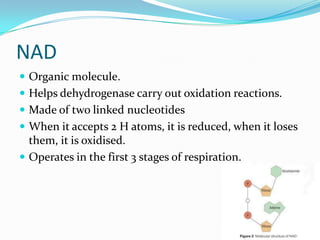
 Organic molecule.
 Helps dehydrogenase carry out oxidation reactions.
 Made of two linked nucleotides
 When it accepts 2 H atoms, it is reduced, when it loses
  them, it is oxidised.
 Operates in the first 3 stages of respiration.
Coenzyme A
 Its function is to carry ETHANOATE, made from
  pyruvate during the link reaction, onto the Krebs
  cycle.
 Simple really!
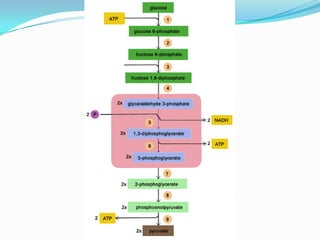
GLYCOLYSIS – Stage 1
 Phosphorylation
 1 ATP molecule is HYDROLYSED and the Pi group released
  is attached to glucose at carbon 6, so it is now FRUCTOSE
  6-phosphate.
 Another ATP is hydrolysed and the Pi is attached to
  fructose 6-phosphate at carbon 1, so it is now called
  fructose 1,6-BISPHOSPHATE.
 The energy released activates the hexose sugars and
  prevents it from being transported out of the cell. It is now
  known as HEXOSE 1,6-bisphosphate.
 Note that 2 ATP molecules have been used in this stage.
Glycolysis – Stage 2
 Splitting of hexose 1,6-bisphosphate
 Each molecules of hexose 1,6-bisphosphate is split into
  2 x TRIOSE PHOSPHATE.
 It is a 3 carbon sugar with a phosphate group attached.
Glycolysis – Stage 3
 Oxidation of triose phosphate
 Anaerobic process – each triose phosphate molecule is
    oxidised.
   This involves dehydrogenase enzymes, aided by NAD.
   NAD = hydrogen acceptor, so becomes rNAD.
   At this stage, 2 molecules of NAD are reduced per
    molecule of glucose.
   2 x ATP molecules are also formed = SUBSTRATE
    LEVEL PHOSPHORYLATION.
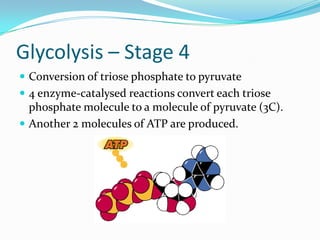
Glycolysis – Stage 4
 Conversion of triose phosphate to pyruvate
 4 enzyme-catalysed reactions convert each triose
  phosphate molecule to a molecule of pyruvate (3C).
 Another 2 molecules of ATP are produced.
Products of glycolysis?
 2 x ATP
 2 x rNAD
 2 x pyruvate
Mitochondria
 The Matrix
 Site of link reaction and Krebs cycle.
 Contains catalytic enzymes, NAD, oxaloacetate.
 The outer membrane
 Contains proteins (forms channels or carriers)
 The Inner Membrane
 Folded into many cristae (large SA)
 Many electron carriers and ATP synthase enzymes
  embedded in it.
The Link Reaction
 Converts pyruvate to acetate. NAD is reduced.
 2pyruvate+2NAD+2CoA2CO₂+2rNAD+2acetylCoA
 NAD becomes reduced, CoA accepts acetate to be
  acetyl CoA, CoA carries acetate to Krebs cycle.
 No ATP produced
 However each rNAD will take a pair of H atoms to
  inner mitochondrial matrix to make ATP during
  oxidative phosphorylation.
The Krebs Cycle
 Also takes place in mitochondrial matrix.
1. Acetate of offloaded from CoA and joins oxaloacetate to
     form citrate.
2.   Citrate is decarboxylated and dehydrogenated to form a
     5C compound. 1 x rNAD is reduced.
3.   The 5C compound is decarboxylated and dehydrogenated
     to form a 4C compound + 1 x rNAD.
4.   The 4C compound is changed into another 4C compound
     = x ATP produced = SUBSTRATE LEVEL
     PHOSPHORYLATION
5.   “                “ = x rFAD
6.   The 3rd 4C compound is dehydrogenated and regenerates
     oxaloacetate + 1 x rNAD produced
KC Continued…
 1 turn of the cycle = 1 x acetate so…
 2 turns of the cycle = 1 x glucose
 Yay…
Chemiosmosis
 As electrons flow along the electron transport chain,
    energy is released and used to pump protons across
    the intermembrane space.
   This builds up a proton gradient (also a pH gradient)
    and an electrochemical gradient.
   So potential energy builds up in the intermembrane
    space.
   H ions cannot diffuse through the lipid part of the
    inner membrane but can diffuse through ion channels.
   The flow of H ions is known as chemiosmosis.
Oxidative Phosphorylation
 Formation of ATP by the addition of PI to ADP in the
  presence of oxygen:
 AS protons flow through an ATP Synthase enzyme,
  they drive the rotational part of the enzyme which
  joins ADP and Pi to form ATP.
 The electrons are passed from the last electron carrier
  in the chain to molecular oxygen, which is the final
  electron acceptor!
 H ions also join so that oxygen is reduced to water.
 And that, my friends, is RESPIRATION!
 All you have to do know is learn it all (mwahahaha)

RESPIRATION!!!

  • 2.
    What is respiration? The process whereby energy stored in complex organic molecules is used to make ATP. It occurs in living cells.  ATP is a phosphorylated nucleotide and it is the universal energy currency.  Energy is the ability to do work.  All living things need energy to drive their biological processes, all reactions that take place within an organism are known collectively as METABOLISM.  Anabolic reactions (build up small to large molecules)  Catabolic reactions (break down large to small)
  • 3.
    Metabolic processes?  Theones which require energy are:  Active Transport – moving ions across a membrane against a concentration gradient. (Much of an organisms energy is used for this)  Secretion – large molecules that need to be exported by exocytosis.  Endocytosis – bulk movement of large molecules into cells.  Movement  Replication of DNA.
  • 4.
    Where does theenergy come from?  Plants, protoctists and some bacteria = PHOTOAUTOTROPHS.  They use sunlight energy in photosynthesis to make large, organic molecules that contain chemical potential energy. The plants are eaten by consumers, and the energy can be released in respiration.  The energy released is used to phosphorylate ADP, making ATP which contains lots of energy.
  • 5.
    The role ofATP  Phosphorylated nucleotide.  High-energy intermediate compound found in both prokaryotic and eukaryotic cells.  Each molecule = adenosine + 3 phosphate groups.  It can be hydrolysed to ADP + Pi = 30.6Kj energy per mol.  So energy can be released in small, manageable amounts = cells will not be damaged and energy will not be wasted.  ATP = UNIVERSAL ENERGY CURRENCY.
  • 6.
    Stages of respiration Glycolysis – happens in the cytoplasm of all cells, it can take place with or without oxygen. It breaks down glucose (6C sugar) into 2 x Pyruvate (3C sugar).  The link reaction – happens in the matrix of mitochondria, pyruvate is dehydrogenated, decarboxylated and converted to ACETATE.  Krebs Cycle – happens in the matrix of mitochondria, acetate is decarboxylated and dehydrogenated.  Oxidative phosphorylation – takes place on cristae of mitochondria. ADP is phosphorylated to ATP.
  • 7.
    Coenzymes  During thefirst 3 stages of respiration, substrate molecules are OXIDISED (H atoms removed).  These reactions are catalysed by DEHYDROGENASE enzymes, but the enzymes are not very good at catalysing oxidation or reduction reactions.  So COENZYMES are needed to help them (e.g NAD)  They carry the H atoms to the inner membranes of mitochondria (for oxidative phosphorylation later).
  • 8.
    NAD  Organic molecule. Helps dehydrogenase carry out oxidation reactions.  Made of two linked nucleotides  When it accepts 2 H atoms, it is reduced, when it loses them, it is oxidised.  Operates in the first 3 stages of respiration.
  • 9.
    Coenzyme A  Itsfunction is to carry ETHANOATE, made from pyruvate during the link reaction, onto the Krebs cycle.  Simple really!
  • 10.
    GLYCOLYSIS – Stage1  Phosphorylation  1 ATP molecule is HYDROLYSED and the Pi group released is attached to glucose at carbon 6, so it is now FRUCTOSE 6-phosphate.  Another ATP is hydrolysed and the Pi is attached to fructose 6-phosphate at carbon 1, so it is now called fructose 1,6-BISPHOSPHATE.  The energy released activates the hexose sugars and prevents it from being transported out of the cell. It is now known as HEXOSE 1,6-bisphosphate.  Note that 2 ATP molecules have been used in this stage.
  • 11.
    Glycolysis – Stage2  Splitting of hexose 1,6-bisphosphate  Each molecules of hexose 1,6-bisphosphate is split into 2 x TRIOSE PHOSPHATE.  It is a 3 carbon sugar with a phosphate group attached.
  • 12.
    Glycolysis – Stage3  Oxidation of triose phosphate  Anaerobic process – each triose phosphate molecule is oxidised.  This involves dehydrogenase enzymes, aided by NAD.  NAD = hydrogen acceptor, so becomes rNAD.  At this stage, 2 molecules of NAD are reduced per molecule of glucose.  2 x ATP molecules are also formed = SUBSTRATE LEVEL PHOSPHORYLATION.
  • 13.
    Glycolysis – Stage4  Conversion of triose phosphate to pyruvate  4 enzyme-catalysed reactions convert each triose phosphate molecule to a molecule of pyruvate (3C).  Another 2 molecules of ATP are produced.
  • 14.
    Products of glycolysis? 2 x ATP  2 x rNAD  2 x pyruvate
  • 16.
    Mitochondria  The Matrix Site of link reaction and Krebs cycle.  Contains catalytic enzymes, NAD, oxaloacetate.  The outer membrane  Contains proteins (forms channels or carriers)  The Inner Membrane  Folded into many cristae (large SA)  Many electron carriers and ATP synthase enzymes embedded in it.
  • 17.
    The Link Reaction Converts pyruvate to acetate. NAD is reduced.  2pyruvate+2NAD+2CoA2CO₂+2rNAD+2acetylCoA  NAD becomes reduced, CoA accepts acetate to be acetyl CoA, CoA carries acetate to Krebs cycle.  No ATP produced  However each rNAD will take a pair of H atoms to inner mitochondrial matrix to make ATP during oxidative phosphorylation.
  • 18.
    The Krebs Cycle Also takes place in mitochondrial matrix. 1. Acetate of offloaded from CoA and joins oxaloacetate to form citrate. 2. Citrate is decarboxylated and dehydrogenated to form a 5C compound. 1 x rNAD is reduced. 3. The 5C compound is decarboxylated and dehydrogenated to form a 4C compound + 1 x rNAD. 4. The 4C compound is changed into another 4C compound = x ATP produced = SUBSTRATE LEVEL PHOSPHORYLATION 5. “ “ = x rFAD 6. The 3rd 4C compound is dehydrogenated and regenerates oxaloacetate + 1 x rNAD produced
  • 19.
    KC Continued…  1turn of the cycle = 1 x acetate so…  2 turns of the cycle = 1 x glucose  Yay…
  • 20.
    Chemiosmosis  As electronsflow along the electron transport chain, energy is released and used to pump protons across the intermembrane space.  This builds up a proton gradient (also a pH gradient) and an electrochemical gradient.  So potential energy builds up in the intermembrane space.  H ions cannot diffuse through the lipid part of the inner membrane but can diffuse through ion channels.  The flow of H ions is known as chemiosmosis.
  • 21.
    Oxidative Phosphorylation  Formationof ATP by the addition of PI to ADP in the presence of oxygen:  AS protons flow through an ATP Synthase enzyme, they drive the rotational part of the enzyme which joins ADP and Pi to form ATP.  The electrons are passed from the last electron carrier in the chain to molecular oxygen, which is the final electron acceptor!  H ions also join so that oxygen is reduced to water.
  • 22.
     And that,my friends, is RESPIRATION!  All you have to do know is learn it all (mwahahaha)

Editor's Notes

  • #5 ‘phosphorylate’ just means adding an inorganic phosphate to it 
  • #6 Adenosine = Adenine + ribose sugar.
  • #7 Dehydrogenated (hydrogen removed)Decarboxylated (carboxyl removed)Cristae = folded inner membranes of mitochondria.The last 3 stages will only take place under aerobic conditions, if no O₂ is available, pyruvate is either converted to ethanol or lactate – hence lactic acid when carrying out anaerobic excercise!
  • #8 OILRIG – Oxidation Is Loss Reduction is Gain 