© 2014. All Rights Reserved.
RESPECT MY AUTHORITAH!
1 // UNDERSTAND WHAT A SOCIAL INFLUENCER IS
A social influencer is:
“A person or group of people who possess greater
than average potential to influence due to
attributes such as frequency of communication,
personal persuasiveness or size of and centrality to
a social network, among others.”
Source: Word of Mouth Marketing Association
Influencer Guidebook 2013
2 // FOCUS LESS ON YOUR BUDGET AND MORE ON UNDERSTANDING INFLUENCER MARKETING
“The key is to focus on how your customers make
purchase decisions and who in their social graphs are
more likely to influence that purchase decision. Most
often it’s not those with large social followings but
people who are in closest proximity (relationship,
frequency of contact, personal nature of contact, etc.)
with the prospective customer. When you understand
this, you can run manual campaigns for 50 prospects
that require little investment, to hundreds of
thousands of dollars in budget for international
campaigns targeting tens of thousands of prospects.”
- Sam Fiorella, partner, Sensei Marketing and author
of Influence Marketing: How to Create, Manage and
Measure Brand Influencers
3 // REMEMBER THE POWER OF WORD-OF-MOUTH
Studies have long shown that consumers find
word-of-mouth recommendations more credible
than traditional marketing messages. Today, 70
percent of US online adults trust brand or product
recommendations from friends and family.
Source: Forrester Research
4 // DON’T FORGET THE PEER SPHERE OF INFLUENCE AMONG MILLENNIALS
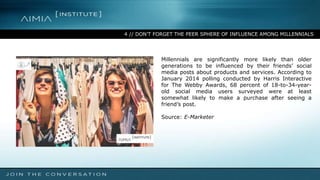
Millennials are significantly more likely than older
generations to be influenced by their friends’ social
media posts about products and services. According to
January 2014 polling conducted by Harris Interactive
for The Webby Awards, 68 percent of 18-to-34-year-
old social media users surveyed were at least
somewhat likely to make a purchase after seeing a
friend’s post.
Source: E-Marketer
5 // KNOW YOUR BUSINESS GOALS
“People can get glossy-eyed and excited about influencer
marketing programs without first understanding their
own business objectives.”
- Neil Beam, Word of Mouth Marketing Association
(WOMMA).
There are several questions which can help marketers
define their brand goals:
:: Are you looking to improve retention?
:: Are you looking to improve customer lifetime value?
:: Are you looking to increase loyalty program
membership?
:: Are you looking to provide better and faster customer
service and support?
:: Are you looking to improve your brand reputation?
Source: WOMMA Influencer Guidebook 2013
6 // CONSIDER INFLUENCER MARKETING A LONG-TERM PLAY
“A big challenge for most companies when it comes to
social influencers is moving from an ‘advertising’
mindset to a ‘relationship’ mindset. For this to work,
you need to nurture these influencer relationships so
they become true organic advocates. That does not
happen overnight - this is a long-term play that
requires persistence and patience.”
- Mark Schaefer, author of “Return on Influence: The
Revolutionary Power of Klout, Social Scoring and
Influence Marketing.”
7 // DON’T RELY ON SOCIAL SCORING
Social scoring, which attempts to use algorithms to
measure an individual’s influence, emerged in 2010 and
now is offered by companies such as Klout, PeerIndex,
Traackr, Kred, and dozens of others. But less than 15
percent of all agencies use Klout alone as a method to
discover influencers. More typically, it is an amalgam of
Klout plus some homemade algorithmic stew that is being
used.
Just over one-quarter of marketers surveyed showed any
enthusiasm for using social scoring tools as filtering
mechanisms. Asked whether these tools are useful, the
majority of marketers surveyed questioned their efficacy.
Source: Mark Schaeffer, Return on Influence
Source: Sensei Marketing, Influence Marketing Survey
2013
8 // DON’T TRY TO BUY INFLUENCERS
Some influencer-marketing efforts have become pay-
to-play campaigns, where brands offer financial
incentives to bloggers, for example, in exchange for
recommendations to followers. But some experts
warn against this practice, particularly since, within
the United States, the Federal Trade Commission
issued endorsement guidelines that advise companies
to disclose the use of incentives.
9 // REMEMBER THAT NOT ALL INFLUENCERS ARE CREATED EQUAL
According to the Word of Mouth Marketing Association,
there are several distinct categories of key influencers
that brands can identify and engage, including:
:: Advocates: brand-independent, not formally
recognized by brand, positive sentiment
:: Ambassadors: formally recognized by brand
(employees, affiliates, volunteers)
:: Citizens: Shares information but isn’t an advocate,
typically anonymous (neighbors, friends, family
members)
:: Professional/Occupational: derive income from
influencing people (journalists, policymakers,
academics)
Source: Word of Mouth Marketing Association Influencer
Guidebook 2013
10 // MEASURE FOR SOCIAL INFLUENCER SUCCESS
In the measureable marketing world, the biggest
question social influence campaigns face is “How do we
know it works?” There are several metrics which offer
insight into these efforts’ effectiveness, including:
:: Direct sales impact during a specified period of time
:: The positive or negative impact on the customer
lifetime value (how long they remain a customer,
total revenue earned, total profit earned, referrals
converted) generated by the new customers/sales
that came in from the campaign
:: The movement of prospects and customers along
the customer life cycle (awareness > consideration
> decision > purchase > satisfaction > loyalty >
advocacy)
Source: Sam Fiorella, partner, Sensei Marketing and
author of Influence Marketing: How to Create, Manage
and Measure Brand Influencers
11 // HAVE AN EFFECTIVE SOCIAL LOYALTY STRATEGY
True Social Influence = Successful Social
Loyalty Strategy
“The real powerhouse in driving social influence is an
effective social loyalty strategy - being true to your
customers on social – all of them. Answering,
helping, rewarding, and collaborating with as many of
them as you can. Being seen by all your customers to
be open, honest, transparent and even-handed
generates credible, positive social influence and
brand loyalty.”
- David Price, Aimia
12 // DEVELOP REAL RELATIONSHIPS
To succeed in social influence, develop real relationships
with customers fostered through on-going relevant
conversation, rewards, emotion and participation - all of
the elements, not surprisingly, of a successful loyalty
program.
Be human. Be brilliant. Be trustworthy,
Be rewarding.
For a deeper look at social media influencers, read
“Harnessing the Power of Social Influencers” at
www.aimiainstitute.com
© 2014. All Rights Reserved.

Respect My Authoritah!

  • 1.
    © 2014. AllRights Reserved. RESPECT MY AUTHORITAH!
  • 2.
    1 // UNDERSTANDWHAT A SOCIAL INFLUENCER IS A social influencer is: “A person or group of people who possess greater than average potential to influence due to attributes such as frequency of communication, personal persuasiveness or size of and centrality to a social network, among others.” Source: Word of Mouth Marketing Association Influencer Guidebook 2013
  • 3.
    2 // FOCUSLESS ON YOUR BUDGET AND MORE ON UNDERSTANDING INFLUENCER MARKETING “The key is to focus on how your customers make purchase decisions and who in their social graphs are more likely to influence that purchase decision. Most often it’s not those with large social followings but people who are in closest proximity (relationship, frequency of contact, personal nature of contact, etc.) with the prospective customer. When you understand this, you can run manual campaigns for 50 prospects that require little investment, to hundreds of thousands of dollars in budget for international campaigns targeting tens of thousands of prospects.” - Sam Fiorella, partner, Sensei Marketing and author of Influence Marketing: How to Create, Manage and Measure Brand Influencers
  • 4.
    3 // REMEMBERTHE POWER OF WORD-OF-MOUTH Studies have long shown that consumers find word-of-mouth recommendations more credible than traditional marketing messages. Today, 70 percent of US online adults trust brand or product recommendations from friends and family. Source: Forrester Research
  • 5.
    4 // DON’TFORGET THE PEER SPHERE OF INFLUENCE AMONG MILLENNIALS Millennials are significantly more likely than older generations to be influenced by their friends’ social media posts about products and services. According to January 2014 polling conducted by Harris Interactive for The Webby Awards, 68 percent of 18-to-34-year- old social media users surveyed were at least somewhat likely to make a purchase after seeing a friend’s post. Source: E-Marketer
  • 6.
    5 // KNOWYOUR BUSINESS GOALS “People can get glossy-eyed and excited about influencer marketing programs without first understanding their own business objectives.” - Neil Beam, Word of Mouth Marketing Association (WOMMA). There are several questions which can help marketers define their brand goals: :: Are you looking to improve retention? :: Are you looking to improve customer lifetime value? :: Are you looking to increase loyalty program membership? :: Are you looking to provide better and faster customer service and support? :: Are you looking to improve your brand reputation? Source: WOMMA Influencer Guidebook 2013
  • 7.
    6 // CONSIDERINFLUENCER MARKETING A LONG-TERM PLAY “A big challenge for most companies when it comes to social influencers is moving from an ‘advertising’ mindset to a ‘relationship’ mindset. For this to work, you need to nurture these influencer relationships so they become true organic advocates. That does not happen overnight - this is a long-term play that requires persistence and patience.” - Mark Schaefer, author of “Return on Influence: The Revolutionary Power of Klout, Social Scoring and Influence Marketing.”
  • 8.
    7 // DON’TRELY ON SOCIAL SCORING Social scoring, which attempts to use algorithms to measure an individual’s influence, emerged in 2010 and now is offered by companies such as Klout, PeerIndex, Traackr, Kred, and dozens of others. But less than 15 percent of all agencies use Klout alone as a method to discover influencers. More typically, it is an amalgam of Klout plus some homemade algorithmic stew that is being used. Just over one-quarter of marketers surveyed showed any enthusiasm for using social scoring tools as filtering mechanisms. Asked whether these tools are useful, the majority of marketers surveyed questioned their efficacy. Source: Mark Schaeffer, Return on Influence Source: Sensei Marketing, Influence Marketing Survey 2013
  • 9.
    8 // DON’TTRY TO BUY INFLUENCERS Some influencer-marketing efforts have become pay- to-play campaigns, where brands offer financial incentives to bloggers, for example, in exchange for recommendations to followers. But some experts warn against this practice, particularly since, within the United States, the Federal Trade Commission issued endorsement guidelines that advise companies to disclose the use of incentives.
  • 10.
    9 // REMEMBERTHAT NOT ALL INFLUENCERS ARE CREATED EQUAL According to the Word of Mouth Marketing Association, there are several distinct categories of key influencers that brands can identify and engage, including: :: Advocates: brand-independent, not formally recognized by brand, positive sentiment :: Ambassadors: formally recognized by brand (employees, affiliates, volunteers) :: Citizens: Shares information but isn’t an advocate, typically anonymous (neighbors, friends, family members) :: Professional/Occupational: derive income from influencing people (journalists, policymakers, academics) Source: Word of Mouth Marketing Association Influencer Guidebook 2013
  • 11.
    10 // MEASUREFOR SOCIAL INFLUENCER SUCCESS In the measureable marketing world, the biggest question social influence campaigns face is “How do we know it works?” There are several metrics which offer insight into these efforts’ effectiveness, including: :: Direct sales impact during a specified period of time :: The positive or negative impact on the customer lifetime value (how long they remain a customer, total revenue earned, total profit earned, referrals converted) generated by the new customers/sales that came in from the campaign :: The movement of prospects and customers along the customer life cycle (awareness > consideration > decision > purchase > satisfaction > loyalty > advocacy) Source: Sam Fiorella, partner, Sensei Marketing and author of Influence Marketing: How to Create, Manage and Measure Brand Influencers
  • 12.
    11 // HAVEAN EFFECTIVE SOCIAL LOYALTY STRATEGY True Social Influence = Successful Social Loyalty Strategy “The real powerhouse in driving social influence is an effective social loyalty strategy - being true to your customers on social – all of them. Answering, helping, rewarding, and collaborating with as many of them as you can. Being seen by all your customers to be open, honest, transparent and even-handed generates credible, positive social influence and brand loyalty.” - David Price, Aimia
  • 13.
    12 // DEVELOPREAL RELATIONSHIPS To succeed in social influence, develop real relationships with customers fostered through on-going relevant conversation, rewards, emotion and participation - all of the elements, not surprisingly, of a successful loyalty program. Be human. Be brilliant. Be trustworthy, Be rewarding.
  • 14.
    For a deeperlook at social media influencers, read “Harnessing the Power of Social Influencers” at www.aimiainstitute.com © 2014. All Rights Reserved.