April 28, 2016
The customer experience has become the competitive battleground for
business. By delivering a consistent, memorable experience, companies can
create a competitive advantage that increases customer engagement,
conversion, loyalty and advocacy.
Today, almost everyone in a company plays a role in the customer
experience — from HR to finance, operations, sales, marketing, customer
service, even general employee connections and interactions. As a result,
ownership and management of the entire customer experience has been
elusive. That is rapidly changing. Over the next three-to-five years, 75 percent
of marketers say they will be responsible for the end-to-end customer
experience.
This series will provide CMOs and business executives with a deeper
understanding of the strategies and tactics required to deliver a superior 

end-to-end customer experience.
/ About the series
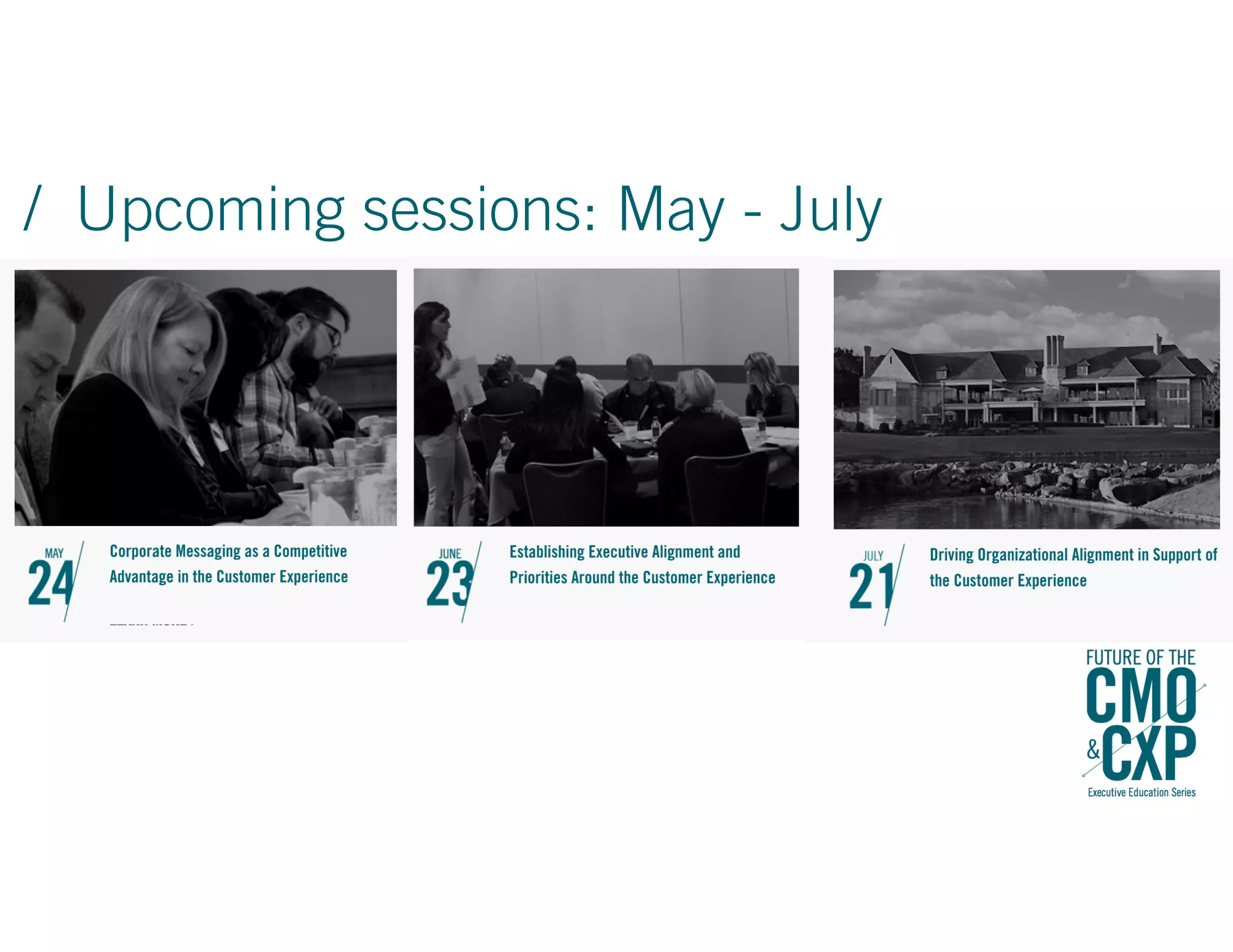
/ Upcoming sessions: May - July
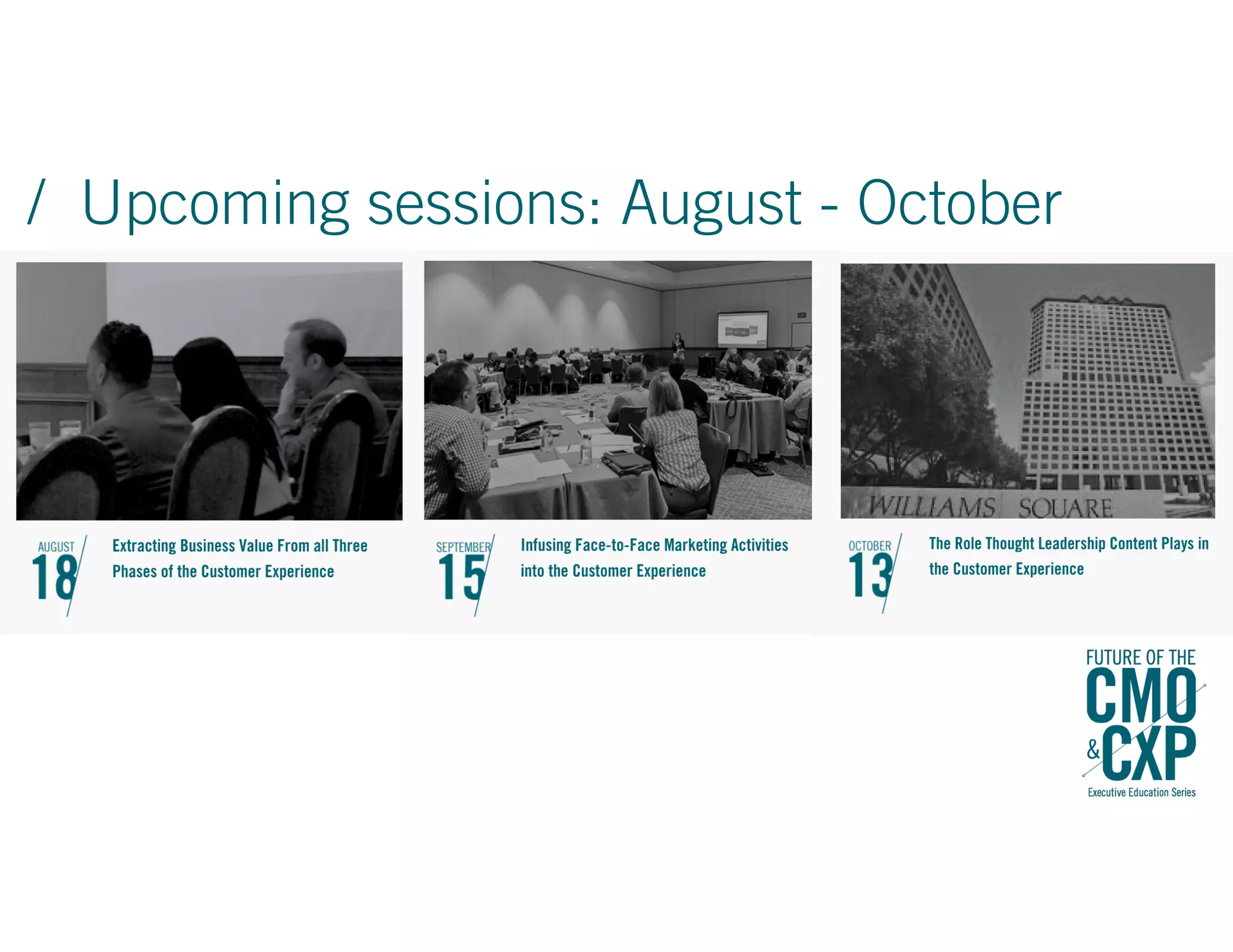
/ Upcoming sessions: August - October
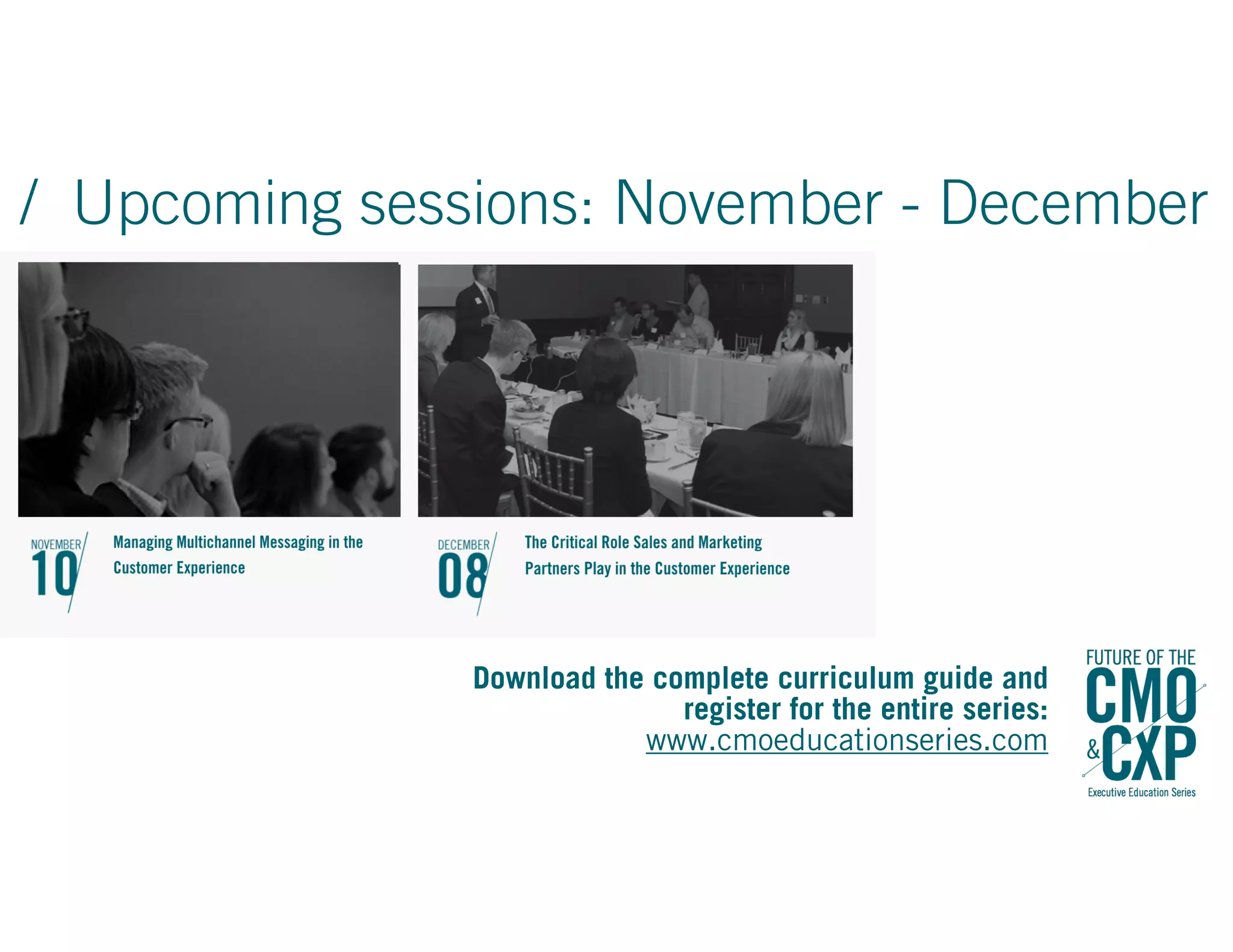
/ Upcoming sessions: November - December
Download the complete curriculum guide and
register for the entire series:
www.cmoeducationseries.com
The March session discussed
the CMO and marketing’s role
in the customer experience.
We focused on the context and understanding
it takes to make material changes to the role
marketing plays throughout the customer
experience.
How customers interact with your 

company has fundamentally changed.
This changes the customer experience.
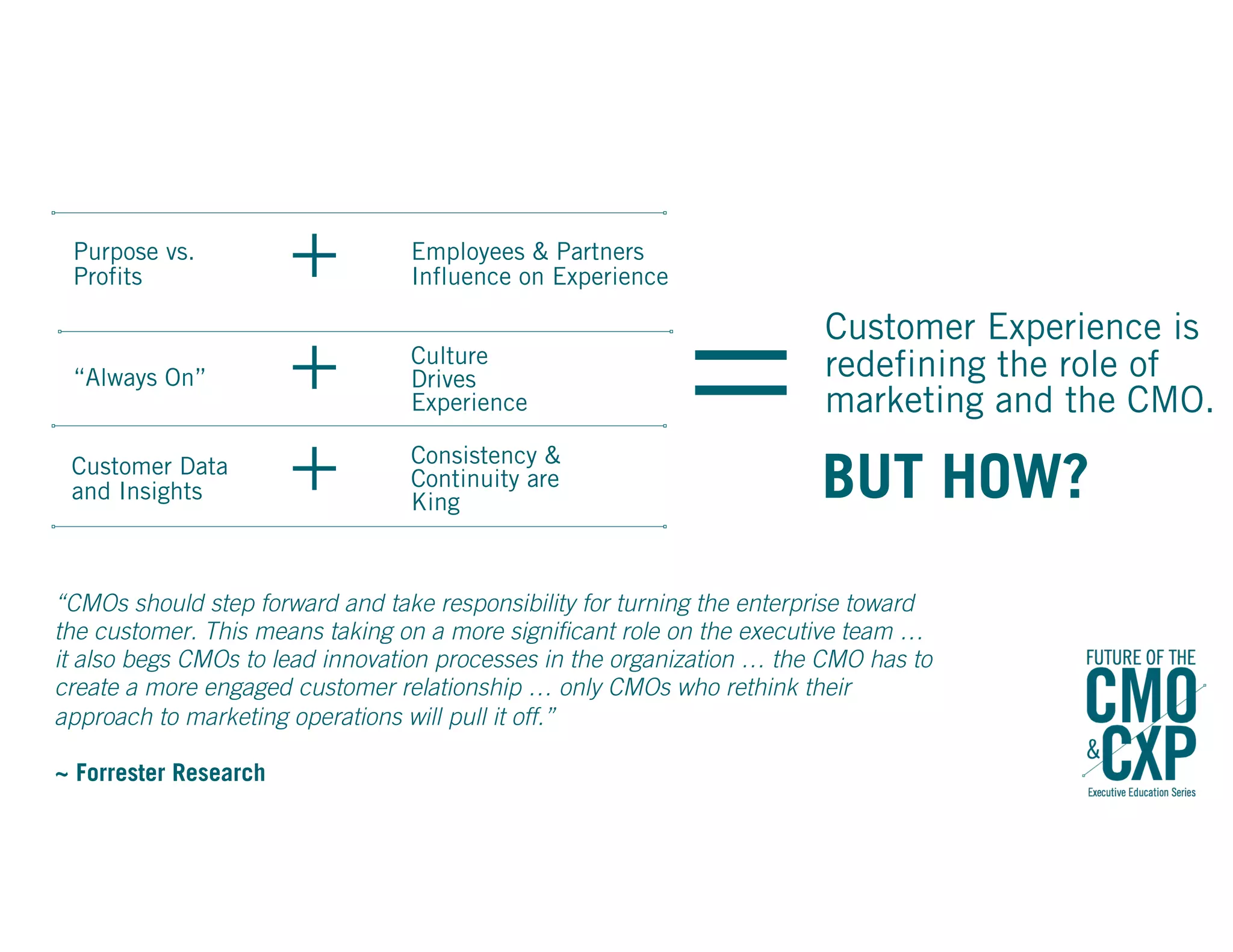
Customer Experience is
redefining the role of
marketing and the CMO.
Employees & Partners
Influence on Experience
Culture
Drives
Experience
Consistency &
Continuity are
King
Customer Data
and Insights
“Always On”
Purpose vs.
Profits
=
+
+
+ BUT HOW?
“CMOs should step forward and take responsibility for turning the enterprise toward
the customer. This means taking on a more significant role on the executive team …
it also begs CMOs to lead innovation processes in the organization … the CMO has to
create a more engaged customer relationship … only CMOs who rethink their
approach to marketing operations will pull it off.” 


~ Forrester Research
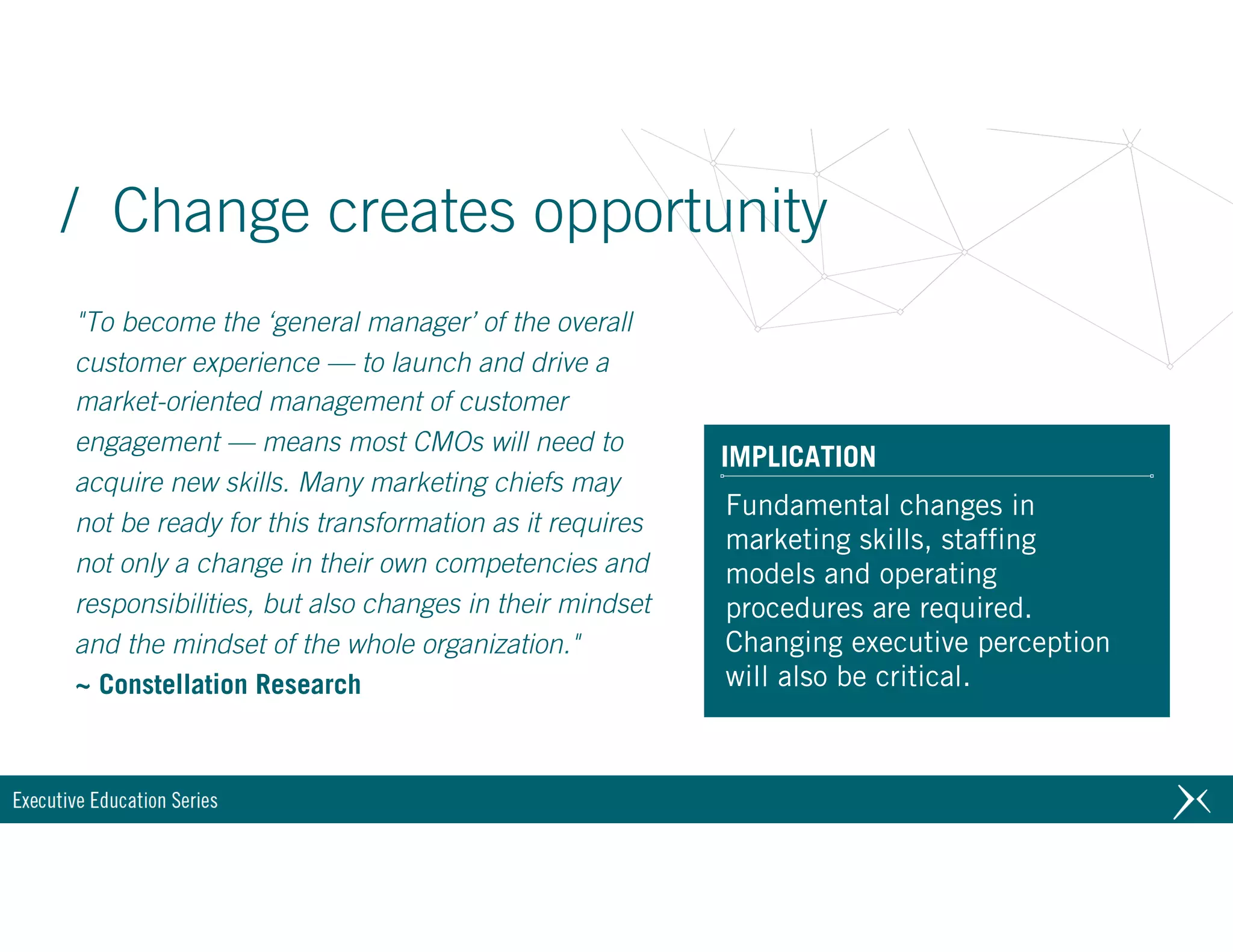
"To become the ‘general manager’ of the overall
customer experience — to launch and drive a
market-oriented management of customer
engagement — means most CMOs will need to
acquire new skills. Many marketing chiefs may
not be ready for this transformation as it requires
not only a change in their own competencies and
responsibilities, but also changes in their mindset
and the mindset of the whole organization."
~ Constellation Research
/ Change creates opportunity
IMPLICATION
Fundamental changes in
marketing skills, staffing
models and operating
procedures are required.
Changing executive perception
will also be critical.
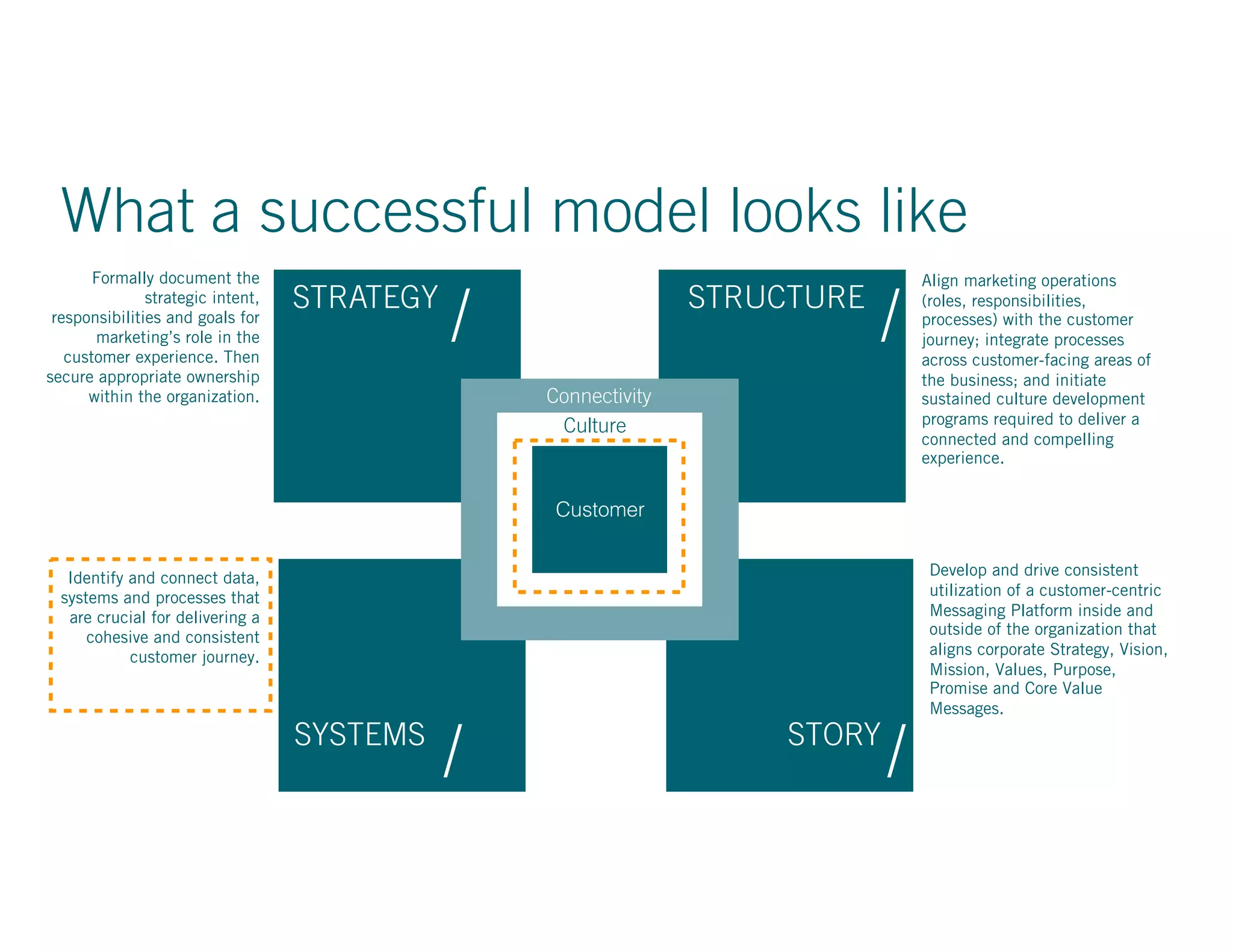
What a successful model looks like
STRATEGY
/ STRUCTURE
SYSTEMS STORY
/
/ /
Customer
Connectivity
Culture
Formally document the
strategic intent,
responsibilities and goals for
marketing’s role in the
customer experience. Then
secure appropriate ownership
within the organization.
Identify and connect data,
systems and processes that
are crucial for delivering a
cohesive and consistent
customer journey.
Align marketing operations
(roles, responsibilities,
processes) with the customer
journey; integrate processes
across customer-facing areas of
the business; and initiate
sustained culture development
programs required to deliver a
connected and compelling
experience.
Develop and drive consistent
utilization of a customer-centric
Messaging Platform inside and
outside of the organization that
aligns corporate Strategy, Vision,
Mission, Values, Purpose,
Promise and Core Value
Messages.
Capturing Customer Data
and Insights that Elevate the
Customer Experience
Learning Objective:
Participants will leave with a deeper
understanding of the customer research
methods and data they need to create a
more engaging and compelling customer
experience.
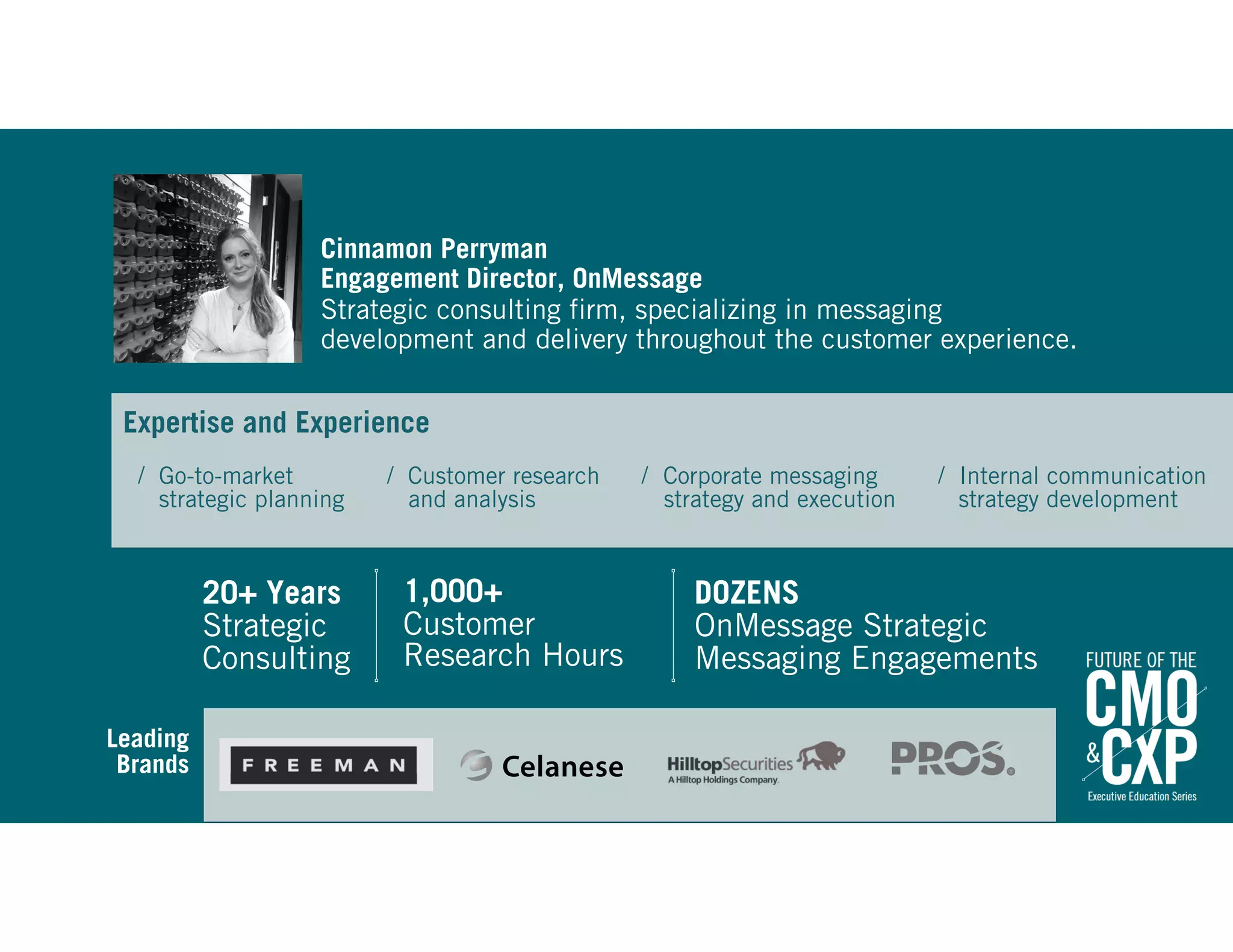
Cinnamon Perryman
Engagement Director, OnMessage

Strategic consulting firm, specializing in messaging 

development and delivery throughout the customer experience.
1,000+ 

Customer 

Research Hours
DOZENS 

OnMessage Strategic
Messaging Engagements
20+ Years 

Strategic 

Consulting
Leading 

Brands

Expertise and Experience

/ Customer research

and analysis
/ Corporate messaging

strategy and execution
/ Internal communication

strategy development
/ Go-to-market

strategic planning
What percentage of your customers
are emotionally or psychologically
attached to your organization?
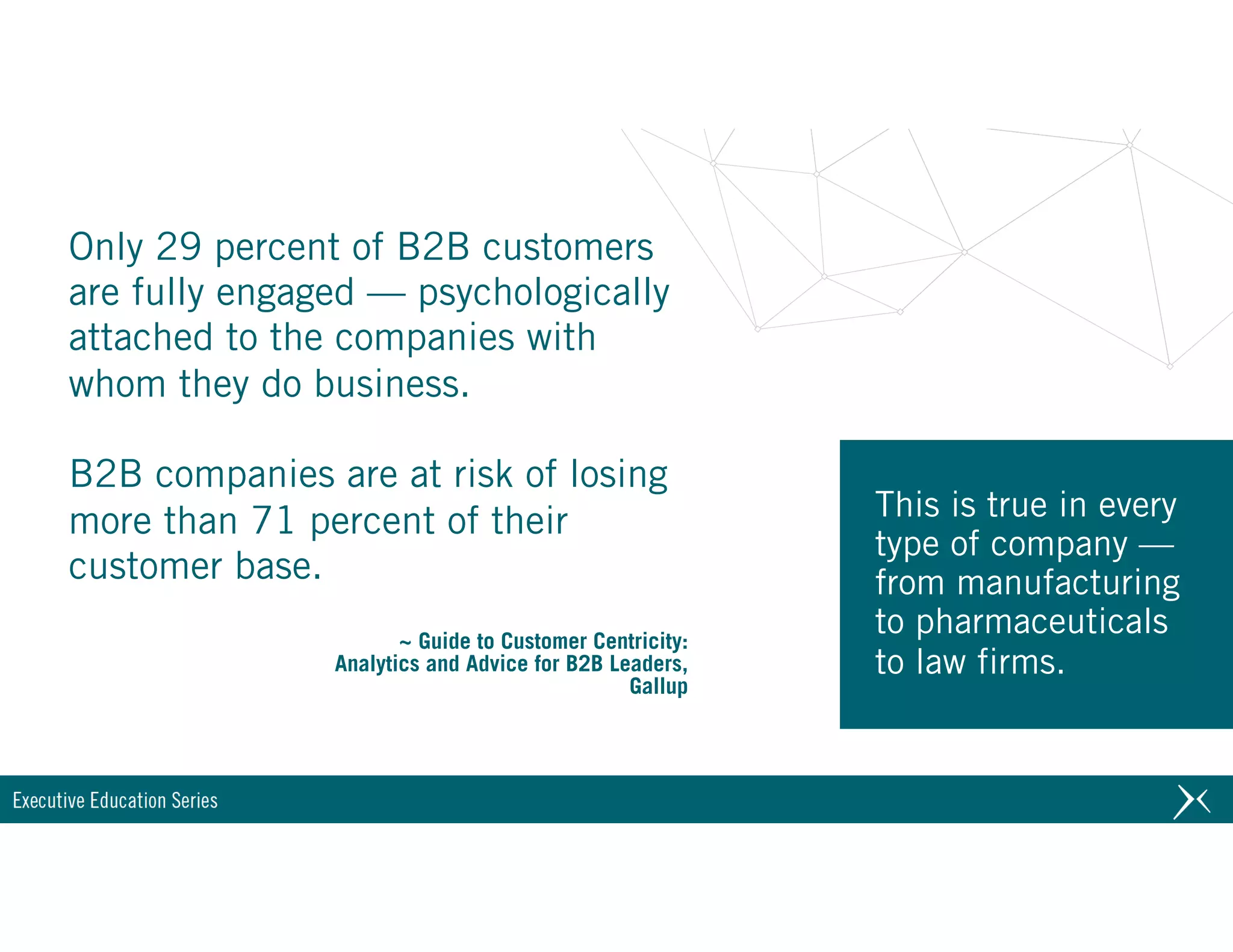
Only 29 percent of B2B customers
are fully engaged — psychologically
attached to the companies with
whom they do business.
B2B companies are at risk of losing
more than 71 percent of their
customer base.
~ Guide to Customer Centricity: 

Analytics and Advice for B2B Leaders, 

Gallup
This is true in every
type of company —
from manufacturing
to pharmaceuticals
to law firms.
Give them what they want.
How can I emotionally or psychologically engage them?
“60 percent of B2B
customers do not
believe their problems
were resolved.”

~Guide to Customer Centricity:
Analytics and Advice for B2B Leaders, Gallup
But how do I know
what they want?
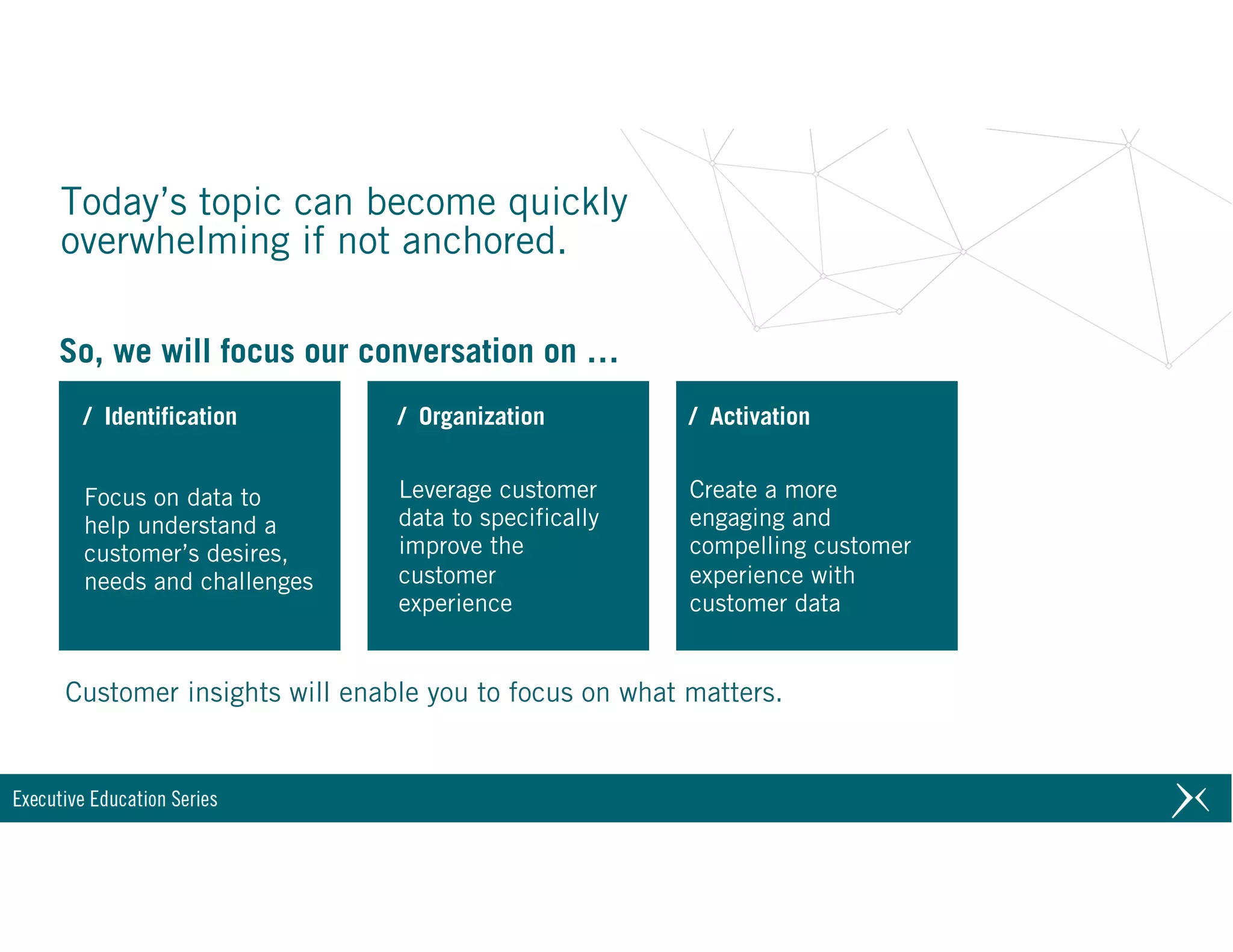
Today’s topic can become quickly
overwhelming if not anchored.
Customer insights will enable you to focus on what matters.
=
=
=
Focus on data to
help understand a
customer’s desires,
needs and challenges
Leverage customer
data to specifically
improve the
customer
experience
Create a more
engaging and
compelling customer
experience with
customer data
/ Identification / Organization / Activation
So, we will focus our conversation on …
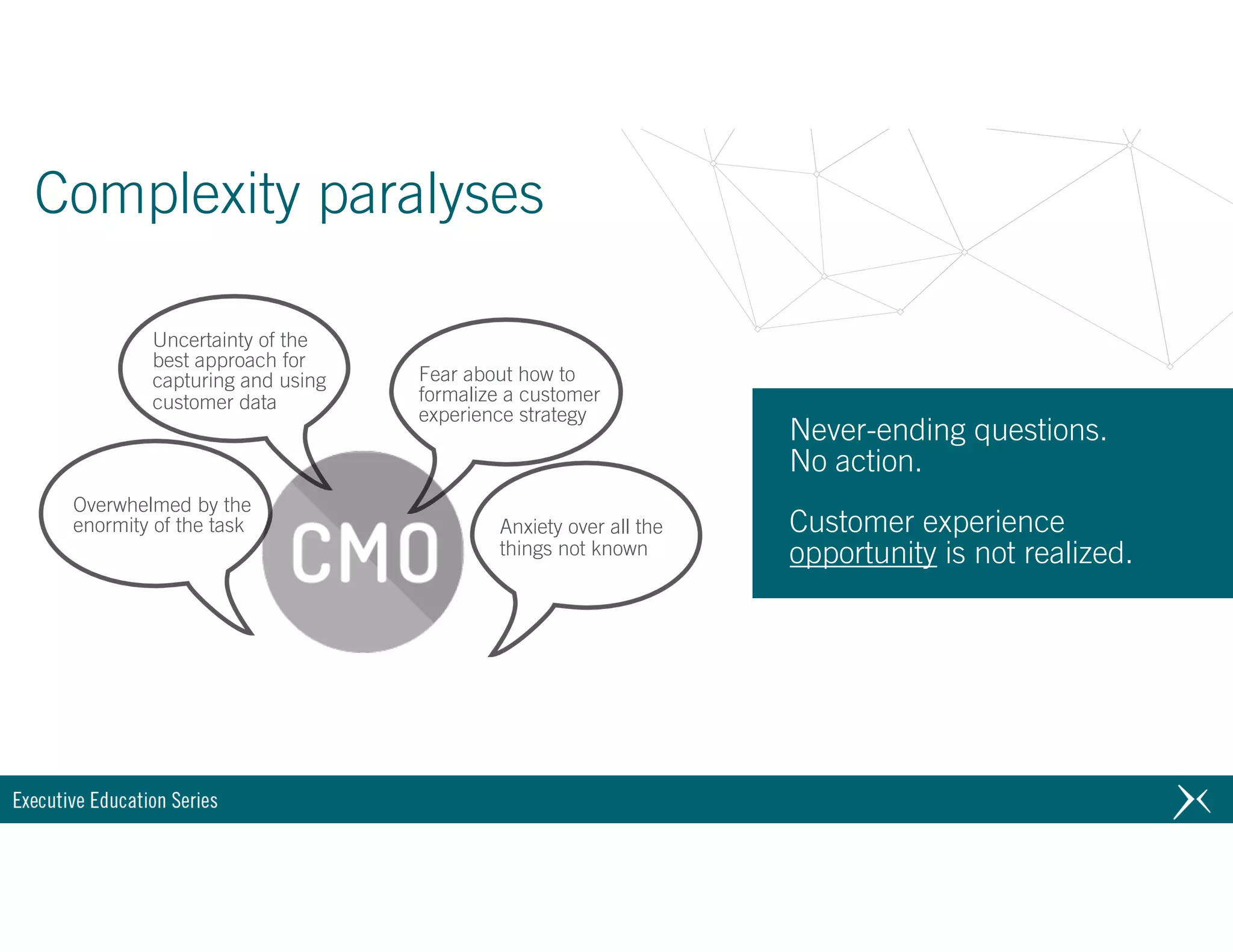
Complexity paralyses
A course of action is never
defined. The customer
experience is never started.
Uncertainty of the
best approach for
capturing and using
customer data
Fear about how to
formalize a customer
experience strategy
Anxiety over all the
things not known
Overwhelmed by the
enormity of the task
Never-ending questions. 

No action. 


Customer experience
opportunity is not realized.
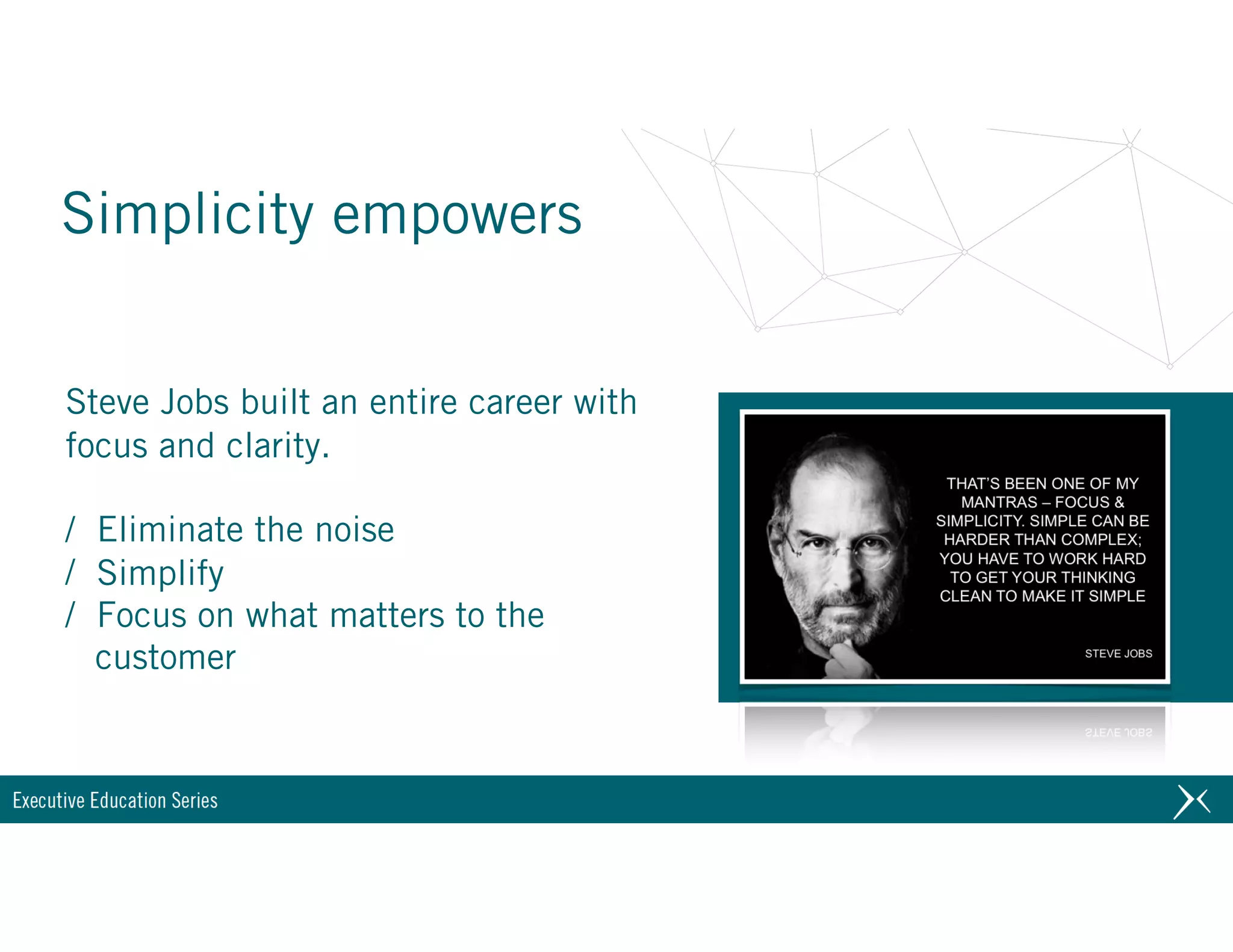
Simplicity empowers
Steve Jobs built an entire career with
focus and clarity.
/ Eliminate the noise
/ Simplify
/ Focus on what matters to the
customer
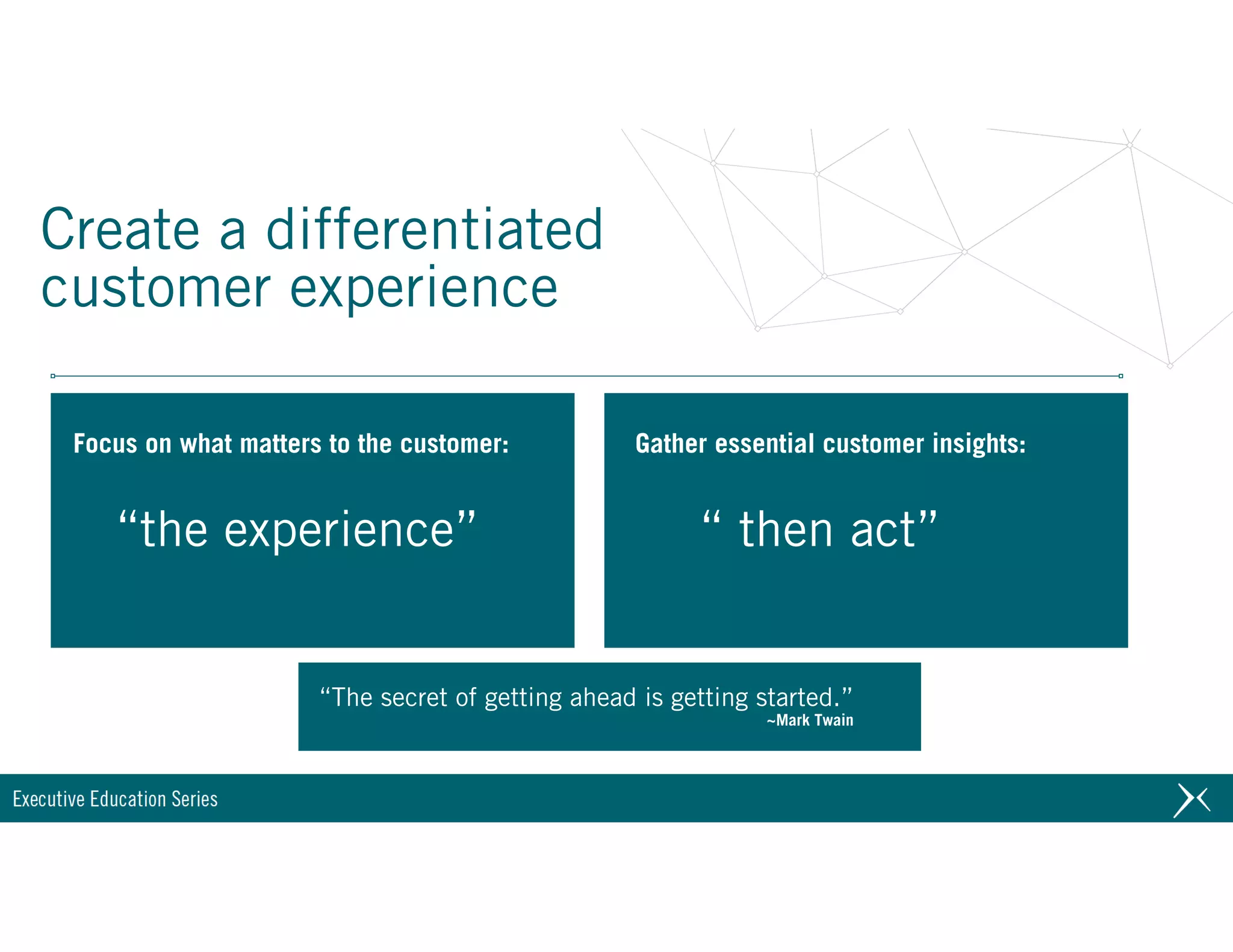
Create a differentiated
customer experience
“The secret of getting ahead is getting started.”

~Mark Twain
“the experience” “ then act”
Focus on what matters to the customer: Gather essential customer insights:
/ Inform organizational strategy
/ Drive strategic initiatives and investments
/ Improve customer acquisition, retention and advocacy
/ Generate and sustain organic growth
Benefits abound
The benefits of customer insights cannot be overstated. Customer insights:
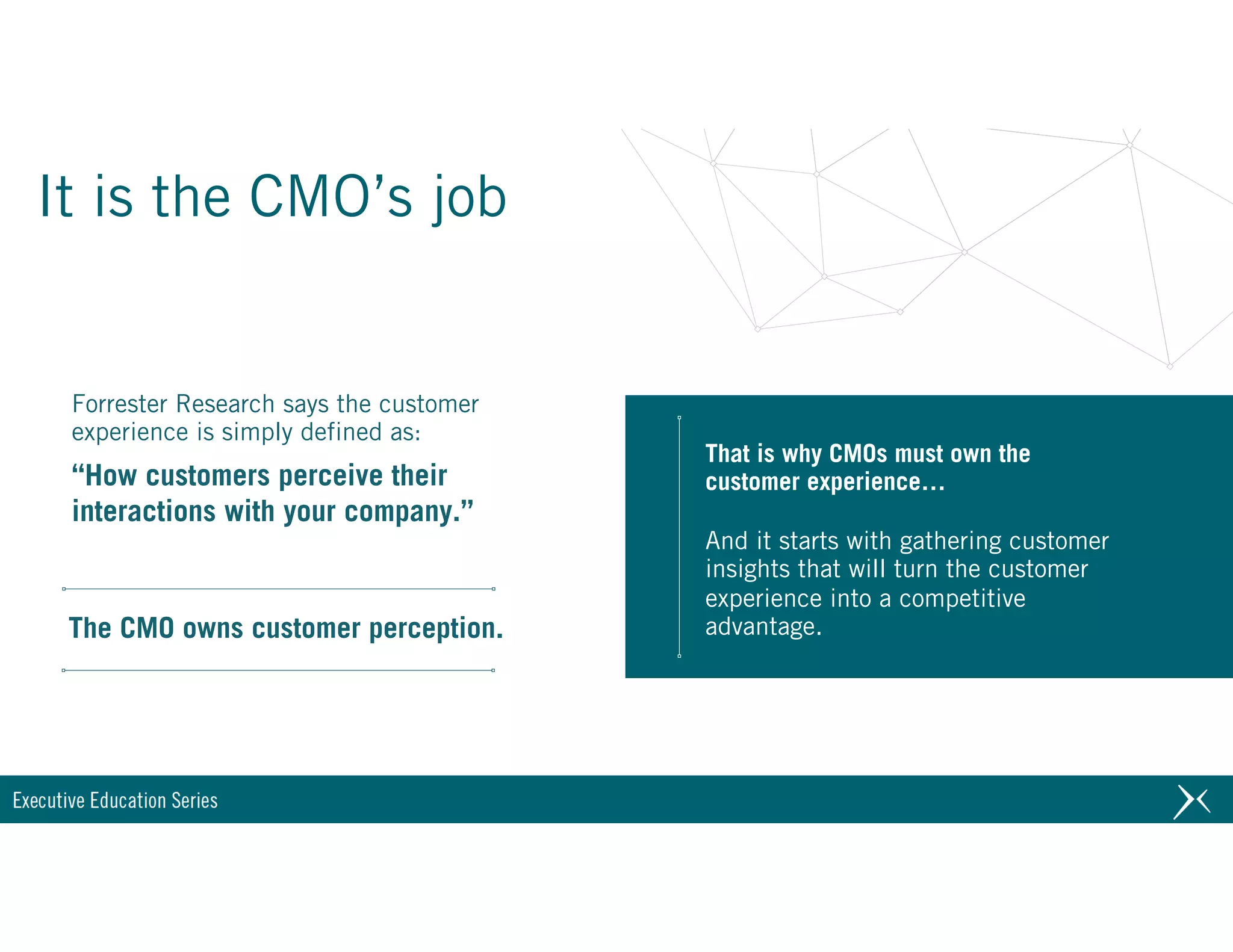
It is the CMO’s job
The CMO owns customer perception.
Forrester Research says the customer
experience is simply defined as:
“How customers perceive their
interactions with your company.”
That is why CMOs must own the 

customer experience…
And it starts with gathering customer
insights that will turn the customer
experience into a competitive
advantage.
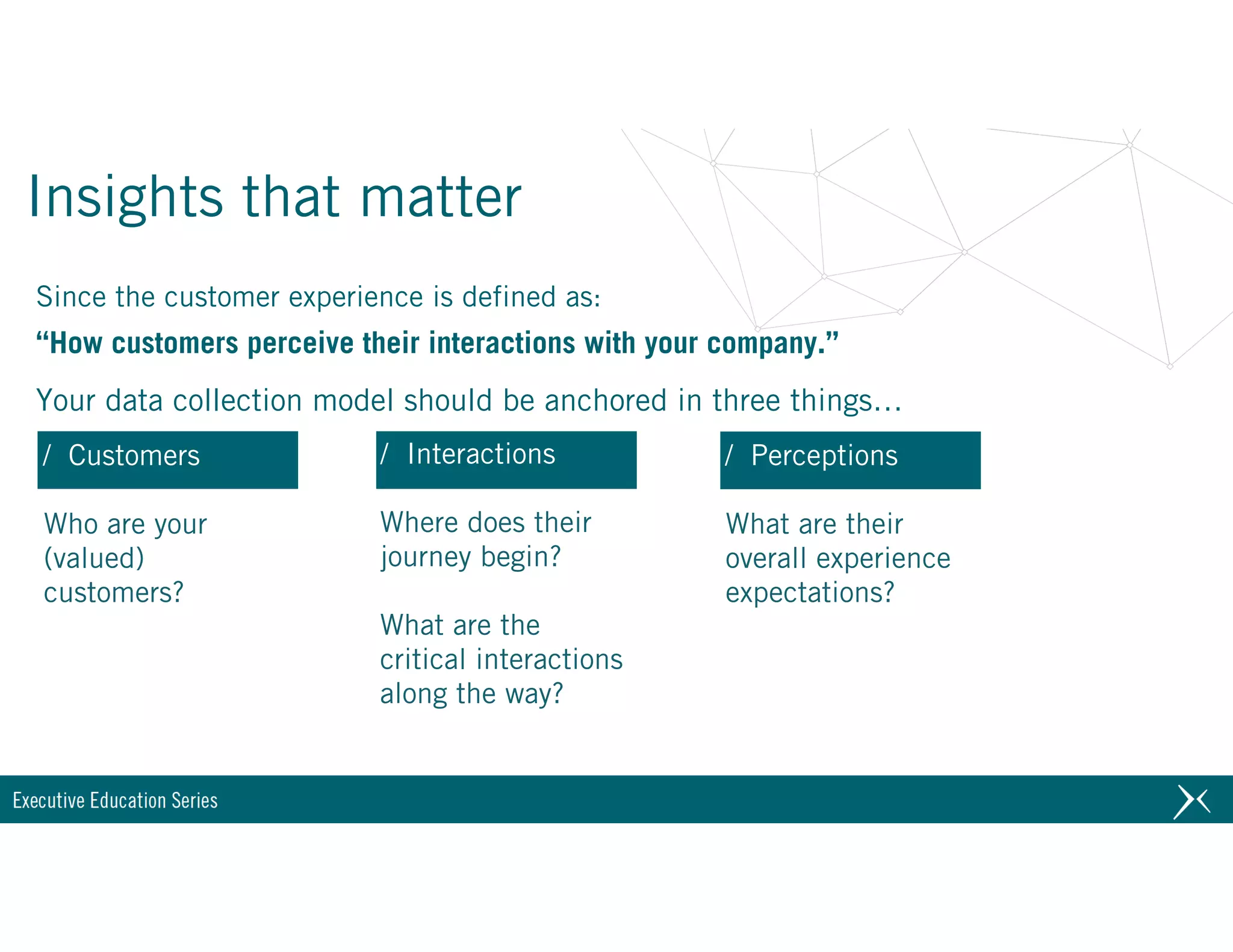
Since the customer experience is defined as:
“How customers perceive their interactions with your company.”
Insights that matter
/ Customers
Who are your
(valued)
customers?
/ Perceptions
What are their
overall experience
expectations?
/ Interactions
Where does their
journey begin? 


What are the
critical interactions
along the way?
Your data collection model should be anchored in three things…
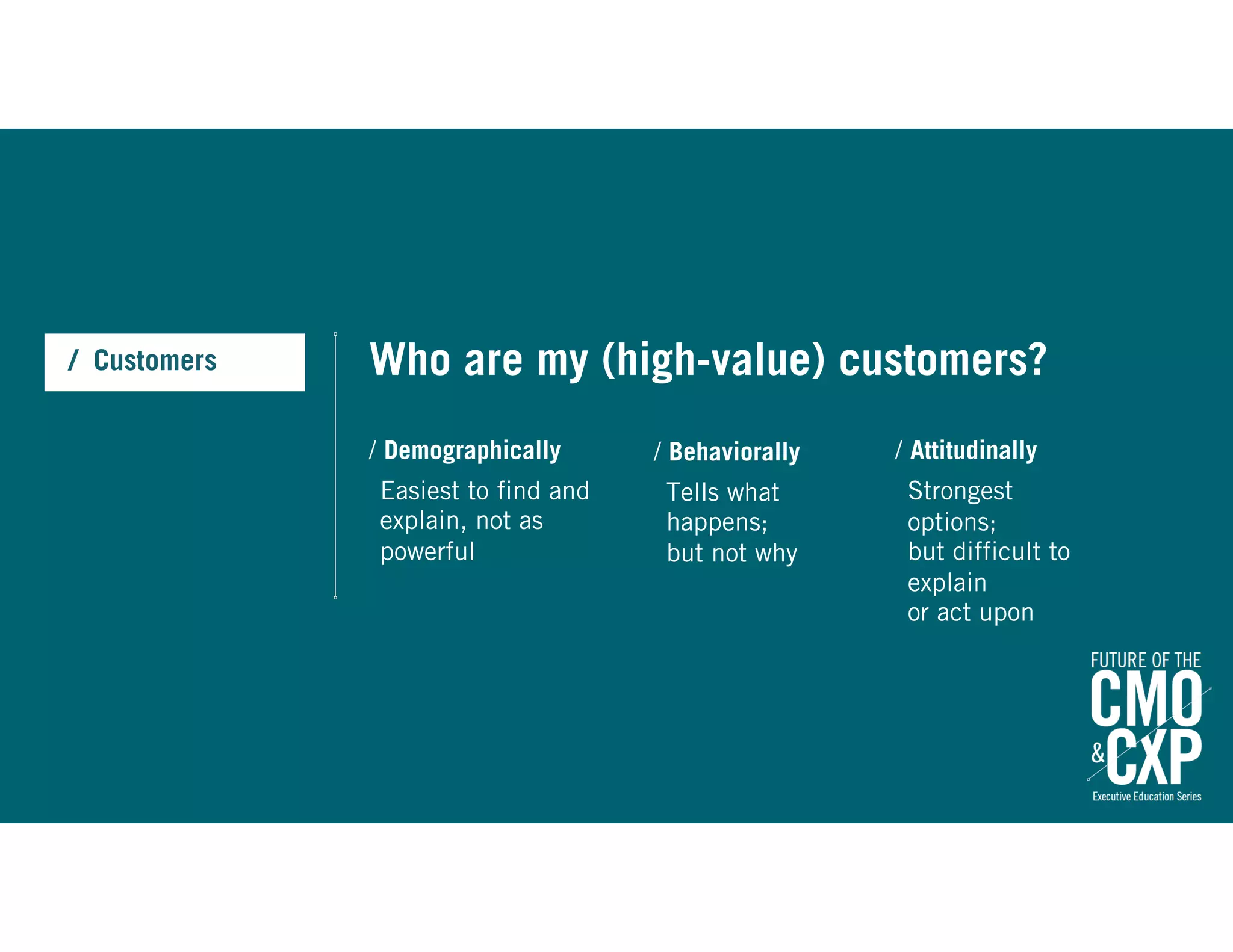
/ Demographically
Easiest to find and
explain, not as
powerful
Who are my (high-value) customers?/ Customers
/ Behaviorally
Tells what
happens; 

but not why
/ Attitudinally
Strongest
options; 

but difficult to
explain 

or act upon
Let’s start here…
Not all customers are created equal.
Customer Segments relevant to your industry (Organizations)
- Strategic Segment: Strategic business alignment, high growth opportunity
- Opportunity Segment: Low market penetration, significant growth opportunity
- Mature Segment: Low growth opportunity but high market penetration
Target Customer / Influencer within each Customer Segment (Functional Role)
- High-Performing Relationships: Loyal and profitable
- Stagnant Relationships: Somewhat content and low maintenance
- Struggling Relationships: Low reliability and higher maintenance
Personas for customers within the Customer Journey (Mindsets / Motivators)
- Don’t assume the persona work done for sales or content will cover this.
- It is likely customers involved in the post purchase and repeat purchase phases of
the customer journey have not been represented in past personas activities.
Segmentation work is required.
Conduct formal research
Now that you know who they are,
you must understand the critical
interactions they have with your
company.
Look for commonalities and differences
within each customer persona:
Who they are.
How they think.
What motivates them.
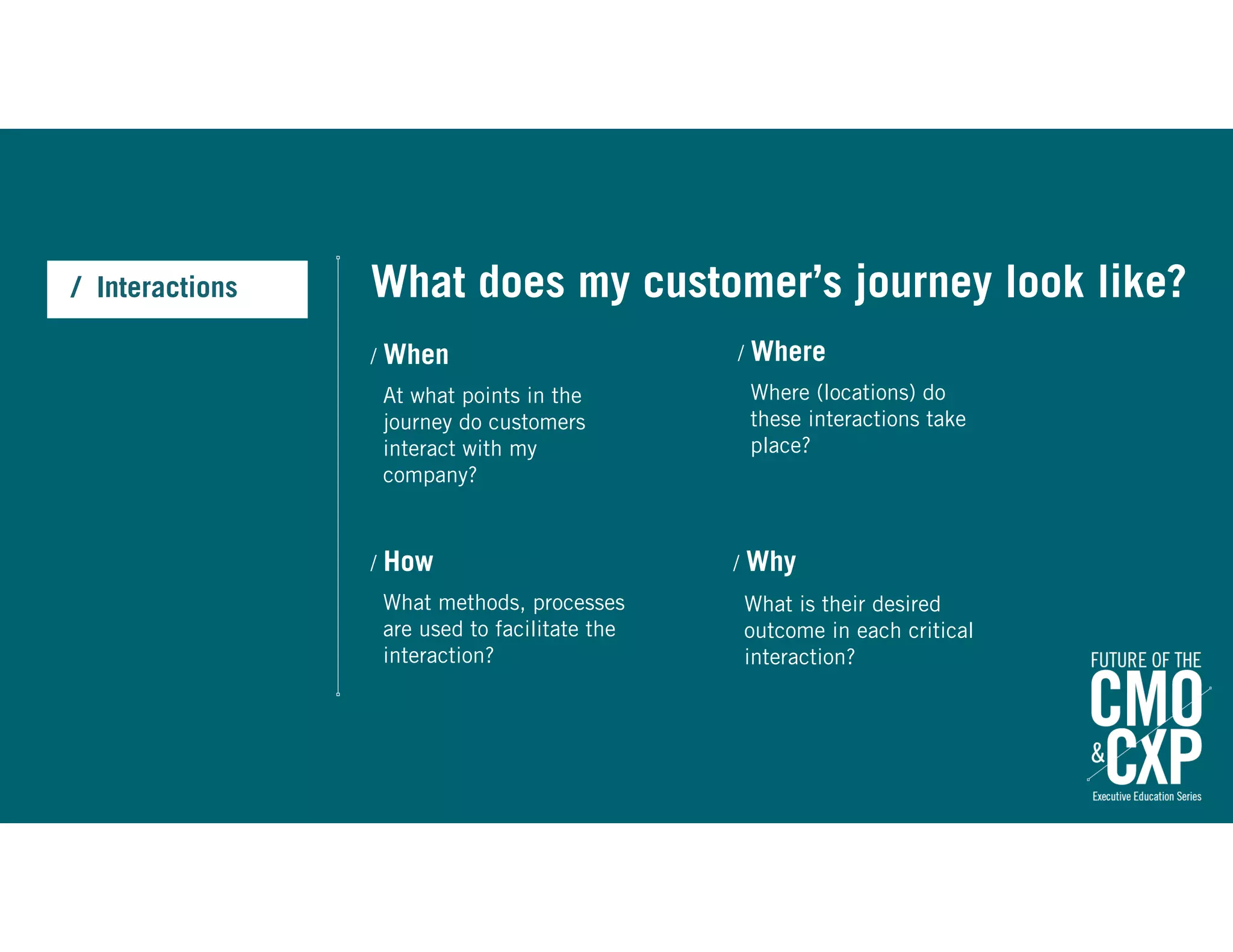
/ When
At what points in the
journey do customers
interact with my
company?
What does my customer’s journey look like?/ Interactions
/ Where
Where (locations) do
these interactions take
place?
/ How
What methods, processes
are used to facilitate the
interaction?
/ Why
What is their desired
outcome in each critical
interaction?
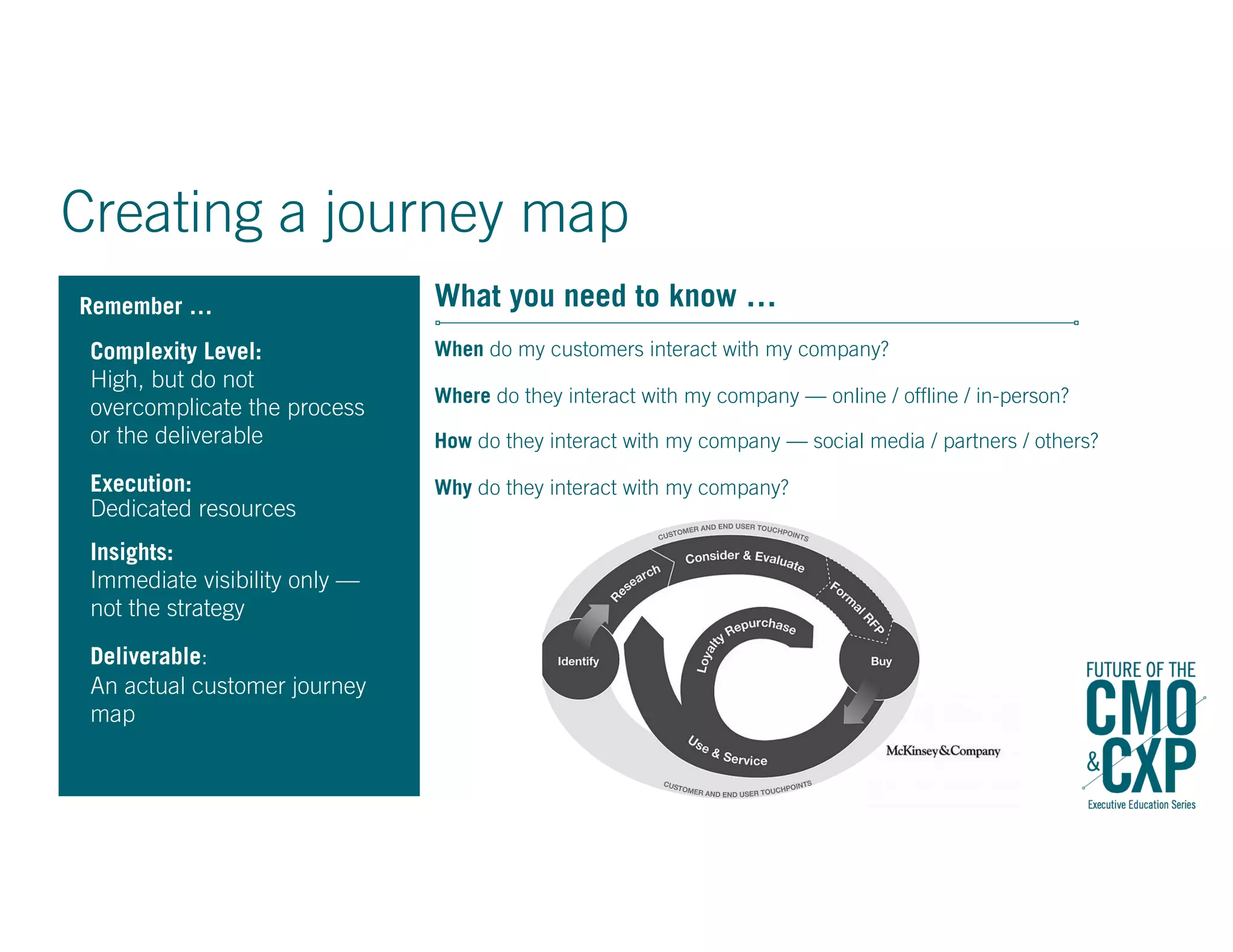
Creating a journey map
What you need to know …
When do my customers interact with my company?
Where do they interact with my company — online / offline / in-person?
How do they interact with my company — social media / partners / others?
Why do they interact with my company?
Remember …
Complexity Level: 

High, but do not
overcomplicate the process
or the deliverable
Execution: 

Dedicated resources
Insights: 

Immediate visibility only —
not the strategy
Deliverable: 

An actual customer journey
map
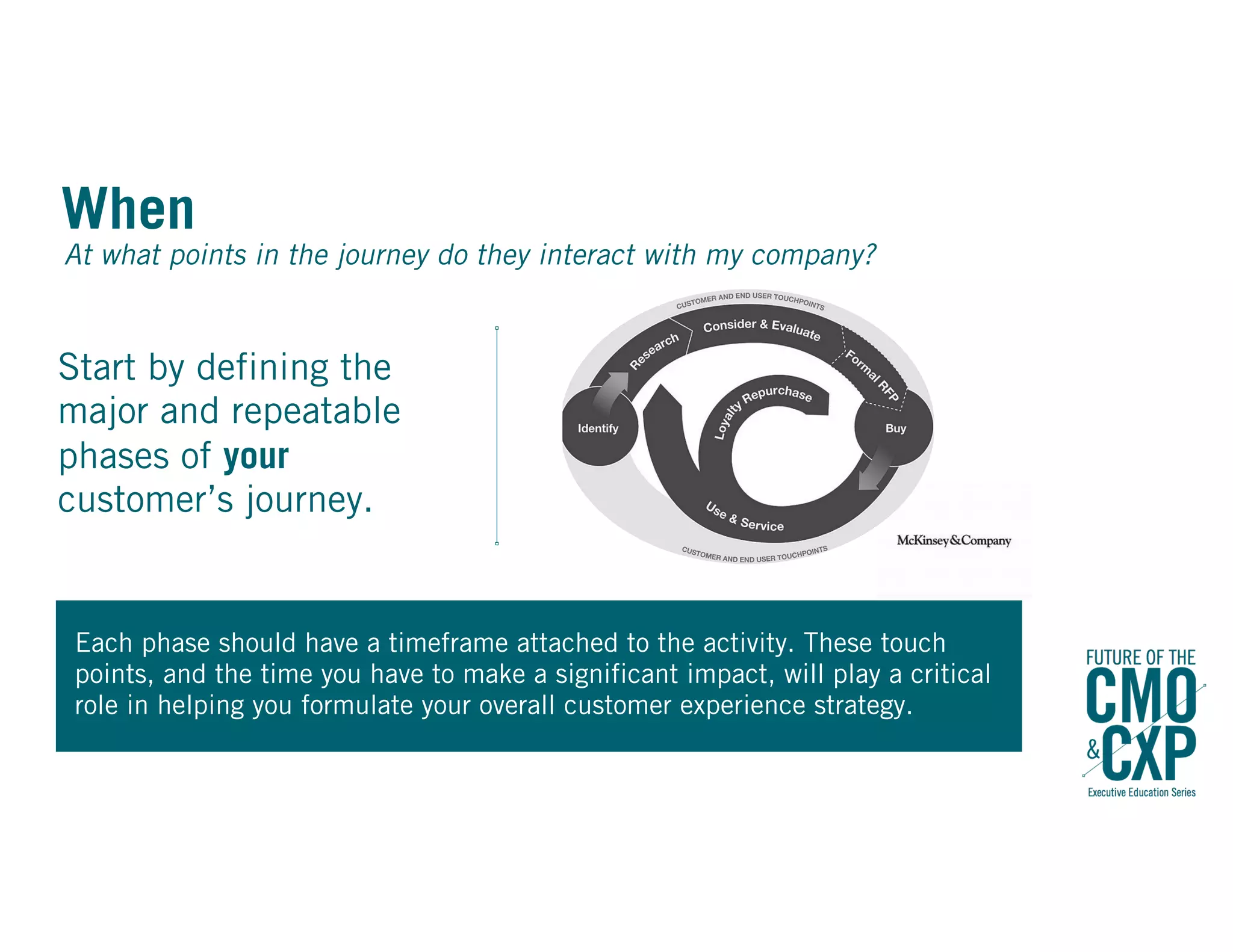
When
Start by defining the
major and repeatable
phases of your
customer’s journey.
Each phase should have a timeframe attached to the activity. These touch
points, and the time you have to make a significant impact, will play a critical
role in helping you formulate your overall customer experience strategy.
At what points in the journey do they interact with my company?
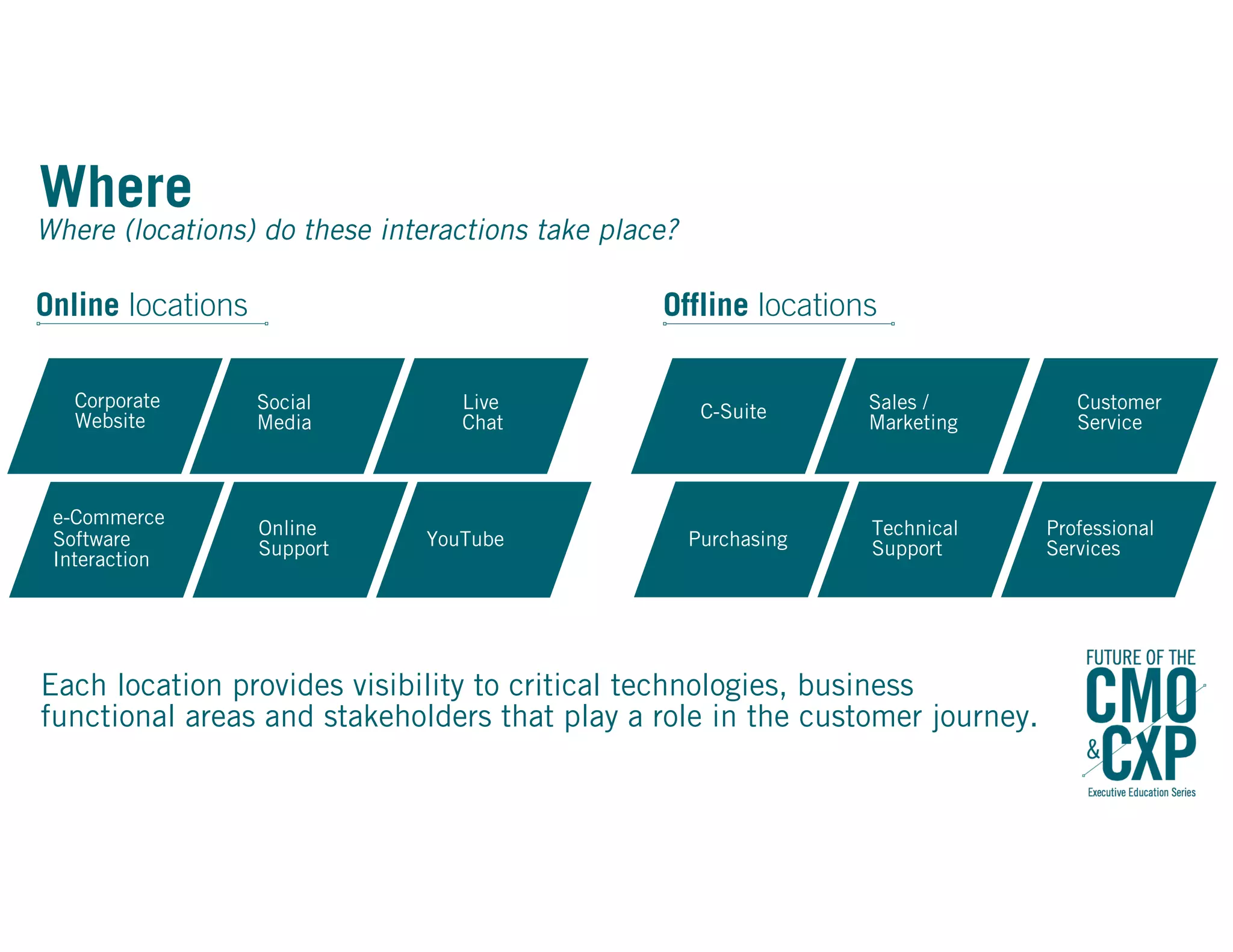
Online locations Offline locations
Where (locations) do these interactions take place?
Each location provides visibility to critical technologies, business
functional areas and stakeholders that play a role in the customer journey.
Where
Social
Media
Live
Chat
e-Commerce
Software
Interaction
Online
Support YouTube
Sales /
Marketing
C-Suite Customer
Service
Purchasing
Technical
Support
Professional
Services
Corporate
Website
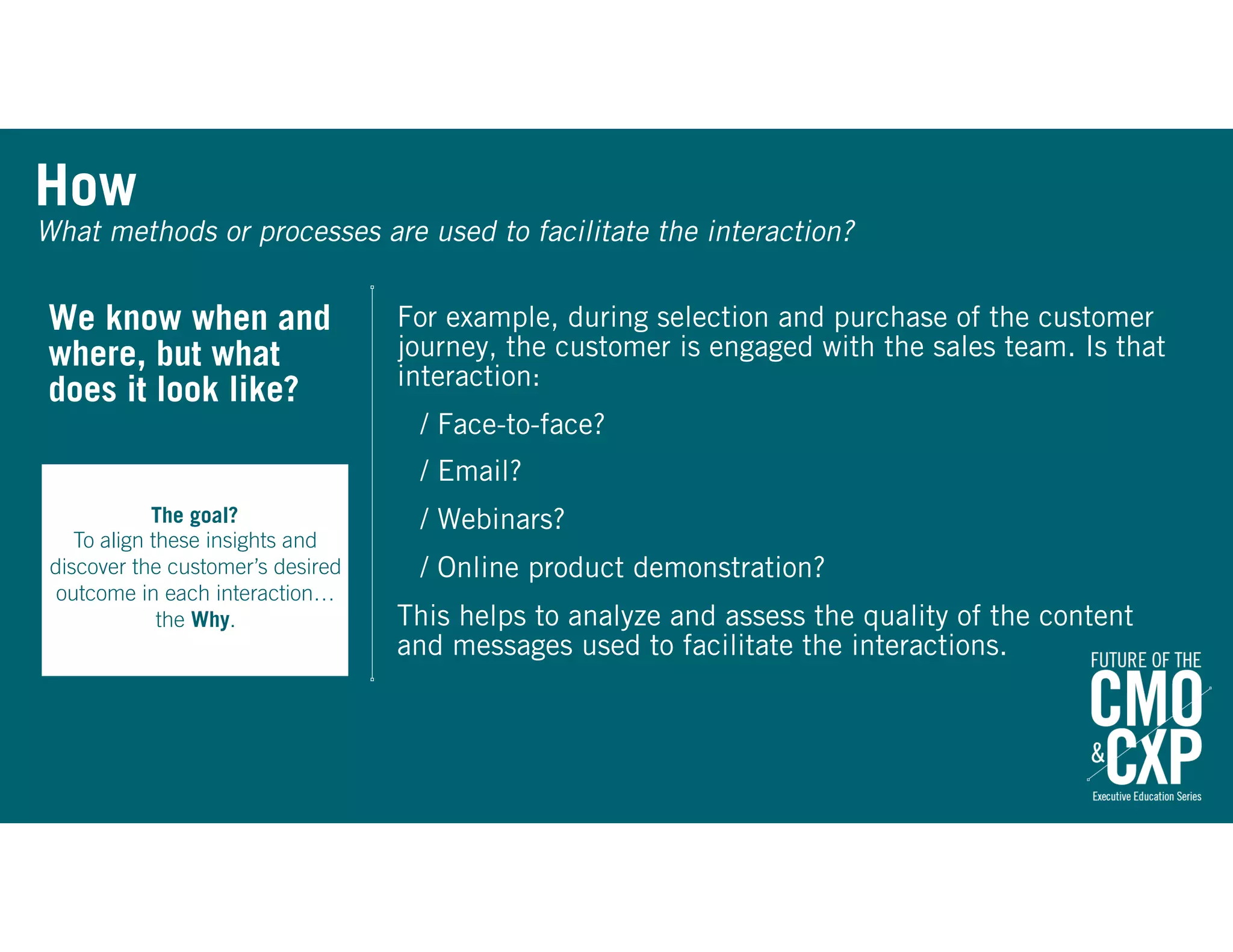
How
The goal? 

To align these insights and
discover the customer’s desired
outcome in each interaction…
the Why.
We know when and
where, but what
does it look like?
What methods or processes are used to facilitate the interaction?
For example, during selection and purchase of the customer
journey, the customer is engaged with the sales team. Is that
interaction:
/ Face-to-face?
/ Email?
/ Webinars?
/ Online product demonstration?
This helps to analyze and assess the quality of the content
and messages used to facilitate the interactions.
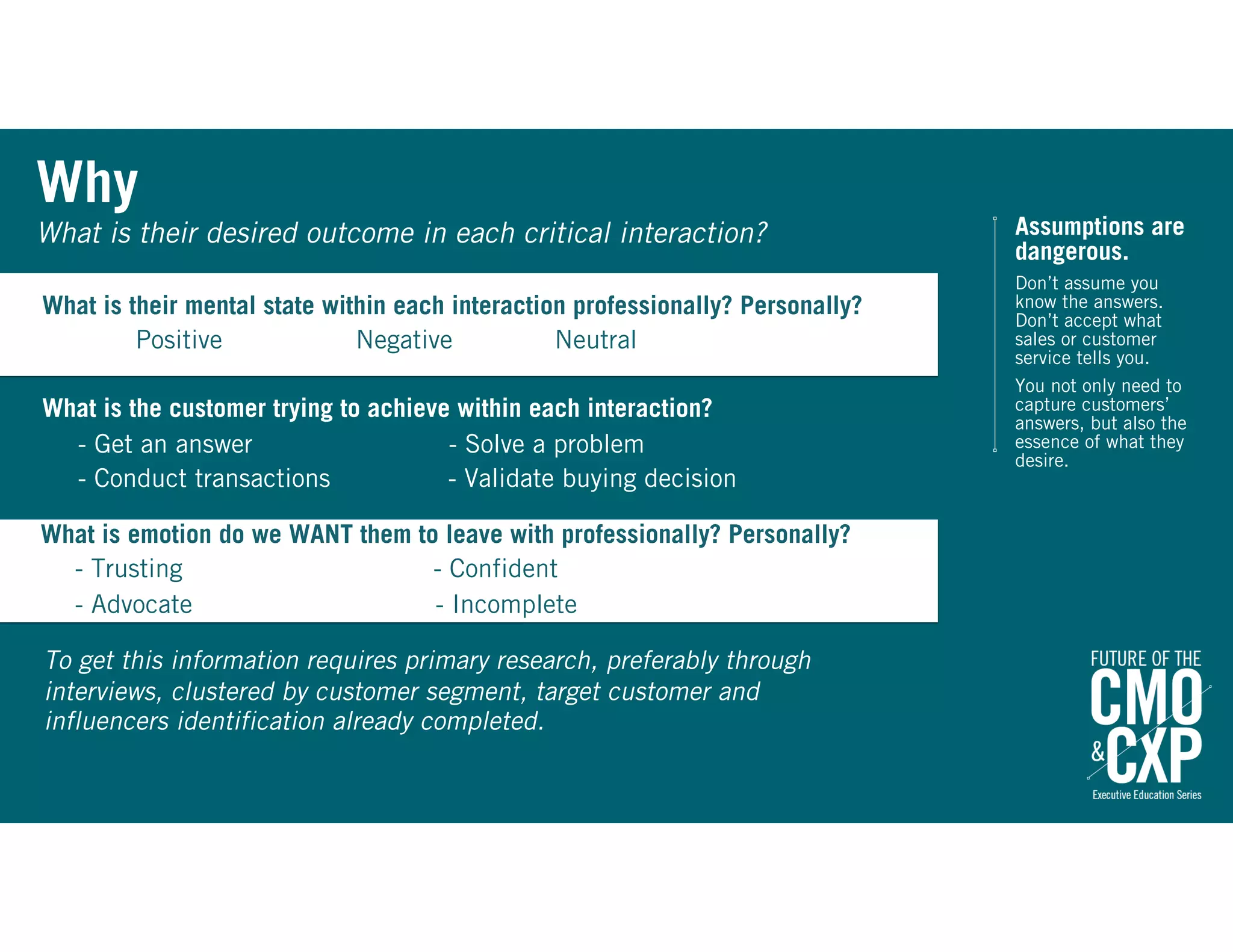
Why
To get this information requires primary research, preferably through
interviews, clustered by customer segment, target customer and
influencers identification already completed.
What is their desired outcome in each critical interaction?
What is the customer trying to achieve within each interaction?
- Get an answer - Solve a problem
- Conduct transactions - Validate buying decision
What is emotion do we WANT them to leave with professionally? Personally?
- Trusting - Confident
- Advocate - Incomplete
What is their mental state within each interaction professionally? Personally?
Positive Negative Neutral
Assumptions are
dangerous.
Don’t assume you
know the answers.
Don’t accept what
sales or customer
service tells you.
You not only need to
capture customers’
answers, but also the
essence of what they
desire.
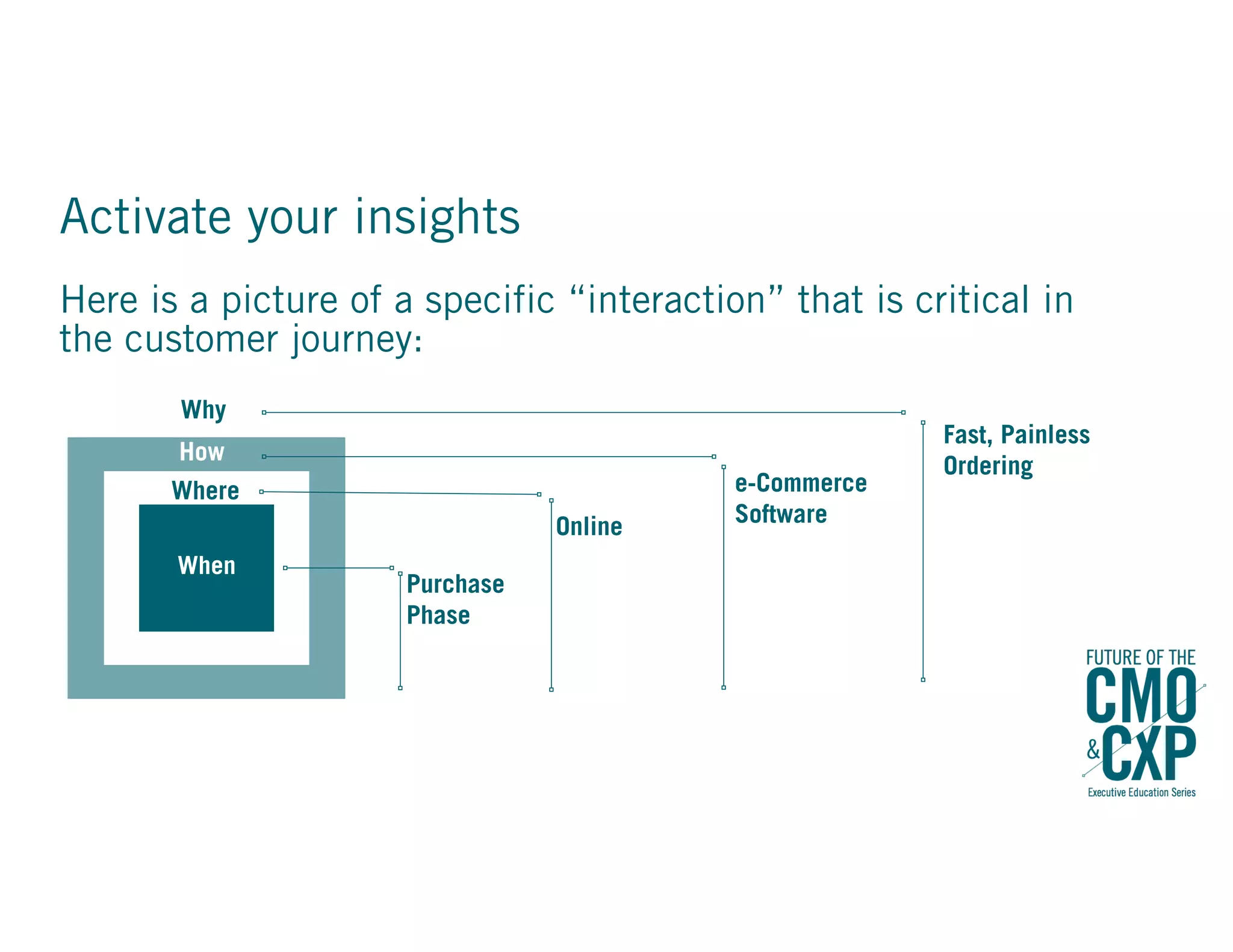
How
e-Commerce
Software
Where
Online
Activate your insights
Here is a picture of a specific “interaction” that is critical in
the customer journey:
When
Purchase
Phase
HowWhy
Fast, Painless
Ordering
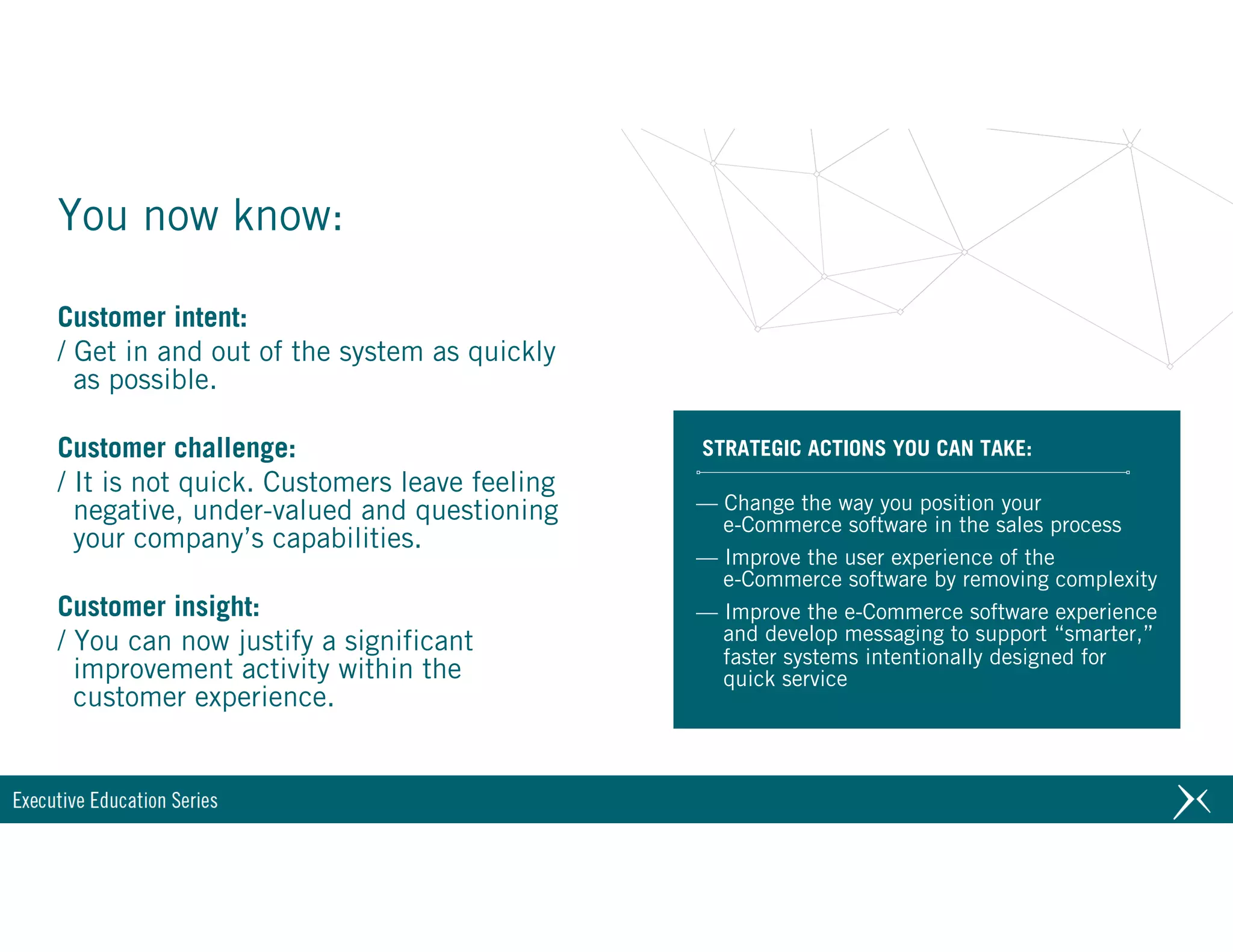
Customer intent:
/ Get in and out of the system as quickly
as possible.
Customer challenge:
/ It is not quick. Customers leave feeling
negative, under-valued and questioning
your company’s capabilities.
Customer insight:
/ You can now justify a significant
improvement activity within the
customer experience.
You now know:
STRATEGIC ACTIONS YOU CAN TAKE:
— Change the way you position your

e-Commerce software in the sales process
— Improve the user experience of the

e-Commerce software by removing complexity
— Improve the e-Commerce software experience

and develop messaging to support “smarter,”

faster systems intentionally designed for

quick service
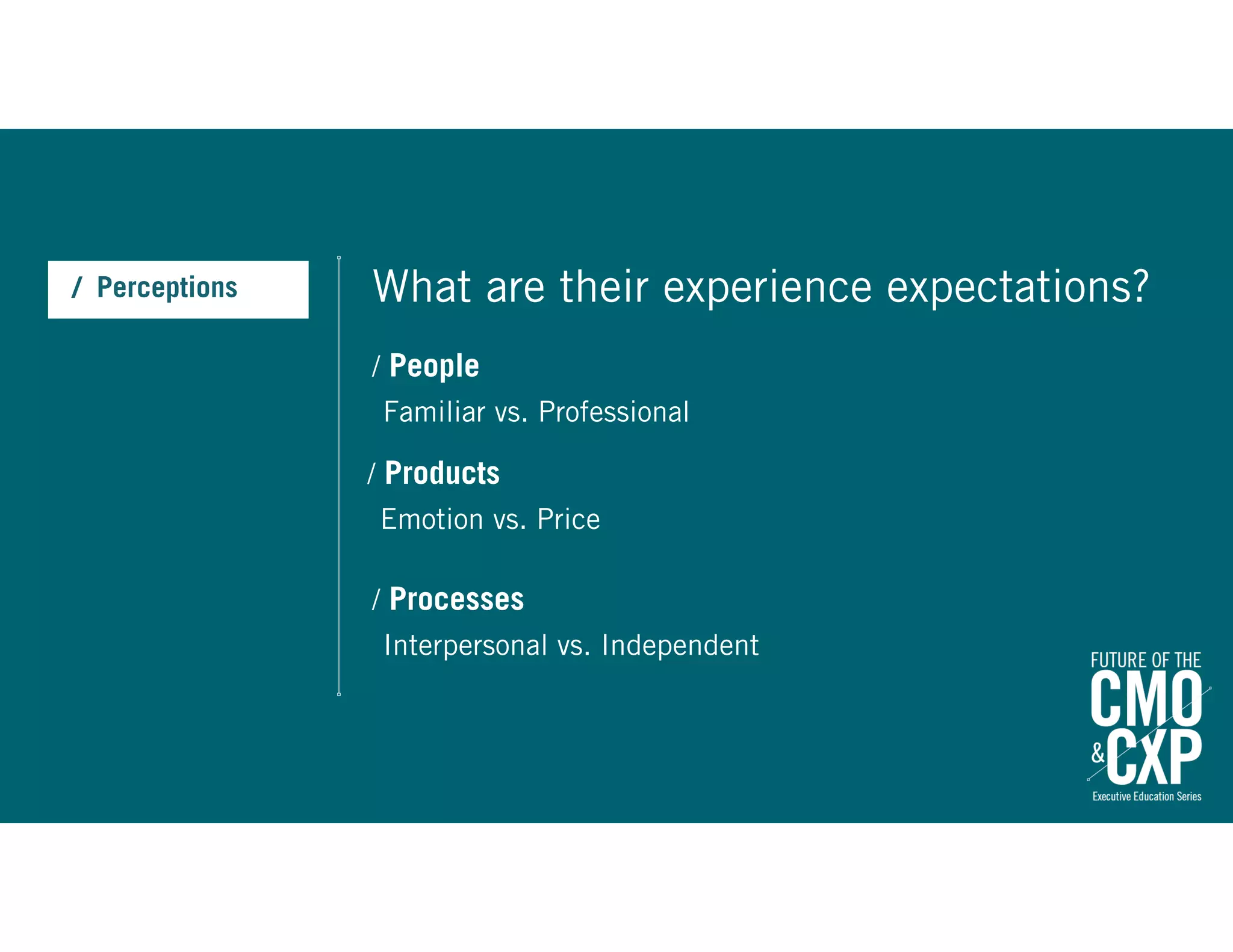
/ People
Familiar vs. Professional
What are their experience expectations?/ Perceptions
/ Products
Emotion vs. Price
/ Processes
Interpersonal vs. Independent
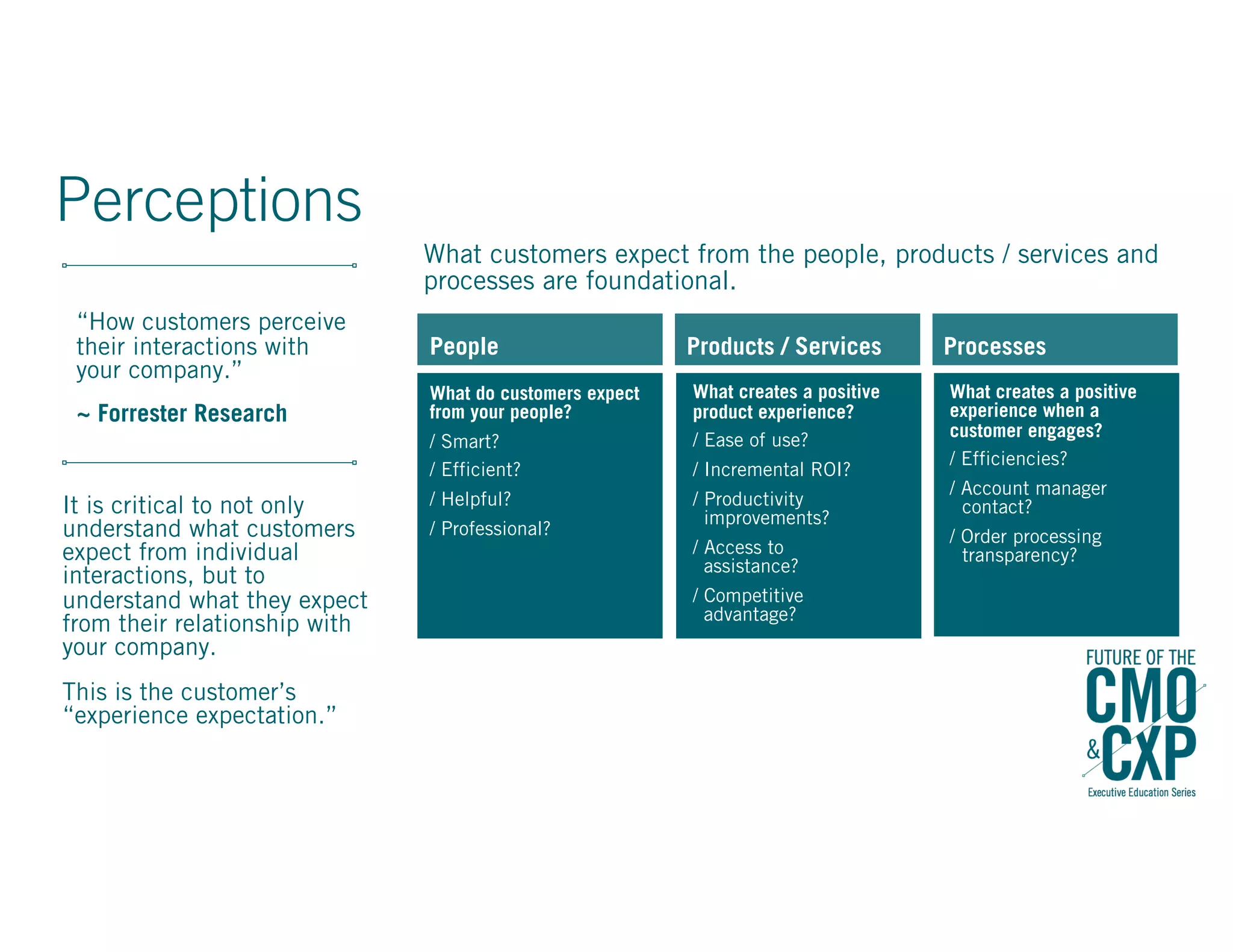
Perceptions
What customers expect from the people, products / services and
processes are foundational.
It is critical to not only
understand what customers
expect from individual
interactions, but to
understand what they expect
from their relationship with
your company.
This is the customer’s
“experience expectation.”
People ProcessesProducts / Services
What do customers expect
from your people?
/ Smart?
/ Efficient?
/ Helpful?
/ Professional?
What creates a positive
experience when a
customer engages?
/ Efficiencies?
/ Account manager
contact?
/ Order processing
transparency?
What creates a positive
product experience?
/ Ease of use?
/ Incremental ROI?
/ Productivity
improvements?
/ Access to
assistance?
/ Competitive
advantage?
“How customers perceive
their interactions with
your company.”
~ Forrester Research
Instead…Developing a customer
experience strategy
can be daunting.
It can turn into a never-ending
data gathering process.
(Stop it : )
Search for answers to
critical, strategic questions
that will lead to action.
Execute actions that will
materially impact the
customer experience.
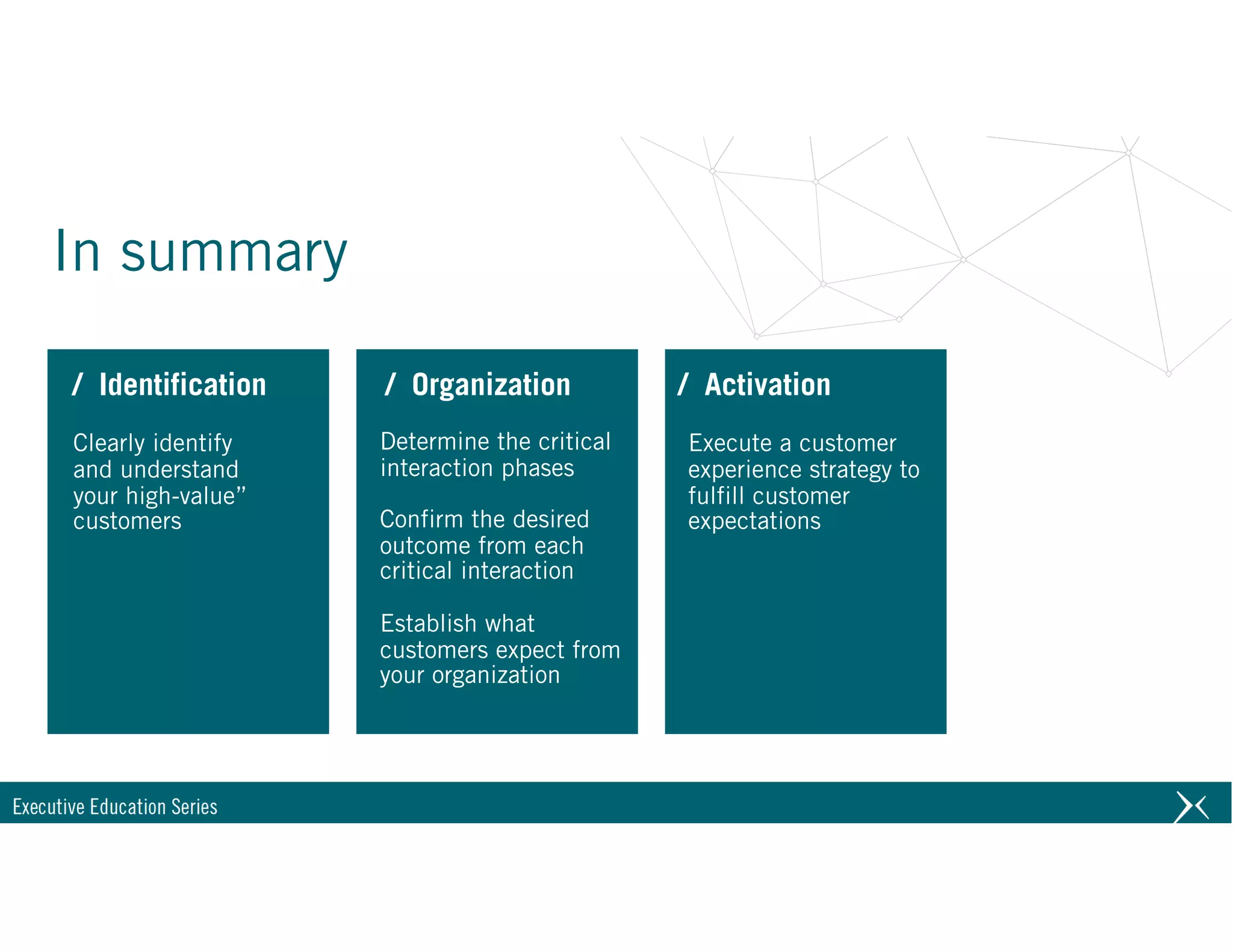
In summary
/ Identification / Organization / Activation
Clearly identify
and understand
your high-value”
customers
Determine the critical
interaction phases

Confirm the desired
outcome from each
critical interaction

Establish what
customers expect from
your organization
Execute a customer
experience strategy to
fulfill customer
expectations
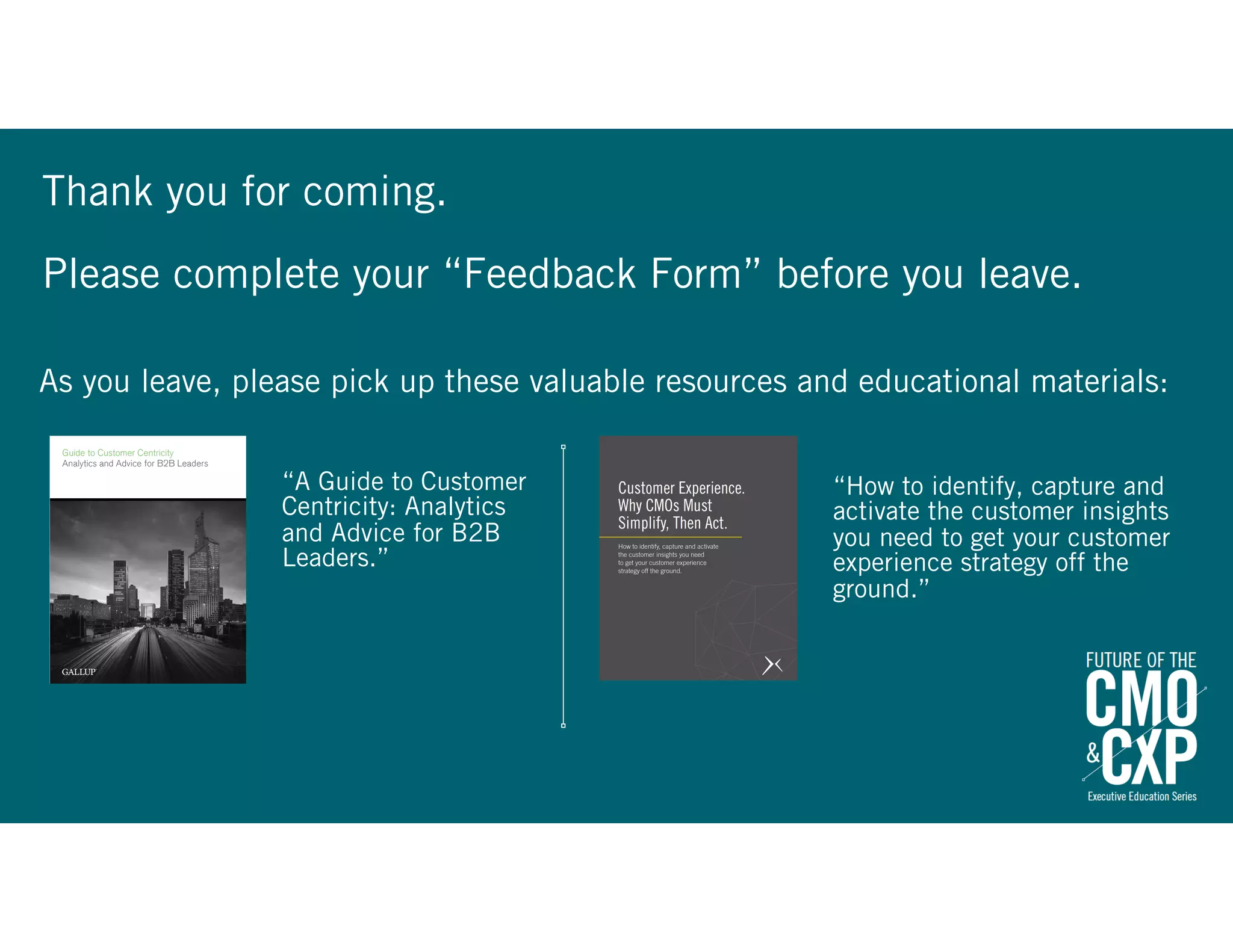
Thank you for coming.
Please complete your “Feedback Form” before you leave.
“A Guide to Customer
Centricity: Analytics
and Advice for B2B
Leaders.”
“How to identify, capture and
activate the customer insights
you need to get your customer
experience strategy off the
ground.”
As you leave, please pick up these valuable resources and educational materials:
Questions?
Next Session
May 24
Gleneagles Country Club
Plano, TX
Topic:

Corporate Messaging as a
Competitive Advantage in
the Customer Experience
About the sponsor.
OnMessage is a strategic consulting firm with 15 years of
experience executing corporate messaging development and
infusion initiatives that enable B2B companies to deliver a
clear, compelling and consistent message throughout the
customer experience. Our Messaging Development and
Infusion™ Methodology aligns and activates your entire
organization around a unified corporate story that increases
customer acquisition, retention and loyalty.
www.itsonmessage.com

Capturing Customer Data and Insights that Elevate the Customer Experience

  • 1.
  • 2.
    The customer experiencehas become the competitive battleground for business. By delivering a consistent, memorable experience, companies can create a competitive advantage that increases customer engagement, conversion, loyalty and advocacy. Today, almost everyone in a company plays a role in the customer experience — from HR to finance, operations, sales, marketing, customer service, even general employee connections and interactions. As a result, ownership and management of the entire customer experience has been elusive. That is rapidly changing. Over the next three-to-five years, 75 percent of marketers say they will be responsible for the end-to-end customer experience. This series will provide CMOs and business executives with a deeper understanding of the strategies and tactics required to deliver a superior 
 end-to-end customer experience. / About the series
  • 3.
  • 4.
    / Upcoming sessions:August - October
  • 5.
    / Upcoming sessions:November - December Download the complete curriculum guide and register for the entire series: www.cmoeducationseries.com
  • 6.
    The March sessiondiscussed the CMO and marketing’s role in the customer experience. We focused on the context and understanding it takes to make material changes to the role marketing plays throughout the customer experience.
  • 7.
    How customers interactwith your 
 company has fundamentally changed. This changes the customer experience.
  • 8.
    Customer Experience is redefiningthe role of marketing and the CMO. Employees & Partners Influence on Experience Culture Drives Experience Consistency & Continuity are King Customer Data and Insights “Always On” Purpose vs. Profits = + + + BUT HOW? “CMOs should step forward and take responsibility for turning the enterprise toward the customer. This means taking on a more significant role on the executive team … it also begs CMOs to lead innovation processes in the organization … the CMO has to create a more engaged customer relationship … only CMOs who rethink their approach to marketing operations will pull it off.” 
 
 ~ Forrester Research
  • 9.
    "To become the‘general manager’ of the overall customer experience — to launch and drive a market-oriented management of customer engagement — means most CMOs will need to acquire new skills. Many marketing chiefs may not be ready for this transformation as it requires not only a change in their own competencies and responsibilities, but also changes in their mindset and the mindset of the whole organization." ~ Constellation Research / Change creates opportunity IMPLICATION Fundamental changes in marketing skills, staffing models and operating procedures are required. Changing executive perception will also be critical.
  • 10.
    What a successfulmodel looks like STRATEGY / STRUCTURE SYSTEMS STORY / / / Customer Connectivity Culture Formally document the strategic intent, responsibilities and goals for marketing’s role in the customer experience. Then secure appropriate ownership within the organization. Identify and connect data, systems and processes that are crucial for delivering a cohesive and consistent customer journey. Align marketing operations (roles, responsibilities, processes) with the customer journey; integrate processes across customer-facing areas of the business; and initiate sustained culture development programs required to deliver a connected and compelling experience. Develop and drive consistent utilization of a customer-centric Messaging Platform inside and outside of the organization that aligns corporate Strategy, Vision, Mission, Values, Purpose, Promise and Core Value Messages.
  • 11.
    Capturing Customer Data andInsights that Elevate the Customer Experience Learning Objective: Participants will leave with a deeper understanding of the customer research methods and data they need to create a more engaging and compelling customer experience.
  • 12.
    Cinnamon Perryman Engagement Director,OnMessage
 Strategic consulting firm, specializing in messaging 
 development and delivery throughout the customer experience. 1,000+ 
 Customer 
 Research Hours DOZENS 
 OnMessage Strategic Messaging Engagements 20+ Years 
 Strategic 
 Consulting Leading 
 Brands
 Expertise and Experience
 / Customer research
 and analysis / Corporate messaging
 strategy and execution / Internal communication
 strategy development / Go-to-market
 strategic planning
  • 13.
    What percentage ofyour customers are emotionally or psychologically attached to your organization?
  • 14.
    Only 29 percentof B2B customers are fully engaged — psychologically attached to the companies with whom they do business. B2B companies are at risk of losing more than 71 percent of their customer base. ~ Guide to Customer Centricity: 
 Analytics and Advice for B2B Leaders, 
 Gallup This is true in every type of company — from manufacturing to pharmaceuticals to law firms.
  • 15.
    Give them whatthey want. How can I emotionally or psychologically engage them? “60 percent of B2B customers do not believe their problems were resolved.”
 ~Guide to Customer Centricity: Analytics and Advice for B2B Leaders, Gallup But how do I know what they want?
  • 16.
    Today’s topic canbecome quickly overwhelming if not anchored. Customer insights will enable you to focus on what matters. = = = Focus on data to help understand a customer’s desires, needs and challenges Leverage customer data to specifically improve the customer experience Create a more engaging and compelling customer experience with customer data / Identification / Organization / Activation So, we will focus our conversation on …
  • 17.
    Complexity paralyses A courseof action is never defined. The customer experience is never started. Uncertainty of the best approach for capturing and using customer data Fear about how to formalize a customer experience strategy Anxiety over all the things not known Overwhelmed by the enormity of the task Never-ending questions. 
 No action. 
 
 Customer experience opportunity is not realized.
  • 18.
    Simplicity empowers Steve Jobsbuilt an entire career with focus and clarity. / Eliminate the noise / Simplify / Focus on what matters to the customer
  • 19.
    Create a differentiated customerexperience “The secret of getting ahead is getting started.”
 ~Mark Twain “the experience” “ then act” Focus on what matters to the customer: Gather essential customer insights:
  • 20.
    / Inform organizationalstrategy / Drive strategic initiatives and investments / Improve customer acquisition, retention and advocacy / Generate and sustain organic growth Benefits abound The benefits of customer insights cannot be overstated. Customer insights:
  • 21.
    It is theCMO’s job The CMO owns customer perception. Forrester Research says the customer experience is simply defined as: “How customers perceive their interactions with your company.” That is why CMOs must own the 
 customer experience… And it starts with gathering customer insights that will turn the customer experience into a competitive advantage.
  • 22.
    Since the customerexperience is defined as: “How customers perceive their interactions with your company.” Insights that matter / Customers Who are your (valued) customers? / Perceptions What are their overall experience expectations? / Interactions Where does their journey begin? 
 
 What are the critical interactions along the way? Your data collection model should be anchored in three things…
  • 23.
    / Demographically Easiest tofind and explain, not as powerful Who are my (high-value) customers?/ Customers / Behaviorally Tells what happens; 
 but not why / Attitudinally Strongest options; 
 but difficult to explain 
 or act upon
  • 24.
    Let’s start here… Notall customers are created equal.
  • 25.
    Customer Segments relevantto your industry (Organizations) - Strategic Segment: Strategic business alignment, high growth opportunity - Opportunity Segment: Low market penetration, significant growth opportunity - Mature Segment: Low growth opportunity but high market penetration Target Customer / Influencer within each Customer Segment (Functional Role) - High-Performing Relationships: Loyal and profitable - Stagnant Relationships: Somewhat content and low maintenance - Struggling Relationships: Low reliability and higher maintenance Personas for customers within the Customer Journey (Mindsets / Motivators) - Don’t assume the persona work done for sales or content will cover this. - It is likely customers involved in the post purchase and repeat purchase phases of the customer journey have not been represented in past personas activities. Segmentation work is required.
  • 26.
    Conduct formal research Nowthat you know who they are, you must understand the critical interactions they have with your company. Look for commonalities and differences within each customer persona: Who they are. How they think. What motivates them.
  • 27.
    / When At whatpoints in the journey do customers interact with my company? What does my customer’s journey look like?/ Interactions / Where Where (locations) do these interactions take place? / How What methods, processes are used to facilitate the interaction? / Why What is their desired outcome in each critical interaction?
  • 28.
    Creating a journeymap What you need to know … When do my customers interact with my company? Where do they interact with my company — online / offline / in-person? How do they interact with my company — social media / partners / others? Why do they interact with my company? Remember … Complexity Level: 
 High, but do not overcomplicate the process or the deliverable Execution: 
 Dedicated resources Insights: 
 Immediate visibility only — not the strategy Deliverable: 
 An actual customer journey map
  • 29.
    When Start by definingthe major and repeatable phases of your customer’s journey. Each phase should have a timeframe attached to the activity. These touch points, and the time you have to make a significant impact, will play a critical role in helping you formulate your overall customer experience strategy. At what points in the journey do they interact with my company?
  • 30.
    Online locations Offlinelocations Where (locations) do these interactions take place? Each location provides visibility to critical technologies, business functional areas and stakeholders that play a role in the customer journey. Where Social Media Live Chat e-Commerce Software Interaction Online Support YouTube Sales / Marketing C-Suite Customer Service Purchasing Technical Support Professional Services Corporate Website
  • 31.
    How The goal? 
 Toalign these insights and discover the customer’s desired outcome in each interaction… the Why. We know when and where, but what does it look like? What methods or processes are used to facilitate the interaction? For example, during selection and purchase of the customer journey, the customer is engaged with the sales team. Is that interaction: / Face-to-face? / Email? / Webinars? / Online product demonstration? This helps to analyze and assess the quality of the content and messages used to facilitate the interactions.
  • 32.
    Why To get thisinformation requires primary research, preferably through interviews, clustered by customer segment, target customer and influencers identification already completed. What is their desired outcome in each critical interaction? What is the customer trying to achieve within each interaction? - Get an answer - Solve a problem - Conduct transactions - Validate buying decision What is emotion do we WANT them to leave with professionally? Personally? - Trusting - Confident - Advocate - Incomplete What is their mental state within each interaction professionally? Personally? Positive Negative Neutral Assumptions are dangerous. Don’t assume you know the answers. Don’t accept what sales or customer service tells you. You not only need to capture customers’ answers, but also the essence of what they desire.
  • 33.
    How e-Commerce Software Where Online Activate your insights Hereis a picture of a specific “interaction” that is critical in the customer journey: When Purchase Phase HowWhy Fast, Painless Ordering
  • 34.
    Customer intent: / Getin and out of the system as quickly as possible. Customer challenge: / It is not quick. Customers leave feeling negative, under-valued and questioning your company’s capabilities. Customer insight: / You can now justify a significant improvement activity within the customer experience. You now know: STRATEGIC ACTIONS YOU CAN TAKE: — Change the way you position your
 e-Commerce software in the sales process — Improve the user experience of the
 e-Commerce software by removing complexity — Improve the e-Commerce software experience
 and develop messaging to support “smarter,”
 faster systems intentionally designed for
 quick service
  • 35.
    / People Familiar vs.Professional What are their experience expectations?/ Perceptions / Products Emotion vs. Price / Processes Interpersonal vs. Independent
  • 36.
    Perceptions What customers expectfrom the people, products / services and processes are foundational. It is critical to not only understand what customers expect from individual interactions, but to understand what they expect from their relationship with your company. This is the customer’s “experience expectation.” People ProcessesProducts / Services What do customers expect from your people? / Smart? / Efficient? / Helpful? / Professional? What creates a positive experience when a customer engages? / Efficiencies? / Account manager contact? / Order processing transparency? What creates a positive product experience? / Ease of use? / Incremental ROI? / Productivity improvements? / Access to assistance? / Competitive advantage? “How customers perceive their interactions with your company.” ~ Forrester Research
  • 37.
    Instead…Developing a customer experiencestrategy can be daunting. It can turn into a never-ending data gathering process. (Stop it : ) Search for answers to critical, strategic questions that will lead to action. Execute actions that will materially impact the customer experience.
  • 38.
    In summary / Identification/ Organization / Activation Clearly identify and understand your high-value” customers Determine the critical interaction phases
 Confirm the desired outcome from each critical interaction
 Establish what customers expect from your organization Execute a customer experience strategy to fulfill customer expectations
  • 39.
    Thank you forcoming. Please complete your “Feedback Form” before you leave. “A Guide to Customer Centricity: Analytics and Advice for B2B Leaders.” “How to identify, capture and activate the customer insights you need to get your customer experience strategy off the ground.” As you leave, please pick up these valuable resources and educational materials:
  • 40.
  • 41.
    Next Session May 24 GleneaglesCountry Club Plano, TX Topic:
 Corporate Messaging as a Competitive Advantage in the Customer Experience
  • 42.
    About the sponsor. OnMessageis a strategic consulting firm with 15 years of experience executing corporate messaging development and infusion initiatives that enable B2B companies to deliver a clear, compelling and consistent message throughout the customer experience. Our Messaging Development and Infusion™ Methodology aligns and activates your entire organization around a unified corporate story that increases customer acquisition, retention and loyalty. www.itsonmessage.com