Highlights of the eBook

If you have any questions Tweet me @KirstyCarrot
Before we get into the detail, there is one thing I need to highlight.

Consumers have changed.

With social media and technology flooding the internet with over 200 million pieces of
content a minute, it’s essential that brands find a way to break through the noise. 

Influencer Marketing is one of the proven ways to do this.
1. Understanding what, exactly, your brand wants out of Influencer Marketing
2. Knowing when to use Influencer Marketing 
3. Creating your Influencer Marketing strategy framework 

a. Determine your goals

 b. Finding the most relevant influencers

c. Building the story

d. The hook

e. Integration into your overall strategy
4. Let’s talk about money
5. Added value: How to get the most value out of your Influencer Marketing campaign

a. Insights

b. SEO

c. Production

d. Market Research
6. Reporting
7. Summary
Chapter One:
Understanding what, exactly, your brand wants out of Influencer Marketing
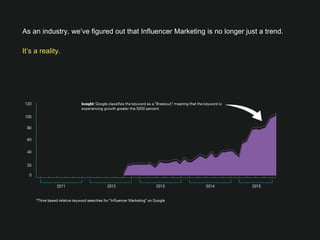
As an industry, we’ve figured out that Influencer Marketing is no longer just a trend. 

It’s a reality.
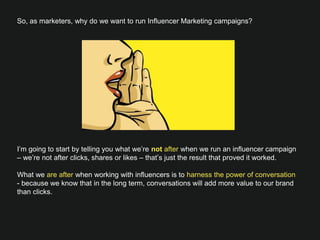
So, as marketers, why do we want to run Influencer Marketing campaigns?


I’m going to start by telling you what we’re not after when we run an influencer campaign
– we’re not after clicks, shares or likes – that’s just the result that proved it worked.

What we are after when working with influencers is to harness the power of conversation -
because we know that in the long term, conversations will add more value to our brand
than clicks.
 
 
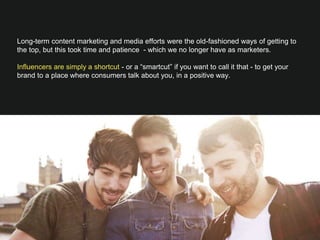
Long-term content marketing and media efforts were the old-fashioned ways of getting to
the top, but this took time and patience - which we no longer have as marketers.

Influencers are simply a shortcut - or a “smartcut” if you want to call it that - to get your
brand to a place where consumers talk about you, in a positive way.
Chapter Two:
Knowing When To Use Influencer Marketing
1) If your brand is looking for
amplification (through
conversation)
“Marketers are starting to understand that their content will only travel
organically as far as it is worth.”
“We know that people are more likely to make a purchase based on what
their peers recommend, and most importantly, they are most likely to
feel loyalty to a brand thereafter.”
2) If you’re looking to build
loyalty (through conversation)
3) When you’re trying to reach
new audiences (through
conversation)
“Working with influencers is a great way for brands to explore how their
content resonates with people outside of their exact target audience.”
4) When you’re looking to
create content (that
generates conversation)
“The most successful Influencer Marketing campaigns I’ve run (and
seen) have been ones where the influencers worked with the brand not
for the brand. ”
5) If you’re looking to disrupt
the path to purchase (through
conversation)
“This is where the influencer’s value really steps up, because consumers
trust a peer-to-peer recommendation far more than brand ads.”
6) If you’re looking to build
brand awareness (through
conversation)
“Influencer Marketing allows you to create awareness in the most
relevant areas possible.”
Chapter Three:
Creating Your Influencer Marketing Strategy Framework
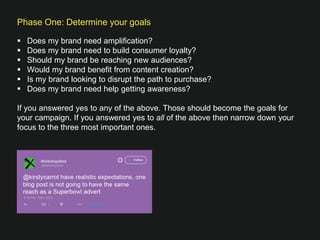
Phase One: Determine your goals

§  Does my brand need amplification?
§  Does my brand need to build consumer loyalty?
§  Should my brand be reaching new audiences? 
§  Would my brand benefit from content creation?
§  Is my brand looking to disrupt the path to purchase? 
§  Does my brand need help getting awareness? 
If you answered yes to any of the above. Those should become the goals for
your campaign. If you answered yes to all of the above then narrow down your
focus to the three most important ones.
t
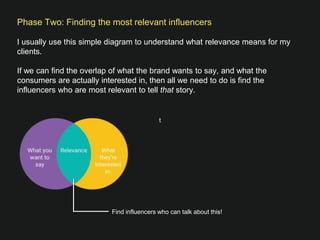
Phase Two: Finding the most relevant influencers

I usually use this simple diagram to understand what relevance means for my
clients. 

If we can find the overlap of what the brand wants to say, and what the
consumers are actually interested in, then all we need to do is find the
influencers who are most relevant to tell that story. 


Find influencers who can talk about this!
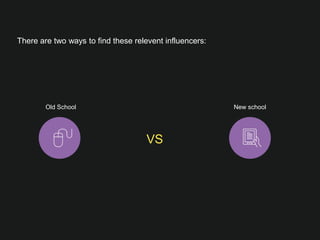
Old School 
 New school
VS


There are two ways to find these relevent influencers:
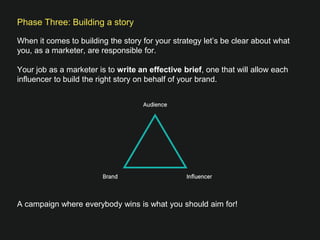
Phase Three: Building a story

When it comes to building the story for your strategy let’s be clear about what
you, as a marketer, are responsible for. 

Your job as a marketer is to write an effective brief, one that will allow each
influencer to build the right story on behalf of your brand.


A campaign where everybody wins is what you should aim for!
Phase Four: The hook

The influencer might craft the story but as the brand it’s important that you
ensure it has a hook. This is the talking point that can transform social
customers into paying ones.
 
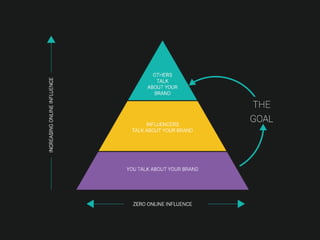
The hook can propel you from the middle of the triangle to the top - so it’s
important that you get it right.
Phase Five: Integration into your overall strategy

You’re working with people who your consumers feel are the best content
creators of our time, it only makes sense to ensure you get maximum value out
of that relationship. 

Integrating your influencer campaign into your overall strategy will ensure you
do just that. 


Chapter Four:
Let’s Talk About Money
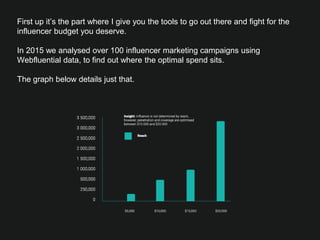
First up it’s the part where I give you the tools to go out there and fight for the
influencer budget you deserve.

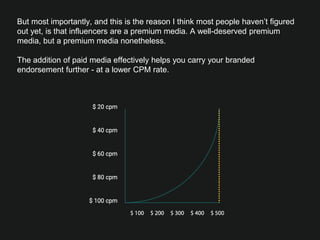
In 2015 we analysed over 100 influencer marketing campaigns using
Webfluential data, to find out where the optimal spend sits.

The graph below details just that. 


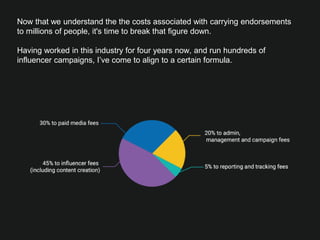
Now that we understand the the costs associated with carrying endorsements
to millions of people, it's time to break that figure down.

Having worked in this industry for four years now, and run hundreds of
influencer campaigns, I’ve come to align to a certain formula. 


But most importantly, and this is the reason I think most people haven’t figured
out yet, is that influencers are a premium media. A well-deserved premium
media, but a premium media nonetheless.
 
The addition of paid media effectively helps you carry your branded
endorsement further - at a lower CPM rate. 


Chapter Five:
Added value
A) Insights

Conversation insights generate extremely valuable data. 
 
With that data, brands can learn about their target audience from conversations
sparked by influencers. It's important to see how people react to your content,
the questions people ask, and the paths your shared content travels.
 
This data can be more informative than your own analytics - because people
tend to react differently when in conversation with a trusted source.
B) SEO

Google wants authentic voices which it can use to guide its search choices. 
 
Credible influencers sharing your content is powerful and effective, not only
today but also months down the line when consumers start searching for your
brand on Google.
C) Production

Influencers are naturally creative when churning out content and they know
exactly how to speak to (and capture) the audience you’re trying to target. 
 
By creating videos, images and supporting the influencers’ stories with
professional production elements, brands are more likely to strike the balance
between professional branded content and stories that their consumers actually
want to watch.
D) Market Research

Social influencers already have established audiences in the niche
demographics you’re looking to survey. 
 
Working closer with influencers can be valuable not only to share data, but also
to collect it.
 
Influencers allow you to ask more people questions, track reliable data, and look
into the conversations that happen when people think your brand isn’t watching.
Chapter Six:
Reporting
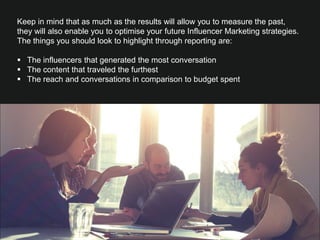
Keep in mind that as much as the results will allow you to measure the past,
they will also enable you to optimise your future Influencer Marketing strategies.
The things you should look to highlight through reporting are:
 
§  The influencers that generated the most conversation
§  The content that traveled the furthest 
§  The reach and conversations in comparison to budget spent 
 
What could we put here?
Chapter Seven:
Summary
Call it buying an audience before they buy your product, call it influencer
marketing, call it what you like. 

At the end of the day as marketers we’re all just trying to create conversations
that will ultimately increase our popularity in the online world - because we know
that if we’re the most popular, consumers will come to us.


Good Luck writing your first Influencer Marketing strategy! 
Simon Sinek
@KirstyCarrot | KirstySharman | Kirsty@Webfluential.com
If you’d like the full version please download
the free eBook on 

www.webfluential.com

How to write your first influencer marketing strategy presentation.

  • 2.
    Highlights of theeBook If you have any questions Tweet me @KirstyCarrot
  • 3.
    Before we getinto the detail, there is one thing I need to highlight. Consumers have changed. With social media and technology flooding the internet with over 200 million pieces of content a minute, it’s essential that brands find a way to break through the noise. Influencer Marketing is one of the proven ways to do this.
  • 4.
    1. Understanding what,exactly, your brand wants out of Influencer Marketing 2. Knowing when to use Influencer Marketing 3. Creating your Influencer Marketing strategy framework a. Determine your goals b. Finding the most relevant influencers c. Building the story d. The hook e. Integration into your overall strategy 4. Let’s talk about money 5. Added value: How to get the most value out of your Influencer Marketing campaign a. Insights b. SEO c. Production d. Market Research 6. Reporting 7. Summary
  • 5.
    Chapter One: Understanding what,exactly, your brand wants out of Influencer Marketing
  • 6.
    As an industry,we’ve figured out that Influencer Marketing is no longer just a trend. It’s a reality.
  • 7.
    So, as marketers,why do we want to run Influencer Marketing campaigns? I’m going to start by telling you what we’re not after when we run an influencer campaign – we’re not after clicks, shares or likes – that’s just the result that proved it worked. What we are after when working with influencers is to harness the power of conversation - because we know that in the long term, conversations will add more value to our brand than clicks.    
  • 9.
    Long-term content marketingand media efforts were the old-fashioned ways of getting to the top, but this took time and patience - which we no longer have as marketers. Influencers are simply a shortcut - or a “smartcut” if you want to call it that - to get your brand to a place where consumers talk about you, in a positive way.
  • 10.
    Chapter Two: Knowing WhenTo Use Influencer Marketing
  • 11.
    1) If yourbrand is looking for amplification (through conversation) “Marketers are starting to understand that their content will only travel organically as far as it is worth.”
  • 12.
    “We know thatpeople are more likely to make a purchase based on what their peers recommend, and most importantly, they are most likely to feel loyalty to a brand thereafter.” 2) If you’re looking to build loyalty (through conversation)
  • 13.
    3) When you’retrying to reach new audiences (through conversation) “Working with influencers is a great way for brands to explore how their content resonates with people outside of their exact target audience.”
  • 14.
    4) When you’relooking to create content (that generates conversation) “The most successful Influencer Marketing campaigns I’ve run (and seen) have been ones where the influencers worked with the brand not for the brand. ”
  • 15.
    5) If you’relooking to disrupt the path to purchase (through conversation) “This is where the influencer’s value really steps up, because consumers trust a peer-to-peer recommendation far more than brand ads.”
  • 16.
    6) If you’relooking to build brand awareness (through conversation) “Influencer Marketing allows you to create awareness in the most relevant areas possible.”
  • 17.
    Chapter Three: Creating YourInfluencer Marketing Strategy Framework
  • 18.
    Phase One: Determineyour goals §  Does my brand need amplification? §  Does my brand need to build consumer loyalty? §  Should my brand be reaching new audiences? §  Would my brand benefit from content creation? §  Is my brand looking to disrupt the path to purchase? §  Does my brand need help getting awareness? If you answered yes to any of the above. Those should become the goals for your campaign. If you answered yes to all of the above then narrow down your focus to the three most important ones.
  • 19.
    t Phase Two: Findingthe most relevant influencers I usually use this simple diagram to understand what relevance means for my clients. If we can find the overlap of what the brand wants to say, and what the consumers are actually interested in, then all we need to do is find the influencers who are most relevant to tell that story. Find influencers who can talk about this!
  • 20.
    Old School New school VS There are two ways to find these relevent influencers:
  • 21.
    Phase Three: Buildinga story When it comes to building the story for your strategy let’s be clear about what you, as a marketer, are responsible for. Your job as a marketer is to write an effective brief, one that will allow each influencer to build the right story on behalf of your brand. A campaign where everybody wins is what you should aim for!
  • 22.
    Phase Four: Thehook The influencer might craft the story but as the brand it’s important that you ensure it has a hook. This is the talking point that can transform social customers into paying ones.   The hook can propel you from the middle of the triangle to the top - so it’s important that you get it right.
  • 23.
    Phase Five: Integrationinto your overall strategy You’re working with people who your consumers feel are the best content creators of our time, it only makes sense to ensure you get maximum value out of that relationship. Integrating your influencer campaign into your overall strategy will ensure you do just that.      
  • 24.
  • 25.
    First up it’sthe part where I give you the tools to go out there and fight for the influencer budget you deserve. In 2015 we analysed over 100 influencer marketing campaigns using Webfluential data, to find out where the optimal spend sits. The graph below details just that.    
  • 26.
    Now that weunderstand the the costs associated with carrying endorsements to millions of people, it's time to break that figure down. Having worked in this industry for four years now, and run hundreds of influencer campaigns, I’ve come to align to a certain formula.    
  • 27.
    But most importantly,and this is the reason I think most people haven’t figured out yet, is that influencers are a premium media. A well-deserved premium media, but a premium media nonetheless.   The addition of paid media effectively helps you carry your branded endorsement further - at a lower CPM rate.      
  • 28.
  • 29.
    A) Insights Conversation insightsgenerate extremely valuable data.   With that data, brands can learn about their target audience from conversations sparked by influencers. It's important to see how people react to your content, the questions people ask, and the paths your shared content travels.   This data can be more informative than your own analytics - because people tend to react differently when in conversation with a trusted source.
  • 30.
    B) SEO Google wantsauthentic voices which it can use to guide its search choices.   Credible influencers sharing your content is powerful and effective, not only today but also months down the line when consumers start searching for your brand on Google.
  • 31.
    C) Production Influencers arenaturally creative when churning out content and they know exactly how to speak to (and capture) the audience you’re trying to target.   By creating videos, images and supporting the influencers’ stories with professional production elements, brands are more likely to strike the balance between professional branded content and stories that their consumers actually want to watch.
  • 32.
    D) Market Research Socialinfluencers already have established audiences in the niche demographics you’re looking to survey.   Working closer with influencers can be valuable not only to share data, but also to collect it.   Influencers allow you to ask more people questions, track reliable data, and look into the conversations that happen when people think your brand isn’t watching.
  • 33.
  • 34.
    Keep in mindthat as much as the results will allow you to measure the past, they will also enable you to optimise your future Influencer Marketing strategies. The things you should look to highlight through reporting are:   §  The influencers that generated the most conversation §  The content that traveled the furthest §  The reach and conversations in comparison to budget spent   What could we put here?
  • 35.
  • 36.
    Call it buyingan audience before they buy your product, call it influencer marketing, call it what you like. At the end of the day as marketers we’re all just trying to create conversations that will ultimately increase our popularity in the online world - because we know that if we’re the most popular, consumers will come to us. Good Luck writing your first Influencer Marketing strategy! Simon Sinek
  • 37.
    @KirstyCarrot | KirstySharman| Kirsty@Webfluential.com If you’d like the full version please download the free eBook on www.webfluential.com